
Welcome back to the transfer portal notebook, where we run through a handful of trends and thoughts about the fast-paced portal world through an analytical lens.
In Week One, we tackled topics including the value of defense, and in Week Two, we broke down how to use context in player evaluations.
There are officially no more portal entries and almost all of the top players have committed, so we can start to get into the nitty gritty of things this week.
Let's break it down!
Can you be a good shooter with a bad percentage?
I found myself using a phrase many times when diagnosing players in the transfer portal over the last month. "Better shooter than the numbers suggest." There were many contextual clues I would use to justify this in my head.
If a player shot way better off the catch than the dribble, they're probably a better shooter in a lower usage role. If a player shot way better when uncontested than contested, and a significant portion of their attempts were guarded, they probably just took a lot of difficult shots. And if a player had a great free throw percentage but missed all their threes, they must have just had an off-year from deep.
We love to talk about team 3-point shooting under the context of variance, but rarely do I hear that same concept mentioned when it comes to players. And yet in the transfer portal era, a player's 3-point percentage can shift their earnings for the next season drastically. We don't have time to break down every one of a player's shots, so we just rely on percentage. In a college basketball season that is rarely much more than 30 games, the sample size can be concerningly small.
Take De'Undrae Perteete. The D-II transfer played at UC Riverside last year and had one of the most rollercoaster seasons I've ever seen. In the 2025 portion of the season, he shot an absolutely crazy 21/32 (65.6%) from deep in 14 games. He then injured his knee, and missed 30 days. In the 13 games after he returned, he shot 11/45 (24.4%).
Perteete finished the season at 41.6% from deep. He entered the transfer portal, but eventually decided to return to UC Riverside. I almost guarantee you, if he missed an extra month with his knee injury and his percentage was closer to 50%, even on such a small sample, he'd have gotten plucked by a bigger fish for a higher price.
But what if the wild variance Perteete saw didn't have a break in the middle of a season, but rather in between two seasons?
In a transfer portal where value is everything, and with the knowledge that elite 3-point shooters are going to get paid way more than poor ones, I wanted to see if we could try and predict future 3-point success from shaky shooters.
Anecdotally, I believe that great free throw shooters that have a 3-point heavy shot diet but shot poorly from deep over the course of a whole season are likely just caught up in the variance monster. So I took a look at every player in the 2024-25 season that shot above 80% from the charity stripe on 1+ attempt per game, but also shot 30% or worse from deep on a 40% rate or higher, and then I compared their 3-point percentage in the 2025-26 season.
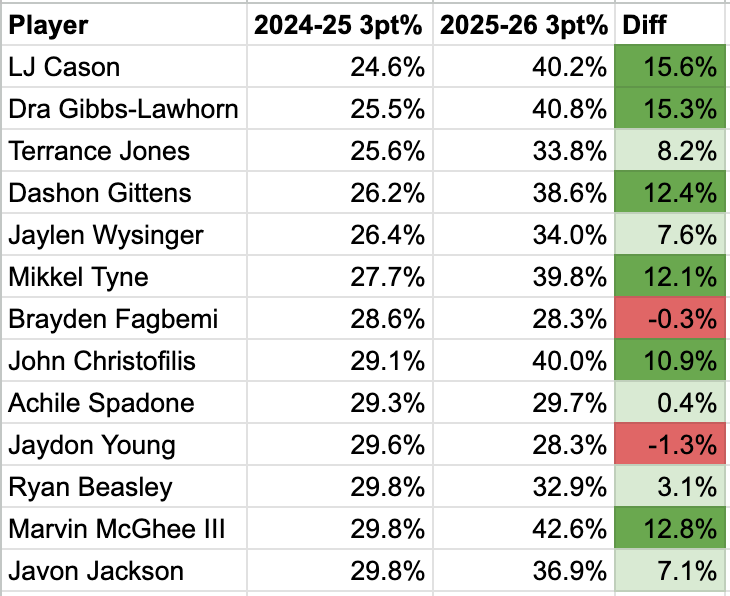
The results were pretty telling. Of the 13 players that qualified two years ago and played last season, 11 of them saw 3-point improvements, six of them by 10% or more. More than half of the players on this list changed their reputation from "shaky shooter" to "great shooter" over the course of 12 months. Let's go back one more season to make sure it wasn't a fluke. Some players even get two years of data to help strengthen the sample size.
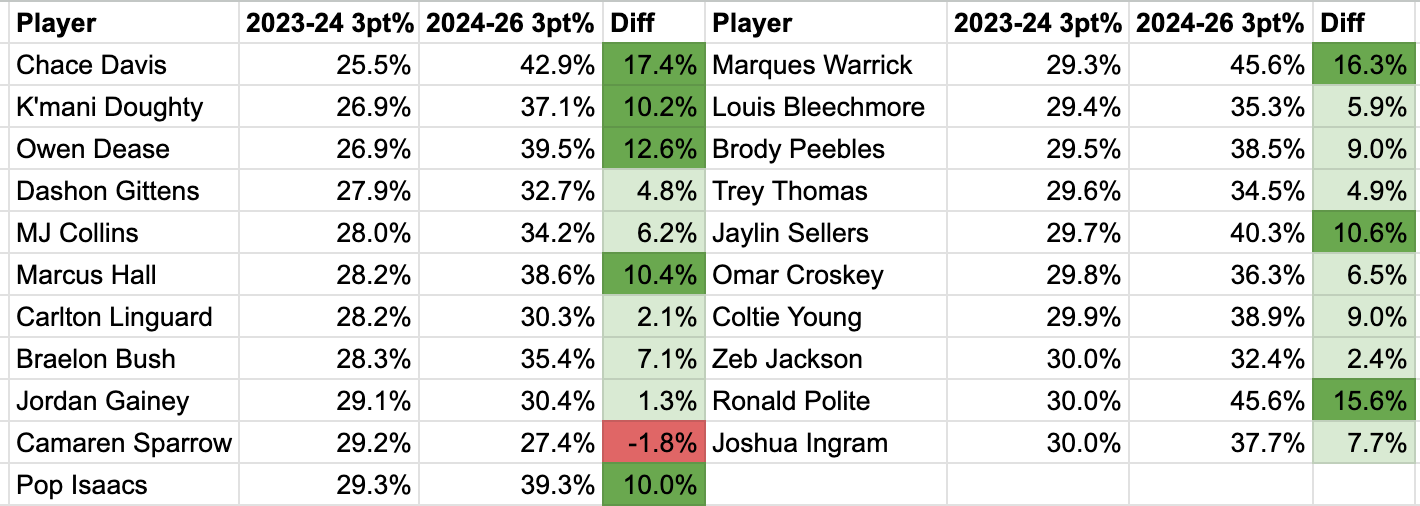
More of the same. Of the 21 players that qualified in 2023-24, 20 of them improved from deep over the one or two years since, with eight of them, or more than a third, jumping up more than 10%. It's pretty clear that if your coach entrusts you with a significant 3-point rate and you can make your free throws, you are more likely to have had a variance-y down year from deep, and you're not actually a horrible shooter.
So let's apply that logic to this year. Which players are in the portal that meet these qualifications?
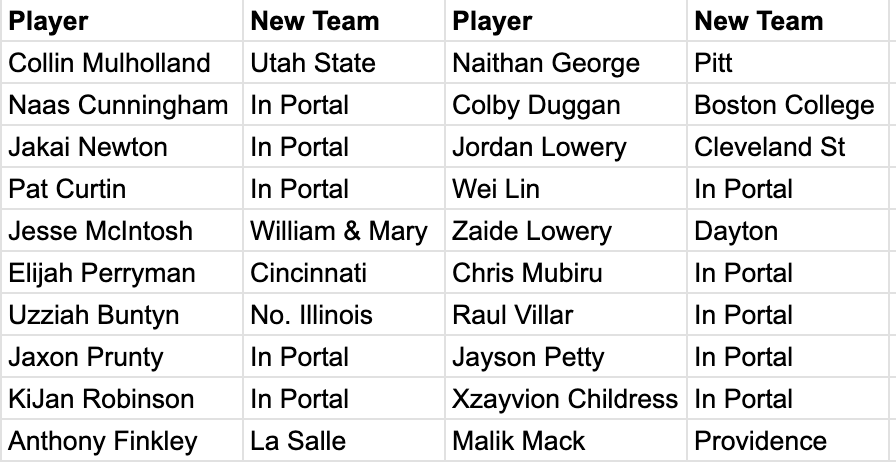
A handful of these guys have chosen very smart places to likely reap the benefits of a much better shooting season. Half of them remain in the portal, and could have at least some value as guys without the reputation of being a shooter that are probably strong floor spacers.
The most interesting guy on this list for me is Malik Mack. He's a career 79.2% free throw shooter and shot over 35% from deep across his first two seasons before falling all the way down to 29.8% last year at Georgetown. Mack actually shot a really solid 39.8% on his 88 catch-and-shoot threes, but a brutal 20.8% on his 101 dribble threes. He certainly did not benefit being the on-ball guard for the 285th-best 3-point shooting team on a roster with only one player that made 1+ long ball per game shooting better than 31%.
Mack now moves to a Bryan Hodgson system that strongly values catch-and-shoot threes and dribble drives. His South Florida team was in the 97th% in catch-and-shoot rate last year. Georgetown was in the 14th%. With both the improved shot quality and his strong free throw numbers along with decent historical 3-point numbers, I would envision a significant senior season jump beyond the arc from Mack.
But what if we reverse this idea? Can we identify flash in the pan shooters who are bound to regress? What happened to shooters that made over 40% of their threes, but shot below 65% from the free throw line?
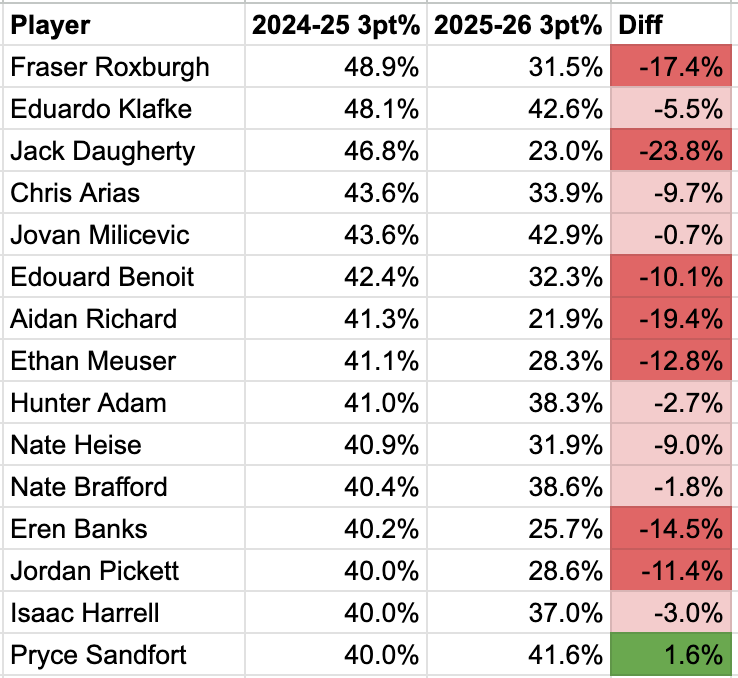
What is Pryce Sandfort doing on this list? Everyone else shot worse this season from deep, and seven of the 15 players shot at least 10% worse. Wildly, a third of these guys went from at least 40% to below 30% in just one year. So who are the candidates for this list in the transfer portal right now?
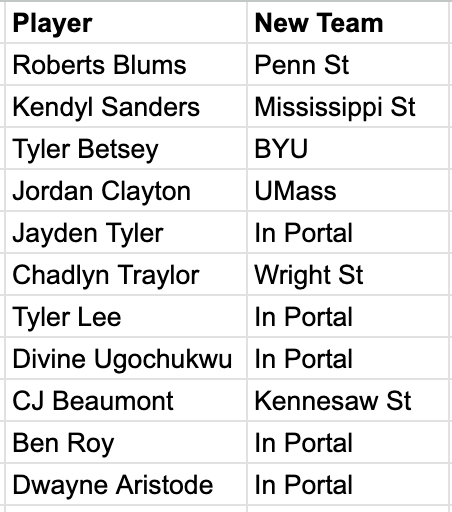
Kendyl Sanders is the most fascinating guy here. He made 40.3% of his threes as a freshman despite going a horrific 12/31 (38.7%) from the free throw line. I don't buy it.
I'll be willing to wager a bet. Donald Hand was the worst 3-point shooter with more than 125 attempts last year at 22.6%. But he's a career 78.6% free throw shooter and was a solid 3-point shooter before last year. The new Loyola Chicago Rambler will shoot better from deep than Kendyl Sanders next year, even if he shot nearly 18% worse in 2025-26.
Focusing on Positional Connectors
Now that the college basketball season is over, I've actually started watching some NBA basketball. And I can't help but notice every team looks the same, relatively speaking.
But perhaps the thing I've noticed the most is how giant most of the on-ball creators are. Jayson Tatum, Jaylen Brown, Cade Cunningham, Paolo Banchero, Scottie Barnes, and even LeBron James. It is very rare for an NBA team's smallest, or even second-smallest player to be its lead on-ball creator. And the guys that are on the smaller end have been torched defensively.
If there's one thing diehard college basketball fans know, is that the NBA style and trends always find their way to the NCAA ranks. We saw it quite a bit this year.
Of the top 15 offenses in the country, only four of them had their leader in shot percentage amongst starters come from their smallest player. Wings and forward like AJ Dybantsa, Cameron Boozer, Yaxel Lendeborg, Thomas Haugh, Koa Peat, David Mirkovic, and Dailyn Swain took on serious on-ball responsibilities on teams that didn't all have true traditional point guards.
While there are many places you can go to read about superstars and on-ball forwards, my main focus with this observation is how college basketball teams can properly compliment those ball dominant players with the right connecting pieces.
The basketball community has long idolized the "3-and-D" wing, and that archetype is by far the most common type of connector discussed. In the Burner Ball Discord alone, the term has been mentioned 559 times, and over 100 times this transfer portal cycle.
But I think the 3-and-D archetype can be a very loose term. A 6-foot-4 guy with a 38% 3-point percentage and a 6-foot-7 guy with a miniscule 7% usage rate can both be seen as 3-and-D players, but really couldn't be more different. What constitutes a good defender? What constitutes a quality shooter? There are so many theoretics when it comes to 3-and-D players, and yet everyone wants one.
What I do know, is that size is everything in the portal right now. A prototypical 3-and-D wing was not re-signed by a well-funded power conference program, with the reasoning being "he was 6-foot-5 and not 6-foot-8." With the influx of wing creators and the value of size for a connecting piece, I started to think about what that meant for college basketball roster construction. And then I stumbled across an awesome research study.
Here are the best and worst archetype pairings in college basketball over the last 3 seasons. The biggest takeaway?Complimentary players win and redundant creators lose. pic.twitter.com/Yvn5ZXQTeB
— Ryan Miele (@BuckAnalytics) April 27, 2026
All of the 10 best lineups amongst high majors across the last two seasons featured either a "Balanced Center" or an "Off-Ball Center," per Bucknell Data Analyst Ryan Miele.
Connecting the dots, the greatest way to combine the need for connecting pieces around wing scorers and maintaining the need for tons of size is to find a big man connector.
My ideal big man connector is a willing 3-point shooter. I just spent over 1000 words explaining why I don't care about percentage as much. My big man connector is also a willing and capable passer. We often just use Assist Rate as a passing indicator, but Dictate the Pace's Jon Fendler put me on to an awesome stat this offseason called Assist Ratio.
Instead of simply measuring what percentage of team assists a player gets while on the floor, Assist Ratio measures what percentage of total possessions a player finishes with an assist, rather than a shot or a turnover. It is a better representation of how pass-oriented a player is, and therefore how good of a connector they are.
My criteria for a big man connector is being at least 6-foot-9, having an assist rate and ratio of at least 15%, and having a 3-point rate of at least 20%. 22 players hit those markers last year.
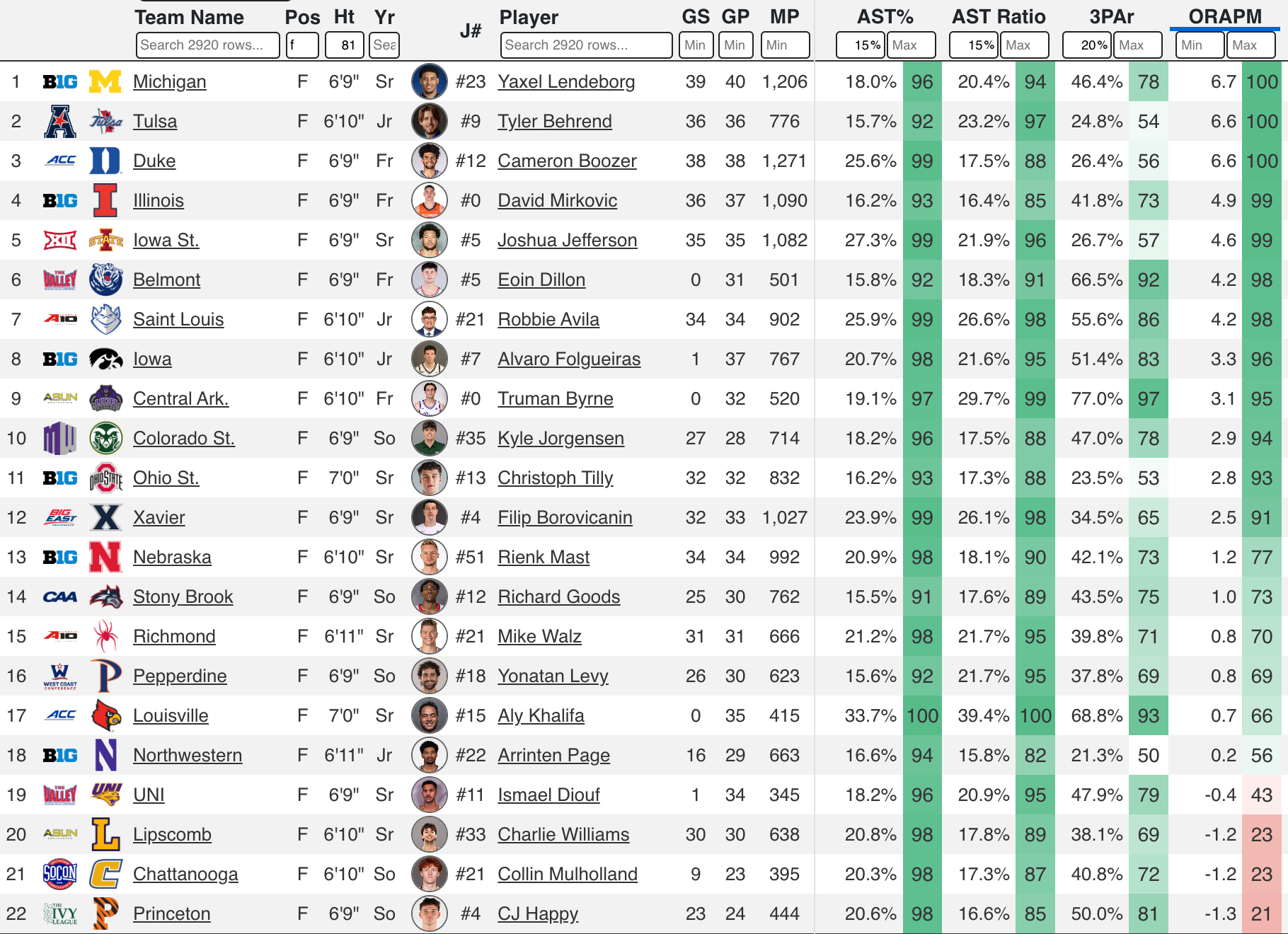
Perhaps unsurprisingly, 12 of the 22 players had at least a 90th% Offensive RAPM, and 18 of them had positive ones. And here's what that list looks like amongst players that portaled and still have clear-cut eligibility.
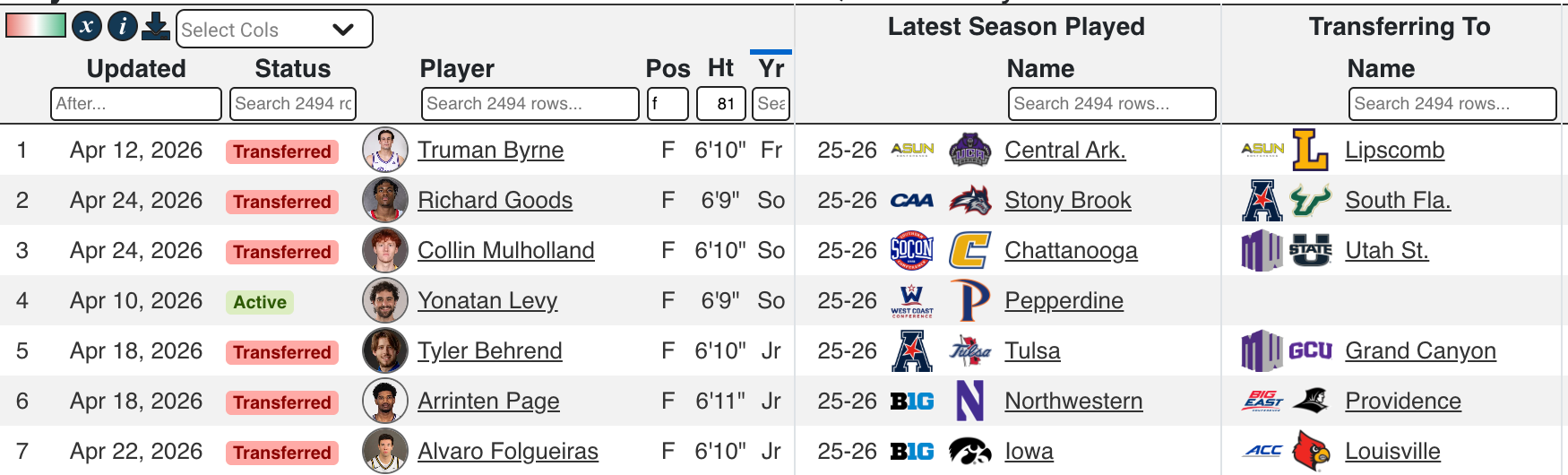
Only Mulholland on this list had a usage rate over 23% last year, but all seven of these guys were willing and capable passers while providing floor spacing and not dominating the basketball. Offensively, these are the perfect options to play the 5-spot and be a connector for an on-ball player.
But there are two sides of the basketball, and Byrne, Goods, Mulholland, and Levy all have major defensive deficiencies. Behrend and Page can play both ends of the court, but neither have proven the ability to be a consistent floor spacer. I think all will be quality players at their new stops, but they aren't complete players.
And that leaves Alvaro Folgueiras, who I would easily consider the crown jewel amongst my first edition of big man connectors. I could genuinely make a 10 minute video on some of his greatest connector plays, but here are a few... from the NCAA Tournament alone.
This one may seem easy, but it isn't. Folgueiras has to be a strong enough shooting threat to extend the Nebraska defense, and a quick enough decision maker to make the extra pass before the defense can fully recover. Very few big men can do both.
This one has multiple key plays from Folgueiras. Many undisciplined bigs would go up with the transition layup, but he brought it out. They felt comfortable with him operating in the high post as a passer, but after both off-ball actions failed, Folgueiras looked to be a scorer. Still working as a duel threat, he located the cutting Tavion Banks with time to spare for the easy and critical basket.
This one is just silly. Folgueiras makes three separate passes above the 3-point line, repositioning after each, before snaking open for a pick-and-pop three that he nails despite the Clemson contest.
Folgueiras is certainly not an elite defender. Iowa was 5.9 points better per 100 possessions without him on that end. It's what gave him a sometimes inconsistent role for the Hawkeyes. Him going brutally cold from deep for two months didn't help. But his rare blend of passing ability, scoring efficiency, and passable defense should make him the most valuable role player at the five anywhere in the country.
Unfortunately, Louisville doesn't have the jumbo on-ball creator I was envisioning pairing the ultimate big man connector with, but the fit with Flory Bidunga is fascinating. Bidunga can make up for some of the defensive issues, and Folgueiras can not only feed Bidunga as a high-low passer, but also space the floor for him to operate in the post. I envision that pairing having a monster season together.
EvanMiya has Folgueiras projected for the 28th-best offensive season next year amongst all transfers. I'd be willing to guess that if he shoots his career 35.8% from beyond the arc across the whole campaign, he may finish as the 28th-best offensive player amongst everyone in the country next season.
The best Down Transfer reclamation projects
In my transfer portal reflection article in the middle of last season, I made an observation about how a disproportionate amount of the best transfers at the mid-major level had a power conference pedigree.
Because of that, I have taken an increased interest in guys that have moved down a level of competition and have the chance to be massive impact pieces at their new stops despite muted previous production. Here are a few that stand out to me.
Tyler Kropp, Washington State
Kropp was the leading scorer at the FIBA U19's last summer, an event that features countless college basketball prospects. He struggled to see the floor early in the season as a freshman, but actually started 10 of Northwestern's 20 conference games.
There's a lot to like here, between his absurd 24-for-26 mark from the line, and the fact that he was actually a significant net positive in league play for the Wildcats. He should also be one of the best rebounders in the new Pac-12. While he's not an above the rim finisher, his ground-bound game is likely to jump up in efficiency playing at a slightly lower level. He could very well be Washington State's best player next year.
Cam Miles, UNLV
Much like Florida State as a whole, Miles' season was a stark contrast between non-conference and ACC play. Miles was a ball hawk defensively with ultra-efficient passing numbers and excellent rim finishing against inferior competition, but his lack of jumper and small stature really caught up to him when moving up in level.
Down in the Mountain West, Miles should be a pure point guard who could lead the league in steals. He's an excellent rim finisher and will likely be able to draw much more contact than his 25.6% free throw rate last season. If he can get the jumper to fall, he could be an all-league player for Josh Pastner.
Sidi Gueye, Santa Clara
Herb Sendek has earned the reputation as a phenomenal player development coach, and he has an enticing new project in Gueye. Endlessly long with great mobility, non-zero shooting touch, and an actual ability to pass the ball, Gueye had a great reputation coming out of the Real Madrid system in Spain but was stuck behind one of the sport's best frontcourts.
Santa Clara has not been afraid to let their rim-running bigs have some offensive and defensive freedom, and also does a great job creating easy rim looks. Starting big man Bukky Oboye led the country in 2-point shooting before bouncing to Auburn, and Gueye could turn around and do the exact same thing.
Elijah Strong, Saint Louis
Strong was second in the nation in shot percentage for one of the worst offenses in power conference basketball. Honestly, the fact that he was able to maintain an offensive rating over 100 is a minor miracle.
Strong very rarely turned the ball over despite his massive usage, and has been a strong rim finisher throughout his career. He will likely be cast in the Dion Brown role (his former teammate) offensively, which is largely just get downhill and finish at the rim. Brown went from shooting 51.5% at the rim for Boston College to 74.1% with the Billikens. Strong will be in for a similar bump, but he stands five inches taller and 60 pounds heavier than Brown. That's a scary thought.
Rytis Petraitis, New Mexico
Petraitis was one of the sport's most unique players as an offensive hub at Air Force, and then maintained his overall efficiency through an awful shooting season at Cal two seasons ago before missing all but seven games last season due to injury.
Eric Olen runs one of the game's most unique systems with a very unconventional approach when it comes to positionality, and Petraitis fits that mold perfectly. Expect Petraitis to play a bit of all five positions for the Lobos next season.
Tre Norman, Milwaukee
Norman was playing genuine rotation minutes as a freshman for a Sweet 16 team, but has simply never been able to shoot, which has hurt his development greatly as a 6-foot-4 wing.
However, Norman is a monster defensively and tremendous at getting downhill. He should live in the paint at the Horizon League level and could perhaps be the conference's best defender. And who knows, maybe with the consistent playing time, he'll actually get a couple jumpers to fall! That's the whole point on taking some chances on guys like Norman.
Donald Hand, Loyola Chicago
I briefly mentioned Hand earlier in the article, but he just had an impossibly bad shooting season on an impossibly bad Boston College offense. Things were a world different 12 months ago when he was coming off a season where he shot 37% from deep and 86% from the line.
Hand has also posted elite free throw rates each of the last two seasons. We uncovered how hard it is for mid-major players to maintain elite free throw rates moving up a level, but Hand should be able to be even more dominant at getting to the line in the A-10. Combine that with his shooting returning to his career average, and he'll be a major impact piece here.
Terrance Arceneaux, George Washington
Last offseason, Arceneaux joined NC State in the transfer portal after putting together one of the best advanced all-encompassing stats portfolio's I have ever seen for a role player:
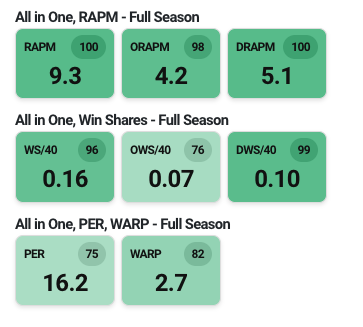
Unfortunately, Arceneaux's defensive disruption didn't fully translate with the Wolfpack, and his limited offensive game actually took an even further step back. However, Arceneaux still has one of the greatest defensive resumes of any wing I can recall moving down to the mid-major level. If he can find his way to the rim more frequently offensively, he'll provide a two-way edge to the Revolutionaries.
