

Welcome back to the transfer portal notebook, where we run through a handful of trends and thoughts about the fast-paced portal world through an analytical lens.
Here's last week's edition in case you missed it.
It's been a crazy week of transfer action with the portal officially closing last night, so let's dive in to some takeaways and thoughts about all that has transpired.
Conceptualizing numbers for high-usage up-transfer guards
Kentucky's addition of Furman point guard Alex Wilkins immediately became one of the more divisive portal gets of the cycle because of his astronomical gap between raw and analytical production with his giant usage rate and inefficient play.
I was planning on coming into this section with some deep takeaway about exactly what types of high-usage players succeed moving up a level and which fail using all-encompassing statistics. Unfortunately, the data over the last couple years is all over the place. Here is every mid-major guard that transferred up a level after posting a usage rate over 32% across the last two seasons:
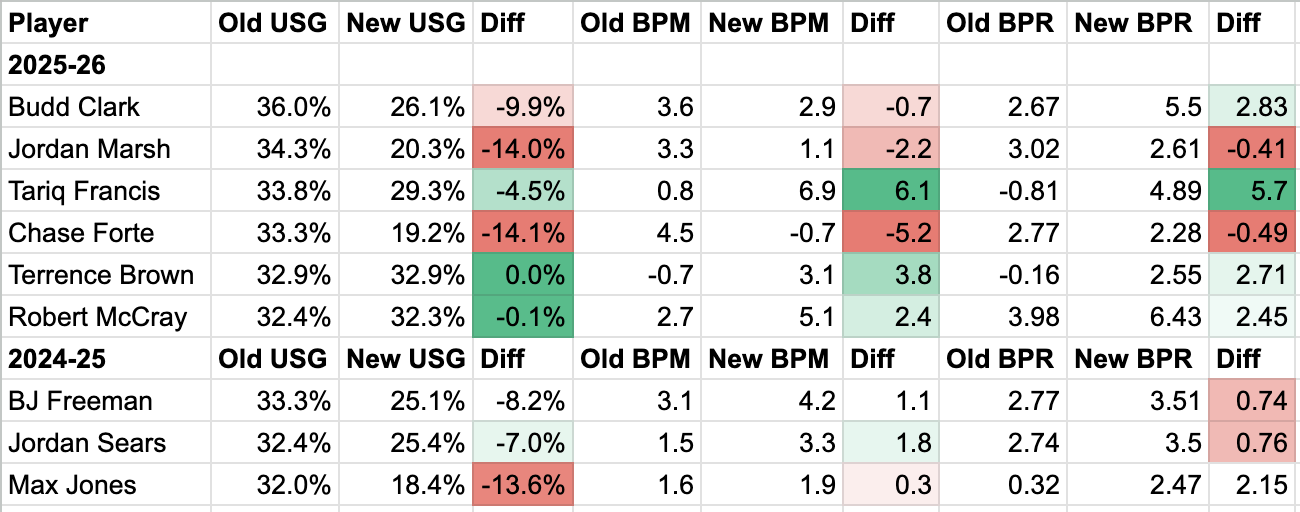
With just usage rate, Bart Torvik's BPM, and EvanMiya's BPR, there aren't a ton of takeaways.
Bad initial BPR or BPM had virtually no effect on how the power conference season would turn out. Tariq Francis had the lowest initial mark in both metrics of any player graded, and found up with the best power conference BPM and second-best BPR of any player here. Chase Forte was No. 1 in BPM by far and near the top in BPR at the mid-major level but fell flat on his face transferring up.
So no, there is no magical number that determines which high-usage mid-major transfers succeed and which don't.
Instead, we have to use a concept that somehow slips through the cracks for both the most casual fan and most analytical numbers nerd: Context!
The best guard on this list across either year is Robert McCray. His 18.21 combined BPM and BPR across the two sample seasons is the highest amongst all players by far. He also saw among the largest increases in both all-encompassing stats and was one of only two guys that saw his usage remain the same moving up a level. Looking back on the initial mid-major seasons, it should have been obvious McCray was the best player.
30%+ Assist Rate: Robert McCray, Budd Clark
30+ Assist Rate and 1+ 3-pointer per game: Robert McCray
1+ 3-pointer and 50% True Shooting: Robert McCray, Jordan Marsh
All Three: Robert McCray
The only player as prolific a passer as McCray was Budd Clark, and he was a non-shooter. Marsh surpassed him as a shooter, but wasn't quite the passer. And perhaps most importantly, Clark and Marsh are 5-foot-10, the shortest guys on this list by multiple inches. McCray is 6-foot-4, the second-tallest. Look at what that size difference meant at the P5 level.
However, sometimes these things are less obvious. Take the cases of Chase Forte and Terrence Brown. It was Forte that had the way higher initial BPR and BPM, but it was Brown that saw big statistical increases with stable usage moving up a level, while Forte faltered. How is that possible?
Looking at shot profile, there's no reason these players should have been ranked so far apart. Brown took 58% of his shots at the rim, Forte took 65%. Brown shot 55.4% at the hoop, and Forte shot 55.5%. Both shot between 32 and 33% on jumpers on identical rates - Brown better in the mid-range and Forte better from deep.
But the one massive difference between the profiles was free throw rate. Forte's was all the way at 61.1%, top 50 nationally, while Brown's was 37.1%, 454th. While both guys got to the rim a ton, Forte's rim dependency with his higher rim rate and way higher free throw rate, proved to be more challenging to scale up. Sure enough, Brown's rim rate, efficiency, and free throw usage was identical moving up, while everything fell off a cliff for Forte.
It's long been discussed that a high free throw rate is one of the hardest numbers to maintain moving up a level in college basketball. Radford head coach Zach Chu, who used to be a basketball analyst in both the NBA and at the power conference level, spoke about this concept over the summer on the Slappin' Glass podcast. To sample this, let's take a look at every player with a 25%+ usage rate and 50%+ free throw rate that transferred up over the last two seasons.
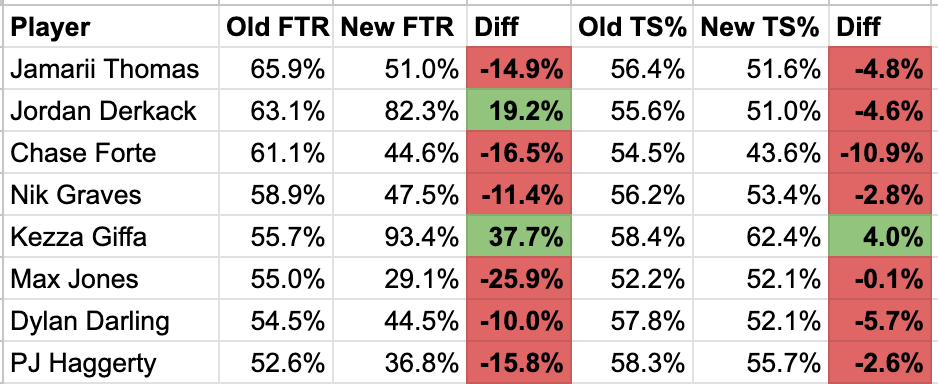
Yeah, it was a very, very tough adjustment up a level for free throw-dependant, high usage guards.
So, how can we use the McCray and Forte/Brown examples to teach us something about this crop of high usage up-transfers?
McCray's previously mentioned numbers of 32%+ usage rate, 30%+ assist rate, 1+ made three per game, and 50%+ true shooting have only been matched by two up-transfer guards in the last five years, and they both happen to be in this cycle. Those would be Wilkins and new Boston College guard Money Williams.
Neither have the height concerns of Marsh or Clark, as both stand at 6-foot-4 or taller. But Williams has the red flag of his free throw rate being 50.8%, while Wilkins' is down at 30.7%.
By the measure of usage, shooting efficiency, 3-point rate, passing ability, size, and lack of free throw dependency, the numbers would suggest that Robert McCray was the best high-usage up-transfer guard last cycle, and Alex Wilkins will be the best high-usage up-transfer this cycle.
Except... Wilkins' -1.9 BPM is the lowest of any high-usage player to transfer up across the last three years by far. His BPR is amongst the lowest too. And that's been a large topic of conversation amongst analytics people about Wilkins.
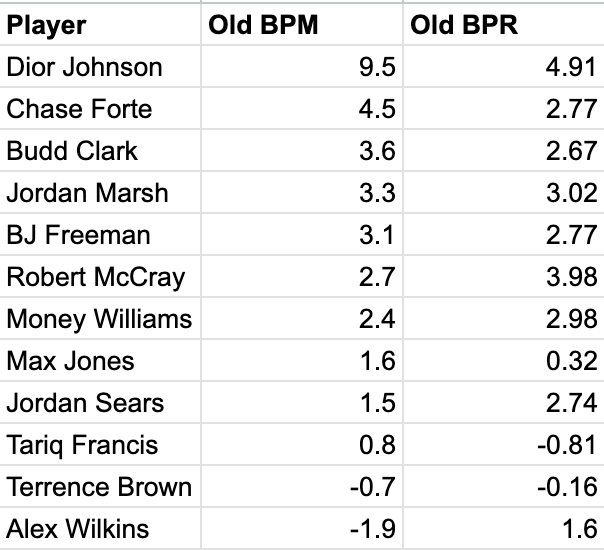
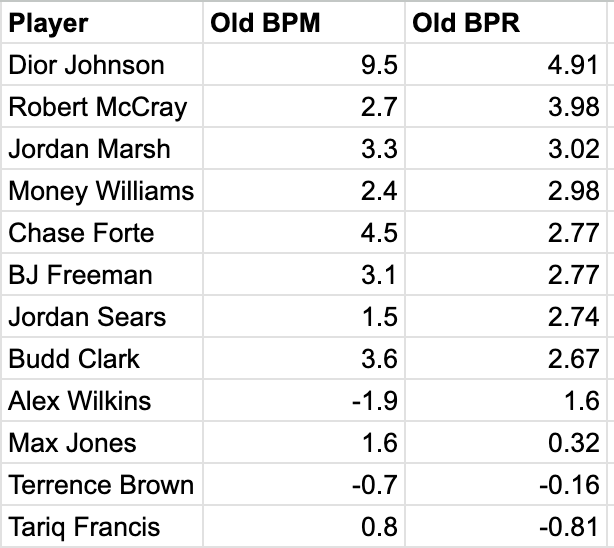
But I mean, even just looking at this list ordered by BPM, we can see that grading high-usage up-transfers based on all-encompassing box score stats just doesn't work. EvanMiya's BPR is better because it takes on/off and team stats into account, but it still is far from a perfect ranking in this instance.
The biggest knock on Wilkins is his turnovers, ranking third-nationally with 133. But do you know who ranked fifth in turnovers this season, and posted the highest turnover rate of any player on our previous lists? Robert McCray. High-usage, high-assist rate guards are going to turn it over a ton. Can Wilkins get better at ball control? Sure. But it shouldn't be seen as a death sentence.
Outside of turnovers, I don't really know why Wilkins is so low in these metrics. His rebounding rates are tiny, but he's a point guard, and Furman had a 72nd% defensive rebounding rate with him on the floor. His steal rate is low, but Furman played one of the least aggressive defensive schemes in the country. He shot below average from deep, but his strong shot profile and good rim finishing handed him fine overall efficiency.
The reality is, with the important addition of context, we should be able to see the value in Wilkins. He maintained above average scoring efficiency despite his sky-high usage, posted an elite assist rate, was a threat from deep, has great size, and wasn't dependant on the free throw line for points. All checkmarks. He even did all that while posting elite on/off numbers for an NCAA Tournament team, something we haven't even discussed.
My case is closed. With all the evidence in front of us, I see no reason not to expect an excellent season from Wilkins at Kentucky, and he may even make an all-conference team like McCray did at Florida State.
Can you become a better rim-finishing big?
Here's the rim finishing efficiency percentile for every Ben McCollum team over the last decade:
2025-26 Iowa: 94th%
2024-25 Drake: 92nd%
2023-24 NW Missouri St: 81st%
2022-23 NW Missouri St: 100th%
2021-22 NW Missouri St: 95th%
2020-21 NW Missouri St: 96th%
2019-20 NW Missouri St: 92nd%
2018-19 NW Missouri St: 90th%
2017-18 NW Missouri St: 98th%
2016-17 NW Missouri St: 98th%
McCollum teams are always incredibly efficient at the rim, and that has held true as he's moved up to D-I and even the power conference level.
So color me a tad shocked when the high-priced big man the Hawkeyes chose in this year's portal was Andrew McKeever, who shot just 56.9% at the hoop last year. That number was in the 47th% of all players nationally, which makes it way worse that he stands at 7-foot-3.
Even crazier is that in McKeever's six Tier A games on KenPom (Gonzaga x2, Santa Clara x2, Texas A&M, Vanderbilt), the big man shot 7/27 (25.9%) at the rim. For reference, 17 of Iowa's 37 games were Tier A last season.
Something isn't adding up here! What are these numbers not telling us, what have I missed in this evaluation that McCollum and Co. saw? I think I'm pretty smart when it comes to this stuff, but would never all-out claim I am smarter than one of the best coaches in the country. So I dug.
And as it turns out, there is an answer here. And much like the high-usage guard debate with Wilkins... the answer once again, is context!
Researching McKeever's rim numbers put me on to the "tip" shot. Synergy and all other rim tracking sites count offensive rebound tips as a rim attempt. McKeever was second in the country in tip attempts, behind Tennessee's JP Estrella. He also shot a putrid 38.5% on those looks. Some of those, he probably should have finished.
And others, it's quite unfair that they are even considered rim attempts in the first place.
McKeever shot 10 more tip attempts than the entire Iowa team combined. If you take away McKeever's tips, he shot 61.3% at the rim, a whole 4.4% better. His national rim efficiency jumps from the 47th% to the 65th%.
I actually think it's not irresponsible to do this, because Ben McCollum teams rarely rely on tips. A McCollum team hasn't had a tip rate above 2.5% since 2019. It makes sense considering how McCollum teams love to elongate possessions as long as possible, so a tip would be out of character. For context, Saint Mary's has had a tip rate well above that for the last half decade, and it was more than double Iowa's last year.
With tips out of the way, McKeever took 108 of his 111 layup and dunk attempts attempts in four different contexts: post ups, offensive rebounds, pick-and-rolls, and cuts. Let's break down how he fared in each:
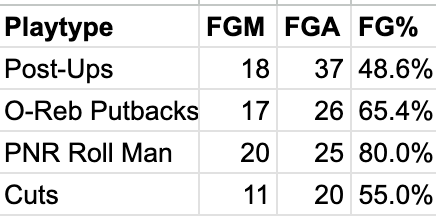
McKeever was incredible right at the rim as a roller, but really bad as a post-up finisher at the hoop. Now, let's see what McCollum's teams used the most in his two D-I seasons, relative to the rest of the country:
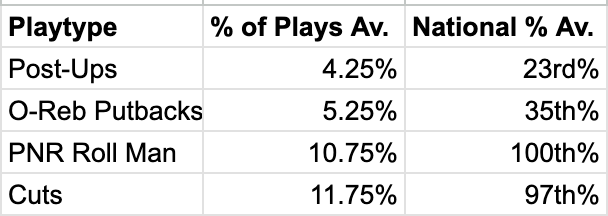
2025-26 Iowa and 2024-25 Drake led the entire country in percentage of attempts on pick-and-roll roll man attempts. They were in the bottom quarter of the nation in post-up attempts on average. In other words, McKeever was an elite 80% on the play type that Iowa attempts more than anyone, and a poor 49% on a shot Iowa rarely takes.
Instead of a third of McKeever's rim attempts being this:
They will largely be looking like this:
McKeever still isn't perfect. He needs to be better in finishing on dump offs at the rim (largely labeled in that cut category), and his 7.3% dunk rate is far too low for someone his size. Then again, six of his 10 dunks came in the pick-and-roll, so maybe it's already slated to grow dramatically.
This is one of the greatest examples of context I've ever uncovered. We already knew that McKeever was a truly giant human with all-time rebounding rates and clear passing chops, but his rim finishing was the one giant red flag in my evaluation. But after diving deeper, it's clear that there is much, much more than meets the eye in the player/system fit.
And if anything, this just reinforces how much smarter Ben McCollum and his staff are than me.
Mid-Majors Making Moves
Not everyone loved when I called High Point the front-runner to become the "next Gonzaga" over the weekend, but there's no denying how well the program has done in the transfer portal, especially relative to other Big South teams.
The Big South was the 21st-best league in adjusted efficiency last year, and that's with No. 85 High Point included. So far in the portal, High Point has added:
- The fourth-best passer from the No. 10 league (CJ Brown)
- The most-efficient shooter in the No. 8 league (Liam Campbell)
- The best rebounder in the No. 13 league (Frankquon Sherman)
- The leader in WARP in the No. 16 league (Jason Rivera-Torres)
And their fifth-best transfer, Oakland's Isaac Garrett, would likely be the best transfer on every other Big South team. This is not meant to be a dig on the rest of the league, but High Point is operating on a level than simply no one else in an equal conference is close to operating at financially.
I don't want the money to take away from the fact that Flynn Clayman is still excellent at his job. Yes, money helped procure this roster, but it still features an elite passer/rim attack point guard, a sniper off-ball guard, a do-it-all on-ball wing with great size, a mega-productive rebounding 4-man and an uber-athletic playmaking big. And all of them played on .500 or better teams in league play. Most power conference teams couldn't put together this cohesive of a roster if they tried.
Considering we collectively do not shed enough light on lower-level teams in the transfer portal, here are some of the true mid-major programs that I think have done an excellent job at nailing both talent evaluations and team/scheme fit so far this cycle:
Utah Valley
As these schools typically do, Utah Valley double-dipped on in-state talent to basically replace their two best players that transferred up.
Starting point guard Trevan Leonhardt was a lengthy 6-foot-4 pass-first point guard with great defensive anticipation before jumping to Nebraska last week. In comes 6-foot-4 Jordy Barnes and his 29.4% assist rate and elite 5.1% steal rate in limited minutes as a freshman at Utah State before falling out of the rotation this year. Seamless transition.
Leading scorer Jackson Holcombe bolted to Utah, and he's a near-impossible replacement as a true passing hub at 6-foot-7 with tremendous mobility but major shooting issues. And naturally, the Wolverines added in-conference transfer Tanner Davis from Utah Tech, an extremely bouncy freshman wing with real passing potential and 10 assists to just three turnovers against Utah Valley this year. And he also can't shoot a lick.
With bruising post man Isaac Davis returning, Utah Valley's keen eye for replacing talent and recruiting well inside its own state has them as a candidate to win the Big West in its first season.
Tennessee Tech
In case you forgot in the year since he's been a D-I head coach, Tobin Anderson is very good at this stuff. He's completely rejuvenated Tennessee Tech in less than a month. I would go as far as saying each of the five D-I transfers he's added would have been the team's best player last year.
D'Ante Green is a big with 20 career ACC starts. Caleb Sanders scored 26 points on 12 shots with nine rebounds, five assists, and three steals in the three games he played 10+ minutes in as a South Florida freshman. Caleb Hollenbeck made 53 catch-and-shoot threes at 42% at Marshall last year.
Anderson also dipped back into his NEC roots with a high-level shotmaker in Trent Mosquera and Stonehill's Davante Hackett. Hackett is particularly interesting to me, he was the sixth-man for the fourth-worst offense in the country last year, but when the team finally unleashed him, he scored 30, 40, 15, 26, and 21 points to end the season. He finished with a +14.1 offensive rating on/off mark.
Pepperdine
Another great head coach back in charge of a program, Griff Aldrich has been murdering the portal at Pepperdine.
I am still firmly of the belief that Anthony Robinson is a power conference caliber big man after failed stops at Virginia and Xavier, and he could be the most physically dominant big in the WCC. He took two strong spacers in Evan Haywood and Jahari Williamson, and paired them with a point guard that has power conference experience in Will McClendon.
He finished with Petar Majstorovic from Long Beach State and his 99th% on/offs, with his team sitting a remarkable 34!! points per 100 possessions better with him on the court. Plus, with Majstorovic starting his career at Syracuse, that means four of Pepperdine's five "gets" have a power conference pedigree, something I noted as important a few months back.
Liberty
I will eventually dive deeper into the D-II space, but Liberty took the No. 1 D-II transfer on my board in Dillon Claussen. This should not be a surprise given the Flames hit a grand slam with now-NBA player Taelon Peter, and an easy triple with JJ Harper coming from the D-II ranks the last two seasons.
The Flames added sharpshooting brothers Cobi and Cooper Campbell from Troy. Cooper in particular has true superstar potential in Ritchie McKay's system after unleashing serious shotmaking potential this season.
Liberty is not a traditional transfer portal team, but it may be one of the most resourceful. That will pay off in a giant way after losing all five starters from last year's NIT team.
