


NASHVILLE—Evan Bradds hadn’t walked into any of Belmont’s athletic facilities since 2017, but he was reminded of why this job as its head coach appealed to him so greatly when he did. In the moments before Bradds took the stage to give his first comments as the Bruins’ head coach, it appeared as if he was participating in a family reunion.
By the time the Bradds took the stage, he had already racked up what appeared to be nearly 100 handshakes, had cracked plenty of smiles and had jumped right back into a flow with a number of Belmont staffers and former players.
It’s been nine years since Bradds earned the OVC Player of the Year award as a Belmont player and set the program’s scoring record in its Division-I era, but any notion that anyone around these parts has since forgotten about him was disproven quickly. Bradds has experienced plenty of life since he left this place, but he didn’t forget about it either.
The now-Belmont head coach says he’s continued watching this program over the years despite his time as a Bruin becoming increasingly distant and his career trajectory leading him elsewhere. Bradds was in the midst of working for NBA staffs and one of college basketball’s premier programs, yet he never stopped caring about this place. He never stopped thinking that one day, he could be the one standing up on its home sideline.
“This is a dream come true,” Bradds told Basket Under Review. “It’s always been something that's in the back of my mind and being the head coach here. I never knew if it would happen. You really never know. But, excited for this opportunity. I'm thankful. It's an exciting time.”
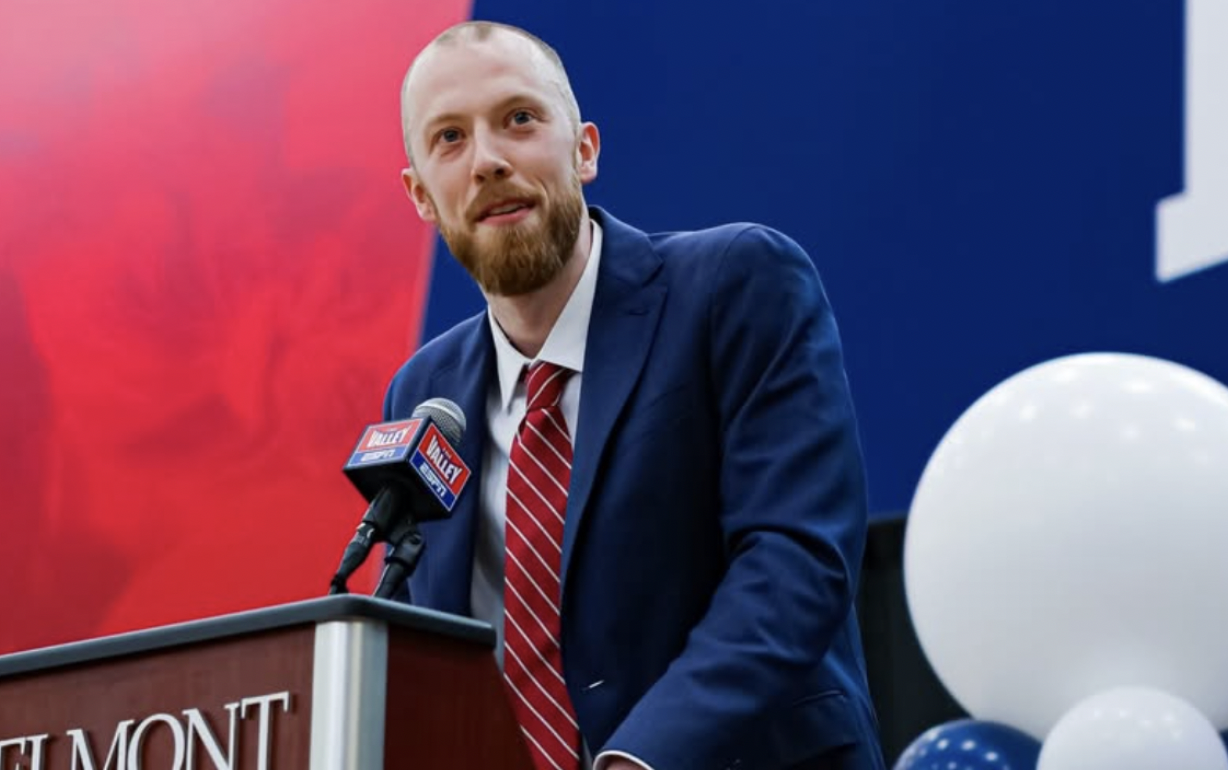
As Bradds was on the podium, he upgraded his statement and declared that landing in this situation being labeled as a dream come true didn’t do the moment justice. The Belmont head coach added a promise that he’s not taking the opportunity he’s earned lightly.
Knowing Bradds’ background with this place, how could he?
He was a four-year player as a Bruin, is one of the best players in its Division-I history and was picked by Corley with the help of Byrd. This is as fitting a job as there is out there for Bradds, and he knows it.
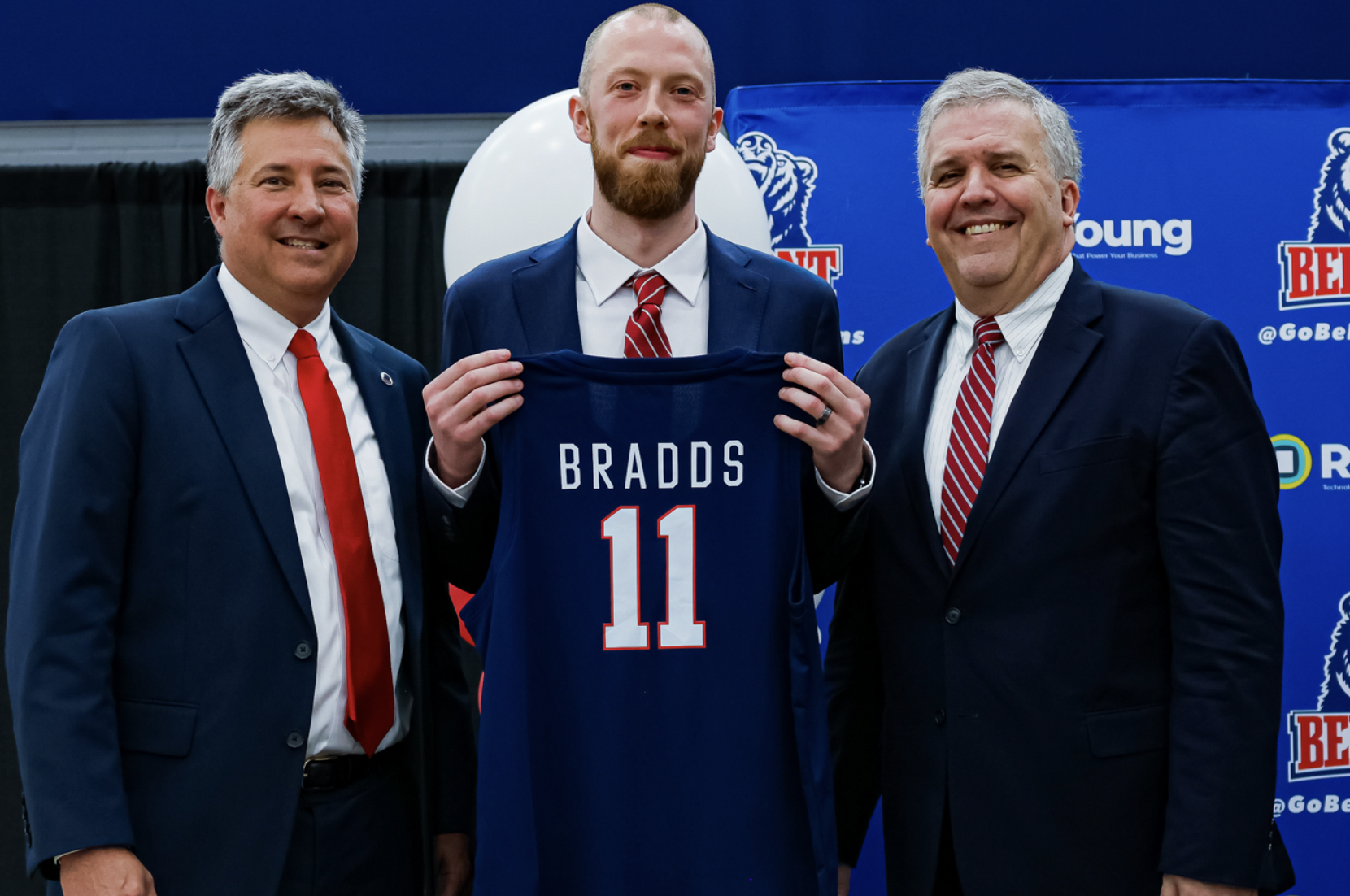
Bradds was hard to break as he sat off to the side alongside Belmont athletic director Scott Corley and listened to a number of speakers sing his praises. He laughed a few times, but didn’t nod along or make any effort to raise the price on his own stock. The composure that Bradds approached this thing with was misleading, though.
While Bradds gears up to walk into the near mob of media waiting for him to take questions, he admits that this is one of the best days of his professional career to date. It may be one of the best days of his life.
This has all come full circle for Bradds, and he’s not taking it for granted.
“Not a day goes by that I don’t think about this place,” Bradds said. “This is truly exciting.”
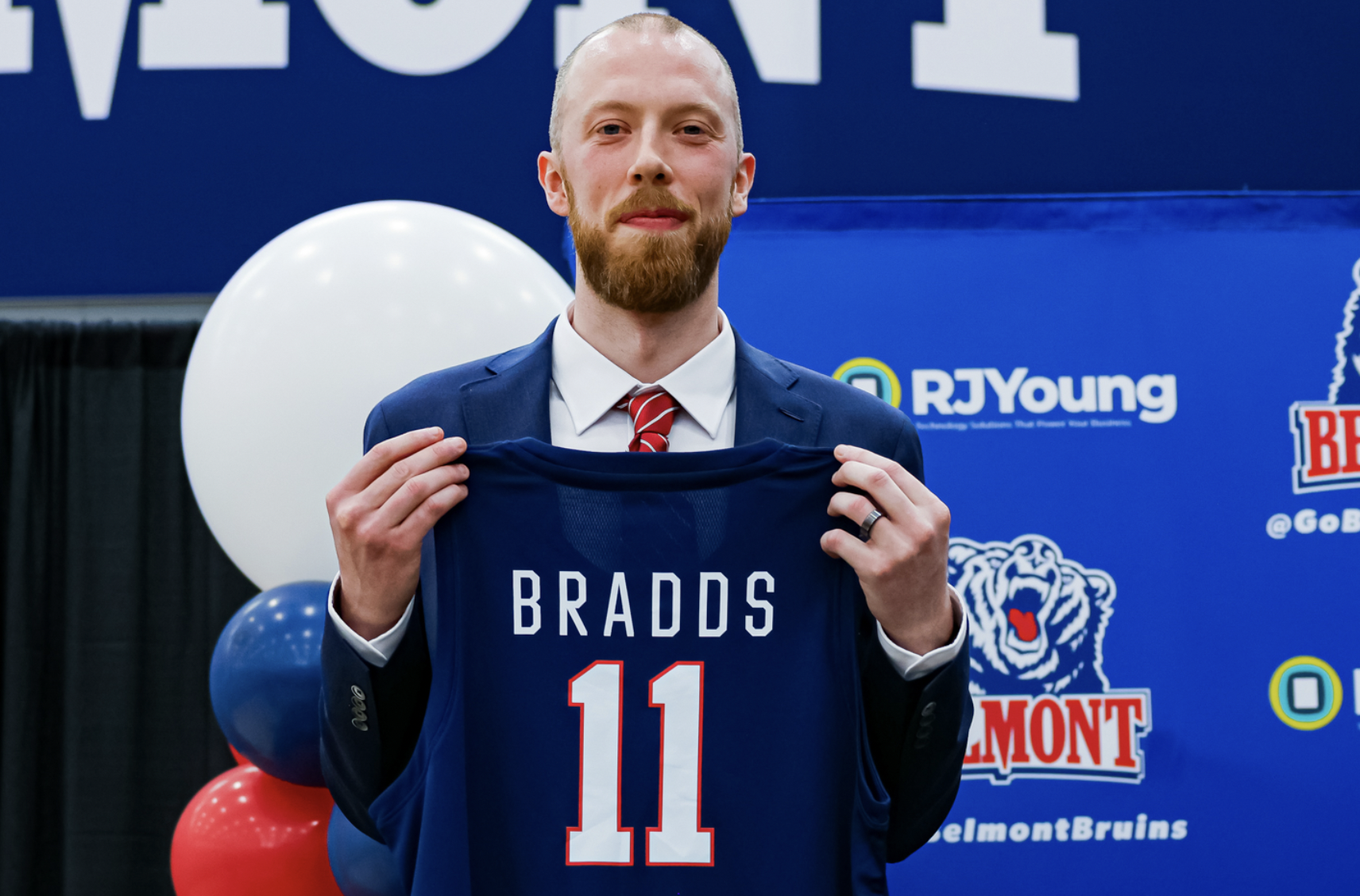
Circled up in front of the stage in Belmont’s Crockett Center For Athletic Excellence are a number of Belmont’s most recognizable players in program history. Each of these guys played for Byrd’s legendary teams, won enough games to find themselves immortalized in these parts and still have interest in this program. The kicker; all of them know Bradds. All of them think he was the right hire.
Bradds has yet to be a Division-I head coach, but none of his old teammates appear to be worried about that as they stand there in the middle of a Wednesday morning chopping it up with Bradds. Some have children now. Most are married. Some have gone on to play professionally. All have memories of Bradds and are more invested in this program than they would have been had Belmont gone outside the family.
“You want somebody that cares about the program and is fully invested and not just here as part of a stepping stone for their career,” former Belmont and NBA forward Dylan Windler told Basket Under Review. “You want somebody that really cares about the success here and that you know, they're going to put all their time and energy into winning games and building a good culture here. I think that's huge, having a guy that's been here and played under coach Byrd.”
Byrd is the monarch of Belmont basketball and is among the few former head coaches in the country that still have enough pull within a program to have a significant voice in its coaching search. It’s been seven years since Byrd last roamed the sidelines at Curb Event Center as Belmont’s head coach, but he’s still a big enough voice around these parts to be one of the three speakers lined up to address the media in regard to Bradds on Bradds’ first day on the job.
When Byrd got up in front of the media contingent that gathered, he delivered a continuous endorsement of Bradds that was likely reminiscent of the one he told Corley behind closed doors. Byrd was likely in favor of this role staying within the family, but he says his desire was for Belmont to hire the right coach regardless of background. Part of him has to be proud that the last Bruins’ coach–Casey Alexander, who has since left for Kansas State–and Bradds are both his former players and understand what this place is about.
Byrd is too polite to say otherwise, but the way he addresses the media on the floor in Belmont’s practice facility indicates that he’s sincere in his belief in his former player. He can’t guarantee wins or losses, but he can all but guarantee that Bradds will continue the Belmont way in regard to how this program operates.
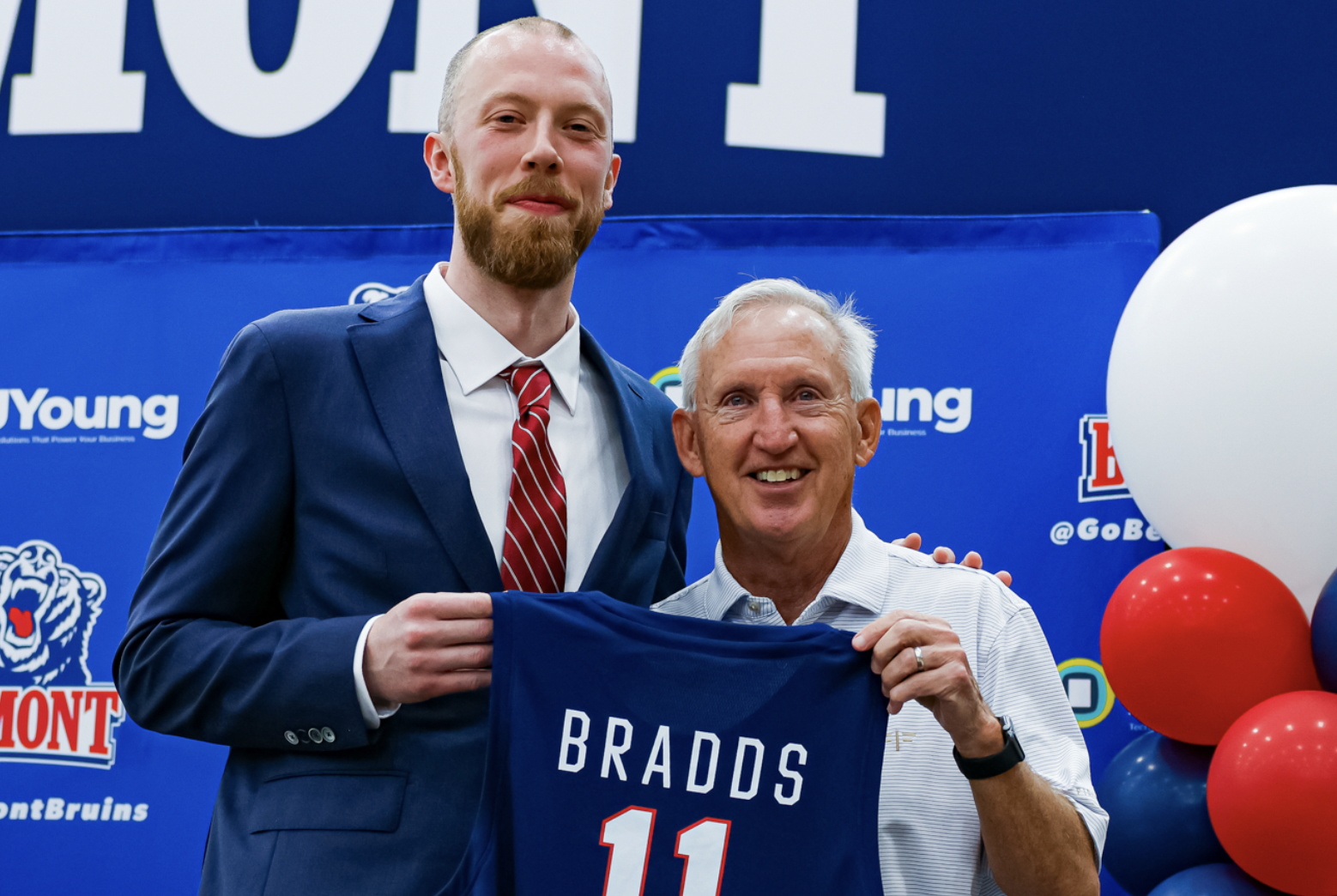
“I'm 100% sure of all that stuff, of all the little stuff that matters outside," Byrd said. "He doesn't know how good a coach is going to be. He hasn't led a team yet by himself. That's another factor. If I was betting on that, I'd have placed a lot of money that he's really good."
Byrd says he didn’t always know that Bradds would be a head coach, but he likely could’ve made some assumptions based off of the leader that he says Bradds was as a player as well as the feel he had for the game. Byrd admits that he doesn’t keep up with former players as frequently as he’d like to, but he says that he always followed Bradds from afar and took the call anytime Bradds picked up the phone.
Bradds has grown up since he last played for Byrd and has been places that Byrd never went throughout his career, but he’s never found Byrd’s advice obsolete. When Bradds was faced with the decision as to whether to leave his role as a Utah Jazz assistant for a job at Duke or not, he called Byrd to ask for input on the decision. Byrd jokes that Bradds opting to get back into college basketball in its current state could be ill advised, but told him at the time that Duke is as good of a place as any to be if he’s going to be in college.
Duke helped to legitimize Bradds’ rèsumè, but his heart is Belmont’s as a result of his experience under Byrd. It’s only fitting that this program’s head coach is a Byrd disciple who doesn’t run from that label. He knows everything that it entails and is proud of it.
“He loves Belmont,” Former Belmont standout Taylor Barnette–who leads a Bible study with Nashville-based college basketball players–told Basket Under Review. “He's one of the best players to come through here in a long time ever, really. But he knows Belmont. He knows the tradition of the program. He's going to continue to do it the Belmont way, which really matters. You know, this is a unique place, a special program that Coach Byrd built, Casey added on, and now Evan's going to continue to add on and even introduce some of his flavor to it.”
“What is up, Mid Major Madness! Evan Bradds here, reporting live from Jamestown, Ohio! If you don’t know much about me, I recently graduated from Belmont University in Nashville, Tennessee. So yes, I did play for the legend himself, Rick Byrd, and yes, he is as good a coach as anyone in the country.”
It’s one of the two ledes that Bradds authored in his brief stint writing mid major basketball content for Mid-Major Madness. Bradds explained in his first story that he believed mid-major basketball was some of the best basketball in the country and that he had always thought that covering basketball was something he felt like he may be interested in doing in the future. As a result, this appeared to be a fit.
Bradds didn’t have any experience as a sportswriter outside of the content that he’d written for his high school’s morning sports news segment, but he was going for it. He never thought he’d be here, but here he was penning pieces and mapping out what Ohio-based midmajors he could see cover in person.
Just over two months before Bradds picked up his first byline on July 18, 2017, Barnette–who was his roommate at the time–picked up a facetime call from him and couldn’t muster up much more than “oh my gosh, dude, what happened?”
Barnette could quickly tell that Bradds had a broken nose. His eyes were swollen, too. He looked like he had just taken a number of hits to the face. As Bradds would quickly inform Barnette, it was much worse than what Barnette was looking at.
Bradds had broken his nose relatively early on into his predraft workout with the Indiana Pacers, but he kept playing in spite of it. Bradds knew he likely wasn’t an NBA player but that he likely had a chance to make money playing basketball for a long time. Although, he wasn’t guaranteed much of anything. This was his opportunity to prove himself, and he couldn’t afford to let it pass him by.
Some cruel spell was on Bradds that day, though.
Before he got 20 minutes into the workout, Bradds had torn his ACL after coming down awkwardly during a drill. He knew it right away. If he didn't know it right away, he’d quickly find out that life was about to change as drastically as his health did. The path to playing professional basketball suddenly became far more difficult to envision for Bradds.
The injury sparked what Bradds can admit all these years later was an identity crisis. He says that it derailed his life. Bradds didn’t often consider the reality that he wouldn’t play basketball forever, but now he was staring down a life in which he’d be hard pressed to step on the floor anytime soon.
“I felt for him, it’s like ‘this guy was going to play professionally, no doubt,’” Barnette said. “Life can sometimes shift you in a different direction.”
As Bradds looks back on the moment nearly 10 years later, he remembers it in a different light than its cruelty would shine.
Bradds was rehabbing his injury in Jamestown, Ohio, wondering what was next, toying with the idea of becoming a college basketball writer. Then former Boston Celtics head coach and current Celtics general manager Brad Stevens called and asked Bradds if he’d be interested in an assistant coach/video coordinator role.
The role was compelling enough to Bradds that he packed up his Nissan Ultima and drove it from Ohio to Maine. He wasn’t going to let this pass him by. Since then, Bradds hasn’t let much of anything in this profession evade him. He didn’t always know that he’d be doing this, but he’s become a rapidly-ascending star less than 10 years after his graduation ceremony and devastating injury.
“Looking back, it was probably the best thing that ever happened to me,” Bradds said. “Without that injury, I probably wouldn't be here today. As much as it sucked during the moment, it was definitely the best thing that ever happened to me.”
“Hey Evan, congratulations on being named the head coach at Belmont. All of us here in Boston are thrilled for you,” Stevens said with the Celtics’ famous practice facility in the background. Stevens’ cameo was the first of many in a video that could be used as Bradds’ resume if he ever looks for another job.
Featured after Stevens was current Celtics head coach Joe Mazzula giving Bradds his best wishes, then the camera cut to Utah Jazz head coach Will Hardy–who said that Belmont was lucky to have Bradds back–Jazz standout Walker Kessler as well as Byrd and Windler.
“I don’t know that anybody in the country has had that kind of a path and worked for the quality of people that he has,” Byrd said. “It is unique, but it’s why he’s here. Without all that, he wouldn’t yet be a candidate.”
If the video represented all of Bradds’ best references, it would’ve been impressive. What made it more impressive, though, was that it didn’t include one of his three best contacts. Duke coach Jon Scheyer and the rest of the members of Duke’s coaching staff were absent in the video, but they likely would’ve been present had it been released at a time other than the days following their heartbreaking defeat in the Elite Eight.
The coaching trees that Bradds is a part of are among the best in the sport and separated his rèsume from any other candidate that Corley vetted throughout the process. Corley says that he communicated with Stevens, Scheyer and Hardy throughout the hiring process. If their reviews in regard to Bradds are anywhere near what they’ve said publicly–or the “stud” remarks that Stevens used to describe Bradds privately to Byrd–they were all but raving about him.
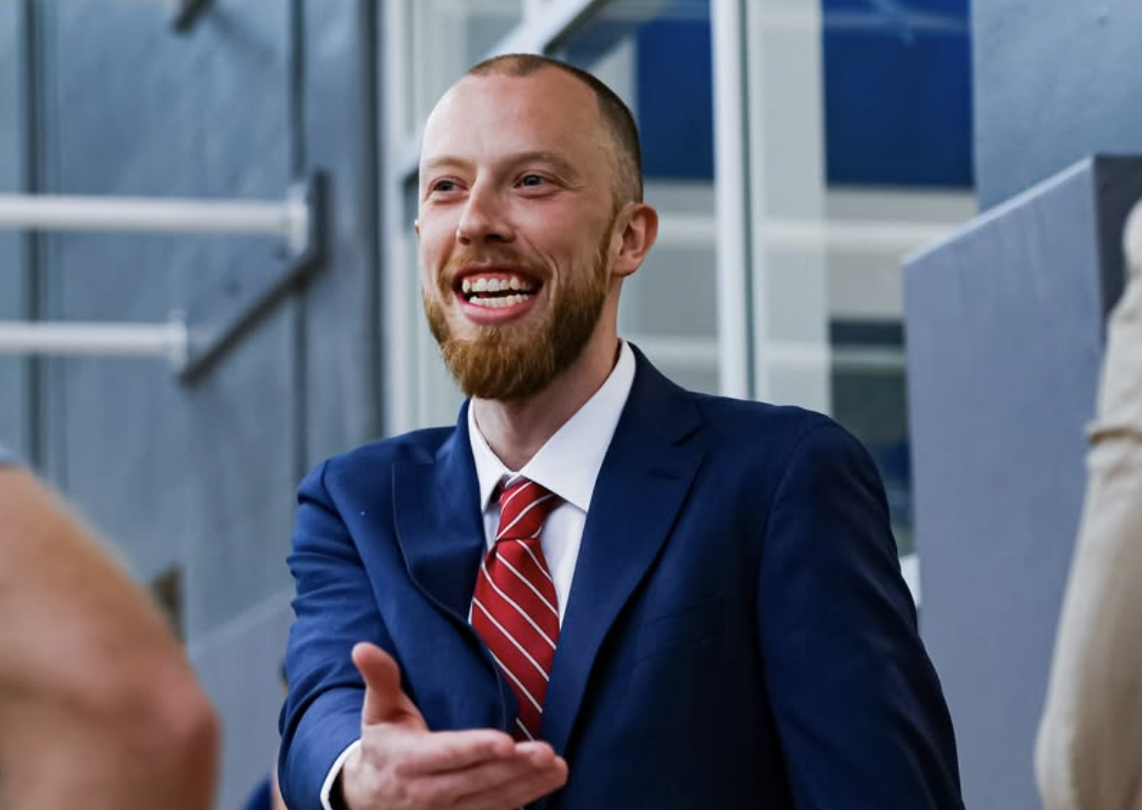
“Evan has been incredibly helpful for me,” Scheyer said during the NCAA Tournament. “He’s got a great mind. He’s been around a lot of great players [and coaches]. I think that experience has been helpful. He’s creative. We’re able to throw some different stuff at the wall and see what sticks. I think it’s led to great confidence in our guys in understanding what we’re looking for, what adjustments we can make, then trusting and executing that plan.”
Bradds’ career has taken him from the G League, to low-level staff roles in the NBA, to traditional assistant roles in the NBA to a deep NCAA Tournament run as a college assistant. He’s been deep into the NBA playoffs, deep into the NCAA Tournament, used one of its most iconic facilities as a workplace and navigated a college basketball blue blood for a season.
Belmont had a logical candidate for its vacancy in Alabama Huntsville head coach Mick Hedgepeth, but in no world could it turn down Bradds and his body of work. Bradds is a first-time head coach and is only 31 years old, but nobody around Belmont Boulevard appears to mind. If they do, a graphic labeled Evan Bradds Player Development that Belmont has circulated on social media that lists off Cameron Boozer, Patrick Ngongba, Grant Willaims, Gordon Hayward, Keyonte George, Collin Sexton and Walker Kessler will likely do the trick.
Bradds has soaked in far more than just about any 31 year old ever could in this business. He may not have been able to draw up his career path–or the group of coaches he’d work under–any better. As a result, he’ll have a number of basketball’s brightest minds hunched over a screen with ESPN + displayed on it in the fall. Perhaps they’ll see something that they taught Bradds on display at Curb Event Center.
“They've helped me make me the coach that I am today,” Bradds said. “Words can't really describe how thankful I am to them. I still consider them all close friends and advisors, family almost. Thankful for them doesn't do the word justice.”
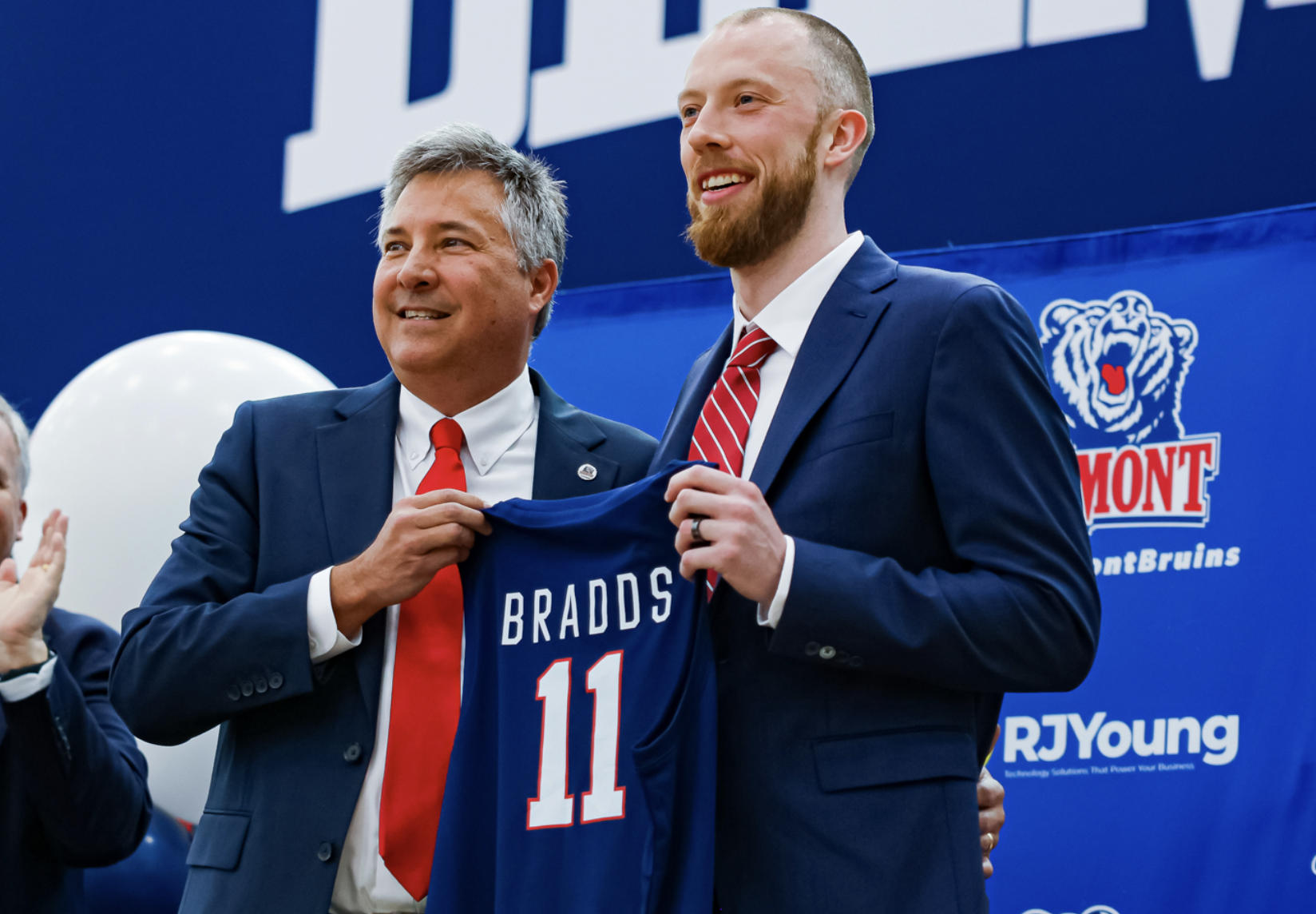
Off to Bradds’ left stand Jack Smiley, Eoin Dillon, Bez Jenkins, Isaiah West and a number of other pieces from Belmont’s 26-6 team. Bruins’ stars Tyler Lundblade, Drew Scharnowski and Sam Orme were already in the transfer portal by the time Bradds was introduced, but he was intent on making sure that those players were the exception rather than the norm.
Bradds was successful in that pursuit.
Smiley, Dillon, Jenkins, West, sophomore guard Cooper Haynes and veteran big man Graydon Lemke have all announced returns to Belmont and combine to form the core that Bradds set out on starting off with once he was named Belmont’s head coach.
“Evan has worked tirelessly to connect with those players, their families and let them know that there’s not going to be interruption in how we do things,” Belmont assistant Brian Ayers said. “I think the players have really embraced how connected he is on the floor with them.”
Belmont has notoriously struggled to retain its best players since the inception of the NIL era–and this cycle wasn’t perfect–but it appears to have more of a hope of doing so consistently moving forward than it did in its past.
Alexander was notably blunt about Belmont’s lack of NIL-related resources and resistance to fully embrace player compensation. Multiple sources have told Basket Under Review that Belmont’s athletic administration has been intentional about allocating more money towards roster building, though. The indication is that Belmont has significantly more money to spend and has adjusted its way of thinking. That shift paired with the mystique of the program and its general track record of success could aid Bradds in getting Belmont back to the NCAA Tournament.
Bradds hopes to become like Alexander and Byrd in that regard and says that the program he runs–as well as its style of play–will have a number of similarities to what Belmont’s two previous coaches did.
That means shotmaking, discipline, an up-tempo style, ball movement and a whole lot of winning. It’s the Belmont way. Bradds’ story is a great one, but it’s only as great as he is successful. He’s not complacent with anything other than an outcome that adds to the legacy of the program that he identifies as home.
“At the end of the day, we're going to compete,” Bradds said. “That is the number one thing, I know everyone says that, but we're going to work really hard, we're going to compete, we're going to have fun together. At the end of the day, we're going to try and win as many games as we can.”
