

Welcome to the transfer portal notebook, where we run through a handful of trends and thoughts about the fast-paced portal world through an analytical lens.
These thoughts will be more big-picture, but for individual thoughts on the top transfers once they commit to their new schools, follow along with our in-depth portal analysis.
Let's dive in.
How do we grade defense in portal evaluations?
Whenever I speak with a coach for the first time, that's usually one of the first questions they ask. We all know that defense is 50% of the basketball court, and that "defense wins championships."
But while we have endless offensive metrics to grade efficiency, role, productivity, and value, we remain somewhat in the ice age with defensive metrics. It's just so much harder to quantify.
It also makes it hard to come to a consensus or even a general direction on comparing defenders. Let's take a look at who led the country in certain defensive metrics this season.
Steals per game: Javontae Campbell, Bowling Green
Steal percentage: TJ Burch, Wright State
Blocks per game: Kyle Evans, UC Irvine
Block percentage: Ugonna Onyenso, Virginia
Steal + Block percentage: Sean Logan, Davidson
Defensive RAPM: Motiejus Krivas, Arizona
Defensive Win Shares: Cameron Boozer, Duke
Highest rated defender on the best team: Yaxel Lendeborg, Michigan
Defensive Player of the Year: Rueben Chinyelu, Florida
And just to reverse-engineer it, DPOY Chinyelu was 263rd in block percentage, 10th in DRAPM, 40th in defensive win shares, and played for the sixth-best defense nationally. Rating defense is almost entirely subjective in college basketball right now.
When I got lit up on X the last few days for calling new Louisville commit Flory Bidunga the best transfer get of all-time, I was probably a bit bold in my claim. Admittedly, Bidunga is somewhat limited offensively and isn't a go-to option, and that threw many people for a loop.
But at the same time, I believe that Bidunga was the single-best defender in college basketball last season. If you could say for certain that a transfer was the best offensive or defensive player in the country, I think suggesting that player could arguably be the best transfer get ever is far more palatable in the very short transfer portal era in college hoops.
Just a quick pitch on why I think Bidunga was the sport's best defender. For one, he checks off every box. 6th in DRAPM, 11th in Defensive Win Shares, 30th in block percentage, and anchoring a Top 10 defense. If you're more into individual defensive on/offs, Kansas was 15.9 points per 100 possessions better defensively with Bidunga on the floor vs. off, a 99th% mark.
But beyond that, Bidunga's defensive versatility is spectacular. He's not absolutely massive at 6-foot-10, but his long arms and masterful mobility allow him to switch on to virtually any player in the country and play man-to-man defense. To put it in perspective, another all-around defender who blocks shots and that metrics love is Krivas, and he defended 2.1 jumpers and 1.1 drives per game. Bidunga defended four jumpers and 2.9 drives per game.
Bidunga allowing Kansas to switch meant that they could focus on rim denial and forcing isolation, which led them to ranking as the nation's No. 2 effective field goal percentage defense. Bidunga's mobility allowed Kansas to be in a good position defensively on drives, and his rim protection was able to erase mistakes when they were made elsewhere. Here's one example of each.
Oh, and how about a bit of both to secure one of the five biggest wins of the college basketball season.
Bidunga on Louisville immediately gives Pat Kelsey the sport's most versatile and dominant defender. The Cardinals could play any defensive scheme imaginable and Bidunga could run it, all while making spectacular individual plays on that end. And again, considering defense is literally 50% of the on-ball equation, that's pretty darn valuable to me.
And that brings us back to the main point, which is how valuable is defense in a transfer portal evaluation, and what should we even look for? It's a complicated question that requires a multi-pronged analysis. Just like my breakdown on Bidunga, there is no one answer.
First, how good is the player's team defense? I think this is important no matter what, but especially for point-of-attack guards and big men. I did a study this season about the outlook for transfer bigs who came from good defenses and bad defenses and the performance gap was stark. How well could a player anchor your defense if he couldn't do that before?
Second, dive into that player's scheme. Is that guard or wing's steal rate really high because he has great anticipation, or is it because he plays for an overplaying defense. Is another option potentially a better defender but has limited steal and block numbers because he plays in a soft drop? Seton Hall's Elijah Fisher had a 6.8% steal + block rate in Big East play on the sport's most disruptive defensive scheme. He never topped 2.2% during league play in any of his other three seasons at his previous stops. He didn't magically go from a horrible defender to an amazing one.
Third, I like to look at on/off numbers, but not necessarily just defensive rating. CBB Analytics allows you to break down defensive on/offs by effective field goal percentage, defensive rebound percentage, turnover percentage, and FT attempt percentage. I used these metrics to show the underlying defensive value for Aday Mara at Michigan as he switched schemes from UCLA. By the same token, new Seton Hall guard Simeon Wilcher had very average steal numbers on a very soft Texas drop coverage, but has had a 71st%+ defensive turnover margin on/off in all three of his college seasons. Considering we mentioned how aggressive that Pirates defense is, his steal rate should soar at his new landing spot.
And of course, the eye-test comes in to play. Positional size is more important than ever, and that shows itself constantly on defense. A player's compete level, size, awareness, and defensive IQ are things that will never be measurable with advanced stats (until we get universal deflection metrics in college basketball), so the need to watch full defensive possessions will never go away.
We are currently in an era where every transfer portal announcement includes the player's points per game, or how many points they scored against "X" team on a random Tuesday in February and an attached video file of dunks and threes. When coaches and programs have to find new rosters in a matter of weeks with guys they've met for maybe one day, I think it's easy to just gravitate towards the offensive ability and raw tools and assume the defensive end will sort itself out. I am even more sure that's the case for fans and many media members. I think that's where the larger disconnect with Bidunga and his true value came from.
But in this portal era, being able to nail defensive evaluations where height, 3-point percentage and points per game drives up salary value is perhaps where the best bang for your buck can be found.
Fascinating first move in the Michael Malone era
In the last six seasons, there have been just five players 6-foot-8 or taller listed at guard with an assist rate over 26%. Let's see who they are:
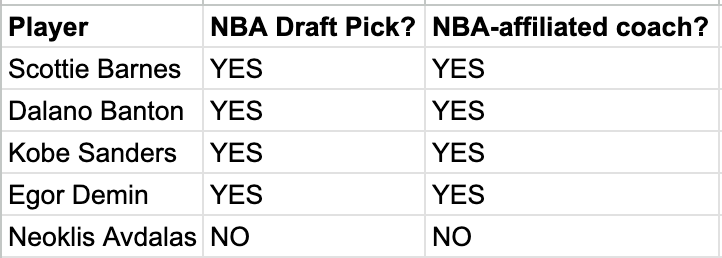
Every player with Avdalas' size and passing chops in the last six years has eventually been an NBA draft pick, and I don't think it's a coincidence that all of their college head coaches were either NBA players or coaches at one point. With no disrespect to Mike Young, it probably takes a certain type of system to unlock an ultra jumbo point guard in college hoops.
It's that idea that makes Avdalas being the first commit of North Carolina's Michael Malone era such a fascinating one.
Last year's Virginia Tech squad and Malone's last Nuggets team averaged the same amount of pick-and-roll ball handler shot attempts, though Denver played an astounding 23 more possessions per game. Avdalas was responsible for nearly half of those possessions for the Hokies. In other words, one should expect Avdalas to be a pick-and-roll creator far, far less under Malone, which should be a good thing considering he scored a below average 0.78 points per possession out of that action.
Instead, Malone's NBA offenses were far more motion and cutting heavy. And while yes, having Nikola Jokic helps in that regard, Denver ranks lower in assist rate this season without Malone than any of the previous five years with him. Malone's Denver teams finished top 10 in assist rate every year he was at the helm.
While there's obviously many more pieces needed to be added and retained for next year's Tar Heels' teams, early indications are that a drastic change in offensive style should be a big help for Avdalas. That type of change is not one that you typically project for when looking at freshman stats.
Avdalas' scoring efficiency was his biggest issue offensively last year, but not all hope is lost. Avdalas was actually good around the basket as a finisher, but only 46% of his 2-point attempts were at the hoop last year. That number was 62% his last season in Europe. Fewer pick-and-rolls and more continuity action should allow Avdalas to continue making plays with his passing, but also allow him to get to the rim way more frequently and use his size to finish over small defenders that will be guarding him. When I think about Avdalas in an NBA-style system, I don't see how he won't abuse mismatches getting downhill like this:
I will admit, my first thoughts when this move was announced was that it was a poor choice because of how inefficient Avdalas was as a freshman. But there is simply no other player his size with his passing ability in the portal, let alone anywhere in the country. Given his position and his potential, he very well may be the perfect starting point for a brand-new roster and era in Chapel Hill.
A perfect portal fit in College Station
Over one week into transfer portal season, and my favorite player-team fit has been PJ Haggerty to Texas A&M. I've already given some preliminary thoughts on the fit in our master transfer portal document, which I will outline below.
"Bucky Ball" has become one of the more notable and distinct styles in college basketball, and I would argue it significantly overachieved in Year One given the talent level. Haggerty immediately takes the crown of the most talented player McMillan has ever had. Offensively, Bucky Ball is all rim and 3-point attempts. Haggerty is nearly 39% from deep off the catch the last two seasons and was fourth nationally in rim field goals per game amongst guards last year. Bucky Ball is also a speedy offensive squad, and Haggerty was sixth-nationally in transition field goals per game last year. Haggerty's teams have been over 3.5 possessions per 100 faster with him on the floor the last two years. Not only is Haggerty a superstar, but one that should fit seamlessly in McMillan's system.
Defensively, Bucky Ball loves to press, and back before Haggerty played for the disgusting Kansas State defense, he was actually a solid defender with disruptive hands. If he's engaged on that end, he could be really solid. I think there's a chance we look back at this, Haggerty's averaging 22 points per game with additional counting stats, and this is a Top 10 transfer pickup. I don't see much downside here.
Interestingly, the only on-ball guard McMillan has ever coached at the D-I level with a usage over 25% was Ques Glover. The 6-foot guard went a truly ludicrous 126-of-201 (62.7%) at the rim under McMillan, and went 45-of-80 (56%) the rest of his career. More than just the percentages, that means he took five rim attempts per game under McMillan, and 1.1 per game at Florida and Ohio State. Look at the spacing and speed of Bucky's offense with Glover, and then picture literally one of the best rim guards in the nation in that system.
If Haggerty was simply a monster transition and rim pressure guard, that would be enough for me to like this move. But it's all the other things that Haggerty does that Texas A&M didn't have last year that make me even more intrigued.
McMillan's Samford squads led the SoCon in free throw rate two of his last three years there, but last year's Texas A&M group only finished 12th in the SEC. Haggerty is one of only six players in the 2020s to post three seasons of 200+ free throw attempts.
None of Texas A&M's three players with a 20% assist rate last year made more than 42 twos. Haggerty has made more twos than all three of those guys combined in each of his three college seasons.
The biggest knock on Haggerty is his defense, but it's worth mentioning we're 365 days removed from him being the leader in steal rate for a Top 50 defense while ranking second on the team in DRAPM and first in Defensive Win Shares. Haggerty was a plus defender in both of his college seasons before the disaster at Kansas State.
In fact, I would argue Texas A&M was only able to access Haggerty's services because of that "down year," quotations because he was still an efficient scorer and passer on absurd usage. But the Wildcats were a team with maybe three other power conference caliber players on the roster with a lame duck head coach that didn't make it through the year. I don't see why we always have to take a player's most recent season as the most important datapoint like a college career has to be a linear experience.
While the Aggies were more of an offense by committee last year, I would expect the 2025-26 squad to be more heliocentric around Haggerty and a bunch of floor spacing. That's a true Bucky Ball offense, and it should be an exceptionally fun watch.
