

As someone who is firmly and insistently against per-game counting stats and for rate and analytic stats in college basketball, I have a confession to make.
I'm not the biggest fan of assist rate and turnover rate for grading a player's passing ability. I think they can fool the naked eye into suggesting someone is a great passer when they aren't, and can hide some elite playmakers below the surface.
Let's use former Utah and current North Carolina guard Terrence Brown as an example.
Brown had a 27.7% assist rate last year, ninth among all Big 12 players. He also had a 13.8% turnover rate, good for the upper 40% of all qualified Big 12 players, despite the heavy passing usage. Of the top 20 assist rate guys in the conference, Brown had the fifth-lowest turnover rate.
And yet, among the 17 players in the Big 12 with at least a 20% assist rate, Brown had the second-worst assist-to-turnover ratio. That's right: despite a very high passing rate and a very low turnover rate, Brown had only 1.58 assists per turnover. How is that possible?

The answers to why Brown's assist rate is inflated and why his turnover rate is deflated both lie in possession usage and shot usage, both of which Brown ranked in the Top 15 in the entire country.
Assist rate is a player's assists divided by the number of field goals their teammates made while they were on the court. This means that when Brown was on the court, 28% of all field goals made by the other four Utes were assisted by Brown. Given Brown's possession usage was so gargantuan, it should be no surprise that he was largely the one who was creating plays for others when he was on the court.
Because he had such a high on-ball usage, only one other player on Utah's roster had even half of his assist rate, and backup point guard Obomate Abbey shared the floor with Brown on just 21.5% of Brown's minutes.
On the other hand, turnover rate is unrelated to assist rate. That stat is simply the percentage of a player's possessions that end in a turnover. In Brown's case, KenPom shows he took 33.5% of Utah's field goals when he was on the floor, plus his 0.415 free-throw attempts per field-goal attempt. Add in the lofty assist rate numbers as the team's leading passer, and there simply isn't a big slice of the pie left for the turnovers.
Because Brown was taking up so many possessions for the Utes, the percentage of his share of possessions ending in a turnover was low, but the number of turnovers he had was high. He finished ninth in the Big 12 in turnovers, but 63 qualified players in the league had a higher turnover rate.
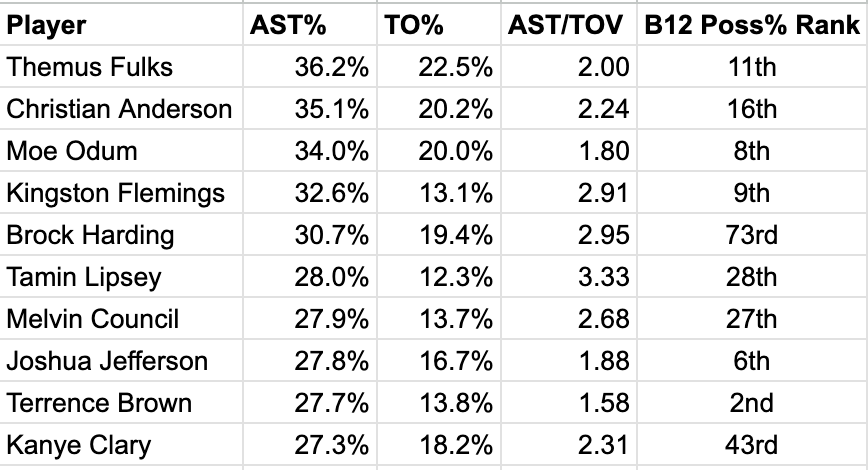
This chart of the top 10 assist rate players in the Big 12 should provide a useful comparison. Christian Anderson and Moe Odum had almost identical AST% and TO% numbers last year, but Anderson's AST/TOV is better because he used a lower amount of his team's possessions to rack up those numbers. Brock Harding has the fourth-highest TO%, but the second-best AST/TOV because he has the lowest possession usage on this list by far.
All this to say, using assist rate and turnover rate to determine who's the best passer is a flawed strategy because the role a player has within an offense dictates a big part of their value.
So, what's the best way to measure passing? I will not give in to the raw assists-per-game metric, because that completely ignores other key factors like minutes, pace, and team system. I just used AST/TOV as a comparison tool, but it can reward players who play extremely small roles in an offense and therefore never turn it over.
After spending all offseason trying to factor in role and possession into a playmaker's assist and turnover stats to try to grade their passing ability, I'd simply had enough. I think it's time we, as a collective college basketball community, re-imagined our passing metrics.
Creating a Role-Adjusted Passing Metric
When it came to rethinking how to grade passers using an analytical metric, I decided to keep assist rate and eliminate turnover rate.
I know I just spent the introduction explaining how assist rate is overrated, but I still think it's the best all-encompassing passing number when we properly consider the context of role. Just by eyeballing possession usage as it relates to assist rate, we can quickly decipher that a 20% assist rate on the sport's highest usage player is nowhere near the feat of a 20% assist rate for a team's fourth option.
CBB Analytics uses a very smart statistic that can help uncover this role-based contextual difference in usage role when it comes to passing, called assist ratio.
I touched on assist ratio when breaking down connector bigs in an article last month, but I think it is a tremendous compliment to assist rate. It is essentially turnover rate's passing cousin - it's the amount of a player's total possessions that end in an assist.
Assist ratio has the same flaw as turnover rate: the number can be deflated by super high-usage scorers, because tons of shots just mean the ratio of everything else gets squeezed. But given that assist rates inflate for high-usage players and assist ratio deflates for high-usage players, I think they counterbalance each other very well. In simpler terms:
High Assist Rate, High Assist Ratio: Elite passer who is both an on-ball option and someone who is looking to pass first.
High Assist Rate, Low Assist Ratio: A heavy scoring option who is looking to score first and possesses an inflated assist rate due to increased on-ball chances.
Low Assist Rate, High Assist Ratio: Off-ball player or secondary option who's either a poor scorer or a heavy pass-first player.
Low Assist Rate, Low Assist Ratio: Heavy off-ball option, or an extreme shot-heavy player who rarely looks to pass.
A good example of this last year was Utah with Brown and Abbey. Their assist rates were within 4% of each other, but Brown's assist ratio was 15.7%, in the 53rd% of all guards, while Abbey's was 33.3%, in the 98th% of all guards. This is because of Brown's aforementioned giant usage, while Abbey had the 11th-lowest usage rate amongst all guards in the Big 12 last year.
Using just assist rate to grade these two as a passer gives an unfair advantage to Brown because of how many more on-ball opportunities he had as an offensive weapon. Using just assist ratio gives Abbey an unfair advantage, because it punishes Brown for simply being a way better scorer and therefore having the ball in his hands more.
Therefore, we'll combine the two metrics. To do so, I simply multiplied the players' assist rate with their assist ratio, and then added that back to their original assist rate to create a new, role-adjusted one. Here's what that looks like:
Terrence Brown: 27.7% Assist Rate, 15.7% Assist Ratio
(27.7%*15.7%)+27.7% = 32.0% Adjusted Assist Rate
Obomate Abbey: 23.6% Assist Rate, 33.3% Assist Ratio
(23.6%*33.3%)+23.6% = 31.5% Adjusted Assist Rate
Funny enough, this adjusted number leaves both players with nearly the exact same rating. This is exactly what I sought out to do. Abbey deserves credit for dishing out 68 assists in an off-ball role that includes just 92 field goals, but Brown deserves credit for being a volume passer while being tasked with a No. 1 option usage rate. This is a good start.
Just to test it out, I tried it on a couple more fun pairings.
Tayton Conerway, Indiana:
31.2% Assist Rate
26.1% Assist Ratio
39.1% Adjusted Assist Rate
Conor Enright, Indiana:
25.6% Assist Rate
46.1% Assist Ratio
37% Adjusted Assist Rate
or
AJ Storr, Ole Miss:
16% Assist Rate
10.7% Assist Ratio
17.7% Adjusted Assist Rate
Eduardo Klafke, Ole Miss:
13.1% Assist Rate
20.8% Assist Ratio
16% Adjusted Assist Rate
As you can see, this new adjusted assist rate puts low-shot passers with strong vision on par with solid passers that are higher usage (Indiana example), and it puts high-volume players with poor vision on par with cerebral off-ball processors (Ole Miss example).
But of course, you cannot have a passing stat that doesn't even consider turnovers. But since I've made a conscious effort to remove the role element from this new statistic, using turnover rate makes no sense for the reasons mentioned in the open.
In this case, I think using assist-to-turnover ratio works quite well. It's not a counting stat in the sense that it changes with minutes or pace, because it's just comparing two numbers for the same player. It's slightly role-dependent, but considering we're comparing ball handlers with other ball handlers, the relationship between assists, turnovers, and role should be relatively linear. For example, Texas Tech's Christian Anderson went from off-ball as a freshman to fully on-ball as a sophomore, and despite his assist rate rising by nearly triple, his assist-to-turnover ratio was exactly the same. He is an efficient passer regardless of role.
To combine this, I'm simply going to use the assist-to-turnover ratio as a multiplier. Most of the best passers in the country have an elite number in this regard. Of the 12 qualified players with a 40%+ assist rate, all of them had an AST:TO of at least 1.4. Only Southern Utah's Elijah Duval had a negative AST:TO with an assist rate over 28%.
For the new equation, I'll multiply the player's AST:TO to the Assist Rate * Assist Ratio statistic, and then add that back to the original Assist Rate to create an adjusted assist rate with an added turnover efficiency element that I'm going to coin as Pure Passer Rating.
Wisconsin's Nick Boyd and Merrimack's Kevair Kennedy both had a 29% assist rate and an 18% assist ratio. But Boyd's assist-to-turnover numbers were much better.
Nick Boyd: 29% assist rate, 18% assist ratio, 2.53 AST:TO
((29%*18%) * 2.53) + 29% = 42.1% Pure Passer Rating
Kevair Kennedy: 29% assist rate, 18% assist ratio, 1.4 AST:TO
((29%*18%) * 1.4) + 29% = 36.3% Pure Passer Rating
With the Pure Passer Rating metric, we can evaluate passers' productivity, efficiency, and processing while accounting for role and usage. With that in mind, here were the 15 best pure passers in college basketball amongst all guards.
First off, it's worth noting that Jeremy Fears' pure passer rating was the highest of any player since at least 2011-12. The gap between him and second-place Mateo Esmeraldo is the same as the gap between 20th and 245th in the rankings.
This metric really helps someone like Enright or Esmeraldo, who both had an assist on over 40% of their possessions while also turning it over once for about every four helpers, but didn't fully pop in the assist rate metric because of lower shot usages.
It also really hurts someone like Jackson State's Daeshun Ruffin, who was third nationally in assist rate, but because he was fourth in shot usage and had just a 1.55 AST:TO, he fell all the way to 40th in pure passer rating.
With this new metric, you no longer have to consider how usage or on-ball context has skewed a player's assist or turnover rates. Though there is no perfect number for any conclusion in basketball, I think this statistic is the closest to grading a player purely on his passing ability.
Using Pure Passer Rating in player analysis
Houston was vying for two possible point guards in the transfer portal, with their entire starting backcourt moving on this offseason. Rumors said they were closely monitoring both LSU's Dedan Thomas and Notre Dame's Markus Burton.
Both entering college in 2023, Thomas and Burton both played on similarly-ranked teams and had pretty comparable passing stats across their first two seasons. Burton averaged a 28.6% assist rate and a 17.5% turnover rate, while Thomas averaged a 28.2% assist rate and a 14% turnover rate. Both had injury-riddled third seasons but put up almost identical assist and turnover rates in Tier A+B games last year.
When reading these passing analytics, it seems like Burton and Thomas are equal passers, but that's just not true.
Over his three-year career, Thomas has averaged a pure passer rating of 58, which would put him in the 96th percentile of all guards with a 15%+ assist rate last year. On the flipside, Burton averages a pure passer rating of 33.8, which would put him in the 66th percentile of that list. Essentially, Thomas is one of the elite passers in the sport, while Burton is very much in the middle of the pack for playmakers.
Much like some of the previous examples, Burton's passing stats are inflated by an absurd usage rate. While he is a dynamic dribble scorer and shot creator, his inability to efficiently find his teammates is a flaw in his game that isn't shown in his assist and turnover rates. On the flip side, Thomas has never been the most-used player on his own team, yet he has never had a season in which more than 16% of his possessions ended in a turnover.
For a Houston team that has ranked in the Top 30 in offensive turnover rate each of the last four seasons, and a group that dominates the offensive glass to a point where a missed shot is far more valuable than a turnover, the more efficient passer in Thomas is a huge boost for its system.
All told, Thomas is the No. 3 returning passer in college basketball per this metric, just behind Esmeraldo and UMass' Danny Carbuccia. He seems like a perfect fit for Houston and is a breakout All-American candidate for me.
Some other examples of players that caught my eye when breaking down pure passer rating:
- New Arizona point guard JJ Mandaquit was sixth among all power conference freshmen in the stat, which backs up his prep pedigree as the consummate point guard. His raw turnover rate is high due to his low shot usage, but don't be fooled - he was a strong floor general as a freshman and should play a big role for the Wildcats this season.
- Along with Thomas at LSU, the only other player in the country with a 30% assist rate, 30% assist ratio, and 3+ AST:TO was Gonzaga's Braeden Smith. While his lack of scoring pop saw him lose his starting job to Mario Saint-Supery, he should be an excellent floor general at Notre Dame next season.
- Amongst players with at least a 25% assist rate, the one with the lowest pure passer rating was Loyola Maryland's Jacob Theodosiou, who is transferring to Duke. While he isn't expected to play many minutes, an injury or two in the backcourt could force him into action. He was 215th in assist rate last year, but 424th amongst just guards in this metric.
- As for forwards, IU Indy's Finley Woodward, Louisville's Aly Khalifa, and Liberty's Zach Cleveland occupy the top three. The two best returning forwards in pure passer rating are Georgia Tech's Victor Valdes and Columbia's Connor Igoe.
Predicting the future with Pure Passing Rate
Of course, being able to pass doesn't automatically make you a star, but when combined with some other statistical clues, we can make a strong guess on who is set for a big leap, especially early in their college careers.
One thing that is particularly hard for freshmen guards is to be an elite passer and an above-average scorer, so the ones that do are typically clear standouts or breakout candidates. Looking back to 2024-25, these were the freshmen who ranked in the 75th% or better in pure passer rating and the 50th% or better in true shooting:
- Labaron Philon, Alabama
- Jaquan Johnson, Bradley
- Jeremiah Fears, Oklahoma
- Dylan Harper, Rutgers
- Andy Stefonowicz, North Dakota State
- Kasparas Jakucionis, Illinois
- Tyler Tanner, Vanderbilt
Three NBA players, one future first-rounder, and a preseason All-American next year is not a bad list. Most importantly, Philon, Johnson, Stefonowicz (who started 30 games for a 27-8 NDSU team), and Tanner all had a higher ranking in pure passing rate than assist rate, demonstrating their value as passers if they were to have seen a bigger role, which they eventually did.
Looking to this past season, the list features Nigel James (Marquette), Jordan Watford (Queens), Alex Wilkins (Furman ➡️ Kentucky), Kingston Flemings (Houston), and Darius Acuff (Arkansas). Two Top 10 picks, two All-League returners in James and Watford, and a fascinating portal piece in Wilkins.
I also want to point out that the top five sophomores in the stat two years ago all finished in the 87th% or higher in the stat this season (Jeremy Fears, Trevan Leonhardt, Elliot Cadeau, Brock Harding, Bud Clark, Nait George).
Point being, shooting variance can go up and down, but good passers usually remain really good passers.
