


Before COVID, if you asked Maxim Klitschko what a layup was, he wouldn’t have an answer for you. Despite towering over all of his peers from an early age, he’d never stepped on a basketball court in a formal setting. He didn’t have any interest in playing basketball.
Nor did he want to follow his family name — as the son of heavyweight champion Vitali Klitschko — into the ring as a boxer.
But when the pandemic shut the world down, Klitschko, then 16, needed things to do. He’d grown to about seven feet tall and figured that he would pick up a basketball and try to dunk in the local parks in England, where he was at boarding school at the time.
He figured he could use basketball to get an education in the U.S., but he didn’t realize just how much the sport would change his life. Flash forward six years, and that has become his reality. Klitschko is two years into a professional and international career that has taken him across Europe, and now, back to the United States, where he spent many formative years. In May, he committed to East Carolina, where he’ll play for head coach Michael Schwartz in the American Conference.
Every basketball player remembers their first dunk. For Klitschko, it was his first goal.
“I couldn’t dunk until I was 17,” Klitschko told Basket Under Review.
A rarity for somebody his size, but he’d just never had any semblance of basketball skill. Despite the athleticism that runs in his family, he’d never harnessed it into something that could be functional on the basketball court in the first 16 years of his life. And not only did he not have basketball skills, but he also didn’t know how to develop any either.
Vitali knew what his son could be athletically. He was always begging Klitschko to compete, but never pushed him towards combat sports. He dabbled in soccer and tennis, but his main sport growing up was swimming.
“He said if I really invested in my genes,” Klitschko said. “He said I could be an Olympic medalist one day. I was always laughing it off, I always thought he was just saying things to say that.”
And while he’s still a ways away from that possibility, Klitschko has started to realize his athletic potential in the most obvious place for somebody his size. Although he wasn’t in the most obvious place to play it.
At his school in Oxford, England, there was no basketball team. Rowing and rugby were the main sports at that institution. So he had to find his own way, and Oxford Hoops gave him that opportunity in 2021-22 to play with their youth team and take part in structured training. A year later, he joined the men’s team.
But quickly, it became apparent that the level of competition, coaching, and training that was once revolutionary for Klitschko’s basketball passion was no longer novel. He needed to take a step up if he wanted to improve.
Unlike most European basketball players, Klitschko didn’t grow up in an academy system. He was never taught the game from a young age, and he needed to leave England in order to maximize his potential.
“I was pretty bad when I started,” Klitschko said. “But I think that the level of competition in England was also pretty bad. It’s not a basketball country. I started progressing pretty quickly because you don’t need that much to be good when you’re tall, especially at the lower levels.”
So he searched for a prep school in the U.S. to take a postgrad year. Klitschko’s research wasn’t just centered around basketball, though, as he wanted to find a place where he could thrive academically as a pathway to an elite college.
He sent out emails to coaches in the NEPSAC, and eventually got on a Zoom with Taft School head coach Shavar Bernier, who bought into Klitschko’s size, upside, and willingness to learn.

“He’s a big kid, was a little bit raw, but I think he’s a special kid,” Bernier told Basket Under Review. “He’s really bright, and he understood process. He made coaching him really easy.”
During his season at Taft, Klitschko wasn’t the best player on the floor.
While pursuing college offers, he was thrust into a much different game than what he was used to. His size alone was no longer enough to dominate, and it was exactly what he was looking for.
“When I was in the U.K., I thought ‘I could probably do it,’ but then when I came here, it’s kind of another level,” Klitschko said. “I saw that there’s different levels, and that gave me my fundamentals. I didn’t really have a hook shot, I didn’t even have a bag when I came over there. Coach Bernier gave me a shot when no other schools wanted to have me.”
“With a lot of players who have talent but have yet to see the speed or pace, it just takes time,” Bernier said. “He just couldn’t finish, the pace was a little too quick for him, the doubles come quicker than usual. If we’re driving and we dump it off, it’s coming a bit quicker. He worked at it.”
“He let me coach the heck out of him,” Bernier continued. “I got after him, and he was cool with it. He’s really stable-minded.”
He was impressive enough both on the court and in the classroom to draw interest from programs in the Ivy League, but none of them “pulled the trigger,” Bernier said.
Klitschko also drew high-end Division III interest. The NESCAC is one of the top leagues in Division III basketball, but also is comprised of some of the best small liberal arts colleges in the country. And he committed to Amherst College in January 2024. It was a reflection of his impact at Taft.
“The faculty would say that he engaged as much as possible for a postgrad,” Bernier said. “Being the thoughtful global citizen that he is, getting a 94 average, was pretty unique.”
Having fulfilled the initial goal that he’d set for himself back when he first started playing basketball a few years prior in England, Klitschko was excited for the next opportunity.
And then, sitting in a Taft class in the weeks after his season ended, his phone rang. The voice on the other end changed his life.
When he started playing basketball, his only ambitions were to have fun, and get an education. But now, he’d been invited to try out for the Ukrainian U20 national team in advance of that summer’s FIBA EuroBasket tournament. He could hardly believe it.
“I was pretty nervous,” Klitschko said. “To be honest, I didn’t know if I had what it took. After two or three years of playing basketball, I was getting called up? Of course I was pretty proud, but I was also pretty nervous, because I knew the level of competition was a step higher.”
Representing your country at the international level is a massive responsibility for anybody, but for Klitschko, it was amplified. Carrying the last name of arguably the greatest athletes to ever represent Ukraine in any sport, the legacy was his to continue.
Even though he wasn’t sure if he was ready, he couldn’t pass up the chance to find out.
“My family was really proud,” Klitschko said. “It was always a dream of my dad’s to see me play for a Ukrainian national team like he used to represent Ukraine.”
When he made the team, he’d earned the opportunity to continue the family legacy. Instead of crumbling under the pressure, Klitschko used it as a point of pride.
“I don’t know if there’s another layer of responsibility per se,” Klitschko said. “I feel like there’s another layer of pride. My dad really cemented our family name in Ukrainian sports, and it’s an honor to build on top of it in whatever way I can. Just even to be mentioned in the same sentence as him in the sports world is a big honor.”
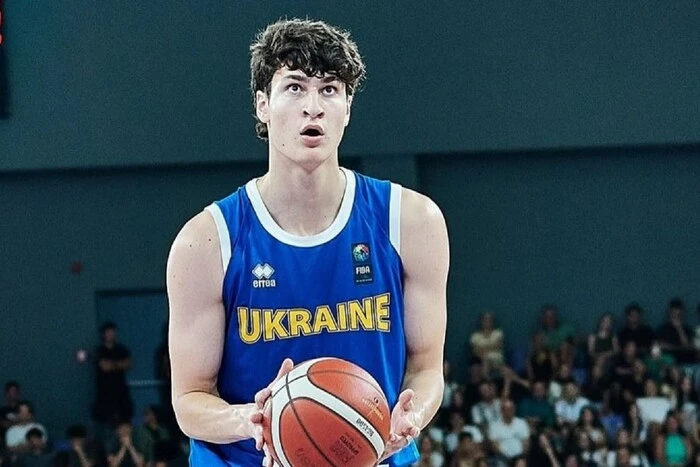
He averaged 6.9 points, 5.1 rebounds, and 1.6 blocks per game at U20 EuroBasket in 2024 for Ukraine, helping the team make the finals of the B Division tournament.
While it wasn’t the most eye-popping statline, it was his first time playing on the European stage, and he caught a few people’s attention. Just days before Klitschko was set to return to America to start his freshman year at Amherst, he received another phone call laying out another potential life-altering decision.
AS Monaco offered Klitschko the opportunity to join its academy program, which could give him a direct pathway to playing professionally in Europe. While academics had driven all of his previous basketball decisions, the experience with the national team changed his perspective.
“That was great exposure for me and that pushed me to prioritize basketball over education at that point in my life,” he said. “I was going to be on myself. I was going to take this gamble and see if it works out.”
It allowed him to play at a high level, and be closer to home, family, and most importantly, the Ukrainian national team.
Throughout this entire story, Ukraine’s war with Russia had been raging, and he’d spent it far away from home. Vitali, the mayor of the capital city of Kyiv since 2014, had been at the forefront of the war as an international symbol of Ukrainian resistance.
Klitschko told French television outlet RMC Sport in May that he’d only seen his father two or three times since the start of the war. But that doesn’t mean the gravity of the situation is lost on him.
“I’m pretty fortunate, there’s people in Ukraine that are much worse off than me,” he said. “So I just try to represent my country the best I can on the court, and I feel the best way to do that is with the national team. So just being close to the national team and trying to help them whatever way I could was important for me.”
Even though Klitschko doesn’t see his father in person, their relationship has tightened.
“(Vitali is) really invested now that I play sports at a high level,” Klitschko said. “I think for him, it’s a big deal and it made our relationship a little bit different. He’s obviously an athlete, me too now. So it’s like a different level of understanding now that we have to one another.”
Klitschko became content to throw his educational aspirations onto the back burner and come play for Monaco. When he made that decision, he didn’t think he’d ever have the chance to come back and play college basketball, and that was okay for him.
But with the combination of his own development as a player, and the development of the European market for NCAA basketball programs, that option came back on the table. It was hardly an easy path though. Just as with his peers in America, he came from a different basketball background than his new teammates, and had a lot of learning to do.
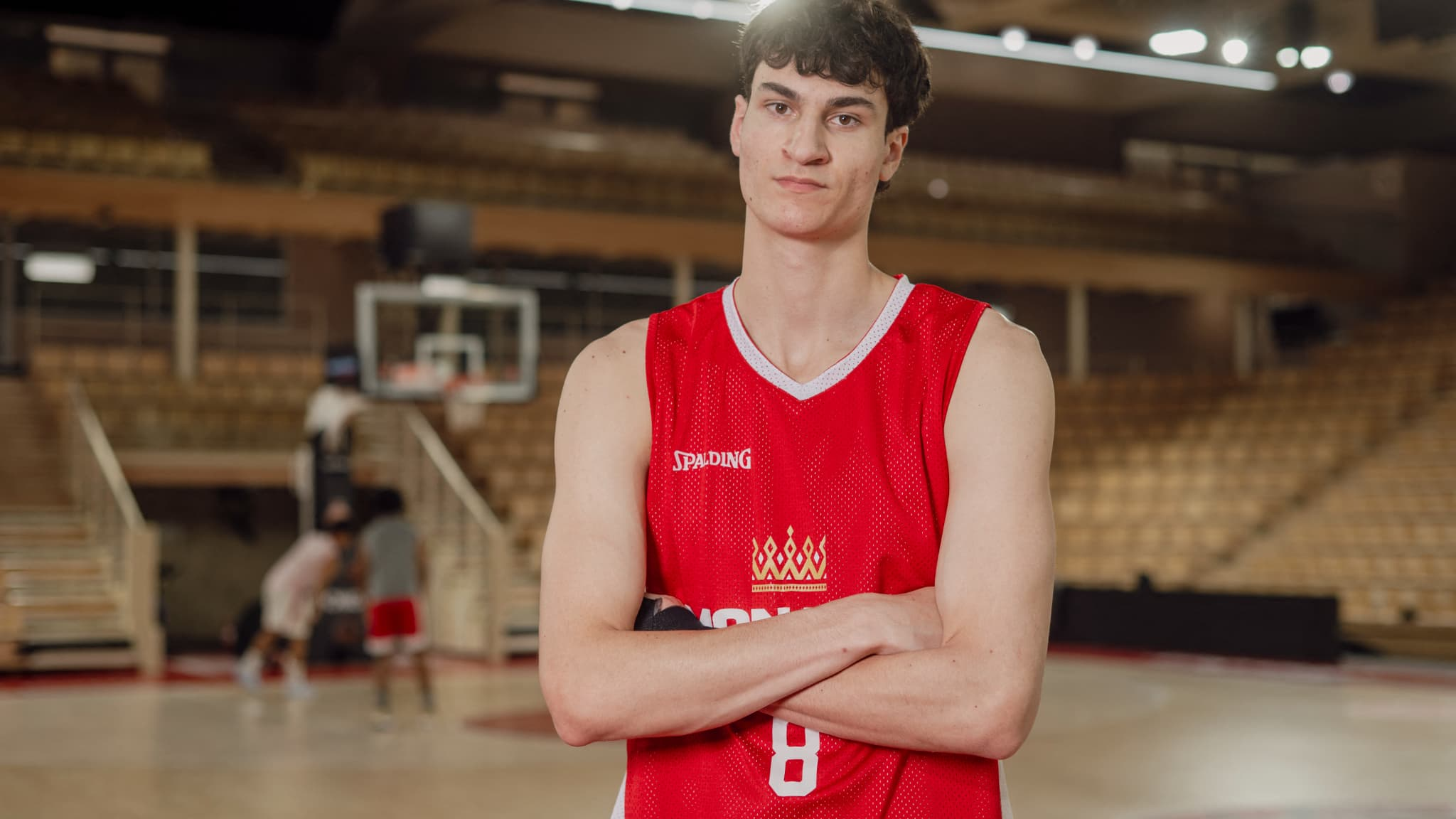
Struggling for minutes during his first season with the Espoirs (youth) team at Monaco, he was promising, but still raw. The shell shock of three completely different basketball contexts in three years was a toll that impacted him, especially for somebody who’d played at any organized level before that. Klitschko’s adaptation to different styles of the game allowed him to build up his skillset.
His agent, former NBA player and Ukrainian basketball legend Oleksandr Volkov agrees with Bernier that Klitschko’s coachability has propelled his game.
“He always tells me it’s a big positive that I didn’t start playing basketball earlier,” Klitschko said. “He says I’m like a sponge, I always absorb new ideas and I was never taught the wrong stuff. So when he teaches me stuff, he tells me stuff, I take it, and that’s like the first time I’ve heard these things.”
Instead of filling his basketball brain from an early age, Klitschko has been able to take in the coaching from different perspectives as his first introductions to the sport, and has gotten exponentially better in the process.
This season, at age 20, he became a key player for the Espoirs team, averaging 15 points and 7.5 rebounds per game, earning a call-up to the senior team at both Monaco and Ukraine. He credits the Monaco academy with taking his game up a notch.
“My IQ, my spacing, my feel for the game, my experience, just to name a few,” Klitschko said. “All the skills stuff, interior, post moves, middies. (Monaco) is where I built my game and my profile.”
As his second season in the system continued, Klitschko began to think again about playing college basketball. He’d seen Monaco teammates like Clarence Massamba make the move, and he was intrigued.
He and Volkov began exploring options. With more and more money and opportunity on the table for European players, Klitschko saw high-level college basketball as a chance to not only continue to grow his basketball career, but also go back and get an education. Albeit not necessarily an Amherst-level education.
Many of the discussions they had with coaching staffs were surface-level and broad, reflecting the fast pace of the current college basketball landscape and uncharted waters that many were swimming in. But one program stood out.
“(East Carolina) probably knew me as a basketball player better than myself,” Klitschko said. “They were showing me statistics I’ve never even seen. Some rankings that I don’t know where they got it from. They probably watched 50 hours of my film, so I was really confident that they knew what they were getting, who I am as a player, and how it fit in the program.”
After a few phone calls, Volkov drove six hours from his home base in Atlanta to Greenville, North Carolina, to visit with the East Carolina coaching staff. He showed Klitschko what the school had to offer in terms of its campus and facilities, and continued the conversations with the staff.
BREAKING: AS Monaco C Maxim Klitschko has committed to East Carolina, per source.
— Sam Federman (@Sam_Federman) May 7, 2026
Klitschko, 21, is a 7-1 big who has represented Ukraine at the senior level and recently made his senior debut for Monaco. Averaged 15/7 for Monaco Espoirs (U21) this year. Son of Vitali Klitschko. pic.twitter.com/iLMpZaVsLs
Things moved incredibly quickly, and on May 7, Klitschko announced his commitment to the Pirates. In June, he’ll once again cross the Atlantic and set foot in Greenville for the first time, joining an ECU squad stocked full of newcomers. Alongside Kent State transfer Cian Medley, Charleston Southern transfer Brycen Blaine, Louisiana Tech transfer Kaden Cooper, UTEP transfer Kaseem Watson, and more, Klitschko will attempt to help East Carolina elevate its program after the worst year of Schwartz’s four-year tenure.
In 2019, before Klitschko started playing organized basketball, he suffered an eye injury from walking into a hook placed on a door inside a bunk at Camp Takajo in Maine. Typically, those hooks would be placed above the eye level, but eye level for the average person isn’t eye level for Klitschko.
He was rushed to the hospital and didn’t return to camp activities for the rest of the summer. He had to have his eye shielded for a period of time. Sunglasses would do the trick, but so would an eye patch.
Perhaps it's only destiny that the Pirate life awaits him seven years later.
