

Madison, Wisconsin, has seen a basketball renaissance over the last half-decade.
The team, once known for its unhurried offense and stifling defense, has transformed with the times.
Now, for people who have watched them, they're better known for their modern offensive system that has created superstar guards and wings seemingly out of thin air.
So how has this offense created a new identity in the modern age of college basketball?
It starts with their continuity pick-and-roll offensive system, and we can prove it with some numbers.
For this exercise, I'll be looking at the following players and corresponding seasons:
- Nick Boyd: 2026 - Wisconsin, 2025 - SDSU
- John Tonje: 2025 - Wisconsin, 2023 - Colorado State (he was injured for 2024)
- AJ Storr: 2024 - Wisconsin, 2023 - St. John's
- John Blackwell: 2025 - Wisconsin, 2024 - Wisconsin
- Johnny Davis: 2022 - Wisconsin, 2021 - Wisconsin
What all of these players have in common is that they had a breakout year at Wisconsin. For the stats that follow, I've also included John Blackwell's 2026 stats, but for this exercise, I'll focus on his breakout season, which I'd consider 2025.
The data shown below is from Synergy.
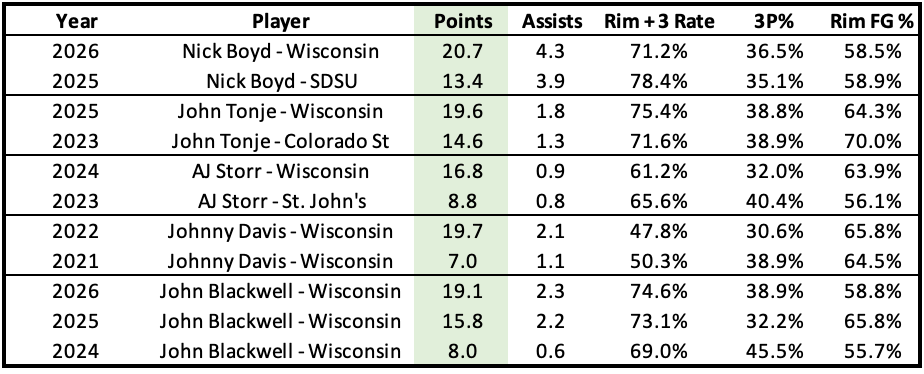
The main point of emphasis in the chart above is the increase in points per game. All five players increased their points per game by at least 5 in their season with Wisconsin, and four increased it by at least 7.
We'll get to the film in a bit on why the offensive system has churned out elite scorers, but I wanted to see if any numbers could help explain why, beyond simply increasing volume. I started with shots taken from three and at the rim, but nothing really correlated.
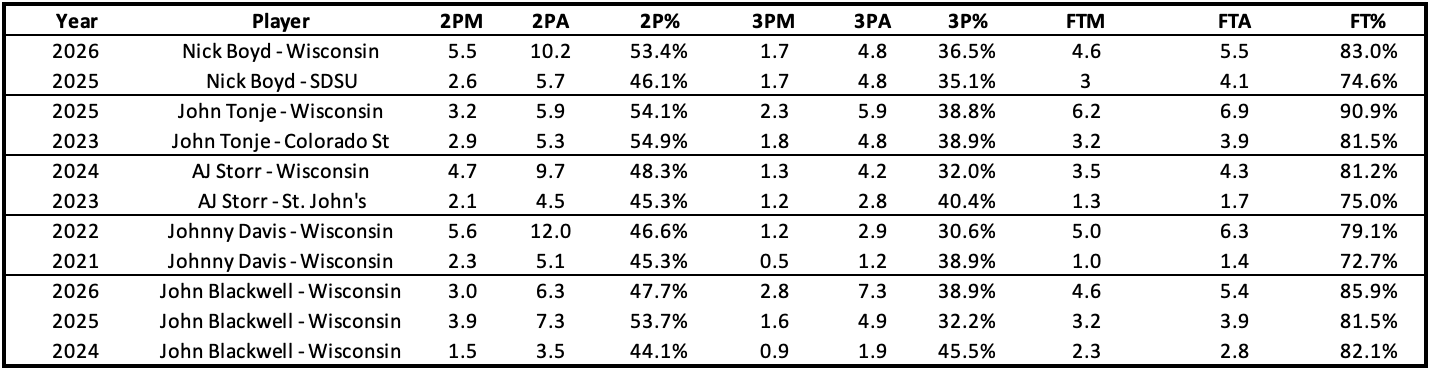
Next I looked at the generalized splits from 2s, 3s, and the free throw line. An increase in volume, of course, plays a large part in all of this. These stats didn't give me the exact answers I wanted, but one thing to note is the increase in volume from both 2s and the free throw line.
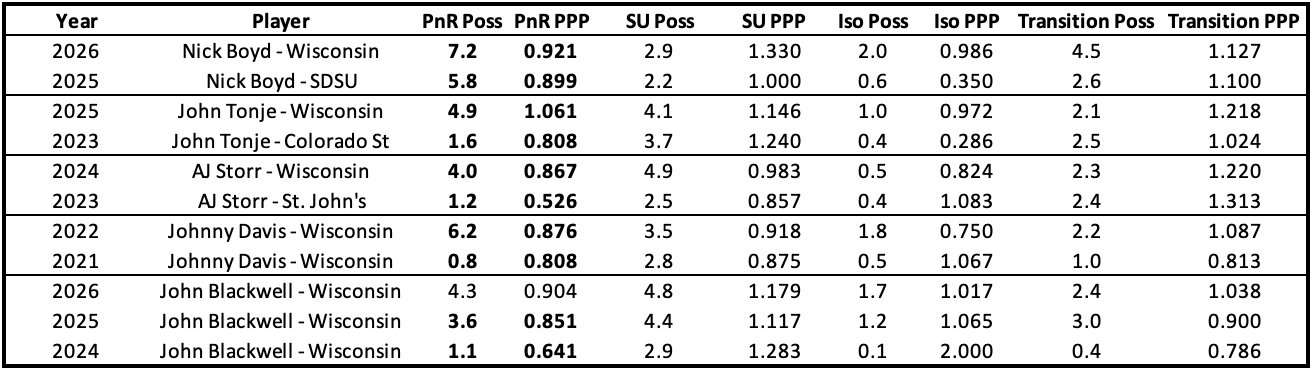
Note: SU = Spot Ups, PnR = Pick-and-Rolls, Poss = # of possessions per game, PPP = Points Per Possession
Then I looked into how the shots were being created, and as I suspected for an offense so reliant on them, pick-and-rolls seemed important.
For an offense that now relies so heavily on pick-and-rolls, it makes sense that each of these players saw an increase in pick-and-rolls run per game. However, it's important to note that all five players increased their efficiency in pick-and-rolls while ALSO increasing their volume.
It was the only category in which all five players increased their efficiency during their breakout year at Wisconsin.
With data showing that Wisconsin's pick-and-roll system played an important part in the breakouts, the question became how impactful it was and how it actually helped.

The data above shows how much each player increased their points per game in their breakout year at Wisconsin for each category. The far-right column shows what percentage of their total points per game increase can be attributed specifically to pick-and-rolls.
Again, pick-and-rolls were the only category that consistently impacted all five players. Nick Boyd was the only player who didn't have at least 30% of his point increase come from pick-and-rolls, as he sat just below 20%.
With two different sets of data showing that pick-and-rolls had a major impact, I next wanted to look at each player's changes in pick-and-rolls only at Wisconsin.
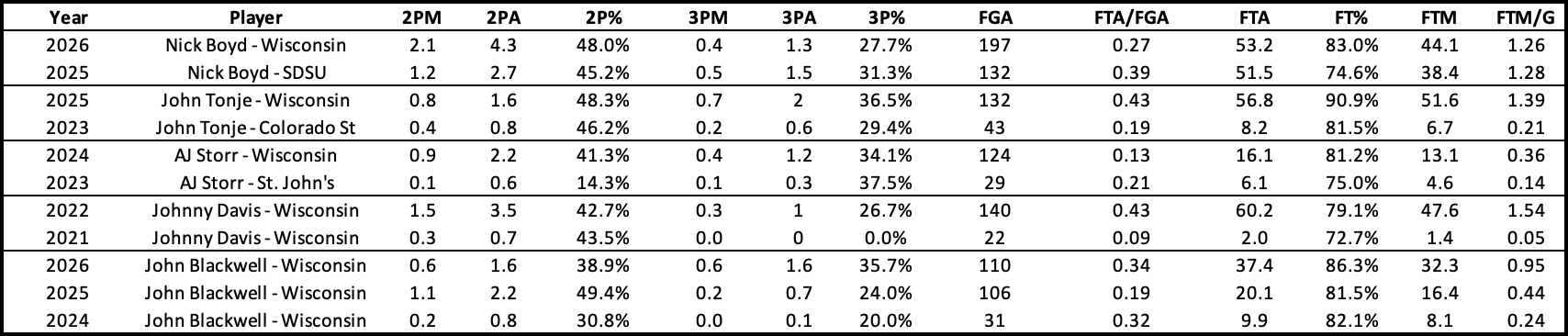
The table above shows some of the raw numbers each player had ONLY out of pick-and-rolls. Below will be a more summarized table.

This table above shows the change in points per game in pick-and-rolls only, broken down by how many of those points can be attributed to twos, threes, and free throws. The right part of the table is calculated by dividing the change in points per game for each shooting category by the total amount of points increase across ALL categories.
For example, John Tonje averaged 3.91 more points per game out of pick-and-rolls in his year at Wisconsin than in his year at Colorado State. These points can be attributed to him scoring 0.8 more points per game via two-pointers out of pick-and-rolls, 1.5 more points per game via threes out of pick-and-rolls, and 1.61 more points per game via free throws out of pick-and-rolls.
Both Tonje and Davis got a big bump in free throws via pick-and-rolls; everyone but Boyd saw a jump in three-pointers via pick-and-rolls; and all five players saw a good increase in points per game coming from two-pointers out of pick-and-rolls.
In fewer words, Wisconsin's pick-and-roll system has allowed these wings and guards to take a big jump in production from inside the arc via pick-and-rolls.
This led me to try to figure out exactly the types of shots out of pick-and-rolls that these players were excelling in.
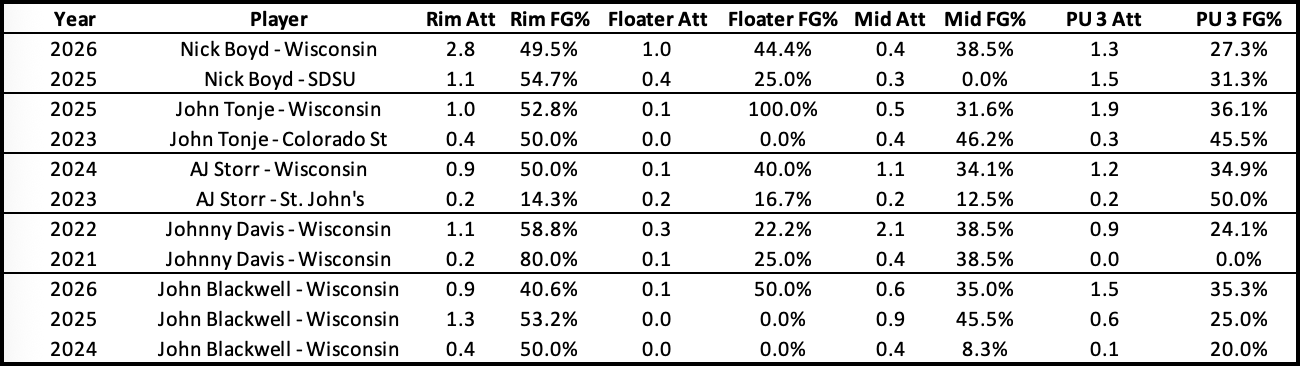
Across all four pick-and-roll shot categories, all five players saw a big increase in shots per game at the rim. John Tonje only increased his shots per game at the rim out of pick-and-roll by 0.6, but it's important to remember just how much he got to the free throw line, which decreases the number of counted attempts at the rim.
So to summarize:
- Wisconsin's perimeter players have seen a big jump in points per game in their breakout year at Wisconsin, compared to the previous season
- The single largest category that causes this increase in points per game is production out of pick-and-rolls, both because of volume and an increase in efficiency
- In pick-and-rolls, all of these players had a point per game increase in two-pointers, four had an increase in three-pointers, and three had an increase via free throws
- In pick-and-rolls, there was a general increase in volume of shots at the rim
Now that we have the data, there are two questions:
- Is the system itself foolproof so that anyone can be placed in it and succeed?
- Who projects to be up next for the Badgers in this role?
To answer number one, you, the reader, and I probably wouldn't be able to succeed in the system unless you're a D1-type athlete with some ability to create downhill out of pick-and-rolls.
In all seriousness, I think Wisconsin has identified players with the skills to be downhill creators and positive shooters, but maybe they just weren't given the opportunity.
Wisconsin saw Nick Boyd graduate and John Blackwell transfer this offseason, leaving nearly 40 points per game of production that the Badgers would need to replace just from those two spots.
Wisconsin added Australian guard Owen Foxwell, George Washington transfer Trey Autry, and Miami OH transfer Eian Elmer, while retaining Jack Janicki, Hayden Jones, and Zach Kinziger in the backcourt. They also added three freshmen: LaTrevion Fenderson, Jackson Ball, and Josh Manchester.
So who could be the ones to pop? Hayden Jones is an interesting player at 6'6 with the ability to operate out of pick-and-rolls and get downhill, although the shooting numbers are concerning. Zach Kinziger is projected to be a very good shooter in college, and a sophomore breakout is possible, but his ability to drive will be something to monitor. Trey Autry has been primarily a spot-up shooter in college, but he could find success in pick-and-rolls if given the opportunity.
But we'll primarily be focusing on the Aussie, Owen Foxwell.
Foxwell averaged 11.1 points, 4.5 assists, 3.0 rebounds, and 1.3 steals per game for the South East Melbourne Phoenix in Australia's NBL. He shot 45% from two, 35% from three, and 80% from the free throw line. For reference, the NBL is generally ranked as around the 10th-12th best league in the world, and a step above the NCAA.
Foxwell turned 23 in August, and he has one year of eligibility left.
In Australia, Foxwell was a primary ball handler who mainly operated out of pick-and-rolls. Below are his pick-and-roll shot attempts over the last three seasons.

If the 2026 numbers seem somewhat familiar, it's because they're relatively close to Nick Boyd's numbers during his 2025 season at San Diego State.

This isn't to say that Foxwell and Boyd are the exact same players, because they aren't. Boyd is more of a physical driver while Foxwell prefers change of pace and direction to get into the paint. At the same time, though, if Wisconsin's goal was to replicate Boyd with a similar player, they did pretty well on paper with Foxwell.
Wisconsin Continuity Pick-and-Roll
Above shows an example of a generic half court possession for Wisconsin in their continuity pick-and-roll system. Although this offense has increased the tempo recently, they're still comfortable working in the half court until they get a look that they want.
What makes Wisconsin's system work so well, in addition to simply having talent, is the spacing that they provide for both their shooters and drivers.
Wisconsin - Replace the Roll
Against High Point, Wisconsin Replaced the Roll, having #22, Austin Rapp, fill to the top of the key after #32, Aleksas Bieliauskas, set the screen. With Boyd refusing the screen, he has a ton of space to be able to drive the ball. With a shooter in the strong side corner, High Point didn't want to over help, thus allowing Boyd to get to the rim.
Wisconsin - Kickout against help
In this clip, Indiana shows help at the nail to try and prevent a Blackwell drive. Wisconsin has multiple shooters on the perimeter at all times, though, meaning that Blackwell doesn't have to force a drive and instead can make the simple kick out for three.
Owen Foxwell - Scoop Layup out of Pick-and-Roll
Foxwell does a good job of getting into the paint out of pick-and-roll, something that is incredibly important for ball handlers to be able to do for Wisconsin. The lefty guard prefers a bit more change of pace rather than bully ball on his drives, and he relies on finesse and craftiness around the rim to convert.
Owen Foxwell - Bad layup
That reliance on craftiness can cause some issues, as shown above by a 180 degree, backwards layup, and it's probably the biggest concern I have with his fit at Wisconsin. Looking back through the list of guards, basically all of them have been pretty physical drivers of the ball. AJ Storr is the one you could argue maybe wasn't as much, but he also had great athleticism to counter.
Owen Foxwell - Pull up 3
Foxwell shot 34.5% from three on 3.7 attempts per game last season. His shooting has improved throughout his career in Australia, and there's good reason to believe that it'll transfer over to the States.
Wisconsin - Baseline rip
Owen Foxwell - Baseline rip
The two clips above show both Wisconsin and Foxwell running the exact same action. In both clips, the ball gets swung to Blackwell and Foxwell, both being the closest players to the strong side corner. Instead of using the screen, they refuse it to rip baseline and get downhill.
Foxwell also has facilitating chops that should allow him to be able to counter over helping defenses by finding one of the myriad of shooters Wisconsin will have.
Wisconsins's offense is built on elite spacing, elite shooting, and having multiple ball handlers on the floor who can make a play happen. The simplicity of it all helps contribute to their ability to seemingly drop guards in and have them be elite, and Wisconsin is hoping Owen Foxwell is next on that list.
