

Every road game presents its own challenge, but some dates get circled the moment the schedule drops.
You know the buildings. The ones that are vital to the lifeblood of the sport, where crazed student sections and fanbases can spur their teams to otherwise unthinkable upsets. The ones where the atmosphere is feared as much as the actual team on the court.
Those are the places we wanted to rank.
Most "toughest places to play" lists lean on reputation and home records, but both can be misleading. A blue blood winning 95 percent of its home games may simply have a great roster. Meanwhile, a hostile gym attached to an inconsistent program can get overlooked for losing games it was never expected to win.
The goal was to measure the building and how all factors impact winning, not just the team inside it.
So, I created a model to measure that — not which arena is simply the loudest or has the best atmosphere, but which place is consistently the most difficult for opponents to win in.
Each venue was graded in four areas. Atmosphere carried the most weight, with a small boost for larger arenas that still fill. A packed 19,000-seat building creates a different challenge than a sold-out bandbox.
Home-court performance accounted for another large chunk, using the difference between a team's performance at home and on the road over the last two decades. That helped isolate the effect of the venue from the roster's quality. The difficulty of the home schedule made up a small portion, while mystique and reputation accounted for the rest.
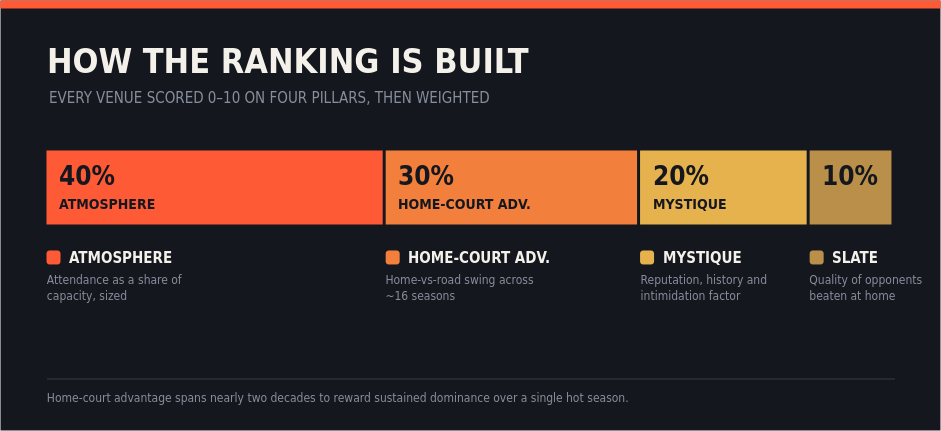
The formula was built around what a visiting team actually experiences. That pushed a few historic programs with quieter, more corporate environments down the list. It also opened the door for several mid-major gyms (and some formerly mid-major gyms) — the kind of places good teams avoid scheduling for a reason.
For programs that occasionally move marquee games into NBA arenas, we graded the on-campus gym where the real home-court advantage lives.
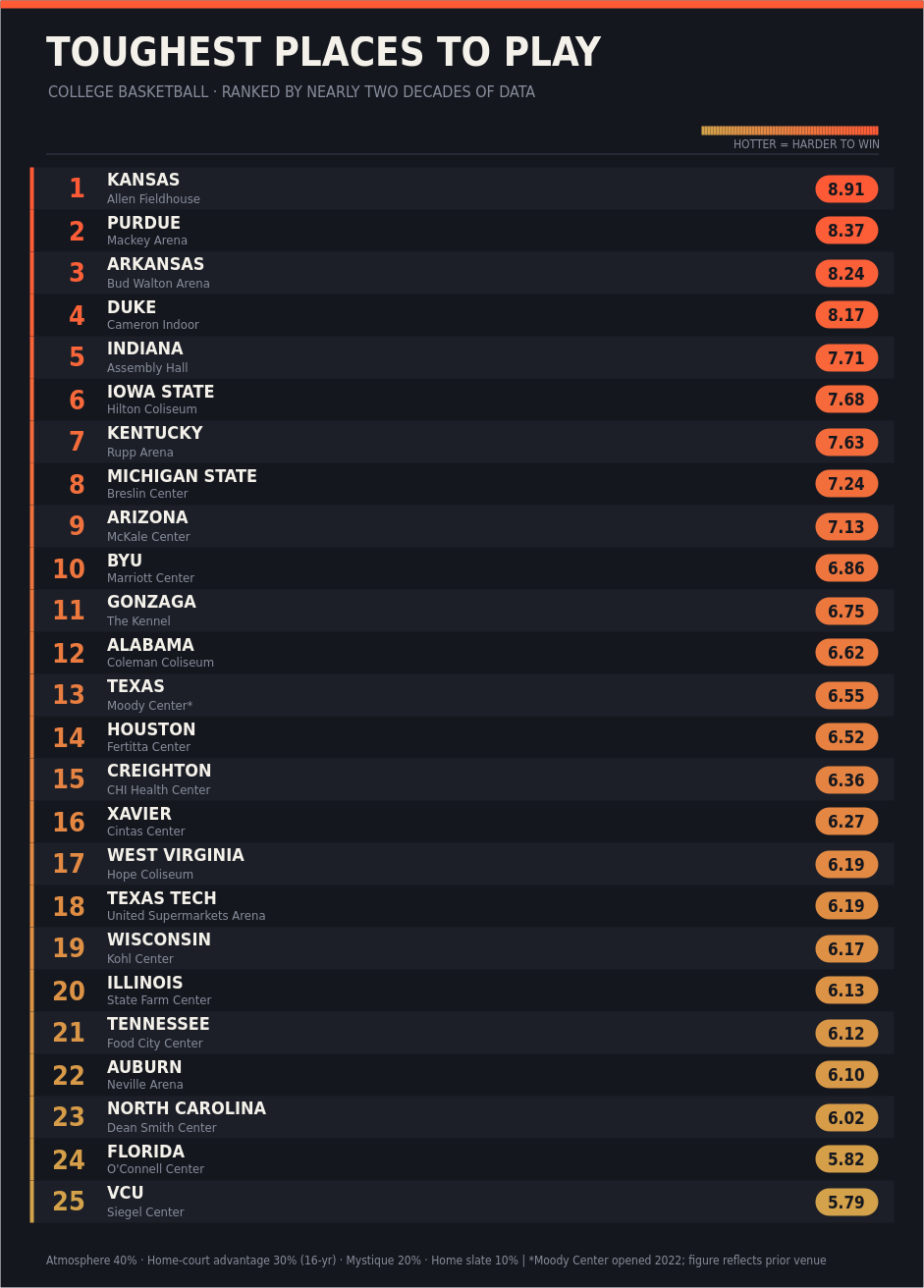
From No. 25 to the building nobody wants to see on the schedule, these are the toughest places to play in college basketball.
25) VCU | Siegel Center
VCU's Siegel Center is one of the great small-building environments in the country — a 7,600-seat box in Richmond that has sold out for the better part of two decades, the "Havoc" era turning every home game into a full-throated event.
Over the long haul, the Rams have protected it well, and while the home-court numbers don't spike the way bluebloods' do, a packed Siegel Center remains a genuinely unpleasant place to bring a road team (and a more life-altering experience than a 10-day trip to Europe).
24) Florida | O'Connell Center
Billy Donovan built a national power inside the O'Connell Center, and the building — a 10,000-seat arena Gators fans call the O-Dome — still fills to capacity behind a program that has returned to the top of the sport.
The home-court edge is steady rather than spectacular, but a full O-Dome with a title contender on the floor is a hard 40 minutes. The SEC arms race has only raised the stakes on every home date.
23) North Carolina | Dean Smith Center
Here's where the long view gets uncomfortable for a blue blood. The Dean Smith Center is the largest on-campus arena on this list, with 21,750 seats stuffed with history — and yet, over nearly two decades, its measured home-court edge is among the softest among the traditional powers, the wine-and-cheese reputation borne out in the numbers.
What keeps the Dean Dome on the board is everything around the swing: a 90% fill and a mystique score few programs can touch. The building trades on its name, and the name is still worth plenty. The atmosphere has improved in recent seasons, too.
22) Auburn | Neville Arena
Bruce Pearl doesn't do quiet, and he quickly turned Auburn's home building — rechristened Neville Arena in 2022 — into one of the SEC's genuine bear traps, a 9,100-seat box that gets loud early and refuses to settle down.
That hasn't slowed down under Steven Pearl, and the crowd is as involved in the game as anywhere on the list. It's the smallest of the SEC entries here, and that's the weapon: the crowd sits close enough to the floor that a 6-0 run feels like an avalanche.
21) Tennessee | Food City Center
Everything about Tennessee's home runs big. The building, officially known as Thompson-Boling Arena at Food City Center, seats nearly 22,000 — among the largest on-campus arenas in the sport — and under Rick Barnes, the Volunteers have filled it behind a defense-first identity built for a big, loud SEC crowd.
The orange stretches to the upper deck, and a perennial top-10 program keeps the marquee dates rolling in, even if the sheer scale of the place means it rarely feels as tight as the smaller cauldrons above it.
20) Illinois | State Farm Center
Illinois plays in one of the sport's architectural oddities — the State Farm Center, a flying-saucer dome ringed by the Orange Krush, one of the loudest and most organized student sections in the country.
Over the long run, the Illini have turned it into a real edge, a near-96% fill meeting a Big Ten schedule that guarantees ranked visitors. When Illinois is good, few Midwestern trips are less inviting.
19) Wisconsin | Kohl Center
The Kohl Center is where opposing offenses go to get frustrated and rattled. Wisconsin's deliberate identity extends to its building — the Grateful Red behind the basket, the methodical grind, a 98% fill that turns every possession into a slog for the visitor.
The data flags one caveat: the Badgers are nearly as good on the road, so the raw home-court swing is smaller than the atmosphere alone would suggest.
18) Texas Tech | United Supermarkets Arena
Lubbock is a long way from anywhere, and that's the first weapon. By the time a road team lands, buses in, and walks into the 15,000-seat arena the locals call the USA, the deck is already stacked. Over the past decade-plus, Texas Tech has posted one of the largest home-court swings in the Big 12.
The Red Raiders have turned a once-forgettable program into a perennial fortress, all rising volume and West Texas hostility.
17) West Virginia | Hope Coliseum
Start with the number, because it's the whole story: across nearly two decades, few buildings in America have moved the needle more than West Virginia's home in Morgantown. The Mountaineers' home-court swing is among the largest in the country, a genuine on-court edge that predates any one roster.
What keeps it here rather than higher is the ebb and flow of the program's success and fan turnout. But when there's a big game in Morgantown or the Mountaineers are good, few places are more difficult to play in.
16) Xavier | Cintas Center
Xavier is the definition of a basketball school, and the Cintas Center plays the part. All 10,250 seats sell out as a matter of routine, and the place roars like a building twice its size.
The Musketeers' spot in the reconstituted Big East guarantees a steady diet of ranked visitors. Over the long haul, the home-court edge has held up — one of the conference's most consistently difficult trips.
15) Creighton | CHI Health Center
Omaha shows up. Creighton plays in an 18,000-seat downtown arena and fills nearly all of it — the Bluejays regularly rank among the national attendance leaders, a sea of blue that would look at home in any power league.
It's the rare program that outgrew its conference roots and dragged an entire city's devotion along with it, and Big East visitors walk into a wall of noise most of them struggle to handle.
14) Houston | Fertitta Center
Houston's Fertitta Center is small, new, and mean. The renovated 7,100-seat arena opened in 2018, and Kelvin Sampson's program — one of the best in the country — has turned it into a genuine fortress, near-sellouts every night behind the most physical defense in the sport.
The home-court numbers back up the eye test: over the years, the Cougars have been dramatically tougher inside Fertitta than on the road, a compact building that plays much bigger than its footprint.
13) Texas | Moody Center
The newest building on this list opened in 2022, and Texas spared no expense — Moody Center is a glass-and-steel showpiece that seats about 10,700 and, crucially, actually fills it.
A caveat worth stating plainly: most of Texas’s long-run home-court data was earned at the old Erwin Center, not inside Moody, so this ranking rewards the program’s two-decade home edge more than the new building itself. But a sold-out modern arena and the move to the SEC give it every chance to earn this billing on its own.
12) Alabama | Coleman Coliseum
Nate Oats turned Alabama basketball into a track sport and Coleman Coliseum into a place opponents genuinely dread. The Tide play the fastest, most relentless brand in the sport, and a 98%-full building feeds the pace — every run is amplified while every transition bucket feels like the start of a massive run.
Football owns Tuscaloosa, but the basketball program's rise has turned the 15,000 inside Coleman into a real weapon and one of the SEC's toughest tickets.
11) Gonzaga | McCarthey Athletic Center (The Kennel)
Here's a building the numbers can't quite capture, for a telling reason: the best teams won't play in it. Gonzaga's McCarthey Athletic Center — the Kennel — seats barely 6,000, sells out every night it opens, and sits on one of the longest home-winning traditions in the sport. That is precisely why marquee programs stopped booking trips to Spokane.
That scheduling avoidance suppresses the raw home-court number even across a long window, so we've accounted for it. A venue this feared shouldn't be penalized for being too feared to visit.
10) BYU | Marriott Center
The Marriott Center is enormous — nearly 18,000 seats, one of the biggest on-campus arenas in the country — and BYU fills every one of them, at altitude. Provo sits above 4,500 feet, and by the second half, visiting legs feel it while a packed, deafening house feels nothing at all.
The Cougars' arrival in the Big 12 turned a great atmosphere into one with weekly marquee stakes, and the long-run home edge has been steady throughout.
9) Arizona | McKale Center
The McKale Center gets loud in a way that surprises people who've never made the trip to Tucson. Arizona basketball is the desert's marquee attraction, and its 14,700-seat arena fills to 97% with a crowd that has watched decades of top-10 teams roll through.
The Wildcats' home-court edge is real and sustained across the long view — the product of a program that treats a home loss as a civic emergency.
8) Michigan State | Breslin Center
Tom Izzo has built a lot of things in East Lansing, but the Izzone might be the loudest. Michigan State's student section packs the Breslin Center's lower bowl and treats every February Big Ten game like a Final Four showdown. There's always a full house behind a coach who has turned home dates into a quarter-century of theater.
The Spartans aren't quite the same juggernaut on the road, which tells you how much of the edge is the room itself — and the two-decade record bears it out.
7) Kentucky | Rupp Arena
Kentucky basketball is a religion, and Rupp Arena is the cathedral for Big Blue Nation. The Wildcats play in front of more than 20,000 a night — a fan base so large and so demanding that consecutive losses register as a crisis — in a building where the sheer expectation of victory becomes its own weapon.
The Wildcats fill 96% of one of the sport's largest arenas, and the weight of all that blue has been a lot for young road teams to carry for as long as anyone can remember.
6) Iowa State | Hilton Coliseum
They named the phenomenon after the building: Hilton Magic. For four decades, Iowa State's 14,000-seat arena in Ames has been the site of upsets that had no business happening — ranked giants walking in and staggering out, undone by a wall of cardinal-and-gold noise that never lets up.
The long-view numbers confirm what the nickname always claimed: the Cyclones post one of the most durable home-court swings in the country, year after year, good team or bad (and it's been mostly good).
5) Indiana | Assembly Hall
This is where history earns its keep. For years, snapshot metrics have undersold Assembly Hall — Indiana's recent teams were good enough on the road to narrow the gap — but over nearly two decades, the truth has come out: the candy-striped barn is still one of the very best home-court advantages in America.
Five national-title banners hang above a crowd that has never stopped believing, and the building's edge over the long haul ranks with anyone's. The reputation, it turns out, was earned.
4) Duke | Cameron Indoor Stadium
No building in the sport is more iconic, and few are smaller. Cameron Indoor Stadium seats just 9,314, the Cameron Crazies pressed so close to the floor that opposing players can hear individual insults, and the noise in that tight wooden box is the stuff of television lore.
The one analytical wrinkle persists even over the long haul: Duke is so dominant everywhere that its home-vs-road swing is modest, the only thing keeping Cameron out of the top three. Nobody who has actually played there would call it easy.
3) Arkansas | Bud Walton Arena
They call it the Basketball Palace of Mid-America, and the data has caught up to the billing: across nearly two decades, no building in the country has produced a larger home-court swing than Bud Walton Arena. Arkansas packs more than 19,000 in, and when the hog calls roll around the bowl — that long, guttural "Woo, Pig, Sooie" — the effect on a visitor is genuinely disorienting.
Nolan Richardson's ghost still hangs over the place, and the current Razorbacks have brought the big crowds and bigger names roaring back to a building that has quietly been one of the sport's toughest for quite some time.
2) Purdue | Mackey Arena
Decibel for decibel, Mackey Arena might be the loudest building in America. Purdue's Paint Crew sits atop a floor sunk below ground level, and the acoustics turn a full house into a jet engine; the snapshot numbers may underrate it only because the Boilermakers travel so well.
Stretch the sample to nearly two decades, though, and Mackey stands revealed as one of the two or three most punishing home courts in the country, a fortress that has held for more than a generation.
1) Kansas | Allen Fieldhouse
"Pay heed, all who enter: Beware of the Phog."
The banner has hung in Allen Fieldhouse for years, and by every measure we have — over any window you choose — it isn't a bluff. Kansas owns the longest, loudest home-court tradition in the sport, a 16,300-seat building sold out for decades running, a program that loses at home about as often as it snows in Lawrence in July.
It leads or nears the top in every pillar we track: fill rate, mystique, home-court swing, and history, over as long a data set as you want. There's no debate at the top of this list that the model had to manufacture.