

Picking the best team never to win it all is one of the great bar arguments in college basketball — and like most bar arguments, it usually runs on nostalgia and whichever heartbreak the person across the table happened to live through.
In an effort to bring some objectivity to this debate, I applied the same system we developed to rank every national champion since 2000 and used it to analyze the other side of the list: the teams that were strong enough to win but came up short.
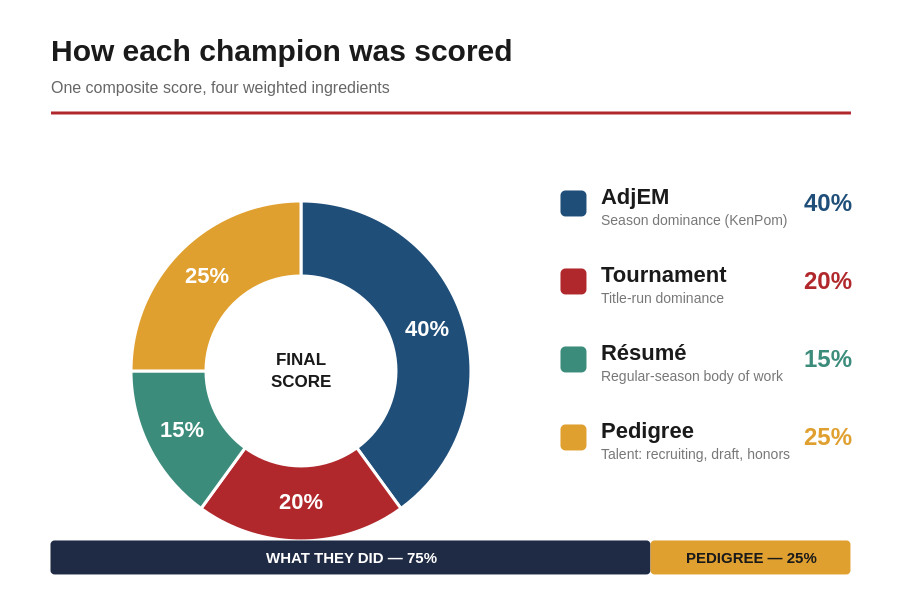
Every contender was graded on four pillars. The backbone is KenPom's adjusted efficiency margin, the gold-standard measure of how dominant a team actually was per possession, adjusted for competition. From there, we layered in regular-season résumé — ranked wins, conference titles, strength of schedule, seeding — then contextualized tournament performance, which here measures how deep a team advanced and how dominant it looked getting there, capped below what a champion earns. Finally, pedigree: recruiting, NBA draft capital, and national honors.
Because this is an all-time list and KenPom's data only goes back to 1997, the pre-KenPom teams on this list are graded on a documented efficiency proxy and flagged with an asterisk; the other three pillars span eras just fine. And yes, the top of the list skews toward the recent, partly because efficiency numbers have crept up across the sport over the past two seasons. The tournament and pedigree pillars are what keep the timeless greats in the mix.
The result is a collision of modern efficiency monsters and decades-old what-ifs. Let's count it down.
15) 2008 Memphis Tigers (38-2)
John Calipari's best Memphis squad was 38-1 with the best player on the floor in freshman Derrick Rose. A 31.51 efficiency margin and the nation's most ferocious defense carried Memphis to the brink — a nine-point lead inside the final two minutes of the national championship game.
Then the free throws wouldn't fall. Mario Chalmers buried his miracle three with 2.1 seconds left, and Kansas finished the job in overtime, 75-68.
Rose went No. 1 overall in the NBA Draft that summer, and the NCAA later wiped the season from the record book. The tape says otherwise.
14) 2015 Wisconsin Badgers (36-4)
No team here has a better trophy in its case-without-a-ring: Bo Ryan's Badgers are the team that ended Kentucky's perfect season at 38-0. Wisconsin's 33.72 efficiency margin was powered by the most devastatingly efficient offense of the KenPom era — National Player of the Year Frank Kaminsky and Sam Dekker led a system that was dynamic and explosive at all three levels.
After toppling the Wildcats 71-64 in the national semifinal, the Badgers had the title in their sights, only to run cold against Duke's freshmen in a 68-63 loss. It was the second straight year they reached the Final Four and the second straight year they fell a step short.
13) 1998 North Carolina Tar Heels (34-4)
Bill Guthridge inherited the program from Dean Smith and immediately had a monster on his hands. North Carolina's 34.68 efficiency margin — second-highest of any team here that didn't reach the title game — came from a balanced roster headlined by National Player of the Year Antawn Jamison and a high-flying sophomore named Vince Carter.
The Tar Heels earned a 1-seed and rolled into the Final Four as a title favorite, only to run into a Utah team that dictated the tempo from the opening tip and never let go, winning 65-59.
Jamison and Carter both went in the top five in the NBA Draft that June.
12) 2005 Illinois Fighting Illini (37-2)
Bruce Weber's Illini spent most of 2004-05 as the best team in America, ripping off 29 straight wins to open the year behind a backcourt for the ages — Deron Williams, Dee Brown, and Luther Head. A 32.68 efficiency margin and a 1-seed reflected a team built to cut down the nets.
They nearly didn't make the Final Four at all, erasing a 15-point deficit in the last four minutes against Arizona in one of the great Elite Eight comebacks ever played. The reward was a title-game date with North Carolina — 37-2 against 33-4, the season's two best teams — and the Illini fell 75-70.
Williams was the No. 3 overall pick that summer and had a successful NBA career that earned him multiple All-Star selections.
11) 1997 Kentucky Wildcats (35-5)
Sandwiched between Kentucky's 1996 and 1998 titles sits the team that nearly made it three straight — and might have been better than the 1998 group that finished the job. Rick Pitino's squad posted a 34.44 efficiency margin behind future lottery picks Ron Mercer and Derek Anderson, the latter gutting back from a midseason knee injury for the tournament.
Kentucky pressed and swarmed its way back to the national championship game, where it met an Arizona team it was favored to beat. However, UK couldn't close, falling 84-79 in overtime.
It's the rare entry overshadowed by its own program's banners. One overtime in the wrong direction was all that stood between this team and a three-peat.
10) 2025 Houston Cougars (35-5)
Now we get to the more modern entries, as a slew of teams from the last two seasons find themselves in the top 10. Again, this isn't recency bias! It is a testament to how strong the top of the sport has been over the past two seasons.
Kelvin Sampson finally got his juggernaut to the final Monday night in 2025. Houston's 36.59 efficiency margin was built on the nation's most suffocating defense — the kind that dragged Duke down in a Final Four comeback for the ages, erasing a six-point deficit in the final minute to get there.
Against Florida, the Cougars led nearly wire to wire and held Walter Clayton Jr. scoreless for 25 minutes. But they couldn't get the last stop or the last bucket, falling 65-63 after a late turnover.
After decades of Houston near-misses, none ever ended closer than this.
9) 2026 Duke Blue Devils (35-3)
Jon Scheyer's second straight dominant team had the best player in the country and earned the No. 1 overall seed. Freshman Cameron Boozer anchored Duke's 37.37 efficiency margin — the Naismith Player of the Year and the son of 2001 Duke champion Carlos Boozer — who poured in 27 points in the Elite Eight against UConn.
The Blue Devils led by 19 in the second half and looked Final Four-bound. Then it unraveled: a late Cayden Boozer turnover led to Braylon Mullins' 35-foot prayer at the buzzer for a 73-72 UConn win, marking the second-largest Elite Eight comeback ever.
It was the second straight year Scheyer's loaded roster came up short of a national championship. A March problem, fairly or not, is the narrative starting to follow this program.
8) 1983 Houston Cougars (31-3)*
Phi Slama Jama became a cultural phenomenon without ever winning the thing. The Cougars dunked on everyone, lost just twice in the regular season, and reached the national championship game as overwhelming favorites behind two future Hall of Famers — Clyde Drexler and Akeem (later Hakeem) Olajuwon.
By documented efficiency proxy, this was one of the most dominant teams of its era, which is why it grades here despite predating the KenPom record. But in the title game, Jim Valvano's NC State hung around, Drexler battled foul trouble, and Lorenzo Charles caught Dereck Whittenburg's airball and dunked it at the buzzer, giving the Wolfpack the 54-52 victory.
Olajuwon was named the Final Four's Most Outstanding Player anyway — still the last player from a losing team to win it.
7) 2026 Arizona Wildcats (36-3)
The highest-rated team on the list from last season, Arizona got a high score despite getting shellacked by Michigan because it was the analytics darling of 2026 — a 38.06 efficiency margin, third-highest of any non-champion in the KenPom era, built on a bruising bullyball identity. Arizona started 23-0, swept the Big 12 titles, earned a 1-seed, and reached its first Final Four in 25 years, with Tommy Lloyd being named Naismith Coach of the Year.
But in that game against the Wolverines, its stout defense was dominated by Elliot Cadeau and Aday Mara, while Big 12 Player of the Year Jaden Bradley was limited by foul trouble.
The result was a 91-73 rout that didn't even seem that close, as Michigan led by as many as 30 points. It is one of the worst Final Four losses a 1-seed has ever absorbed.
6) 2021 Gonzaga Bulldogs (31-1)
Mark Few's Bulldogs spent the season chasing the first undefeated title since 1976. Gonzaga's 36.48 efficiency margin paired the nation's best offense with enough defense to win every which way, and Jalen Suggs, Corey Kispert, and Drew Timme made it look effortless.
The signature moment was Suggs' banked-in 40-footer at the overtime buzzer to beat UCLA in an instant classic Final Four matchup.
Then the clock struck midnight: Baylor punched the 31-0 Zags in the mouth, never trailed, and rolled to an 86-70 victory in the championship game.
It remains the closest the sport's great bridesmaid program has come to a title. Thirty-one wins were supposed to end in the coronation of the power program Few built in Spokane. Instead, it was undone in one night of reckoning.
5) 1974 UCLA Bruins (26-4)*
John Wooden won 10 titles in 12 years — and this is the one that got away. Bill Walton's senior team was the only squad in Wooden's final nine seasons that didn't cut down the nets, and, by proxy, it was a juggernaut: the No. 1 team in the country by adjusted scoring margin, with a schedule ranked No. 2 in the land.
The 88-game winning streak — still the men's record — was snapped at Notre Dame in January, but the Bruins were 26-4 and the prohibitive favorite to win their eighth straight title. Then came one of the cruelest semifinals ever played: UCLA blew an 11-point second-half lead, then a seven-point cushion in the second overtime, before NC State escaped 80-77.
Walton, a three-time National Player of the Year, went for 29 points and 18 rebounds in defeat. The dynasty's one unfinished masterpiece.
4) 2015 Kentucky Wildcats (38-1)
This might be the most talented team in the sport's history. John Calipari platooned two full units of future pros — Karl-Anthony Towns, Devin Booker, Willie Cauley-Stein, the Harrison twins, Trey Lyles, Tyler Ulis — and started 38-0 behind the No. 1 defense in the country and a 36.91 efficiency margin.
Kentucky was 80 minutes from the first undefeated title since 1976, and would've been the first (and only) team to go 40-0. Then Wisconsin — and only Wisconsin — solved the platoon, grinding out a 71-64 win in the national semifinal to end the perfect season.
Six Wildcats heard their names in that June draft, four in the top 13. Never has so much NBA talent been on the same roster, and this group came up just short of history.
3) 1991 UNLV Runnin' Rebels (34-1)*
This UNLV squad is the top non-Duke team on the list and the favorite answer in this debate for many. Jerry Tarkanian's defending champions returned everyone from a team that had obliterated Duke by 30 in the 1990 final, then spent the season steamrolling everyone in the sport. The Rebels were 34-0 and on a 45-game winning streak heading into the Final Four, led by a foursome of Larry Johnson, Stacey Augmon, Greg Anthony, and Anderson Hunt that overpowered everything in its path.
By proxy, the dominance is off the charts; by reputation, it's the gold standard of teams that didn't win it all. Which is what makes the ending so haunting: the same Duke team UNLV had humiliated a year earlier, shocked the unbeaten Rebels 79-77 in the national semifinal.
Larry Johnson was the National Player of the Year, yet the most dominant team of its decade failed to defend its crown.
2) 2025 Duke Blue Devils (35-4)
By raw efficiency, this is the best team in the entire column. This group of Blue Devils posted a 39.29 efficiency margin behind National Player of the Year Cooper Flagg, the No. 1 overall pick, who was flanked by fellow lottery freshmen Kon Knueppel and Khaman Maluach.
Duke swept the ACC titles, earned a 1-seed, and led Houston by six with under a minute to play in the Final Four — 40 seconds from the title game. Then a 9-0 Houston run closed it out, 70-67, and a summer of what-ifs settled over Durham.
Flagg's lone college season ended on a collapse, and his potential game-winner (game-saver, really) fell just short.
1) 1999 Duke Blue Devils (37-2)
The best team to never win a national championship isn't especially close. Mike Krzyzewski's 1999 Blue Devils posted a 43.01 efficiency margin — the highest mark of any team ever measured in the KenPom era, champion or not. It breaks the scale this system runs on.
After an early two-point loss to Cincinnati, Duke won 32 straight games, averaging nearly 92 points a night behind a roster that's almost unfair to list: National Player of the Year Elton Brand, Shane Battier, Trajan Langdon, Corey Maggette, and William Avery, with future pros coming off the bench.
The Blue Devils carried a one-point lead into halftime of the title game. Then Richard Hamilton and UConn caught fire, and the most dominant team of the modern era went home a runner-up, 77-74.
Elite on every axis this model measures, and elite by every memory of watching it. The 1999 Blue Devils ran into the one team, on the one night, that could beat them.
