

Ranking national champions is usually a fool's errand. These lists tend to boil down to vibes, recency bias, and whichever team the writer happened to grow up watching.
I wanted to do it differently, so I built a grading system to objectively rate all 26 champions since the turn of the millennium.
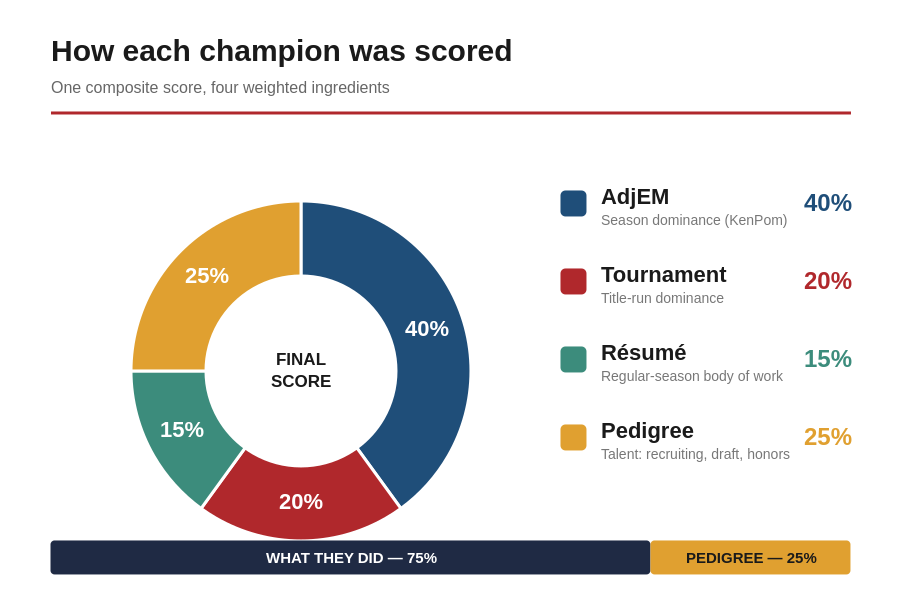
Every champion since 2000 — all 26 of them, since COVID wiped out the 2020 tournament — was graded on four pillars. The backbone is KenPom's adjusted efficiency margin, the gold-standard measure of how dominant a team actually was against its competition that season. From there, I layered in regular-season résumé: wins over ranked teams, conference regular-season and tournament titles, strength of schedule, and seeding. Then came contextualized tournament dominance, because beating a 14-seed by 20 in the first round shouldn't carry the same weight as beating a 1-seed by 20 in the Final Four. Finally, I accounted for pedigree: recruiting, NBA draft capital, and national awards won.
The result confirms a few things you thought you knew — and blows up a couple of others. Let's dig in.
26) 2014 UConn Huskies
We start at the bottom, and analytically, it isn't particularly close. Kevin Ollie's Huskies posted an adjusted efficiency margin of just 22.13, the lowest of any champion in the KenPom era. They backed into the bracket as a 7-seed — the second-worst seed ever to cut down the nets.
The profile screams fluke, but we know the tournament run says otherwise.
Shabazz Napier was magnificent, dragging UConn past Villanova, Michigan State, and a freshman-laden Kentucky in a 60-54 title-game grind. It was a guard's tournament, and Napier was the best guard in it. Still, no champion this century was a worse team across the regular season. UConn got hot at the only time that mattered — which, to be fair, is the entire point of March, especially in a season where there was no dominant team.
25) 2011 UConn Huskies
This is the other UConn outlier, and the one with the better story. Kemba Walker authored one of the great individual runs the sport has ever seen, winning five games in five days to claim the Big East Tournament title before steering a flawed roster through six more in the Big Dance.
The numbers never bought it — a 23.93 efficiency margin and 9-9 record in conference play are not championship markers. The title game was an outright eyesore, a 53-41 slog in which Butler shot a record-low 18.8 percent. But Jim Calhoun's group had Kemba, and for a month, that was enough.
Sometimes one player wills a team to incredible heights, and this remains the cleanest example of it we have.
24) 2003 Syracuse Orange
Jim Boeheim waited his entire career for a title, and a freshman delivered it. Carmelo Anthony was the best player in the country down the stretch, and the 2-3 zone smothered everyone in Syracuse's path to an 81-78 win over Kansas — sealed when Hakim Warrick came flying out of nowhere to swat a potential game-tying three from Michael Lee at the buzzer.
The advanced metrics are unkind here; a 23.28 efficiency margin is the third-lowest on this list, reflecting a young team that wasn't truly dominant until the bracket arrived. But Carmelo's freshman tape still holds up, and a title is a title. This one belongs to one of the best one-and-done seasons we'll ever see.
23) 2022 Kansas Jayhawks
Bill Self's second championship will forever be remembered for one half. Down 15 to North Carolina at the break (the largest second-half deficit any team has ever erased in a national title game), the Jayhawks roared back to win 72-69 behind Ochai Agbaji, Christian Braun, and David McCormack. It was the kind of resilience that defines champions.
The full-season profile, though, was merely very good rather than great. Their 27.49 efficiency margin ranks in the bottom third of the champions listed here, which is the byproduct of a team that took its lumps in a brutal Big 12. Still, Kansas won the league, earned a 1-seed, and rose to the occasion when it counted most.
The Jayhawks were a worthy champion — just not a juggernaut.
22) 2017 North Carolina Tar Heels
Redemption rankings would slot this team higher. A year after losing to Villanova on Kris Jenkins' buzzer-beater, the Tar Heels returned to the title game. They refused to let it slip again, grinding past Gonzaga 71-65 in one of the uglier championship games in recent memory.
Joel Berry II, Justin Jackson, and Kennedy Meeks carried a roster built on toughness rather than pure firepower. The metrics reflect that — a 28.22 efficiency margin and seven losses point to an excellent team without ever being overwhelming. North Carolina won this title with grit and an unrelenting attack on the offensive boards.
The Heels may not have been the top team that season, but they were the final team remaining, earning it all.
21) 2002 Maryland Terrapins
This Maryland team was the crowning achievement of Gary Williams' career. It is also the champion that tends to get lost in the era's shuffle.
Juan Dixon was the engine — a do-everything guard who carried the Terrapins to a 64-52 win over Indiana and the program's first and only national title. Steve Blake, Lonny Baxter, and a young Chris Wilcox rounded out a balanced, well-coached group that earned a 1-seed and posted a respectable 29.25 efficiency margin.
There's nothing flashy in the profile and no signature blowout in the run, which is precisely why this team flies under the radar. But make no mistake: Maryland was a legitimately good basketball team that did exactly what good teams are supposed to do.
20) 2006 Florida Gators
The first chapter of the 2000s' last true dynasty. Billy Donovan's Gators weren't supposed to peak yet — Joakim Noah, Al Horford, Corey Brewer, and Taurean Green were sophomores and juniors who could've turned pro but chose to chase something bigger. They dismantled the field, capping it with a 73-57 demolition of UCLA in which Noah was the best player on the floor.
The 28.28 efficiency margin undersells a group still rounding into its final form, and the tournament run was genuinely dominant. This was a team ahead of schedule, full of future pros who enjoyed playing together. The sequel, as we'll see, was even better.
19) 2004 UConn Huskies
The 2004 UConn team was a tale of two stars and the two-way force at the center of it.
Emeka Okafor was a defensive monster and the Most Outstanding Player; Ben Gordon was the bucket-getter who made everything go. Both went in the top three of that summer's draft, and Jim Calhoun's Huskies handled Georgia Tech 82-73 to finish it off. The 28.3 efficiency margin is modest by champion standards, but the top-end talent and NBA pedigree here were considerable.
One more wrinkle that makes this season unique: UConn's men and women both cut down the nets in 2004, the first time a single school pulled off that double.
18) 2023 UConn Huskies
Here's where the system and the eye test wage perhaps their biggest debate.
Dan Hurley's first champion had eight losses, finished fourth in the Big East, and entered the NCAA Tournament as a 4-seed — a 29.86 efficiency margin that doesn't sniff the top tier.
Then the tournament started, and the Huskies became the most dominant bracket force we've seen, winning all six games by double digits at an average margin of roughly 20 points. "They had their way with the entire field," San Diego State coach Brian Dutcher said after the 76-59 title-game loss.
UConn was a perfect 17-0 in non-conference games that season, but a 13-7 mark in Big East play (including a stretch when the Huskies went 2-6) kept this from being a truly dominant season.
17) 2010 Duke Blue Devils
Quietly, this group was one of the most efficient teams Mike Krzyzewski ever assembled. Their 33.29 efficiency margin ranks comfortably in the top half of the teams ranked here, driven by elite offense and a swarming defense.
It's also the least heralded of Coach K's titles, won by a roster of glue guys rather than lottery picks: Jon Scheyer, Kyle Singler, Nolan Smith, and the offensive-rebounding specialist Brian Zoubek. The lasting image is Gordon Hayward's half-court heave rimming out at the buzzer, preserving a 61-59 win over Butler in one of the great what-if moments in tournament history.
This team gets overlooked because it lacked star power, but the numbers insist it shouldn't be.
16) 2019 Virginia Cavaliers
This Virginia team went through the ultimate redemption arc, but serious numbers back its dominance.
One year after becoming the first 1-seed ever to lose to a 16-seed, Tony Bennett's Cavaliers posted a monster 34.22 efficiency margin — fourth-best among the champions we measured — and refused to break no matter how dire it got. They survived a near-collapse against Gardner-Webb, a Mamadi Diakite buzzer-beater to force overtime versus Purdue, controversial late free throws against Auburn, and, finally, an 85-77 overtime classic over Texas Tech.
The run was harrowing rather than dominant, which is the only reason a team this analytically strong sits here. Still, Bennett's pack-line defense and the team's ice-cold composure gave us perhaps the best comeback story the sport has produced.
15) 2007 Florida Gators
This was the rare sequel that outdid the original. Donovan's Gators ran it back — Noah, Horford, Brewer, and Green all returning — and became the first program to repeat since Duke in 1991 and '92, handling Greg Oden and Ohio State 84-75.
Horford, Brewer, and Noah all went in the top nine of the ensuing draft, a staggering concentration of frontcourt talent. The 30.81 efficiency margin slightly trails the 2006 version, but this team was more polished, more battle-tested, and more decorated. Repeating is the hardest thing to do in this sport, and Florida made it look routine.
14) 2013 Louisville Cardinals
On the floor, this was a genuinely elite team — a 32.92 efficiency margin powered by Rick Pitino's relentless full-court press and the nation's No. 1 defense. Russ Smith and Peyton Siva applied 94 feet of pressure, Gorgui Dieng anchored the back line, and reserve Luke Hancock became the first non-starter ever named Most Outstanding Player in the 82-76 win over Michigan.
The run is also seared into memory by Kevin Ware's gruesome leg injury, which galvanized the group. The asterisk is unavoidable: the NCAA later vacated this title amid a recruiting scandal, making Louisville the first college hoops program ever stripped of a championship. In the record book, it didn't happen. On the court, it was one of the era's best.
13) 2016 Villanova Wildcats
This group owns the single greatest ending in title-game history — Kris Jenkins' buzzer-beating three to topple North Carolina 77-74, moments after Marcus Paige's own miracle had tied it. But don't let the dramatic finish fool you into thinking this was a lucky champion.
Jay Wright's first title team posted a 32.01 efficiency margin and obliterated Buddy Hield's Oklahoma by 44 in the national semifinal, the most lopsided Final Four game ever played. Ryan Arcidiacono, Josh Hart, and Daniel Ochefu led a team that shared the ball beautifully and defended with discipline. Villanova didn't sneak up on anyone — it blew the doors off the bracket and then made the most iconic shot we've ever seen for good measure.
12) 2000 Michigan State Spartans
Tom Izzo's lone national title was won the way every Izzo team is built to win: with toughness, rebounding, and a senior point guard who refused to lose.
Mateen Cleaves was the heart and soul, the Most Outstanding Player who willed the Spartans past Florida 89-76 with the "Flintstones" backcourt humming. A 33.61 efficiency margin lands this team in the upper third of this group, and the roster was sneakily loaded — future pros Morris Peterson, Jason Richardson, and Zach Randolph all wore green that season.
Michigan State played bully ball before it was fashionable, dominating the glass and grinding opponents into submission. A quintessentially Izzo champion, this unit set the foundation of one of the sport's most enduring programs.
11) 2015 Duke Blue Devils
Coach K's fifth and final title was a masterclass in roster construction — three one-and-done freshmen blended seamlessly with battle-tested veterans.
Jahlil Okafor, Justise Winslow, and Tyus Jones brought the upside; Quinn Cook brought the steadiness; and a freshman named Grayson Allen brought the second-half spark that beat Wisconsin 68-63 in the final. Duke ranked third nationally in adjusted efficiency that season, behind only an undefeated-until-the-end Kentucky and Wisconsin's generational offense — and the Blue Devils handled that Badger team twice.
A 32.48 efficiency margin and a roster brimming with NBA talent make this one of the most complete champions of the decade, and it was arguably the best blend of youth and experience this era had to offer.
10) 2021 Baylor Bears
Scott Drew's first title didn't just end Gonzaga's perfect season — it ended it emphatically, an 86-70 demolition of a 31-0 juggernaut that was supposed to be a coronation. Instead, Baylor's guards turned it into a clinic.
Jared Butler, Davion Mitchell, and MaCio Teague were relentless, and Mitchell's on-ball defense was so suffocating that he was nicknamed "Off Night." A 33.87 efficiency margin ranks among the era's best, and the tournament run was a steamroller. This was a guard-driven, defense-first machine that peaked at the perfect moment and dismantled the best team in the country on the biggest stage. Ending a historic unbeaten bid in a 16-point rout is about as dominant a finish as a champion can author.
Remember, Baylor's only two losses that season came on the heels of COVID going through the team. Had that not happened, the Bears might have been undefeated going into that title game against Gonzaga, too.
9) 2005 North Carolina Tar Heels
Roy Williams' first title came thanks to one of the most talent-rich rosters of the century.
Sean May was the Most Outstanding Player, but the supporting cast was absurd: Raymond Felton, Rashad McCants, and freshman Marvin Williams, who came off the bench. Four Tar Heels went in the first 14 picks of that summer's draft — a staggering concentration of NBA talent.
They beat a 37-2 Illinois team 75-70 in a title game between the two best teams in the country all year, and posted a 32.77 efficiency margin to back it up. This was a loaded, dominant, championship-or-bust group that delivered exactly what it was built to deliver.
8) 2025 Florida Gators
The numbers adore this team — and they should. Todd Golden's Gators posted a 36.46 efficiency margin, the third-highest among champions in the KenPom era, while navigating a historically brutal SEC.
Walter Clayton Jr. authored one of the great March runs in recent memory, becoming the first player since Larry Bird to score 30-plus in both the Elite Eight and Final Four games.
The title game was a different kind of heroics: held scoreless for 25 minutes by Houston, Clayton still made the game-saving defensive stop to preserve a 65-63 win. Florida led for just 64 seconds all night. A survival-style run is the only thing keeping this analytically elite team out of the top five, but make no mistake — this was a monster.
7) 2009 North Carolina Tar Heels
Data suggests this UNC squad put together the most dominant NCAA Tournament run of all time. The Heels won all six tournament games by double digits and led by double figures at halftime in every single one, a level of bracket dominance almost no one matches.
Tyler Hansbrough, Ty Lawson, and Wayne Ellington formed a buzzsaw offense. Still, a 31.14 efficiency margin tells the rest of the story: North Carolina owned the nation's best offense paired with a merely good defense, which is why it grades as elite rather than untouchable.
A devastating tournament team — just not, per the numbers, the most complete one.
6) 2012 Kentucky Wildcats
The gold standard of the one-and-done era, Kentucky also proved to be the rare team that won a title without needing its best player to score. Anthony Davis managed just six points in the 67-59 win over Kansas but was still dominant, stuffing the box score with 16 rebounds, six blocks, five assists, and three steals.
John Calipari sent six players to the NBA Draft from this roster, including Davis at No. 1 and Michael Kidd-Gilchrist at No. 2. The pedigree is unmatched on this list.
Interestingly, the analytics show a merely very good team — a 32.59 efficiency margin, the product of close tournament games against strong competition. The most talented champion of the century, carried here by a roster the sport may never replicate.
5) 2008 Kansas Jayhawks
Bill Self's first title was decided by one of the most famous shots in tournament history — Mario Chalmers' three with 2.1 seconds left to force overtime against a 38-2 Memphis team, the moment forever known as "Mario's Miracle."
The Jayhawks were absurdly deep and dominant all year, posting a 35.21 efficiency margin that ranks fourth among champions, with Chalmers, Brandon Rush, Darrell Arthur, Sherron Collins, and Cole Aldrich rotating through.
Kansas finished No. 1 in defensive efficiency and No. 2 in offense, the most balanced statistical profile of any champion in the KenPom era. It took a miracle to get to overtime against Derrick Rose. Everything before and after that shot was sheer, relentless quality.
4) 2018 Villanova Wildcats
This Villanova group comprised one of the most lethal offensive teams the sport has ever produced. Jay Wright's second champion in three years stretched defenses to the breaking point with elite shooting and spacing, and the tournament run was a procession — capped by Donte DiVincenzo erupting for 31 points off the bench in a 79-62 dismantling of Michigan.
Jalen Brunson won National Player of the Year, Mikal Bridges was a lottery pick, and the whole operation hummed with NBA-caliber talent and ruthless efficiency.
A 33.76 efficiency margin and a six-game run that never felt in doubt make this the more dominant of the two Villanova titles. This team didn't just win — it overwhelmed, and it did so with a beauty and balance that still holds up.
3) 2026 Michigan Wolverines
Going strictly by adjusted efficiency margin, Dusty May's Wolverines are the most dominant champion the KenPom era has ever measured. Their 39.7 rating sits atop this 26-year sample, ahead of even 2001 Duke. Michigan became the first team to ever score 90-plus in each of its first five tournament games — an offensive avalanche the likes of which March had never seen — before grinding out a 69-63 win over UConn in an uncharacteristically ugly final.
The wild part? It was built almost entirely through the transfer portal, with Yaxel Lendeborg leading the way and Elliot Cadeau named Most Outstanding Player. A sign of the changing times in college sports, this Michigan team will forever go down as one of the most dominant teams ever.
2) 2024 UConn Huskies
One of the two teams topping Michigan is this UConn team that went on the most dominant two-year stretch the modern game has seen, and the capstone was a masterpiece.
The Huskies became the first repeat champion since Florida in 2006-07 and — combining 2023 and 2024 — won 12 consecutive tournament games by double digits, a level of sustained postseason annihilation without precedent. The 2024 squad posted a 36.43 efficiency margin and steamrolled the bracket again, finishing it with a 75-60 rout of Purdue. Donovan Clingan anchored the defense, Tristen Newton ran the show, and freshman Stephon Castle was a lottery-bound spark.
As a back-to-back package, this is arguably the best the era produced. The only thing standing between UConn and the throne is the team that maxed out every single category.
1) 2001 Duke Blue Devils
When a team is elite on every axis we measured, it wins. Mike Krzyzewski's masterpiece is the only champion that checks every box — a 37.32 efficiency margin (No. 2 among champions on this list, a hair behind 2026 Michigan), a brutal schedule, and a roster stacked with two National Players of the Year on the same floor in Shane Battier and Jason Williams. Add Carlos Boozer and Mike Dunleavy Jr., and you have perhaps the most NBA-loaded lineup of the century.
The signature moment came in the national semifinal, when Duke erased a 22-point deficit against Maryland before handling Arizona 82-72 for the crown. Elite efficiency, elite pedigree, elite résumé, elite under pressure. Pick a category — this team is at or near the top of all of them.
2001 Duke is the best champion of the 21st century, and it isn't especially close.
