


“Permanent uncertainty” may seem like an apt way to describe college basketball as a whole lately, but the phrase was actually uttered by Jeff Probst a few weeks ago in the first episode of Season 51 of Survivor. Without getting too into the weeds, or rather the jungle, of Survivor, the phrase meant that competitors of the long-running reality show should expect anything at any time. College basketball fans have lived with that same permanent uncertainty the past few years. From the seismic reshuffling of conference realignment to the ongoing evolution of the transfer portal and NIL, the sport has rarely felt more unpredictable. Even the games themselves have carried a new layer of volatility.
That uncertainty has extended to the sidelines as well. The coach’s challenge is still relatively new to college basketball. Introduced at the Division I level for the 2025-26 season, the rule arrived with little precedent and even less consensus on how to use it. Coaches spent that first season essentially learning on the fly, deploying challenges at wildly different moments and with wildly different results. Last season was the first year the rule existed at this level, meaning the math around when and how to use it is still being written.
So how well are coaches actually using it? The rule is simple enough: a head coach may challenge one reviewable call per game, things like out-of-bounds rulings, goaltending, or whether a secondary defender was in the restricted-area arc. If the challenge is successful, the call is overturned and the coach retains their timeout and may challenge again. If it fails, the timeout is charged to the team and the ability to challenge is gone for the rest of the game. That cost, surrendering a timeout and losing the ability to challenge again, is what makes the decision genuinely consequential. A challenge is not free. Used poorly, it can strip a team of a critical stoppage in the final minutes. Used well, it can swing a possession, flip a foul call, and shift the odds of winning.
To understand how well coaches are navigating that tradeoff, we analyzed 1,904 challenges from the 2025-26 college basketball season using win probability data, a metric that estimates a team’s likelihood of winning at any given moment in a game. By measuring the change in win probability from immediately before a challenged play to immediately after the challenge resolves, we can put a number on how much each challenge actually mattered. What we found offers a clearer picture of when challenges add value, when they don’t, and what the data suggests coaches should and shouldn’t be doing with them.
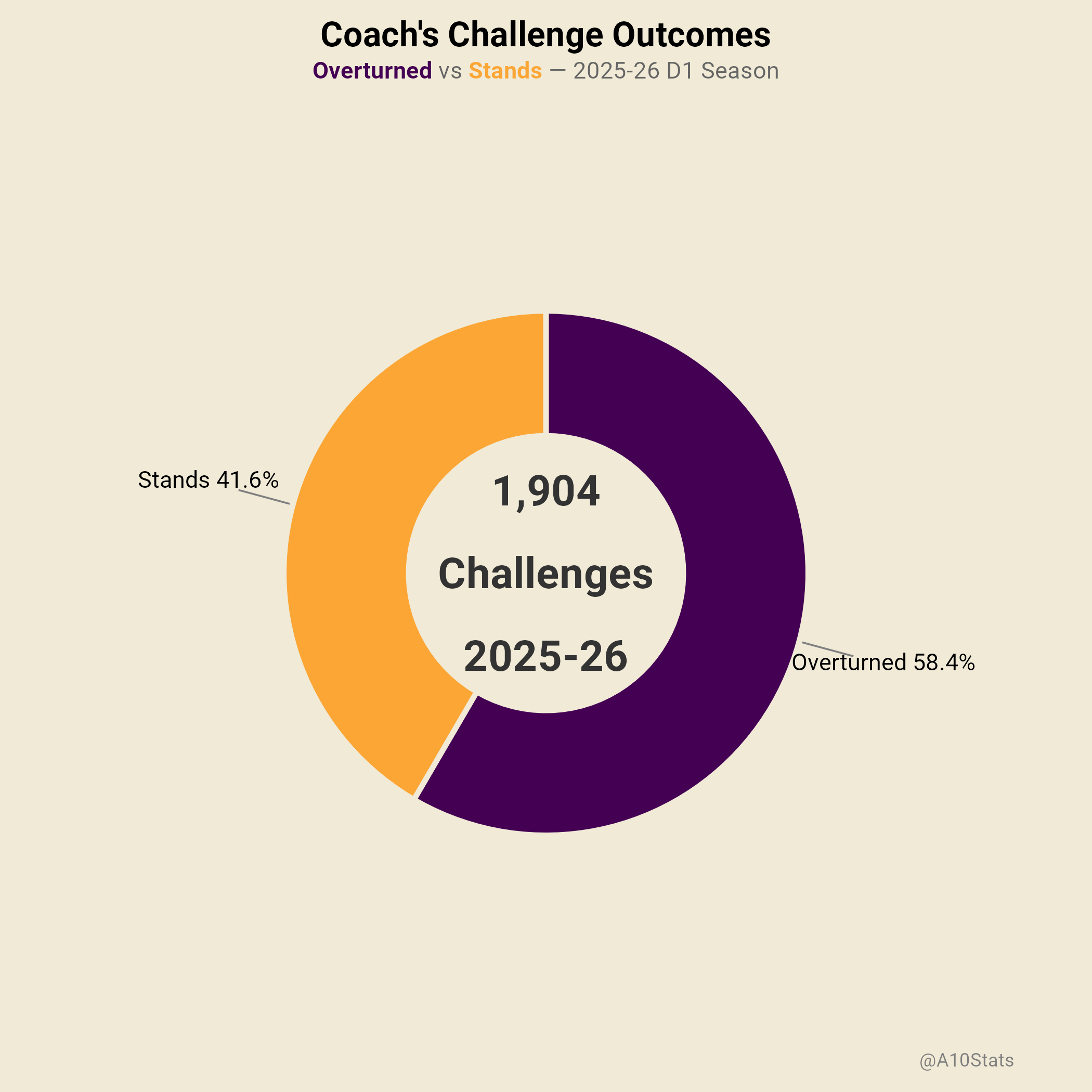
In those 1,904 challenges last season, D1 coaches won 1,112 of them, good for a 58.4% success rate. That’s actually a reasonably healthy clip. If you translated that win percentage to shooting, it would be higher than what Cam Boozer and Caleb Wilson shot last season. We can all picture coaches making the challenge signal with their hands while viewers at home can clearly see the ref got it right, but perhaps coaches were more disciplined than that narrative suggests. Still, losing four out of ten challenges is no small thing when a timeout is the price of being wrong.
Averaging out the win probability won and lost across all challenges last season, a successful challenge netted a team a 0.74% increase in win probability on average, while an unsuccessful one decreased win probability by just 0.03%. The asymmetry here is noticeable. Winning a challenge added roughly 25 times more win probability than losing one cost. On the surface, that would seem to suggest coaches should challenge more aggressively. But a straight average across all game states oversimplifies things. The timing of the challenge is critical to measuring its true impact, and the same challenge made at different points in a game can be worth dramatically more, or less, than that average implies.
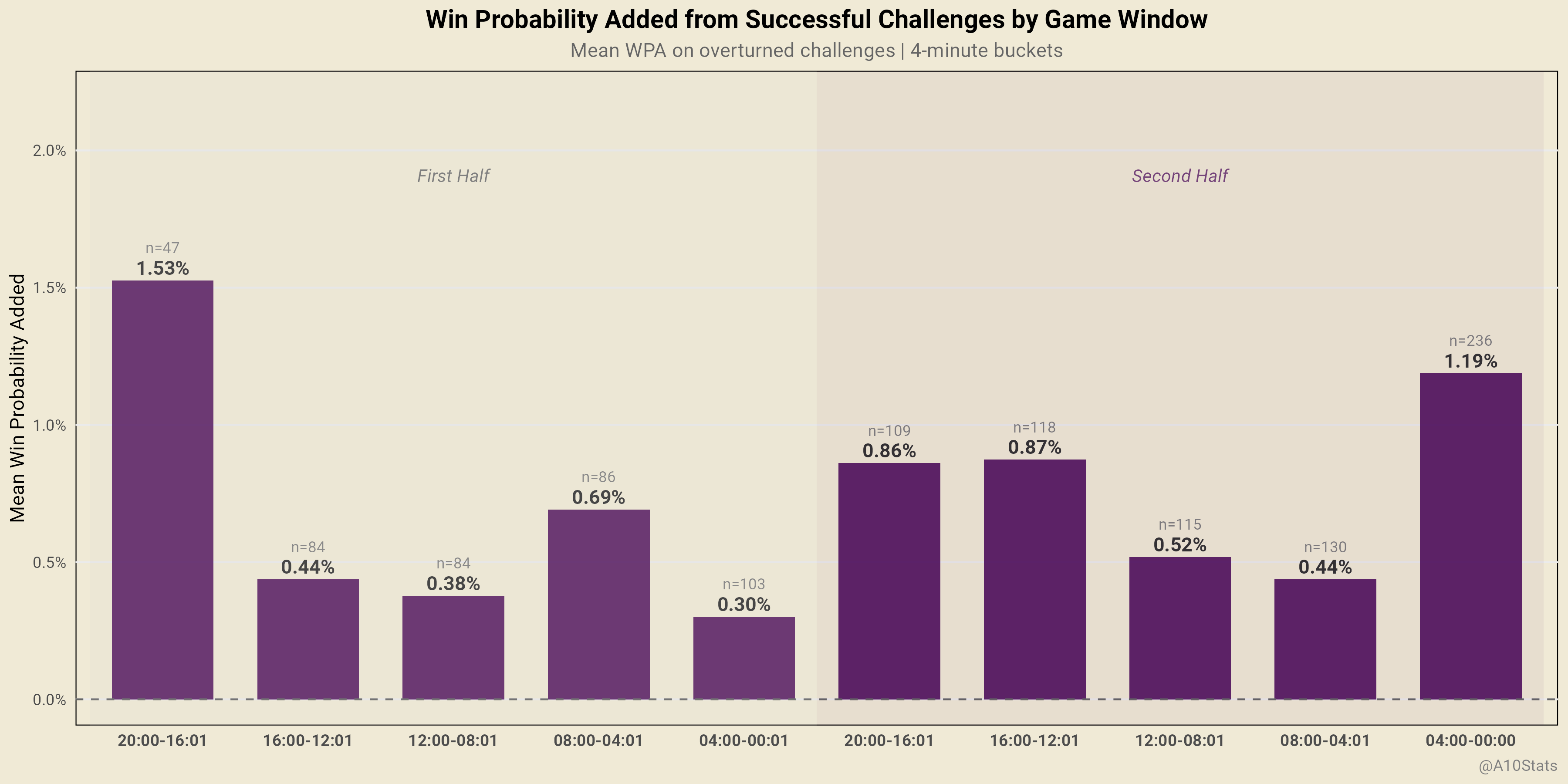
As USA Network reminds viewers during the final minutes of an Atlantic 10 game, crunch time is the most important part of the game, and the same holds true for challenges. Most challenges occurred in the final four-minute window last season, suggesting coaches could act on instinct when it mattered most. Winning a challenge in that window added over 1% to a team’s win probability on average. The only other time window that averaged more win probability added per successful challenge was the first four minutes of the game, though that window saw 384 fewer challenges, so some small-sample skew may be at play. Winning a challenge in the last four minutes of a game is one of the most direct contributions a coach can make, and it's worth protecting that chip when the game is on the line.
The natural instinct is to evaluate coaches by their challenge win percentage. A handful of coaches went perfect last season, including Jai Lucas at Miami and Steve Forbes at Wake Forest. Winning challenges is good, but winning the right challenges is what matters. Of the seven D1 men’s coaches with a 100% challenge win percentage last season, only UC Davis’ Jim Les added double-digit win probability over the course of the season.
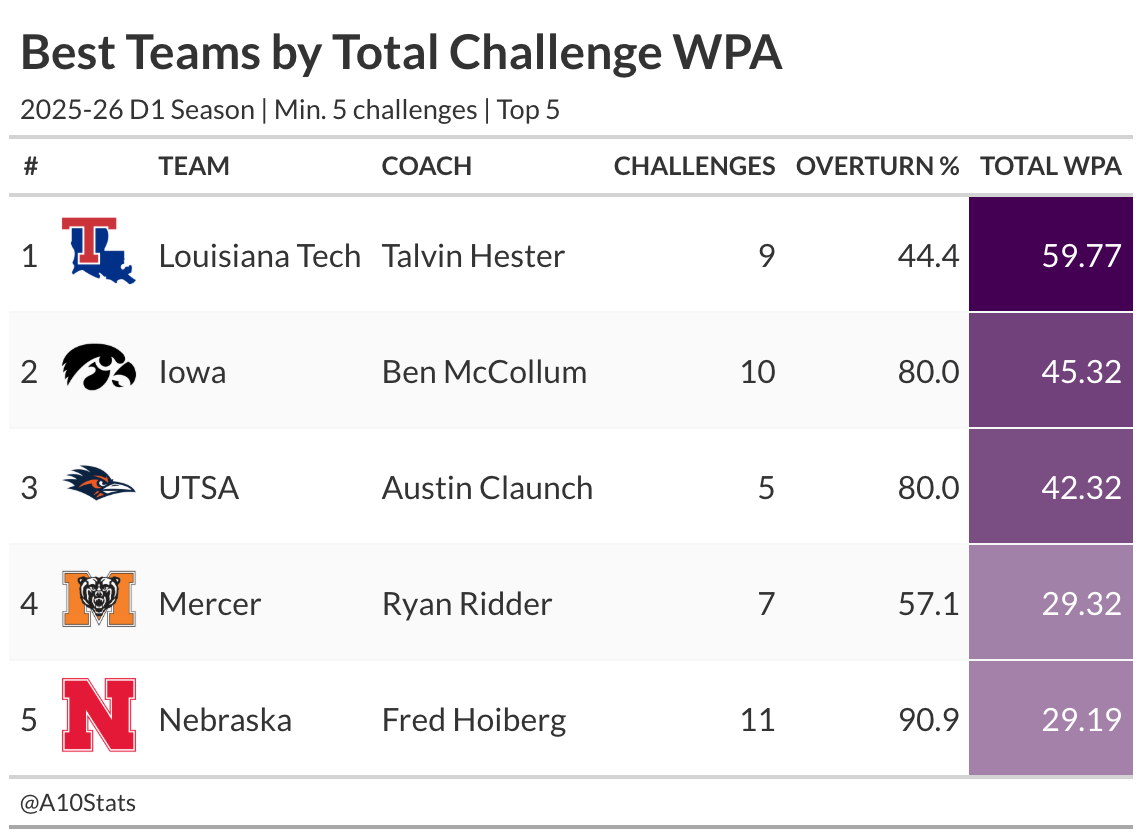
So rather than looking at who won the most challenges, we can examine who actually added the most value. Last season, Talvin Hester of Louisiana Tech led the country in challenge Win Probability Added, adding nearly a sixth of a win despite winning just 44% of his challenges. Almost 40% of that WPA added came in Tech’s January 15th game hosting Middle Tennessee. The Bulldogs were down one with 37 seconds to go, got a stop, but the ball went out of bounds and officials initially awarded possession to MTSU. Hester challenged, got the call overturned, and the Bulldogs hit a three on the ensuing possession to win the game. That challenge moved Louisiana Tech’s win probability from 15.72% to 55.54%, a reminder of what it means to have a late challenge still in your pocket in a close game.
Names like Ben McCollum and Fred Hoiberg appearing near the top of that WPA leaderboard may not come as a surprise, but one name that might raise an eyebrow is Austin Claunch of UTSA. The Roadrunners won just five games last season, which is not a resume that usually invites close analytical inspection. But Claunch won 80% of his challenges and added 42.32% in WPA. In a season with almost nothing to celebrate, his challenge on an out-of-bounds play against Charlotte, up three on the road with 3:38 remaining, contributed to over 6% of the Roadrunners’ total win probability across the entire season.
A season in, the coach’s challenge is still finding its identity in college basketball. Last season's data tells a story that is both encouraging and instructive. Coaches win more than half their challenges, and the ones that get overturned make a real difference. But the value is not evenly distributed. A challenge burned early in a low-leverage moment is a resource that cannot be recovered, and the data shows just how disproportionately valuable those late challenges can be.
What separates the coaches at the top of the WPA leaderboard is not always a high win percentage. It is situational awareness and occasionally a bit of luck. Hester’s Louisiana Tech challenge changed the game's outcome. Claunch’s challenges were a rare bright spot in an otherwise difficult season. The coaches who figure out how to be in those moments, timeout intact, challenge available, game on the line, will have an edge.
Permanent uncertainty is the right framing for college basketball right now. But for coaches who learn to use the challenge wisely, a little bit of that uncertainty can be resolved.
