


When Dustin Kerns took over at Appalachian State in the spring of 2019, one of the first staff meetings he called had nothing to do with roster construction or ball-screen coverages.
He stood at the front of the room next to a whiteboard and asked his assistants to name every reason App State couldn't win.
The list filled up fast. The Mountaineers hadn't posted a winning season in eight years. Boone is a hard place to get to, which makes it a hard place to recruit to. App is a football school, and the basketball facilities weren't close to where they needed to be. The staff kept going until no one could think of another.
Then Kerns went back to the top and had the group decide, one item at a time, whether each reason was real or just an excuse. Every excuse got erased.
"By the time we were done, the board was empty," associate head coach Bob Szorc told me.
"It set the tone for what we've done here, what he's done here," assistant coach Bradley Fey added.
Seven years later, App State is the Sun Belt's most consistent winner. The Mountaineers haven't had a losing season under Kerns, and no team in the league has won more conference games since he arrived. They won the 2021 Sun Belt Tournament, then won the league outright in 2024 with a program-record 27 wins.
What they haven't done is get back to the NCAA Tournament. App's only appearance under Kerns ended in the 2021 First Four with a 54-53 loss to Norfolk State.
The question now is how to get back. Kerns' answer starts with the one thing he won't change.
"Our staff and players change, but our identity can't change," Kerns said. "I think the key is keeping our identity while finding ways to get better where we need to."

I spent two days in Boone with Kerns and his staff, and the visit started in his office. It has three whiteboards, and each one is full.
Seven neat, separate stacks of paper sit on his desk. He keeps a large notepad for big-picture tasks and a smaller one for reminders, plus two massive notebooks he works from all year — one for the season, one for scouting.
"I can't be successful if I'm not organized," he said.
The biggest thing he has framed is a photo from December 2023, taken after App beat Auburn in front of a sellout crowd at the Holmes Center. It shows his players, the court, and the fans getting ready to pour onto it.
It isn’t the only picture of that night, either. Kerns’ office holds plenty of artwork from his two children, and some of their drawings are of the same game: App beating Auburn.
Auburn went on to win the SEC Tournament that season. After the game, Kerns recalled that athletic director Doug Gillin asked him during his job interview how he planned to change the perception of Appalachian State basketball. He said he believed it had "officially changed."
That perception didn't change overnight. Some of what was on that first whiteboard took years to turn into strengths, and that afternoon's tour covered most of them.
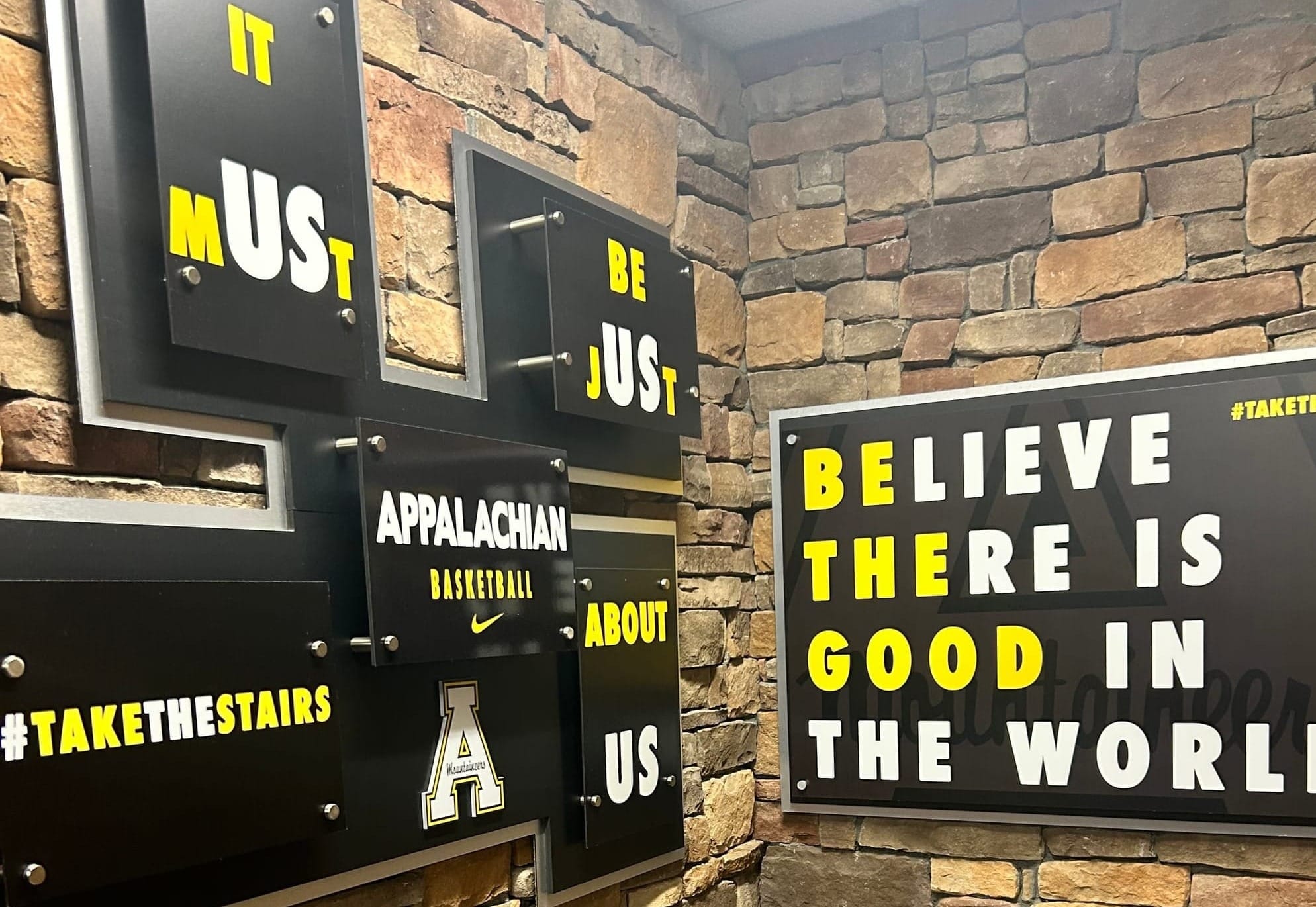
The losing went first. Kerns won 18 games in Year 1, the most by a first-year App coach since 1942. Facilities took longer. The Mark E. Harrill Basketball Practice Facility opened in 2020, giving the basketball and volleyball programs their own gym instead of splitting time at the Holmes Center. The men's basketball offices are brand-new, and core values and motivational reminders cover nearly every wall.
The Holmes Center itself has become one of the league's toughest places to play. App is 76-29 there under Kerns and has won at least 10 home games in five straight seasons, a first for the program in the Division I era.
Kerns' next stop was a meeting with freshman guard Jonathan Moss, and it ran straight into a phone call with Scott Cross.
Cross left Troy for Georgia Tech in March after winning back-to-back Sun Belt titles. He and Kerns both took over their programs in 2019 and spent seven seasons game-planning against each other. Kerns had noticed a defensive detail Cross' Troy teams did well, and he wanted to ask about it directly.
Cross is the latest Sun Belt coach to move up. Mark Byington took James Madison to 32 wins and an NCAA Tournament victory in 2024, then left for Vanderbilt. Bryan Hodgson won a share of the league title at Arkansas State in 2025, took the South Florida job, and was hired by Providence a year later. Each move came right after a breakthrough season.
App's players have left, too. After the 2024 title, eight Mountaineers entered the transfer portal, including first-team All-Sun Belt forward Tre'Von Spillers and Defensive Player of the Year Justin Abson. App returned two scholarship players that next season.
This spring, Luke Wilson, the league's Defensive Player of the Year and its leader in blocks, transferred to Syracuse. He was the third App big to leave for a high-major program in three years.
Assistants have also gotten opportunities elsewhere. Tanner Smith, promoted to associate head coach a year ago, left this spring to become the head coach at West Florida. Frank Young, who spent eight seasons on Kerns' staff, became Cleveland State's associate head coach in 2025. Three of App's five assistants this season are new.
Szorc and Fey are the exceptions. Both followed Kerns from Presbyterian, and both were in the room for that first meeting.
Fey has a simple explanation for how the program keeps winning through it all.
"He's been able to stay successful because he's an avid learner," Fey said. "He's always open to new ideas and new philosophies if it will make the team and the program better. Like he says, we're married to the season's roster, not a particular system. He's only worried about what works."
Lunch was at The Mountaineer Tavern, a new restaurant that sits right next to the Holmes Center. Kerns made a point of stopping at four different tables of people he recognized, catching up with each like old buddies.
He came to Boone determined to become part of the town and to build real relationships with anyone who wanted to be close to the program. He's comfortable with basketball being the second sport at a football school, and he likes building things.
"We've been able to put our stamp on things here and really re-engaged the fan base," Kerns said over lunch. "Eight straight losing seasons at a football-first school, you have to do everything you can to draw people back in. We've done a number of things that have helped with that."
The 2023-24 team broke the Holmes Center's regular-season attendance record. Donor fatigue is real across the sport, Kerns told me this spring, but "donors never get tired of competition."
"This is my community, too," Kerns said. "These people are important to me and important to our program."
The afternoon brought a coaches meeting. The staff is high-energy and low on ego, and nobody treats the work casually.
Boone is still hard to get to, and the walk from the offices to the practice facility afterward reminded me what's at the end of the drive. Campus sits at 3,333 feet above sea level in the Blue Ridge Mountains, and every tree on the ridges around it had turned some shade of fall, red and orange and gold stacked one mountain behind the next. It was the kind of view that ends up on a postcard.
"You just can't beat the view," Szorc said when I asked why the staff chooses to make the half-mile walk every day rather than drive.
Practice ran the same way the meeting did — intense, loud, and full of accountability.
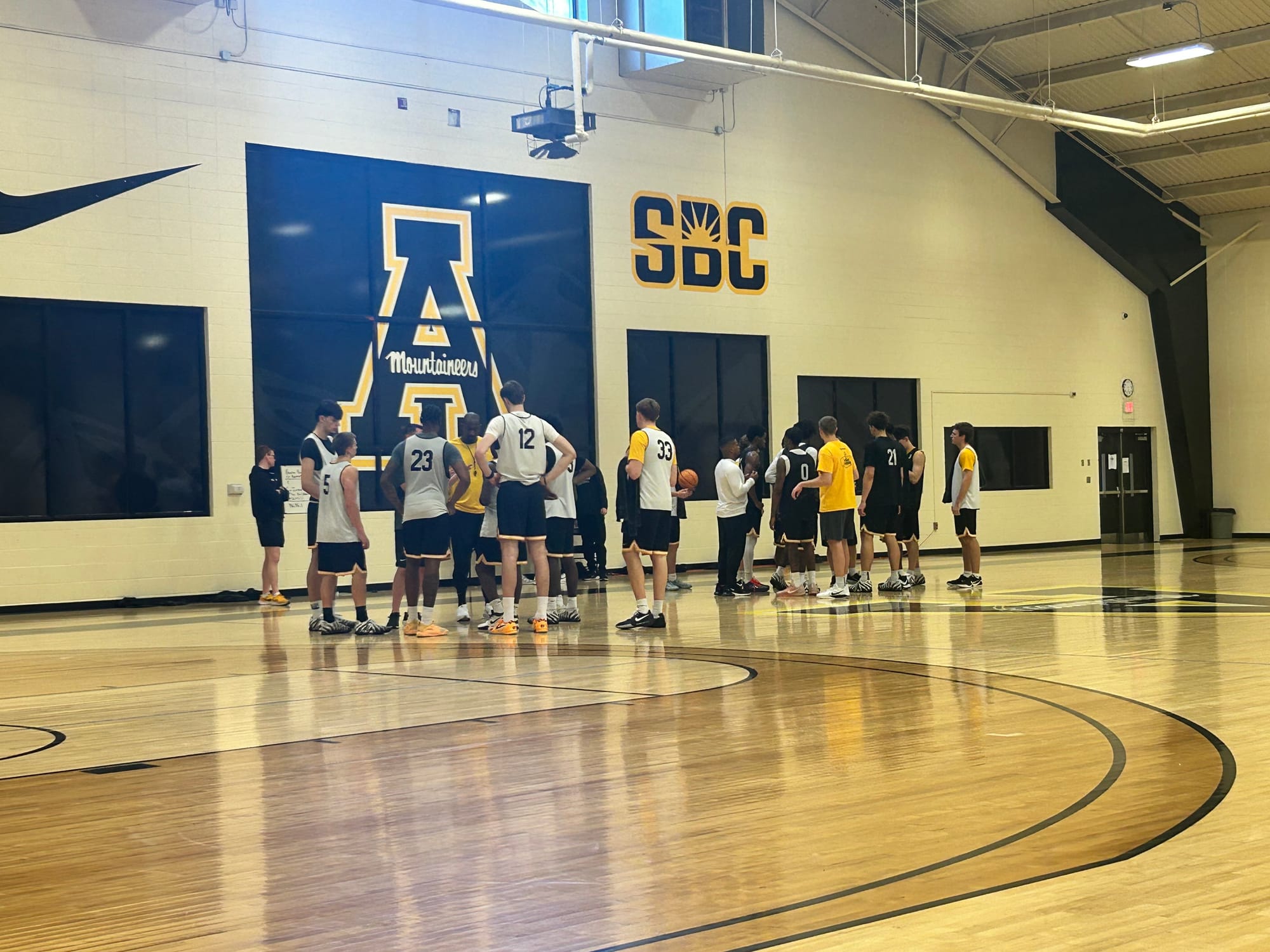
The day before I arrived, App held a practice devoted entirely to defense. The coaches set up a scoring system tilted heavily in the offense's favor — a stop was worth a third of a basket — and kept the team in the drill until the defense came out ahead. It took the whole practice.
Revamping the offense is getting most of the attention this offseason, but the defense still gets days like that because, in Kerns' program, high-level defense is non-negotiable.
That is why, despite the roster churn that is synonymous with this era of college basketball, the Mountaineers routinely have one of the best defenses in the mid-major ranks.
App has led the Sun Belt in scoring defense five straight seasons and hasn't finished outside the league's top two since Kerns and Szorc, his defensive coordinator, arrived. Even in 2024-25, with a mostly new roster, it ranked in the top 10 nationally in both field-goal percentage defense and three-point percentage defense.
Scoring defense flatters a team that plays this slowly, so efficiency numbers better show what App does well. It doesn't gamble. It plays straight up, dares opponents to execute in the half court, and takes away good shots without fouling. Its opponent effective field-goal percentage has ranked in the top 35 nationally for three straight years, including fifth in 2023-24.
The slower tempo is part of the plan. App hasn't ranked higher than 213th in adjusted tempo under Kerns and has been one of the 15 slowest teams in the country in each of the last two seasons.
"I think it's one of the reasons we've been successful in the Sun Belt, honestly," Kerns explained. "It's a tough ask for any team to consistently defend or consistently execute long half-court possessions, and we think we can get an advantage there."
While that is the bedrock of the program, this roster is pushing the offense in a new direction.
App has never finished better than 134th in KenPom's adjusted offensive efficiency metric under Kerns. The one season it reached that level, the Mountaineers won the league outright.
Last season, App took 45.9 percent of its shots from three, the 48th-highest rate in the country, but made only 30.4 percent of them, which ranked 335th.
The defense held opponents to the 33rd-lowest effective field-goal percentage in the country, and App still went 19-13, largely because its own offense kept handing games back.
Kerns' coaching background sits on the opposite end of the floor from his reputation. The Kingsport, Tennessee, native and Clemson graduate spent more than a decade as an assistant before Presbyterian gave him his first head coaching job, including six seasons at Santa Clara and two stints at Wofford.
At Presbyterian, an 11-21 debut was followed by a 20-16 season in 2018-19, the program's first winning season as a Division I member. That team made 394 threes, second nationally behind only Auburn.
The defense-first identity in Boone grew out of the rosters Kerns could build there.
This offseason, he went looking for help on the other end. He hired assistant Jonathan Mitchell away from Mercer — the same Mercer team that beat App by eight in Macon last November — to help open up the offense. The Bears went from 303rd in KenPom's adjusted offensive efficiency two seasons ago to 122nd last season and led the Southern Conference in scoring. Mitchell's influence played a massive part in that jump.
The biggest change Mitchell is bringing is more spacing. App's bigs will spend more time on the perimeter, roll into the paint, then get back out, leaving more room for the guards. The roster also has the depth to play faster than past App teams, and the coaches are comfortable letting it run when the chance is there.
The Mountaineers won't become a track team, and the half court will still be home. But for the first time in years, the staff believes App has a roster that can win a game by simply outscoring someone. Nobody wants that at the expense of the defense, however.
"It's big for a head coach to try something new like that, especially one who has had the success he has," Mitchell told me. "I think the guys are getting it down."
Fifteen players have earned All-Sun Belt honors under Kerns, and with rosters turning over so often, getting new players to buy in quickly has become part of the job. That isn't much of an issue for Kerns, though.
"His superpower is people," Szorc said. "He's great at connecting with anybody."
This year's group needed that. App has 10 newcomers, and the staff has put a lot of time into building chemistry and camaraderie away from the court.
"They've become a tight group and meshed quickly," Szorc said. "We want them to spend as much time together as they can off the court and build those relationships. That's something you'll see translate to the court."
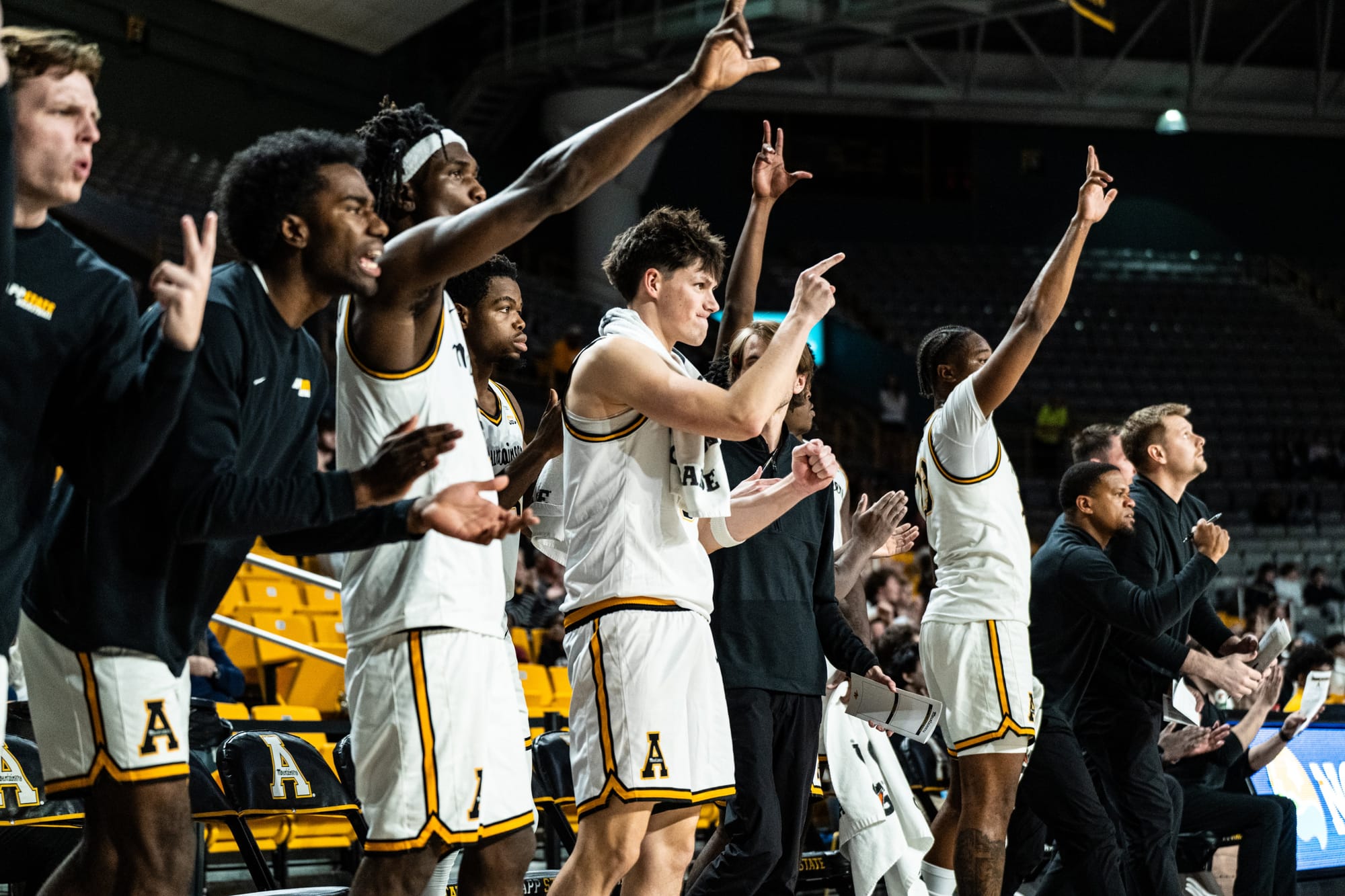
Through the two practices I saw, this group already looked connected. The shooting improvement looked real, too. App has never made much more than 34.0 percent of its threes in a season under Kerns, and its top two newcomers each made at least 37.0 percent on real volume last season.
They're replacing nearly all of last season's production. Kasen Jennings and Alonzo Dodd, both All-Sun Belt picks, are out of eligibility, while Wilson is now at Syracuse and Michael Marcus Jr. transferred to George Mason.
Ben Kopetzki looks like the offensive centerpiece. He'll start at point guard after three seasons at Division II Concordia St. Paul, and he'll likely be the team's most dynamic scorer. His shooting, feel, and IQ are all at an extremely high level, and he has a knack for finding open space and the weak spots in a defense. Last season, he led the Northern Sun in scoring at 21.1 points per game, made 38.8 percent of his threes, and scored in double figures in all 29 games.
App has seen the Division II jump work before. Jalen Tot came from Montana State Billings last season and led the Mountaineers in scoring several times during Sun Belt play.
Hermann Koffi, a transfer from Stonehill, might be the roster's most versatile player. He's a strong, athletic defender who rebounds well for a guard. He also made 78 threes last season, second-most in the NEC. Koffi saved some of his best work for bigger opponents, scoring in double figures against all three high-major teams on Stonehill's schedule, including 27 points and seven threes at DePaul.
Up front, App has size it rarely has had: Rrezon Elezaj, a 7-foot-2 transfer from UConn, and Bryan Chretien, a 7-foot freshman from France. Neither has played meaningful college minutes. The new offense needs bigs who are comfortable away from the basket, and App's best recent defenses have had a true rim anchor in Abson and Wilson. Whether one of the 7-footers can grow into that role may decide how high this team's ceiling goes.
Da'Mori Lytch, a first-team junior college All-American, is a freak athlete. KJ Vasser should carve out a solid role after missing last season with an injury.
Then there's Moss, the freshman Kerns met with that first afternoon. The Kentucky Mr. Basketball finalist scored more than 2,000 points in high school and had signed with Chattanooga before asking for his release and reopening his recruitment. He could be a future star.
Nobody outside Boone expects much from this group. The Sun Belt's coaches picked App to finish eighth in the league, and no Mountaineer made any of the three preseason all-conference teams. KenPom has App 257th nationally, its lowest preseason projection of Kerns' tenure, which makes sense for a roster whose key newcomers come from Division II, the NEC, junior college, and high school.
The Mountaineers have made a habit of beating those numbers. They finished ahead of their preseason KenPom ranking in four of Kerns' seven seasons, most notably in 2023-24, when they climbed from 121st to 83rd. Last season, the coaches picked them seventh, and they finished tied for second.
This team should be better than eighth, too. If the offense comes around and the improved shooting holds up over the regular season, App looks like a team that can win the league again.
Even then, the NCAA Tournament bid will almost certainly come down to a few days in March. The best team of Kerns' tenure went 27-7, and it lost in the Sun Belt Tournament semifinals. The one team of his that made the NCAA Tournament lost by a point.
Along with the whiteboards, the stacks of paper, and the Auburn photo, Kerns' office holds a chair from the bench of that game.
It was played on March 18, 2021, at Assembly Hall in Bloomington, the year the entire tournament was played in Indiana. App had won the Sun Belt Tournament and advanced to the NCAA Tournament. A win over Norfolk State in the First Four would have been the program's first NCAA Tournament victory and would have earned the Mountaineers a game against Gonzaga, the No. 1 overall seed.
It started about as badly as a tournament game can. App missed all 18 of its 3-point attempts in the first half and trailed by 19.
Then the defense took over. The Mountaineers held Norfolk State without a point for nearly seven minutes in the second half, blocked 10 shots—tied for the most ever in a First Four game—and led by six when Justin Forrest scored with 5:48 to play.
App's only points after that came on two Adrian Delph free throws with 1:03 left, which put it ahead 53-52. With 8.6 seconds remaining, Norfolk State's Devante Carter made two free throws at the other end. App got two looks on its final possession, a contested 3-pointer from Michael Almonacy and a last-second try from Forrest. Neither fell.
Norfolk State moved on to play Gonzaga. App is still waiting on its first NCAA Tournament win.
Szorc and Fey were on that staff, too. Five years later, the chair is still in Kerns' office, and a March Madness pull-up banner sits in the locker room, reminding everyone where the program has been and where it's trying to get back to.
Asked what would make this season a success, Kerns answered with a question of his own.
"Are we in the mix to win the league again and go to the NCAA Tournament? If the answer is yes, then I think so," Kerns said. "We want to be in position to give ourselves a chance."
