

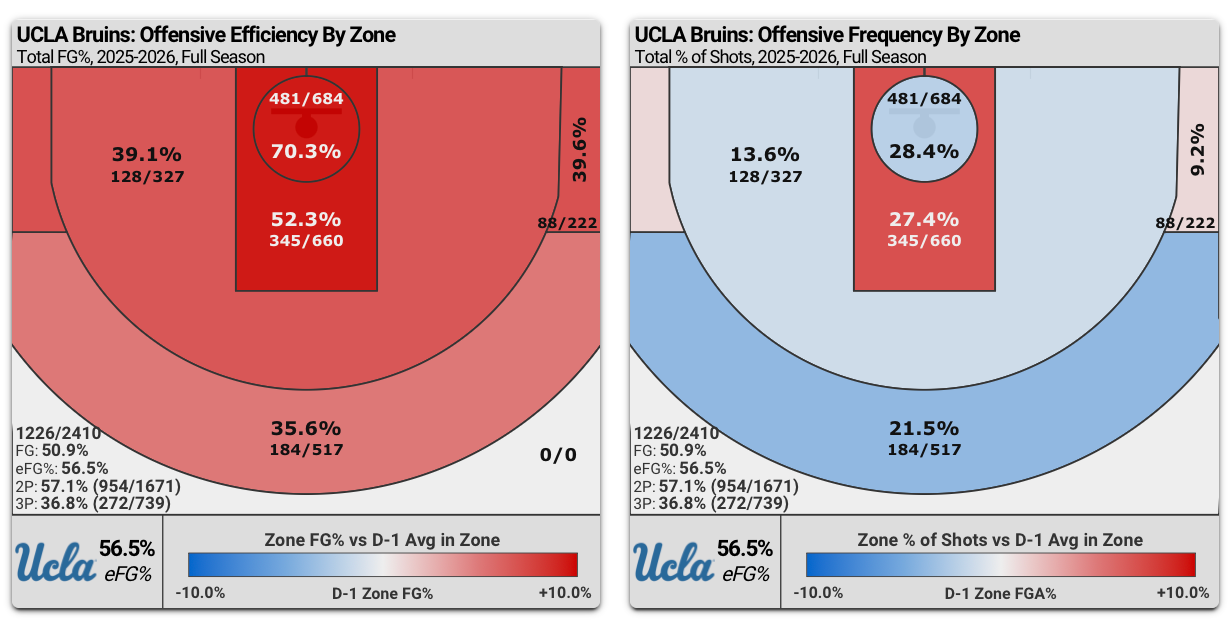
UCLA didn't just lose a group of talented players this offseason; nearly the entire group that made up the nation's best offense now plays nightly in the WNBA. The Bruins finished 2025-26 as the top adjusted offense in Division I per Bart Torvik's T-Rank, and it wasn't just because they got up and down the court in transition. UCLA got into its half-court sets and out-executed everyone, playing at an unhurried pace that had nothing to do with running teams off the floor.
It did that by pounding the rim. This was a team that got there more than nearly anyone in the country and finished at an absurd clip once it did, largely because it had a 6'7" program-altering center in Lauren Betts doing the finishing. Perimeter shooting largely complemented their post-scoring ability, and they didn't rely on shooting the ball much. But when they did shoot the ball, they were among the elite teams in the country at doing so.
That version of UCLA is gone. Betts is in the WNBA now, along with Angela Dugalić, Gabriela Jaquez, Kiki Rice, Gianna Kneepkens and Charlisse Leger-Walker, a record six Bruins off the board in a single WNBA Draft, five in the first round. Six of UCLA's top seven scorers from a national title team, gone in one night.
What's left is a five-player core that mostly watched that title run from the bench, plus a portal class Cori Close built to answer for the losses. Whether that class can replicate anything close to the best offense in the country is the whole question this season.
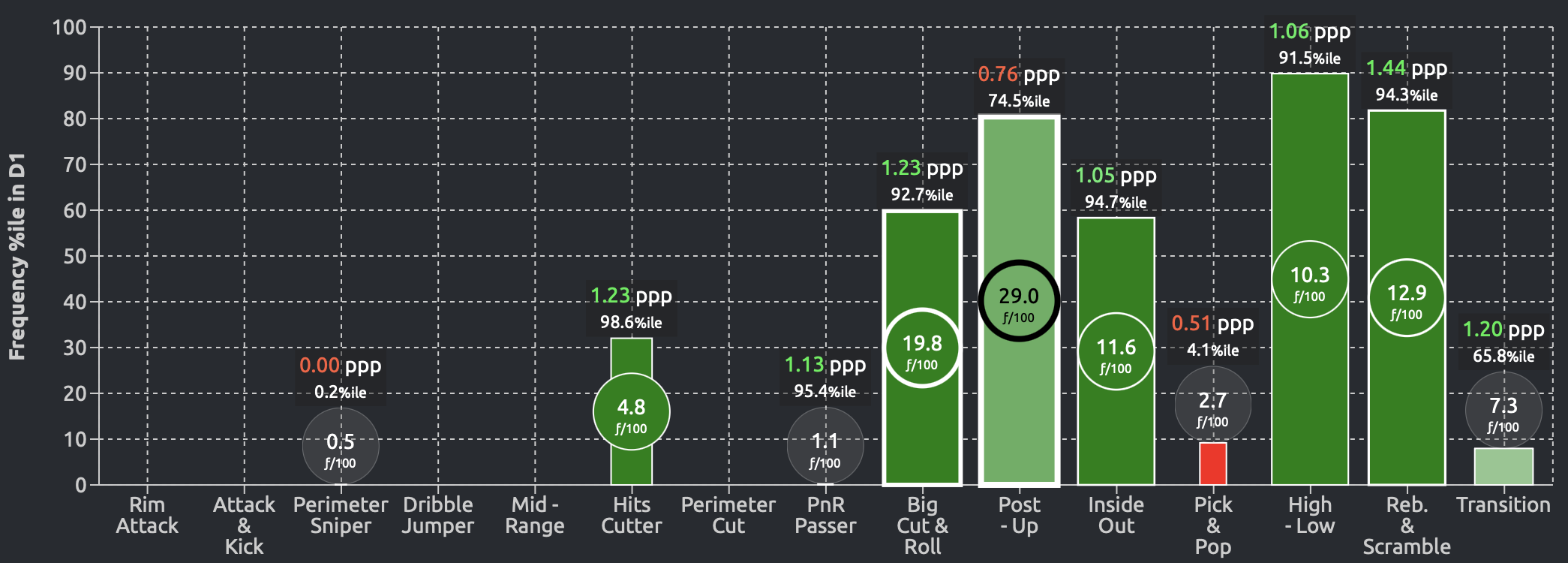
Start with Sienna Betts, who inherits both the paint and the shot profile UCLA leaned on more than any team in the country. As a freshman playing behind her sister, Betts posted a 53.8 percent true shooting mark, which landed her in the 70th percentile. This came on a usage rate in the 76th percentile while only playing 14 minutes a night. The play-type data shows how UCLA used her: 29.0 possessions per 100 came on post-ups, her least efficient action at 0.76 points per possession, which landed her in the 74th percentile. On cuts and putbacks, she was nearly automatic; she scored 1.44 points per possession on rebound-and-scramble plays and 1.23 points per possession on hard cuts. Both numbers were in the 94th percentile or better, making her one of the country's elite players in both actions.
That's a player who finishes plays rather than creates them herself, as she does a nice job of playing outside of structure. She finished with a 51.2 percent free-throw mark, which landed just inside the 16th percentile. Betts shot 76.5 percent at the rim and 65.6 percent combining rim looks and threes, but attempted only 10 shots from the perimeter and made just one. If she can push some of that post-up volume into a bigger offensive role and the free-throw shooting climbs once teams start fouling her nearly every time she gets the ball deep, she's the closest thing UCLA has to a focal point. If she continues to develop an outside shot, it can open up quite a bit of space on the offensive end of the floor for her team.
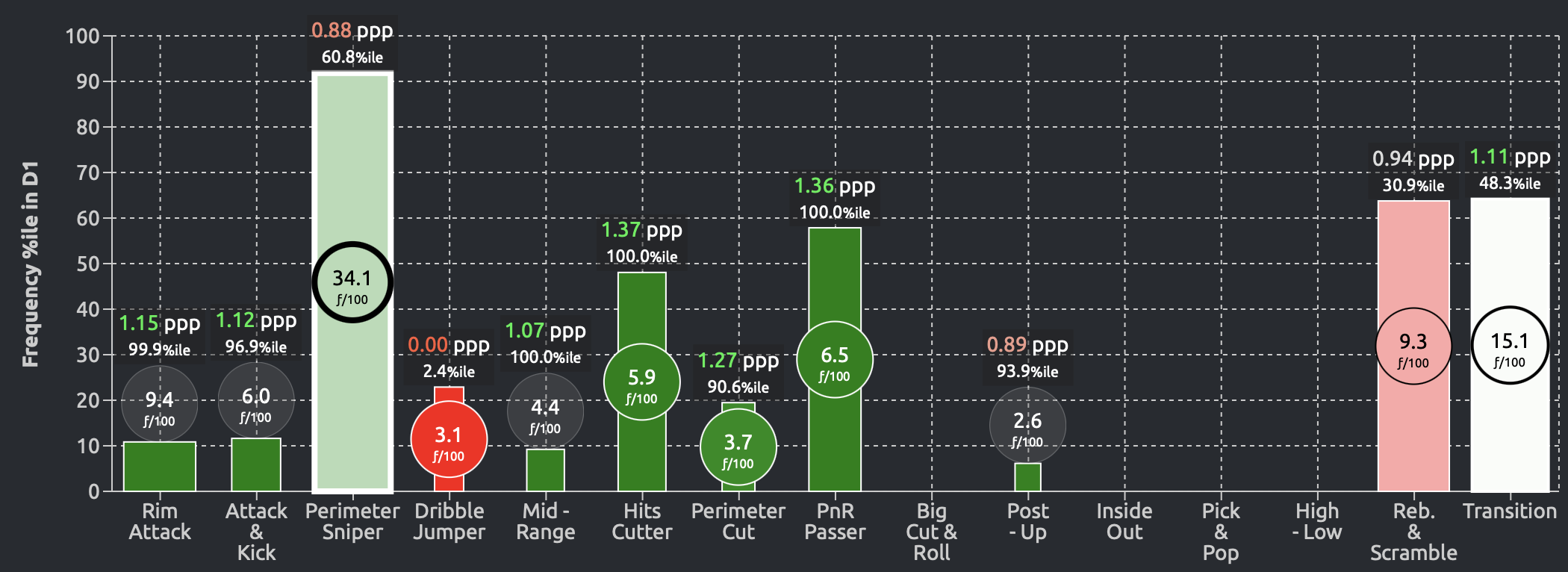
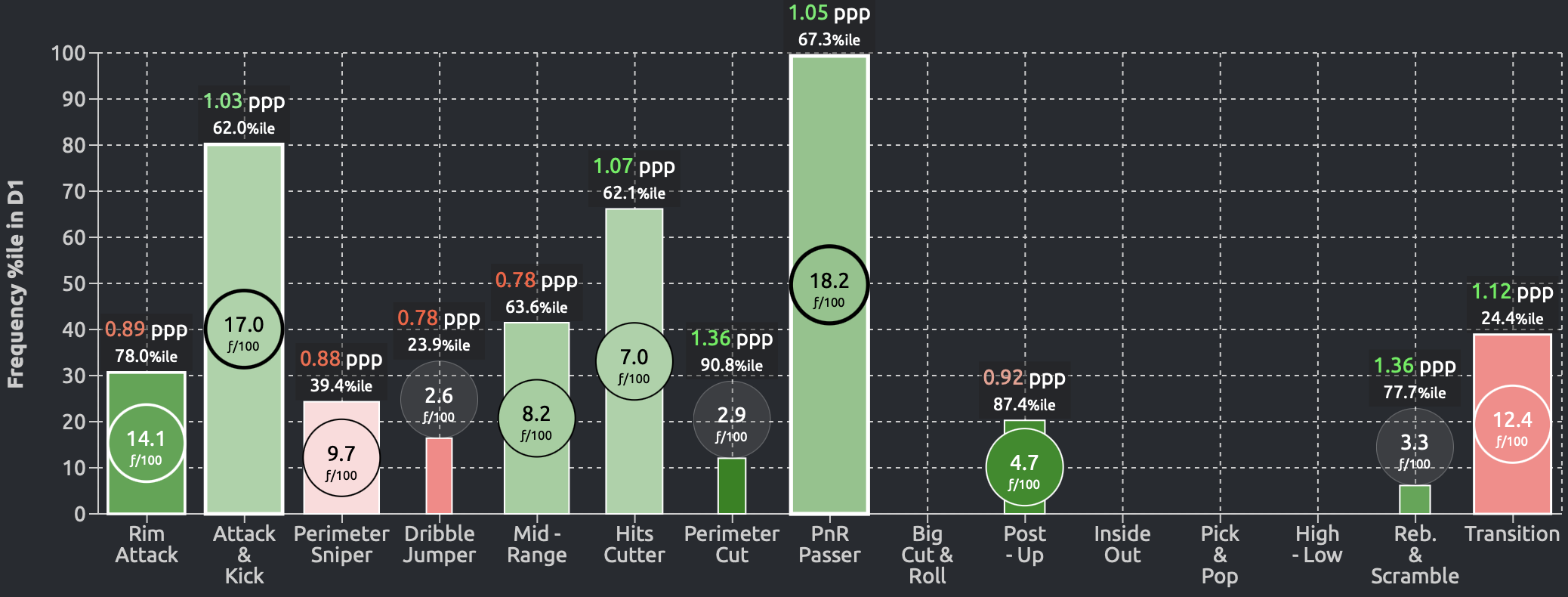
Lena Bilić's numbers are the strangest among the returners, and the play-type data shows why. As a freshman, the 6'3" guard barely touched the ball as she had a 13.6 percent usage rate, just at the 14th percentile. Even with these light touches, she was elite almost everywhere she got involved: 1.36 points per possession as a live-dribble passer, 1.37 points per possession as a cutter, and 1.15 points per possession attacking the rim off movement, all of which were in the 99th percentile or better. She also rarely turned the ball over, making her a producer everywhere on the floor.
The one action she's actually known for, catch-and-shoot threes, was by far her most frequent action, as she did it on 33.9 possessions per 100. However, it was also her least efficient, as she scored 0.88 points per possession and shot 27.4 percent. She took a high share of her looks from the corner, with 36.5 percent of her shots coming from there, but made just 30.8 percent of them. UCLA graduated a guard class loaded with shooting, and Bilić's size gives Close a guard who can defend multiple spots while spacing the floor, one of the few things that resembles last year's roster. But the leap that moves the needle isn't volume; it's becoming more efficient where she's used the most.
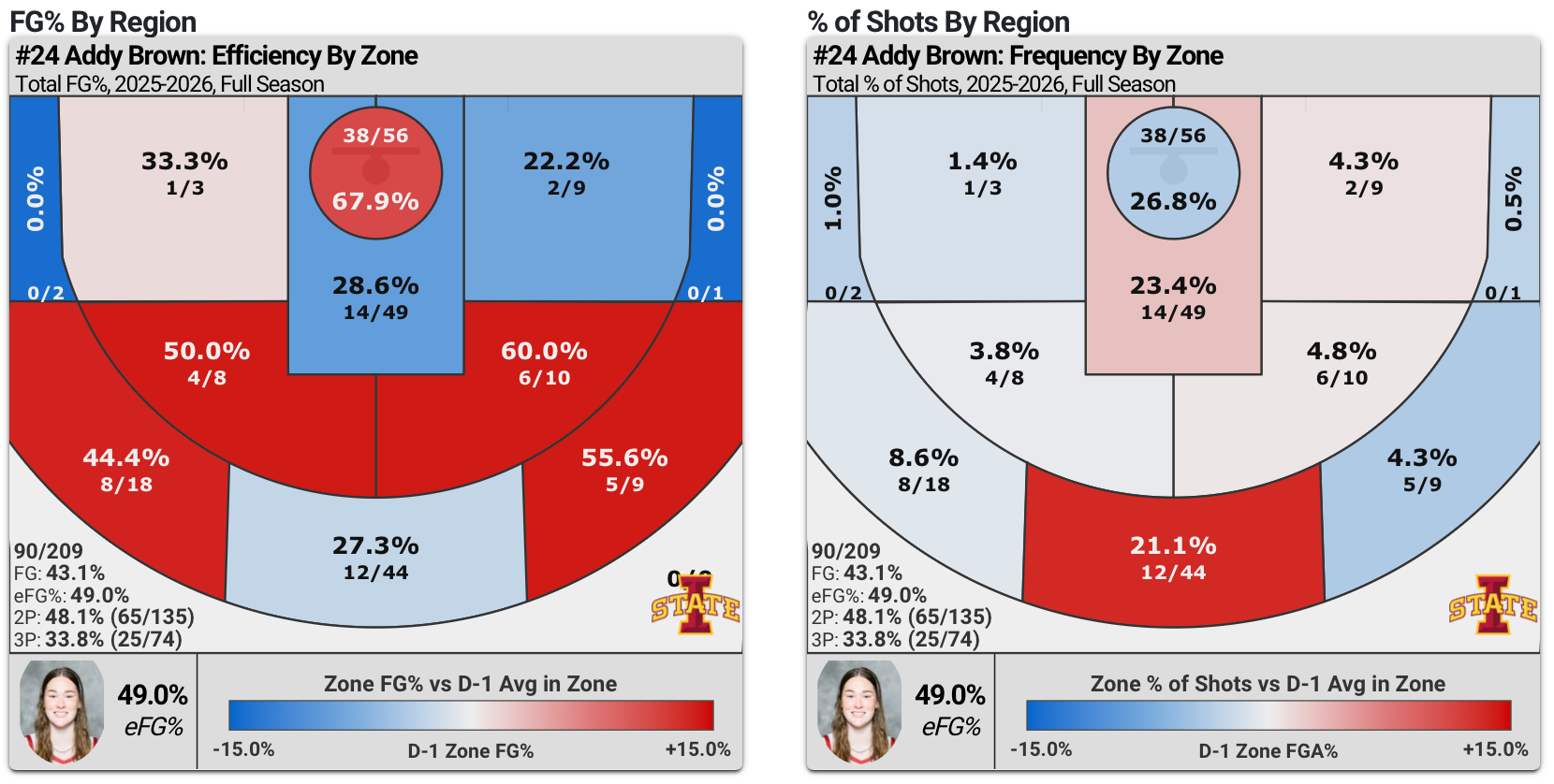
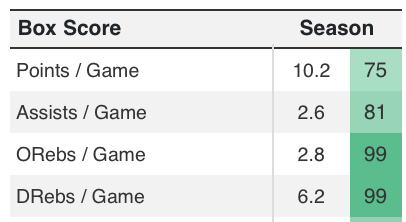
If one newcomer defines what Close actually went and got in the portal, it's Addy Brown. The Iowa State transfer was ESPN's fourth-ranked portal prospect nationally, and the numbers back it up. Her assist rate sat at the 100th percentile among forwards, 7.4 per 40 minutes, a genuinely elite number for a 6'2" player. She averaged 1.26 points per possession as a live-dribble passer out of ball screens, which was in the 99th percentile, and posted a 98th-percentile clip when she posted up.
Her efficiency held up across three years at Iowa State, not a one-year outlier; her RAPM net climbed from 7.1 as a freshman to 11.4 as a sophomore before settling at 8.5 in an injury-shortened junior year. What stands out on her shot chart is how selective she is at the rim: only 26.8 percent of her shots came there, yet she made 67.9 percent of them, which was in the 87th percentile. Her on/off is another piece that you can point to since she started all 21 games she played. Iowa State's offensive rating was 120.8 with her on and 107.2 off, a difference of 13.6 points per 100 possessions, which is a swing in the 95th percentile nationally.
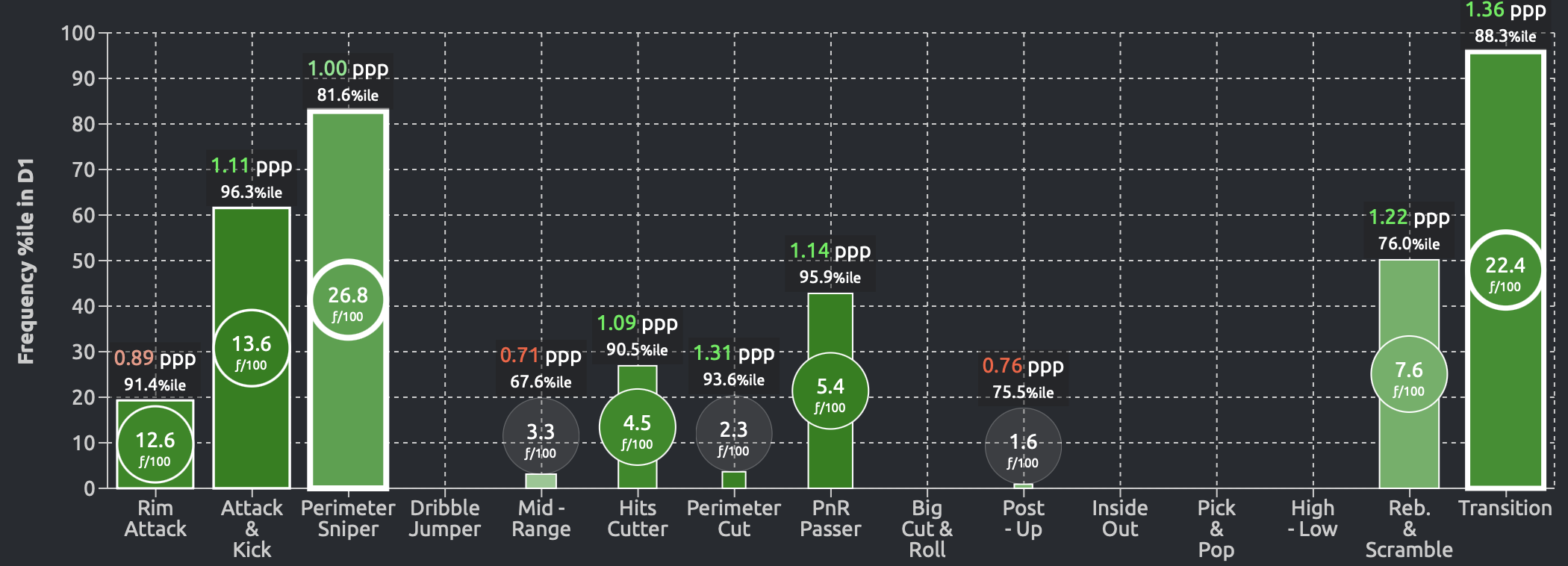
Donovyn Hunter's path to UCLA runs through two programs, and the numbers show a player whose role got more efficient every year even as usage shrank. As a junior starter at TCU, she posted a 56.5 percent true shooting mark, which was in the 91st percentile. Her usage rate was down to 15.3 percent from 17.8 percent as a freshman at Oregon State. Her game is built around movement without the ball, as her play types show. Her most frequent action was perimeter shooting, and she was efficient at 1.00 points per possession, which landed her in the 81st percentile. She was even better in transition, scoring 1.36 points per possession, which landed in the 88th percentile. She also made the Big 12 All-Defense team, which matters on a roster that just lost its Defensive Player of the Year. Her on/off at TCU was eye-opening, as the Horned Frogs' offensive rating jumped 14.1 points with her on the floor, which is exactly the plug-and-play guard Close wanted out of the portal, not just a simple shot creator.
Bonnie Deas is the wildcard to this transfer class. At 5'9", she led Arkansas in rebounding as a true freshman with a 9.7 percent offensive rebound rate, which landed inside the 97th percentile. Her defensive rebound rate was in the 99th percentile, which is an absurd mark for a guard. She struggled to score, with her true shooting at just 40.1 percent, in the 14th percentile. Her most frequent action was attacking the rim, but she scored only 0.57 points per possession. When she cut to the basket, she was in the 13th percentile, showing she did not provide much offensive value when looking to score.
The one bright spot is her work away from the ball: she scored 0.99 points per possession off attack-and-kick actions, and as a live-dribble passer, she was in the 70th percentile. With Deas, UCLA wasn't after another scorer; they were after one of the best rebounders in the game, and they'll hope her scoring efficiency improves during her time in the program.
Elina Aarnisalo is the one player in this class with real before-and-after data, since she's already played for this program. As a freshman at UCLA in 2024-25, she was used almost entirely as a distributor: her most frequent action was passing out of ball screens and her assist rate sat at the 92nd percentile, but her usage was just 15.6 percent. Her biggest struggle that first season was turning the ball over, as she sat in the 12th percentile.
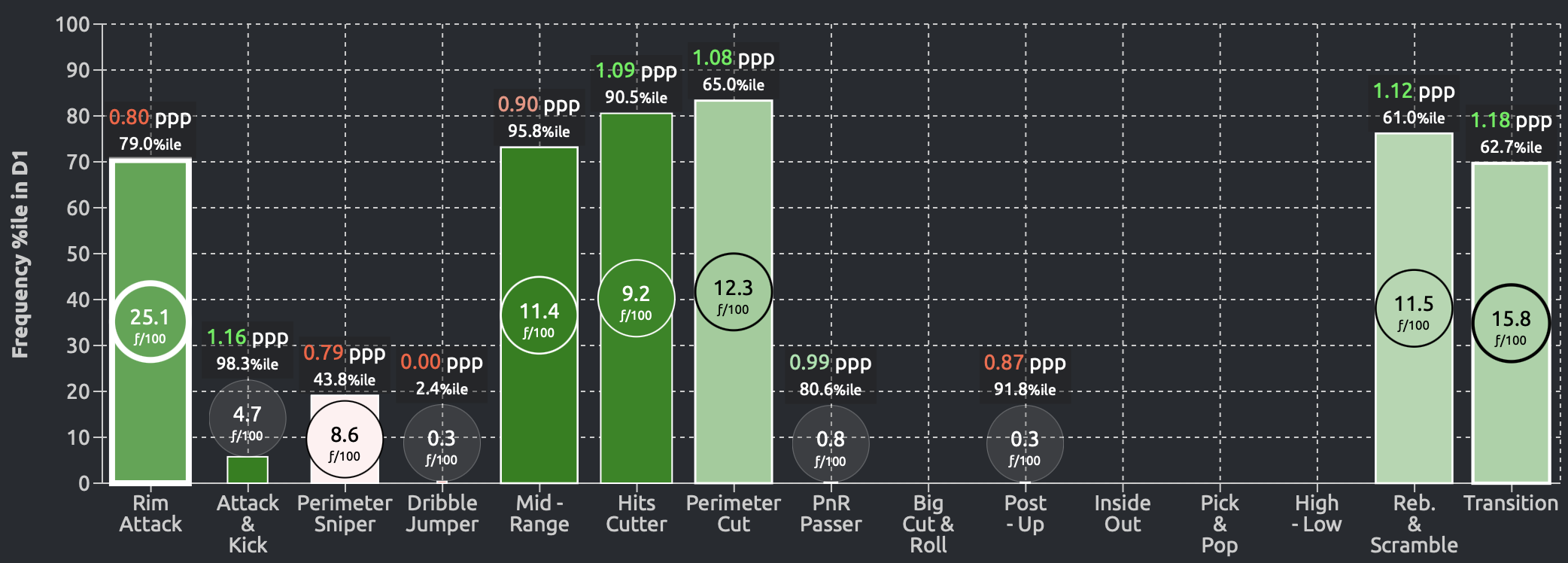
At North Carolina as a sophomore, that role flipped. Rim attacks became her most frequent action on over 25 percent of her possessions; her usage climbed to 20.8 percent, her turnovers dropped to 22.5 percent, and her true shooting jumped from 51.8 to 55.4 percent. Her assist rate, meanwhile, fell from the 92nd percentile to the 64th. She posted three 20-point games for the Tar Heels, at Virginia, against Duke, and against Maryland, and she shot 40.4 percent from three, which put her in the 94th percentile in the country. She changed her game to fit the role North Carolina asked her to play and improved in every aspect.
So which version of Aarnisalo is Close getting back? The freshman version may not give Aarnisalo the shot creation that made her so good at North Carolina. The North Carolina version is a real shift from what Close asked of her the first time, and this time, it's on a roster that badly needs shot creation now that Rice and Leger-Walker are gone.
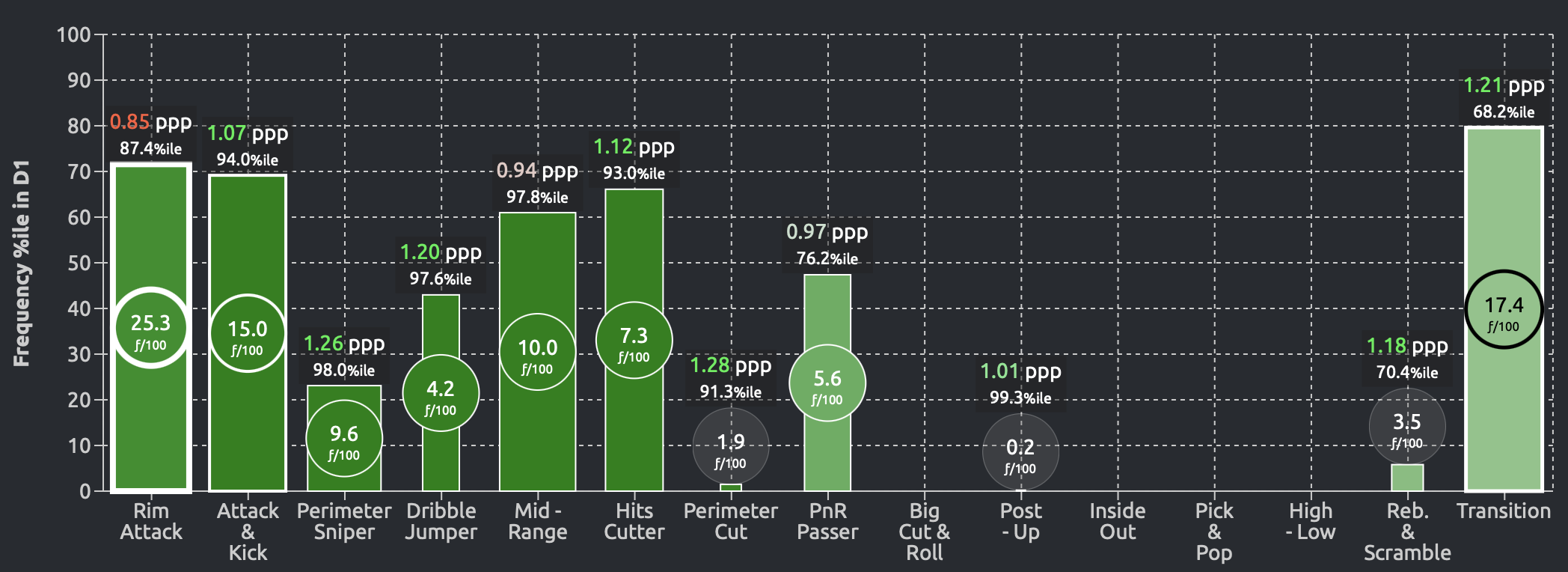
KK Bransford is UCLA's fifth and final transfer, and her Notre Dame data shows a genuinely versatile guard whose availability has always been the biggest question. She posted a 6.8 percent offensive rebound rate, in the 89th percentile for a guard, giving UCLA another guard who rebounds well. Her shot profile skewed heavily toward the rim, as she took 50.7 percent of her shots at the rim, which was in the 96th percentile. Her play-type chart shows real two-way range: she scored 1.16 points per possession attacking off the catch and 1.09 points per possession in the mid-range, both in the 96th percentile or better.
Her career history also has a few gaps, as she has dealt with injuries. She missed a handful of games last season due to an injury and missed her entire 2024-25 season at Notre Dame. As long as Bransford stays healthy this season, UCLA will greatly appreciate her rebounding ability. She is a versatile player who can attack a defense in different ways.
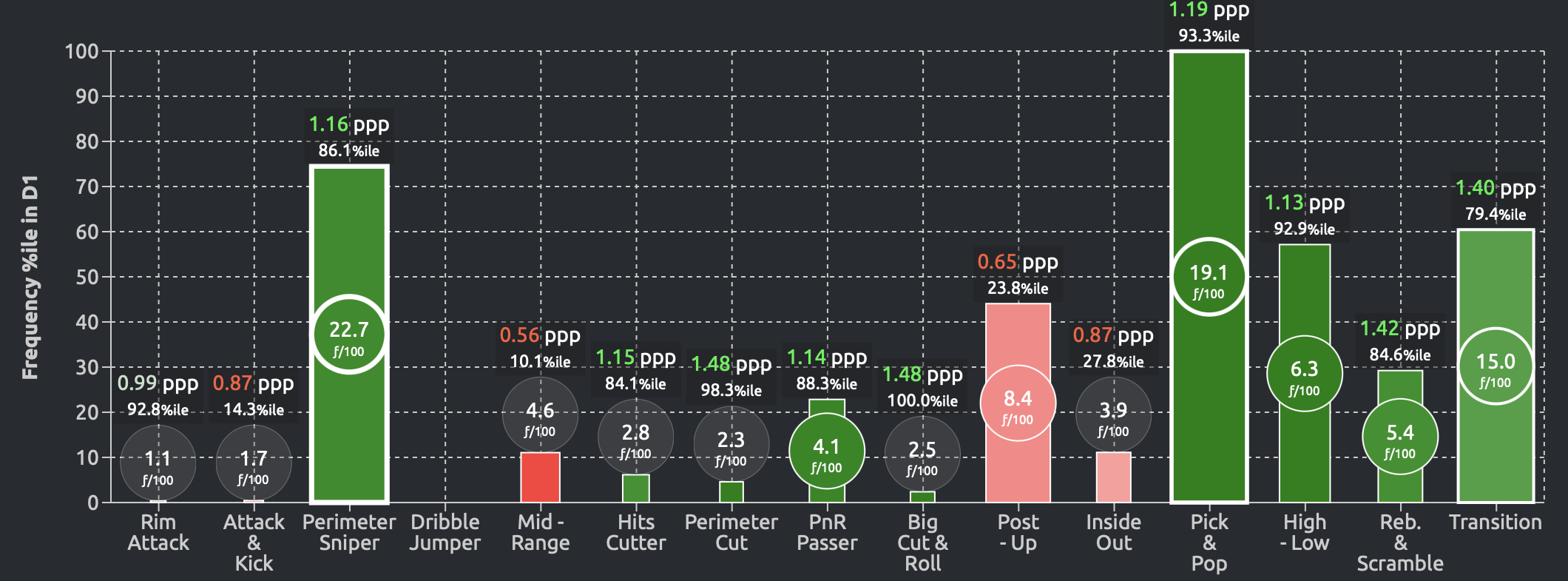
Timea Gardiner didn't see the floor in 2025-26 after suffering a knee injury, but now she's back, and her return could make this UCLA team much better. At 6'3", she posted a 57.8 percent true shooting mark built almost entirely around one skill. 72.0 percent of her shots came from three, and she made 39.5 percent of them, which landed her in the 92nd percentile for shot-making. Nearly half her shots, 48.4 percent, came from the top of the key, and while she shot the ball well from there, she shot an elite 43.4 percent on shots she took from the corner.
The play-type data backs it up. Perimeter sniper was her most frequent action, 22.7 possessions per 100 at 1.16 points per possession, and pick-and-pop wasn't far behind, as seen below. Those two catch-and-shoot actions alone made up close to half of everything she did on offense. She hasn't been a rim threat; just 5.8 percent of her shots came there, and her post-up and inside-out numbers both sat below the 30th percentile. The shot data does make one thing clear: Gardiner, healthy, might be the best proven shooter on this roster, at a position where UCLA can use her in multiple spots on the court.
Somto Okafor and Lina Jerković round out the class as UCLA's two true freshmen, both international, continuing a pipeline that's become something of a signature for this program. Okafor led Spain in scoring and rebounding at the U19 World Cup. Jerković, a point guard from Slovenia, came in after forward Joyce Isi Etute decommitted and landed at Texas. Both come into a UCLA program that would love it if they could push for important playing time in their first season. With the roster shaped as it is, it's likely that the freshmen will play a big role during the season.
Put all the numbers side by side, and the picture is pretty clear: this is a different team. Last year, UCLA ran the top offense in the country by getting to the rim more than almost anyone in Division I, and none of the five transfers profile as a traditional rim-finishing big. Brown is a passing, rebounding forward more than a scorer around the basket. Betts is the closest thing to a true frontcourt scorer here, and she took only 10 threes as a freshman while operating mostly off cuts and putbacks. Gardiner adds a body at 6'3", but healthy, she profiles as a movement shooter, not a post presence. Amanda Muse, another returner for this team, saw just under 10 minutes a contest last year and will play a much bigger role on the floor. If she keeps improving her efficiency, having her and Gardiner back in the fold is huge for this roster.
What UCLA does have is shooting, more of it than the roster gets credit for. Aarnisalo and Hunter both arrive with proven marks from three, 40.4 and 33.7 percent on good volume; Brown adds a credible third option at 33.8 percent, and Gardiner might be the best of the group at 39.5 percent on the highest three-point rate anyone in this class posted. That's four plausible shooters. Bilić, Deas, Bransford, and Betts, to be clear, have not proven to be good shooters. If any of them can show a leap to over 30 percent this season, it will only raise the group's ceiling even higher.
Last season's shot chart shows exactly how UCLA scored, and the roster Close built doesn't replace the rim pressure that made it work. What she replaced it with is spacing, passing, and defensive versatility spread across four transfer guards, a returning forward who might be the best shooter in the group, and a sophomore who is poised to take a huge jump after her freshman season. This team is on the hunt to defend its national championship this upcoming season. It's just a different team than the one that won it last year.
