
In our Champions Rewind series, we'll be looking at the seasons of past National Champions, including breaking down both the offensive and defensive systems used.
This week, we'll look at the 2011-2012 championship year that John Calipari had at Kentucky.
Season Recap
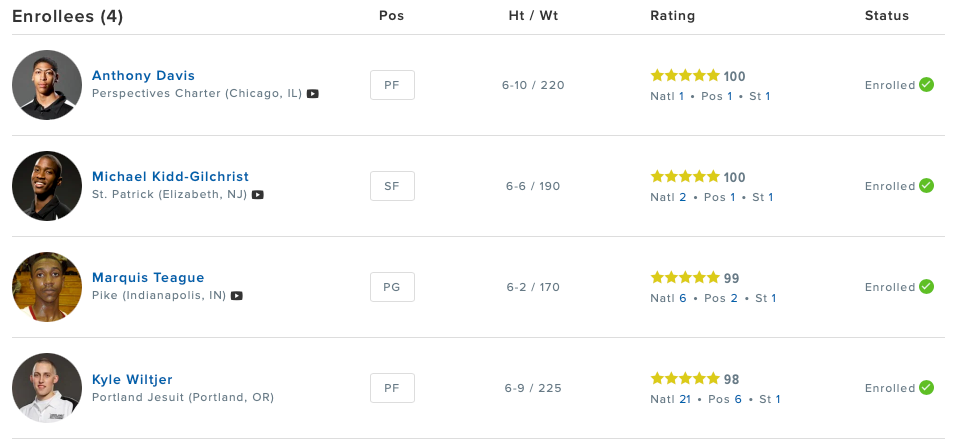
Coming off a Final Four appearance in the 2010-11 season, returning 3 key players from the roster, and adding 4 top 25 freshmen, including #1 ranked Anthony Davis and #2 ranked Michael Kidd-Gilchrist, it's safe to say that expectations were sky-high for this young squad.
Heading into the season, the Wildcats were ranked #2 in the AP Poll, behind only a UNC team led by Harrison Barnes and Tyler Zeller.
Despite having a rotation that featured 5 underclassmen as starters and only 1 upperclassman consistently in the rotation, the talent that this team had was undeniable in the offseason.
Starters
- Marquis Teague - 6'2 - Freshman - Point Guard
- Doron Lamb - 6'4 - Sophomore - Shooting Guard
- Michael Kidd-Gilchrist - 6'7 - Freshman - Small Forward
- Terrence Jones - 6'9 - Sophomore - Power Forward
- Anthony Davis - 6'10 - Freshman - Center
Bench
- Darius Miller - 6'8 - Senior - Wing
- Kyle Wiltjer - 6'10 - Freshman - Forward
Entering his third season as head coach of Kentucky, John Calipari was coming off runs to the Elite Eight and Final Four. The expectation coming into the season was, at minimum, a Final Four appearance. It wasn't uncommon to view this dominant Kentucky roster as a championship-or-bust type of team.
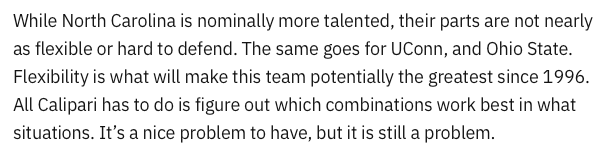
Those expectations only grew as Kentucky beat Kansas 75-65 in the 2nd game of the season. The 5 underclassmen starters all scored in double figures while Anthony Davis added 7 blocks. After UNC lost to UNLV just a week later, Kentucky jumped up to number one in the AP Poll.
After rattling off 5 more wins to get a 7-0 start, the preseason #1 and #2 teams faced off in Lexington. It was an incredibly hyped game between UNC and Kentucky, the two favorites to win it all entering the season.
It was a pretty back-and-forth game throughout, with the largest lead only 8. UNC led by 1 with 9 minutes left, but an Anthony Davis shot out of rolling to the rim put Kentucky up 1, and they never let up the lead from there. John Henson had a look to try and win the game, but missed, and Kentucky won 73-72.
One week later, Kentucky took on Indiana at Assembly Hall in a game that has gone down as one of the most famous college basketball games in history.
After trailing the unranked Hoosiers 66-57 with 7 minutes left, Kentucky went on a 12-2 run, taking a 69-68 lead. Indiana scored off a Christian Watford drive after getting an offensive rebound of a Victor Oladipo miss. Marquis Teague immediately came down and got to the rim out of a pick-and-roll to put Kentucky up 71-70. Watford missed, and Anthony Davis was fouled with 19 seconds left and a chance to go up three. Instead, he missed the front end of a 1-and-1, and Indiana had a chance. Oladipo turned it over, and Doron Lamb got fouled with 5 seconds left. He split a pair to go up 72-70, and then Christian Watford hit one of the most well-known game winners in recent college basketball history as Indiana gave Kentucky their first loss of the season.
It was the first loss of the season for this young squad, and questions arose about how they'd bounce back. Luckily for them, they had a stretch of four buy games in a row to get right before taking on Louisville at home.
Heading into the in-state rivalry, Kentucky was ranked 3rd in the AP Polls, while Louisville, led by Russ Smith and Peyton Siva, was ranked 4th. This one didn't have near the excitement as some of Kentucky's previous big-time games. The Wildcats led 36-33 at half and extended their lead to double digits with 5 minutes left. They got the big win, with a final score of 69-62. Michael Kidd-Gilchrist had 24 points and 19 rebounds, Anthony Davis had 18 points, 10 rebounds, 6 blocks, and 3 steals, and Doron Lamb contributed 10 points.
The top two rated freshmen coming into the season, Davis and Kidd-Gilchrist, were really starting to take off and show just how dominant they could be.
This young team was only getting better as the season progressed, and after that loss to Indiana, Kentucky won 22 straight games to end the regular season.
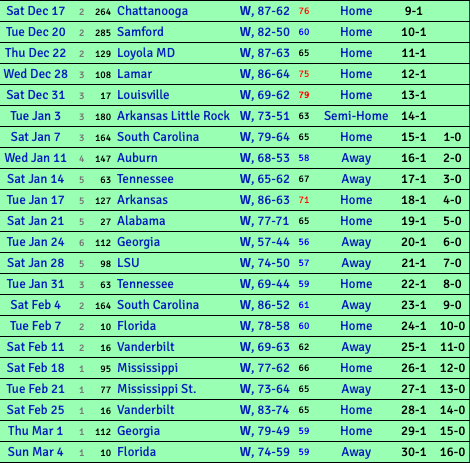
Winning 22 games in a row was impressive in itself, but the way they were winning games was equally impressive. Out of those 22 games, only 6 of them were decided by fewer than 10 points, and just 3 of them were decided by 6 or fewer. Kentucky entirely lived up to the 'dominant' adjective.
The Wildcats ran through the SEC, and although it was a down year for the conference (the SEC was ranked 4th-best per KenPom and had only 4 NCAA Tournament teams), that doesn't take away at all from how dominant an effort Kentucky put on.
Kentucky finished the regular season ranked #1 in the AP Poll, and we'll list below some of the awards for this Kentucky team
- AP Player of the Year - Anthony Davis
- Wooden Award - Anthony Davis
- Naismith Award - Anthony Davis
- USBWA Player of the Year - Anthony Davis
- USBWA Freshman of the Year - Anthony Davis
- NABC Defensive Player of the Year - Anthony Davis
- Consensus 1st Team All-American - Anthony Davis
- Consensus 2nd Team All-American - Michael Kidd-Gilchrest
- SEC Player of the Year - Anthony Davis
- SEC Defensive Player of the Year - Anthony Davis
- SEC Rookie of the Year - Anthony Davis
- First Team All-SEC - Anthony Davis, Michael Kidd-Gilchrest
- Second Team All-SEC - Terrence Jones
- SEC All-Freshman - Anthony Davis, Michael Kidd-Gilchrest
- SEC All-Defense - Anthony Davis, Michael Kidd-Gilchrest
So uh, yeah, Kentucky was good and basically got every award between Anthony Davis and Michael Kidd-Gilchrist.
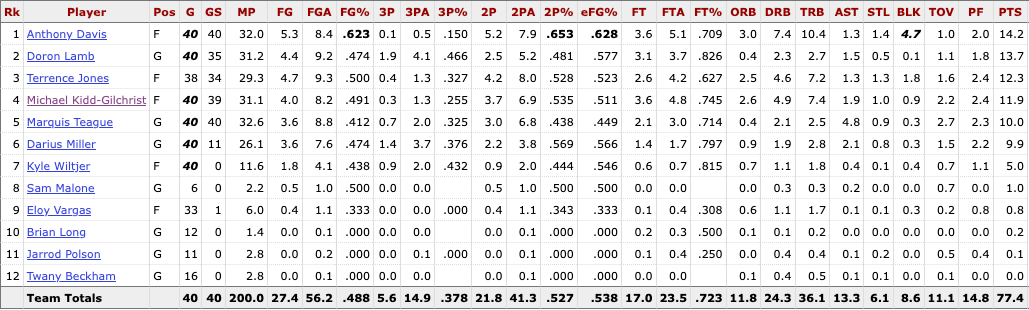
Maybe it was fatigue from the regular season for this young team, or simply looking ahead to March Madness, but Kentucky didn't exactly steamroll through the SEC Tournament.
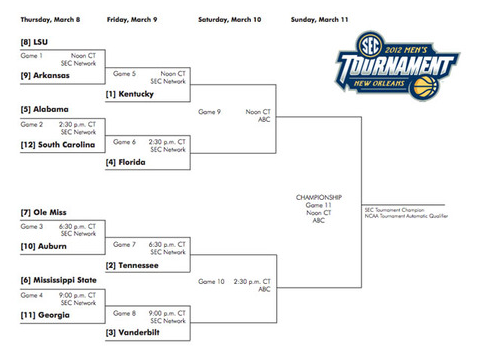
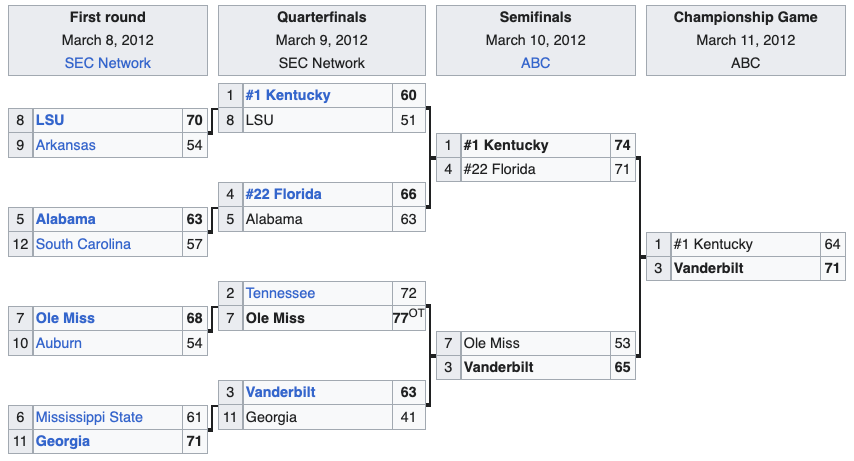
Kentucky faced LSU in their first game, a team it had beaten by 24 on the road earlier that season. However, LSU hung around in this one, leading 35-32 before a 13-2 run from Kentucky ultimately gave Kentucky a 60-51 win.
Kentucky faced off against Florida in the semis, a team Kentucky beat by double digits twice that season. In a similar story to the LSU game, Florida led 56-53 with 10 minutes left before Kentucky went on a 14-0 run to ultimately win 74-71.
This set up the championship against Vanderbilt, a team Kentucky beat by only 6 that season. It was a back-and-forth first half as the game was tied 37-37 at halftime. Kentucky, very slowly, pushed its lead to 7 with about 6 minutes left, seemingly poised to sweep the SEC regular season and tournament. However, Kentucky didn't make a single field goal over the final 5 minutes, while Vanderbilt couldn't stop scoring. Vandy ended up going on a 16-2 run over the final five minutes to shock Kentucky and win the SEC Tournament.
Kentucky ended up being the number one overall seed heading into March Madness, heading to the South Region.
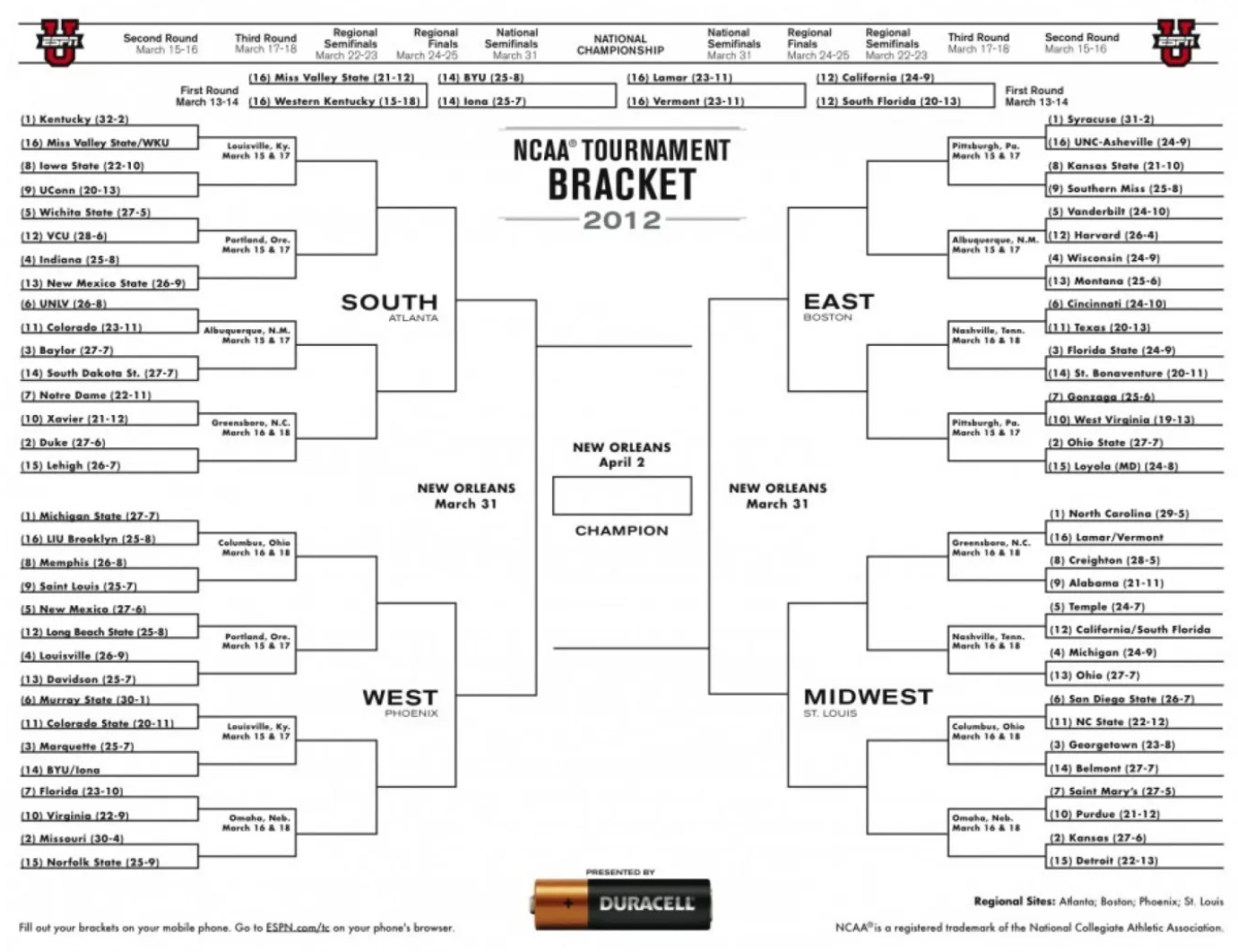
The SEC Tournament loss may have snapped Kentucky back into focus, as they had no real issues in their first two rounds.
They first knocked off Western Kentucky 81-66. Anthony Davis had 16 points, 9 rebounds, 7 blocks, and 3 assists. Terrence Jones added 22 points and 10 rebounds, while Doron Lamb and Marquis Teague both scored at least 12 points.
They then beat Iowa State 87-71. Davis had 15 points, 12 rebounds, 5 assists, and 2 blocks. Marquis Teague went for 24 points and 7 assists, and Doron Lamb scored 16 points.
This set up a rematch in the Sweet Sixteen against Indiana, one of only two teams that had beaten Kentucky that season.
It was a high-scoring game, with Kentucky leading 50-47 at halftime. There wasn't a really big run from the Wildcats, but they were able to systematically extend their lead to double digits with 10 minutes left. Unlike in the previous matchup, Kentucky knocked down free throws this time and ultimately won 102-90. Kidd-Gilchrest led the way with 24 points and 10 rebounds, and Doron Lamb added 21. Kentucky got production off the bench as Darius Miller went for 19 points on only 8 shot attempts.
Kentucky faced off against Baylor in the Elite Eight, a game whose final score makes it seem much closer than it actually was. The Wildcats went on a 16-0 run to get a 21-10 lead, and they shortly followed it up with a 17-3 run to lead 42-22 at half. Some late game shot making from Baylor caused the score to be 82-70 in the end, but Baylor never really had a chance. Kidd-Gilchrest, Davis, Lamb, and Jones all went for double-digit points, and Davis added in 11 rebounds and 6 blocks on top to clinch a Final Four berth.
Kentucky and Louisville had to travel all the way to New Orleans to face off against each other in the Final Four. Kentucky held a double-digit lead for most of the 1st half, but Louisville tied the game with 9 minutes left in the 2nd half. Kentucky responded with an 11-2 run that spanned 6 minutes and ultimately won 69-61. Anthony Davis had a complete game with 18 points, 14 rebounds, 5 blocks, 2 assists, and a steal.
The Wildcats got a rematch in the championship against Kansas, the team they beat by 10 in their second game of the season. As was the case with most of this tournament run, Kentucky got out to a double-digit lead in the first half and held it for most of the second half. Kansas cut the lead to 7 with 3 minutes left, but it was too little too late as the Wildcats ended up cutting down the nets.
Anthony Davis had only 6 points but added 16 rebounds, 6 blocks, 5 assists, and 3 steals. Doron Lamb led the game in scoring with 22 points, and both Kidd-Gilchrist and Teague added in double-digit scoring.
The most impressive thing from this tournament run, and really could be applied to most of the season, was how little doubt there was that they were winning games.
Per KenPom's win probabilities, the lowest winning percentage Kentucky had in the 2nd half of any March Madness game was 72.9% against Louisville, when the Cardinals tied the game with 9 minutes left.
Anthony Davis ended his historic season by being named Most Outstanding Player of the tournament.
Offense
Kentucky ended the season with the #2 offense in the country, per Kenpom, as they dominated most areas of the floor.
They ended up in the top 25 in eFG%, TO%, and ORB%, while in the top 50 in free-throw attempt rate. On top of that, they shot 37.8% from three and 52.7% from two, putting them #37 and #21, respectively.
The offense revolved around the ability to win 1-on-1 matchups and get downhill. The Wildcats were 313rd in the country in three-point attempt rate and 292nd in assist rate.
Dominating the paint and at the rim was priority number one for Kentucky. They were top 20 in both rim attempt rate and field goal percentage at the rim. Terrence Jones, Anthony Davis, Michael Kidd-Gilchrist, and Marquis Teague all averaged at least 4 shot attempts at the rim per game, and Marquis Teague was the only one out of the four to shoot below 60% at the rim.
The other catalyst for the Wildcats' offense was their ability to get out and run. They only had the 142nd fastest offense in the country per KenPom, but they were top 25 in transition usage on the season. The Wildcats wanted to run every chance they could, but if they didn't get a look, they'd reset and take their time.
Kentucky in transition
Their secondary transition was also lethal, helping set up the rest of their offense, which focused on individual creation.
Kentucky early drive and kick
Once Kentucky got into the half-court, that's where they were willing to slow the game down to set up their offense. Although the Wildcats wanted to be able to hunt mismatches, it wasn't always just as simple as iso and go. They'd often pair early offensive actions to move defenders and create the matchup they wanted.
Hawk Punch
In the clip above, Kentucky was trying to get Anthony Davis into the post. They started with Hawk action, which is a UCLA cut followed by a side ballscreen. (A UCLA cut is the guard getting a backscreen on the perimeter to go to the rim.)
What this does is create a lot of space for the empty-corner pick-and-roll. If Ole Miss wanted to try to hedge, the slip could be there. They opted to switch, and Davis immediately made them pay.
Elbow Flex Punch
The flex action was a staple for Kentucky in setting up its offense. A flex screen is a cross-screen that a player cuts from the weak-side block to the strong-side block. After Kentucky entered the ball to the elbow, a flex screen opened up the post, allowing them to attack the matchup they wanted.
Overplayed flex
If a defense wanted to overplay the flex action, Kentucky was capable of moving the ball elsewhere off of it to score.
Early action stopped and then lots of isos
If the early action was stopped, as shown in the clip above, that's when Kentucky could flow into more pure isolations. In the clip above, there was constant drive-and-kick before an eventual pick-and-roll.
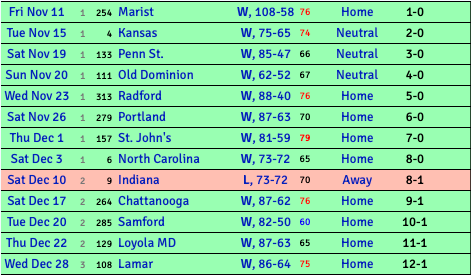
That's what made Kentucky so dangerous. They trusted everyone on the floor at all times to win their matchup, so they had a very good combination of offensive flow and skill. Despite not being a team that took many threes, their ability to dominate the paint and the offensive glass made it so difficult to consistently slow them down.
Defense
Kentucky finished with the 7th-best defense per KenPom, led almost entirely by its ability to defend the paint. Opposing offenses shot just 39.6% from two against Kentucky.
The crazier stat is that Kentucky had a block rate of 20.2%, the 4th highest single-season rate in the KenPom database (going back to 1997). This means that, as a defense, Kentucky was blocking 1 in every 5 opponent shots. Anthony Davis anchored the tough interior defense, with an individual block rate of 13.8%. He averaged 4.7 blocks per GAME for the entire season. That number is currently tied for the 40th-highest blocks-per-game mark in the Stathead database and the 11th-highest since 2000.
Kentucky drop coverage
It helps to have Anthony Davis, one of the greatest defensive anchors in recent memory, as the rim protector. Kentucky generally played more drop coverage, meaning the big would stay below the level of the screen to help keep the ball in front. In the clip above, Davis is in a position to move his feet and contest at the rim.
With the paint covered, the Kentucky guards and wings didn't have to show much help off the perimeter. Kentucky wasn't in full denial off-ball, but they rarely overhelped, instead opting to try and force offenses to beat them 1-on-1. Offenses took just 29% of their shots from three against Kentucky, the 52nd-lowest rate that season. Offenses also assisted on just 47.2% of their makes, the 40th lowest.
Kentucky dared you to beat them 1-on-1, and the offenses rarely won that battle.
Drop coverage with no help
In the clip above, notice how on the drives, Kentucky's off-ball defenders never help more than a small stunt towards the ball. They opt to stick to their man more and avoid easier kick out opportunities.
Scared to drive against Davis
When Anthony Davis would get caught on the perimeter, offenses would often be scared to even try and drive at him. This resulted in contested pull-ups, shots that Kentucky was going to live with defensively.
This Kentucky team truly is one of the dominant teams of the 21st century. Despite being one of the younger teams, the pure talent and star power, combined with Calipari's willingness to adapt, allowed them to cut down the nets at the end of the season.
