
We aren't even five years deep into college basketball's true "transfer portal era." While we learn more about how to recruit a transfer portal class, the intricacies of how money is involved, and how to analyze a team's overall haul, there's still lots of learning on the spot for everyone.
Ranking a college basketball team before it ever plays a game is already hard, and has been made even more challenging by the constantly changing teams. But even still, in last year's AP Top 25 preseason poll, 23 of those teams made the NCAA Tournament. Meanwhile, in 247Sports' top 25 portal rankings, only 14 did.
This is not to single out 247Sports or any other portal rankings service; I'm a big fan of their work and reference their site all the time. I do my own yearly portal rankings and go extremely in-depth, and of my top 25 ranked power conference teams, only 14 made it as well. While I was much higher on a team like Virginia that had a small but mighty class, I was also far too low on Florida because I didn't like the Boogie Fland/Xaivian Lee fit.
Of course, grading portal rankings by NCAA Tournaments is hard because every squad has different season-long expectations. But even grading by KenPom preseason/end-of-season rankings, 247's list had just nine of the 25 teams beat their expectations. My rankings (just P5 teams to compare apples to apples), had nine as well. Not exactly setting the world on fire.
ON3 does things a bit differently: they grade the overall gap between outgoing portal talent and incoming talent. And even still, only 10/25 of their top teams made the NCAA Tournament, and only 7/25 beat out KenPom expectations.
It is clear that when it comes to consensus or composite transfer portal rankings, we have a long way to go, myself included. Because my rankings aren't done yet (should be out by mid-July), I'm still tinkering with the right formula to buck this trend.
To try and improve how we grade transfer portal rankings, I'm going to look back at some of the biggest whiffs we collectively made last season and then look ahead to how we can predict things with better accuracy.
Washington
247 Ranking: 13
ON3 Ranking: 3
ESPN Ranking: 6
My Ranking: 14 (amongst P5)
Washington's transfer portal class of eight was really only six, given that former Florida State reserve Christian Nitu and highly ranked JUCO prospect Mady Traore both didn't play. This obviously hurt their depth, but it's not like Washington falls out of these rankings if they aren't included.
The Huskies took two chances on two freshmen who had fine freshman seasons inside their own conference. Lathan Sommerville and Bryson Tucker showed flashes, and though they didn't quite work out, were reasonable gambles all things considered. Washington's roster at least had enough depth to survive if both didn't pan out. Plus, in retrospect, Sommerville staying in Seattle for his junior year is an added bonus.
Washington also added two mid-major players, Quimari Peterson and Jacob Ognacevic, who profiled as really strong complementary offensive pieces around their stars. Peterson was great, finishing second in minutes percentage on the roster. Ognacevic was hurt in the non-conference, and his lack of athleticism and defense made him hard to hand big minutes to. One for two, not horrible.
Where the Huskies' portal class really fell apart was at the top. Already set with projected and eventual first-rounder Hannes Steinbach in the frontcourt and promising sophomore Zoom Diallo at point, Washington added the USC backcourt duo of Wesley Yates and Desmond Claude. They were the highest-rated players in the class according to both 247 and ON3.
The duo alongside Diallo made zero sense. Going back to the 2024-25 season, Diallo, Yates, and Claude combined to take 295 jumpers off the dribble and only 113 off the catch. None of them had an assist-to-turnover ratio better than 1.3:1, and none of them used even 20% of their possessions on assists.
Claude ended up hurt for much of the year, but the team went just 3-3 with all three of them in the lineup, including a loss to Seattle and a 2OT win over Southern. The Huskies just couldn't play all three of their best guards together because of their overlapping games. Here are a couple of examples of what happened when they all shared the floor.
The trio simply did not have the spacing to work in unison, not to mention star big Steinbach made just 18 threes all year. And because each was a score-first player with a dribble-heavy shot diet, it was a lot of pounding the ball into the floor.
Inevitably, injuries played a huge role in Washington's struggles last season. Maybe if Claude was able to play all year, the trio of backcourt options would have figured it all out. But Washington ended up finishing second-to-last in jumper rate, second-to-last in 3-point efficiency, and third-to-last in assist rate in the Big Ten for a reason.
Of perhaps all the top-ranked portal teams that didn't live up to expectations, Washington's is the greatest example of why fit matters.
As it pertains to this year's cycle, I think a team in a similar boat is USC. Already loaded with two dribble-heavy players in Rodney Rice and Alijah Arenas, USC added three backcourt options in KJ Lewis, Jalen Cox, and Jadis Jones, who made a combined 49 threes at a clip just above 30%. Considering Arenas struggled mightily from deep in his freshman season and Rice has just one game as a point guard against a Power Five opponent under his belt, the fit and the talent aren't on the same level.
Kentucky
247 Ranking: 5
ON3 Ranking: 2
ESPN Ranking: 2
My Ranking: 9 (amongst P5)
The obvious answer to why Kentucky's portal class didn't live up to expectations is injuries, but I don't think that tells the whole story.
First of all, it was known that Jayden Quaintance would not be healthy coming into the season, and his return was both questionable and uncertain. There's a reason why Kentucky had two other true bigs in the rotation alongside Quaintance coming into the year.
Kentucky also only got nine games out of projected starting point guard Jaland Lowe, which effectively left them without a real point guard for the rest of the season. We can argue how much better Kentucky would actually have been with Lowe in the fold, considering the Wildcats went 2-4 against Top 100 competition with him in the lineup, including two blowout losses.
Of course, things didn't turn out bad. Denzel Aberdeen took a big leap in his first year as a starter, and Mo Dioubate remained a rate stats darling, even though he didn't take a giant leap. But even if Kentucky got a half-season out of Quaintance and Lowe remained healthy, this was never going to be a top-five portal class, and Kentucky was never going to live up to its hype as a top-10 team.
The real issue with Kentucky's roster was a lack of identity and cohesion, something evident in its portal additions. After a successful first season in Lexington that featured a Wildcats team with clearly defined roles, Year Two seemed more like a collection of talent, with little thought given to how they'd blend.
Let's compare the 2024-25 and 2025-26 Kentucky offenses by assist ratio, assist-to-turnover ratio, and percentage of points from deep. This largely eliminates actual shotmaking that comes with tons of variance in a shortened season and focuses predominantly on shot diet and offensive process.
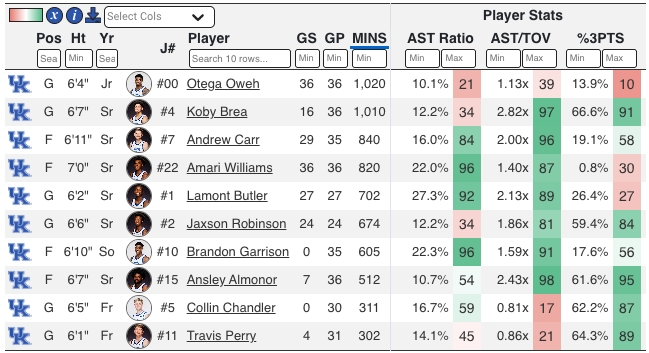
Outside of the athletic, downhill-attacking Oweh, Kentucky's next seven leaders in minutes were all in the top 20% for their position in two of the three stats. Guys that couldn't shoot were elite passers, and guys that weren't heavy passers were efficient and 3-point threats. The ninth and tenth men were pure spot-up guys, capable of spacing the floor around so much ball movement.
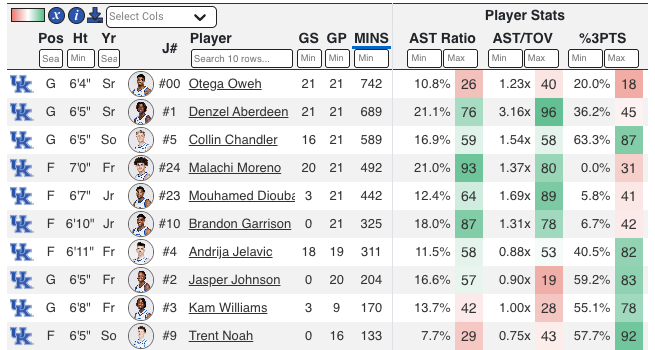
Keeping Oweh and his shot-heavy, downhill game should have been a clear signal to attack guys that were similar to the 2024-25 squad. Instead, only Moreno, who turned into the team's second-best player, fit the parameters that the entire 2-through-8 members of the year prior's rotation had met. The non-shooters weren't at the same level as passers in both usage and efficiency, and there weren't as many dedicated shooters to space the floor.
Even in a world where Lowe and Quaintance were healthy all season, this is what that breakdown would have looked like between Oweh and all the transfers, using their previous year's stats.
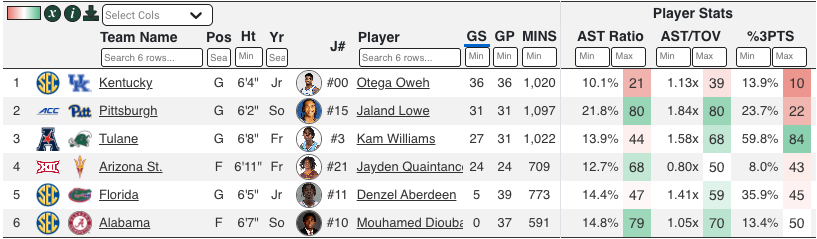
Maybe Kentucky believed that Dioubate's 46% shooting from deep on extremely low volume at Alabama would hold, which it certainly did not. Maybe they believed Williams would become a pure 3-point specialist or expand his playmaking repertoire, but both actually regressed as he moved up in level from the American.
I will say there's a real chance Kentucky's defensive equation would have changed entirely if Quaintance had played the second half of last season. They were much better than the year prior and could have been elite with the now-San Antonio Spur. But for an offensive coach like Pope, there just wasn't enough emphasis on the offensive fit that made Kentucky a Top 10 team on that end in his first campaign.
So, let's see if Kentucky has learned its lesson ahead of next season.
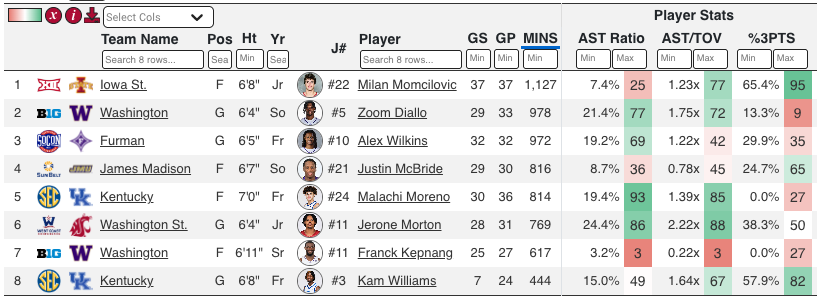
Pope will undoubtedly find ways to try to make this team gel, but the same issues of talent without offensive cohesion remain, and defense seems to be nowhere near the strength it was last year.
If we use 2025-26 Kentucky as an example of how an increased talent level doesn't always mean a better team, 2026-27 Kentucky runs the risk of being another cautionary tale to look at next year. The Wildcats surely won't be bad next year, but the bar may be unrealistically high.
Kansas State
247 Ranking: 4
ON3 Ranking: 45
ESPN Ranking: NR (of 14 teams)
My Ranking: 51 (amongst P5)
2025-26 Kansas State taught us three valuable lessons about putting together a roster. That one fantastic player isn't enough to make your team good, that recruiting without defense in mind whatsoever is bound to backfire, and that if you need to add multiple international recruits in June or later to fill out your rotation, you're probably a bit too little, too late.
In my personal grades, I gave PJ Haggerty an A, Khamari McGriff a B+, and everyone else a "C". Because the rest of the roster was so awful around him, Haggerty truly had to be an "A" player to lift them, but he ended up putting together the worst season of his career.
Though many will attribute Haggerty's struggles to the "pay-to-play" model, where Haggerty just joined the highest bidder and wasn't locked in to play the season because it was entirely financially motivated. I simply don't buy that. Have you never heard of the NBA?
Rather, the extreme lack of other primary options on the roster put immense offensive pressure on Haggerty. Of the 89 players who averaged at least 35 minutes per game, Haggerty was second in usage rate. Only he, Ebuka Okorie, and Nick Martinelli averaged 35 minutes per game with a 30%+ usage on a power conference team.
Haggerty's possession usage has ranged from 28% to 32% across all three of his college seasons. But at Tulsa, he had three other teammates in the top 20%. At Memphis, he had two others. And at Kansas State, he had just Abdi Bashir, who missed three quarters of Big 12 play due to injury. Haggerty had virtually zero help on-ball with his teammates.
Speaking of those teammates, they are not excused here. Bashir, Nate Johnson, and Khamari McGriff all had negative defensive on/off ratings at their previous mid-major stops. None were regarded as plus defenders, and yet all three were tasked with starting alongside a ball-dominant offensive player in Haggerty. With those four on the floor together, the Wildcats had a 115 defensive rating against Quad 1 and 2 teams, a 25th% mark nationally.
This is what that defense looked like less than one minute into a game, one month into the season, against a Bowling Green team that Kansas State lost to by 16 on their home floor.
Bowling Green had its third-highest offensive efficiency output of the entire season in that game, and Kansas State was its only power conference opponent all year. Fire this Wildcats team into the sun.
As we look towards next year, I think the closest comparison to Kansas State's class is Baylor. They have 247's No. 29 transfer in Kayden Mingo, but nobody else inside the Top 100. He'll have to handle a bulk of the on-ball load with his brother Dylan, an incoming freshman. Their second- and third-highest-ranked transfers, Brett Decker and Isaac Celiscar, were both significant defensive net negatives on underperforming defenses at their last stops. And just like the Wildcats last year, the Bears are a brand new team, with only one returner.
Going into next year, Baylor is ranked No. 19 by ON3, inside the Top 22 by ESPN, and 32nd by 247, and my guess is they will underperform expectations. And you'd never guess which program former Kansas State head coach Jerome Tang bounced to after last season.
What can we learn about grading portal classes?
If there were three main takeaways I gathered from analyzing both the three failed portal classes above and a handful of others that didn't live up to expectations last year, it would be:
- Offensive role - Is there a clear usage pecking order? Do your highest-paid and highest-usage players make sense together?
- Offensive fit - Does your team have a coherent blend of initiators, connectors, and spacers?
- Defensive floor - Have you filled out your team with enough net-positive defensive contributors to at least be capable on that end?
One easy step I've taken to help strengthen my rankings is to hand players a "Starter", "Key Reserve," or "Reserve" tag. Grading Quin Berger on the same scale as Acaden Lewis amongst backcourt transfers at Miami next year is foolish, and significantly hampered some of my team grades last year.
I also don't think we should immediately reward a team for having a "deep" portal class, and negative or below-average adds should bring down a ranking as much as good adds prop up a ranking. I'll be assessing negative points for adds I grade a C or worse, rather than a team earning points just for adding a transfer. Sometimes less is more.
Lastly, I don't believe it's right to grade a portal class without grading the fit that group has with a team's returners. While I think ON3 is on the right track by comparing a team's incoming class with the guys that left, I think that element is far less important than who those new guys will actually be playing with. It seems a tad counterintuitive to grade a portal class alongside the guys a program already has, but I think it may be the only way to do it accurately.
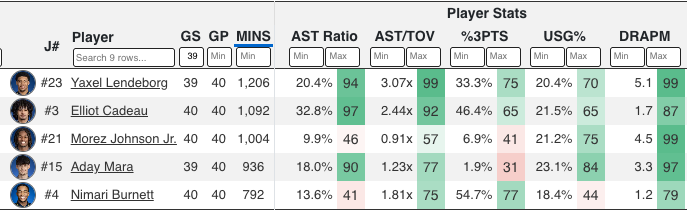
For example, let's look at Michigan and Vanderbilt's portal classes from last season, combined with their returning starters. I'll be including the offensive stats I used for the Kentucky example, plus usage and Defensive RAPM, to try to check all three boxes: offensive role, offensive fit, and defensive floor. Again, we won't be using numbers to assess scoring efficiency because that can vary widely year-by-year.
We'll begin with numbers from the 2024-25 season, the year before these groups joined forces.
Michigan
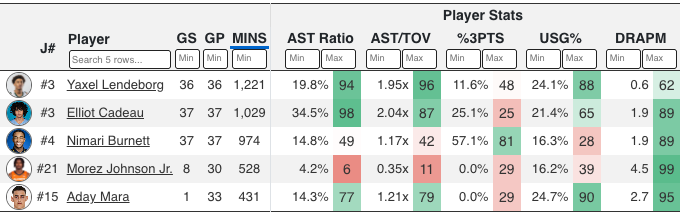
Two elite passers for their position, four top-tier defenders, two higher-usage players, and two lower-usage options. The only red flag is the 3-pointers, which resolved itself by Lendeborg and Cadeau taking huge leaps in that regard. You can see how everything smoothed out when they actually played together.
Vanderbilt
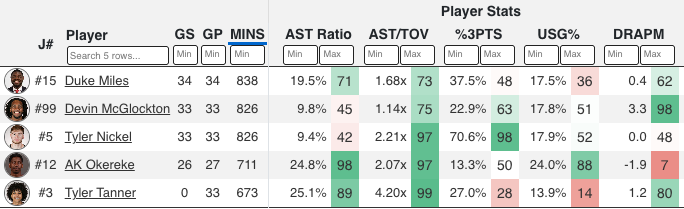
The passing efficiency is through the roof with this lineup, and Okereke's pass-first mentality allowed Miles' usage to jump significantly higher than his Oklahoma campaign. The defense was carried heavily by Tanner and McGlockton, but both were outstanding on that end. Nickel's extreme offensive gravity offsets the fact that none of the other five were 3-point heavy options. Nickel, Miles, and Tanner all needed to take big jumps in usage for it to work out.
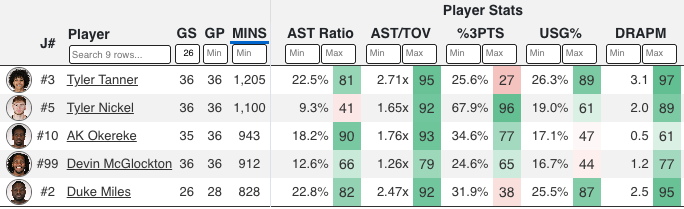
Now, let's quickly analyze the projected starting lineup for five teams that are in the top seven of both 247 and ESPN's portal rankings for this upcoming season. Please don't get mad at me if you think I have these lineups wrong; I am just guessing.
Louisville
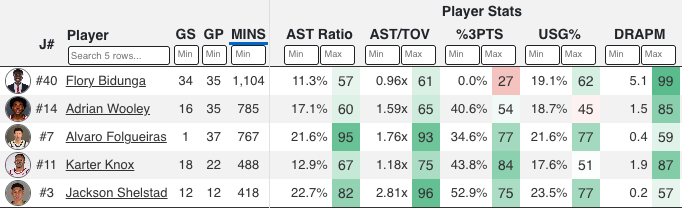
This lineup seems to have great synergy. Strong passers, lots of capable shooting with Bidunga's rim pressure, and three very capable defenders. Like Vanderbilt last year, the main question is whether some of these guys' usage rates jump, with no clear on-ball star in this group.
Tennessee
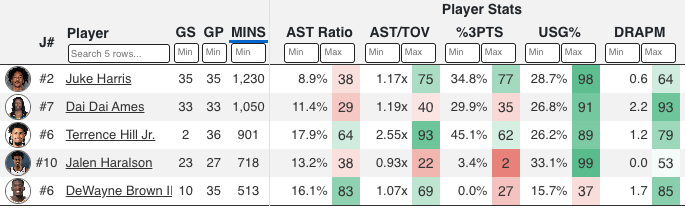
This assortment feels extremely problematic. The only guy here with a top 20% assist ratio is the low-usage big man in Brown. Four guys with top-11% usage rates to go along with it. If Tyler Lundblade is swapped in for Ames, the defense gets demonstrably worse. This group will require multiple guys to take on a lesser role and become better off-ball connectors, which just feels unlikely.
Texas
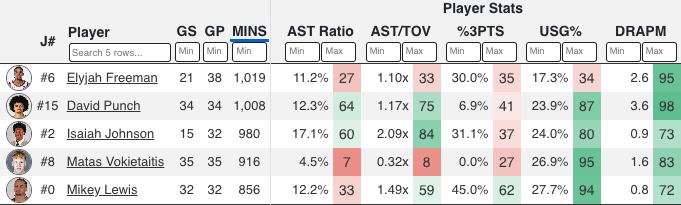
This grouping has some of the issues Tennessee has, with just two passers in the top two-thirds of all players at their position. The usage rate is definitely a tad too high, but not quite as high as the Volunteers', and Freeman + Punch is a terrific defensive duo. Texas also succeeded offensively last season with a more isolation- and rim-centric approach, whereas a Rick Barnes team hasn't finished outside the top 30 in assist rate since 2017.
Indiana
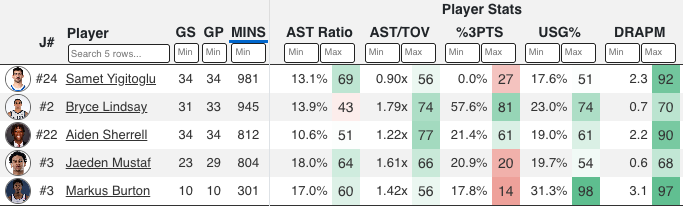
Like Tennessee and Texas, Indiana doesn't have any player in its projected starting five who used up more than 18% of its possessions via the assist last year. This team also has defensive concerns, given that Burton's DRAPM is inflated due to missing all of ACC play, and one of Yigitoglu and Sherrell will play out of position. But this group should have capable spacing and a clear offensive pecking order.
Miami Florida
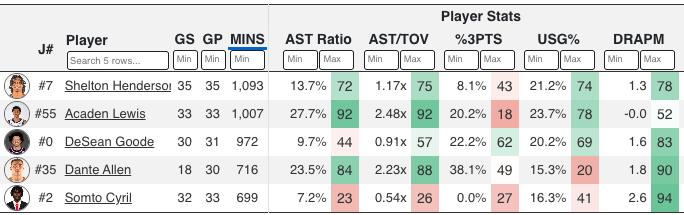
This is my favorite roster fit of the five. Lewis is the on-ball playmaker; Allen is an efficient off-ball connector next to him. Henderson's projected sophomore leap should see him lead the team in usage, and Cyril's rim pressure and defense will make up for a weaker point-of-attack defender in Lewis. They are short on spacing outside of Goode and Allen, but have multiple 3-point heavy players off the bench. In spurts, it might make sense to play small-ball with Henderson moving to the 4 and Nick Dorn jumping into the lineup.
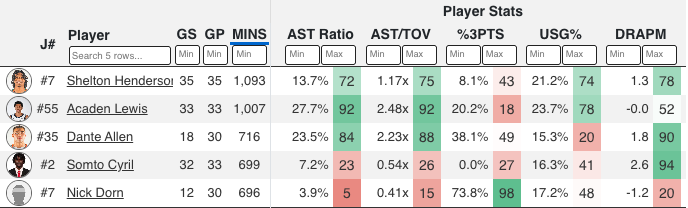
In short, if I were to rank these five portal classes, not based on talent, but rather on offensive role, offensive fit, and defensive floor, I would go:
- Louisville
- Miami Florida
- Texas
- Indiana
- Tennessee
And lastly, let me show you which team my personal rankings will have higher than a handful of these teams.
Arizona State
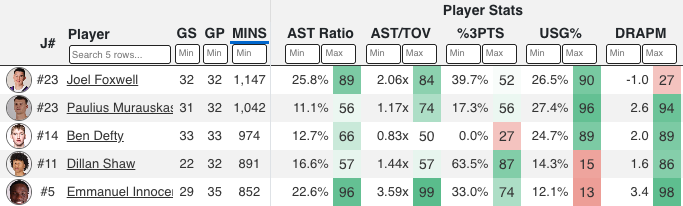
I absolutely love Arizona State's build in Randy Bennett's first year. Two excellent passers, one on-ball, one off-ball. A 3-point wing, three high-usage options, three very low-usage ones, and four very capable defenders. Foxwell carries the offense while the rest carry him on defense. Depth is a serious concern here, especially in the backcourt. But the Sun Devils will exceed expectations if they stay healthy.
