


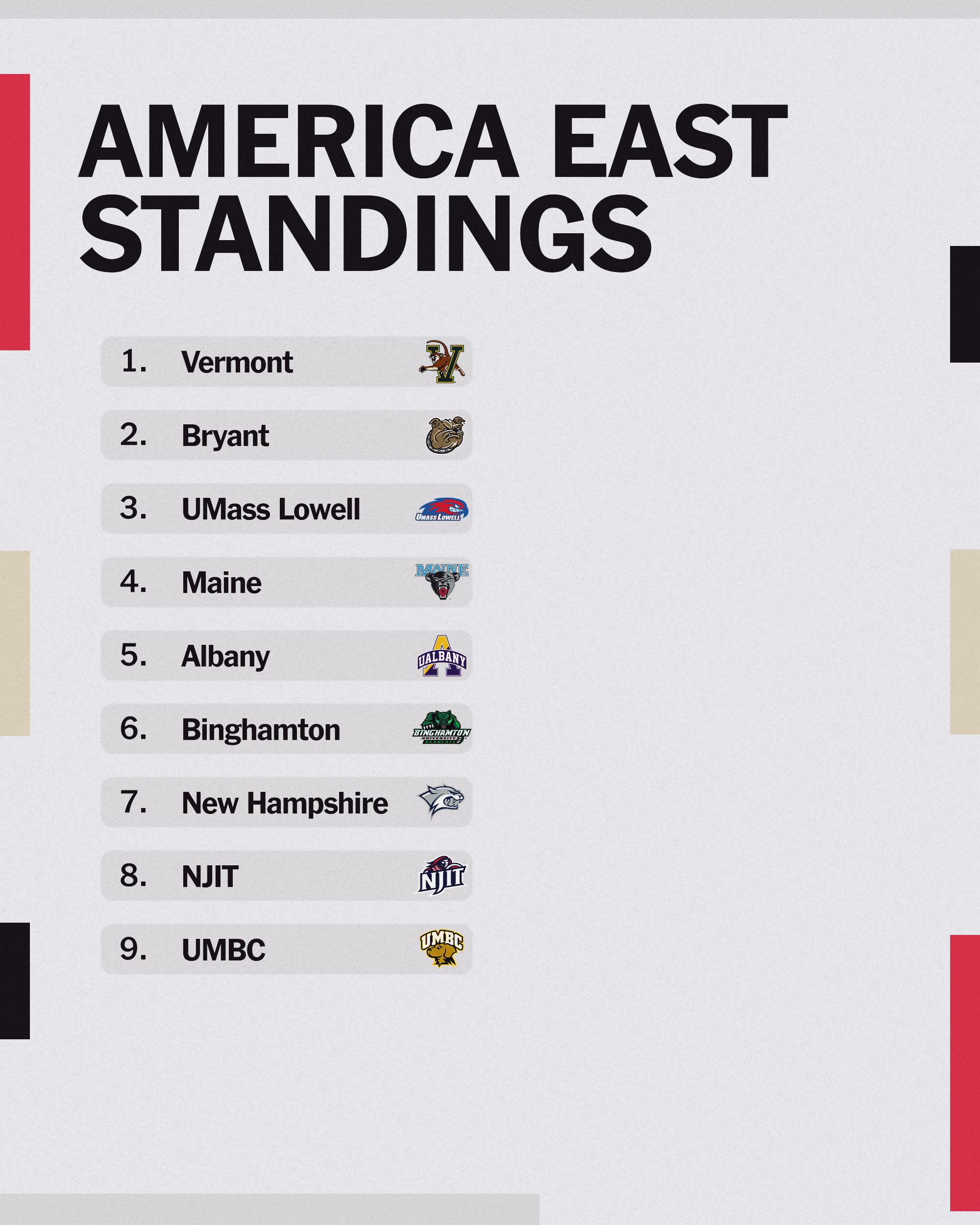
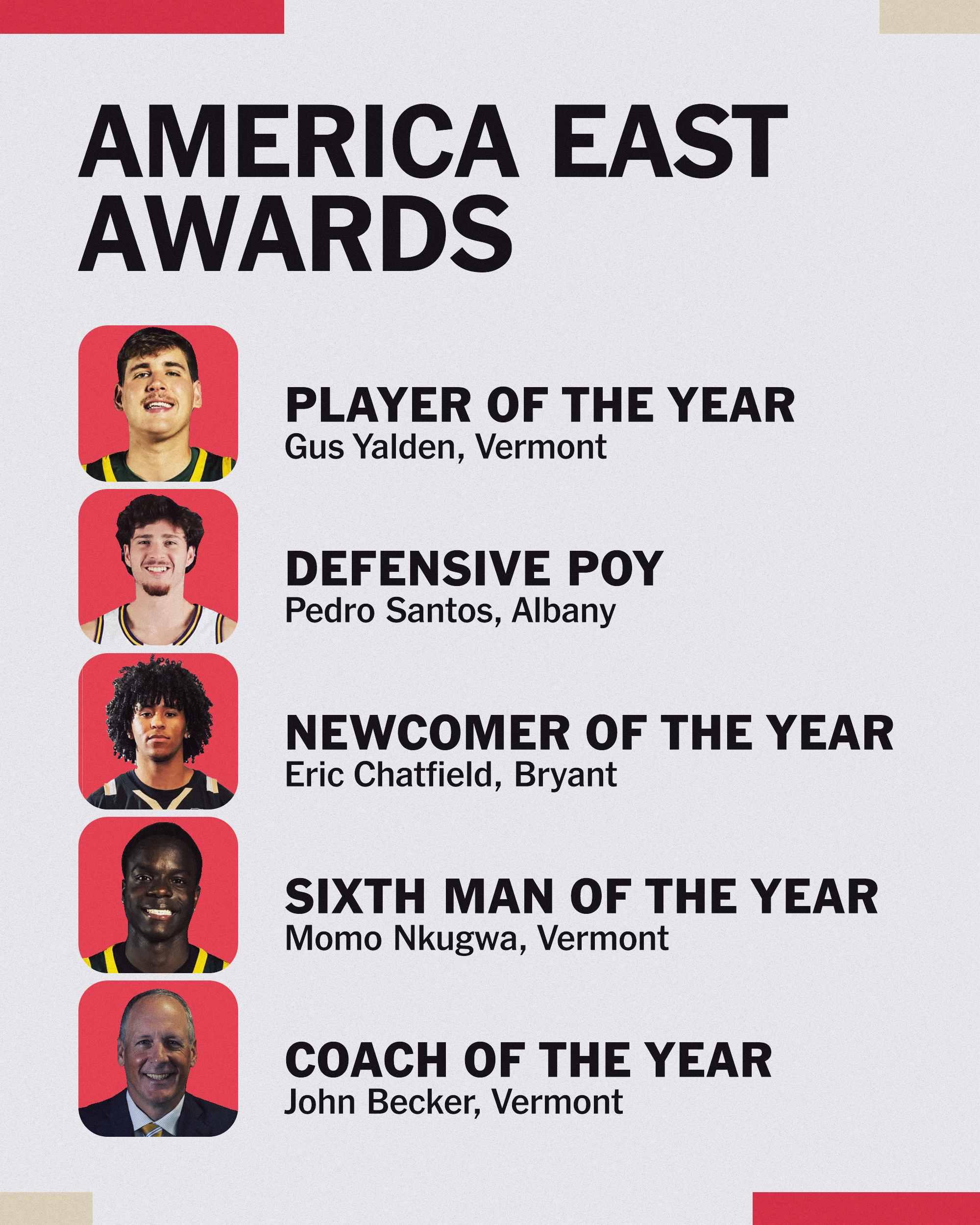
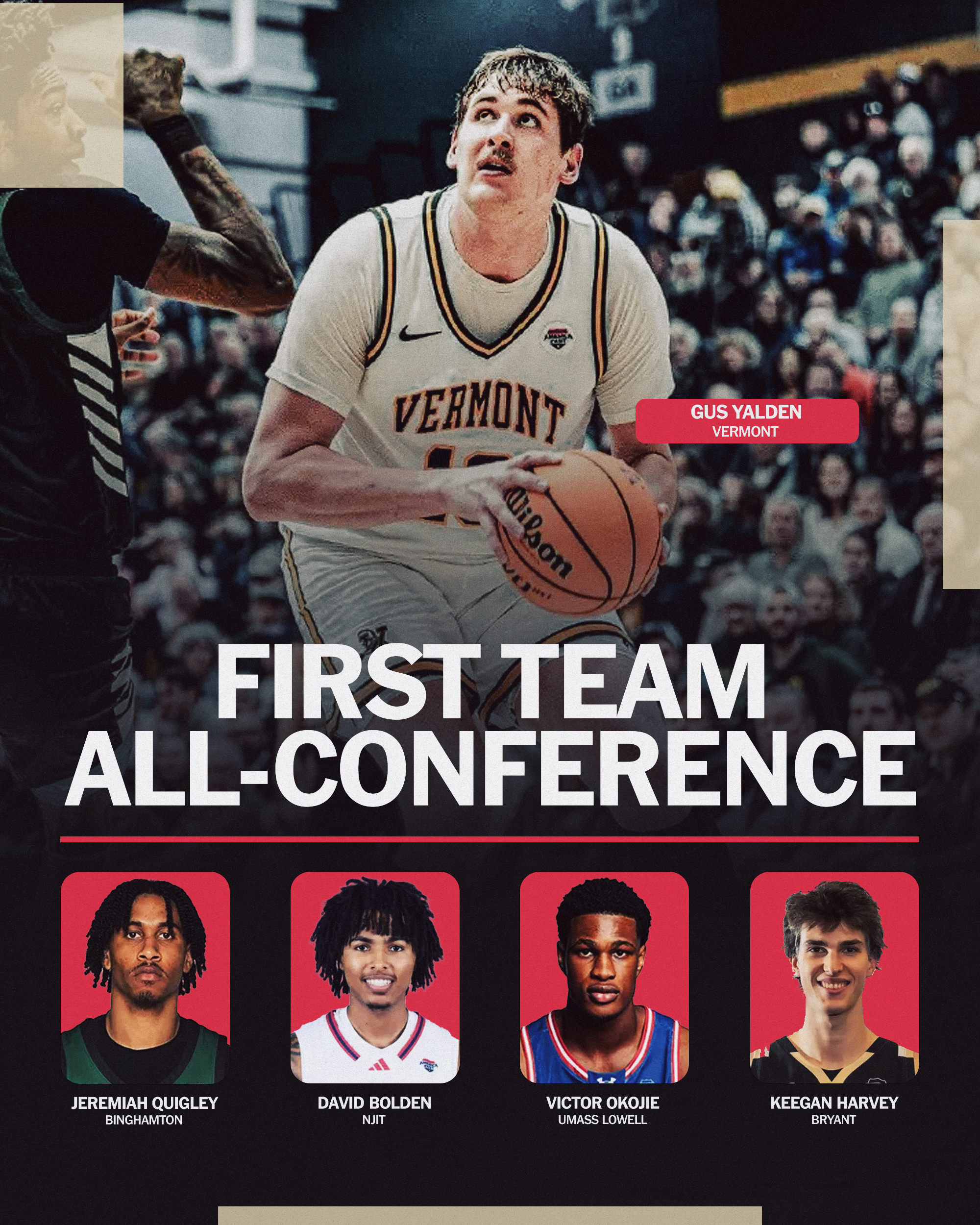
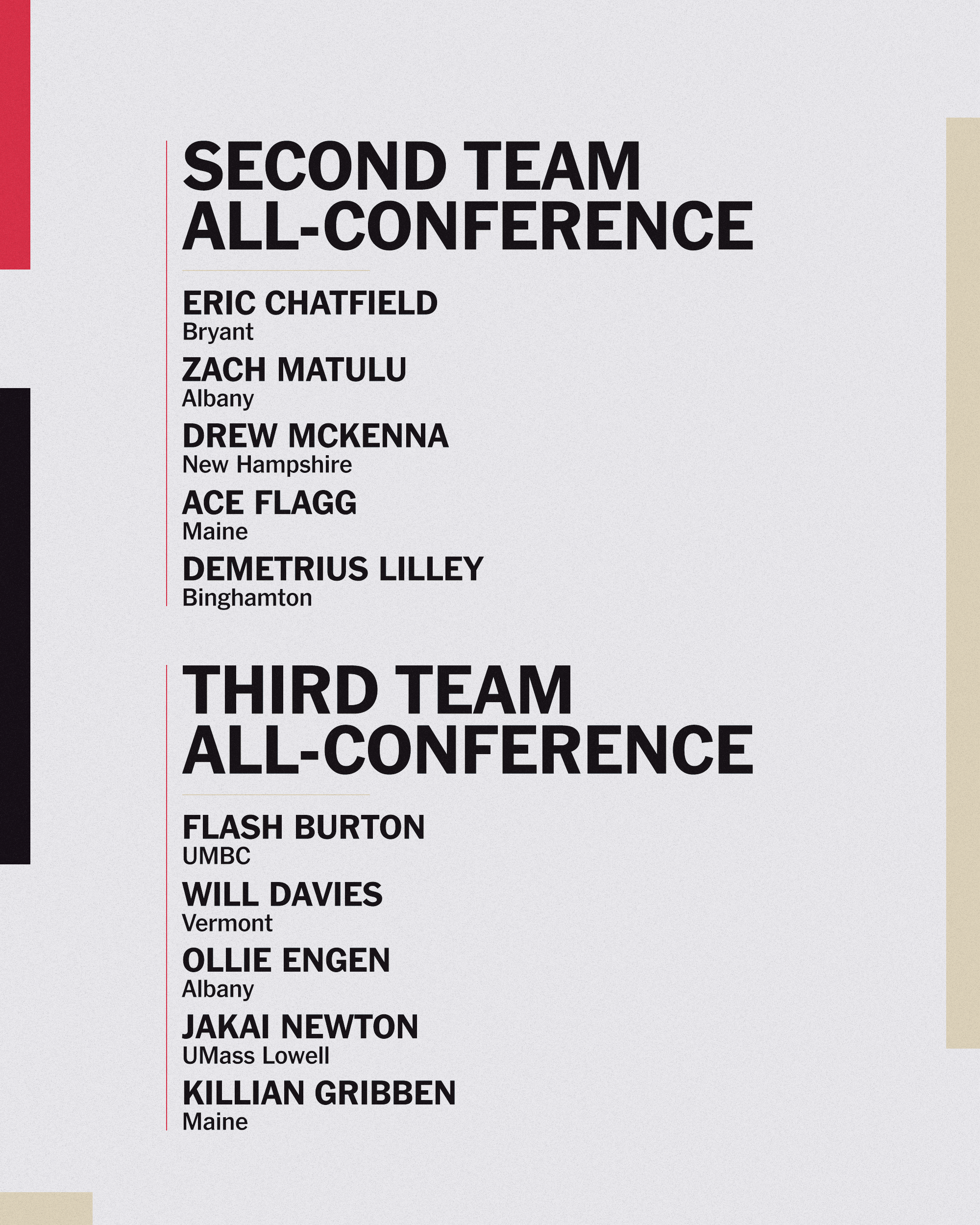
1. Vermont | 2. Bryant | 3. UMass Lowell | 4. Maine | 5. Albany | 6. Binghamton | 7. New Hampshire | 8. NJIT | 9. UMBC
Vermont
Key Returners:
Gus Yalden, Noah Barnett, Momo Nkugwa
Key Newcomers:
Will Davies, Darrel Yepdo, John Broom, Khalil Badru, Daniil Glazkov
Key Losses:
TJ Long, TJ Hurley, Sean Blake
Roster:

Reasons for Optimism:
The Gus Bus has returned for 2027.
Vermont's offense will revolve around the big man in the middle. Yalden is one of the nation’s most prolific per-minute scorers (25 points per 40 minutes) thanks to a savvy and varied offensive game. He’s basically unstoppable as a one-on-one back-to-the-basket scorer (1.01 post-up PPP), especially when he can back his man down and spin underneath to his right hand. However, you can’t double team him because he has elite passing vision from the post (1.17 PPP when hitting cutters, over two assists per game). And forcing him out into space typically doesn’t work because he’s an awesome pick-and-pop 3-point shooter (1.02 PPP) who can put the ball on the floor a little (1.03 PPP when attacking the rim).
6’9 Gus Yalden is bringing post play back! The sophomore has been a force this season for @UVMmbb
— Workin It Hoops (@workinithoops) December 23, 2025
• 17.7 PPG
• 4.7 RPG
• 1.5 APG
• 57.7 FG% and 41 3PT%
The Seton Hall transfer has been a monster for the Catamounts. On 5.2 posts up per game he’s posting 1.33 Points Per… pic.twitter.com/WaQGDieuey
Yalden is also the perfect big man for this system. Most of John Becker’s best offenses run four-out with a burly scoring-and-passing hub in the post (Ryan Davis), or five-out with a stretch forward at the five (Matt Veretto). The Gus Bus can do both.
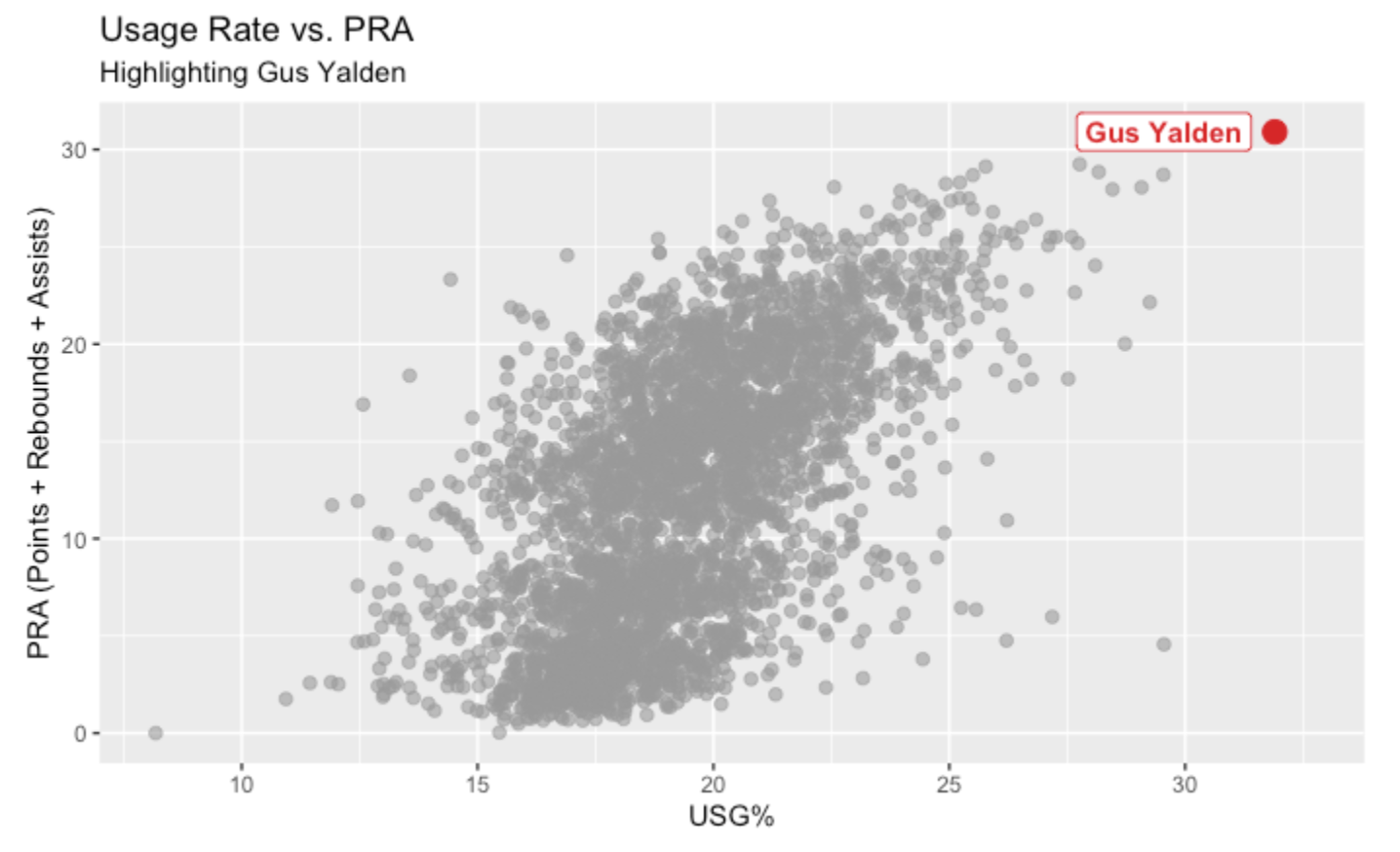
For what it’s worth, Torvik projects Yalden to lead the nation in PRA this season (31 on a 32% usage rate).
But we know what we’re getting (and what we’re not getting — more on that later) with Yalden. The roster around him will decide the Catamount ceiling.
Last year’s perimeter group was built on skill and shot-making, but they sacrificed defense and athleticism for 3-point percentages. They ultimately didn’t shoot well enough to run an elite, skill-based motion offense (33%, 208th nationally).
“I think that the problem with last year’s team was that we were built to shoot the ball and space the court, and we didn’t shoot the ball as well as we should have,” Becker said in an interview with Basket Under Review. “We sacrificed athleticism for 3-point shooting, and that reared its head on the defensive end.”
This year’s roster features more athleticism, size, and depth.
“I really like our group,” Becker said. “IQ, athleticism, size, and length. That’s how we went about [building the roster], and I think we’ve done a pretty good job.”
Most of the non-Yalden impact will come from the guards and wings.
I expect the starting backcourt to be Saint Anselem transfer Will Davies and UMass Lowell transfer Darrel Yepdo.
Becker loves bigger guards who can close out effectively in Vermont’s compact man-to-man while also serving as more versatile offensive pieces (Shamir Bogues was mostly a post-up and rim-attacking guard a few years ago). Davies is a 6-foot-5 point guard, and from what I’m hearing, he’s the real deal.
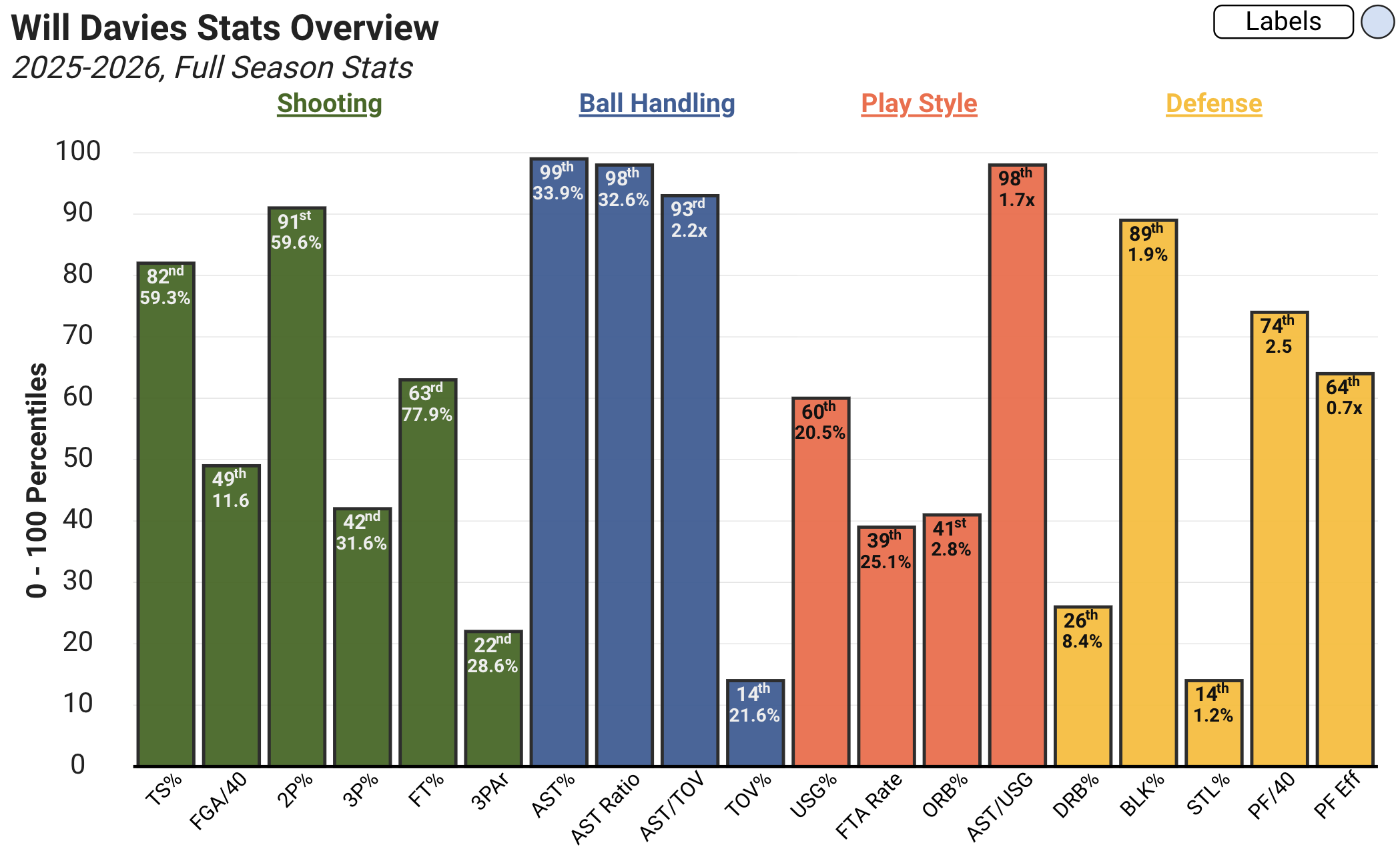
He was the Northeast 10 player of the year last season, posting 15 points per game (62% from 2, 31% from 3), 7 assists per game (35% assist rate), and a 22% usage rate.
“He’s a better-shooting Robin Duncan,” Becker said of his new point guard. “He’s not quite as big or versatile, and I don’t want to compare him to one of my favorite players of all time, but he’s a 6-foot-4 high IQ player who can really pass.”
Basket Under Review spoke with another Vermont buddy of mine, team play-by-play radio broadcaster Brian McLaughlin, about the backcourt rotations.
“Davies is so awesome,” McLaughlin said. “He’ll throw some wild passes and take some risks, but he really understands the offense, as he ran a similar one for former assistant Chris Santo at Saint Anselm. He’s different from Sean [Blake] in that he’s not as explosive downhill, but he’s a very willing passer and will shoot it more often.”
I was extraordinarily high on Yepdo last season, and after struggling through the first half of the season, he started to turn it on late in conference play. From February onward, he averaged 12/4/3 on 43%/36%/76% shooting splits, posting several excellent box scores along the way, including:
- 1/31 vs. Maine: 17 points, 6 assists, 6 rebounds, 6-for-8 (2-for-3), +20
- 2/12 vs. Bryant: 22 points, 4 assists, 8-for-13 (4-for-8), +25
- 3/7 vs. Albany: 17 points, 8 assists, 2 steals, 5-for-12 (4-for-8)
He’s much smaller than the rest of the backcourt, standing 6 feet. But he has a wide frame and quick hands, and he was a good POA defender at the Division II level a few seasons ago. Personally, I think he struggled defensively last year because he played for a River Hawk team that doesn’t care about staying in front of the ball, and things could really turn around under Becker.
“Yepdo’s shooting splits will be the key,” Becker said. “But he brings tremendous leadership and work ethic. Between him and Davies, you have two Division II players with a lot of success who can play both on and off the ball.”
I expect Davies to play mostly on the ball, and the hope is that Yepdo shoots well off the ball. I have faith that will happen — he still posted .98 PPP on catch-and-shoot jumpers last season despite slumping for three months.
The other key backcourt figure is Momo Nkugwa.
He still has a shot at starting, but I picked him for Sixth Man of the Year because he was such a shot in the arm off the bench last season, and I could see him taking on a similar role this year. For a squad that sorely needed athleticism and off-the-bench playmaking, he was a sparkplug who brought an innate ability to finish at the rim and pesky defense on the other end — and he was only a freshman!
The Catamounts closed with frosh Momo at PG, and he gutted out some tough buckets in that unlikely win. Improving with each game. Starting to become a big fan. pic.twitter.com/cm6qyR0MCq
— Tanner McGrath (@tannerstruth) January 13, 2026
“For Momo, the sky’s the limit,” Becker said. “If he can continue to shoot the ball well in games, he’s going to be a tough cover because of his ability to get to his left hand and finish above the rim. He also gives us another high-level defender and rebounder.”
I expect the wing corps to be held down by South Alabama transfer John Broom, Iona transfer Khalil Badru, and Loyola Chicago transfer Daniil Glazkov.
Broom is a strange case. He’s a very low-usage guard/wing tweener who has mostly been a defensive stopper, but his defensive metrics may have been propped up by playing in USA’s SuperZone.
However, the staff is extremely high on him.
“I think John Broom has been our best two-way player so far,” Becker said. “He has maybe been our most impressive guard.”
“If the season starts today, it’s John Broom,” McLauglin said after I asked him who might start at the three. “He is an extremely instinctual rebounder, the ball seems to find him around the rim, and he’s shot 41% from 3 on limited attempts, which probably gives him a slight edge over Badru.”
I adore Badru. He essentially turned into New Hampshire’s best player two seasons ago. The Wildcats were a vastly different team when he was on the court (13-point increase in Net Rating), as the 6-foot-5 wiry freshman carved out a spot as a small-ball four who created paint points (off-the-bounce driving to his left or via cuts), obliterated the offensive boards, and played good multi-positional defense (adding plenty of steals). He really found his stride late in the season after his 3s started falling, forcing defenders to respect him on the perimeter, and then taking advantage in isolation and as a surprisingly good ball-screen operator.
He’s probably still best suited as an athletic off-ball wing slasher, board-smasher, and versatile defensive chess piece — he fits this defensive scheme well with his length and closeout ability. Unfortunately, he couldn’t hit the broad side of a barn at Iona, and that might limit his minutes in this offense.
“Khalil has the potential to be Defensive Player of the Year in this conference,” Becker said. “His athleticism is through the roof. His motor is terrific. He’s still working on his shooting, but he’s really good in transition, and he’s relentless on the offensive glass. He can play the one through five, which gives us a lot of flexibility”
I think Glazkov will mostly be a wing spacer as a low-usage 38% 3-point shooter, although Becker said he has the potential to be much more.
“He’s a really high-level player, standing 6-foot-6 with wide shoulders,” Becker said. “He was asked to be more of a 3-and-D guy at Loyola Chicago, but after watching his IMG tape where he was playing point guard, we know he can play one through four. He can play in actions, coming off ball screens and handoffs, while guarding multiple positions.”
Causes for Concern:
The AmEast Media Conglomerate (which is really like a half-dozen other guys and me) has crowned the Catamounts off-season champs in back-to-back seasons, but they weren’t good enough to get over the hump either year. Two seasons ago, they couldn’t score enough. Last year, they couldn’t get enough stops.
What’s going to be different this year?
“Our staff and I have learned how to construct a team in this new era,” Becker said, referring to the past few years of NIL and the transfer portal. “With Gus, Noah, and Momo back, I thought we did a good job of building around that and getting complementary pieces.”
While Vermont likely has the best top seven or eight in the conference, I have two major concerns and two minor concerns.
First Major Worry: I wonder whether building a solid defense with Yalden at center is just too difficult. He’s a monster liability with his slow feet and lack of verticality.
I think about last year’s AmEast championship game against UMBC. The Catamounts switched everything against UMBC’s guards, and it worked … for about 30 minutes until Yalden ran out of gas.
“I think he’s taken his conditioning much more seriously this offseason, and he’s moving much better,” Becker said. “That is absolutely an area he has to improve in. He needs to be solid defensively and, from a conditioning standpoint, be able to exert the required effort and still have enough for the offensive end.”
“You can only hide it so much,” Becker continued. “But we’ve always done a good job of accounting for certain guys. We’ll come up with schemes and things like that.”
The good news is that more athleticism around Yalden should make him easier to hide, even when he plays big minutes. Even better news: the Cats got Noah Barnett back.
Barnett is limited on offense, but he’s a stud on defense — he was probably the best big-man defender in the conference last year. He’s vital for protecting Yalden on that end of the court, providing the rim protection and interior defensive mobility his running mate lacks.
Noah Barnett one of the best defenders in the AmEast. Vermont's defense far more physical when he's on the court. pic.twitter.com/srmDFf5FTI
— Tanner McGrath (@tannerstruth) February 23, 2026
The whole team just seems more physical and aggressive when he’s on the court. His motor is contagious. The Catamounts’ defensive rating dropped six points when he was on the court last season.
First Minor Worry: Frontcourt depth behind that duo. Vermont will run plenty of guard- and wing-heavy lineups, which helps, but they’ll still need a few more bodies.
The Cats brought in two Euro guys, Marko Masic and Sublime Gbiegba, and a JUCO up-transfer, Mario Brunetto, to be those bodies.
Among those three, I think I’m highest on Masic. He played in the German pro league as a long, mobile forward with positional size, versatility, and some ability to stretch the floor. Brunetto has a little Division I experience after starting his career at Eastern Michigan.
At minimum, all three bring length — Gbiegba is 6-foot-8, Masic is 6-foot-9, and Brunetto is 6-foot-11. But they’re all old and bring plenty of basketball experience, even if not all of it was at the NCAA Collegiate level.
Second Major Worry: shooting and floor spacing.
Becker sacrificed athleticism for shooting last year, so this season he had to sacrifice some shooting for athleticism. This roster isn't devoid of shooting (Glazkov, Yalden), but key rotation guys are either streaky shooters (Yepdo, Davies, Broom) or non-shooters (Barnett, Nkugwa, Badru).
Of course, Becker and other Catamount staff members will tell me about the improvements many of the guys have made in the shooting department (Badru, Broom, Nkugwa), but that could be just CoachSpeak.
I need to see it on the court, and if it’s not there, Becker’s four-out motion offense could break down. Yalden needs interior space to work his magic, or he’ll see more effective doubles and be forced to catch the ball farther from the basket, where his efficiency drops.
Second Minor Worry: Before I check out entirely, I want to mention one other thing about two-way rebounding and open-court play.
Becker has long emphasized transition defense over offensive rebounds, and the Catamounts have always been elite at transition defense and defensive rebounding. However, he’s increasingly talked about sacrificing some transition defense for more offensive rebounds. I wonder if that’s just the talk of the town among Division I coaches.
🏀 Illinois head coach Brad Underwood explains his why he changed his rebounding philosophy, their simple rebounding rules, and how these changes helped Illinois become the No. 1 team nationally in recovering missed threes. pic.twitter.com/Zwg12iiVCP
— Coaching U (@Coaching_U) October 19, 2026
Becker still hasn't fully implemented a faster-paced, more aggressive style, but this roster fits that mold more than any of his past squads. That’ll be something to monitor very, very closely.
Bottom Line:
Vermont likely has the conference’s best starting five, best depth, and best player.
But we’ve said that multiple times over the past few seasons, and it hasn’t been enough. Additionally, I think the conference has improved mightily this year — I expect Bryant, Maine, Binghamton, Albany, and New Hampshire to all bounce back after performing like a collection of dumpster fires last year. It’s not like the Cats are head and shoulders above the rest of the pack.
Can Vermont actually piece together a good defense around Yalden? The Cats have more athleticism and depth than last year, which gives them a good shot. But that added athleticism comes with less shooting, which could sink a Becker-led four-out motion offense.
Time will tell. For now, though, Vermont is again the America East favorite.
Bryant
Key Returners:
Keegan Harvey, Ty Tabales
Key Newcomers:
Eric Chatfield Jr., Andre Pasha, Onyx Nnani, Duane Thompson, Connor Lyons
Key Losses:
Timofei Rudovskii, Quincy Allen, Aaron Davis, Ashley Sims, Jakai Robinson
Roster:

Reasons for Optimism:
I was hard on Coach Jamion Christian last season. I often wondered why the administration hired him instead of promoting someone from within.
However, I realize I may have been too hard on him. He had to finish his contract in Italy before he could fully dive into building his collegiate roster. Instead of picking his portal additions, Christian had to lean on freshmen, with the Bulldogs ranked 358th nationally in average Division I experience (0.37 years).
“I was commuting between Italy and Smithfield while we were trying to build a team,” Christian said in an interview with Basket Under Review. “That put us in a tough spot where we didn’t have a lot of experience on the roster, so we decided to get some talented young guys and see if we could get hot at the right time.”
Well, Christian and Co. had a full offseason to build a roster their way, which, per Christian, consists of four types of players:
- Combination Forwards (or Conductors)
- CEOs
- Spies
- Snipers
It starts in the frontcourt, where Bryant has arguably the most versatile, highest-upside collection of players in the Low-Major landscape.
“I love guys at the four and five who we call Combination Forwards,” Christian said. “These are guys who can post up, shoot, and move the ball. I want to be able to throw the ball into the post and settle our team, and I expect these guys to conduct the offense by making sure the ball moves from one place to another, and then scoring when they have the opportunity to finish.”
Returning big man Keegan Harvey has long been heralded for his versatile skill set — specifically, he’s a 6-foot-11 big who can post up, shoot the 3, and pass. But he’s also long been known as a high-upside guy because he couldn’t stay healthy.
That is, until last season. Over the final 11 games, Harvey averaged 18/7 on 64%/59%/88% shooting splits. He was a monster in Bryant’s AmEast Tournament loss to Vermont, dropping 21/5 on 6-for-7 shooting from the field, 3-for-3 from deep, and 6-for-6 from the charity stripe.
He was easily the conference's most improved player in the conference —he was playing like a true POY candidate by the end of the year.
Aussie, Aussie.
— Bryant Men's Basketball (@BryantHoops) February 13, 2026
Keegan Harvey posted a career high 28 pts, 10 reb and 3 blocks on Thursday at UML. pic.twitter.com/ld84jWpc1S
“He has a very unique skill set with his shooting ability and ball-handling, but he hadn’t played a lot,” Christian said. “It was more about when it was going to happen.”
Andre Pasha is another combination forward, especially with his ability to play away from the basket at 6-foot-9. He’s really skilled — he loves isolation matchups, is an excellent shooter off the bounce or the catch, and is a pretty good passer. He’s also a good rebounder. I loved watching him at New Haven.
Film Class
— Bryant Men's Basketball (@BryantHoops) October 10, 2026
We love bigs and Andre Pasha is one to love. pic.twitter.com/jms7W0A8N3
Pasha isn’t exactly a big-time interior presence, but he likely won’t have to be when he plays alongside Harvey.
Onyx Nnani is the X-Factor. He’s a 6-foot-9 guy who moves and dribbles like a guard. He didn’t get any opportunity with Bryan Hodgson at South Florida, but he will in Smithfield.
He’ll be one of the biggest wings in the league,” Christian said. “He’ll play some three and two for us.”
The thought of a fully unleashed Nnani playing the two in the America East sends shivers down my spine.
2025 Onyx Nnani of Phelps with some impressive plays against Perkiomen in the State Championship. pic.twitter.com/r7myRYjQfF
— RareFootage (@RareFootageNews) March 5, 2024
“We feel we have a really good collection of frontcourt players,” Christian said. “If the big is below you, they can pop out and make that shot at a 35% or 36% clip. If the big has to show out because [Eric] Chatfield can turn the corner, our guys can affect the game on the roll. If the help guy comes over, they can make the next pass.”
“I don’t know if there are a lot of frontcourts like that in the country,” he said as I nodded enthusiastically.
That’s a good segue to the CEOs segment, who are “point guards or guys who organize the offense,” as Christian said.
Eric Chatfield will take over point guard duties this season. He didn’t get to showcase his skills at Georgia Tech, but he was a phenomenal high school prospect with his wizardry off the bounce as both a scorer and passer. He’s quick and shifty with great vision — he could be deadly in ball screens. Based on pedigree alone, he could be one of the best scorers, or players, in the conference.
“When we played at Georgia Tech last year, I said to the staff during the game that if they want to win, they should play him more,” Christian said. “He can get the ball to other guys in a way that they could score. It’s been great watching him elevate these guys around here.”
Eric Chatfield is a high IQ guard who doesn't need much time or space to connect on jumpers from around the perimeter.
— Shun Williams (@OntheRadarHoops) December 13, 2023
📌:
@Jr_OTRH @coachswhite @Pace_Hoops @JrChatfieldEric pic.twitter.com/P2kemKYOAQ
Our guy Matthew Winnick wrote that Chatfield’s best AmEast comp is Amir Lindsey, which struck a chord with me because they have similar frames.
“I think in the worst-case scenario, he has an Amir Lindsey type of year,” Christian said, surprisingly. “Lindsey had an incredible year, but Chatfield is probably a Player of the Year candidate. He’s really going to score the ball, assist it, and he’s a phenomenal on-ball defender.”
But Chatfield’s most important job might simply be taking Ty Tabales off the ball, letting him become a Spy.
“Spies are basically scorers and finishers for us,” Christian said. “These are guys who can go and score the ball and do so in different ways, maybe off-script from the offense, but also within the flow — guys who can get to the rim, make an outside shot, or hit a pull-up.”
“Guys like Tabales fit that category.”
Tabales had some hype out of high school, but he went through the classic ups and downs of a Freshman point guard. It’s hard to blame him given his on-ball responsibilities were absurd. He was never a great ball-screen initiator or even a true point guard, and in his first collegiate season, he tried to do everything for the Bryant backcourt.
“He would’ve never played point guard for us before,” Christian said. “But he played much better down the stretch.”
That second part is true. He started to clean up the TOs as the season progressed, and he played much better on-ball defense (he finished fourth in the league in steals).
Also, I don’t think he could shoot as poorly as he did last year. He was dreadful, canning 21% of his 5.4 3-point attempts per game. He was a good shooter in high school, but he went through a full 30-something game season of bad bounces, the yips, or some unexplained extraterrestrial phenomenon that moved his 3-point jumpers three feet off line.
“I think his shooting will improve just by having a chance to play off the ball more,” Christian said. “I think the ability to go and play more freely on offense, where the ball isn’t in his hands all the time, is really going to benefit him. People in the Northeast know how good of a scorer he can be, and he should be able to settle into that role with the CEOs we have beside him.”
At minimum, Tabales should get more open catch-and-shoot opportunities now that he’s not handling the rock for 30 minutes a night.
“He can also impact the game defensively,” Christian continued. “He will have better ball pressure beside him with Chatfield or Nnani, and he’s great at jumping the passing lanes.”
Finally, I’ll touch on Snipers, which should be pretty self-explanatory.
“These are great outside shooters who can really space the floor,” Christian said.
A few Bryant Snipers are worth discussing, but the most interesting is Connor Lyons. He averaged 17.3 points per game last season behind 116 made 3s at the Miller School. At 6-foot-8, he’s got crazy positional size for a shooter, and he could carve out a rotational 3-and-D role.
‘26 @STABHoops/@TeamLoadedBBall wing Connor Lyons checks plenty of boxes that college programs are prioritizing.
— Colby Giacubeno (@ColbyGHoops) August 20, 2024
▫️Elite outside shooting presence
▫️Solid positional size
▫️IQ as a mover w/o the ball
▫️Embraces his role
21.5PPG shooting over 42% from 3 in @DMVHoopsLive S1 https://t.co/Oke44HK5Yr pic.twitter.com/aFMUEJe3wS
Causes for Concern:
We'll learn a lot about Coach Jamion Christian this season.
Bryant will be one of the nation’s biggest teams. The Bulldogs have seemingly unlimited versatility and upside, especially on offense. Tabales is a clear bounce-back candidate in his new role, and Harvey is a legitimate POY Candidate. Everything seems to be falling into place.
The question is whether Christian can pull it all together, because there are reasons to doubt his coaching acumen.
The offense went through several different phases last year. Christian began the year with a plodding, motion-based offense that generated plenty of catch-and-shoot jumpers for bad 3-point shooters (Bryant led the league in 3-point attempt rate while ranking last in effective field goal percentage). He then tried running a more spread PNR approach spearheaded by Tabales. Finally, he ended the year relying more on big-to-big DHO actions with Harvey and Timofei Rudovskii — that approach seemed to work the best.
This year, expect more of a post-heavy approach with a web of off-ball motion-based concepts around the perimeter.
“We want to be a team where we have good balance, and balance means we can play through the post,” Christian said. “If you switch on Harvey or Pasha, we’re going to throw the ball inside and attack you.”
“We’re also not as crazy pick-and-roll heavy as we used to be when I was at Mount St. Mary’s,” Christian continued. “We will definitely play more off the ball and use more motion concepts. I think we have a good identity where we can play through the post, but we have strong penetration threats between Chatfield, Tabales, and Nnani.”
For what it’s worth, I think this roster could be deadly in that type of offense.
That said, is there enough shooting to make that scheme work? Maybe. Both Chatfield and Tabales have strong shooting pedigrees, but they haven’t shown it at this level. The same goes for Nnani. The same goes for the Freshmen depth pieces like Lyons.
Chatfield handling the rock more should help with last year’s crippling turnover issues (351st nationally in turnover rate last season). At the same time, Harvey is still a turnover machine, Pasha can be loose with the rock, and Tabales still needs to prove he can decrease his turnover rate alongside his usage.
Last season, I fully expected Christian to install the havoc-based defenses he was known for at Mount St. Mary’s. Instead, the Bulldogs took a far more conservative approach by leaning into the squad’s positional size and switchability. While they finished last in the conference in defensive rating (112.2), I didn’t mind how they played — they forced a lot of isolation possessions and denied catch-and-shoot jumpers effectively — and I thought they mostly got unlucky with opponent 3-point variance (35% allowed, dead last in the AmEast).
“Last year, we just didn’t have the foot speed for it, but we’ll get back to pressuring the ball more and being more aggressive,” Christian said. “Each year, I’ve kind of backed off our pressure point, and our defense has gotten worse and worse.”
But this year’s roster also has tons of positional size and switchability. I can easily see this defense being very similar to last year’s, with Harvey as the anchor and Tabales at the POA. Then again, Chatfield and Pasha are far quicker laterally, and Nnani can really move. Will Bryant’s massive, mobile defenders be monsters in the paint and on the perimeter? Or will they just take up space?
I also haven’t touched on the depth, mostly because it’s pretty unproven and I know little about it. Six freshmen are projected to be on the bench, along with a JUCO up-transfer.
In our interview, Christian hyped up Duane Thompson, Tim Nwanko, Elijah Crispin, Elijah Hayeems, and Lyons.
Thompson will be a Frontcourt depth piece, but he was underwhelming at St. Bonaventure. Nwanko also projects as a Combination Forward. I expect Crispin to run point (or CEO) when neither Tabales nor Chatfield is handling the rock. Hayeems projects as a lengthy combo guard (6-foot-6).
Bottom Line:
It’s easy to imagine this team being awesome, but it's more hypotheticals than proven production. Additionally, I need to see Christian find and implement a two-way identity — roster talent and upside mean nothing without coaching (see: Dwayne Killings).
“I think if you want to be a really good Mid-Major team, you want to be a little different,” Christian said. “Whether you’re pressing all the time, as we did at Mount St. Mary’s, or playing zone, as Joe Gallo does at Merrimack. That identity piece is very important.”
The question becomes, what will we remember Jamion Christian’s Bryant Bulldogs for?
Personally, I’m cautiously optimistic, even bullish, on Bryant’s prospects.
I adore the roster. The Nnani/Pasha/Harvey frontcourt offers unlimited offensive versatility: all three can dribble, pass, shoot, and post up, and they’re all massive. Chatfield could be one of the best point guards in this league based on pedigree alone, and Tabales is in line for a bounce-back season now that he’s getting moved off the rock.
Sure, this all needs to happen on the court, rather than in our collective AmEast imaginations. But I think there’s too much talent and size to ignore.
UMass Lowell
Key Returners:
Austin Green**, Victor Okoji, Isaiah Walter
Key Newcomers:
Jakai Newton, Jayden Harris, Christian Jones, Kenyon Giles, Jasiah Cannady, Elhadji Diallo
Key Losses:
Xavier Spencer, Darrell Yepdo, Angel Montas, Shawn Simmons, Jared Frey, JJ Massaquoi
Roster:

Reasons for Optimism:
Pat Duquette won’t change for anyone.
Two seasons ago, Lowell pieced together one of the most talented rosters in its Division I history. The core of Quinton Mincey, Max Brooks, Cam Morris, Yuri Covington, and Martin Somerville was expected to terrorize the America East.
That team fell flat on its face, partially due to bad luck, but also because it coupled an elite offense with turnover problems and an apathetic defense.
That offseason, Coach Duqette lost his entire roster. Yet he rebuilt a squad that looked much like the year before. Led by slashing forward Angel Montas (20 PPG in conference play), the River Hawks paired a dangerous offense with turnover problems and a troubled defense.
This all comes back to how Duquette wants to play. He’s not one of those malleable coaches who adapt to their personnel. Instead, he’s really good at finding guys who can thrive in his system, getting them to buy in, and squeezing the best possible performance out of them.
The Hawks run an up-tempo flex-adjacent offense that emphasizes transition buckets, rim-running cutting, paint points, and offensive rebounds. Year in and year out, they’re the league’s most rim-dependent and rim-dominant offense. Typically, they run the offense through the frontcourt and score in bunches (despite essentially avoiding the 3-point shot).
“That’s always been the centerpiece of our offense,” Coach Duqette told Basket Under Review in an interview. “The incoming guys buy in quickly when they know we’re going to play fast and score a lot of points.”
Even as Lowell prepares for another roster rebuild — five of the top six scorers from last season are gone — I mostly expect the same things from a Duquette-led team.
That begs the question: which forwards will anchor this attack?
I think it starts with Victor Okojie.
Okojie didn’t see much time on the court last year, but I thoroughly enjoyed every minute he played. He’s a versatile, cerebral, athletic forward who’s capable on the ball (scoring or passing) and dependable as a multi-positional defender (he led the team in DBPR last season, though that’s not saying much). He’s also a monster on the boards (seven rebounds per 40 minutes last season), good in transition (1.29 PPP, 66th percentile), and I think he’s a better shooter than his numbers suggest.
“He’s tough, and he makes winning plays,” Duquette said of his Sophomore forward. “I think he’s capable of producing significantly more.”
Overall, Okojie has the upside to be a lead forward this season. He played like one for Ireland over the summer:
UMass Lowell forward Victor Okojie led Ireland to their best finish ever at the FIBA U20 EuroBasket Division B. The 6’9” Okojie averaged a double-double as Ireland took home fifth place honors
— Baseline Drift (@BaselineDrift) July 22, 2026
14.0 PPG
10.3 RPG
2.7 APG
1.9 SPG
1.4 BPG
41.8% FG pic.twitter.com/m2sAS6HEZt
The other two frontcourt names to watch are Austin Green and Elhadji Diallo.
Green is a 5-for-5 candidate whose eligibility is still up in the air, but Duquette and his staff are treating the case as if he’s good to go. He was a third-team All-Conference guy last season as a typical Lowell paint-bashing forward — he averaged eight paint points per game as a roller (1.11 PPP), poster (.85 PPP), and offensive rebounder (3.5 per game, four second-chance points per game, 1.22 PPP).
“He’s in great shape,” Duquette said of Green. “He’s even stronger, and he’s a big piece of our team.”
Somehow, Duquette snagged two top-300 recruits this offseason, beating out Chris Jans and Mississippi State for both.
Diallo, the first of those recruits, is a 6-foot-7, 200-pound, above-the-rim power forward who should fit perfectly as a cutter, roller, poster, and offensive rebounder who can finish through contact. Given Duquette’s penchant for brutalizing scoring forwards, he should get plenty of minutes.
The other top recruit is Jasiah Cannady, a playmaking score-first guard with a wicked handle and a decent jumper (though I think it needs a bit of work).
“I think we’ve done a great job of recruiting high school kids for a long time, and I’m committed to doing that every year, even as more coaches are focusing on the portal,” Duquette says. “[Diallo and Cannady] have already shown why they were highly rated because they’re immediate-impact guys. They’re both in the rotation, and they’re both going to play.”
The rest of the backcourt and wing corps will be a trio of veteran transfers: Christian Jones from Siena, Jakai Newton from Georgia State, and Jayden Harris from Eastern Kentucky.
I'm not a big fan of Jones. He’s a decent off-ball shooter but can’t do much else (he posted a -2.57 BPR last season, ranking 85th among 101 Metro players). Given his 5-foot-11 frame, I’m not enticed by his potential point-of-attack defense. I won’t be surprised if Cannady quickly snatches his job.
Harris didn’t do much at Eastern Kentucky last season, but he seems like a low-usage connecting wing who can hit some open 3s, crash the offensive glass, and wreak havoc in transition (1.47 PPP).
Newton is the X-Factor. He was a four-star frosh recruit at Indiana just two seasons ago. He’s the best athlete in the conference, and he’ll look to leverage that athleticism into downhill dominance as an on-ball slasher and rim finisher. Given his relatively short Division I history, he has a wide range of outcomes, but the upper end of his projection is tantalizing, and I like the idea of him and Cannady sharing ball-handling duties.
“I will say that the incoming four-year transfers are very talented and have more experience,” Duquette told me. “They’re all going to be in our top seven and will play significant minutes.
I also expect Kenyon Giles to fit somewhere in the backcourt rotations, but I just don’t know where. The 6-foot off-ball sharpshooting southpaw guard averaged nearly 15 PPG at the JUCO level last season.
Causes for Concern:
Duquette mentioned something to Ryan Restivo of Blue Ribbon that I thought was fascinating.
“We’ve got as good of size in the frontcourt as we’ve ever had, and if we play Newton and Harris on the wing, they’re huge for that position.”
Okojie and Green played 126 minutes together last season, and those lineups posted an even 100 defensive rating (95th percentile) — Diallo has some defensive upside as well. Pair that trio with lengthy, versatile wings playing free safety in a drop-coverage scheme, and you’ve got the ingredients for a downright good defense.
But I repeat: Duquette won’t change for anybody.
He’s assembled an enigmatic crew with undeniable talent and upside, but I often wonder whether Duquette is more a floor-setter than a ceiling-raiser. Put another way, I’m more confident that the River Hawks will have an elite offense rather than a good defense.
Here’s what bothers me the most about Lowell’s defense over the past three seasons:

The dribble defense has been atrocious, so they allow paint touches in droves. Although their rim protection isn’t awful (partially because they play drop and funnel toward the middle of the floor), it ultimately doesn’t matter when nobody can stay in front of the ball.
Duquette never found a replacement for Ayinde Hikim. This season, I think Newton and Cannady have a very high offensive ceiling. But the Newton/Cannady/Jones/Giles backcourt quartet has a very low floor on the other end, especially at the point of attack.
When asked about his team’s defensive woes over the past few seasons, Duquette responded:
“I don’t know what the numbers are, and I don’t pay much attention to them. Every coach emphasizes defense, and anybody who tells you differently is crazy. You do the best you can with the guys you have, but you’re only coaching them for nine months, and it’s not like we have this super strong defensive culture in place.”
That’s not exactly a ringing endorsement of this squad’s defensive prowess.
As a final aside, turnovers are another staple of Duquette-led teams. The River Hawks love to play fast and throw the ball away, especially because they constantly plow headfirst into crowded lanes and loathe shooting 3s.
I’m not sure I trust this backcourt not to fall into that habit. Neither Newton nor Jones has been a high-usage Division I option, and I can imagine Cannady facing the typical ball-security issues that plague many Freshman guards (see: Ty Tabales).
Bottom Line:
The 1,000 words I just wrote boil down to this: I’m expecting another typical River Hawk team.
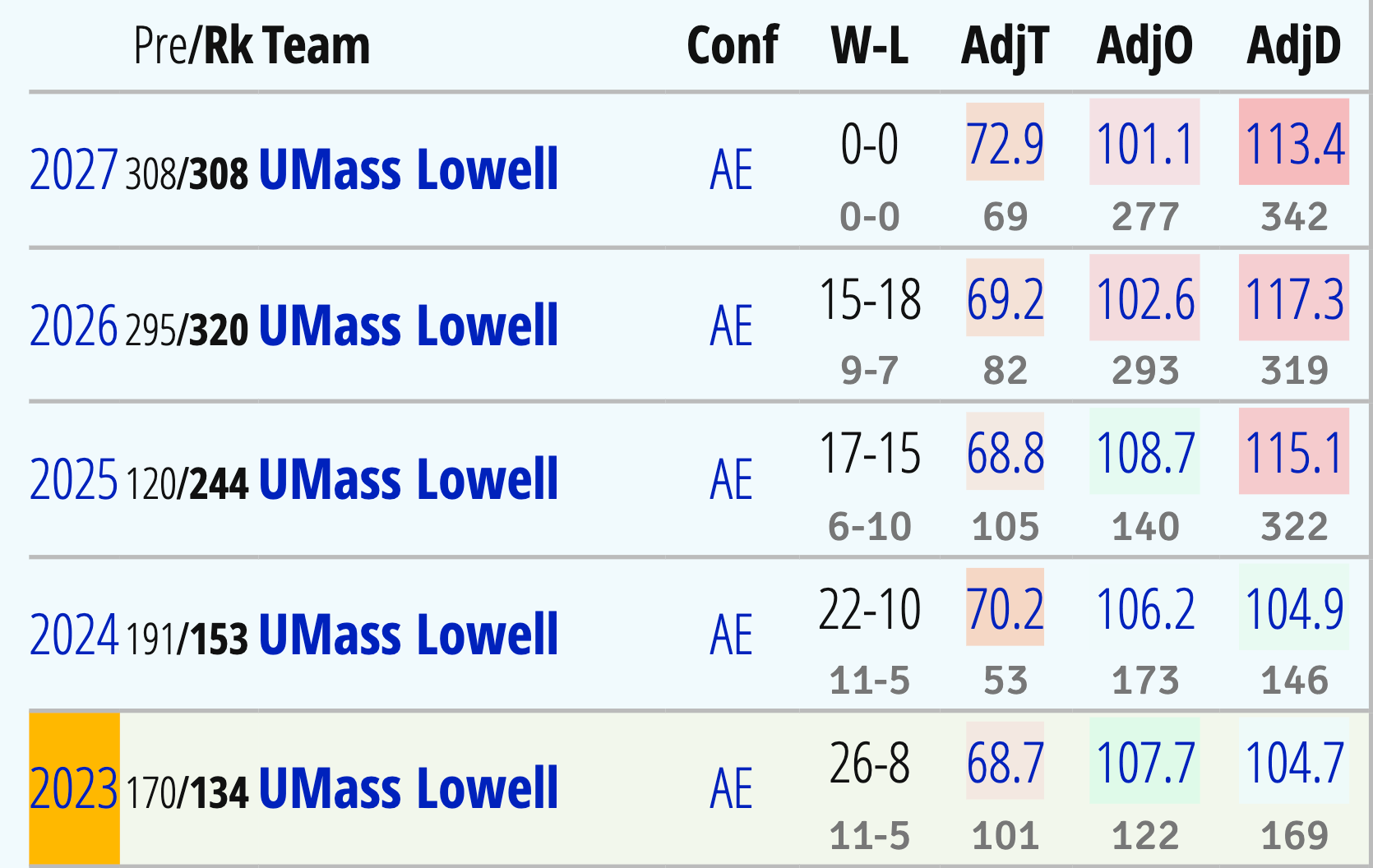
I think they’ll play fast, shred in transition, dominate the rim, score in bunches, throw the ball away plenty, and have zero interest in playing defense. I project them to finish second in the conference in offensive efficiency and seventh in defensive efficiency.
Like most of Duquette's teams over the past half-decade, that probably equates to around 10 conference wins, which should be enough to host a Conference Tournament game.
Maine
Key Returners:
Ace Flagg, Killian Gribben, Darius Lopes, Caleb Crawford, Yanis Bamba
Key Newcomers:
DeAndre Williams, Villiam Garcia Adsten, Oliver Faubert, Ayden Evans, Wyatt Triestman, Wesley Waddles
Key Losses:
Keelan Steele, Logan Carey, Ryan Mabrey, Mekhi Gray, TJ Biel
Roster:

Reasons for Optimism:
It’s become clear to me that Chris Markwood is the best coach in the America East.
Despite several critical injuries last season, including season-ending injuries to two starters, Markwood picked up the pieces and found a way to win six conference games (though only after a 0-11 start in non-conference play). He consistently lifts the floor for the often under-resourced Black Bears, and his 2-3 zone traps are the best in the business, confounding every other coach in the conference.
The Markwood defense should be the league’s best, even if just because of length. Returning center Killian Gribben is 6-foot-10, and the Bears brought in frontcourt transfers who stand 6-foot-8, 6-foot-9, and 6-foot-10. Returning point guard Darius Lopes is 6-foot-4, and the Bears added backcourt transfers who stand 6-foot-3 and 6-foot-6. Ace Flagg and Yanis Bamba will also be roaming the wings, standing 6-foot-7 and 6-foot-6, respectively.
“I think we have a very high ceiling defensively,” Markwood said in an interview with Basket Under Review. “We have some really good on-ball defenders, good versatility on the wing, and I love the bodies and athletes we have at the five spot.”
Maine’s defense also has a very high floor. Both Markwood’s zone and man coverages emphasize extended on-ball pressure, and he knows how to coach up perimeter guards while finding under-recruited forwards on the back end. Year in and year out, Markwood’s teams lead the league in defensive turnover rate (19%, 36th nationally) while destroying drive-and-kick offenses with elite dribble defense (.51 dribble jumper PPP allowed and .81 attack-and-kick PPP allowed) and forcing drawn-out, inefficient, late-shot-clock possessions (19-second average defensive possession length, sixth-longest nationally).
Typically, the Black Bears are backcourt-driven, but I want to start this preview in the frontcourt.
Flagg ranked third among AmEast players last season in DBPR (+0.87) and Defensive Win Shares (1.6). Maine’s Defensive Rating dropped nearly six points when Flagg took the court. He racks up steals like crazy (4% steal rate, 98th percentile), but otherwise, he doesn’t exactly pop off the page defensively.
“He’s not going to wow you athletically,” Markwood said. “But he gets it done with great understanding, execution, and toughness.”
Because Gribben suffered a season-ending injury last season, Flagg was forced to play a few too many minutes at the five. With Gribben back to anchor the interior, both should return to their natural frontcourt roles.
Gribben’s impact on the court is much easier to see. The Irishman led the AmEast in block rate two seasons ago (9%, 1.5 per game) while providing rock-solid post-up defense and finishing everything around the rim on offense (70% shooting with 90% of his points coming in the paint).
Gribben’s return is monumental precisely because of Maine’s scheme. Maine’s extended coverage leaves the rim and offensive glass wide open — if you can crack the Bears on the perimeter, you can have your way on the interior. Typically, Maine ranks among the America East’s worst teams in 2-point shooting allowed and defensive rebounding rate.
However, Gribben is basically a pressure valve for Markwood with his rim protection — if you crack Maine on the perimeter, you still have one more Bear to beat. With Gribben on the court, the Bears typically allow three fewer at-the-rim field goal attempts per 40 minutes, and opponents typically shoot about 10% worse on those shots.
In the backcourt, Lopes’ return from a season-ending injury should be a major boost. He was on track to be last year’s starting point guard, and an assistant coach from another AmEast program (who will remain anonymous for now) told me he thought Lopes would’ve been last season’s ROY.
“He definitely would’ve started for us last year just based on sheer talent as a redshirt Freshman,” Markwood said. “Darius is 6-foot-3, brings great length, and can be very dynamic on offense. He can really attack off the bounce, he’s good in the pick-and-roll, and he’s a really unique finisher around the rim for a guard.”
I’d keep a close eye on him just because of how Markwood coaches up his guards — Lopes has now been in the program for two seasons without playing a game yet.
Joining Lopes in the backcourt will be returner Caleb Crawford and Holy Cross transfer DeAndre Williams.
Crawford is your typical Maine guard: a bully-ball, brick-wall defender who snatches steals like crazy but does little on offense. Williams should bring more offensive pop to the position with his finishing at the rim and mid-range pull-up shot (.96 PPP) — he could be a strong scorer in Markwood’s ball-screen motion.
“DeAndre can score the ball, and we need that,” Markwood said. “He has a very good mid-range game and can score around the rim. He has a pit-bull mentality as a two-way combo guard. He’s similar to Darius in that you can play him on or off the ball — we can definitely play those guys together and be versatile in how we move those guys around.”
Off the wing, I think Bamba and Wyatt Triestman will rotate. I prefer Triestman because of his shooting, as the Division II transfer nailed 37% of his seven 3-point attempts per game last season at Eckerd.
A dark-horse name to watch is Wesley Waddles. Standing 6-foot-6, the Freshman can defend one through four, and he shot 40% from 3 in high school. He’s young, but that type of versatile, multi-positional shot maker is literal gold in Markwood’s system.
Paranoid after last year’s frontcourt injury debacle, Markwood and his staff added big-man depth. They brought in three forwards from good programs: William Garcia-Adsten from Drexel, Oliver Faubert from Saint Mary’s, and Ayden Evans from Ohio. I think they’ll all play reserve roles behind Gribben and Flagg, but they’re all massive and should take up space, rebound a bit, and keep the floor from falling out if injuries hit.
“We have to have depth in the frontcourt because it’s really hard to survive those injuries,” Markwood said. “I’m hoping this year we can stay healthy because I really like the depth we’ve got there. Some of it is unknown and unproven, and those guys will have to learn on the fly a little bit.”
Causes for Concern:
Markwood is a defensive-minded coach, and offense will typically be hard to come by up in Orono (where the Allen’s Coffee Brandy flows like water).
Things will not be as ugly as they were last season, when the Bears finished with the nation’s third-lowest Offensive Rating (91.7). The top-end talent and depth are better now.
But they’ll never be an elite offense, and a few things need to go right for them to reach their capped ceiling.
Markwood runs a fairly simple ball-screen motion offense, with multiple ball-handlers running PNRs on each side of the court in a my-turn, your-turn fashion until they find a decent opportunity. I expect Lopes and Williams to take command of the offense.
I like Williams as a scorer in this scheme, and I have really high hopes for Lopes, so I have faith in this dribble-drive duo — it’ll likely be better than last year’s Logan Carey-Mekhi-Gray combo.
That said, I wonder a bit about their playmaking abilities. Williams is a wildly inefficient passer, and I think Lopes might go through the classic ups and downs of a first-year starting guard (see: Ty Tabales).
“Lopes has really good passing instincts, and we’ll continue to try to develop him as a playmaker,” Markwood said. “He can fill multiple roles, whether he’s the guy scoring or the guy creating. But he’s going to have to grow through the first-year jitters and mistakes before he settles down.”
Gribben is an awesome roll-man and post scorer who will finish everything around the rim, but he needs guards like Kellen Tynes and Jaden Clayton to hit him in the right pockets. We’ll see if this new backcourt can replicate the old one.
I actually think Flagg might be the key to the offense. He’s a really high-IQ player with great passing vision, and he could be a deadly short-roll facilitator or pick-and-pop shooter in Markwood’s offense.
He needs to hit 3s consistently. Last year, as the triples started to fall late in the season, defenders had to respect that shot in ball screens, opening up everything for him and the Bears on that end.
For example:
While The Better Flagg Brother™️ had his best game of the season last Thursday, this was my under-the-radar favorite play from him — you'll have to read the recap column to find out why. pic.twitter.com/eRRO1EbJ5g
— Tanner McGrath (@tannerstruth) January 25, 2026
Above, Flagg sets a chin screen for Carey and enters into a little two-man DHO action. Flagg’s jumper was falling in this game, so his slight spot-up motion, as Carey begins to probe the interior, drew shot-blocking monster Okechukwu Okeke out to the perimeter, opening the rim for the guard to finish.
If that defender stays down, Flagg needs to hit that shot. Then the big men have to come up, opening the interior for an initial dribble-drive or any potential short-roll pass against help.
“We ended up playing Flagg and TJ [Biel] together a lot, and because TJ was pretty dynamic, most teams defended them with their four-man,” Markwood explained. “So, we were able to generate some favorable matchups for him by using his perimeter skill against bigger guys. That opened up some clean looks for him in the pick-and-pop, off-ball screen, and just by getting opposing big men out in space.”
“Moving forward, he’ll play the more traditional four spot for us, where he’ll be spaced out on the perimeter more consistently and get more shots he can knock down.”
Those shots keep falling, and Flagg is a real well-rounded All-Conference candidate.
Taking it a step further, Markwood’s offense depends on 3-point shooting.
When the triples fall, those PNR lanes open up, and the offense hums. When they aren’t, defenses sag in, messing up the spacing and bogging everything down. That’s a big reason why the Bears were a decent offense two seasons ago (when they shot 39% from 3) and a tragic one last year (when they shot 31% from 3).
Plus, Maine’s lack of rebounding on both ends of the court (baked into the two-way scheme) often puts the Bears at a shot-volume disadvantage. They’re an elite first-shot defense, and they have to be a respectable first-shot offense.
Is there enough shot-making on this roster? There’s absolutely more than last year. Williams has started to find his 3-point stroke, and I know Lopes has a decent shooting motion. I trust Triestman to make some shots off the wing, and I’m hopeful about Waddles. I’m not convinced, but I’m bullish that Flagg will keep making shots at stretch four.
“This year, I think this group of guards is one of the better shooting backcourts we have,” Markwood said. “Those guys all can make shots, both in the mid-range and from 3. And I think our frontcourt will be able to throw in a couple of 3s.”
“I’m hoping that we’re able to do it collectively at a higher rate.”
Bottom Line:
Maine’s defense will be elite, likely the best in the conference, especially with Gribben back in rim protection and plenty of length across the board.
Offensively, there’s plenty to like between Lopes/Williams as PNR orchestrators, Gribben/Flagg as rollers, and Triestman/Waddles as wing shooters. I think the key for this team is really “four dudes and shooting.” If those four play great and everyone shoots the lights out, Maine could be going dancing (for the first time in program history).
Regardless, the offense will be much improved. But “much improved” might not mean much after last season. The Bears are a long way from being considered "good" on that side of the court.
Still, with better top-end talent and depth, I expect the Bears to take a solid step forward this year. You can’t hold Markwood down for long.
Albany
Key Returners:
Zach Matulu, Abdoulaye Fall, Miles Rose
Key Newcomers:
Ollie Engen, Pedro Santos, Kean Webb, Papa Kounta, Moustapha Ndao
Key Losses:
Amir Lindsey, Jaden Kempson, Okechukwu Okeke, Isaac Abidde
Roster:

Reasons for Optimism:
Dwayne Kilings has never had issues building rosters. This one could be elite on defense. This squad is loaded with length, athleticism, and switchability.
Killings has really dialed up the ball pressure over the past few seasons, even developing an amoeba matchup zone a la Rick Pitino. It’s really helped the Danes stay in front of the dribble, and behind plenty of turnovers and offensive rebounds on the other end, they hold a shot-volume advantage in most games.
These guys could be very deadly in that system.
“We wanted to be more switchable, with more length and more size, especially in the backcourt," Killings said in an interview with Basket Under Review. “I think we can be very disruptive.”
I love the two returning starters, Zach Matulu and Abdoulaye Fall. They’re both terrific two-way wings who bring length, athleticism, rebounding, defense, and scoring.
Pedro Santos is an elite portal addition from UT Martin. He ranked fifth nationally in steal rate last season (5%), making him a perfect addition to a disruptive, ball-pressure defense. He’ll make a run at DPOY this season.
“He’s got really good defensive awareness and instincts,” Killings says of his new wing/forward tweener. “He’s very switchable with great size, so he can guard one through four.”
They also added a few new international guards in the offseason: Ollie Engen from Queen’s University in Canada and Moustapha Ndao from the Qatari professional league. Ndao stands 6-foot-2, while Engen stands 6-foot-5, giving them excellent size at the position.
Killings talks about his defense in terms of Zones. Zone 1 is on the perimeter, mostly regarding on-ball pressure. Zone 2 defends the middle of the floor, around the free-throw line. Zone 3 is around the rim.
His goal is to transfer some of last year’s Zone 3 defense to Zone 1 this year.
“We’ve been talking a lot about two things: on-ball pressure and how we’re handling ball-screens,” Killings said. “I think we have more size, so we can be different in terms of our on-ball defense.”
“We have a lot of depth and versatility one through four, but we’re going to have to do the center spot by committee.”
Causes for Concern:
The big question is how they handle that five spot. Replacing Okechukwu Okeke will not be easy — Albany pieced together its best interior defense since 2022 last season, largely thanks to Okeke’s rim protection.
“Sometimes, Okeke wouldn’t do the right things defensively, but he could recover because of his athleticism,” Killings said. “We have to be very sound and technique-driven this season because we won’t have the ability to recover in the same ways we did last year — Okeke made so many aggressive defensive plays.”
I think the Danes will probably roll with Portland State transfer Kean Webb as the de facto starting center, mainly because of his massive 6-foot-11 frame. He’s got a good motor, but he’s a mess defensively, and the wings will have to take on much of the rebounding.
But the biggest question is how far the rim defense could regress. Before Okeke, the Danes were a sieve in Zone 3.

The second biggest question is who will replace the offensive production. Okeke, Jaden Kempson, and Amir Lindsey departed over the Summer, and with them, Albany’s three leading scorers and just under 40 points per game.
Lindsey is the big one. He was the AmEast Iron Man, playing 38 minutes per game and essentially carrying Albany’s offense as a scorer and playmaker.
“We put a lot of pressure on Amir to be our offense,” Killings said. “But this season, I think we have a lot of balance and malleability with the ability to change our offense based on defensive coverages and matchups.”
As mentioned, I love Fall and Matulu on the wing. They’re two very efficient, lengthy, three-level scorers. They’ll have a big impact night in and night out.
But the point guard position is far more interesting and important.
Engen was a U Sports superstar. The tape says he’s got a great handle, great passing vision (five assists per game), and is an excellent interior scorer (20 points per game) with his size and willingness to play through contact.
This is a freshman USPORTS G...
— Jonathan Chen (@jonathancchenn) March 14, 2025
The handle, ability to play through contact on drives. Very promising stuff from Ollie Engen https://t.co/kMOL4c9f7Q pic.twitter.com/x5xnAnvXFH
“Queen’s played fast, getting up and down the court while pressing a little bit,” Kilings said. “Ollie is very good in the open court as a very capable passer and scorer.”
Engen was named team captain, alongside Matulu and Fall. Those three should shoulder much of the half-court scoring in Albany’s ISO-heavy offense.
“He’s walking into a great situation,” Killings said. “We’re going to ask him to lead our team and be our point guard from Day 1.”
Still, Ndao has some promise in the backcourt. He’s an uber-aggressive scorer who loves to pressure defenses by playing quick and facilitating often. He has the tools to be a pesky Zone 1 on-ball defender who turns defense into offense.
Moustapha Ndao has committed to Albany.
— JPR (@Scouting_Col) May 30, 2026
The Senegalese guard played pro in Qatar.
His dad was also a pro and he’s represented the national team.
Ultra aggressive scorer who can facilitate.
Will be a big time two-way player in the America East. pic.twitter.com/PD5N9hMUw5
I think that last point will be crucial for the Danes this season.
Under Killings, shot diet, turnovers, and decision-making in a read-and-react system are often issues — Albany ranked eighth in the conference last season in turnover rate (18%), and they’re now replacing their All-Conference, overly ball-dominant point guard with a U-Sports transfer and a dude from Qatar.
This year, I worry the half-court offense could be especially clunky when Engen, Santos, and whoever plays the five share the court. The spacing could be ugly, and the two forwards will provide limited offense. They’ll have to crash the boards a lot to make up for what could be an ugly, mistake-prone first-shot offense.
However, on the other end, they’ll force turnovers, and the athletic wings will crash the glass, so they should use that to fuel a transition-heavy offense.
I think Engen could be an elite open-court point guard. Ndao wants to put defenders on their heels. Matulu posted 1.40 PPP in transition last season, and I think Fall could do the same, while Killings calls JUCO transfer Papa Kounta “basically a clone of Zach.” Santos may be a limited half-court offensive player, but he lived in transition with the Skyhawks, and I think that’s where he could be best used.
I think the Danes need to spend as much time as possible turning ball pressure and rebounding into transition offense, especially when they play with smaller four-guard lineups (which Killings says is an expectation this season). They need to be uber-aggressive in passing lanes and very active on the defensive boards. I also think this athletic roster could be monsters on the offensive glass, which Killings likes to crash. If they execute on all these fronts, they could be the shot-volume kings of this league.
That’s a realistic path to competing in the America East.
But another major issue is Killings.
He builds great rosters and consistently underperforms. Albany has underperformed its KenPom pre-season rank in four of five seasons since Killings took the helm.
Underneath Killings, the Danes are often less than the sum of their parts.
Preparation and in-game coaching are always issues. Look no further than Killings' matchups with the ever-elite Chris Markwood: both started at their respective schools in 2022, and the Black Bears are 7-1 in their head-to-head matchups.
Instead of being excited about the team’s athleticism and defensive prowess, I’m instead wondering what will hold them back. It could be any number of things:
- Miserable half-court ISO-heavy offense with poor spacing and an inefficient shot diet
- An inability to replace Lindsey’s usage, scoring, and playmaking
- Turnovers
- Poor rebounding and rim defense in the amoeba zone with no clear big man
- Unreliable depth
Bottom Line:
The Danes could be an elite defense with a great combination of size, athleticism, and switchability, though questions remain about rim protection and rebounding, with no clear plan for the five spot.
I worry about the half-court offense, but they could be deadly in transition by using turnovers and defensive rebounds to create offense.
Still, Killings often underperforms with exciting rosters, and I worry that will happen again this season.
Binghamton
Key Returners:
Jeremiah Quigley, Demetrius Lilley
Key Newcomers:
KiJan Robinson, Dylan Godfrey, Bobby Montgomery Jr., Joul Karram
Key Losses:
Wes Peterson, Zyier Beverly, Ryan Richardson, Bryson Wilson, Jackson Benigni
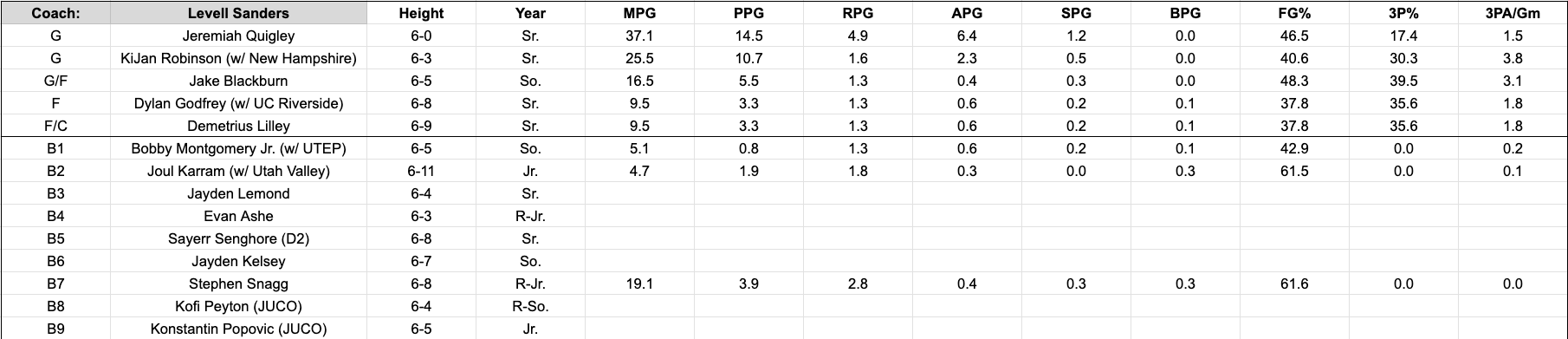
Roster:
Reasons for Optimism:
I was listening to the 3MW’s Mid-Major Extravaganza podcast episode, and while I’m typically the trio’s most fervent supporter, I have to push back on their assessment of Binghamton.
What happened to Binghamton last year? What do you mean what happened!?!?
The Bearcats went through injury hell. They lost seven players to season-ending injuries, including All-Conference big man Demetrius Lilley. In total, nine players missed multiple games, and only one played all 31. The roster missed 170 games combined, and head coach Levell Sanders used 14 different starting rotations.
“The biggest thing for us was the practices,” Coach Sanders said in an interview with Basket Under Review. “We couldn’t practice much because we typically only had five or six players available. We never had more than seven players available for any single practice last year.”
Sanders told me about a week in February when the Bearcats were scheduled to play UMBC on Thursday and NJIT on Saturday. They went into the Thursday game with seven healthy players, and two suffered injuries in a 17-point loss.
“We were going into a Saturday game against NJIT, which was first in the league at the time, with only five guys,” Sanders said. “I called my athletic director and asked if there was any way we could postpone the game.”
And he said the games were the easy part! That’s how bad it got last season.
The Bearcats should be the conference’s most improved team by a long shot, which is saying something in a conference where I expect seven teams to either improve or maintain. The amount of positive injury luck they’re owed is impossible to quantify.
The most amazing part of last year is that, although they finished last in the league, they were competitive night in and night out. They rarely laid down, and they even finished the season with three wins in their final four games.
“A big credit to those players for keeping themselves motivated,” Sanders said. “It never felt like we were going into a game thinking we couldn’t win.”
Jeremiah Quigley was Binghamton’s savior. He played all 40 minutes in six of the team’s final seven games. He’s the conference's best pure point guard, leading the league with nearly seven assists per game. But he also scored over 15 points per game efficiently at all three levels despite a sky-high usage rate — although his patented move is a mid-range pull-up.
The Air Force Reserve America East Men’s Basketball Playoffs begins in less than a week as just one regular-season game remains. UMBC locked up the regular-season title on Saturday while Vermont, NJIT and UMass Lowell will serve as the other three quarterfinal hosts.
— America East (@AmericaEast) March 2, 2026
Player of… pic.twitter.com/g3tcrTo3uk
He’s a paint-touch machine, and he’s the perfect point guard for Sanders’ cut-heavy offense — you need guys who can break down a defense and find the back doors.
He should also show modest improvements on the other end. He’ll never be an elite perimeter defender with his 5-foot-11 frame, but he graded out fine defensively in limited minutes at Iona and George Mason, and he’s got quick hands.
But most importantly, he won't be so tired all the time.
“Jeremiah is a much better defender than what he showed last year, but when you’re playing 40 minutes a game, you have to save yourself,” Sanders said. “Because of his size, his thing has to be on-ball pressure. By not having to play as much, he should be more disruptive on the defensive end.”
Meanwhile, Lilley might lead the nation in rebounds. He’s a monster on the boards.
When he came to Binghamton, I was initially concerned about his offense, as he was a lousy finisher at La Salle. But Sanders unlocked his interior scoring as both a roller (1.02 PPP) and a poster (.92 PPP). He scored double digits in five separate non-conference games.
The Quigley-Lilley combination instantly gives Binghamton the conference's best inside-out duo.
I’m also cautiously optimistic about New Hampshire transfer KiJon Robinson.
At first, I thought he was a terrible addition because he played so much on-ball for the Wildcats, and I thought he couldn't effectively play second fiddle to Quigley.
However, after a deeper dive, I think he’s a better off-ball shooter than the numbers show, mainly because he makes all his free throws and has a decent stroke.
“First thing I did was I reached out to Speedy [Claxton] at Hofstra,” Sanders said. “The first thing he told me was that Robinson was a great shooter with deep range and the ability to catch and shoot. He’s going to shoot close to 40% from 3.”
More importantly, he was an elite off-ball cutter last season (1.47 PPP, albeit on low volume) when playing off New Hampshire’s post presence (the Wildcats played entirely through the post last year). Cutting is everything in a Sanders-led offense, so Robinson could be a sneaky great fit.
Additionally, it might be nice for Binghamton to have a secondary ball-handler, just to take some of the playmaking weight off Quigley.
“We were looking for a second guard who could handle and make plays,” Sanders said. “One thing I really liked about KiJan was his ability to get the ball up the court fast, both with the dribble and the pass.”
Causes for Concern:
At one point, I power-ranked Binghamton as high as third in the conference. I still think there’s an outside chance the Bearcats go from worst to first this season, if only because they are returning a superstar duo who will be surrounded by real, functioning bodies.
However, as I dove deeper, more and more worries popped up.
First, there’s a pretty sizeable drop-off from the top three to the rest of this roster. Yes, the Bearcats will be deeper than last season, but that says little.
The other guys returning from season-ending injuries — Jayden Lemond, Evan Ashe, Sayerr Senghore, and Jayden Kelsey — are all average to below-average players.
Lemond has one of the nation’s worst turnover issues, and Sanders benched him as a starter two seasons ago. Kelsey is a Sophomore who only managed one game last year, where he was a -26 in 21 minutes against Syracuse.
Meanwhile, Ashe and Senghore are still recovering from their season-ending injuries. Ashe is an exciting athlete who has never produced, and he’s downright brutal on defense. Senghore was a good player at Fort Valley State, and I think he’ll be a good defender at this level, but he’s a hypothetical.
The other big returner is Jake Blackburn, who I like because he can really shoot it (40% from deep last year on over three attempts per game). But that’s about all he can do.
Three newcomers are Division I transfers: Bobby Montgomery Jr. from UTEP, Dylan Godfrey from UC Riverside, and Joul Karram from Utah Valley.
Montgomery and Karram barely played at their last stops, and they didn’t put up encouraging per-40 numbers.
Godfrey is interesting because of his stretch-four potential — Sanders said he may use him similarly to how he used Ben Callahan-Gold a few years ago, and I loved how that worked out. Still, he’s not a good defender, and Riverside’s Net Rating dropped a full 20 points in the 196 minutes he played last year.
Maybe one of the JUCO imports pops (Kofi Peyton, Konstantin Popovic), but if not, this could be one of the most top-heavy squads in the low-majors.
I have two other major issues.
First, I’m concerned about the defense. Quigley is small, and Lilley isn’t overly mobile, so I worry the Bearcats will get shredded in ball screens. While there are guys who profile as quality defenders (Senghore and Karram), there’s a lack of athleticism across the board, which will hurt them. Additionally, while the Bearcats haven’t always been a bad defensive team under Sanders, they typically struggle to stay in front of the dribble.
“Throughout the Summer and in the preseason, we’ve been more aggressive against ball screens, trying to not let teams get into the paint,” Sanders said. “We’ll play some drop, but we’re not a deep drop team because I don’t like playing that kind of defense. We’ll switch it up.”
Second, I’m a tad worried about the floor spacing. Quigley and Lilley are two non-shooters who will bookend nearly every lineup, so the 'Cats need as much shooting at the two, three, and four as possible. That’s possible with Blackburn, Robinson, Godfrey, and Peyton, but how much are you sacrificing on the other end?
Bottom Line:
I have zero doubt that Binghamton will have a monster bounce-back season. Between two All-League players, a rock-solid third fiddle, plenty of healthy bodies, and a good coach, the Bearcats will win plenty more games this season.
How many more games depends on the rest of the roster. Those depth guys need to pick up the slack on the shooting and defense fronts, and I'm hesitant they will.
That said, Sanders has pieced together a roster with plenty of potentially impactful players. Basically, he’s got like 11 bites at the apple to find a few more quality guys. That is a real possibility.
“I truly believe we have 14 guys who are capable of playing in this league,” Sanders said. “It’s now about figuring out a rotation of who works well together.”
New Hampshire
Key Returners:
Tyler Bike, Davide Poser, John Squire, Giannos Xanthopoulos
Key Newcomers:
Drew McKenna, Erik Oliver-Bush, Kaleb Myes, Ryan Zan, Adam Squire, Josiah Coleman
Key Losses:
Belal El Shakery, Comeh Emuobor, KiJan Robinson, Jack Graham
Roster:

Reasons for Optimism:
It’s been a lean few years in Durham, but I really like the roster Nathan Davis has put together this offseason.
The returning core of Tyler Bike, Davide Poser, and John Squire gives the Wildcats a solid foundation at all three levels. Through the portal, Davis brought in a high-floor forward in Erik Oliver-Bush and a high-ceiling forward in Drew McKenna. The roster has a few good lower-level (JUCO and NAIA) adds, and I’m cautiously optimistic that Giannos Xanthalapos will have a breakout season.
Is this the year the Wildcats finally break through as AmEast contenders under the fourth-year head coach?
“You certainly hope so,” Davis said in an interview with Basket Under Review. “There’s no reason not to be optimistic right now.”
Before we get into the concerns, let’s talk about the roster from a glass-half-full perspective.
Everything starts with Bike. He’s barely taller than me at 5-foot-11, but he’s an unbelievable perimeter defender. He is a pest on the ball and an elite PNR POA defender. Last season, he posted a 2.0 DRAPM (90th percentile), and the team’s defensive rating dropped by nearly 12 points when he was on the court.
“He’s little, but he doesn’t play that way,” Davis said. “He’ll throw his body in there. He’ll fight you. He’ll scratch and claw for every inch. That’s what he’s made of.”
You see it night in and night out.
Winners make winning plays. Freshman Tyler Bike on a pivotal moment puts himself in the right place to deliver and a big win for UNH! Keep working kid! pic.twitter.com/J6xRleULCy
— Matt Regan (@NEStormNHDir) December 18, 2025
Offensively, he’s a knockdown shooter, but I think he needs to take on more lead-guard duties this season — specifically, he needs to become a higher-usage ball-screen orchestrator. That said, EvanMiya projects him with the conference’s second-highest Playmaking score (trailing only Jeremiah Quigley).
“He’s really good at making reads in ball-screens and dribble-handoffs,” Davis said of his second-year guard. “I think you’ll see more ball-screen and dribble-handoff sets with Bike and Poser in them because they do a great job of reading them.”
I’ve long been a Poser defender. He’s an excellent low-usage connector who takes care of the rock and makes his 3s. Defensively, his skills are debatable, but he will be a fine running mate for Bike.
In the frontcourt, Squire is a dependable, big-bodied, rim-tied forward who makes his 2s (65%) and rebounds pretty well (six per game). He’ll be a predictable stalwart in the rotation, but the two frontcourt transfers are far more interesting.
Oliver-Bush is a high-level wing who parlays elite athleticism into elite defense — he ranked among the top-10 Metro players in Hakeem rate last season (6%). He’s a high-floor transfer rather than a high-ceiling one because he’s entirely useless on the other end, but his floor comes from being a multi-positional chess-piece defender.
Also, he’s got some ups:
Erik Oliver Bush (@erikbush311) enters the transfer portal after a electric freshman season at Saint Anslem (D2) where he won NE10 Rookie of the year:
— Rising Ballers Network (@RBNHoops) March 20, 2025
11.3 PPG
3.0 RPG
2.0 APG
1.0 BPG
49.2% FG
35.2% 3FG
📈⏳ pic.twitter.com/k2zkjhznqy
McKenna is the X-Factor. He earned rotation minutes at both Georgetown and Old Dominion (albeit minimal), so the AmEast should be a breeze. He’s a versatile, athletic combo big who can live at the rim and dominate the defensive glass (he should be one of the conference’s best rebounders).
However, somewhat surprisingly (because of his horrific jumper), Davis sees him mostly as a wing, splitting time between the two, three, and four, though those spots are all similar in his system.
“He’s athletic and physical, so he can guard multiple positions at a high level,” Davis said of his transfer wing. “He’s great around the basket, and we have to get him opportunities to make plays in the paint.”
Ryan Zan, a transfer from Fairfield, will likely get some run as a key reserve big man. However, I’m far more interested in Xanthopoulos, who stands 6-foot-10, can stretch defenses with a good-looking jumper, can put the ball on the floor a little, and has the length to be a decent rim protector.
Giannos Xanthopoulos with the emphatic swat‼️
— UNH Men's Basketball (@UNHMBB) December 31, 2025
Game Day Central ➡️ https://t.co/TNpsgXhe1u
📺 Big 10 Network#BeTheRoar pic.twitter.com/qSzAOStM8D
The rest of the roster will be filled by a trio of lower-level up-transfers: Kaleb Myers (NAIA), Adam Squire (JUCO), and Josiah Coleman (JUCO).
“I think people are really going to like Coleman,” Davis told me. “He’s a really strong and physical combo guard with the ability to be an excellent defensive player. He’s strong enough to play in the paint and, while he’s not a knockdown shooter, he’s capable of making 3s when he takes the right ones.”
Squire is a reserve gunner who should play the two and shoot plenty from deep. According to Davis, Myers is a “big-time athlete at the five who can attack the rim, finish around the basket, defend multiple spots, and even put the ball on the floor sometimes.”
Causes for Concern:
All the questions are about the offense, and I have no answers.
The problem with Davis’ tenure in Durham has been an inability to implement his style. He wants to play fast and take shots in a motion-based offense. Two years ago, it was all ISO-ball with Sami Pississ. Last year, it was all post-up booty-ball with Belal El Shakery.
In the frontcourt, McKenna and Myers are interesting but unproven, while Squire and Oliver-Bush are very limited.
In the backcourt, there’s plenty of off-ball shooting but no clear playmakers. Davis needs Bike to develop into a true lead point guard, which isn’t impossible, but I think he probably works better as an off-ball marksman. Overall, the team has very little on-ball usage, self-creation, or scoring.
“The first thing is that we have to play with great pace,” Davis said. “We don’t have someone like Clarence Daniels who will go and get you 20 every night. We have to learn to play together, create advantages, read the play, and create space for guys.”
Bottom Line:
I think the Wildcats could field a really good defense. Bike is a superstar POA defender. Oliver-Bush and McKenna are two potential high-level wing defenders. I trust Squire to be a reliable anchor.
I expect plenty of toughness, physicality, and switchability from most of the ‘Cats. I see these guys developing a hard-nosed, gritty, lunch-pail-box mentality. They should defend the rim well, keep teams out of transition, and rebound effectively. Of course, they did those things well last year and were a lousy half-court defense, but this year’s roster is far more athletic and versatile.
On offense, the lack of lead ball-handlers and playmakers is a major concern, and I think the frontcourt is particularly underwhelming.
I like the roster, but Davis needs to prove he can scheme a reliable two-way identity on both ends of the court. Until I see it, I have my reservations.
NJIT
Key Returners:
David Bolden, Quentin Duncan, John Kelly, Rocco Awad
Key Newcomers:
Mario Tatum, Brandon Stores Jr., Brendan Oliver, Victor Vanderstraeten, Mathéo Coffi
Key Losses:
Sebastian Robinson, Ari Fulton, Melvyn Ebonkoli, Jordan Rogers, Malachi Arrington, Jeremy Clayville
Roster:

Reasons for Optimism:
After a lean few years in Newark, it was satisfying to see Grant Billmeier start to see his vision come together in Year 3. Behind a stingy defense and a strong backcourt, the Highlanders surged to a 10-2 start in AmEast play, ultimately earning third-place regular-season honors.
“I kind of envisioned this,” Coach Billmeier said in an interview with Basket Under Review. “I knew we were going to take our lumps through the first two years of taking this job, but it was exactly where I wanted to be in Year 3.”
“We hope to continue moving up and trying to compete for a championship in Year 4.”
If that dream comes true, it will start in the backcourt with David Bolden. The 2026 America East Rookie of the Year is a certified tough shot maker, draining around 33% of his seven 3-point attempts per game to average about 12 points, often cashing in on the biggest moments.
David Bolden is a certified clutch shot maker pic.twitter.com/9H3d08SYqR
— Tanner McGrath (@tannerstruth) January 13, 2026
Bolden was also the head of the snake in Billmeier’s dribble-denial defense—he led the conference in steals (59), averaging over two per game as the main POA ball-screen defender.
Bolden’s 18% assist rate and three assists per game don’t jump off the page, but he’s a decent distributor who scores and passes well in Billmeier’s isolation and ball-screen attack. He was also a big reason why the Highlanders rarely turned the ball over.
Billmeier hopes those facilitating numbers will jump this season.
“I think we’ll have more shot-makers around Bolden on the perimeter than we did in the past,” Billmeier said. “So I think his assist rate will go up significantly. He’s a pure point guard, and I love the fact that he can control the game and make every right read.”
I’ll touch on the potential shot-making in the next section.
I would have far more faith in this team if both Bolden and Sebastian Robinson were returning. Alas, only Bolden is returning, an excellent perimeter scorer who provides zero rim pressure as a downhill driver and finisher. Only SebRob did that for the Highlander backcourt last season.
Replacing that rim pressure will be paramount. The options are returner Quentin Duncan, Georgia Tech transfer Brandon Stores Jr., and VMI transfer Mario Tatum.
We didn’t see much of Duncan last season, but he flashed promise as a strong catch-and-shoot (1.12 PPP) and off-the-dribble (1.02 PPP) shooter. Unfortunately, he did not show promise as a downhill driver (.72 PPP).
Stores missed most of last season with an injury, but he has a strong pedigree, and Billmeier is looking to him as a microwave wing scorer. There’s hope he can be a useful slasher with his 6-foot-5 frame.
Tatum is the one who intrigues me. VMI’s offense is built around the slash-and-kick game, and while Tatum was inefficient (eight points per game on 40% shooting), he provides plenty of paint touches off the bounce and in transition. Robinson was similar in his first two seasons before developing his downhill decision-making and finishing under Billmeier. I think Tatum has a shot at doing the same thing.
Let's meet our newest Highlander, Mario Tatum Jr!
— NJIT Men’s Basketball (@NJITHoops) July 13, 2026
The guard from Edgewood, Maryland comes to NJIT after a productive freshman campaign at VMI, averaging 8.5 points per game while appearing in 31 games and making eight starts.#UNITY | #RollTech⚔️ pic.twitter.com/wLEf6kBp0e
“Mario is a physical guard, and I think his production will only go up as a sophomore,” Billmeier said. “I love his ability to attack the rim. When you put him and David out there together, you allow Dave to get freed up on some off-ball screens.”
I’m pretty fuzzy on the frontcourt rotations. I feel like John Kelly will be involved in some form, since he's the team’s most experienced frontcourt player (and he’s got a solid 6-foot-8 frame). But the two guys to watch are imports Victor Vanderstraeten and Mathéo Coffi.
We have some info on Coffi, who comes over from UTSA. He was super low-usage with the Roadrunners, but every one of his rate stats were incredible. If he can keep that efficiency with higher usage, he could be an uber-valuable versatile forward who can finish at the rim, stretch the floor from 3 (41% in conference play), and guard multiple positions.
Let's meet our newest Highlander, Mathéo Coffi!
— NJIT Men’s Basketball (@NJITHoops) August 10, 2026
The UTSA transfer joins NJIT after appearing in 30 games with 21 starts during his freshman season, highlighted by his first collegiate double-double with 12 points and 14 rebounds against Rice.#UNITY | #RollTech⚔️ pic.twitter.com/7BEFpmmTjy
Vanderstraeten is more of a hypothetical, but he’s very experienced from a basketball perspective. He’s coming off two seasons with the Leuven Bears in the Belgian league, where he averaged 5/4 in limited minutes and shot nearly 60% from the field.
“I think our frontcourt will be a lot different than last year,” Billmeier said. “Victor and Mathéo can really pass and handle the ball for guys their size, and it will help us look a lot different and more modern.”
“One thing I’m excited about is that we’ll have size.”
That’s true. NJIT ran 6-foot-7 and 6-foot-8 in the frontcourt last season. This year, Vanderstraeten is 6-foot-8, Coffi is 6-foot-10, and Billmeier has two more 6-foot-11 pieces on the bench: Stefan Jimenez-Vojnic and Zack Scherler.
Causes for Concern:
I question Billmeier’s excitement about the shot makers.
What was great about last year’s squad was that it had several different kinds of shot makers — SebRob was a pure rim slasher (who scored 18 points per game in conference play with a whopping 31% usage rate), Melvyn Ebonkoli was a paint-and-glass bully, Ari Fulton was a crafty scorer off the wing, and Jordan Rogers was super efficient inside the arc.
Those guys are gone, leaving Tatum, Duncan, Stores, Kelly, Vanderstraeten, Coffi, Brendan Oliver, and Rocco Awad in their place.
We can only hope Tatum develops into the efficient finisher that SebRob was. We can only hope Duncan develops into the crafty wing scorer that Fulton was. We can only hope Kelly becomes as efficient as Ebonkoli.
Oliver is a project, but his upside is probably similar to Stores: a slashing wing with a solid frame. I’m relatively high on Awad, who I think played awesome in his limited minutes last season — he could be a plus floor-spacer and shot creator.
Vanderstraeten and Coffi are exciting, but largely unproven at volume. If they translate, that’s great, but they likely still won’t be as physical as the Ebonkoli-Rogers duo was.
Even if all this happens, remember that NJIT fell apart down the stretch last season after the triples stopped falling, which exposed cracks in the underlying process built on mid-range jumpers (the league’s longest average 2-point shot distance). This roster's offensive ceiling might still feature way too many turnaround jumpers.
Meanwhile, I think replicating last season’s defense will be very hard, if not near impossible.
Ebonkoli was a singular defensive force who was a three-level monster in ball-screen coverage as a hedge-and-recover guy. Rogers graded out as one of the conference's best defenders (sixth among qualified players in DBPM). Fulton provided length on the wing at 6-foot-7, but he was most impactful as a defensive rebounder (seven per 40 minutes, 99th percentile). SebRob was a bully at the POA (1.4 steals per game) and chipped in on the boards (3.0 defensive rebounds per game).
When those four shared the court, the Highlanders posted a 94.3 Defensive Rating (100th percentile). They were all experienced players who fit well into Billmeier’s dribble-denial, shell-like defense that entirely walled off the paint and rim.
This year’s group doesn’t fit the scheme as well.
“I think we might drop off a little bit,” Billmeier said. “We’re going to be younger this season, which probably means our defense isn’t going to be as good.”
Also, despite running a relatively compact scheme, the Highlanders weren't a very good rebounding team last year (eighth in the AmEast in Defensive Rebounding Rate). It could get worse this year with two thinner EuroSkill (I just made that word up) guys in the frontcourt. That’s a scary thought.
That scheme also allows plenty of 3s, and they were a little lucky with those last season (32% allowed, 80th nationally). Regression on that end of the court is in the cards, and that’s another scary thought.
Bottom Line:
I don’t think NJIT will suddenly drop back into the absolute depths of the Division I landscape, but I definitely project, at minimum, a slight regression on both ends of the court. They won’t be a disaster on offense or defense, but that might not be good enough in a much-improved conference.
If they want to reach Billmeier’s lofty goals, Bolden must stay Bolden, Tatum must become a more efficient finisher, Duncan/Stores/Awad need to create shots while hitting all their catch-and-shoot jumpers, and the frontcourt guys need to step up massively on defense.
That’s a lot of ifs.
UMBC
Key Returners:
Riley Jacobs, Regimantas Ciuyns
Key Newcomers:
Flash Burton, Jovan Ristic, Austin Cross, Jaiden Reynolds, Evan Morton
Key Losses:
Ace Valentine, Jah'likai King, DJ Armstrong, Josh Odunowo, Jose Roberto Tanchyn, Caden Diggs
Roster:
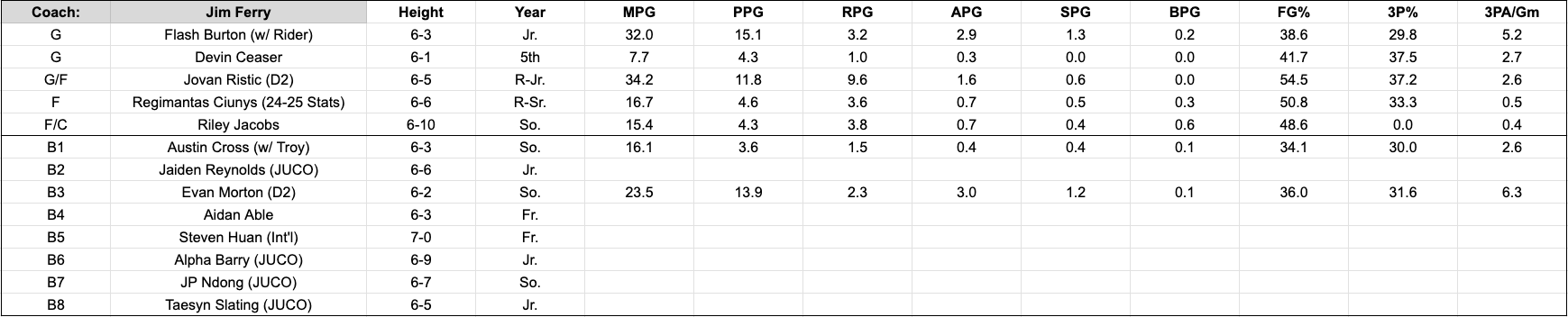
Reasons for Optimism:
I am really, really low on UMBC this season. Shockingly low. Most people reading this will be shocked by how low I am on the Retrievers.
That said, I might be too low. Let’s talk about why there’s a very good possibility that’s the case.
Jim Ferry offenses always start with the backcourt. The Retrievers typically run an up-tempo rim-attack-and-kick offense (they slowed it down last year, but Ferry and I both expect a return to tempo this season).
There’s a lot to like about this backcourt, starting with Flash Burton.
Burton is the type of guard Ferry loves. He’s a ball-dominant, quick-twitch, wired-to-score self-creator who loves playing off the dribble. He carried Rider’s offense last season, averaging 17 points per game with a great assist-to-turnover ratio (22% assist, 9% turnover) on a whopping 28% usage rate.
The problem is that he did everything for Rider last season, which ultimately led to him shooting 39% from the field and 30% from 3. However, I am hopeful we’ll see improved efficiency with reduced usage.
“I’m playing him as our primary ball handler, head coach Jim Ferry said in an interview with Basket Under Review. “I think part of his shooting efficiency last year came down to how Rider played offense — they often relied on him for late-shot clock plays.”
“He’s been doing a great job of facilitating, running our team, and scoring. He has a chance to be an All-League player.”
His running mate, Devin Ceaser, was expected to start last year before a season-ending injury. He’s another classic Ferry guard, as I wrote in last year’s AmEast preview for Mid-Major Madness:
“Also in the backcourt, Old Dominion transfer Devin Ceaser is the big-name newcomer who should play alongside Valentine. He’s a bucket-getting combo guard who should shoulder a huge scoring load. His shot selection, shooting stroke, efficiency, and playmaking ability are big question marks. He’s also a tiny guard who doesn’t hold up well when defending the perimeter (1.23 ball-screen PPP allowed, third percentile). But most importantly, he does two things every Ferry guard needs to do well: he gets out in transition and ruthlessly attacks the paint in the half-court. He’s an aggressive up-tempo off-the-dribble guard, which is what the Retrievers are built on.”
I was curious about his health after missing the past year and a half, but his exhibition performance against Fordham eased those worries:
The full box score from tonight’s 87-67 exhibition win over UMBC: pic.twitter.com/A3fL7rjZUQ
— Everything Fordham Hoops (@fordhamhoopsfan) October 22, 2026
I feel good about that backcourt duo, and I feel good about the five spot behind returner Riley Jacobs.
Jose Roberto Tanchyn stole Jacobs’ starting job in the second half of last season, but JRT’s rise mattered more than Jacobs’ issues. Jacobs was a reliable two-way starter. He’s still very young, and with his athleticism, I expect a good jump this year.
Causes for Concern:
“I feel really good about our guard positions, and I feel really good about our five position,” Ferry said. “It’s the four and the three we’re trying to figure out.”
I’m not overly excited about this season’s wing corps.
Regimantas Ciunys returns, and I like him. He’s one of the team's more versatile defenders. He rebounds well. He’s a low-usage, high-efficiency offensive player.
Jovan Ristic is the big name to watch as a Division II transfer who can space the floor (37% from 3) and score in bunches. JUCO transfer Jaiden Reynolds is another floor-spacing wing (40% from 3).
But here’s the thing about these lower-level transfers:
UMBC is the only school in the America East that opted out, so Ferry doesn’t have much money for roster-building. He built last year’s squad by swooping in at the lower levels and digging up gems, including DJ Armstrong, Jah’likai King, and Tanchyn.
This year, that Moneyball-style roster build won’t fly.
“Without much money, I had to do something different and unique last year, which is why I took five Division II guys and started three of them,” Ferry said. “This year, those same kids were commanding money, so there weren’t many Division II kids out there that we could get like the year before.”
Last year, I was overly excited about these lower-level transfers. I thought they'd catapult UMBC to the top of the league, and they did. This year’s crop of JUCO and DII guys doesn’t have me as excited.
We also need to talk about what the Retrievers lost. The top seven scorers departed, including a three-headed monster in the backcourt. Tanchyn was the perfect two-way big man for Ferry, and his mobility and defense changed everything for the Retriever defense. While Josh Odunowo had a relatively down year compared to his standards, I still wouldn’t overlook what losing an interior stalwart like that could do to a frontcourt.
UMBC lost its entire conference-dominating squad, and the replacements just aren’t as enticing.
While I’m intrigued by the Burton-Ceaser backcourt, there’s no way they’re as effective or efficient as last year’s. They feel like more of a high-volume, low-efficiency duo, and they might be really bad perimeter defenders.
To repeat myself, I don’t love the lower-level adds, which should show on the wing.
“Ristic is a solid glue guy,” Ferry said. “Is he going to have as big an impact as DJ [Armstrong] had? I don’t know about that.”
Again, Tanchyn was a generational defensive fit. Jacobs is good, but someone stole his starting spot for a reason.
Along those lines, I’m very worried about the defense. Ferry has never been a very good defensive coach, as he typically recruits skill over size.
Last year’s team was a perfect storm. The dribble defense was elite behind the three-headed backcourt, and Tanchyn was a big body who actually protected the rim.
This year, the Retrievers are small again.
Jacobs is 6-foot-10, but he’s more of a natural four behind his slimmer frame. Perhaps Chinese seven-footer Steven Huan makes a big impact, but he’s young, and the transition from the international game can be difficult. In the backcourt, Caesar and Burton graded out as horrific defenders at their prior stops. Troy transfer Austin Cross is the only perimeter defender I feel good about this season, and only because I think his dad (Scott Cross) taught him how to stop ball screens at the POA.
Have people forgotten about Ferry’s history? It feels like we’re all overrating him a bit after one tremendous outlier season.
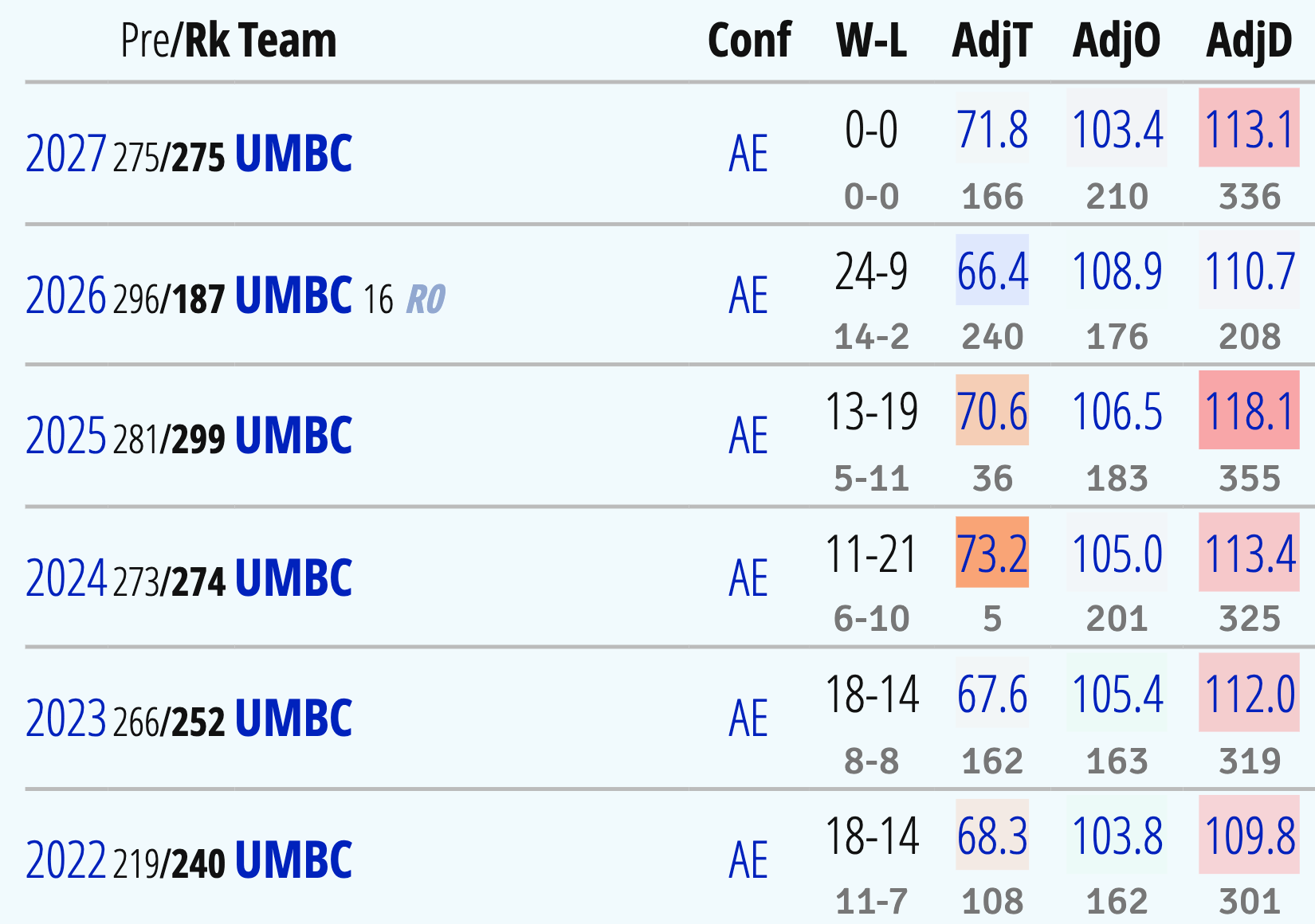
The common thread among those sub-300 defenses has been a lack of size. It’s severely affected UMBC’s rebounding and rim defense. I think this team is built more like those teams, but with more questionable guard talent, especially on offense.
Bottom Line:
I might be overreacting by ranking UMBC this low.
However, I feel strongly that the Retrievers are due for a massive rebound-and-regression year, while most other AmEast teams are due for bounce-back seasons.
I don’t trust the incoming offensive talent as much as last season, and I think their smaller defense will drop off a cliff without Tanchyn.
This could change quickly, but right now, I feel worst about the Retrievers heading into the season.
