

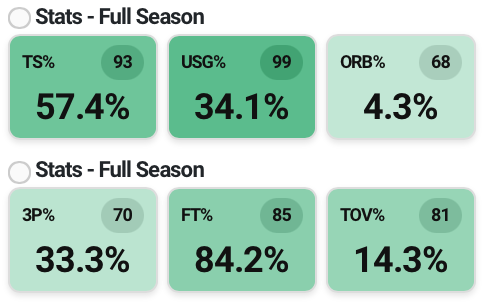
Hannah Wickstrom led the Big West in scoring last season at UC Riverside with 23.4 points a game, a number that was the fifth-best in the country. She did it on a usage rate of 34.1 percent, one of just four players nationally, alongside Mikayla Blakes, Hannah Hidalgo and Audi Crooks, to combine a usage rate that high with a true shooting mark above 55 percent and a turnover rate under 15 percent. Now she's a Purdue Boilermaker, and the assumption that comes with every mid-major star who makes this move is that the level jump is going to expose something. It's a reasonable assumption. It's also, according to a decade of players who've actually made that jump, only half right.
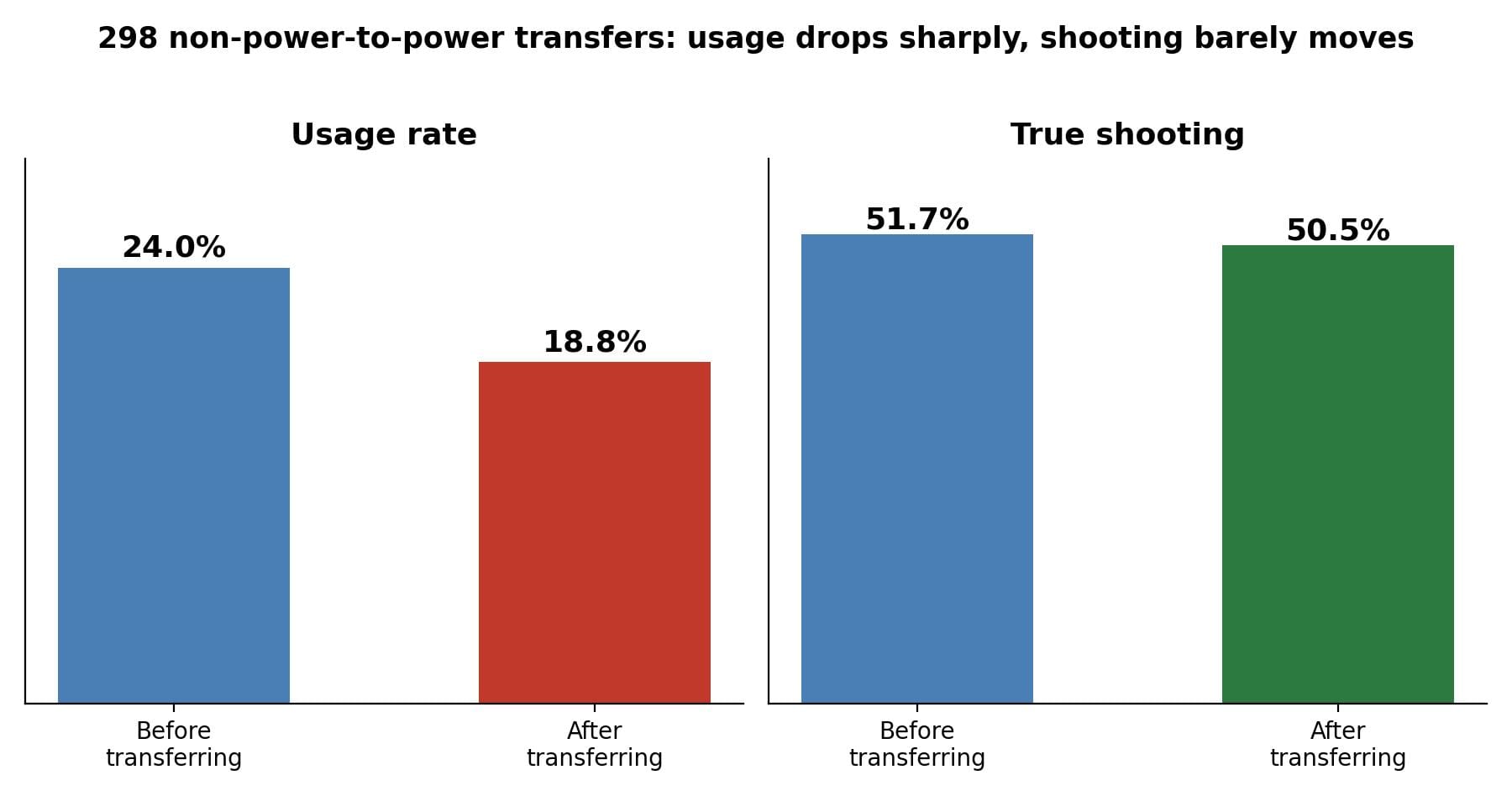
I wanted to know what actually happens to players like her, so I looked at the 298 players who transferred from a non-power to a power conference going back to 2011-12 and played 300 minutes or more in their final non-power season. I found that usage rate falls from 24.0 percent to 18.8 percent on average, and their minutes drop with it. But surprisingly, true shooting barely moves, sitting at 51.7 percent before the transfer and 50.5 percent after. This suggests that whatever's happening to these players' production is mostly a story about touches, not talent.
If you dig into the numbers a bit further, the picture becomes clearer. Three-point attempt rate actually climbs after the jump, from 27.4 percent of shots to 31.6 percent, even as accuracy dips slightly. Two-point shooting barely moves at all. Playmaking shifts more noticeably, as assist rate falls from 15.6 percent to 12.3 percent and turnover rate ticks up a bit against tougher competition.
The overall picture is a player who shoots almost as well as before, gets fewer chances to set up teammates, and turns the ball over slightly more often. That's not the adjustment most fans picture when a mid-major star heads to a bigger conference.
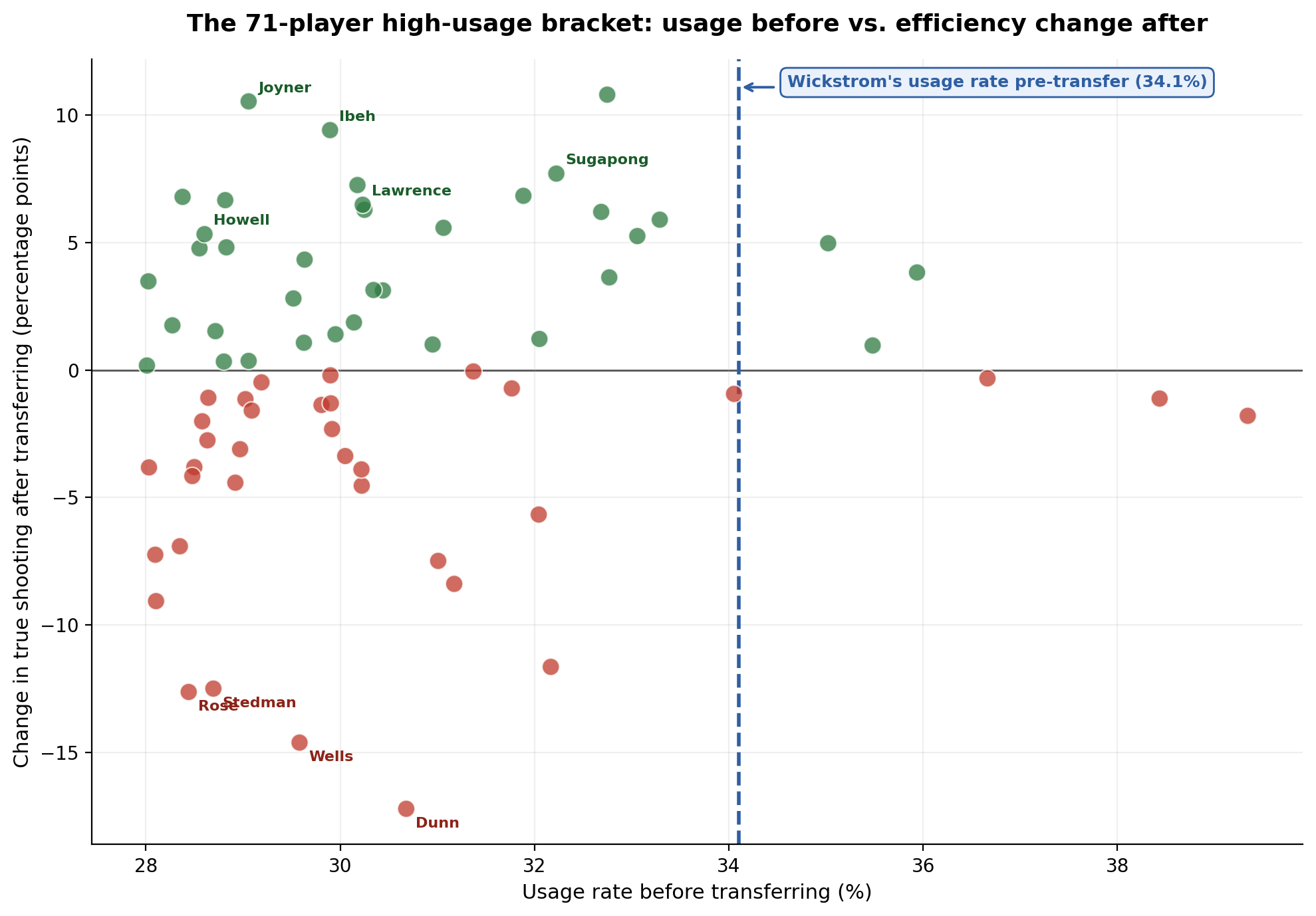
The players that I want to dive into the most are the true offensive engines at the non-power level. Among the 71 players in this sample who carried a usage rate of 28 percent or higher before transferring, the higher the starting number, the bigger the fall in usage after the transfer. A player in that bracket keeps only about 73 percent of her usage rate at the new level, on average. A 30 percent usage player becomes something closer to a 22 percent usage player, and this happens nearly without exception. What doesn't collapse alongside that shrinking role is shooting efficiency, at least not very reliably.
Among that same 28 percent usage-or-higher bracket, 51 percent saw their true shooting hold flat or improve after the jump, close to a coin flip rather than a guarantee. But a coin flip on efficiency, paired with a near-certain cut to their role, is a meaningfully different outcome than the wholesale bust that gets assumed by default.
This makes basketball sense once you think about defensive attention. At the non-power level, the best player is often the entire scouting report, the one defenders are told to deny at all costs, so a lot of their shots come with a hand in their face by design. At a power program, these players are just one dangerous piece on a much deeper roster, and a defense can't afford to sell out on stopping just them. They generally see fewer double teams and fewer possessions where the whole defense is built around stopping just them.
One theory doesn't hold up, though. Some might think that three-point shooters translate better than players who score mostly inside. Splitting the bracket by shot profile produces almost no difference in outcome. Class year matters more, since most high-usage transfers making this move are juniors and seniors. 63 of the 71 players in the high-usage bracket are entering their junior or senior seasons.
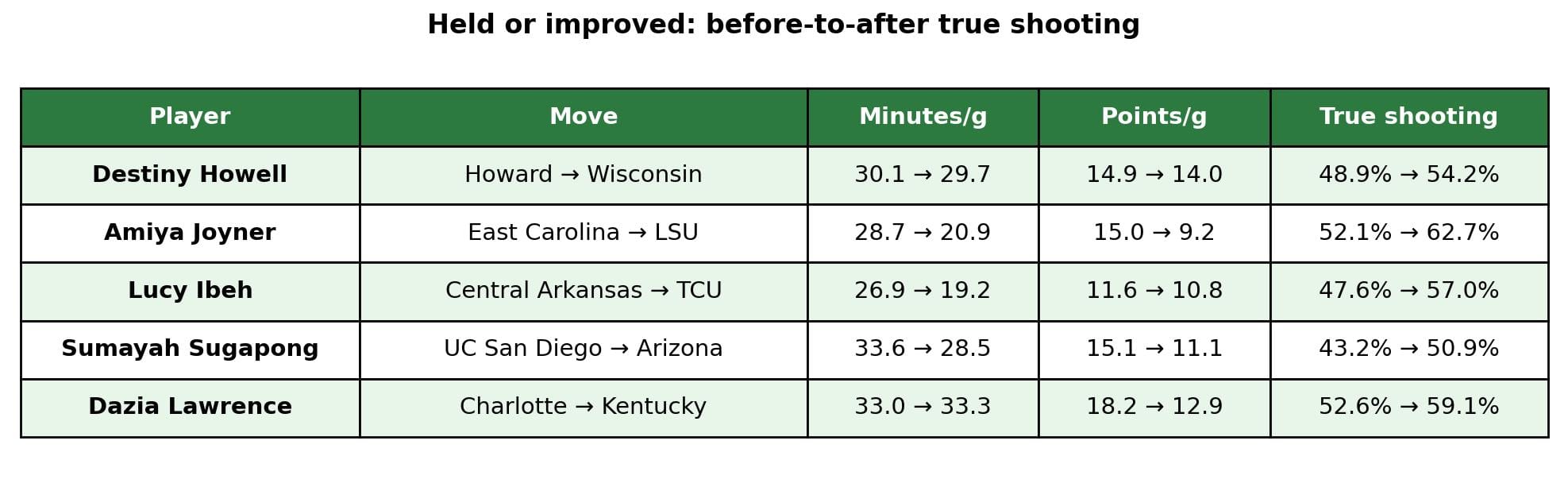
Forwards also hold up a little better than guards overall; 56 percent saw their shooting hold or improve, compared with 48 percent of guards, and the gap comes down to which shot is involved. Guards see a dip in three-point shooting after the jump, from 32.0 percent down to 30.3 percent, even though they are taking more of them. Their two-point shooting barely moves, and among the highest-usage guards it actually ticks up, from 45.2 to 45.8 percent. That split shows up directly in the best names from this bracket: Destiny Howell, Amiya Joyner, Lucy Ibeh, and Dazia Lawrence all saw a double-digit jump in two-point shooting specifically.
Every one of them kept meaningful minutes at the new level, and none were pumping up stats off the bench in small roles. Howell and Ibeh barely lost any scoring at all despite the jump. Joyner's role shrank the most of the five, yet her efficiency gain was the largest. Sugapong's minutes dipped slightly, and she still added nearly eight points of efficiency on top of that. Lawrence's minutes actually held flat, from 33.0 to 33.3, even as her scoring dipped with a smaller share of the offense.
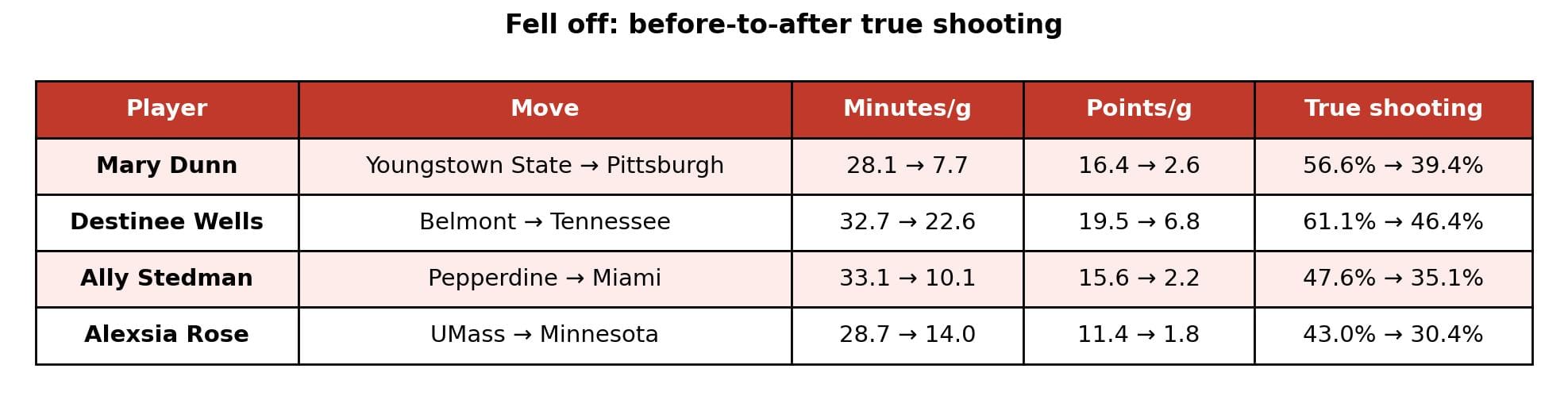
The names on the other side of the table are just as telling, and the playing-time numbers confirm these are players who fell off once they made the jump, not just small samples going the wrong way. Mary Dunn's role and shooting collapsed together. Destinee Wells is the more interesting case, since her minutes barely moved, but her scoring and efficiency both cratered. Ally Stedman's minutes were cut by two-thirds, and her shooting fell right alongside them, down to 35.1 percent. Alexsia Rose's minutes were nearly cut in half, and her shooting fell even further, to just 30.4 percent. Nothing in this dataset clearly separates those four from the five above before the season actually started. This is why it's so tough to project who will make the jump with ease and who will struggle when they move up.
The timing of the transfer carries some weight too, though it's a smaller effect than position. Break the sample into three groups by how early the transfer happened: after freshman year, after sophomore year, and after junior year. The freshman-year group held up best, with 57 percent holding steady or improving. The sophomore-year group came in worse, at 47 percent, and the junior-year group was nearly identical, at 46 percent. That gap mostly disappears once you narrow to the highest-usage players, where the numbers are close enough not to show much separation at all. Wickstrom is transferring after her sophomore year, which puts her in that middle group, not the strongest track record of the three, but not the weakest either.
She's not just another name in this dataset; she's the best non-power player making this exact jump anywhere in the country this offseason, and her usage rate sits above almost everyone in this sample. A stat line like hers belongs next to the best individual offensive seasons anywhere in the country.
She's headed to a Big Ten program that lost seven players to the portal this offseason and needs someone who can take shots. The retention math points toward her usage settling somewhere in the low-to-mid 20s once she's sharing the floor with a deeper roster. A meaningful chunk of her 23.4-point average is not walking through Purdue's door with her, the same way it hasn't for almost every high-usage transfer before her. That part of the prediction is close to certain.
What's still uncertain is whether her shot-making holds up on that smaller diet. Wickstrom is a guard, which cuts both ways given the position split in this data. Her two-point shooting, the shot that made up the bulk of her damage at UC Riverside, is the safer bet, since high-usage guards in this sample saw that number hold steady or tick up. Her three-point shot is the more exposed piece, since guards as a group see a measurable, if modest, dip from deep. The broader relationship between starting usage and efficiency change still favors her, the same direction that helped Howell, Joyner, and Sugapong all get better, not worse, once their roles shrank.
The strongest single piece of evidence isn't even a stat. It's Abbey Ellis, who made almost this identical jump, Cal Poly to Purdue, at a similar usage rate in the high usage bracket, and saw her true shooting climb from 51.4 to 58.2 percent in her first season in West Lafayette while barely losing any playing time. She's also the only other Australian to ever play for Purdue's women's program. If there's a clear answer for what this move can look like, it already happened once, in the same building, to a player with a strikingly similar profile.


None of this guarantees Wickstrom repeats what Ellis did. Roughly half the players in her exact bracket don't. But the fear driving most of the conversation around her, that the best player making this jump automatically gets exposed the moment the competition improves, isn't what a decade of this pattern actually shows. What it shows is a near-certain cut to her usage and a real, close-to-even chance that her shooting travels with her anyway. So don't watch for 23 points a game again this winter. Watch whether her shooting holds up once her usage drops by a third. Ellis already proved that's possible not long ago.
