

The international revolution is very clearly here in college basketball.
25% of all starters in the Final Four were born outside of the United States. There were 403 players born outside of the U.S. and Canada that played over 25% of a Division-I team's possessions last year, which is by all accounts a new record.
And that revolution has carried over into this offseason. For a multitude of factors, international recruiting has ballooned in recent years and is reaching a tipping point. This spring has seen a wild range of scenarios, from 16-year-old Joaquim Boumtje-Boumtje headed to Duke, 23-year-old Euroleague guard Quinn Ellis headed to St. John's, and new LSU head coach Will Wade reportedly filling out nearly his entire roster internationally.
But what do we really know about this unprecedented rise in international players? Using Hoop-Explorer's phenomenal database of every player's hometown across the last three seasons, I dove in to find some takeaways and come to some conclusions about this burgeoning area of roster construction.
The Data
Before looking at some more contextual elements and trying to create some takeaways, let's first dive into the raw data. Just a caveat, I didn't include Canada in this study. As a Canadian, I know first-hand how intertwined the two countries' hoop scenes are and how the NCAA boom north of the border really began over a decade ago.
Beyond last year's 403 players that met the criteria (not Canada/U.S., over 25% of possessions played), there were 362 players in 2024-25 and 337 in 2023-24. There was obviously an increase across each year, but not by some massive number.
Countries
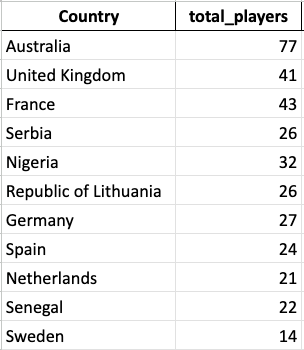
The country with the most total qualified players within the three years was Australia with 77. No other country was remotely close. France (43), United Kingdom (41), and Nigeria (32) were the only other countries over 30. 20 different countries had at least 10 total qualified players over the sample.
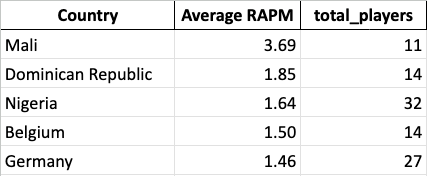
Using Hoop-Explorer's RAPM calculation, the best country with at least 10 total qualified players in producing talent was Mali. The African nation had 11 players in the data set, but only three had negative RAPMs, while players like Oumar Ballo, N'Faly Dante, and Keba Keita were standouts. Weirdly, Mali only had three players last season, compared to eight and 12 the last two years. It also helped that none of Mali's NCAA players were guards (more on that later).
The best country with more than 20 total players was Nigeria. Even though the nation only had half the RAPM of Mali, its overall consistency and largely big man player pool helped the overall output.
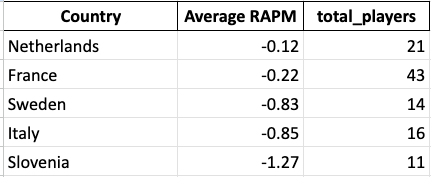
In Europe, it was Belgium, Germany, and Lithuania with the highest average RAPM. The three worst counties with at least 10 players were Slovenia, Italy, and Sweden.
There were nine countries that had at least 10 players compete in multiple seasons of the study. Within that group, Spain had the largest increase in RAPM from the player's first to final campaign, with highlights including Alvaro Cardenas, Pablo Tamba, Baba Miller, Alvaro Folgueiras, and Aday Mara. The United Kingdom and Senegal both saw a slight average decrease in RAPM across the sample.
Teams
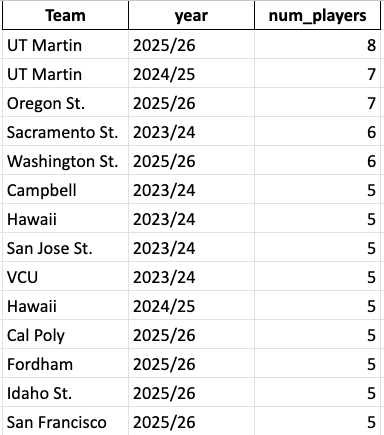
Something that should not be a surprise to anyone that follows the game closely is that UT Martin leads the country in international players who played at least 25% of possessions over the last three years with 12. All 12 of them have come in the two years that head coach Jeremy Shulman has been at the helm. Interestingly, the other four teams in the top five all played in the WCC last year, and every other team in the top 10 is on the west coast.
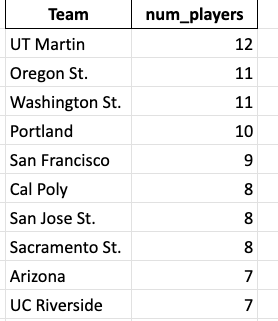
With that in mind, it makes sense that UT Martin set the record with most qualified international players on one roster in the last three seasons, with eight during its most recent campaign. A team has only had five or more qualified players 14 times across the data set, and half of those came this past year.
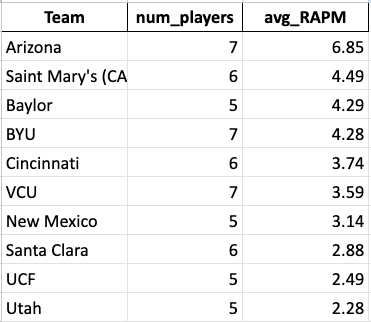
We've long known Tommy Lloyd as an international recruiting whiz, so it's not a shock that Arizona laps the field in average RAPM per international player amongst teams with at least five guys. Interestingly, four of the top 10 schools are not in the power conferences.
Positions
By position, there were 345 guards, 650 forwards, and 174 true centers in the study. The bigs had the highest RAPM, and the guards had the lowest.
That's why it's not surprising that countries like Mali and Nigeria fared so well. There were a combined three guards of the 119 players from African countries.
Among the 64 countries with a position group of at least five players, the 18 centers from Mali had the highest overall RAPM. The best forward group was from the Dominican Republic (shoutout Chad Baker-Mazara), and the best guard group was from Belgium.

The worst group of bigs is from the United Kingdom, the worst forward group was Slovenia, and the worst guard group was Turkey.
Conferences
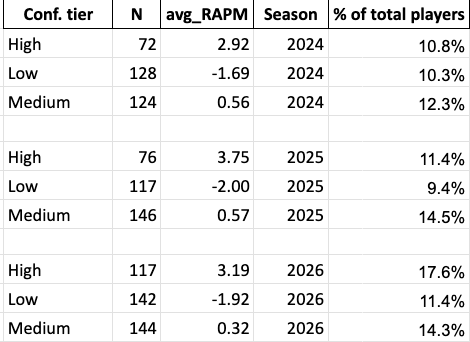
With Hoop-Explorer dividing all leagues into High-Major, Mid-Major, and Low-Major, we can also explore the conference gap with international players.
Mid-Major teams had the highest ratio of international players at approximately 13.7%, with High-Major just behind at around 13.3%. Low-Major was down at 10.4%.
However, the gap is beginning to increase. There were only 72 High-Major international players in 2023-24, compared to 117 this past season, marking a near-7% increase in total ratio. Over that span, Low-Major international players have only increased by 1% relative to all players. The RAPM gap between those two levels has also grown from 4.6 to 5.1. In other words, the international game is starting to rise above the lowest levels of Division-I.
The proportions of positions are also off depending on conference level. 24% of international players in High-Major hoops are true bigs, while the number is just 9% in Low-Major basketball. 35% of all Low-Major international players are guards, the highest ratio of the three levels. Considering we know that guards are the least valuable type of international players, it's not surprising that the data skews this way.
Academic Classification
Unfortunately, there is no ability to filter all players by age in this data. The best we can do is academic classification, which is becoming increasingly more challenging of a task with many older players from Europe joining the NCAA ranks and being given inconsistent classifications.
That said, 35% of all international players over the 3-year sample size were seniors, while just 18.5% of players were listed as freshmen. While freshmen unsurprisingly had the lowest average RAPM, it was actually juniors that on average had the highest. Juniors and seniors both had over half of its total sample produce a positive RAPM, while freshmen and sophomores were both below 40%.
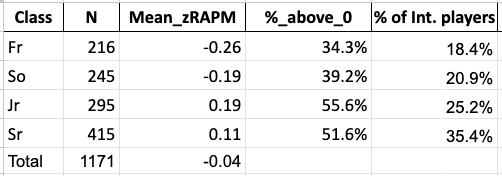
Interestingly, juniors were the only class that has an RAPM higher than the national average for its classification amongst all players.
Likely due to an increase of older freshmen, the first-years saw increases across the board. In raw numbers, 25% of all international players were freshmen last year, compared to an average of 15% across the previous two years. Freshman production also jumped significantly. 44% of all international freshmen had a positive RAPM last year, compared to 27% in 2023-24.
Another interesting side note is that the average age of all 32 High-Major freshmen in the study averaged out to be 20.1 years old. Only three were 22 or older.
Age and College Experience
While we had no data for player age, or any college experience beyond the confines of the three-year sample, I decided to add a little context of my own.
Breaking down the Top 50 international players in RAPM each of the three seasons, the average age is practically identical, ranging from 21.6 to 22.2 years old in each campaign.
However, while these Top 50 performers in 2023-24 and 2024-25 averaged 2.4 years of college experience before having a star season, this most recent campaign had an average of 1.7 years. With stars like Hannes Steinbach, Thjis De Ridder, and David Mirkovic, this makes sense. 15 of the Top 50 international RAPM performers this past season had zero college experience, while there were only nine total instances the last two years combined.
Region Breakdown
To try and generalize geographical areas and strengthen sample size, I enlisted Bucknell Data Analyst Ryan Miele to do some further breakdowns by regions. The data set was broken down into nine groups:
- Caribbean & Latin America
- Western Europe
- Southern Europe
- Eastern Europe + Balkans
- Scandinavia + Baltics
- West Africa
- Central + East Africa
- East Asia
- Australia and Oceania
Here's a heat map of where players are coming from within the regions:
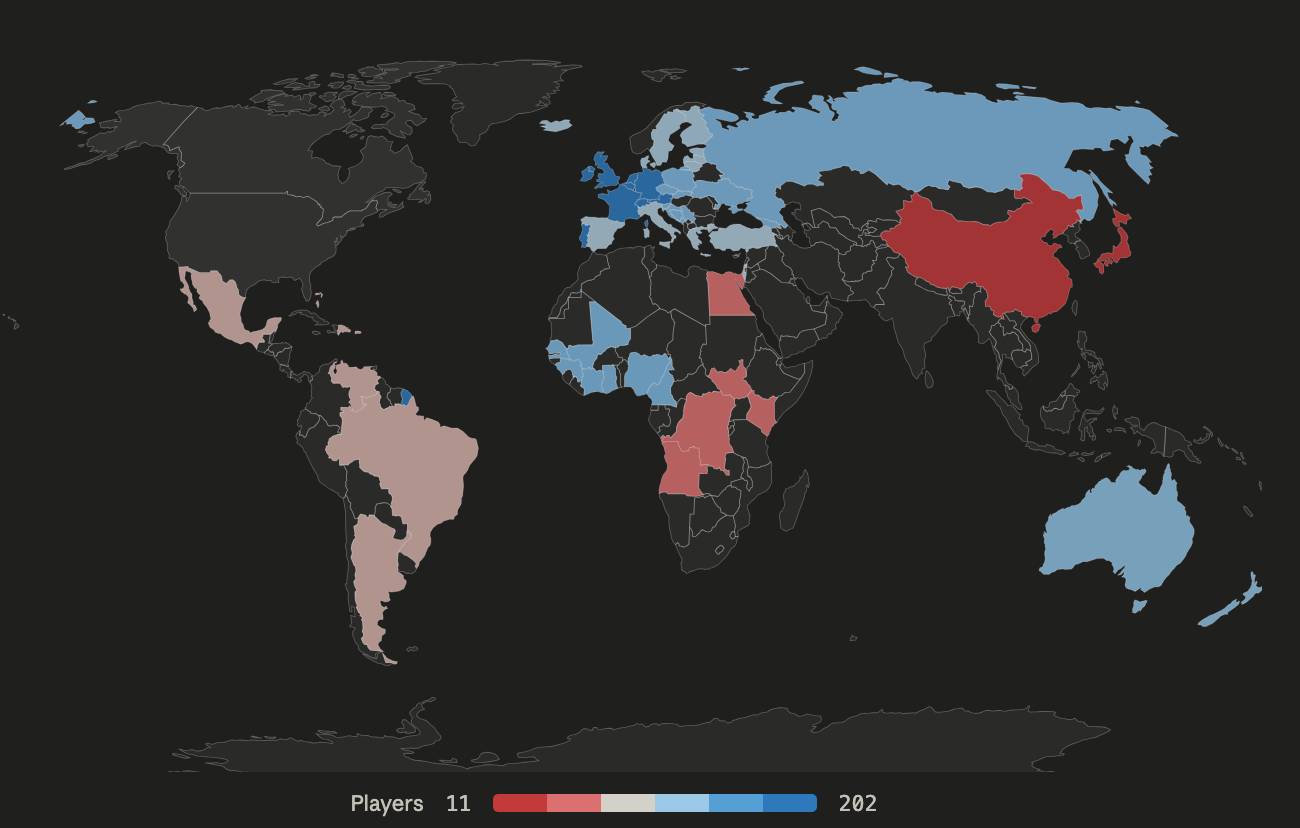
And here's a heat map of the average RAPM of the players within each region:
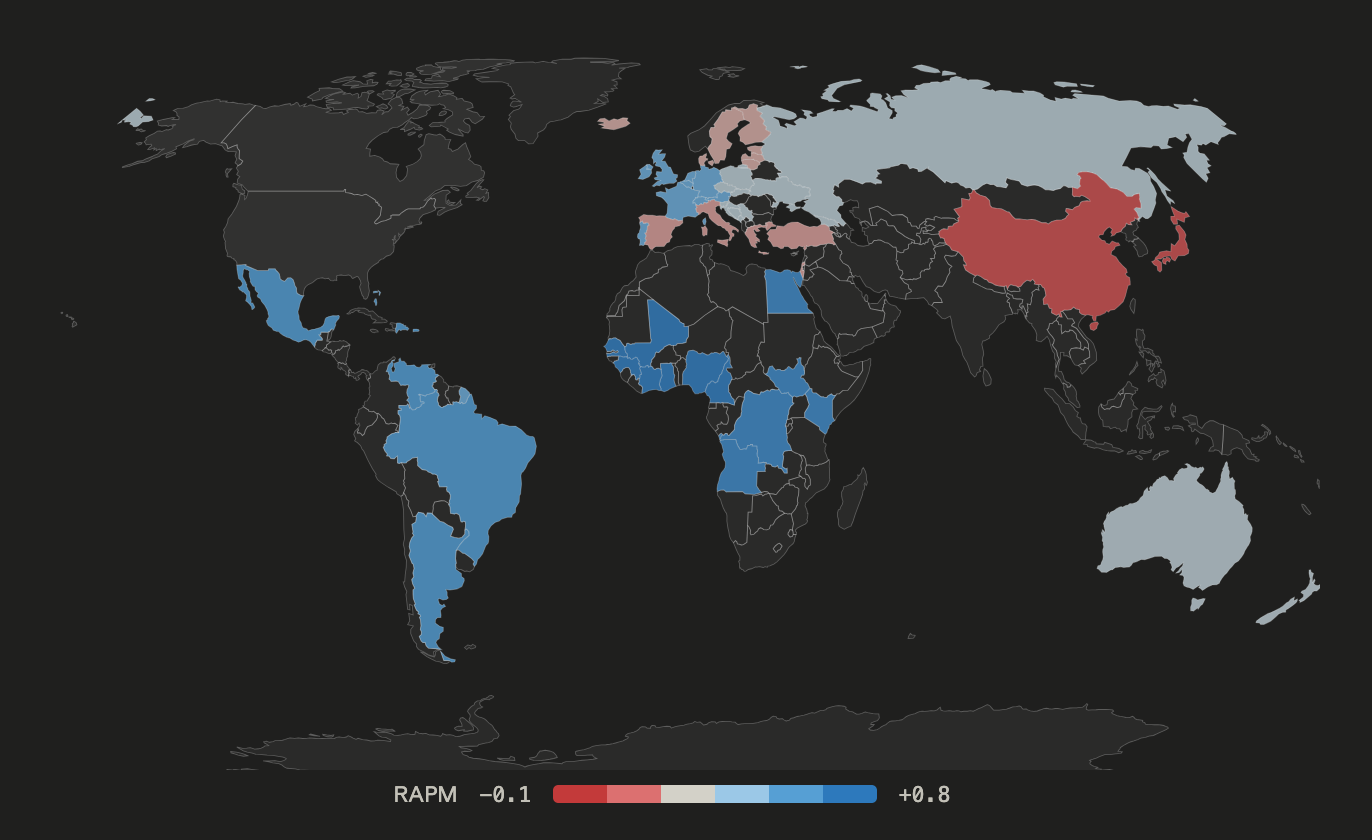
And lastly, Ryan put together a fascinating table of each region's average RAPM, along with its hit rate (amount of players with a positive RAPM), and star rate (amount of players with a top-10% RAPM).
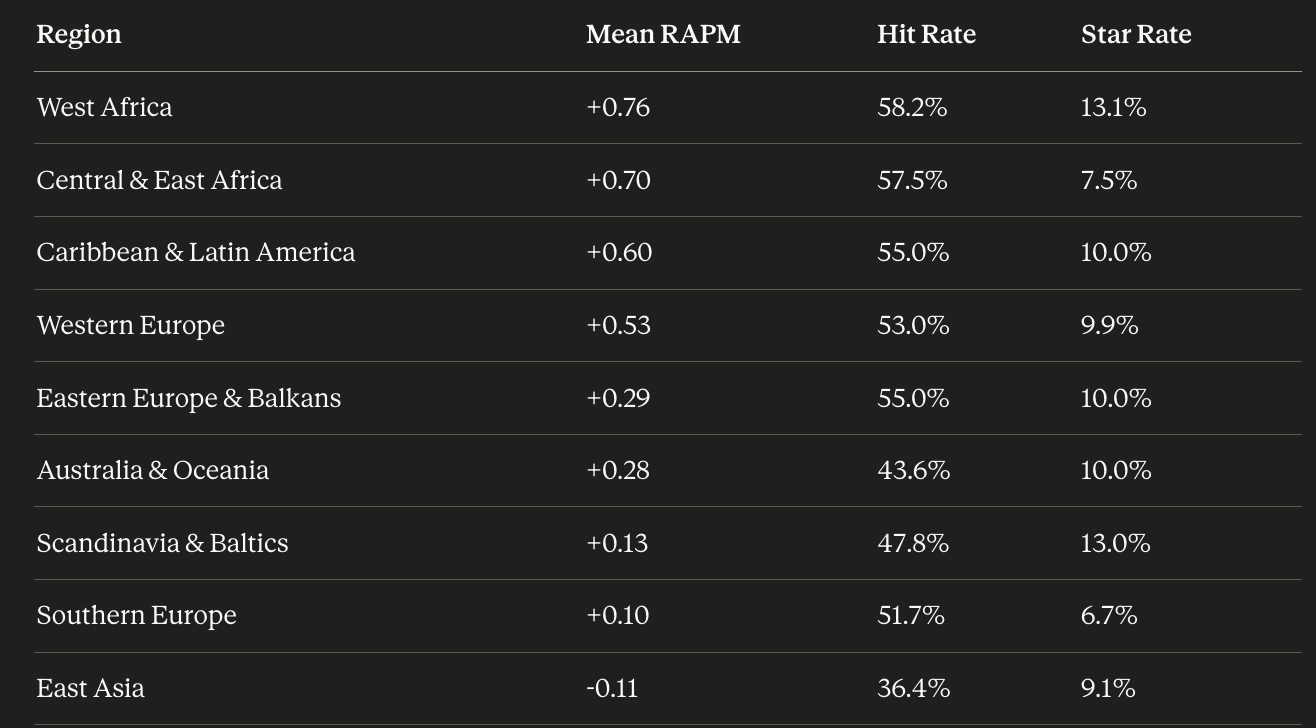
Africa remains the clear winner of this entire research study with its big man-heavy concentration. Scandinavia & Baltics have a disproportionate star rate compared to its average RAPM, which suggests high volatility. Meanwhile, Southern Europe has a solid hit rate but very low average RAPM and star rates, suggesting a higher floor and lower ceiling.
Analysis
So, what does this all mean? We've broken down a boatload of very insightful and eye-opening data, but how can we relate it to what we're seeing sweeping the college basketball landscape today?
For one, I think it's incredibly important to remain patient with these players. Not only is the average international RAPM below zero as an underclassmen, but among the 19 countries with five or more players that were in this sample more than once, 18 of those nations saw an overall RAPM increase over time. The average player from those countries saw a net RAPM increase of 1.2.
And then even just in general, of the 304 players amongst all international countries that played multiple years in the study, 192 of them (63%) saw an RAPM increase. 99 of them saw an RAPM increase of 2+ (33%), while only 37 saw a decrease of 2+ (12%).
Aday Mara is an obvious example of this concept. He didn't even qualify for this study as a freshman because his minutes were so low, and he posted a ghastly 93.6 offensive rating. Fast forward to now, and he had a Top 20 RAPM in the entire database last season.
A notable element with Mara is the fact that he started at UCLA when he was just 18. Amongst the top 50 RAPM players in the data set across all three seasons, only 12 of the 150 finished that campaign as a teenager.
Because of that, I'm tempering my expectations for Duke phenom Joaquim Boumtje-Boumtje. He'll begin his freshman season at just 17 years old. Though Boumtje-Boumtje can do many guard and wing things on the floor, he is still a big man for all intents and purposes. Much like Mara's story, the RAPM gap in our sample between freshman and sophomore big men is a wider gap than any academic classification for any position on the floor. Big men usually take a year to reach true productivity, and Boumtje-Boumtje is even younger than the average big.
That same concept also has me fascinated about Quinn Ellis at St. John's. In the entire study, there were eight total British guards, and none had remotely close to the professional impact Ellis had. The 23-year-old will almost certainly be listed as a senior, which is the only academic classification that has a positive RAPM amongst guards in the dataset.
Given all the data, my best guess is that Boumtje-Boumtje shows tantalizing flashes in 10 minutes per game as a freshman, while Ellis proves himself to be a top point guard in the sport.
A team of internationals
Largely due to the fact that NIL has made college basketball a lucrative league for international professionals, and a weird two-year gap between the end of Covid fifth-years and the beginning of the proposed 5-in-5 eligibility rules, there have been lots of holes on rosters that aren't being filled by domestic players.
That has led teams like LSU, Kentucky, and North Carolina to look aggressively overseas for talent. Will Wade mentioned on Jon Rothstein's podcast this week that their team may largely be comprised of international recruits.
The very clear distinction is how old and what academic classification these players will be.
In the last three years, only four teams have had three or more international freshmen in their rotation. One was UT Martin last year, who barely counts because freshmen only comprised half of their international players. The other three (2023-24 Sacramento State, 2025-26 Loyola Maryland, 2025-26 Fresno State) went a combined 30-63 and 19-35 in league games.
Of the 32 teams that have had at least four international players of any classification in their rotation across the last three years, only six of them finished in the KenPom Top 100, and only four finished in the Top 50.
The only Top 25 team that had four or more international rotation players was this year's Arizona team. Two of the four were upperclassmen (Mo Krivas, Anthony Dell'Orso), one barely played (Dwayne Aristode), and one was an outlier (Ivan Kharchenkov). None of it would have even mattered if they didn't also have two potential first-round picks AND the Big 12 Player of the Year on the roster domestically.
Sure, it's possible that a team largely comprised of international players with zero NCAA experience could be fantastic without a serious injection of domestic talent, but it would require players like Brice Dessert and Jean Montero, who are both at least 22 and are genuinely good players in the EuroLeague.
Otherwise, I think the extreme dependance some schools will have on international players will likely fade in a year if/once American fifth-years become commonplace.
Opportunity for smaller schools
Things have started to become harder for mid and low major schools in the international game, with many power conference teams swooping in this summer. Though a lot of the players top schools are signing this offseason cost more than many programs' entire budgets, these smaller schools are still facing an increasingly uphill battle.
Add in the fact that the transfer portal is reaching all-time highs, and the thought of adding an international freshman and watching them grow in your program is also an unlikely one.
Much like how I've advocated for picking up former high-major recruits in the transfer portal, I'd argue that pathway is perhaps more beneficial for international players.
Oscar Cluff, Baba Miller, Miro Little, and even lesser-known guys like Petar Majstorovic and Nils Machowski are all examples of players that truly blossomed only after moving down a level of competition. Since we have all this new data on international upperclassmen succeeding in Division-I, and guards having the steepest learning curve in the NCAA, why not take a gamble that their year of growth happens when transferring down?
We learned that international bigs take a huge jump between their freshman and sophomore seasons. George Washington's Andrija Vukovic, Santa Clara's Sidi Gueye, and Saint Louis' Alon Michaeli all have the chance to capitalize dropping down a level.
We learned that international point guards are only positive contributors on average as senior, which could bode well for guys staying at their school like High Point's Conrad Martinez and George Washington's Jean Aranguren, or for guys transferring to new stops like Jan Vide and Isaac Tavares.
High-Level Takeaways
There was a whole ton discussed in this study, so let's conclude with a handful of jotted notes on some key takeaways:
- International players in the NCAA have been growing, but only by a small amount each year. This upcoming season may be an exception, but it may also be a blip with the smoothing out of NIL funds and the potential inclusion of 5-in-5
- Australia dominates the game with nearly double the amount of players as any other country across the last three years
- Spanish players have the highest rates of internal improvement while in the NCAA
- 63% of all multi-year players in the study saw an RAPM increase, and 62 more saw increases of 2+ than decreases of 2+
- UT Martin is the sport's most international-based program, while Arizona is the best as it pertains to RAPM
- The 295 juniors in the study had the highest RAPM amongst all four academic classifications, and was the only group that had a higher RAPM than the national average for its classification
- The percentage of international freshmen is rising while the percentage of international seniors is diminishing, largely due to older players coming to the NCAA later and getting "generous" classifications
- Centers are the best position group of international players, which mirrors national data, while international guards are slightly negative value players as a whole
- Because of this, countries with great big men and practically no guards like Mali, Nigeria, and Senegal dominate the most effective international countries in Division-I hoops
- Mid-Major programs technically have the highest ratio of international players compared to domestic across the last three seasons, but 2025-26 was dominated by High-Major programs, suggesting a stark shift in that logic
- The highest concentration of bigs is in High-Major hoops, while the highest concentration of guards is amongst Low-Major teams
- Within the Top 50 RAPM international players in each of the last three years, the average age has stayed steady, but the average years of D-I experience has dropped. There were 15 players on that list with no D-I experience this past year, and none total the previous two
- Big men see their largest RAPM increase from FR to SO but are positive contributors in all four years
- Forwards see their largest RAPM increase from SO to JR and are positive contributors as upperclassmen
- Guards see their largest RAPM increase from JR to SR and are only positive contributors as seniors
