


By assembling one of the deepest teams in the country, Kentucky has proven its ability to acquire talent is without question. The offseason is long, and the rules are different these days. After early struggles, Mark Pope and his staff put the program’s vast resources to work, eventually signing two of the portal's top summer transfers: forwards Milan Momcilovic, who picked the Wildcats after testing the NBA Draft process, and Mark Mitchell, who signed an Exhibit 10 contract with the Denver Nuggets but was cleared to play a fifth season of college hoops via a temporary restraining order.
Now standing at 15 players, Kentucky’s roster is brimming with size, experience, positional versatility and playmaking. The talent is in Lexington, but the focus now shifts to cohesion. Communication and chemistry are hard to quantify, yet critical to building a winner. Over a long season, how will Pope blend these pieces to maximize the team's ceiling?
In Momcilovic and Mitchell, Pope has a tandem with clear, natural synergy. Their skill sets complement each other seamlessly, with one player’s gravity constantly opening up looks for the other.
Let’s look at how this duo should fit together in Lexington.
Space and Slash
Momcilovic was the best shooter in college hoops last season, draining a ridiculous 48.7 percent from beyond the arc while attempting 14.4 3-pointers per 100 possessions. In doing so, Momcilovic became just the seventh high-major player since the 2007-08 season to shoot above 45 percent from deep on more than 14 3-point attempts per 100 possessions.
Nearly 68 percent of Momcilovic’s field goal attempts came from beyond the arc, brining his career 3-point attempt rate to 60.2 percent. Unsurprisingly, Momcilovic didn’t get much of his work done on the interior. The 6-foot-8 forward scored just 3.5 paint points per 40 minutes, and the average distance from the hoop on his 2-point attempts was 10.0 feet, per CBB Analytics.
Momcilovic offers little half-court rim pressure, but this is where Mitchell enters the picture. Mitchell won’t be the only reliable source of rim pressure on the roster; however, the 6-foot-8 southpaw offers a different dimension.
Mitchell is a rugged, functional driver and creator, especially for a big forward in the college game. He can work as a reliable mismatch piece, collapsing defenses and forcing interior help. Put a bigger defender on him, and Mitchell can attack top foot and get downhill. Put a smaller defender on him, and Mitchell can look to drive through him with his upper body. If Mitchell gets a switch or a cross-match with a guard, he can look to post up. In all of these scenarios, there’s a natural partnership between Mitchell and Momcilovic — one of the best catch-and-shoot bombers in the country.
According to CBB Analytics, Mitchell attempted 10.9 field goals in the paint per 40 minutes, including 6.4 rim attempts, where he shot 68.2 percent. Mitchell is a magnet for contact; as his usage rate jumped at Missouri, so, too, did his free throw rate. Mitchell drew 4.6 shooting fouls per 40 minutes last season — ranking in the 99th percentile. Of the 129 shooting fouls Mitchell drew last season, all 129 came on 2-point attempts, including 34 and-one opportunities.
All of that slashing ability forces defenses to contact or rotate help in Mitchell’s direction, which, in turn, creates those open kick-out looks. Mitchell averaged 2.2 assists on 3-pointers per 40 minutes, including 0.9 corner 3s per 40 minutes (99th percentile).
Last season, Mitchell became the first high-major player since Juwan Staten in 2014 to post an assist rate above 20 percent, a turnover rate below 15 percent and a free throw attempt rate over 60 percent. In fact, since the 2007-08 season, the only other high-major player in Bart Torvik’s database to hit those single-season benchmarks was Ty Lawson during UNC’s 2009 national championship run.
It’ll be fascinating to watch how Pope leverages Momcilovic’s spacing to unlock Mitchell as a driver and post threat. Stationing Momcilovic in the weak-side corner during a Mitchell post-up forces help defenders into a bind, leaving an elite shooter wide open for cross-court skip passes whenever the defense commits inside.
If defenders elect to play Mitchell straight up, he has the size and power to fall back on his 1-on-1 game, facing up and isolating from the mid-post or elbows.
Alternatively, Kentucky could place Momcilovic one pass away while Mitchell is in attack mode, complicating defensive gap responsibilities. A talented as Mitchell is as a driver, he has limitations. He isn't exceptionally fluid off the bounce and can struggle in tight spaces, which sometimes leads to clunky drives — forcing contact before spinning back to his preferred left hand. When that happens, Mitchell becomes vulnerable to off-ball defenders, like Otega Oweh, digging in from the strong-side corner to strip the ball.
However, if Momcilovic is stationed in the right corner, helping off him becomes far more perilous. Positioned just one pass away, he’s primed for a spot-up jumper the moment his defender commits to Mitchell. More likely, though, Momcilovic’s man will be hesitant to leave the best shooter on the floor open for a clean kick-out. That hesitation widens Mitchell’s driving lanes or forces the defense to pull help from elsewhere on the floor.
Off-ball Actions for Momcilovic
As evidenced by his career assist rate of 6.5 percent and free throw attempt rate of 19.2 percent, Momcilovic is not a high-volume live-ball playmaker, though he isn’t a one-trick pony: Momcilovic reads defense well out of dribble-handoffs (DHO) and can isolate in the mid-post. Above all, he’s a dynamic movement shooter, possessing a quick-trigger release, excellent size and deep range. His value in Pope’s half-court offense will come primarily off the ball. flying off screens and hunting rhythm 3s.
Similar to how Pope has utilized other movement shooters in recent years — Richie Saunders, Jaxson Robinson, Koby Brea and Collin Chandler — he’ll deploy Momcilovic in a variety of ways as a roving shooter and screener.
Some of Kentucky’s early-offense actions fit him seamlessly, including "Wide" action. In this set, a player at the top of the key sets a 5-out high pindown screen for a wing on the weak side, angled to let the cutter fly across the formation toward the ball. For example, as Denzel Aberdeen initiates early offense, Malachi Moreno trails the play and sets the down screen on Michigan State’s Coen Carr to free Oweh.
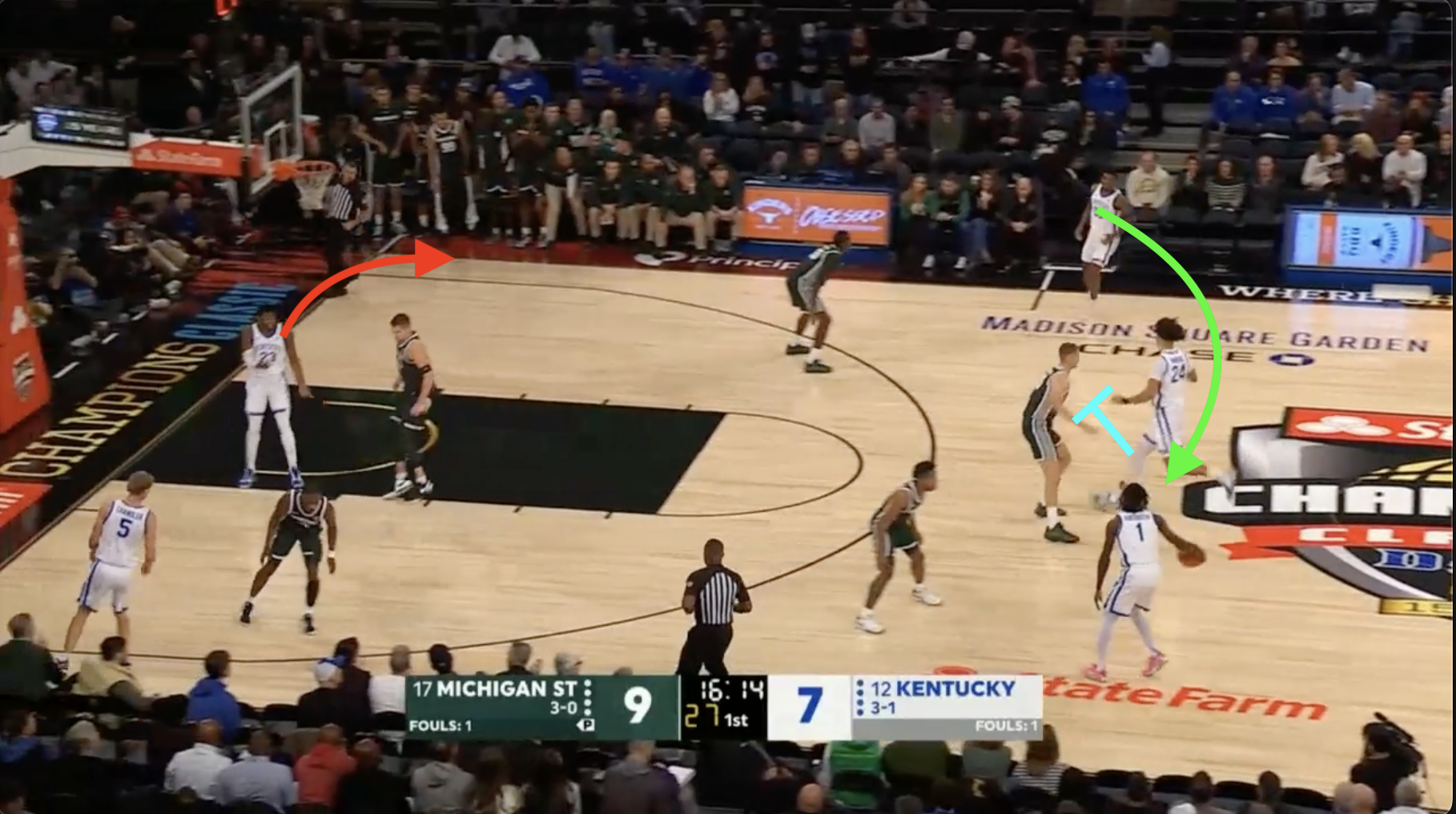
Carr gets stuck going under Moreno’s screen and Oweh has plenty of time to line this up and drill an open 3-pointer.
Against Louisville, Moreno sets the Wide down screen for Aberdeen. Isaac McKneely chases Aberdeen over the screen, with center Aly Khalifa pulled out of the paint and up to the level of the screen. It’s a nice read off the Wide action from Aberdeen, who curls downhill and wins the race to the hoop for a layup.
From the 2024-25 season, Kentucky runs more Wide action for Oweh — this time on the road at Clemson. Oweh opts to not shoot the 3-ball off the catch. Instead, Kentucky flows into its next progression: a step-up ball screen from Amari Williams. Oweh gets the switch and draws a foul on center Christian Reeves trying to contest.
Right out of the gate at Tennessee from the 2024-25 season, it’s Wide action for Brea, who curls into space after a poorly-executed switch from Jordan Gainey and Felix Okpara.
During his time in Ames, Momcilovic was used in this same Wide action by T.J. Otzelberger.
On this possession, Iowa point guard Bennett Stirtz — defending Momcilovic — makes the mistake of going under the down screen from Blake Buchanan. Momcilovic comes off the pindown and drains a poorly-contested 3-ball.
In early 5-out offense, Kentucky will also run “Stong” — or “Double Away” — action for a shooter coming out of the weak-side corner, running off staggered down screens.
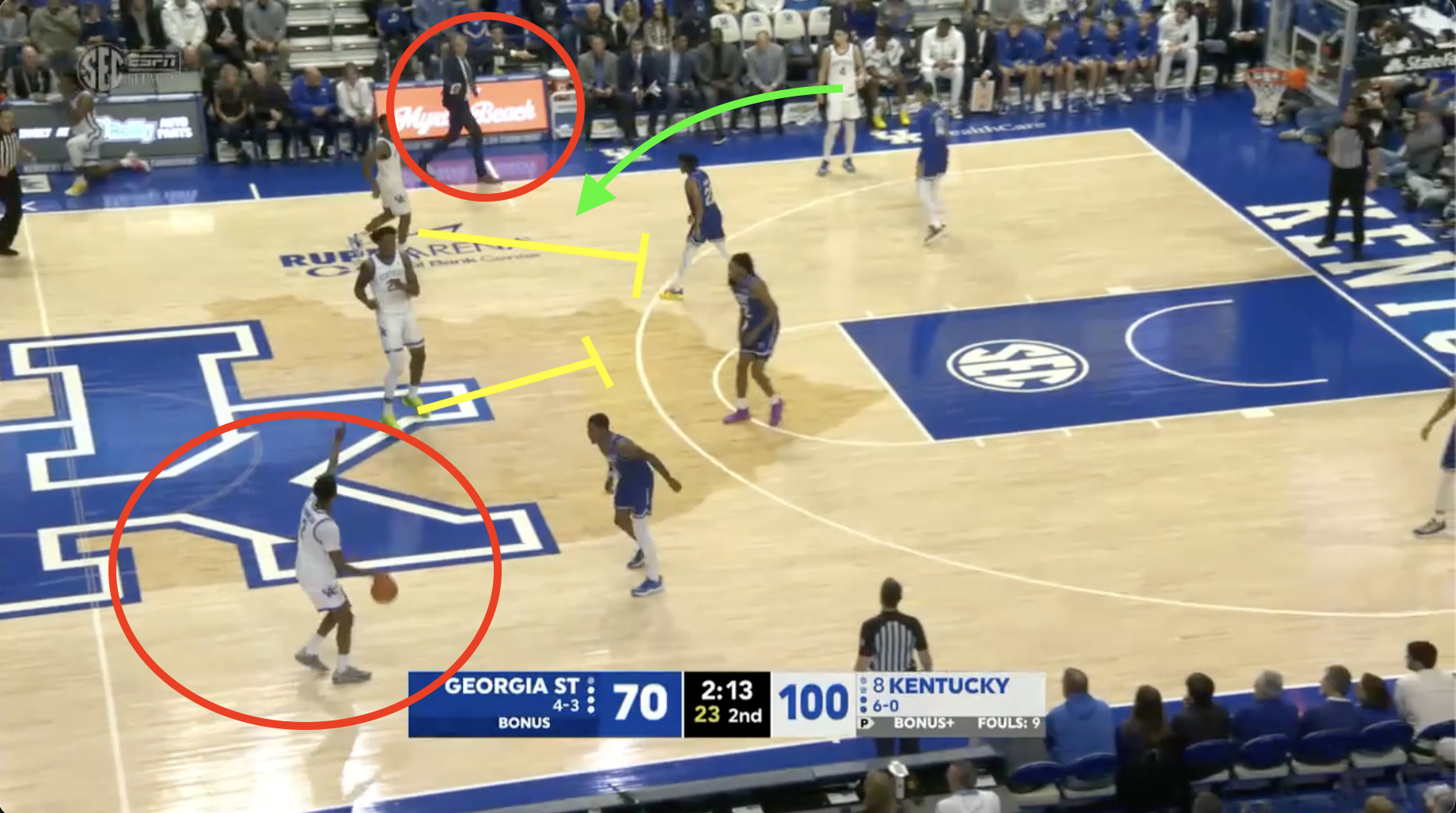
Late in a blowout victory over Georgia State from two seasons ago, both Robinson and Pope call for Lamont Butler and Williams to set staggered screens for Brea, coming out of the far left corner. Brea breaks free and curls for an uncontested triple from the middle of the floor.
Here’s the same action for Brea on the road against Alabama. Brea glides off the staggered down screens and gets separation from Labaron Philon, who closes out late on one of the best shooters in the nation.
Another one of Kentucky’s go-to motion sets — and one that should prove tailor-made for Momcilovic — is what I refer to as its "Loop" action. Kentucky aligns with its 4 and 5 on opposite baseline blocks, paired with a shooter stationed in the right corner. The action launches as the shooter sprints across the baseline, curling off staggered bumps from both bigs.
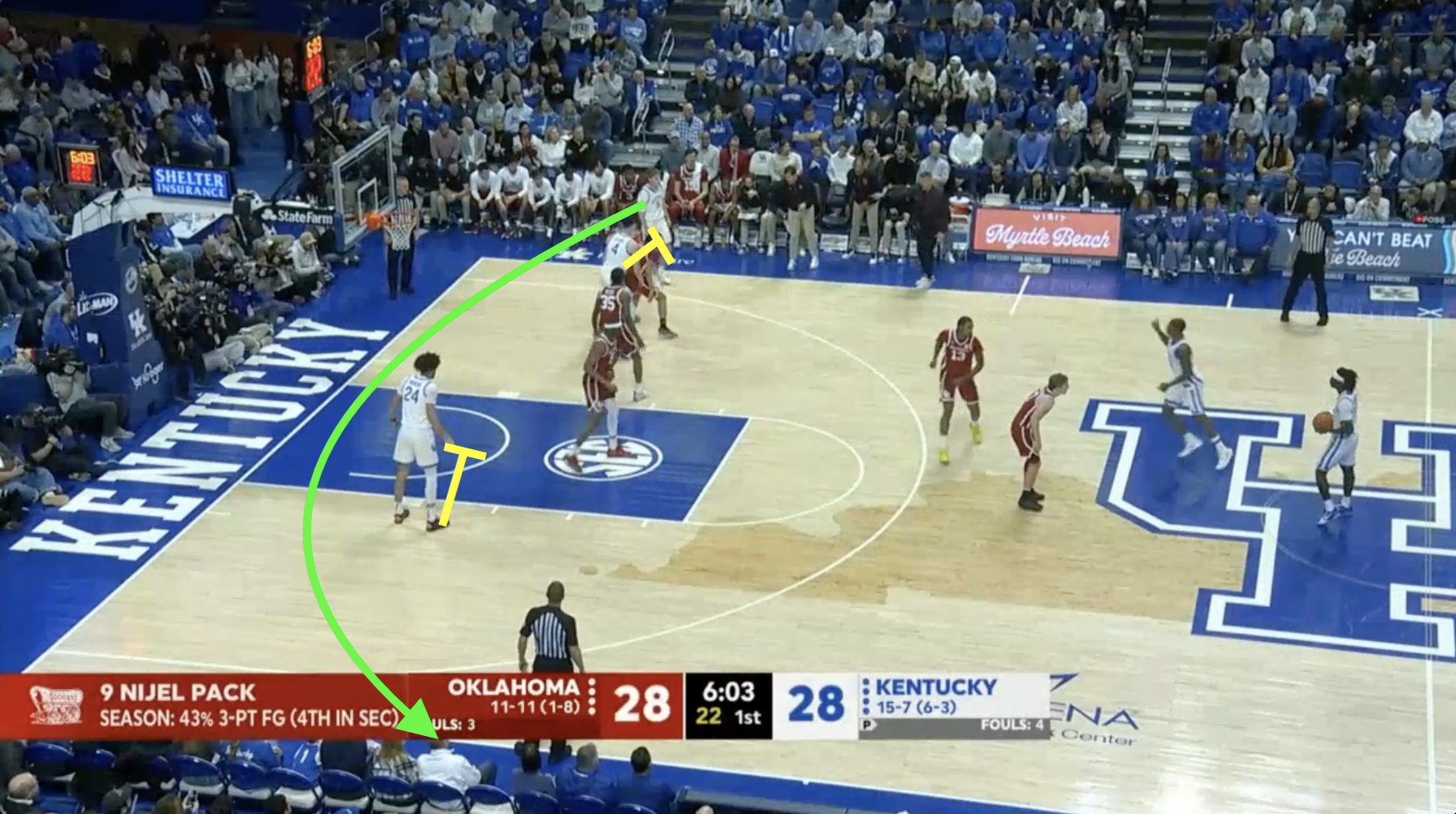
After setting the first off-ball screen, one of the big men — in this case, Andrija Jelavic — will chase and lift toward the left wing, prepared to set a ball screen if necessary. This could be a way to unlock some empty-side screen-roll with Momcilovic and Mitchell.
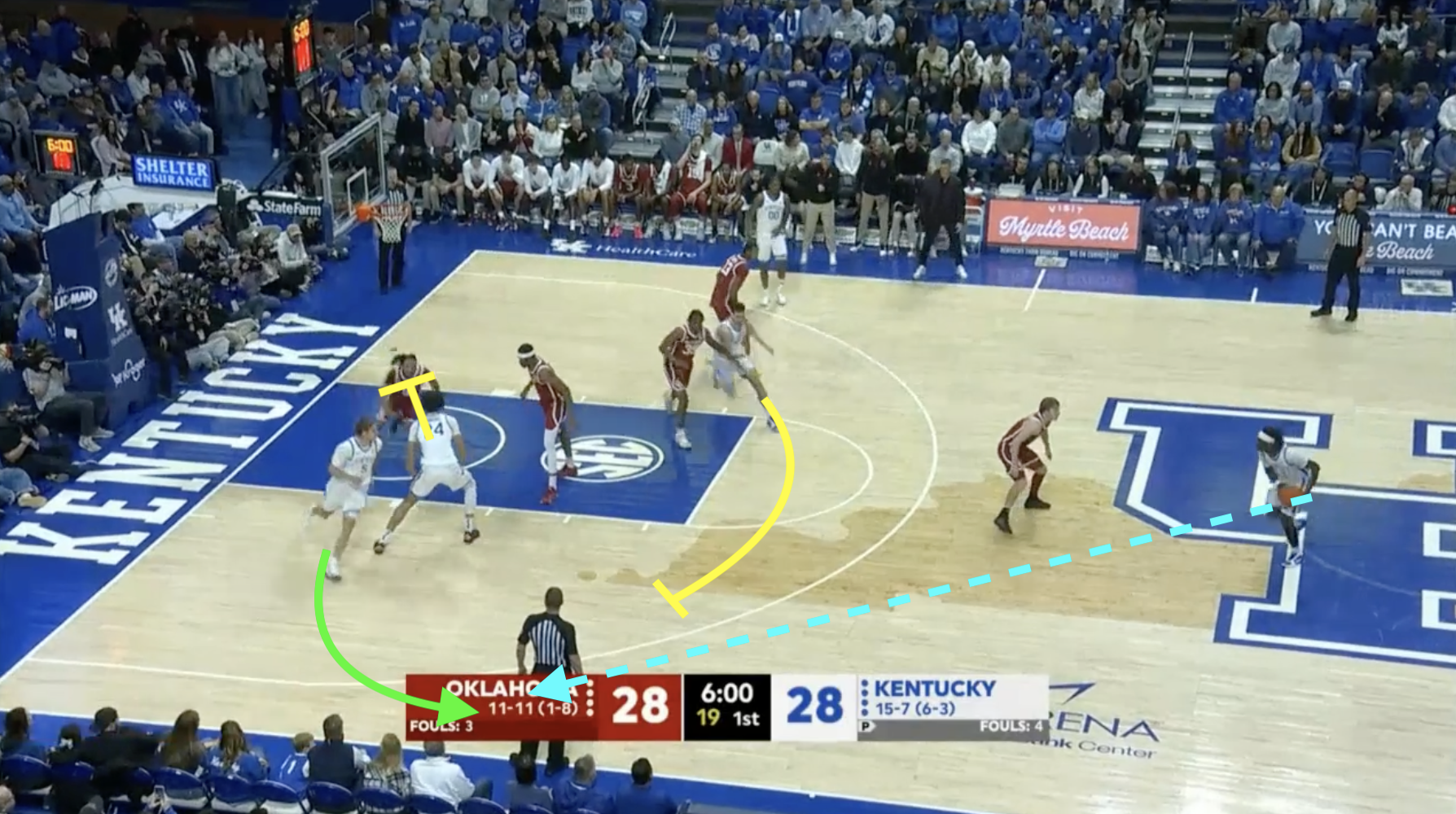
However, if the shooter comes off the second screen with a clean look, he can rise up and let it fly, which is exactly what happens on this possession against Oklahoma. Chandler curls around screens from Jelavic and Moreno while his defender attempts to shoot the gap on the second screen. Reading the defense, Chandler fades Moreno’s down screen into open space for a rhythm 3.
Here’s the same set for Kam Williams at LSU. This time, the chase defender, Charlotte Hornets Summer League legend Max Mackinnon, tries to follow Williams around the screen, but Kentucky generates another clean catch-and-shoot 3 off the action.
Flares and Slips
During Mitchell’s final year at Duke, the Blue Devils finished the 2023-24 campaign with a Top 10 offense in terms of adjusted efficiency. These problems are all relative for a team that won 27 games and went to the Elite Eight; however, that Duke squad never quite hit its lofty ceiling on offense, which needed to be its calling guard. Duke entered the ceiling planning to run 5-out offense through playmaking-5 Kyle Filipowski, flanked by the ball handling and shooting of Jared McCain, Tyrese Proctor and Caleb Foster — along with Mitchell’s face-up slashing and dirty-work finishing. That, however, never quite happened.
Early that season, opponents like Arizona and Arkansas aggressively sagged off Mitchell, daring him to pull up from deep. Duke's primary backup bigs, Ryan Young and Sean Stewart, offered no perimeter threat either and were treated with the same leniency. Duke wanted to play 5-out, but defenses ignored Mitchell outside, clogging the paint and completely neutralizing the team’s presumed spacing advantage. What was supposed to be a strength was turned against the offense.
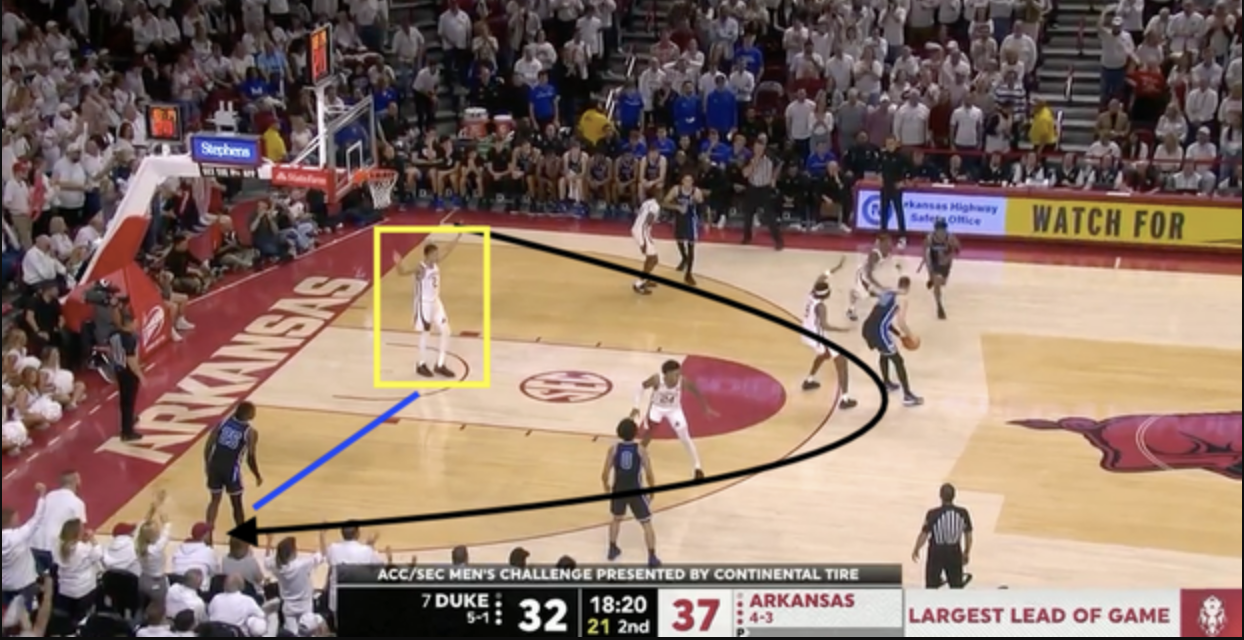
Making matters worse, Mitchell’s confidence slipped and a once reliable low-volume spot-up shooter became a liability. This regression forced the Blue Devils problem solve their offense on a game-to-game basis. Honestly, when Duke needed to achieve pure 5-out spacing, it required playing backup point guard Jaylen Blakes as the de facto small-ball 4, or TJ Power, who has finally found at home in the college game in the Ivy League.
1st play for Duke with the 4-guard lineup vs. Hofstra: after-timeout -- wide pindown for Jeremy Roach, flows into inverted 5-1 pick-and-pop between Kyle Filipowski + Roach at the nail, results in a Flip and-1
— Brian Geisinger (@bgeis_bird) December 13, 2023
Duke: +11 in 7 mins with Foster, Roach, McCain, Blakes + Flip vs. HOF https://t.co/rkQkYWwPK4 pic.twitter.com/rFLwFIHmkh
In either case, these lineups changes caused Duke to be either really small or just not viable on defense. The Blue Devils needed Mitchell on the floor for his defense, rebounding and interior finishing.
One of the key adjustments Jon Scheyer made that season was tapping into Mitchell more as a screener — both on and off the ball — especially as it related to the high-post passing of Filipowski and the movement shooting of McCain. If opponents were going to “off the body” against Mitchell, and sag his defender way off of him, Duke needed a counter; this became using Mitchell to set flare screens for McCain.
Fun concept for Duke's half-court offense centered on Kyle Filipowski's passing + Jared McCain's gravity
— Brian Geisinger (@bgeis_bird) February 8, 2024
Flip initiating in high post, Mark Mitchell flare screen for McCain — flare action puts screen defender in bind: help on McCain or open the lane for Mitchell's cut https://t.co/qb1bCNyYVT pic.twitter.com/WzeRwla6iq
Here’s the first play of the second half from a Feb. 2024 victory over Notre Dame. Filipowski lifts to the left slot and receive an entry pass from Proctor, who cuts down the left corner. McCain spaces to the opposite wing. Notre Dame power forward Tae Davis sinks off of Mitchell, hanging a half-step outside the lane, leaving Mitchell alone in the corner. Instead of remaining static, Mitchell is put in movement lifting up to set a flare screen on Braeden Shrewsberry.
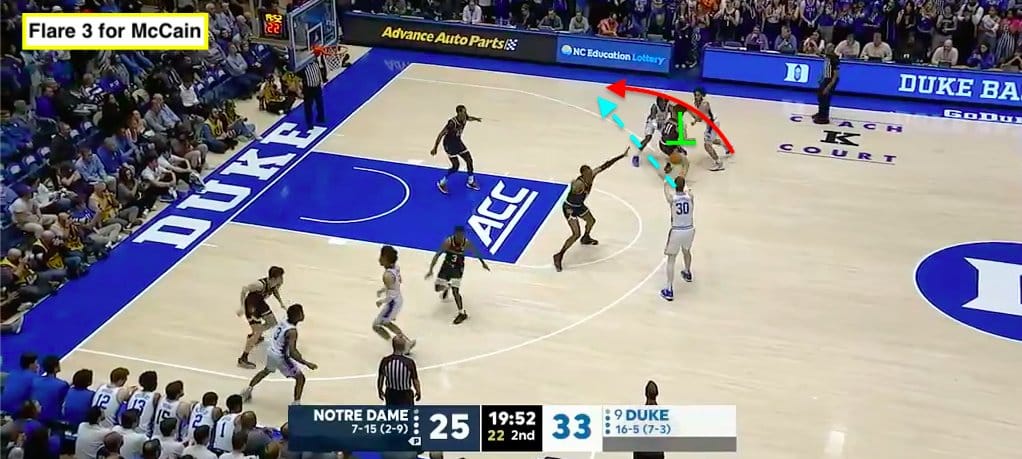
This puts a lot of pressure on Shrewsberry to get over a physical screen set by a larger player for the best shooter in the gym, and with Davis dropped into the paint, there’s no help defender. Duke’s taken Notre Dame’s coverage and turned it into a de factor 2-on-1 power play. Filipowski skips over the top and McCain hits a 3.
On the very next possession, Duke runs the same action: Filipowski lifts to the left slot and receives a pass from Proctor, who cuts to the corner. As that takes place, Mitchell comes up to set another flare screen on Shrewsberry.
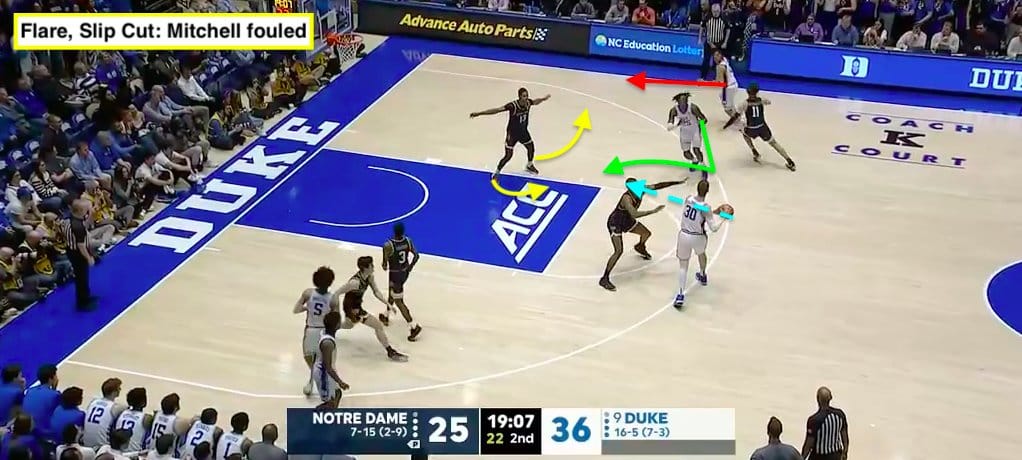
Davis calls out the flare action to Shrewsberry and takes a step back toward the corner, presenting himself as a potential help defender after getting burned the last trip down the floor. In doing so, though, Davis opens up the lane. Mitchell slips his screen for McCain, receives a pass on the run from Filipowski and is fouled on his basket cut as Davis scrambles to recover.
Later in the second half, Duke runs a slightly different action, but ends up in a similar setup: Filipowsoki in the high post and McCain flaring to the right corner off a screen from Mitchell.
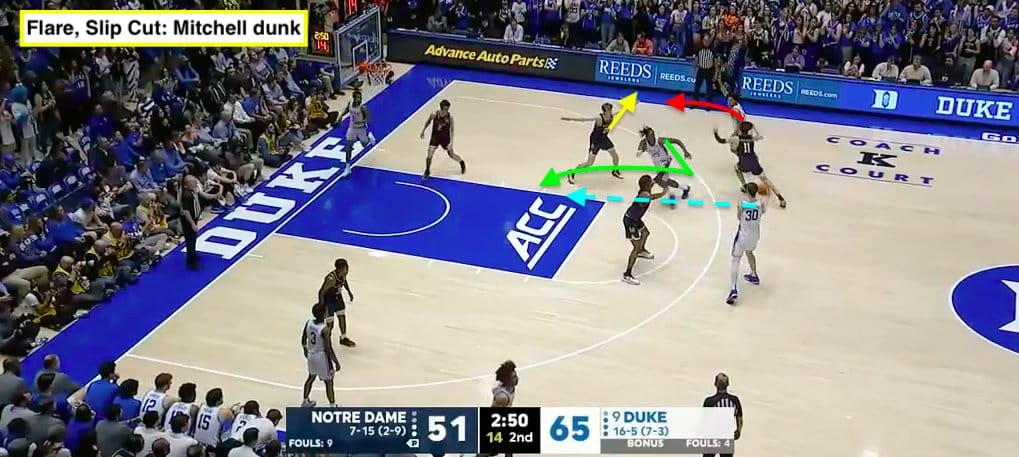
I refer to this as Duke’s “Down Swipe” action; during the 2024-25 season, this play would become a go-to for Kon Knueppel and Isaiah Evans. Here against Notre Dame, though, McCain is the off-ball mover and Mitchell is poised to benefit from his gravity. Once again, Mitchell slips the screen and Filipowski hits him for a dunk.
Mitchell made strides as a 3-point shooter last year at Missouri, hitting 19-of-49 (38.8 3P%) from beyond the arc, similar to where he was as a freshman at Duke in the 2022-23 season. The gains are modest, but it may be enough for defenses to honor his shot enough where they don’t play off him in such in exaggerated fashion.
This is where Mitchell’s partnership with Momcilovic (or Kam Williams) can be valuable. If teams defend Mitchell off the body, Kentucky can have him smack Momcilovic’s defender with a flare and play out of it, which is something Pope has gone to before.
Last season at South Carolina, Kobe Knox defends off of Moreno, with Elijah Strong switched to Chandler. On the empty-corner side, Moreno lifts and sets a flare on Strong. Knox and Strong don’t properly communicate the action, thus Chandler floats into open space off Moreno’s flare — with Knox too far behind the play to apply a good contest.
Of course, like he did against Notre Dame 2.5 years ago, Mitchell can slip those off-ball actions and get downhill off cuts.
On this baseline-under possession against South Dakota, Missouri comes out in a “Box” set and runs screen-the-screener action for Jacob Crews (43.4 3P%), an excellent shooter with size, like Momcilovic. As Crews gets set to curl toward the corner off Mitchell’s screen, the Kansas City product slips downhill and finishes above the rim with a powerful dunk.
Given the power of his off-ball gravity, Momcilovic will force defenses to bend and shift when he runs off screens. This will create openings for other guys on the floor, especially when the defense feels like it can’t defend off the body. When that happens, Mitchell, Moreno or any of the other rollers on Kentucky’s roster should be able to take advantage of playing next to Momcilovic.
If Momcilovic and Mitchell can nail down the timing and chemistry, then there’s real upside the be unearthed. This is where those two can find synergy and help the other get to his best spots on the floor in space.
DHOs, Keep Actions and 5-out
Mitchell initiating dribble-handoff action is another way to pair him with Momcilovic, especially when defenses want to guard Mitchell off the body, playing him for the drive. If Mitchell’s defender is underneath the mesh point, and Momcilovic’s defender is hugging him along the perimeter, the DHO is a great way to snap into quick screening actions — initiated by the ball handler — including out of flow or a secondary reads. A simple DHO can be a springboard to launch Momcilovic into space along the arc, which is a dangerous proposition for defenses.
Kentucky runs a lot of 5-out offense, featuring different reads, screening and cutting concepts, including “Zoom” action, where a down screen flows into a DHO with one of the bigs. That’s precisely what happens here with Aberdeen: he pulls Missouri center Shawn Phillips up to the level of the screen, opening space for Moreno to roll to the low block and seal deep post position.
Oweh comes off the Zoom action from Moreno here against Tennessee, which results in a give-and-go with Jasper Johnson, with Kentucky taking advantage of early nail help from both Bishop Boswell and Nate Ament.
Momcilovic will naturally feature heavily in these sets for Kentucky; when he drags a second defender up to the level of the handoff, the player initiating the action and rolling downhill should find a clear runway to the rim. His movement will put defenses into rotation and create openings.
During his time at Iowa State, Momcilovic was prolific in these actions, including when paired with Joshua Jefferson, another playmaking 4 whom defenses had to respect as a slasher. When defenders chase Momcilovic hard around the screen, it gives him an open lane to curl downhill for an occasional paint finish.
With a streamlined shot process and high release point, Momcilovic is really tough to contest on these looks. This is a dynamic Kentucky should regularly get to when he and Mitchell share the floor. (The same applies for Mitchell and Kam Williams, another tall, talented shooter.)
If the defense anticipates a handoff coming, the frontcourt player initiating the action can use a little bit of misdirection and fake the handoff, keeping the ball for himself.
Here’s the first play from Duke’s 2024 win over Virginia: McCain cuts across the formation over Iverson screens from Mitchell and Filipowski. Proctor feeds the ball into Mitchell at the right elbow and cuts in his direction. Ryan Dunn follows Proctor, but Mitchell’s defender, Jake Groves, is caught flat-footed when — like an option quarterback — Mitchell fakes the handoff and turns the corner for an easy layup.
If Mitchell and Momcilovic are paired in these actions, some defenses will look to switch between the like-sized forwards. While somewhat matchup-dependent, that approach may present 1-on-1 opportunities for the bruising Mitchell to exploit — or allow Kentucky to counter with DHO "Keep" actions, an effective tool to use against switching coverages.
Two-Man Game: Screen-and-Roll in Either Direction
Outside of the dribble-handoff, another way to involve Momcilovic and Mitchell directly in actions together is through some pick-and-roll offense.
Historically, Momcilovic doesn’t initiate a lot of pick-and-roll, nor does he project when an expanded role in this play type in Lexington, especially given the guards on the roster: Zoom Diallo, Alex Wilkins and Jerone Morton. It makes more sense for those guys to be on the ball, while freeing up Momcilovic as spacer and off-ball mover. However, second-side pick-and-roll will occasional occur; Momcilovic and Mitchell could work as a pairing in these situations.
Momcilovic’s shooting is a lever to pull to get two defenders on the ball, bringing the screen defender up to or above the level of the pick. When that happens, Mitchell can short roll into pockets of space, where he’s both a quality connective passer — pulling in a help defender and kicking to the weak-side for an open 3 or hitting a cutter in the dunker spot — and a productive in-between scorer.
This is similar to how Pope utilized Mouhamed Dioubate or Andrew Carr as 4-man screeners even when playing alongside a non-shooting 5, spaced to the opposite slot.
Of course, Kentucky can easily invert these actions and use Momcilovic as the screener for Mitchell. Whether it’s “Pistol” action in early offense or a secondary progress mid-possession, this is simple setup that carries big-time potential. There’s plenty of low-hanging fruit to grab here: when Mitchell draws a second defender to the ball, Momcilovic can pop into open space along the perimeter for uncontested 3s.
At Missouri, the Tigers capitalized on Mitchell’s handle and slashing ability in various ways, often using guards and wings to set subtle brush screens on the wing. That’s what plays out here against Florida, where Anthony Robinson sets the screen, forcing Alex Condon to fight over it as Mitchell attacks the space for a layup.
Against switching coverages, Mitchell gets clear isolation opportunities against smaller defenders. When he catches a mismatch like Auburn’s Tahaad Pettiford, Mitchell immediately puts his head down and attacks the rim. At a minimum, he’s getting to the line.
What It All Means?
The pairing of Momcilovic and Mitchell gives the Wildcats a catalyst for their new-look frontcourt. By seamlessly balancing elite movement shooting with determined rim pressure and passing, the duo covers for each other’s functional limitations while accentuating their greatest strengths.
Whether leveraging Momcilovic’s off-ball gravity to open up downhill driving lanes for Mitchell, or using Mitchell’s screening to free up high-percentage looks for Momcilovic, their skill sets bring a lot to the table for Pope's 5-out system. If these two find the right blend, it creates a much better ecosystem for the rest of a super-talented roster. That's the real upside of this duo.
