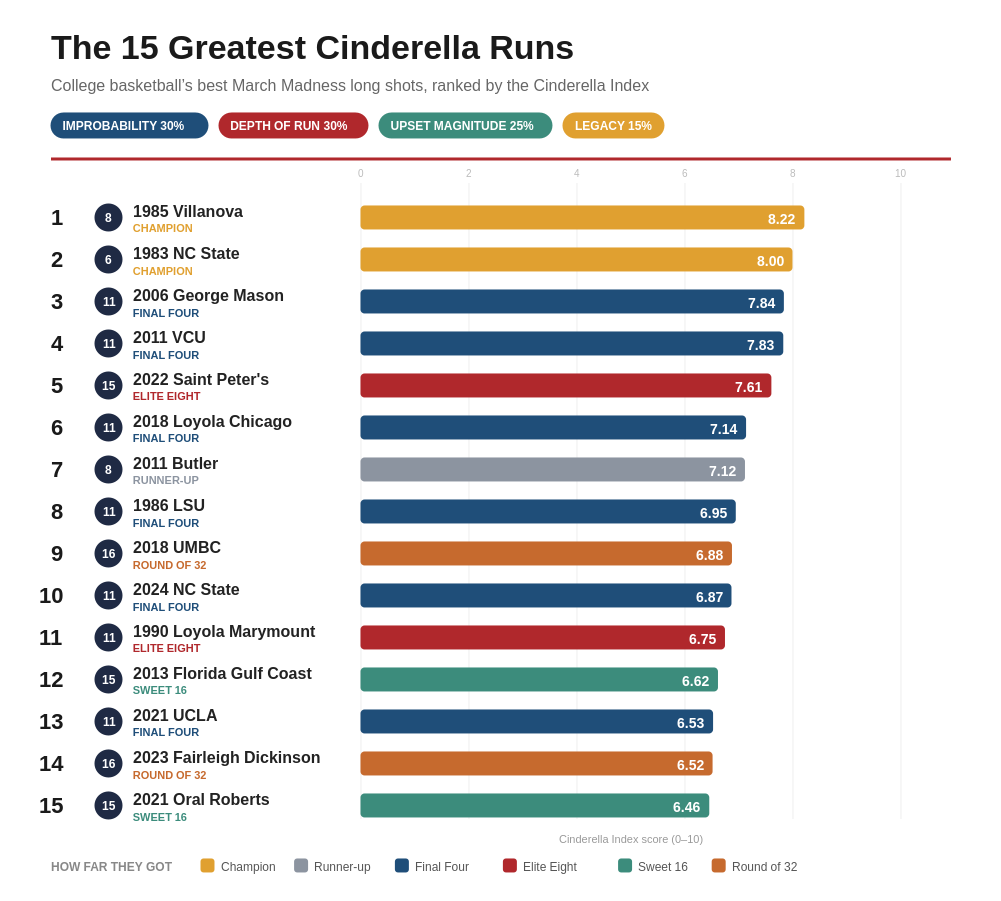


One of the best parts of March Madness is how quickly a team can become part of the tournament's history. A school most fans had barely watched all season wins a game or two, captures the country's attention, and suddenly has a permanent place in the sport's collective memory. That is also what makes ranking the greatest Cinderella runs so difficult: everyone remembers a different team, a different shot, or a different weekend that felt impossible at the time.
Much like with our articles ranking the best national champions since 2000 and the best teams that never won a title, we needed a formula — built specifically for long shots — to determine this ranking. Because it starts with seed rather than KenPom, it can compare 1979 and 2024 without forcing an era adjustment.
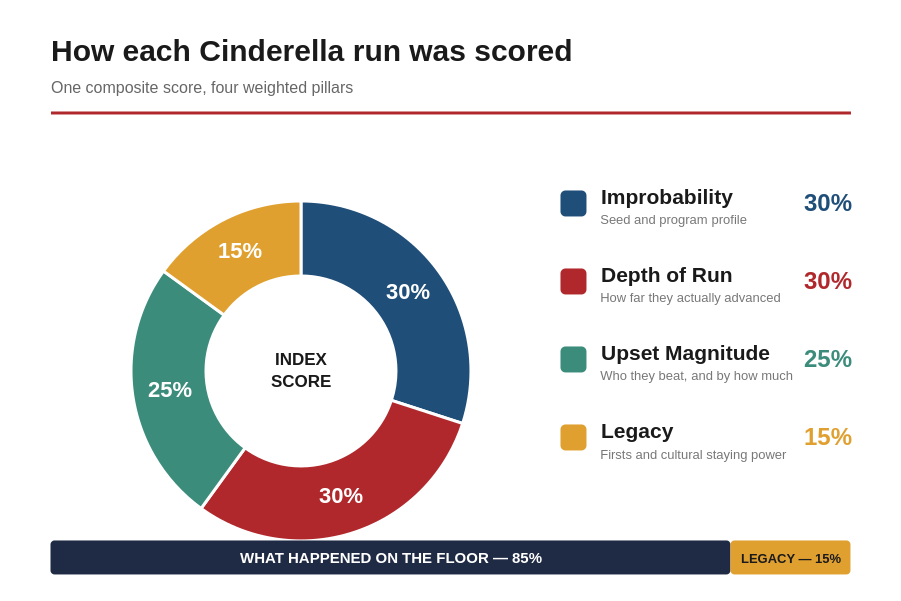
Each run was graded across four areas. Improbability (30%) accounts for seed and program stature, giving more credit to a one-bid underdog than an underseeded power. Depth of run (30%) rewards how far each team advanced. Upset magnitude (25%) measures opponent quality and margin, allowing a shorter run with a historic win to remain competitive. Legacy (15%) captures the firsts, the lasting moments, and each run's place in the sport's memory.
The results draw a firm line between a surprising tournament run and a true Cinderella. That pushes underseeded powers such as 2014 Kentucky and 2022 North Carolina down the board despite reaching the title game. It also created one painful omission: 2008 Davidson. Stephen Curry's breakout run to the Elite Eight finished 21st, only a few hundredths outside the field. Memorable as it was, a 10-seed that stopped in the regional final could not crack a group this strong.
From play-in teams that were barely included to the lowest-seeded national champion ever, these are the 15 greatest Cinderella runs of the seeded era.2021
15) Oral Roberts (No. 15 seed, Sweet 16)
Oral Roberts entered as a one-bid Summit League champion, and few outside Tulsa expected it to survive the opening weekend. Then the Golden Eagles beat No. 2 Ohio State in overtime and knocked off No. 7 Florida, becoming only the second 15-seed to reach the Sweet 16.
Max Abmas, the nation's leading scorer, and Kevin Obanor carried the offense, matching high-major teams shot for shot without looking overwhelmed. The run ended one possession short against No. 3 Arkansas, which escaped 72-70 after Oral Roberts missed at the buzzer.
Most 15-seeds are remembered for making one favorite uncomfortable, but Oral Roberts eliminated two and came within one shot of reaching the Elite Eight.
14) 2023 Fairleigh Dickinson (No. 16 seed, Round of 32)
Fairleigh Dickinson was not even supposed to represent its conference. The Knights lost the NEC title game to Merrimack but earned the league's autobid because Merrimack was still ineligible under the NCAA's transition rules. They arrived with the shortest roster in Division I and a profile built to be dismissed.
It didn't play out that way on the court as FDU's speed and shooting allowed it to control the game and upset Purdue, 63-58, becoming only the second 16-seed to defeat a No. 1 seed. Tobin Anderson had publicly insisted his team could compete with the Boilermakers. Against a 7-foot-4 National Player of the Year in Zach Edey, the Knights proved him right.
FAU ended the run in the next round. By then, FDU had produced an almost impossible win — after entering the field through a door that was never supposed to open.
13) 2021 UCLA (No. 11 seed, Final Four)
UCLA is the obvious exception here. The sport's winningest program is not a traditional Cinderella, but the 2021 Bruins entered the First Four as an afterthought before winning five games to reach the Final Four, matching VCU as the only teams to make that climb.
Mick Cronin's team survived Michigan State in overtime in Dayton, then beat BYU, Abilene Christian, No. 2 Alabama in overtime, and No. 1 Michigan. UCLA nearly added undefeated Gonzaga to its list of victims before Jalen Suggs banked in a 40-footer at the overtime buzzer in an all-time classic.
The name on the jersey works against UCLA, but the path it went through does not. Three overtime games and five wins from the First Four are enough to put the Bruins here. That is an underdog profile, even if UCLA is not an underdog program.
12) 2013 Florida Gulf Coast (No. 15 seed, Sweet 16)
No team on this list announced itself with more personality than this group. Florida Gulf Coast was in only its second year of tournament eligibility when Andy Enfield's team turned the opening weekend into a two-game highlight reel and introduced Dunk City.
FGCU stunned No. 2 Georgetown and ran past No. 7 San Diego State, becoming the first 15-seed to reach the Sweet 16. The alley-oops became March's defining images, Enfield became a national name, and a young Fort Myers commuter school became the sport's most entertaining team.
Florida ended the run in the next round, but could not erase the weekend that changed what a 15-seed could look like.
11) 1990 Loyola Marymount (No. 11 seed, Elite Eight)
Loyola Marymount's place here carries more than just on-court wins and losses. LMU's star, Hank Gathers, collapsed and died during the conference tournament, leaving Paul Westhead's team to enter March under an incredible amount of grief. Bo Kimble honored his best friend by shooting the first free throw of each game left-handed, just as Gathers had done.
Once the games started, few opponents could handle the pace at which LMU played. The highest-scoring team in NCAA history overwhelmed defending champion Michigan, 149-115 — a score that still feels impossible — then beat Alabama to reach the Elite Eight. Eventual champion UNLV was the first team capable of stopping this high-octane attack.
The run was remarkable on basketball terms alone. What Loyola Marymount carried with it — playing in Gathers' memory — made the accomplishment mean far more than the result.
10) 2024 NC State (No. 11 seed, Final Four)
NC State had to win five games in five days at the ACC tournament simply to make the field. Head coach Kevin Keatts entered that tournament on the hot seat, but instead of facing a barrage of questions about his job, he led the Wolfpack to an automatic bid and added four NCAA tournament wins. Nine straight victories turned a lost season into a Final Four accomplishment.
DJ Burns became the face of the run, using his size, touch, and footwork to overwhelm 2-seed Marquette and 4-seed Duke. Purdue ended NC State's run in the national semifinal, one win before the Wolfpack could complete the sport's most unlikely turnaround.
41 years after the original Cardiac Pack, NC State produced a sequel worthy of the name.
9) 2018 UMBC (No. 16 seed, Round of 32)
If this ranking measured only the greatest single upset, UMBC would be No. 1. For 33 years and 135 attempts, every 16-seed had lost to a No. 1. Ryan Odom's team ended that streak by dominating top overall seed Virginia in a 74-54 win.
The model holds UMBC back because the "run" lasted one win. Kansas State eliminated the Retrievers in the Round of 32. However, nothing can match the improbability or historical weight of an America East school accomplishing something some thought was impossible.
A 16-seed beat the No. 1 team in the country by 20. The greatest upset and greatest run are different questions, but UMBC belongs in both conversations.
8) 1986 LSU (No. 11 seed, Final Four)
LSU entered the Big Dance injured and inconsistent, seeded 11th in a region loaded with ranked teams. Dale Brown's group looked more likely to exit early than threaten the Final Four. Instead, the Tigers survived every challenge the bracket threw at them.
The path included beating No. 6 Purdue in double overtime, ousting No. 3 Memphis State, topping No. 2 Georgia Tech, and getting past No. 1 Kentucky. LSU became the first 11-seed ever to reach the Final Four before eventual champion Louisville ended the run.
No double-digit seed had traveled that far, and few have faced a tougher road since.
7) 2011 Butler (No. 8 seed, Runner-up)
Butler had already proven its 2010 run was possible. The remarkable part was doing it again. One year after Gordon Hayward's half-court shot narrowly missed against Duke, Brad Stevens led an 8-seed back to the national championship game — something no other modern mid-major has matched in consecutive seasons.
The Bulldogs survived a chaotic finish against No. 1 Pittsburgh in the Round of 32, controlled No. 4 Wisconsin in the Sweet 16, and beat No. 2 Florida in overtime before defeating VCU in the Final Four. The second title game ended badly: Butler shot 18.8 percent in a 53-41 loss to UConn, the worst shooting performance ever in the championship game.
Butler never won the trophy, but reaching the title game in consecutive years was historic enough.
6) 2018 Loyola Chicago (No. 11 seed, Final Four)
Loyola Chicago became the emotional center of the tournament almost immediately. Sister Jean, the Ramblers' 98-year-old team chaplain, became a national celebrity, while Porter Moser's team kept validating the attention with late-game execution that never seemed to break.
The Ramblers won their first three games in the NCAA Tournament by a combined four points. Donte Ingram hit the winner against No. 6 Miami, Clayton Custer delivered against No. 3 Tennessee, and Marques Townes buried No. 7, Nevada. Loyola then removed all suspense in the Elite Eight, beating No. 9 Kansas State by 16 to reach the Final Four before falling to Michigan.
Three games decided in the final seconds, followed by a regional final rout. Loyola supplied the story and the substance.
5) 2022 Saint Peter's (No. 15 seed, Elite Eight)
Saint Peter's changed the ceiling for every 15-seed. The small Jesuit school from Jersey City had none of the resources, recruiting profile, or physical advantages associated with teams usually capable of making a deep run. Shaheen Holloway's team kept winning anyway.
The Peacocks opened the tournament by beating No. 2 Kentucky in overtime behind Doug Edert, whose mustache became nearly as recognizable as his shot-making. They then handled No. 7 Murray State and upset No. 3 Purdue. That made Saint Peter's the first 15-seed to reach the Elite Eight. North Carolina stopped it one win short of the Final Four.
No 15-seed had ever made it that far, and Saint Peter's did it with a roster overlooked by high-major programs and a coach Seton Hall hired after the tournament. It remains the deepest run by a seed built to disappear during the opening weekend.
4) 2011 VCU (No. 11 seed, Final Four)
VCU began the tournament having to defend its right to be included. The selection committee was criticized throughout Selection Sunday for giving the Rams an at-large bid — even though it was put in the First Four. By the end of the second weekend, Shaka Smart's team had made the entire debate look ridiculous in retrospect.
The Rams unleashed their "Havoc" pressure against No. 6 Georgetown, No. 3 Purdue, and No. 10 Florida State before dismantling No. 1 Kansas in the Elite Eight, becoming the first team to advance from the First Four to the Final Four.
Plenty of Cinderellas surprise the field, but VCU spent five games proving everyone who doubted its invitation wrong, emphatically and repeatedly.
3) 2006 George Mason (No. 11 seed, Final Four)
George Mason is the dividing line in modern Cinderella history. Before Jim Larrañaga's team, a mid-major from the Colonial reaching the Final Four felt unrealistic. Afterward, every double-digit seed with veteran guards had a blueprint to follow.
The Patriots beat No. 6 Michigan State, defending champion No. 3 North Carolina, and No. 7 Wichita State before meeting No. 1 UConn in the regional final. George Mason beat a roster filled with future NBA players in overtime, sending a mid-major program to the Final Four for the first time since 1979.
Florida ended the run one game later on its way to winning the first of its back-to-back titles. The possibility George Mason created never disappeared, and is the run every mid-major Final Four run since has been measured against.
2) 1983 NC State (No. 6 seed, Champion)
NC State's 1983 title remains the standard for survival. Jim Valvano's team had to win the ACC tournament to make the field, then turned every close game into another escape. The Wolfpack survived Pepperdine in double overtime, came back to beat UNLV, and kept finding the possessions it needed.
The run became legendary in the final two rounds. NC State beat Ralph Sampson and No. 1 Virginia to win the region, then faced Phi Slama Jama — No. 1 Houston and one of the sport's most imposing teams — for the championship. Dereck Whittenburg's final heave fell short, but Lorenzo Charles caught it and dunked at the buzzer, sending Valvano sprinting across the floor in search of someone to hug.
NC State was the lowest-seeded champion until Villanova won from the No. 8 line two years later.
1) 1985 Villanova (No. 8 seed, Champion)
And that is what puts the Wildcats atop this list.
Villanova is the clear No. 1 because no other run combines this level of improbability, opponent quality, and championship payoff. No team seeded eighth or lower has won the title before or since. Rollie Massimino's Wildcats survived a brutal path, then played one of the most precise championship games in the sport's history.
After escaping 9-seed Dayton in the opening round, Villanova beat 1-seed Michigan, 5-seed Maryland, 2-seed North Carolina, and 2-seed Memphis State to get to the title game. Waiting was defending champion Georgetown, Patrick Ewing, and a team that had beaten the Wildcats twice during the regular season. Villanova shot 78.6 percent, still the title-game record, in the final game before the shot-clock era.
An 8-seed. Five straight wins over major-conference opponents. One nearly perfect night against the defending champion. Four decades later, Villanova remains the lowest-seeded team to win it all — and the best Cinderella run the tournament has produced.