


Jay Wright was not trying to change college basketball when he moved Randy Foye to power forward. He was trying to replace Curtis Sumpter.
That was the problem Villanova had to solve heading into the 2005-06 season. The Wildcats already knew how good their guards were. Foye, Allan Ray, Kyle Lowry, and Mike Nardi had spent the previous year pushing one another in what was, by every account, an unforgiving practice gym, and Villanova had reached the Sweet 16 with Sumpter giving that group some balance up front.
But when the 6-foot-7 Sumpter tore up his knee in Villanova's second-round win over Florida in the 2005 NCAA Tournament, Jay Wright knew he was going to have some adjustments for the ensuing 2005-06 campaign. He looked at what remained and came to a pretty simple conclusion: most of his best players were guards, so he was going to play them.
The decision has taken on a much grander meaning over time. Villanova became the most notable team to consistently play four-guard lineups as Wright became the coach willing to throw out convention.
In retrospect, the whole thing can look like the beginning of a basketball revolution, given the way the sport leaned into small-ball in the 2010s. Wright has never described it in those terms. Speaking at a coaching clinic in 2008, he practically brushed aside the idea that he had created anything new.
"There was no four-guard offense," Wright said. "Our forward got hurt, and we moved Randy Foye into the forward spot and ran the exact same plays. They just played him differently."
That explanation gets closer to why the 2005-06 Wildcats still matter 20 years later. Wright did not install a new offense to fit the lineup — he kept the same one and trusted that four guards would create different problems within it. Foye's defender had to follow him away from the basket, opening up more driving lanes. Opposing big men were forced to cover more space than they wanted to, and Villanova's guards were good enough to recognize where the advantage was coming from.
There was also no obvious way to hide from it. Put a traditional forward on Foye, and Villanova could pull that defender out of the paint. Counter with another guard, and Foye had the strength to punish the matchup. Lowry could get downhill, Ray could score from anywhere on the perimeter, and Nardi gave the group another shooter and ball-handler.
None of those individual skills were new, but putting all of them on the floor together — with enough room to use them — changed what defenses had to account for on every possession. The spacing is what made it all work.
That sounds obvious now because spacing is central to almost everything teams do offensively. It was not as common in 2006, when college basketball was still more rigid about positions and a power forward was generally expected to play like a second center.
Wright's larger point was that the offense had to fit the players in it and the way opponents chose to guard them. At that same coaching clinic, he emphasized that realization allowed him to lean into the four-guard lineup. Coaches can institute new plays based on their roster, but he didn't do that. He saw the differences in how opponents defended those plays based on the personnel changes and tweaked off that.
There is a tendency to remember the 2005-06 Villanova team as a fun tactical wrinkle that caught teams off guard for a few months, yet the actual season was much more substantial than that. The Wildcats opened No. 5 in the preseason AP poll and spent most of the year near the top of the rankings with Duke and UConn, only dropping out of the top four for two weeks in January. They finished 28-5, tied Connecticut for the Big East regular-season title at 14-2, and earned the first No. 1 seed in program history. That came in a version of the Big East that had eight NCAA Tournament teams and put two of them on the No. 1 line.
Villanova was not sneaking up on anyone, either. The four-guard lineup was the first thing opponents prepared for, and the Wildcats still lost only twice in league play. They beat UConn in Philadelphia, won at Louisville, and went into the postseason looking like a legitimate threat to win the whole thing.
The lineup made them interesting, but winning at that level made it more than a novelty.
Foye averaged 20.5 points per game and won Big East Player of the Year over a group that included Rudy Gay and Quincy Douby. Ray averaged 18.5 ppg. Lowry was still a sophomore, but the force he played with already drove so much of what Villanova did. He would eventually make six NBA All-Star teams.
The Wildcats beat Monmouth, Arizona, and Boston College to reach their first Elite Eight since 1988 before losing to a deeper and more physical Florida team that was about to win the first of two straight national championships.
It was the second year in a row Villanova's season ended against the eventual champion. Foye, Ray, and Lowry all left for the NBA that summer.
The four-guard label has lasted longer than most of those details. It also created an inaccurate picture of how Villanova played. The Wildcats are often remembered as fast and frantic, probably because they were small and because Lowry made every possession feel like it had some urgency to it. They averaged 65.6 possessions per game, 143rd nationally. That was almost exactly average.
What separated them was where the shots came from and how efficiently they played on both ends. KenPom rated Villanova fifth nationally in adjusted efficiency margin at plus-24.6. The Wildcats ranked 11th in offense and 14th in defense against the second-toughest schedule in the country. Four guards did not make them soft or one-dimensional. Foye and Lowry were strong enough to defend bigger players, the guards pressured the ball, and big man Will Sheridan handled much of the work around the rim.
The lineup created an offensive identity, but Villanova's defense was every bit as important to the team's success.
The Wildcats took 39.6 percent of their field-goal attempts from three, which ranked 33rd nationally at a time when the sport had not yet shifted that heavily toward the perimeter. Villanova was not flying up and down the floor, but it was using four guards to spread teams out, get into the gaps created, and take a lot of threes before that became the standard approach.
The pace number matters because it affects how the team should be remembered. This was not chaos. Wright's guards played with freedom, but there was patience underneath it.
That is where the connection to Wright's championship teams becomes clear. The 2016 Wildcats finished No. 1 overall on KenPom, third offensively and fifth defensively, while taking 42.7 percent of their shots from three. Two years later, Villanova produced the most efficient offense in the country at 127.8 points per 100 possessions, then the second-best mark KenPom had ever measured, and took 47.5 percent of its field-goal attempts from beyond the arc.
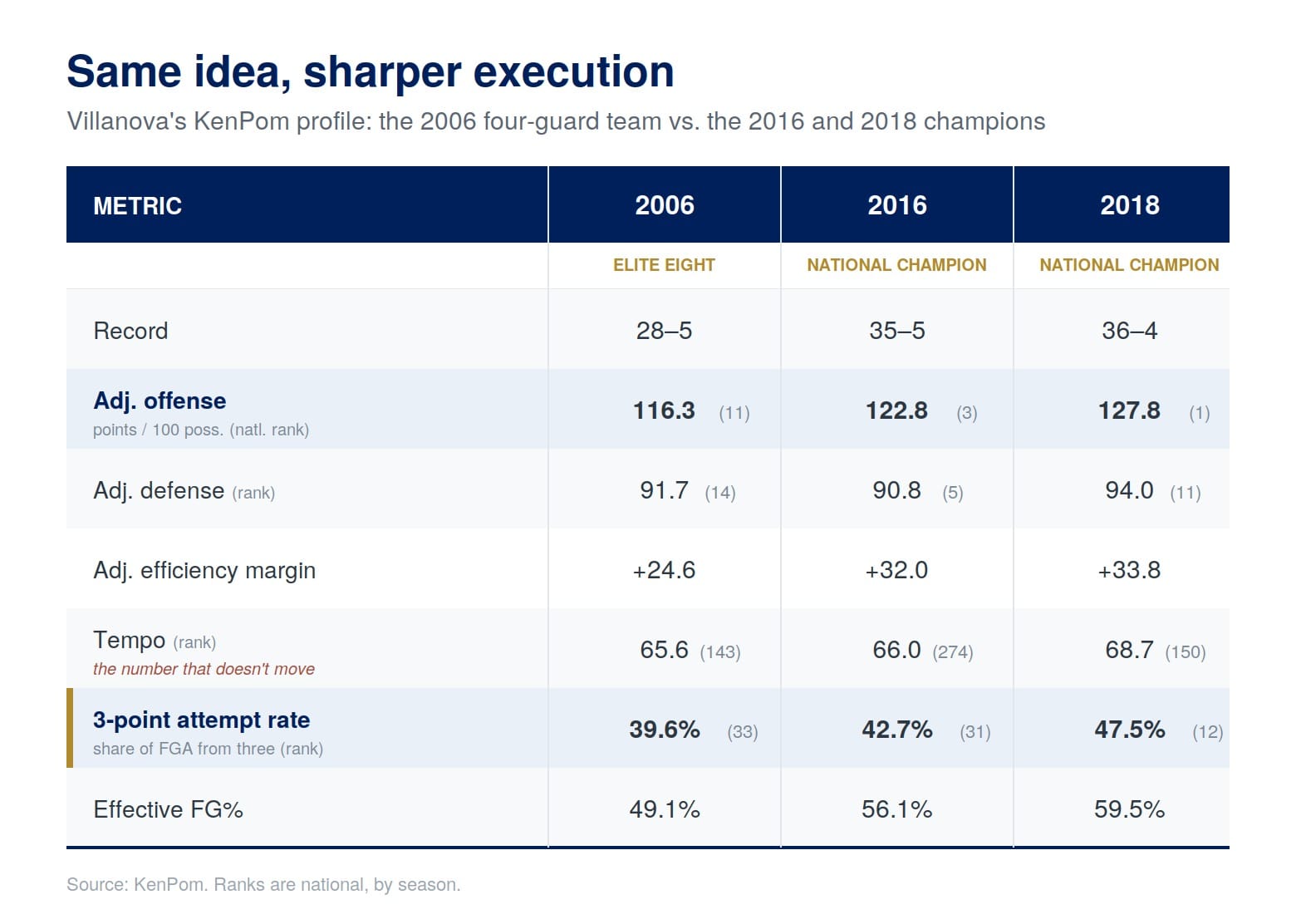
The progression is easy to track. The three-point rate went from 39.6 percent in 2006 to 42.7 percent in 2016 and 47.5 percent in 2018. Adjusted offensive efficiency climbed from 116.3 to 122.8 to 127.8. Effective field-goal percentage rose from 49.1 to 56.1 to 59.5.
Tempo, however, barely changed: 65.6 possessions per game, then 66.0, then 68.7. Villanova's title teams did not play a much faster version of what the 2006 team had done. They further leaned into the style and spacing that had worked so well for the 2005-06 group, but added more shooting, more depth, and more players capable of filling multiple roles.
That enabled the 2016 and 2018 Villanova teams to take this system to a championship level. The 2006 team was still a rough draft, something Wright stumbled into that morphed into a path that allowed him to reach the sport's mountaintop.
Sheridan was the only true big in the rotation, and the margin for error was smaller than it would be for the teams that followed. The 2016 group defended better and had more scoring options. Josh Hart could attack mismatches, and Kris Jenkins gave Villanova a frontcourt player who fit the spacing without sacrificing size.
The 2018 group took that another step, with NBA players across the lineup (hello, 2026 Knicks) and very few places for a defense to hide. Those teams were more complete. They also had years of program development behind them that the original four-guard group did not.
By then, Wright could recruit directly to the style rather than discover it in the middle of a roster problem. Villanova found guards who could post smaller players, forwards who could shoot, and bigs who could make decisions away from the basket. The labels mattered less with each version because nearly everyone could handle more than one job. The original idea remained, even as the roster around it became better suited to carry it through six games in March.
People inside Villanova could feel that development happening before there were championships to validate it. Dante Cunningham was a freshman in 2005-06 and a senior on the 2009 Final Four team. When he was asked that spring about Villanova's legacy, he went back to Sumpter's injury and the group that figured out how to keep winning without him.
"I knew when I got here that there was a legacy," Cunningham said during media availability at the 2009 Final Four. "That 2005 team, and in 2006, when Curtis Sumpter went down, it seemed like there was no way, and then they started to go with four guards. There's not much you can do about it when you have an injury like that. You could tell that all those guys had so much heart and passion for the game. It showed when they played."
Cunningham was drawing the line before it stretched all the way to a title. Scottie Reynolds and Corey Fisher followed Foye, Ray, Lowry, and Nardi. Then came Ryan Arcidiacono, Josh Hart, and Kris Jenkins, followed by Jalen Brunson, Phil Booth, and Donte DiVincenzo. Collin Gillespie and Justin Moore reached the Final Four after them in 2022.
The individual pieces changed, and Wright's teams became bigger and more versatile, but guards continued to control the program, and the floor remained spread around them.
That continuity is part of why the championship breakthrough felt so natural when it finally came. The 2016 team was not a sharp turn from the Villanova teams before it. The Wildcats had spent years playing through guards, valuing shooting and asking players to read the defense rather than run through an oversized menu of sets. The title gave the approach a different level of credibility, but it did not create it.
That is why reducing the 2005-06 Wildcats to the four-guard team undersells them. They were not just memorable because the lineup looked unusual. They won 28 games, earned a No. 1 seed, and played like one of the best teams in the country.
More importantly, Wright found a way of playing that fit the guards he had, then kept building on it long after that group was gone.
Villanova did not win a championship that season. Florida was better in the Elite Eight, and the Wildcats were still short of what the program would eventually become. But when Villanova finally broke through a decade later, the basic idea was familiar.
Wright had not drawn that plan up as some grand vision in 2006. Sumpter got hurt, Foye stepped up, and Villanova created what became its identity from there.
