


As if he was sitting in the eye of an incoming storm, then-Lincoln Memorial head coach Jeremiah Samarrippas took a moment to get on his phone and pass along a message to Elyjah Freeman’s mom Sussy Sanchez to warn her about what was coming.
“Hey, listen,” Samarrippas told her, “You’re going to start to get some phone calls. Elyjah is doing so good.”
Samarrippas wasn’t exactly sharing anything groundbreaking to those who had been around his profession, Sanchez’ son had blown up enough to become the most coveted Division-II transfer in college basketball. By the time Lincoln Memorial got to the final stretch of its season, Freeman was the subject of a number of highlight reels posted by NBA evaluators that had pinned him as an under-the-radar draft prospect.
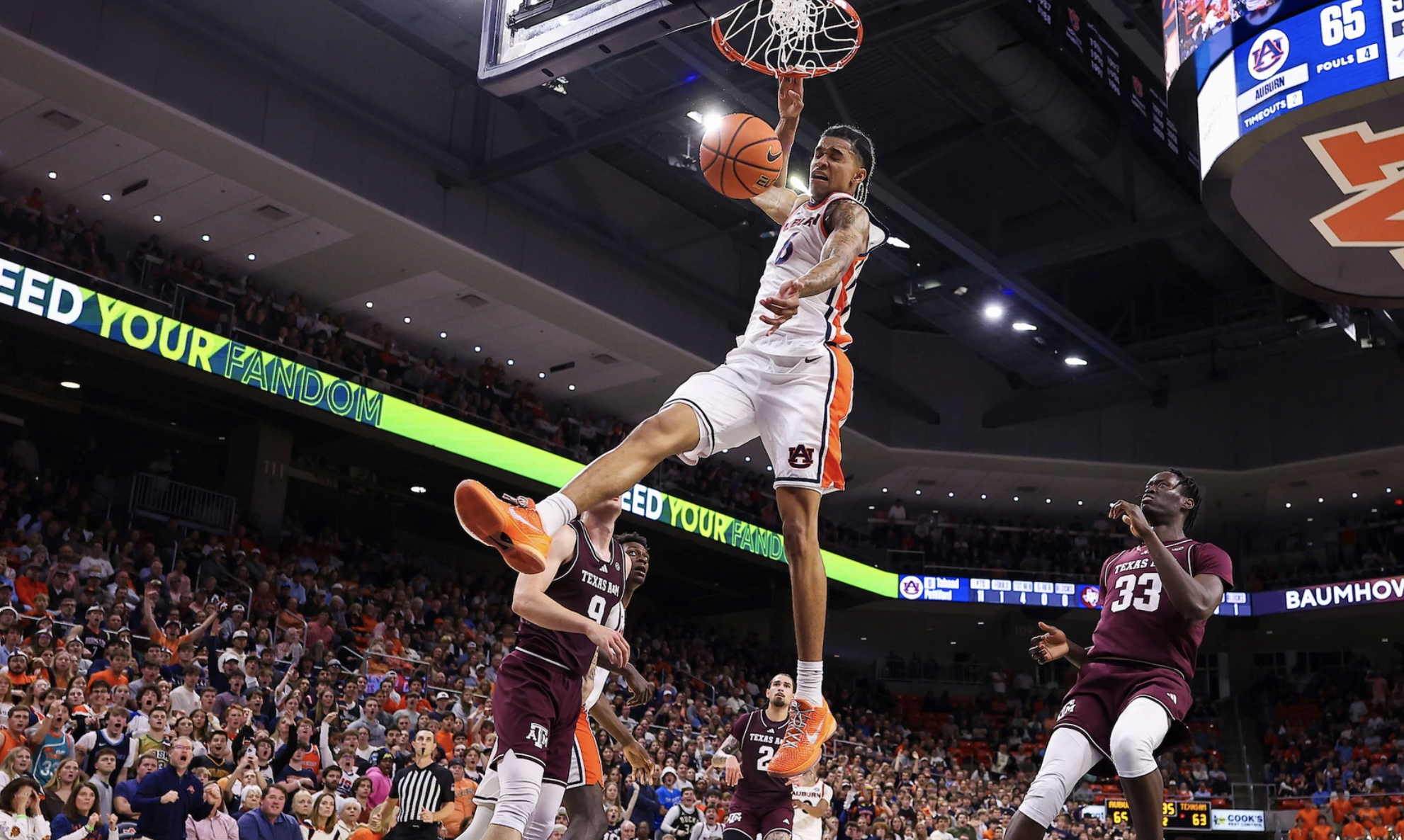
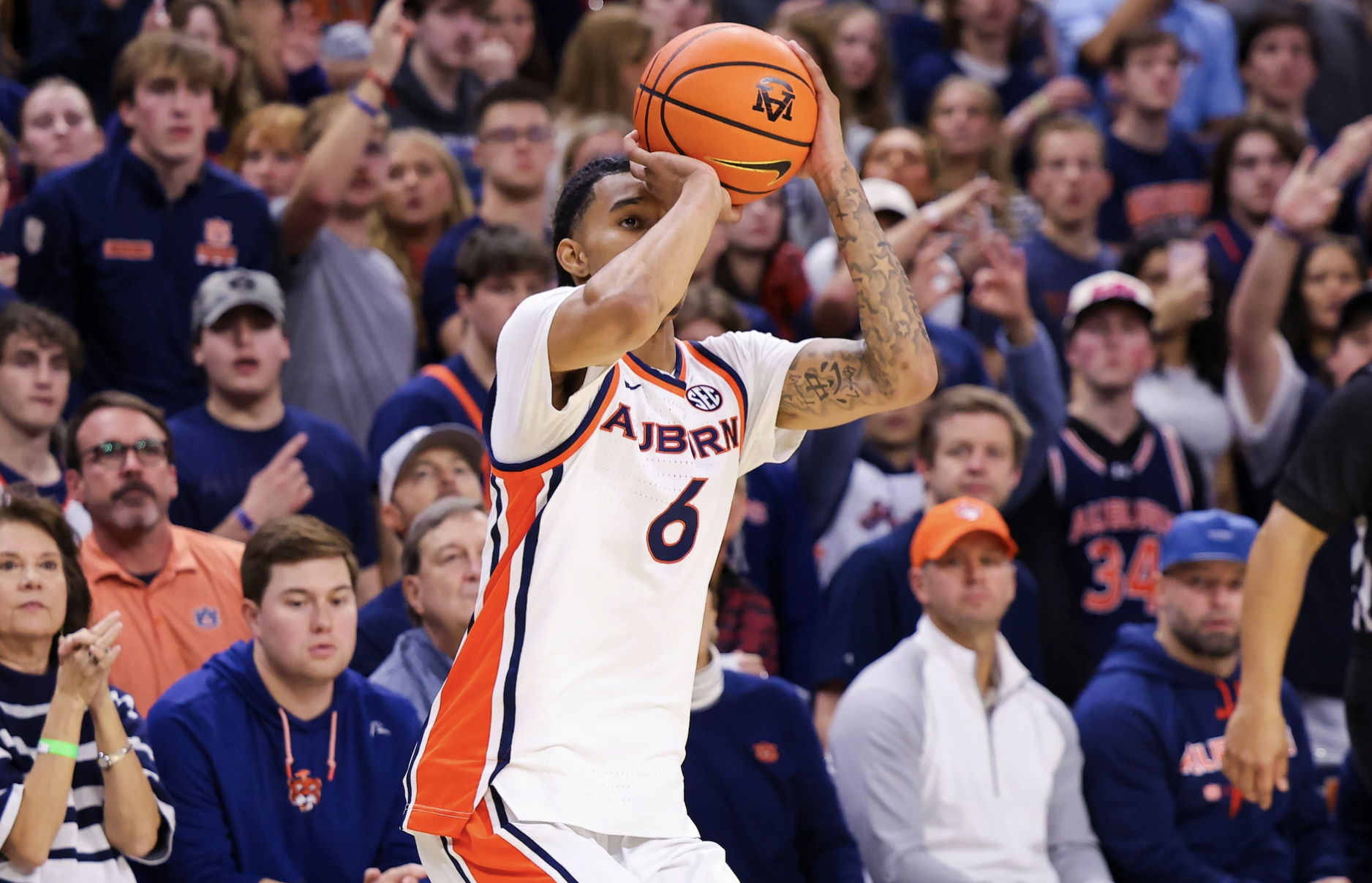
Freeman didn’t quite make the jump to the NBA as a result of the freshman season he had in Division-II, but his arrival at a power-five school was inevitable at that point. The 6-foot-8 sophomore has emerged as a focal point in Steven Pearl’s first season as Auburn’s head coach while averaging 9.6 points and 4.7 rebounds a game on 46.8% shooting for Auburn these days. Freeman’s rolodex of other-worldy dunks have also established him as one of the SEC’s most electrifying athletes.
There he was hiding in plain sight as the understated star of a town of 4,355, away from any national television and the analytics services that Division-I programs are privy to, though. Freeman played sparingly at the beginning of his Lincoln Memorial career because of what Samarrippas described as the freshman learning curve that included learning to have a better motor, defend and be effective on the glass. By March, Freeman’s ability transcended the place and the level he was starring at.
“The kid from BYU, all these great freshmen players, he was that for us at the Division-II level,” Samarrippas told Basket Under Review. “But, he didn’t come in as that. He developed and got better and worked on his game and improved his feel for the game, our offense and how we wanted to play. I think all those things aligning for him–along with his talent–gave him that big jump and had a lot of people wondering why he was at LMU.”
The Lincoln Memorial staff wanted to see Freeman’s development through, but they weren’t naive enough to believe that their star freshman would still reside in Harrogate, Tennessee, when the 2025-26 season began. After Freeman followed his 36-point performance against Carson Newman with a 35-point outing against Coker College, Samarrippas and company knew that the final stretch of his freshman season would likely be the final games they had him for. Anything else wouldn’t make much sense. Freeman valued the place and its winning ways, but he had to have bigger things in mind.
In the days and weeks following Samarrippas told Sanchez where this was heading, Freeman was “bombarded,” as Sanchez says, by Division-I coaches to the point where he had to divert his recruitment process to her. Freeman and his teammates were still in the midst of their season and were pushing for a high seed in the Division-II NCAA Tournament. He had to focus on what was at hand, even if that was difficult.
“It was just constant phone calls, texts and emails,” Sanchez told Basket Under Review. “He's like ‘mom you know I'm still busy. I'm still trying to finish. We’re still trying to get to the tournament.’ I'm like ‘Ok don't worry I got it and I didn't know what to do. I was like oh this is great. I was like there's now all these other schools wanting him. We got some big choices we gotta make here.’”
Samarrippas says he met with Freeman to remind him not to let the “noise” on social media or the calls he was receiving stop him from making progress. “Rely on the things that you can control,” Samarrippas says he told him as he referred to Freeman’s approach. “Whatever is supposed to happen at the end of the season will happen, but it’s only going to happen if you continue to do the things that you’re doing.”
The warning from Samarrippas to Freeman also included a few sentences on avoiding buying into the hype, not working as hard or dropping in focus level. Samarrippas says Freeman had agents “blowing him up, trying to get him to sign,” but he advised Freeman and his mother to wait until the end of the season so that he could maintain his focus.
Freeman took a second to replicate his production after his highlight reel went viral among evaluators and Division-I program went slow then snapped back into it after what Samarrippas called a “refocus.” Sanchez still dealt with consistent calls and texts from numbers that she didn’t recognize as she tried to manage Freeman’s recruiting process without dragging him into it, but
“My mindset was really just to focus on winning this year and seeing what the future holds after,” Freeman told Basket Under Review. “In the moment during the season, I really wasn't worried about anything that was said about me. I wasn't really paying attention to it, to be honest. I was just trying to win.”
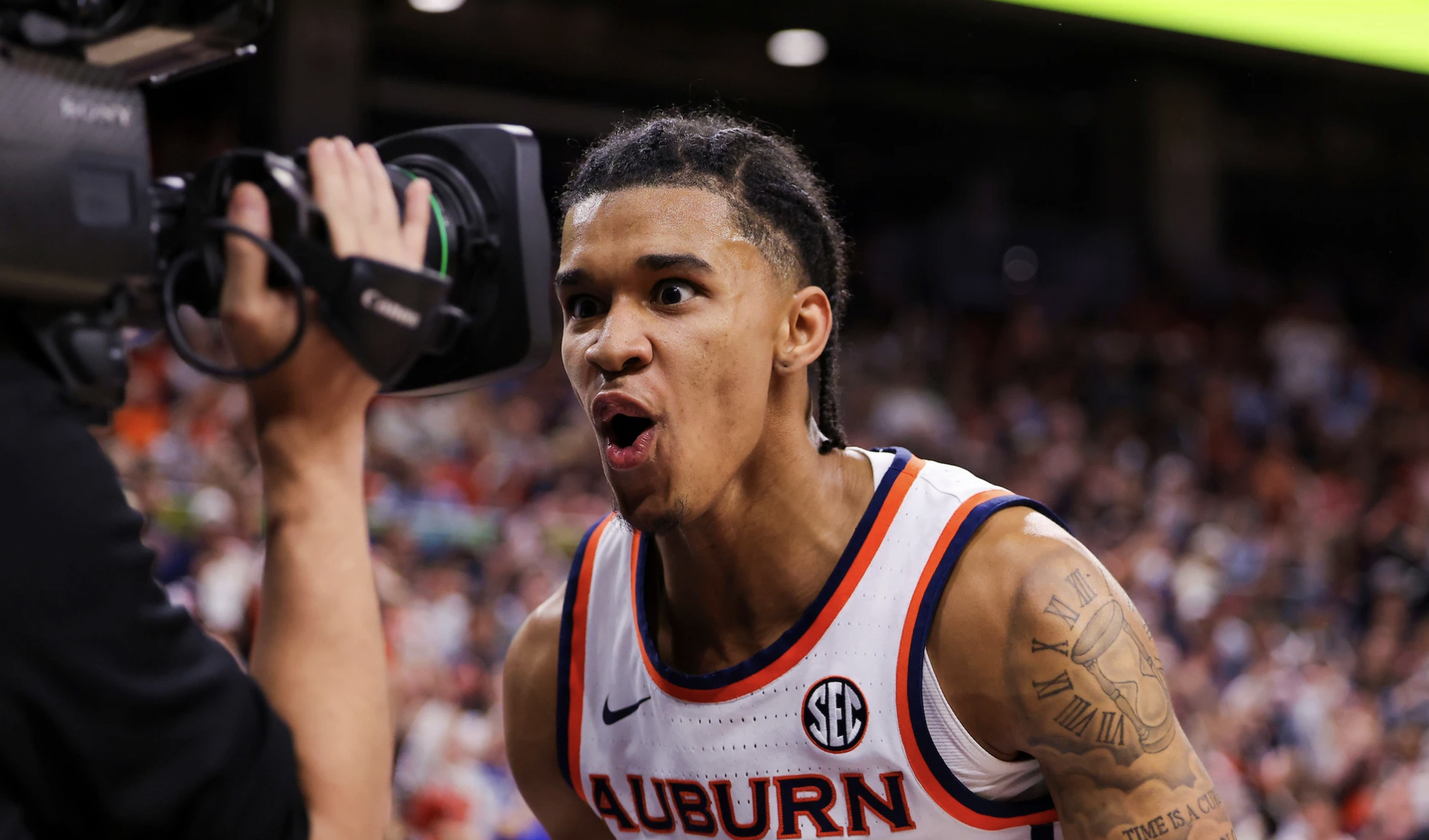
Freeman gained his bearings, walked onto the floor at Arizona’s McKale Memorial Center and took a glance at everything that surrounded him. At that stage, the Auburn wing would’ve been doing himself a disservice by not doing so.
The crowd on hand to see Arizona’s eventual blowout win over Auburn that night was 14,668–nearly 10,000 more people than a sold-out crowd at Lincoln Memorial’s B Frank Tex Turner Arena. Freeman had perhaps his worst game in an Auburn uniform that night with three points on 1-for-7 shooting, but the mere idea that he was on that floor should’ve meant something. Freeman describes it as his first welcome to the SEC, power-five moment. He says another came as Auburn went to Gainesville and beat the defending-national champions in February.
Perhaps the moment is lost on some, but it can’t be for Freeman. Not after he entered college just over a year ago without any Division-I offers. The moments in which Freeman often participates in these days appeared to be a far cry from reality three years ago as he took the floor as a high school junior.
“I probably would’ve been like ‘I don’t know about that,’” Freeman said in regard to what he would’ve said if he was told he’d be playing for Auburn as a sophomore in college. “I wasn't as confident as I am now. I’m really thankful that I took the D-II route. I'm so blessed that I made that decision because that kind of broke the confidence out of me. In high school I could’ve been way more confident.”
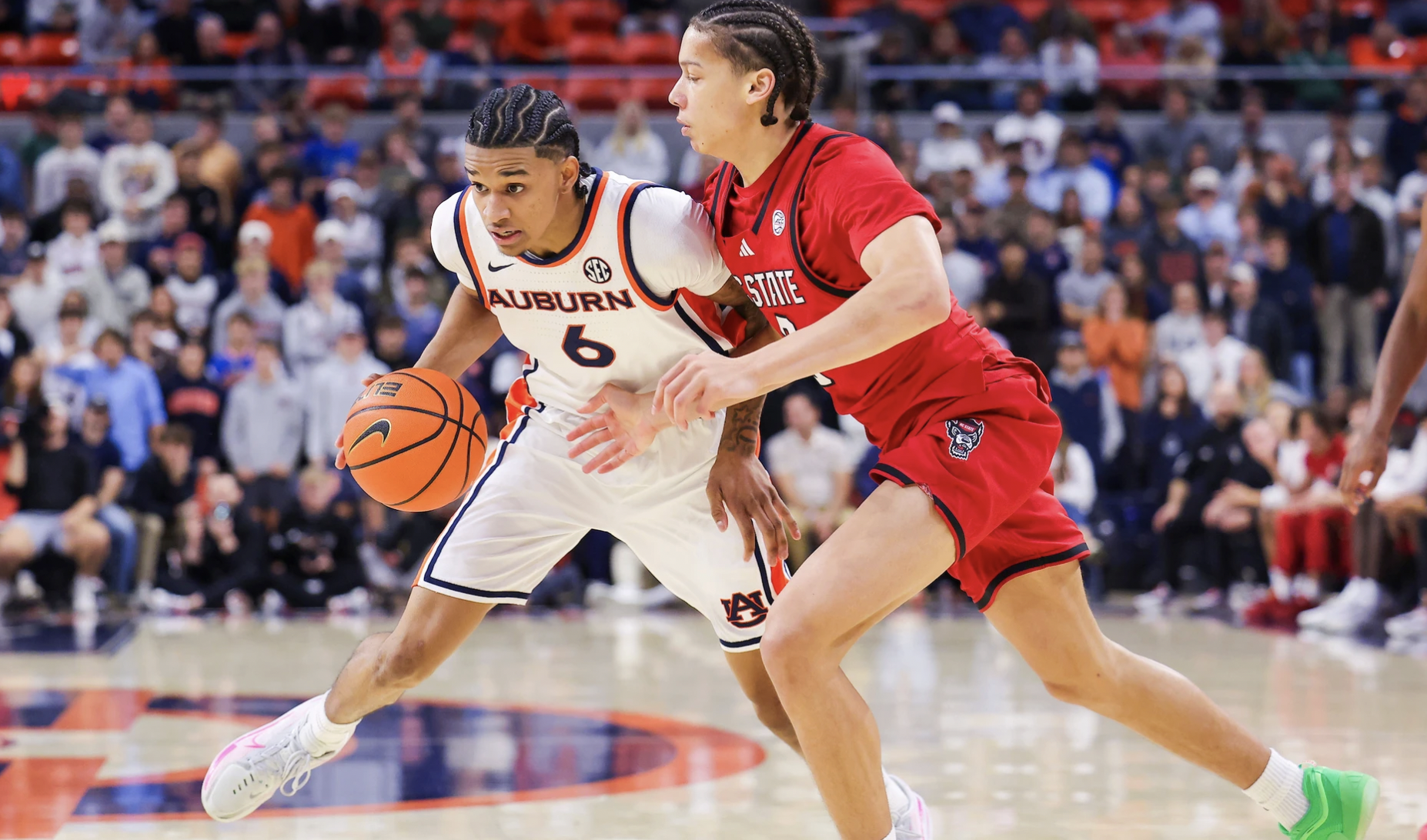
Freeman wasn’t as intentional about flying around back then as he is now. He didn’t take the types of shots that he does nowadays, either. The now-Auburn wing says he always believed that he was a Division-I player because of how he performed against higher-level competition, particularly in a few standout AAU performances late in the recruiting process. Freeman's high school coach Matt Colin says he always believed Freeman was capable of becoming a Division-I player, too, although he describes him as a “late bloomer.”
Colin reached out to Division-I schools to advocate for Freeman often and heard back from a few interested schools. The relationships between Division-I schools and Freeman always stopped at interest, though. James Madison reached out. Florida Atlantic reached out. North Florida reached out. None of them offered, though.
Retrospect brings into question how all 365 Division-I schools missed on their evaluations of Freeman before a rolodex of high majors came calling a year later. Freeman is nationally ranked in three of KenPom’s efficiency categories and has an NBA-like body to grow into. How could everyone look past him?
Freeman doesn’t necessarily agree with the thinking, but he thinks he has an idea as to why it occurred.
“I feel like it was my size, I was real skinny out of high school and I was athletic. I wasn't like a crazy shooter or anything,” Freeman said. “I really just played hard and stuff like that but I feel like schools wanted to just give me a year to develop for them to finally see ‘oh yeah he can play here now.’ I've always been the youngest in my class so that kind of played a factor in that. Like ‘he can take this year and he can finally once that year is over he can show up.’”
Perhaps Freeman got it, but the consensus among those around Freeman is that his lack of traction in the recruiting process was a motivator for him. Instead of picking up traction like most other McDonald’s All-American nominees did, Freeman and those around him were stuck posting highlights in an effort to show the atmosphere of evaluators what they thought he could do.
Freeman had a few peaks in which he got to answer the phone a few times and knew that there was a world in which he could do this for a living one day, but he was viewed externally as a Division-II player. There wasn’t much he could do about that. All he could do was move forward in the ways that he knew how.
“It was still about education and school. Basketball was just extra,” Sanchez said. “I always kept embedding that into his head ‘just make sure you're good with your books.’”
Sanchez still has the picture of Freeman and his teammates wearing Lakers jerseys while celebrating a rec league championship. As Sanchez looks back at the image, she sees the group of then-rec basketball players who are now grown men in the context of what many of them have gone on to do as high-level athletes across a few sports.
For a few months, though, they were members of the third and fourth grade Lakers and were under Sanchez’ watch. Sanchez was a more than qualified coach–particularly for a league that was practically begging for coaches–as a result of her college basketball career, but she ran into some unforeseen trouble.
Freeman was among the best players on the team if he wasn’t the best player on the team, but he was also coach’s son. At first, he was coachable. As things went, though, Sanchez had a harder time getting through to her son–who was becoming more and more competitive as the season went.
“I was like ‘alright, I’m gonna have to let somebody else coach you because this isn’t gonna work,’” Sanchez says with a laugh as she looks back. “It's not like he was disrespectful or anything, but they start to grow out of it.”
“At a young age nobody really wants their mom to be their coach. Nobody really wants to hear that advice they’re trying to give you at the time,” Freeman said as he recalled the moments in which Sanchez was coaching him. As an adult, though, Freeman says he’s since realized that “it was good stuff” that his mom was preaching to him.
One lesson sticks out to her, though. Freeman’s mom says he would get trapped in the corner at times and that she would tell him that in life he would often be in similar situations where he would have to fight when adversity hit. Sanchez recalls that her advice at the time also related to Freeman not being so hard on himself. Perhaps Freeman didn’t see it now, but he sees that his mom was right all along.
Perhaps that realization was the birth of a mentality that’s gotten Freeman here despite a general lack of external validation throughout his career relative to others at this level. Freeman’s natural athleticism, size and work ethic have their place in his rise. His general sense of fearlessness has been as big of a piece of this as anything, though.
“You kind of have to have a crazy mindset,” Freeman said. ”Obviously you care but, playing like you don't really care [is a key] at the same time. Like, taking a bad shot. It might be a bad shot, but knowing it's going in and still being able to take it just to prove and say that ‘I’m here’ and just to give the guys the idea that ‘oh yeah he's really like what he says, for real.’ I feel like you’ve got to be a little bit crazy with this basketball stuff.”
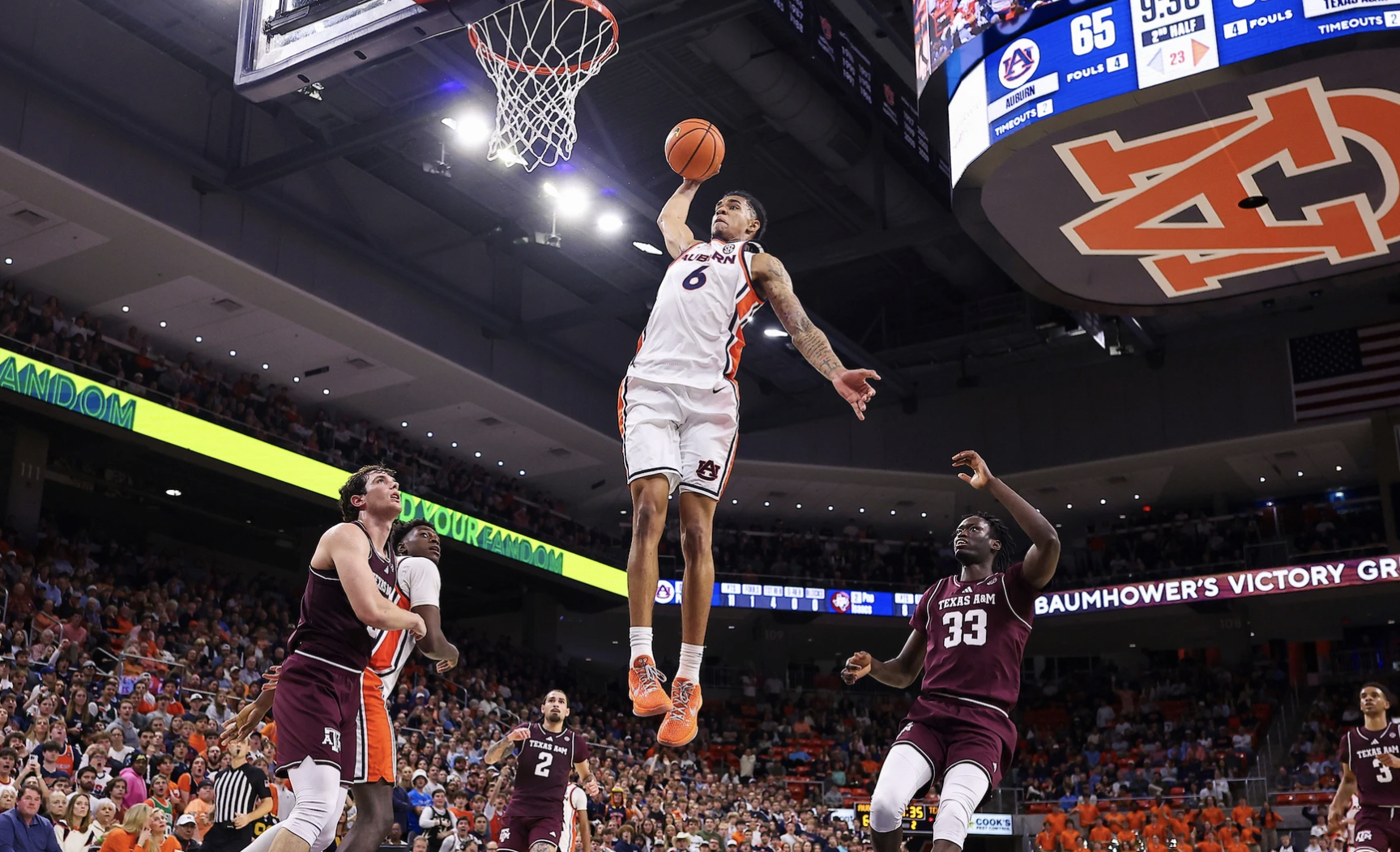
The rise Freeman embarked on a season ago in which Samarrippas–a now Wofford assistant–says “everyone” was surprised by because of its suddenness, was in some ways a result of a certain level of fearlessness he possessed. Samarrippas says it was possible because of Freeman’s baseline of talent, his ability to “keep the main thing the main thing” as well as his character.
Perhaps in some ways, the bold mentality that has propelled Freeman here is best measured by Samarrippas’ favorite dunk of his–a windmill dunk that he threw down in transition with a defender chasing him and less than five minutes left on the clock in a tie game. If he had missed the dunk, Samarrippas says he would’ve had a talking to waiting on the bench. He made it, though.
“In what world is going to windmill at that point in the game what you would think of doing?” Samarrippas said. “Who has that type of confidence that they’re going to go and windmill in transition with a guy chasing him, right behind him? The score is tied and the dude windmills it. To me that was pretty impressive because the dunk was really nasty, but with the time and the score it was like ‘oh, this kid is different.’”
Well below Orlando and a bit northwest of Miami sits Wellington, Florida. The city was named after Charles Wellington, a New York accountant, investor and aviator who developed the land as a strawberry farming operation known as the “Flying Cow Ranch.”
The town is known as the equestrian capital of the world, for its upscale areas and its often-underrated high school basketball talent. Freeman’s high school—Wellington High School—knew one of those descriptors well.
“I think there can be times when guys from this area get overlooked, especially if they don’t fit the exact mold recruiters are chasing at that moment,” Colin told Basket Under Review. “His success absolutely helps shine a light on this area, but more than anything it shows what happens when talent, opportunity, and work ethic all come together.”
Colin says that Freeman was mature about the idea that he wasn’t going to be a Division-I player right out of high school and that he learned quickly in the midst of that. But, Freeman—without prompting—brought up the idea that his area should likely be recruited more heavily.
The Auburn wing believes he can be an example to evaluators and players that are in his footsteps these days that they can rise like he did. To do so, he says, they’ll have to make their own way and assume that nothing will be handed to them. They can do it, though. He’s proving that each time he steps on the floor at Neville Arena.
While he does so, he makes sure to promote them as if he’s speaking directly to recruiters.
“I feel like there's definitely some talent, a lot of talent in West Palm Beach in Palm Beach County. There’s definitely a lot of kids out there that have similar games to mine,” Freeman said. “There’s a lot athletic kids and just dogs that are ready. And I feel like me being in this position, I feel like them being able to see me where I'm at now in a situation that I kind of built from high school to now could maybe encourage them to keep playing, give them confidence to max out their abilities in this basketball world.”
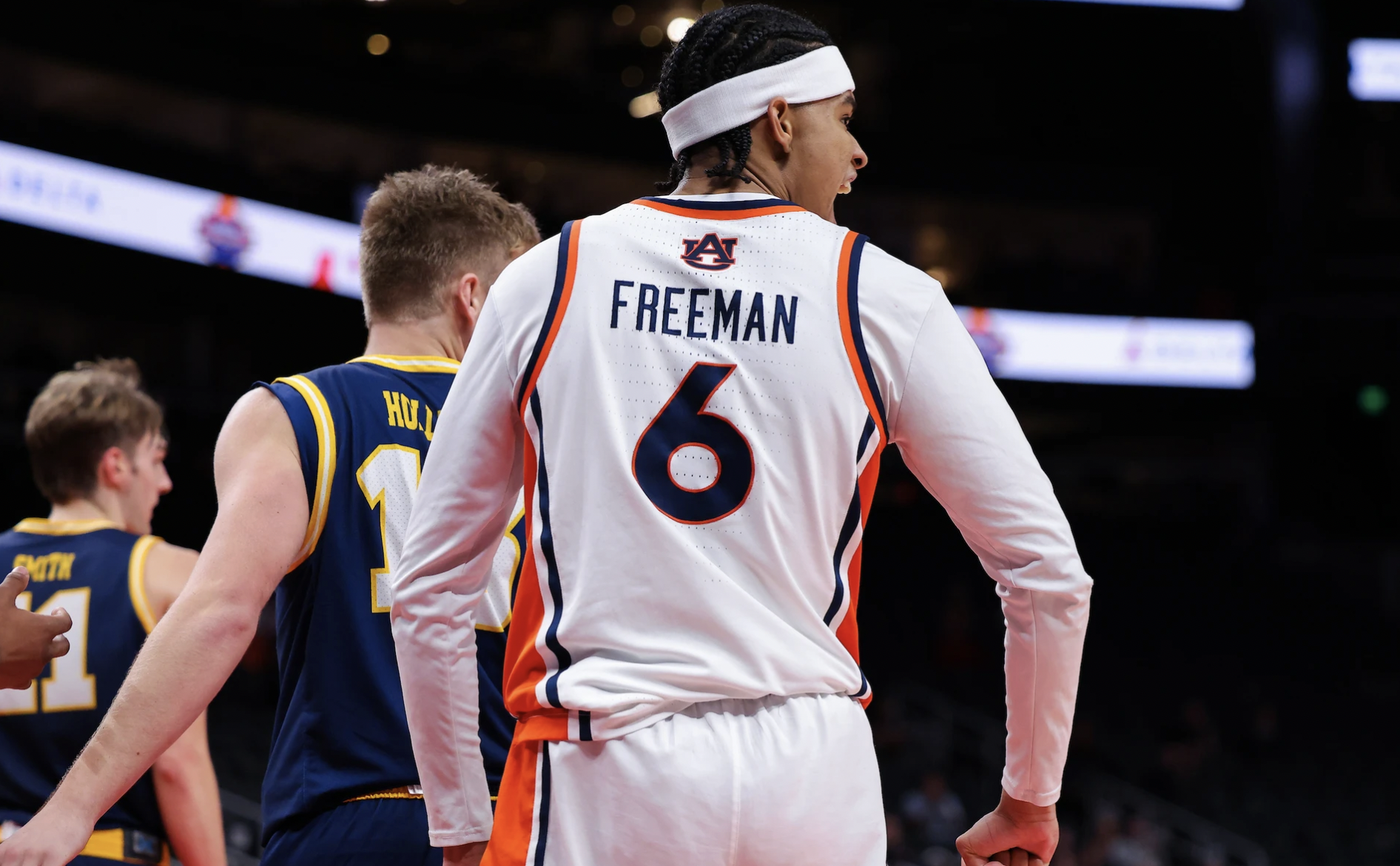
Perhaps stardom is more suited for Auburn forward Keyshawn Hall more than Freeman at this stage. But if the 6-foot-8 forward has tools that NBA evaluators dream of. When they’re clicking, he’s capable of elevating Auburn like he did in back-to-back 13-point games against Arkansas and Missouri.
The idea that Freeman won’t tap into his ability more consistently than he is these days appears to be shortsighted. If his previous head coaches’ opinions mean anything, they indicate that his development has the chance to come along rapidly. When it does, it changes the ceiling of this Auburn team in year one under Steven Pearl.
"There's nobody on the team I'd rather see be in a good headspace and play well," Auburn guard Kevin Overton said. "He's young, so it's good to see him take these strides. We need everybody to step up, and he's definitely, to me, the X-factor of our team. If he has it going, it makes it a lot easier and less pressure on the rest of us."
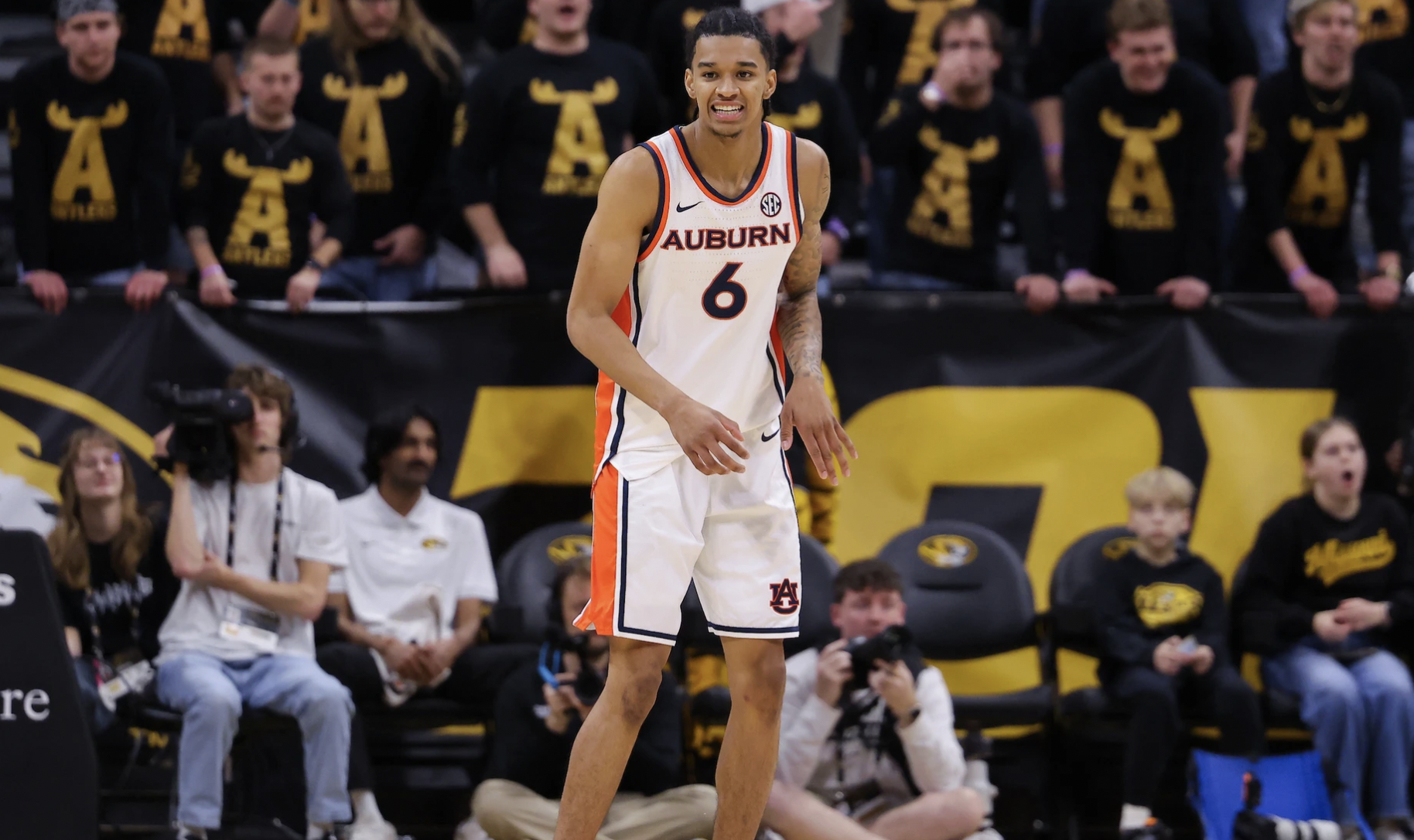
Auburn is 6-2 in games this season where Freeman goes for double digits and develops a new element as a result of his shotmaking ability. Freeman hasn’t stolen the stage for this Auburn program like he did a season ago in Harrogate, Tennessee, but he appears to be acceptant of that role for now. Even in that role, Freeman still has the most compelling highlight reel of just about anyone in the SEC.
This Auburn team is on a path towards an NCAA Tournament berth and will feature Freeman along the way. A year after he took the floor in Division-II and fielded calls, he’ll be looking to do anything he can to make this Auburn program a winner in year one under Steven Pearl.
“A lot of good things happen when you win,” Freeman said. “Being able to do anything you can for a win and being able to pull the window off and watch film and come back and do it again I feel like that's the whole point of it. That's a love for it.”
