

There are a few different ways to make yourself into an elite defense, but generally every elite defense is above average at most things on the defensive end of the floor. They force turnovers, hold opponents to a below-average field goal percentage, rebound well defensively, and limit opponents' chances at the free-throw line. Balance is supposed to be the mark of a good defense because a team that is weak defensively in certain areas has an exploitable weakness.
Montana State is breaking that rule. They are one of the most foul-prone teams in the country. They give up a high percentage of makes from behind the arc. They are a below-average defensive rebounding team. And they've still built one of the best defenses in all of college basketball; they force turnovers at a level that is almost unheard of nationally. Instead of being good on paper at everything, Montana State found out just how far you can go by being elite at one thing.
Let's start with what they're actually elite at. The Bobcats forced turnovers on 32.9 percent of opponent possessions in 2025-26, good for 7th nationally, and their steal rate sat at 20.1 percent of opponent possessions, in the 99th percentile of college basketball. To put it into context, Montana State forced at least one turnover every five opponent possessions. Per game, that's 14.9 steals a night and 24.8 opponent turnovers forced, both of which are in the 99th percentile.
This disruption pays off on the other end of the floor, too. Montana State scored 25.1 points per game directly off opponent turnovers, which again is in the 99th percentile nationally. That means a huge chunk of the Bobcats' own offense isn't their half-court execution; it's the direct byproduct of the same disruption that defines their defense. At that point, the turnover number isn't really a defensive stat anymore. It's what drives their success on both ends of the floor.
Montana State back-to-back steals
Montana State steal into points
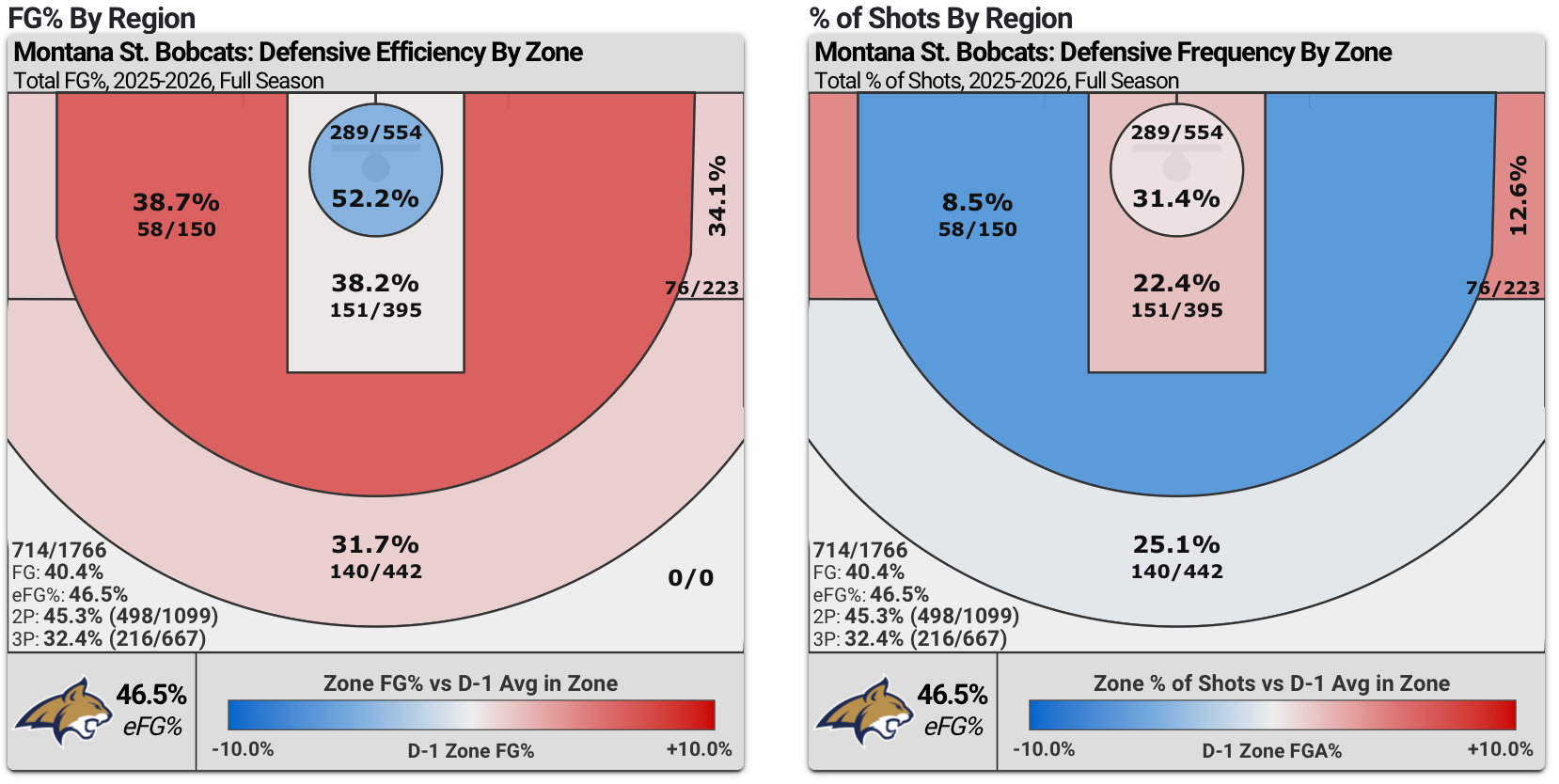
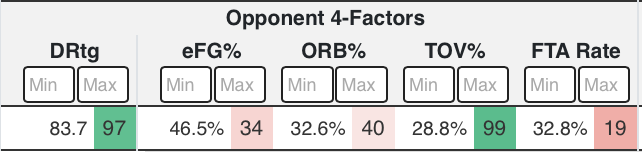
The numbers behind the defense are where it gets interesting. Montana State's effective field goal percentage allowed sits at 46.5 percent for the season, around the 34th percentile nationally. Opposing teams shot nearly 38 percent from behind the perimeter against them last season. Their 67.4 defensive rebounding percentage is around the 40th percentile, and opponent offensive rebound percentage allowed is 32.6 percent, 217th nationally. Their free-throw rate allowed is 32.8 percent, 293rd in the country.
None of those numbers would be worth writing about individually, as you'd generally find a below-average defense surrounding these numbers. But together, they suggest Montana State is proving something more interesting than "we're good at defense." They're proving you can be an elite defensive team without being especially good at preventing other teams from scoring when they shoot the ball.
The defense gets even more interesting when you look at Montana State's numbers in half-court defensive settings and in transition settings. Montana State is still elite at forcing turnovers in both settings, not just when they are creating chaos with their press. In the half-court, where there's no broken play to exploit and opponents are set up in an actual offense, the Bobcats still force turnovers on 31.2 percent of possessions, which is 6th nationally. In transition, that number jumps to 41.5 percent, which is 2nd nationally. Together, these two statistics show that turnover forcing isn't just something that happens when teams get sped up; it's something the team is coached to do, and the players buy in.
What makes the entire defense fascinating is that on nearly 60% of every live defensive possession for Montana State, it either ends in a turnover or a made shot by the opposing team. They also defy conventional thinking about when and where opponents make their shots. In the half court, Montana State allows a 33.0 percent clip from the arc, which ranks 314th nationally and is near the bottom of the country. In transition, opponents shoot just 24.7 percent from deep against the Bobcats, which is an elite mark that ranks 16th nationally.
Generally, you see teams shoot better in the half-court than in transition from the perimeter, so this is interesting to note as a byproduct of their intense defense. In the exact setting where closeouts should be rushed, and shooters should be more open, Montana State somehow locks down the three.
The catch is what happens inside the arc in transition: opponents shoot 57.6 percent on twos in the open floor, meaning the Bobcats aren't stopping transition offense so much as running and jumping at the three-point line, which funnels the ball into the lane. In the half-court, opposing teams can use Montana State's aggression against them to get open looks from the perimeter, and in transition they can use that aggression to get good looks at the basket. The defense is built on length and athleticism that plays fast and forces opponents to feel rushed and uncomfortable. With this style of play, defensive breakdowns are bound to happen somewhere.
One thing worth adding, and it makes the story better rather than more complicated, is that Montana State's shot-blocking is also genuinely elite. The block percentage sits at 12.3 percent, which is in the 94th percentile nationally. The combined steal-plus-block rate, sometimes called Hakeem percentage, checks in at 32.4 percent, which is in the 99th percentile. So it's not fair to say Montana State has exactly one elite skill propping everything else up. It's more that everything the Bobcats do well on defense is about ending a possession outright: a steal, a block, forcing a live-ball turnover, while the stuff that requires a full possession seems to at times fall to the wayside because of how their defense is structured, and it's working anyway.
Put the four factors side by side and the picture is clear: three of the four are below average, and the fourth is strong enough on its own to push the overall Defensive Rating into the 97th percentile. That's not luck or by chance, either. It's the product of a system with players who fit its style of play and have bought in. That's what happens when a program commits fully to one defensive identity and executes it better than nearly anyone else in the sport.
It's a totally different way to build a great defense, and it positively affects the offense as well. Montana State scores 11.3 fast-break points per game, which is in the 83rd percentile nationally, turning turnovers directly into easy offense. As teams tire and get sloppy with the ball, most end up going to the bench. Montana State keeps the pressure on as opposing bench players manage just 19.2 points per game against the Bobcats. This suggests that their depth is superior to the other teams they play and that their aggression continues even when the starters are not in. That depth question matters for the Bobcats too, since a style this demanding needs bodies to sustain it across 40 minutes.
Ten players return from the 27-8 team that made the WNIT Great 8, and the individual advanced numbers show, player by player, exactly where the national-outlier turnover rate comes from.
Every great turnover-forcing defense needs someone setting the tone at the point of attack, and for Montana State that's Taylee Chirrick. She broke a 37-year-old Montana State and Big Sky record last season with her 145 steals, and the reigning Big Sky MVP and Defensive Player of the Year backed it up with the underlying numbers to match. Her steal rate was 7.2 percent, which was a Top 10 mark across all of college basketball last season. Her defensive box rating, 73.2, also landed inside the top 20 nationally, so the record wasn't just luck. She's one of the most athletic players on the floor at any given time, and her instincts allow her to take over. In Montana State's full-court defense, she sits at the top of the press and can turn turnovers into points quickly.
Taylee Chirrick steal and score
Taylee Chirrick steal and score #2
Chirrick wasn't alone in being elite individually on the defensive end of the court. Jamison Philip, as a true freshman, posted a 5.2 percent steal rate that also ranked inside the national Top 40. Two guards from the same backcourt cracking the top 40 nationally in the same season is rare, and it shows the coaching staff has instilled ball pressure across the roster rather than relying on one player to create turnovers. What catches my eye is that Philip's game wasn't purely about jumping passing lanes, either. She was elite on both ends of the floor, and her assist rate of 44.9 percent and her defensive box rating of 81.0 were both in the Top 110 nationally. This is a lot to ask of a freshman point guard on both ends at once; she passed both tests at an elite level.
Then there's Ella Johnson, who does something neither guard does. Her block rate of 7.5 percent ranked inside the national Top 40, which on its own would make her one of the better paint defenders in the Big Sky. Add a steal rate of 4.7 percent, also comfortably above average within the Top 70, and you've got a two-way disruptor who racks up blocks and takeaways at the same time all while playing along the perimeter. Not many players in the country do both at Johnson's level, and she's a big reason Montana State's block percentage, which is in the 94th percentile, stands as a second real defensive strength and not just something that takes a back seat to their ability to force turnovers.
Ella Johnson's game saving block against Eastern Washington
The rest of the returning perimeter rotation shows how much of the roster contributes to the pressure. Brianne Bailey had a 4.2 percent steal rate, which was Top 120 nationally; Isobel Bunyan's steal rate was 2.9 percent, and Addison Harris had a steal rate of 1.9 percent. While these aren't overly impressive numbers compared to the top three players, they contribute greatly to a scheme built on volume, not just one or two players doing all the work. Kadynce Couture, Teagan Erickson, and Brooke Fatupaito posted steal rates in a similar range while playing significantly less time, showing that if they need to step in, they can provide value on the defensive end of the floor in the press.
The 2026-27 additions reinforce how specifically this program recruits for the identity. Binford described incoming junior college guard Ebele Mbagwu as "fast, athletic, disruptive, and dynamic" and able to "guard 94 feet," which directly reflects the profile of the guards Montana State brings in for its system. Braeden Gunlock also transferred this year from BYU, and Binford's description of her is similar, noting that she is a "versatile, athletic, fierce competitor…who can guard multiple positions." The Bobcats will also have two freshmen on the roster this season, both of whom possess great length: 5'10 Madison O'Connor and 6'5 Emma Dongelmans.
With 10 of last year's contributors back and newcomers being recruited specifically to fit the mold, Montana State isn't just holding onto its turnover machine for another year. It's doubling down on the idea that this is the program's identity. It's not a phase, not a fluke, but a deliberate bet that one historically great skill can outweigh being merely average everywhere else on paper. Montana State has finished in the Top 10 of defensive turnover percentage the past two years, and it only appears to be headed that way again this season.
The Big Sky has had two years now to find an answer for Montana State's pressure, and largely hasn't. Beating a defense like this takes a specific profile most Big Sky teams don't possess: guards who can break ball pressure with live dribbles and quick decisions instead of deliberate half-court execution. Few programs in the conference, or outside it based on Montana State's non-conference results, have had a consistent answer. The only answer teams have had is hoping Montana State has an off day rebounding defensively, as last year half of their eight losses came when they had 18 defensive rebounds or fewer.
That's the case for taking this defense seriously instead of treating it as a scheduling quirk or a stat due for regression. The elite turnover-forcing ability has held at an elite level for multiple seasons now, in both half-court and transition settings, which marks an actual coaching system rather than a one-year outlier.
Heading into 2026-27, with the bulk of the roster fully intact and reinforcements added specifically to gain even more depth, there's no real reason to expect approach changes, or that anyone in the Big Sky is close to solving it consistently. Montana State has shown that a defense doesn't need to check every box to be great. It just needs one box checked at a level almost nobody else in the country can match.
