

In our Champions Rewind series, we'll be looking at the seasons of and systems used by National Champions in the 2010s.
We start with one of the most famous runs in college basketball history, the 2011 UConn Huskies, led by Kemba Walker.
(If you're wondering why I'm starting in 2011 instead of 2010, it's because I have poor planning skills. I'll semi-shamelessly plug my YouTube channel, Feed The Post, which will have a corresponding video about the Kemba run come out soon.)
Season Recap
We all remember the Kemba Walker step-back game-winner against Pitt.
That's gone down as one of the most memorable shots in recent college basketball history, and it helped set up one of the craziest runs that we've seen.
The Huskies rattled off 5 consecutive wins in 5 consecutive days to win the Big East Tournament as the 9 seed. This included the game winner as shown above, followed the next day by a 5-point win in overtime against Syracuse, and followed the next day with a 3-point win over Louisville to win the tournament.
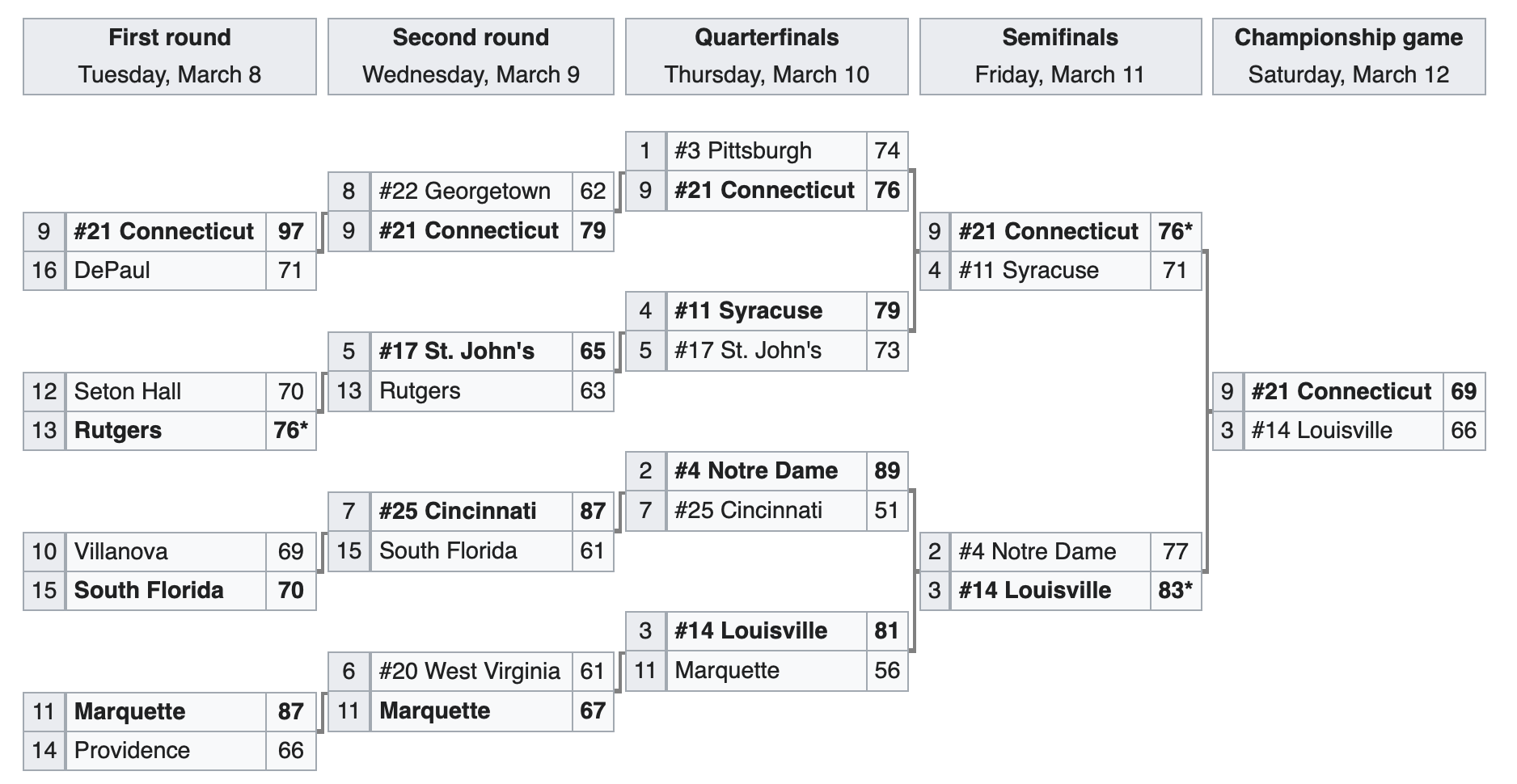
UConn was a very unproven team entering the season. Kemba Walker was the undoubted go-to guy, and he was considered one of the best in America. However, this was an incredibly young team that ended up starting:
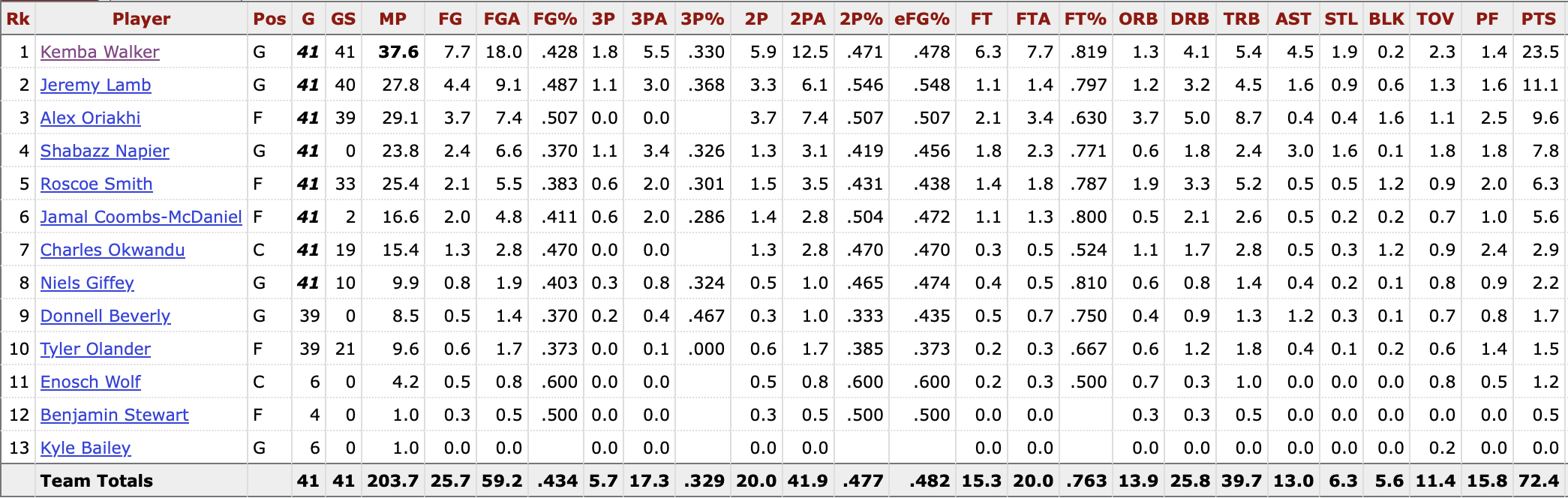
- Kemba Walker - Junior
- Jeremy Lamb - Freshman
- Roscoe Smith - Freshman
- Alex Oriakhi - Sophomore
The 5th starting spot rotated between:
- Charles Okwandu - Senior
- Tyler Olander - Freshman
- Niels Giffey - Freshman
There were a few other major rotational players:
- Shabazz Napier - Freshman
- Jamal Coombs-McDaniel - Sophomore
- Donnell Beverly - Senior
Although he didn't start any games, Shabazz Napier was 4th on the team in minutes and would often start the 2nd half of games.
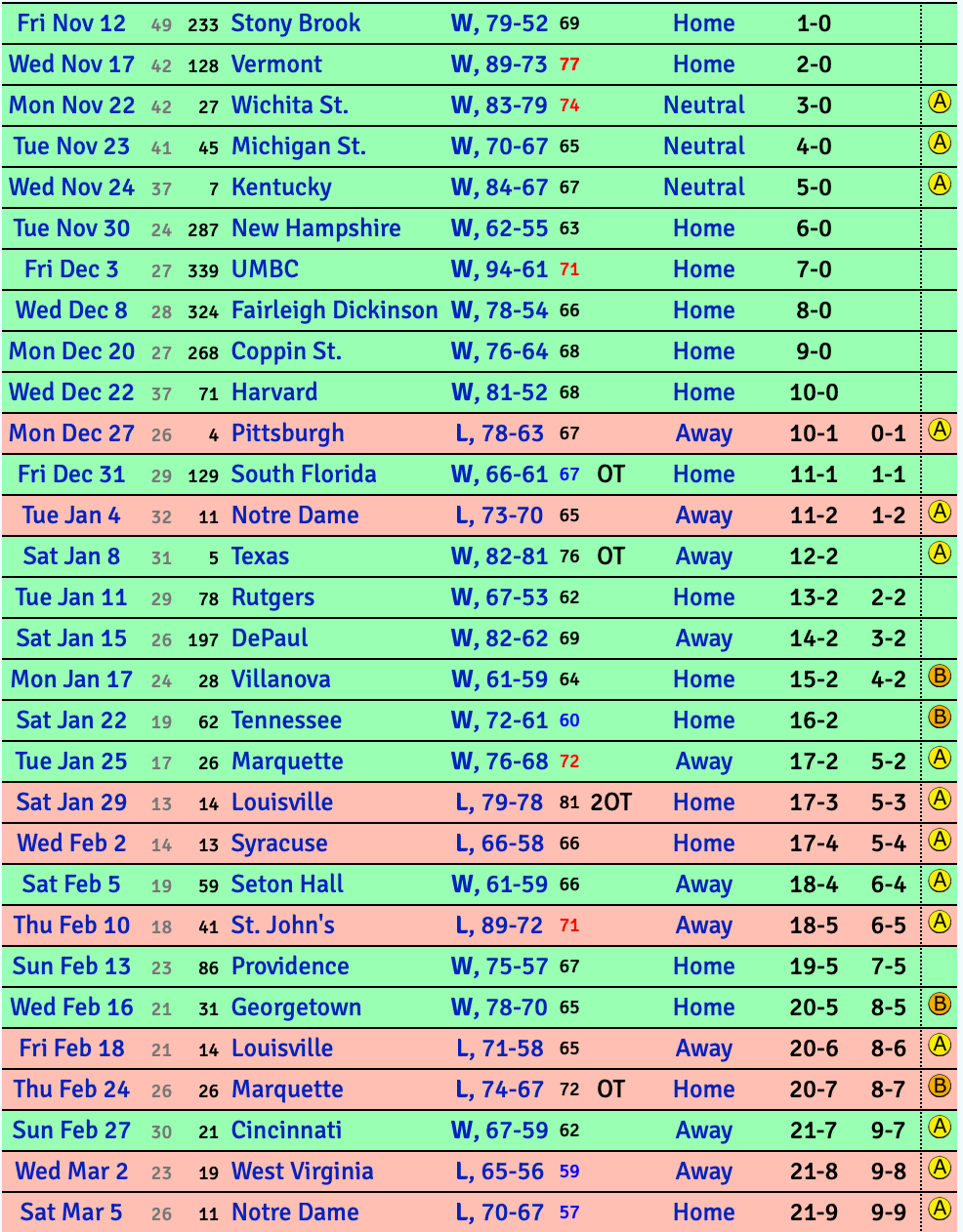
This UConn team was unranked to start the season, but quickly shot up to a top 5 team in the country as they beat Wichita State, Michigan State, and Kentucky to win the Maui Invitational. They also got a big road win over Texas that helped them start 17-2 and be a top 5 team in the country.
But it wasn't all sunshine and rainbows for this young Huskies team that only had 3 upperclassmen in the rotation, and relied on 3 freshmen heavily. Maybe it was the freshman wall, or maybe it was just them coming back to earth after a great start, but the 17-2 Huskies went just 4-7 over their next 11 games, finishing the regular season at 21-9 overall and 9-9 in the Big East. UConn went from potentially winning the Big East Championship to having to play on the first day of the Big East Tournament in the span of a month.
The Big East Tournament Champs, though, ultimately got a 3 seed out West in the tournament, thanks in large part to their historic run. They breezed through the first round with a 29-point win over Bucknell, followed by an 11-point win over Cincinnati in a game that was tied with 10 minutes left.
In the Sweet Sixteen, they took on Kawhi Leonard and San Diego State in a largely back-and-forth game. Kemba was Kemba, though, scoring 36 points to help UConn get the win. Freshman Jeremy Lamb had 24 points that game, and no other Husky had more than 5. In the end, UConn was able to get a 74-67 win over the Aztecs.
With a trip to the Final Four on the line, and what would be UConn's 9th straight postseason win in the span of 18 days, the Huskies took on Arizona, led by Derrick Williams, MoMo Jones, and Solomon Hill. It was a pretty incredible game that was very back and forth. The backcourt trio of Kemba, Lamb, and Shabazz combined for 49 of UConn's 65 points as they were able to sneak out a 65-63 win, despite Arizona getting two good looks from three in the final 15 seconds.
In the Final Four, UConn took on a Kentucky team led by Brandon Knight and Terrence Jones. It wasn't a high-scoring game as both teams ended up scoring in the mid-50s. UConn controlled the end of the first half to go up by 10, but Kentucky hit 4 threes in the first 5 minutes of the second half to get right back into the game. From there, it was a pretty close one the entire way. It looked like relying on underclassmen could've cost UConn the game as Shabazz Napier turned it over up 2, with 15 seconds left. Kentucky got a look from three that missed, and UConn found themselves in the National Championship via a 56-55 win. Kemba led the game in scoring with 18 points while also having 7 assists. Jeremy Lamb had 12 points, 9 rebounds, and 4 assists.
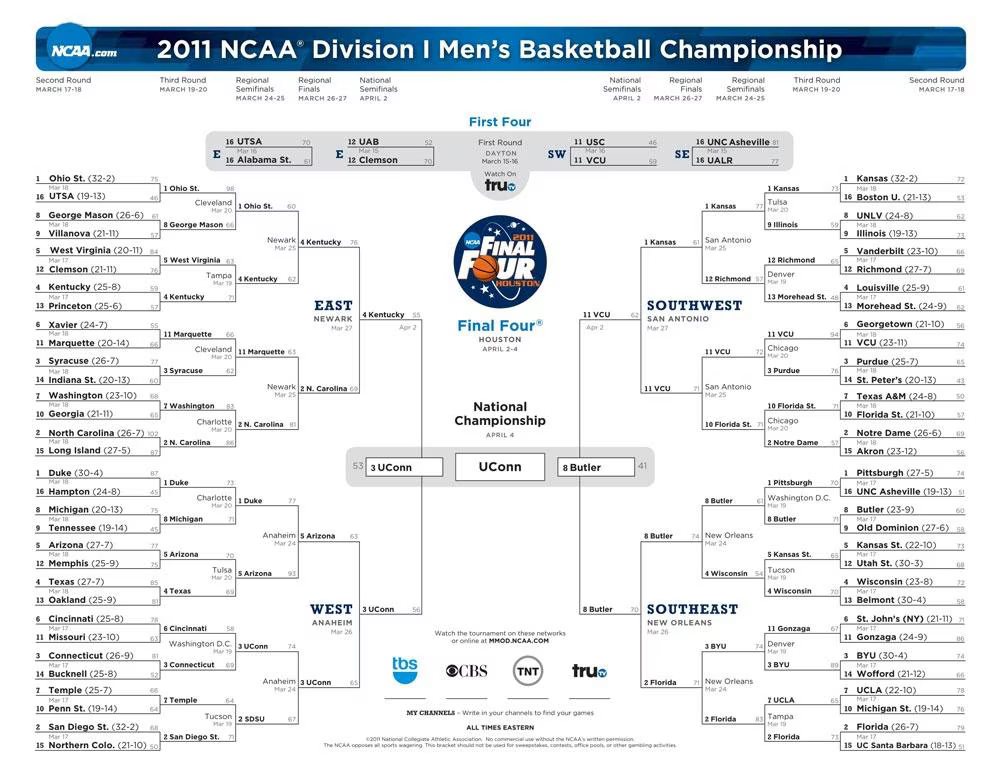
And then the National Championship came between two teams on historic runs of their own. UConn, on the run we all know, took on an 8-seeded Butler team that had just lost in the National Championship the year prior to Duke. Butler was led by Shelvin Mack and Matt Howard. Butler, who was in the Horizon team at that time, had won 14 in a row at that point, dating back to early February. UConn was on a 10-game winning streak of its own.
Despite Butler only having one top 60 Kenpom win for the entirety of the regular season, they found themselves in the championship after the following stretch:
- 60-58 W vs Old Dominion (#48 in Kenpom)
- 71-70 W vs Pitt (#4)
- 61-54 W vs Wisconsin (#6)
- 74-71 W in OT vs Florida (#17)
- 70-62 W vs VCU (#53)
Yes, Butler beat 11 seed VCU in the Final Four. What a tournament that was.
I wish I could say the championship was this ultra exciting game, but it truthfully just wasn't. UConn ended up winning 53-41!!! Butler made three (3) two-point field goals in the entirety of the 40 minutes of game time. Three.
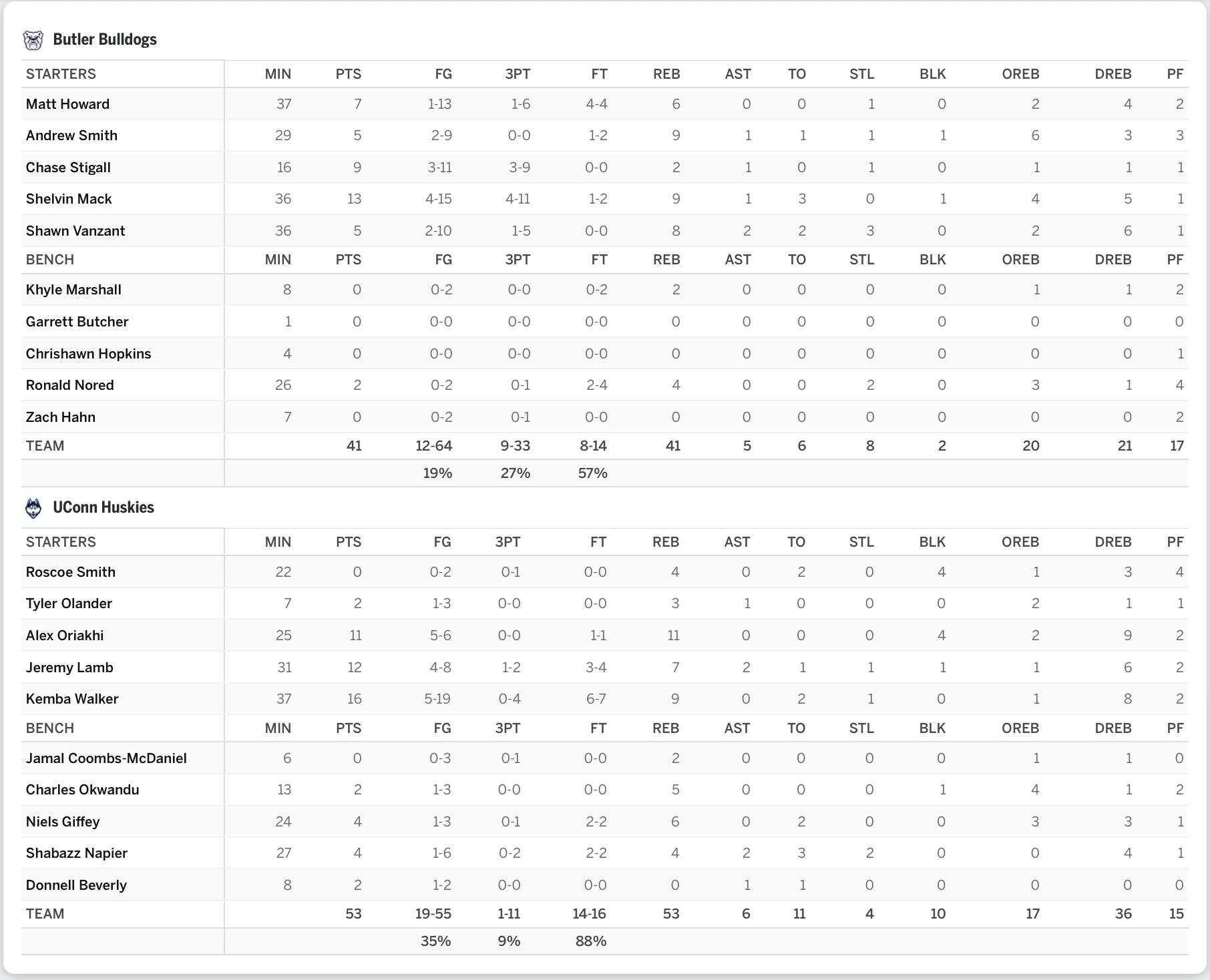
Butler shot 3/31 from two for the game. Luckily for them, they knocked down 9 threes while UConn only made 1. It was a close game for the first half as Butler led 22-19 at the break. They immediately hit a three to start the second half and push the lead to 25-19. However, they scored one singular point over the next 7:30 of game time. Butler scored a total of 3 points over the span of 13 minutes in the 2nd half, and that was really enough for UConn to figure it out.
Kemba had a game-high 16 points, and Lamb contributed 12. It's a memorable finale for the wrong reasons, but it in no way takes away from just how impressive a run UConn had.
For those that really want to dive into it, let's get into some of the schematics that UConn used to be able to win the championship, starting with their defense.
Defense
For reference, I was 11 when this season happened. So, for me, I just assumed this offense was incredible, and that's why they won the championship. But as I started researching, I realized it was a pretty even balance between their offense and defense, and ultimately, their defense did rank slightly better in KenPom. I think I'd also argue that, given how their tournament games went, the defense is really what set up their championship run.
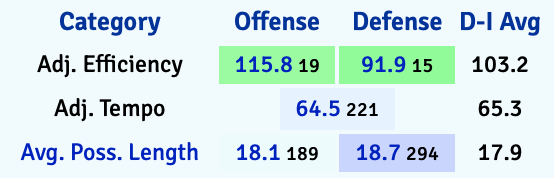
Some context for the state of college basketball is needed in order to properly setup defenses, especially in comparison to modern day college basketball.
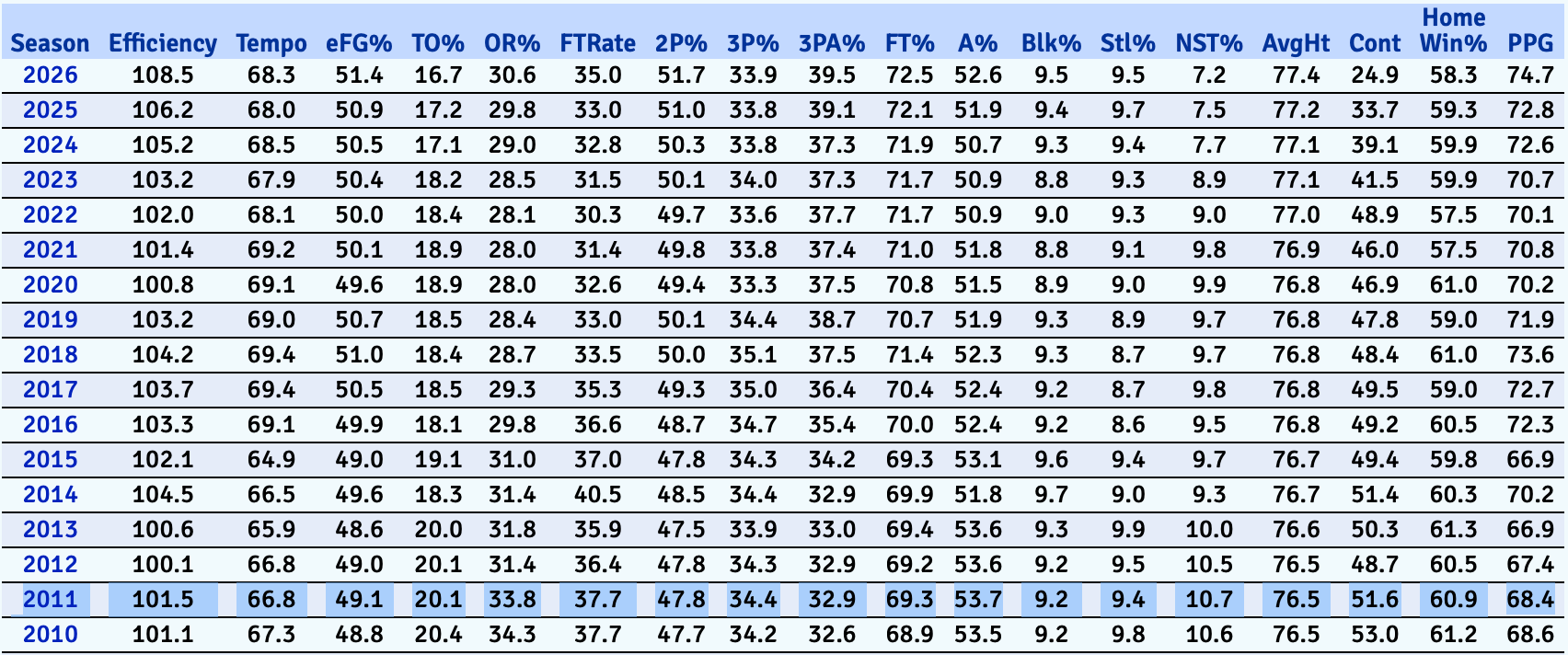
Tempo was slower in 2011, thanks in large part to the 35 second shot clock.
Side tangent - It was shocking just how big of a difference it made watching the game with a 35 second shot clock compared to the modern day 30 second shot clock. I watched roughly 8 games from this UConn season, and I can't tell you how many times I'd glance at the shot clock in a possession, expecting to see somewhere between 3-5 seconds left, only to see a team still have 10+ left.
The pick and roll was something definitely still featured within the flow of offenses, but it was just as likely to see teams run pindowns as the base motion of their offense. In 2011, the average D1 team ran a pick and roll on roughly 12.5% of their possessions. In the 2025-26 season, the average D1 team ran pick and roll on about 28% of their possessions. Offenses were also much more willing to dump the ball down into the post.
As shown above in the chart, the offense's three-point attempt rate was WAY down comparatively. Because of this, defenses were focused even more on trying to clog up the paint.
Okay, so let's get into the UConn system then.
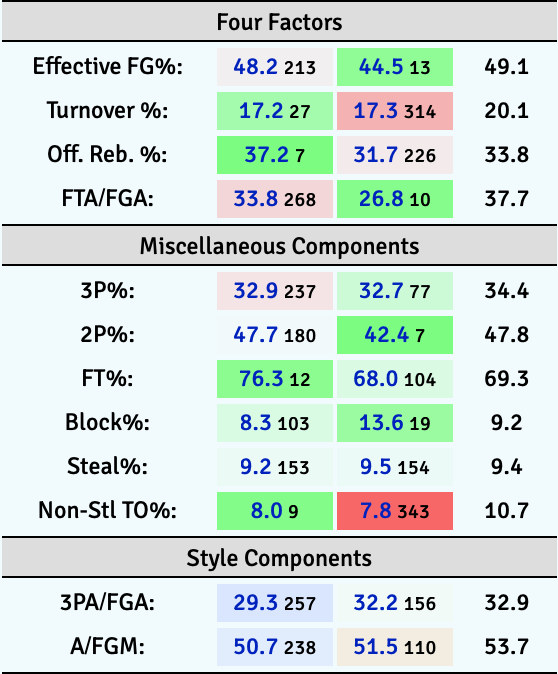
Above shows the four factors for UConn in 2011, with the defensive stats being on the right, and the D1 average for each category being the column without the green/red shading. This wasn't a team that forced a ton of turnovers, and because they often played small and wanted to run, they struggled to defensive rebound consistently.
However, they didn't foul, and they forced opponents into tough shots.
Both Kemba Walker and Shabazz Napier were very capable of getting into ball handlers to try and force turnovers. Outside of those two, though, the focus was more on simply trying to stay in front of the ball.
Defensive Shell
Starting with UConn's defensive shell to highlight some help principles, UConn generally had two different types of shells they'd run. When they'd have two bigs in the game, and the opposing bigs couldn't shoot, you'd often see the UConn bigs sag into the lane. What this helped reinforce is the guards' ability to try and play in passing lanes and not help or sag nearly as much.
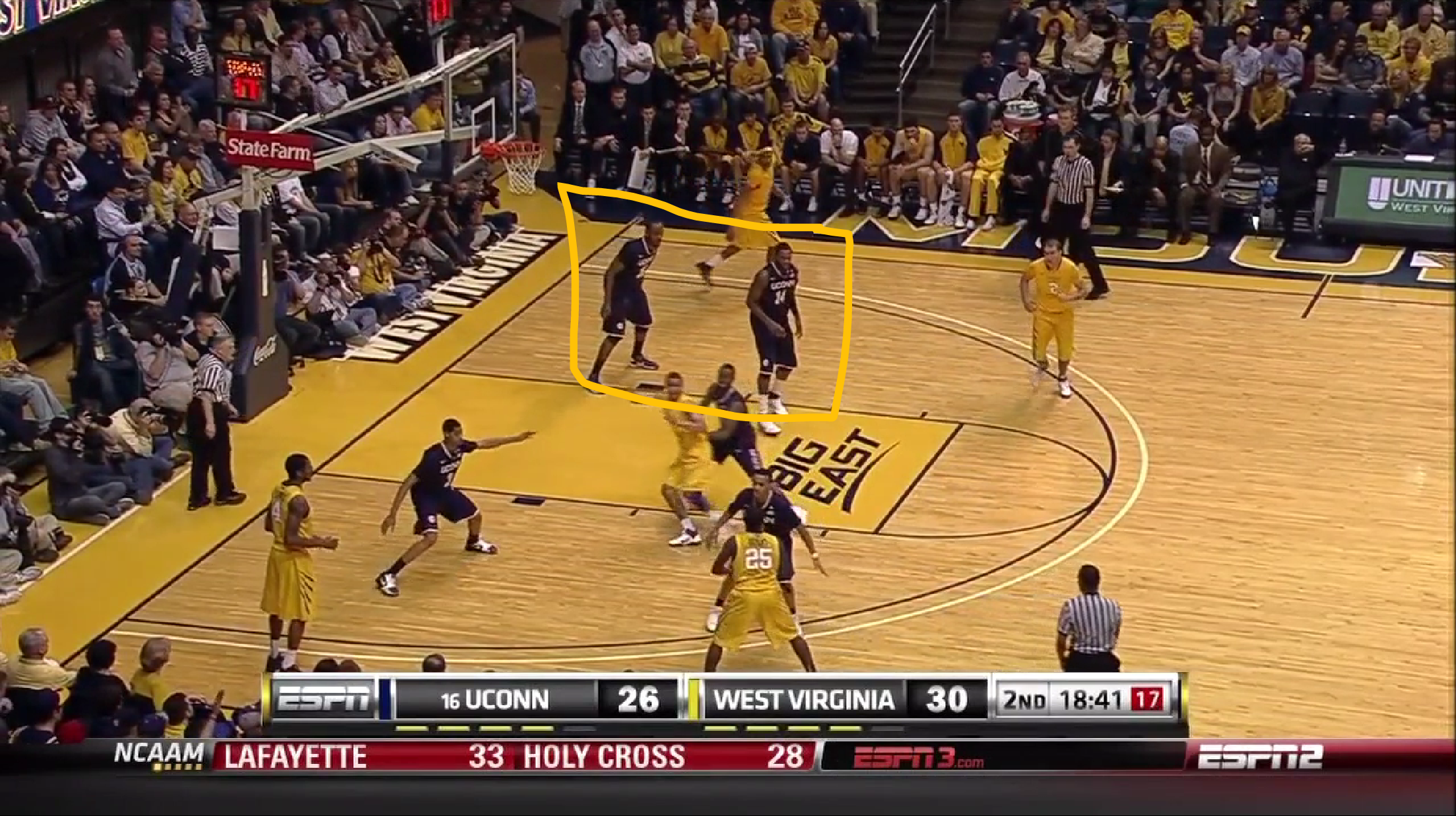
Below is the full possession of that clip.
With UConn's roster, however, they often would have lineups that consisted of 4 guards/wings and only 1 big, something that wasn't super common in that era of basketball. When this happened, UConn would generally try to turn up the pressure more and get into passing lanes. This puts much more pressure on the individual defender to stay in front of the ball, while also decreasing the margin of error the big man would have to rotate and protect the rim. However, it could also make it that much more difficult for opposing offenses to really get into the actions they wanted to.
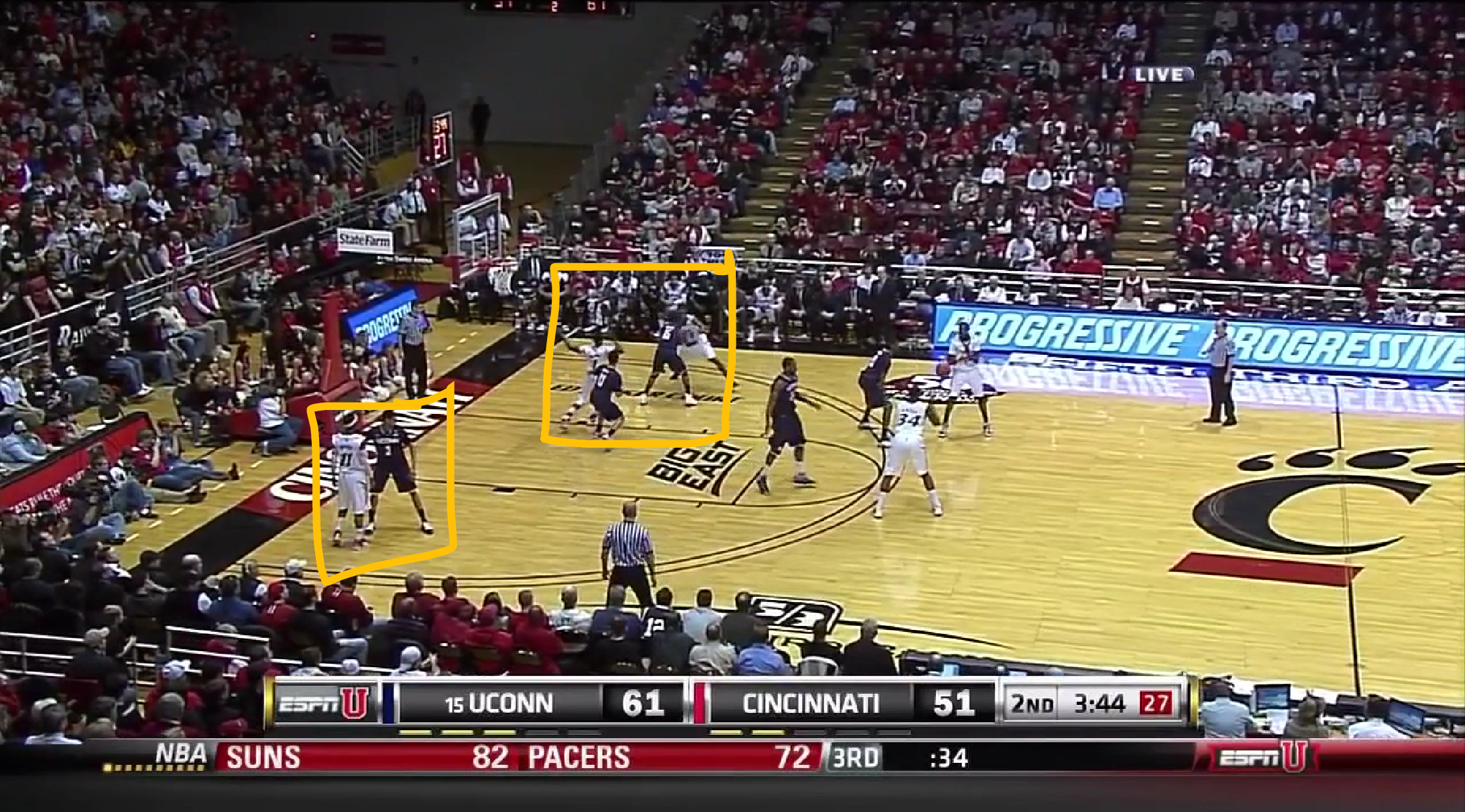
Interior Defense
Knowing what we know now about how UConn generally wanted to set up defensively, we can move into how they were actually able to operate.
UConn's defense was predicated ultimately on their ability to make teams take tough shots in the paint. Teams shot just 51% at the rim, putting UConn as a top 15 rim defense in the country, despite Alex Oriakhi being the main rim protector at 6'9.
This ties in with the defensive shell, hence why we started with it above. As three point shooting wasn't as big of a threat, teams wanted to take away the paint and the physical brand of basketball. In addition, it doesn't hurt that teams were comfortable taking 17 foot jumpers, meaning shorter closeouts for any defender sunk into the paint.
With post ups being a prevalent offensive option, UConn primarily was willing to stay 1 on 1 in the post. At times you could see either the opposite big or a guard dig down to try and cause chaos, but it wasn't an automatic.
UConn Post Defense - 1 on 1
In the clip above, Marquette gets the ball down low early. You can see Kemba think about trying to dig down at the ball, but all in all, they ended up staying 1 on 1 in the post and living with the result.
In general, UConn was going to try to have at least one big man in the paint defensively at all times. The clip below is a good example.
UConn Defense - Rim Help
As the pick and roll happens, UConn has one big at the level to defend the screen, while their other big stays near the rim and ultimately ends up defending the shot.
The other major aspect of the interior defense of UConn was the guards' willingness to send gap help.
UConn Defense - Gap Help
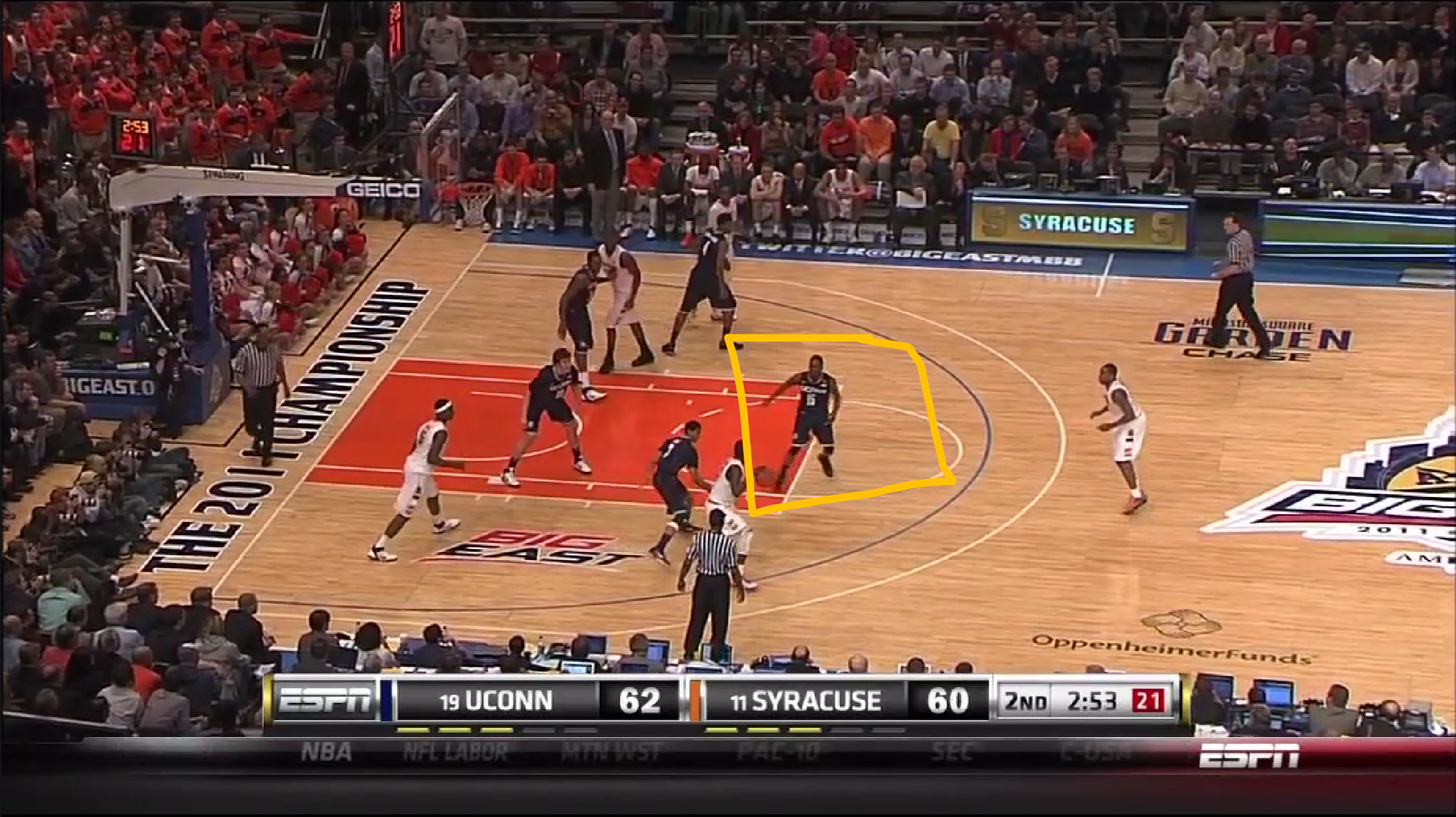
The full clip shows a lot of the defensive principles UConn has, but the screenshot shows the gap help I mentioned. As Syracuse came off the pindown, Kemba Walker (in the yellow box) digs towards the nail (center of free throw line) to prevent any drive from even happening. So even though UConn would often play in passing lanes off-ball, they still had the responsibility of trying to stunt at drives.
Offense
As mentioned above in the defensive section, the offensive philosophy was entirely different 15 years ago. UConn took under 30% of their shots from 3, ran nearly the same amount of isolations as pick and rolls, and featured a lot of off-ball movement.
They ended up being a top 20 offense in the country despite being #213 in eFG%. They made it up by being #27 in turnover percentage and being #7 in offensive rebounding percentage.
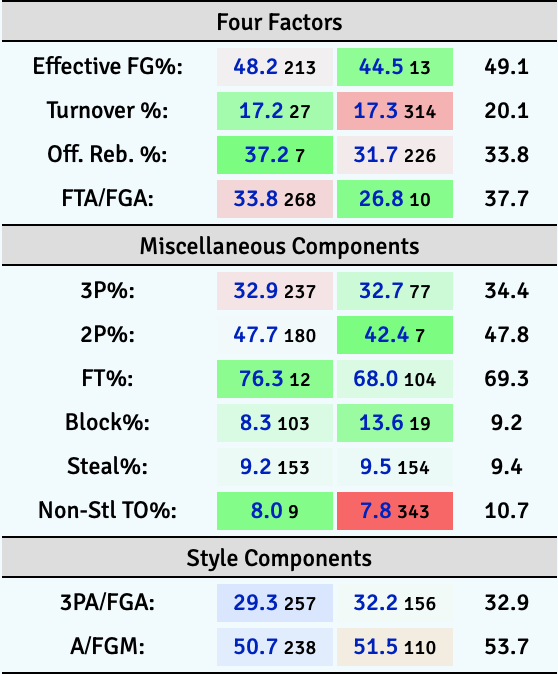
Despite UConn being only about D1 average in terms of offensive tempo, they still averaged 13.5 transition possessions per game, putting them in the top 50 of D1 that season. Between Kemba Walker, Shabazz Napier, and Jeremy Lamb, UConn had three options they trusted to be able to push the ball and score. With how physical defenses could be at times, there were plenty of games where simply pushing in transition or getting offensive rebounds were the only consistent way to score.
Once UConn got into the half-court, though, they were going to slow it down and run a set to try and get a look. One thing to note is that UConn wasn't a big post-up team, which went a bit against the grain of college basketball at that point. Instead, pretty much everything UConn did was to set up their guards and wings to be able to score.
Off-ball Screening and Movement
We'll start with off ball screening, which was almost exclusively utilized to get Kemba and Lamb shots. There were a few different set ways that UConn would get these two going off-ball.
UConn - Baseline stagger
After some initial movement and setting up the play, Jeremy Lamb runs off an Iverson, two screens across the elbows, which flowed into a staggered pindown for Kemba. As Kemba gets it, you see Jeremy Lamb, who was on the weakside wing, start to run off his own staggered screen across the baseline.
The baseline stagger was a staple in the UConn offense, and it was pretty prevalent within the flow of most offenses at that point in college. With teams being fine taking 17 footers, players had the freedom to be able to get to any open spot and put up a shot.
UConn - Baseline Floppy
In this clip above, instead of running off a designed staggered pindown, UConn went to Floppy, an action where a shooter starts under the basket and can run off screens going either direction. Within their championship run, this set and its variants were very important in being able to get the UConn offense going. With the ability to go off screens in either direction, it became nearly impossible for the defender to try and cheat through the screen.
UConn - Flex Screen
And of course, there were plenty of flex screens set. A flex screen is a cross screen at the block, and often followed immediately with a pindown for whoever set that cross screen. In UConn's case above, that meant Kemba Walker setting the cross screen before immediately getting a pindown up the middle.
UConn - Backdoor play
If you got caught trying to deny Kemba the ball, or just sleeping overall defensively, UConn had this 1-4 High look as a counter. As shown in the clip above, UConn brought their offense up to try and clear out the baseline. From there it was just a simple backdoor cut, and you'd be surprised how often UConn was able to steal two points from this.
If a defense was able to sniff out the backdoor, UConn could easily flow into a pindown or floppy action for Kemba from there.
Pick and Roll
UConn didn't utilize the most pick and roll in the country, but they did have two dynamic guards in Kemba and Shabazz who they trusted to operate out of pick and rolls.
UConn - Empty Corner Pick and Roll
One of UConn's go-to formations was this empty corner pick and roll shown above. With no one in the strong side corner, this would give Kemba the opportunity to either utilize the screen and get to his pull up, or refuse the screen and get downhill like in this clip. UConn wanted to maximize the spacing Kemba had, and this was one of the simplest ways to do it.
If UConn did go to a more traditional pick and roll, this is where Kemba could shine with his ability to split the defense and get two feet in the paint.
UConn had Kemba Walker
The last area to mention is UConn's willingness to play out of isolation, primarily because of Kemba Walker. During his junior season, Kemba averaged over 4 shots out of isolation per game. His ability to get low and quickly blow by defenders was nearly unmatched in college basketball, and it was one of the biggest reasons why UConn ended up becoming champs.
UConn - Movement into Kemba Iso
In the clip above, UConn starts with Kemba running off a baseline screen to get the ball at the wing. From there it was simply trying to win the 1 on 1 and go to work from there. UConn had a variety of ways to get Kemba the ball, but ultimately they wanted him to get the ball on the wing or top of the key and go to work.
And other times it was as simple as Kemba getting a switch out of pick and roll, and going to do what Kemba did best.
