

Take a deep breath. Then another. Try some box breathing if you haven't before.
You made it. We made it. The longest offseason in college basketball history is over, never to return again (and by never, I mean we go at least five years with the chaos meter down 20 percent).
National writers are not required to break down legalese anymore for what feels like the fifty billionth court case in college sports this decade. The wildest wave of conference realignment yet at the mid-major level has subsided for now. 2,060 Division I transfers have settled into their new homes, and 90%+ of them are guaranteed to be eligible for their teams this season. Yes, during the first week of March Madness, you will likely have to pretend to work at the tail end of Tuesday and Wednesday now. You can make a fuss about it, but the field of 76 is here for the foreseeable future.
You can make a fuss about a lot of things in college basketball right now (see above), but looking back excessively on what was prevents us from seeing what will be, and the on-court action that awaits us in 2026-27 looks nothing short of spectacular. One of BUR's best writers, Will Warren, shared this mindset much more eloquently in his season-opening essay last week:
"But I would submit the following: the present, and the future, is more than worthwhile. It is not what any of us imagined 15+ years ago. That does not mean it is bad. I can accept that things are different without accepting every consequence of that difference. I may not like the 76-team Tournament, I may not like rosters still being unsettled three days out from the season, I may not like Players Era. But I accept that I cannot control these things, and I accept that I will continue to watch and love the sport I have watched and loved for 25 years.
What I can control is how I react to these changes. I choose to attend games. I choose to care about the basketball instead of the discourse."
 Will Warren
For all the off-court drama that will follow college basketball into this season, you now have full control to tune it out. The game is being played at a higher level than it ever has before, and the stories, traditions and zaniness that draw us all into this sport have survived.
So, if you're willing to do this with me, let's take a deep breath and refresh our minds. Clear out the countless [BLANK] v. NCAA cases, the quiz on who's in the newly-formed United Athletic Conference and the worries over how you'll watch the 3:00 p.m. ET opening round game on March 16, 2027.
Over 300 Division I men's college basketball games have already been played. For now, I only want to focus on that and share what I noticed throughout copious amounts of ball-watching this week. This weekly column is meant to educate with a bit of entertainment mixed in: I want to give you 8-9 informative blurbs on players, teams and results that caught my eye before using the 10 spot for discussions on arena rankings, halftime entertainment, things of that nature.
As the season progresses, I can't say I won't spend some time discussing the macro-level issues that seek to muscle their way into our viewing experience. All of these court cases and changes are still quite important to the sport, after all. I refuse to bring those topics up now, though. Not while we're healing ourselves with an abundance of ball screens and quick twos.
The regular season has arrived: let's talk about that.
1) Florida's rim protection has somehow improved
We'll start with arguably the biggest game of opening week. The top two teams in the state of Florida – No. 1 Florida and No. 14 Miami – battled it out on Monday in Jacksonville for state supremacy, and the Gators came out on top 77-67.
Miami (FL) is, and will continue to be, one of the most physical teams in the country. Sophomore standout Shelton Henderson is built like a tight end, Dante Allen is a bruiser in the backcourt and the duo of Malik Reneau and Somto Cyril create one of the most imposing frontlines in America. Jai Lucas' squad scored nearly half of its points at the rim last season, converting close twos at a 63.6% clip. This program relishes bully ball.
The standout stat from Monday: the Hurricanes shot 14-of-36 (38.9%) at the rim. The bullies faced off against a game opponent – a Florida team that ranked 8th nationally in 2PT% allowed last season – and got a taste of their own medicine.
As Joe Jackson outlined in his most recent film breakdown (available with a Basket Under Review subscription), Todd Golden and assistant Dave Klatsky had the perfect gameplan to neutralize the 'Canes down low. Rueben Chinyelu and Alex Condon were the anchors of the defense, making timely decisions on when to drop and rotate and walling up on takes.
After halftime, Miami still looked to play within the arc, but Condon and Chinyelu's presence led to more of its possessions ending in the now-dreaded mid-range jumper. The result: the Hurricanes' average two-point shot on Monday came from 7.4 feet away. For reference, that number is the second-highest in a game over Lucas' short tenure (Virginia forced a 7.6 mark in last season's ACC Tournament). When Miami faced Florida last season, its average two-point shot was almost two feet closer (5.6).
I knew Florida's frontcourt was a strength on both ends, but it still impressed me that the unit was this successful on defense against that opponent. The SEC certainly features its share of physical rosters, but in that realm, the Gators passed their first test with flying colors.
2) Davis Fogle is the latest name to know from Gonzaga
In 2025, I attended the HoopHall Classic, a premier high school basketball event held in Springfield, MA. I had no media obligations there but still managed to secure a credential, so like a true hoophead, I attended most of the 33 games and took notes like my opinion meant something to people.
When a player really impressed me, I put a little star next to their name. 13 high schoolers earned this prestigious distinction throughout the week, including one Davis Fogle at Arizona Compass Prep.
It's very early, but I'm ready to reap the fruits of my labor (saw Fogle play once and wrote down four bulletpoints). The sophomore was the main scoring option for the Zags in their win over Purdue on Monday night, scoring 22.
Fogle's not an elite athlete, but he compensates with his shot and craftiness down low. He made difficult layups look easy on multiple occasions in Las Vegas, keeping the Boilermakers at arms' length.
On the other end of the court, Fogle posted the third-highest DBPM (2.6) on his team. His main assignment was C.J. Cox (11 points on 4-of-11 shooting), and he caused a few disruptions on-ball against the guard.
The performance backed up faith that he can maintain good defense in an increased role. Fogle had a 3.3 DBPM last season in 16.8 minutes, ranking 26th amongst all freshmen that played at least 10 minutes a night.
Efficiency was a concern on Monday for the wing (6-of-18 shooting, 1-of-5 3PT), but I have faith his numbers should stabilize as non-conference play rolls on. There's precedent for that too, as the Washington native shot 56% 2PT/35% 3PT last season.
3) Oklahoma wasn't the only power conference school with a red logo that struggled on opening night
There's always some chaos that sets in amongst college basketball fans on the sport's opening Monday night; with so many games going on, it's impossible to be glued in on all of the interesting scores/moments.
One of the top stories that came from Monday was Oklahoma's stunning 68-64 loss to East Texas A&M. If you follow the sport even somewhat casually, you've seen that scoreline.
The Sooners weren't the only red power conference school to struggle with their low-major opponent though. There were actually two others that battled it out against inferior opposition, but I don't want to talk about Utah's narrow victory over Long Beach State. We kind of knew the Utes were in a tough spot this season.
Wisconsin's seven-point win over Denver is a little different. Sure, the Badgers were up big for the game's middle 10 minutes, but the final score's the final score, and I'm not loving some of the stats that Greg Gard's team produced.
On defense, the Pioneers shot 19-of-33 (57.6%) on twos, finding success in the paint and off mid-range jumpers. Wisconsin did have a snafu like this in a buy game last year against Northern Illinois (Huskies shot 57.7% on twos), but the mark is concerning nonetheless for a defense that's been expected to improve.
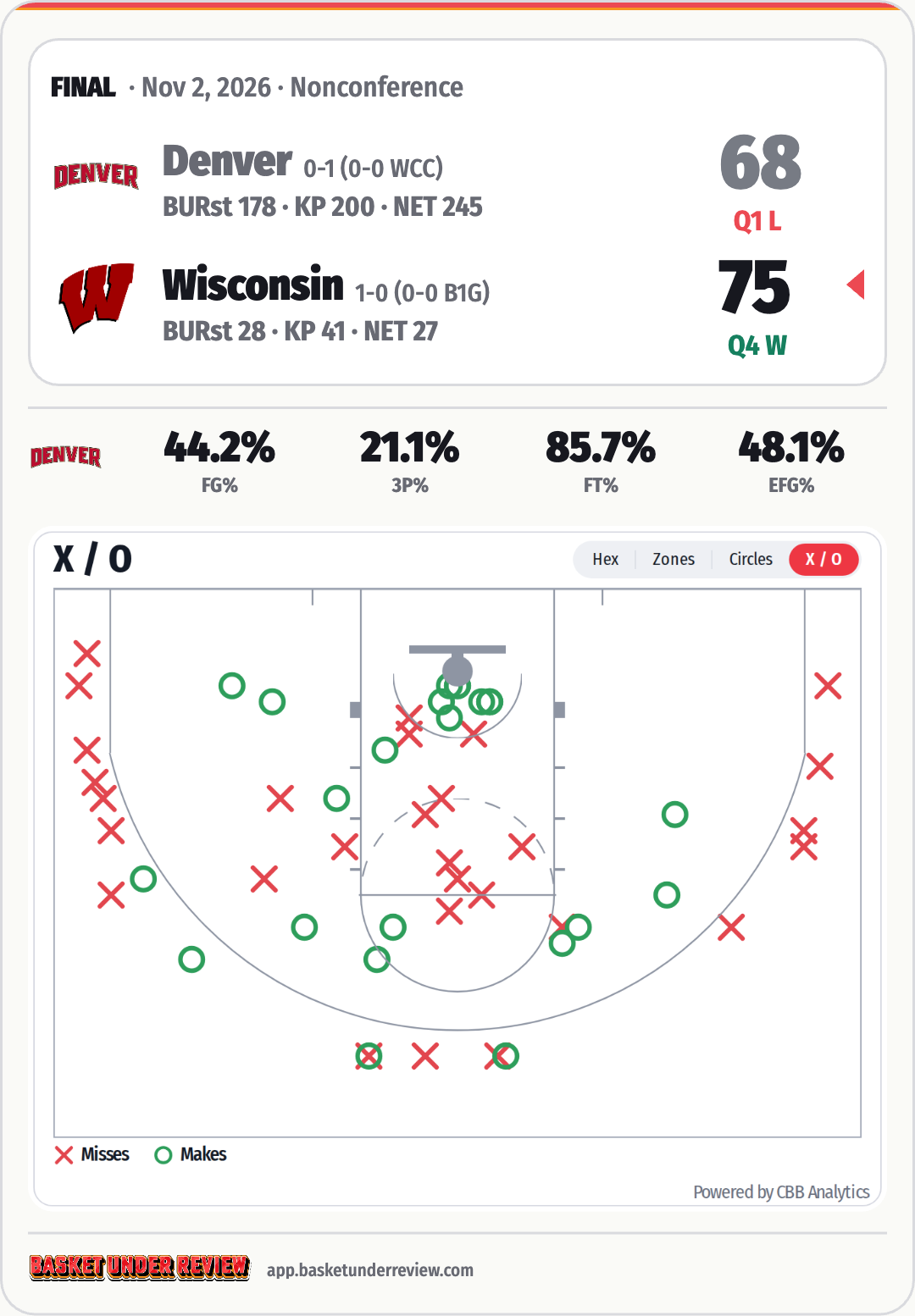
Another stat that jumps out: Wisconsin shot 6-of-26 (23.1%) from deep. That number won't be that low every night, but the Badgers' shooting struggles have more permanence to me.
Braeden Carrington is elite from deep, and he made three of the Badgers' six triples against Denver, but let's look at the five other players on Wisconsin who shot above 35% 3PT at the college/professional level last season. Two (Trey Autry, Eian Elmer) played in inferior conferences in offensive systems that were much more perimeter-centric than what Gard ran on Monday. Owen Foxwell just became a high-volume three-point threat last season in the NBL, and the combo guard was used more as a finisher/facilitator. Austin Rapp and freshman Jackson Ball seem steady, but Ball barely played.
Outside of Rapp and Carrington, I'll wait to see who steps up from deep for the Badgers. It might take a little while if Wisconsin continues to play like it did Monday: Gard's squad took 38.8% of its shots from deep against Denver after posting 48.2%/52.1% marks in each of the past two seasons.
4) The D2 -> D1 player pipeline extends outside Iowa
When we think of Division II to Division I success stories in the transfer portal era, it's easy to start and end with Ben McCollum's Drake/Iowa squads.
While those teams certainly proved that some Division II talent can hang with the sport's best, we still haven't seen many high-major programs look to that level for additions. More teams should go after top-end Division II guys, and I have a supporting opinion from Evan Miyakawa to back me up.
Oh, well. In an era where non-power programs are suffering more than ever, that oversight is their gain, and some teams are already reaping the rewards. Looking through Miyakawa's projected top 15 D-II transfers, we have:
- No. 1 Pace Prosser (Gannon -> Siena): 15 points, 7 rebounds, 8 assists vs. Bryant
- No. 2 Zach Philipkoski (Daemen -> St. Bonaventure): 28 points (10-of-14 shooting) vs. Youngstown State
- No. 3 Benjamin Bill (Daemen -> St. Bonaventure): 15 points, 9 rebounds vs. Youngstown State
- No. 6 Conrad Luczynski (Lenoir-Rhyne -> Central Michigan): 14 points, 4 rebounds, 3 assists, 3 blocks vs. Louisiana Monroe
- No. 8 Evan Ramsey (UVA-Wise -> Wofford): 8 points, 10 rebounds, 2 blocks vs. Tennessee
- No. 13 Bryson Lucas (California (PA) -> FGCU): 25 points (10-of-17 shooting), 10 rebounds vs. UCF
- No. 15 Rashawn Inglemon (Anderson -> Campbell): 20 points, 5 assists vs. NC State
There are good hoopers at every level, folks. If that level is just below/on-par/better than some Division I conferences (depending on the D-II league), maybe you should look into those guys!
5) The proof of concept is there with DePaul
After getting a ton of national hype heading into the season (including from our site's founder), DePaul's opening night win over West Georgia felt a little flat.
The Blue Demons struggled mightily out of the gate against KenPom No. 331, and they were down by two at half. The offense picked it up coming out of the break, but you'd like more than a 75-58 win if you're a DePaul fan after winning my personal offseason Big East title.
The calling card of this team has always been its defense, however, and that unit held to its high standard in the second half. The Wolves in those final 20 minutes: 0.77 points per possession, 10-of-35 shooting (28.6%), seven attempted free throws.
"Well, that's what DePaul should do against KenPom No. 331," you say. Exactly. Even the most optimistic of Blue Demons supporters are not expecting some top-50 offense to take the floor in Chicago. They are looking for rockfights against high-major opponents, enough wins in races to 70 to push DePaul into the expanded field.
The beginning was rough, but that vision stayed alive on Monday and hung on by a thread in Thursday night's game against South Florida. The Bulls' offensive stats don't paint the prettiest picture either – 1.2 points per possession, 59.4% on twos, only six turnovers – but when the lights shone brightest, the Blue Demons held on by making multiple clutch stops.
6) High Point's guards do not belong in the Big South
Welcome to the F.O.68.T.G/W.T.I.M (Field of 68 Tipoff Guards/Wings That Impressed Me) portion of this week's column!
Our first entry is the obvious one: High Point's guards are way too good for their level. Money well spent, if I do say so myself.
In a resounding victory over Liberty at the stroke of midnight Monday, all four of the Panthers' backcourt contributors showed up in their own way. CJ Brown (South Florida) will start at the 1 for this team, and while the likely priciest get in this unit contributed the least, he still showed flashes as a lead facilitator.
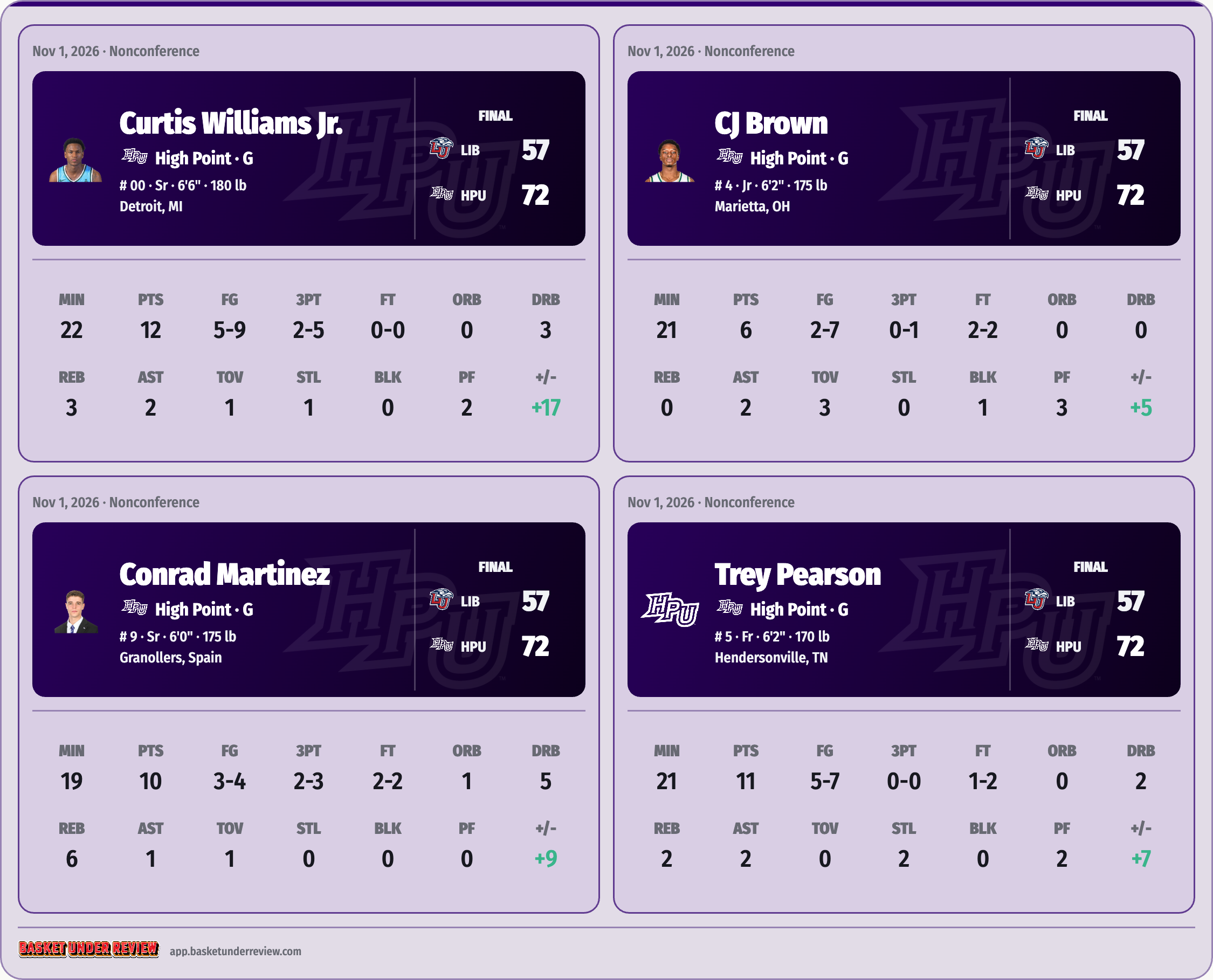
Curtis Williams filled up stat sheets often at Tulane last season, but on such a talent-rich roster, he can play more of a secondary role as the starting 2. He did just that against the Flames and still finished as the team's leading scorer, pouring in 12 on an efficient 5-of-9 shooting. True freshman Trey Pearson (No. 184 prospect per 247) was considered a good get for the Panthers, and he may have turned the most heads out of any High Point player with his innate ability to get to the rim.
I saved the best for last, though. Conrad Martinez may be my favorite backup guard in the nation. You know what you're getting with him – efficient scoring, good facilitating, defensive/shooting limitations – and he just does it with a flair and excitement level that's great for the sport. I mean, look at this:
That's a guy I want to pour my all into rooting for at 2:15 p.m. ET in mid-March. He finished with 10 points and 6 rebounds (!) on 3-of-4 shooting against Liberty.
High Point got a stinker out of the way against Maryland Eastern Shore on Wednesday (14-point win as 28-point favorites). I'm expecting the Panthers to be a very fun watch as they enter the meat of their non-conference schedule.
7) Winthrop has a prime time player at the wing
In a similar fashion to my story at No. 2, I tried to sharpen my eye for basketball talent in 2024 as a college sophomore with too much time on his hands.
I didn't have Synergy (and still don't: college coaches, hit me up), but I did have access to a great Instagram page known as @pdtmedia_ (now a friend of BUR!). He posted (and still posts) short highlight reels of players at all levels, and I decided to watch every video and take a couple notes. Yes, I know it's foolish to draw conclusions on a player based off 120 seconds of hand-picked footage. I did it anyways.
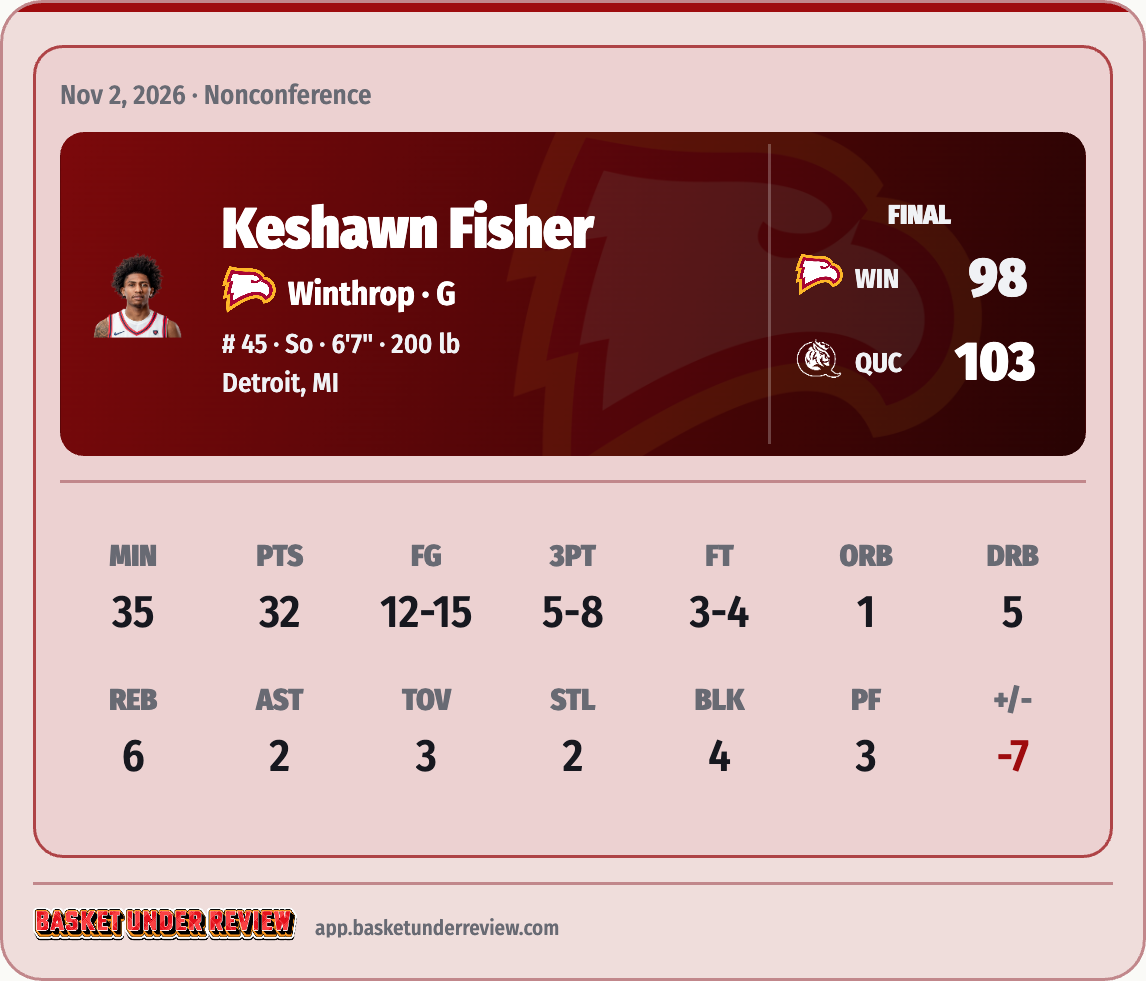
Off this story, color me shocked when I tune into Queens/Winthrop on Monday morning and find out that KeShawn Fisher is now on the Eagles! I chronicled Fisher twice off PDT's page with high-level observations like "wiggle", "fearless" and ... "projection: mid-major starter".
Don't let me get hot, y'all.
Despite losing to Queens by five, Fisher won the KenPom MVP of this game with a dazzling 32-point performance. He felt very comfortable leading Mark Prosser's high-tempo offense, converting at all three levels and wanting the ball bad in crunch time.
His shot diet wasn't perfect, and I foresee some 5-of-16 shooting nights in his future, but he doesn't lack the ability to make good reads.
He held strong on defense against a fantastic Queens backcourt too. The average DBPM of the four other Winthrop starters on Monday: -3.9. Fisher's DBPM – in a game where his team allowed 103 points! – was +4.5.
Many across the nation were surprised that Fisher, who averaged 5.5 points in 11.4 minutes at Detroit Mercy last season, wound up as one of the top performers at Rock Hill. As someone whose only exposure to Fisher came in four minutes of highlights two and a half years ago, let me be the first to say you should've bought stock a while back.
8) Larry Johnson might be top-50-player-in-the-nation good
McNeese returning Larry Johnson this offseason was one of the biggest coups in mid-major basketball. The former Creighton commit never suited up for the Bluejays, and after moving to Lake Charles, he's been nothing short of amazing.
Johnson certainly received some preseason hype: for example, Evan Miyakawa's site ranked the sophomore as the 96th-best player in the nation. Well, Johnson is already up to 71st in that ranking after two games played, and that's mainly due to his performance Monday against UAB.
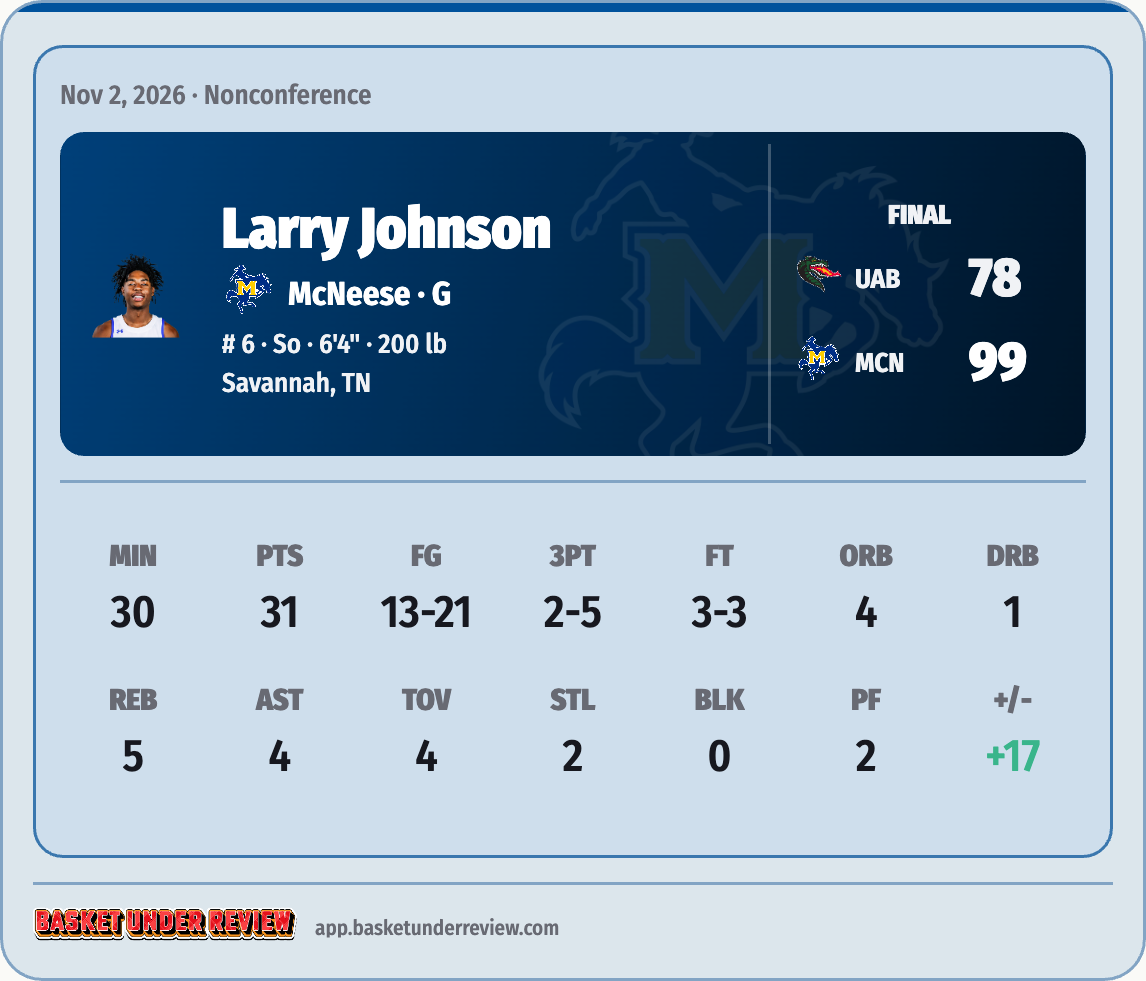
31 points, 13-of-21 shooting, 5 rebounds, 4 assists, 2 steals. That was the statline as the Cowboys cruised past a UAB squad that should be solid in the American this year.
If you're really a top-50 player nationally in a mid-major league, you should look like a man amongst boys against fellow mid-major sides, and it's safe to say that's how I saw Johnson. He has the burst and fluidity of an elite high-major guard, and he's very crafty at the rim.
The gameplan has always been to run a deep drop on him – he shot just 24.8% from three last season – but he's currently 4-of-10 on his tries through two games. Even if that number drops to, say, 34%, you'll still have an outstanding offensive guard suiting up for McNeese in March (I don't care about his defense right now).
I wish Bill Armstrong the best trying to hold onto him in April.
9) To the Power 5: more in-state buy games!
We've jumped the shark over these past few years when it comes to non-conference scheduling in college hoops. National reporters discuss the issue each year, which is mainly that power conference schools refuse to schedule teams ranked 50th-250th, but nothing has changed. Like many things in college basketball and in life, I have come to accept that non-conference scheduling falls into the category of "slightly worse than it used to be", and it will probably remain there for a long time.
I do not have some grand plan to get quality mid-majors respectable games again. I do, however, have the smallest of fixes that I estimate could bring 2.7% more joy back to the non-conference slate.
When looking around the nation on opening week, there were some close buy games that caught my eye. FGCU/UCF. Oakland/Michigan (close-ish). Western Carolina/North Carolina. All of these were in-state matchups.
Listen, if you're Mike Rhoades and you insist on preparing your Nittany Lions for the Big Ten with eight buy games, let's at least get Lehigh on there instead of New Haven. Bowling Green would love to come to Cincinnati even without Javontae Campbell: surely you can give them a chance over UMass Lowell, Jerrod Calhoun. Oral Roberts doesn't have Max Abmas and Kevin Obanor anymore; you're all good to schedule them, Porter Moser! Well, maybe you can stand pat for now.
To be fair, some power conference teams already do this, and they do it pretty well. I'd still wager we don't have enough of these matchups though. Even in the transfer portal era, we see players get fired up playing a bigger school in their state. Schools might attract a few hundred extra fans when they play a smaller school that somebody's aunt or cousin attended. There's also maybe a 1-5% greater chance (depending on the matchup) that the team getting bought wins, but no one in an autonomous conference needs to know that right now! If I have to watch KenPom No. 26 vs. No. 302, at least give me a shred of a storyline.
10) When it comes to being a college hoops "sicko", remember that legends are made in the dark, not in the light
Ah yes, another annual conversation in this sport. What qualifies a college basketball fan as a "sicko"?
This question became timely again with The Field of 68's marathon on Monday. I avoided most of the discourse, but I imagine there were takes such as: if you're not up at 3:00 a.m. watching Grambling/Northern Illinois, don't even bother filling out a bracket! If you didn't DoorDash Dunkin' to your house at 7:30 a.m., keeping your eyes glued to Merrimack/Appalachian State even as you walk to your door for the food, I don't want to hear your takes on Joaquim Boumtje Boumtje!
Enough.
"You have to work hard in the dark to shine in the light." - Kobe Bryant
You may think the dark is the 3:00 a.m. tipoff in this case, and the light is March Madness. No, it is not.
You can pull an all-nighter in November and post a picture on X of the Grambling/NIU score, sure. Guess what? There were thousands of other people watching the game live that night, some of whom did the same thing. Thousands more learned about it through social media the following morning. It was the third game of the college basketball season, and again: it started at 3:00 A.M. EASTERN STANDARD TIME! Of course it was going to be a mild spectacle. That game has always been the light.
You really want to be a "sicko"? You got five more months of this, buddy. When we hit mid-January and there's a Tuesday night full of good games, send me a picture of the 6:00 p.m. CBS Sports Network tip so I know you're locked in for the slate ahead. That's working in the dark. You heard about the 10:00 a.m. SoCon games this year? Enjoy your brunch with a side of Ed Conroy's Citadel offense: that's working in the dark. Buy a MidCo Sports Plus subscription to watch the Dakota Marker in basketball this season, and you're working in the dark.
It's a long season, and there's a lot to this sport. All good if you got the full eight hours of shuteye on Sunday night: you can make it up later.
