


The holidays mark the end of another year, but for college basketball teams, they signify the end of the non-conference season and the beginning of conference play. It’s a period that is either dead or the treacherous waters of buy games with no students or early conference matchups in an off-kilter, subdued environment. This week, we examine some developments that could have significant impacts in the new year.
Gonzaga finds their perimeter shooting
Throughout the first two months of the season and to this day, when discussing Gonzaga basketball, you often mention their frontcourt tandem, which allows you to discuss their havoc-causing defense. It makes sense considering Graham Ike and Braden Huff account for nearly half of the team’s field goal attempts this season.
However, over the last few weeks, and particularly in their 91-82 win over Oregon last weekend, the supporting cast of the offense has demonstrated its ability to relieve the post duo of scoring duties by being hyper-efficient scoring from the perimeter. It’s a developing facet for the team, considering they still rank 340th in the country in three-point attempts to total field goal attempts at just 31% of their shots coming from the perimeter.
However, over the last five games, that percentage has increased to 39% of attempts coming from deep, thanks to the blistering shooting of their three-point specialists, Steele Venters and Adam Miller. After going a combined 13 for 43 (30%) in the first five games of the season, the two are 21 for 36 (58.3%) over the last five games. The team has shot 46.5% in this span, the fourth-highest percentage in the nation.

Miller and Venters are integral to the spacing afforded to Ike and Huff. They nearly exclusively play in place of each other throughout the game, feasting on catch-and-shoot opportunities. In their most recent game, the two accounted for 23 of the Bulldogs’ 91 points. Keeping defenses honest and uncomfortable living in zone is vital for the number one points-in-the-paint offense in the country to continue overwhelming their opponents.
Brayden Maldonado is making a case for the best lead guard out west
One of the primary holiday season’s underdog heists came when Seattle upset Washington last Friday. The Redhawks have climbed to 94th in the NET Rankings and look to be in that second tier of teams in the WCC that could pose a threat to the Zags and Gaels on any given night.
The Redhawks are primed to make a major statement in their new conference, thanks to the leadership of their senior guard Brayden Maldonado, who is averaging 17.2 points, 4.2 rebounds and 2.5 assists this season. He’s an efficiency monster, boasting an effective field goal percentage of 61.2%, three-point percentage of 44.1% and a free throw percentage of 97.9% (on just under four attempts per game).
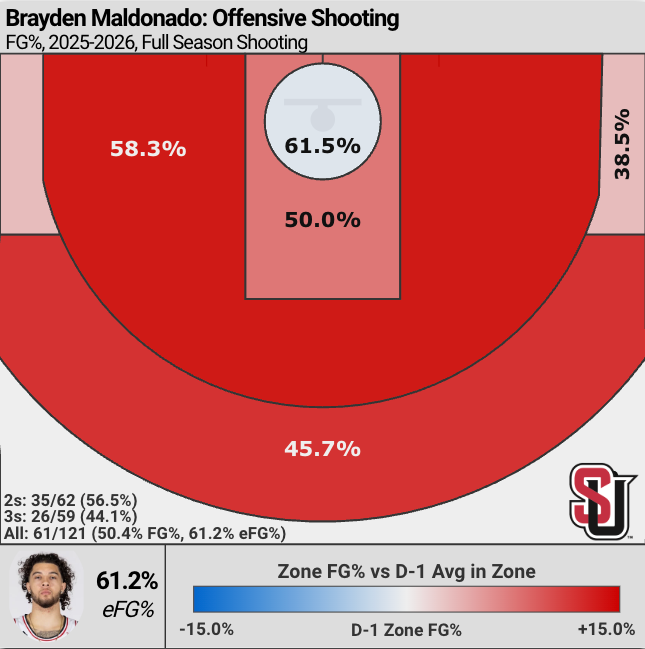
Maldonado does a bit of everything for the Redhawks. For a top-15 team in defensive turnover percentage, his 1.8 steals per game is second on the team, only to fellow starting backcourt mate Maleek Arrington, who averages 2.2 steals. His 3.7 defensive rebounds per game rank in the 92nd percentile nationally, and he is a key contributor to Seattle's ability to get out in transition. He accounts for 3.9 of the team’s 8.2 fast break points per game.
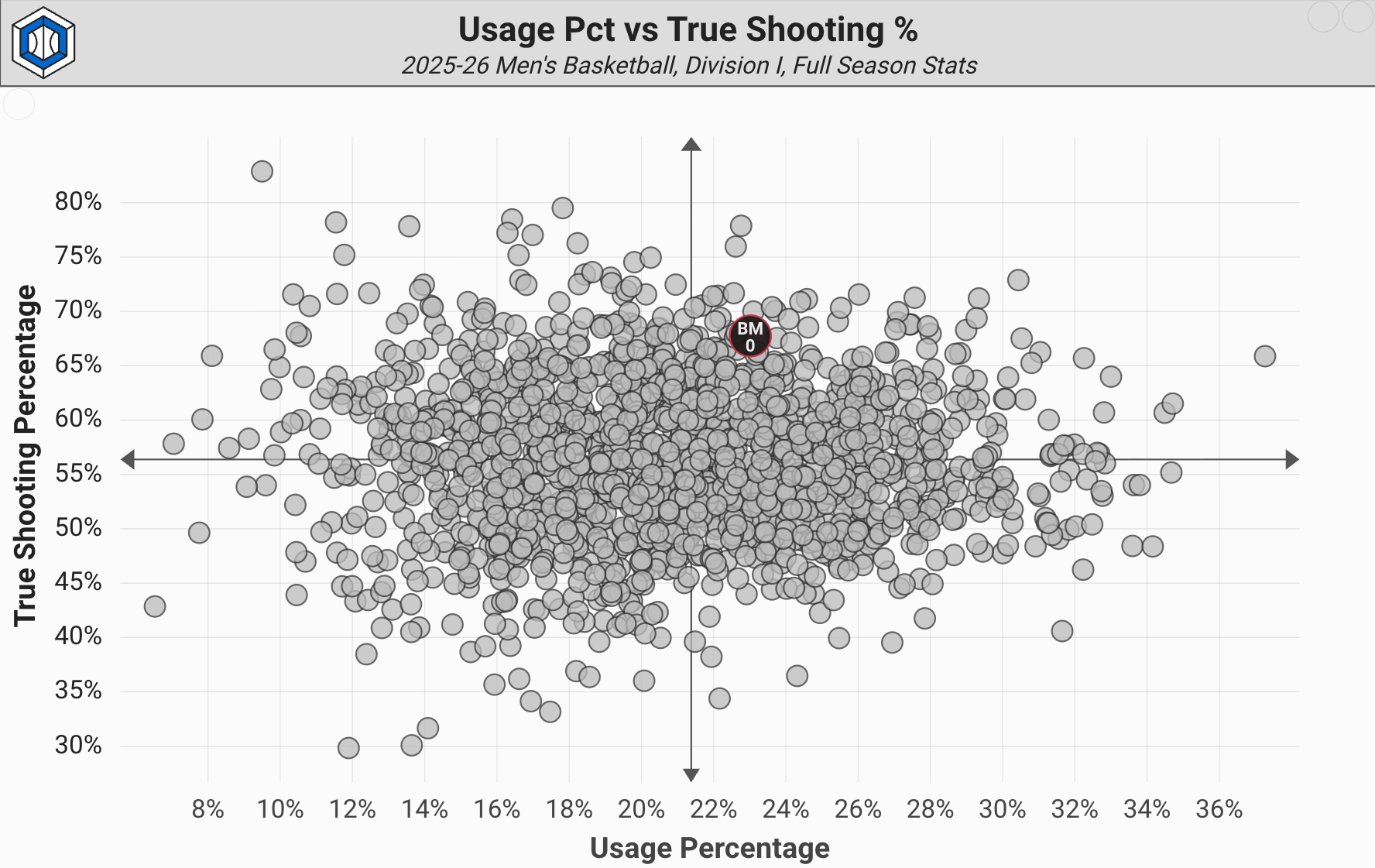
The former junior college player had his worst game of the season from an efficiency standpoint against Washington, but still managed to record 14 points, 6 rebounds and 3 assists in 31 minutes. He will need to raise his efficiency against higher competition once league play starts if Seattle wants to play the role of spoilers and make a statement in their first season in the WCC.
MJ Collins brings Utah State to another level
When we talk about this new era of college basketball and the transfer portal, it’s easy to focus on the negative storylines of free-moving in the offseason. So-and-so is making how much? How many portal entrants are still without a team? However, we seldom get to truly focus on the major individual winners from the class of journeyman players seeking a genuine opportunity.
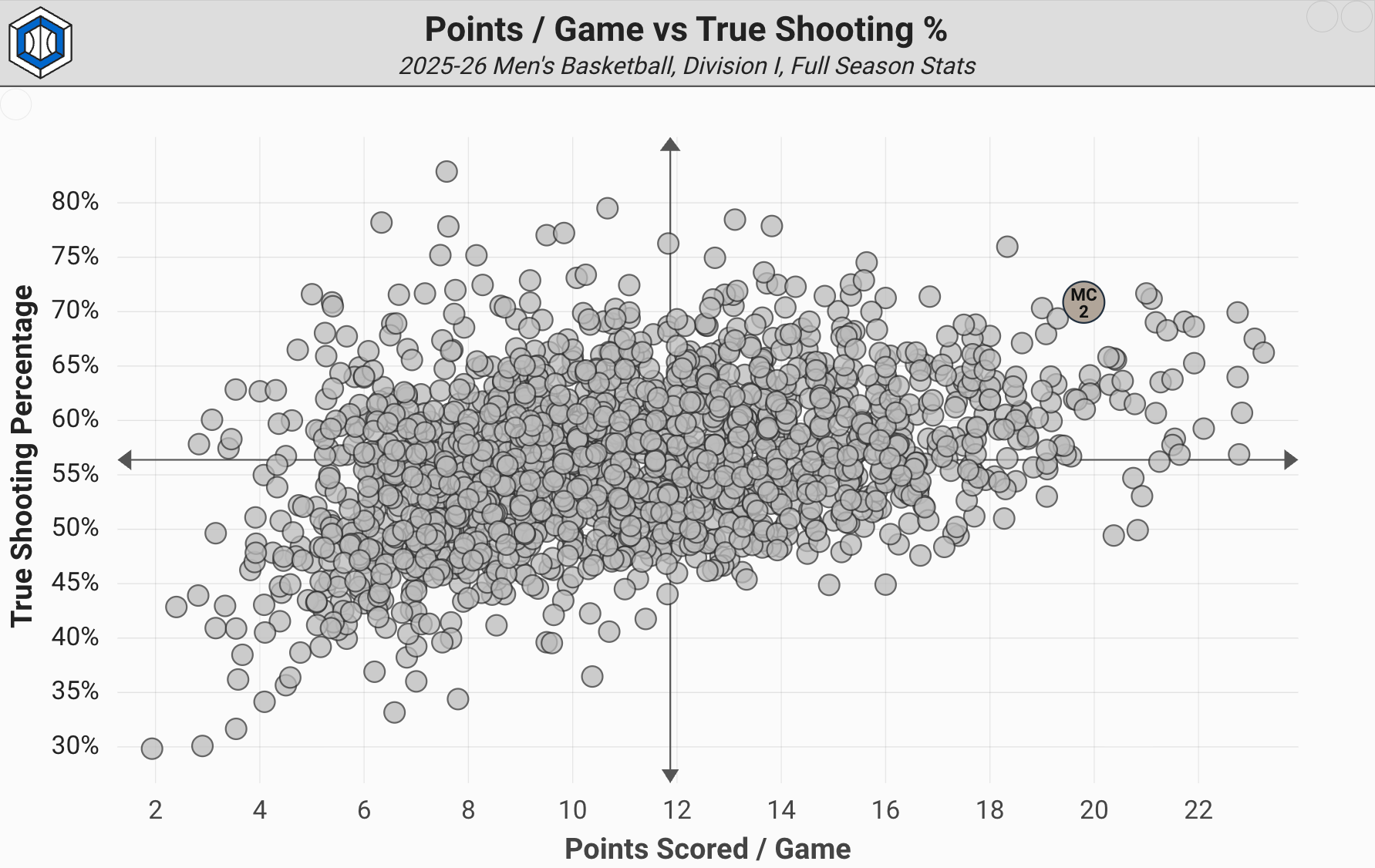
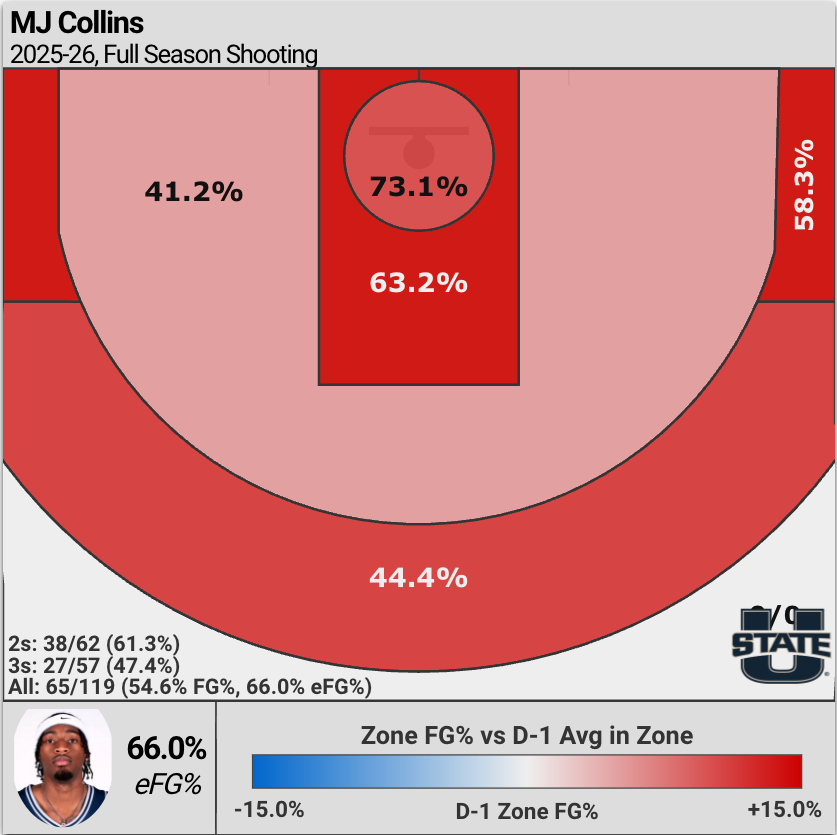
One of the best examples of this kind of storyline is the one unfolding at Utah State with senior guard MJ Collins. The 6-4 guard is averaging 20.1 points this season with an effective field goal percentage of 69.2% in 30.2 minutes per game. In his three previous seasons, he averaged 6.3 points with an effective field goal percentage of 43.4% in 24.3 minutes per game. Most remarkably, his 32 made threes in 11 games this season is already a single-season career high.
Collins accounts for a third of the Aggies’ made threes on the season and is 44.4% above the break from the three-point line. But he’s more than simply a perimeter, catch-and-shoot player. He’s shooting 73.1% at the rim this season, over 10% higher than the national average from that distance. Most of those opportunities come in the fastbreak, where he averages 5.1 points per game, ranking in the 99th percentile in Division I.
The Aggies’ Collins and Mason Falslev are arguably the two best players in the Mountain West Conference for the first half of the season. They needed to play just 22 minutes each in their 100-58 win over Colorado State to kick off conference play. If the Aggies can play this well on both ends of the court, the gap between them and second-best in the Mountain West could be the largest gap the conference has seen since the COVID-shortened season.
MJ Collins Jr., ladies and gentlemen 🤯
— USU Men's Hoops (@USUBasketball) December 20, 2025
That's a PERSONAL 11-0 run#AggiesAllTheWay pic.twitter.com/rBUniKs7Xa
Games to watch
- Santa Clara at Oregon State, 6 pm ET/3 pm PT, ESPN+
- Saint Mary’s at LMU, 7 pm ET/4 pm PT, ESPN+
- Seattle at San Francisco 8 pm ET/5 pm PT, ESPN+
