

Not many first-year head coaches have had as successful years as Nolan Smith is in the midst of at Tennessee State...
The former Duke standout and Portland Trail Blazer took over as head coach of the Tigers in July of this past offseason after stints as an assistant coach at each of Duke, Louisville, and Memphis, but didn't let the late start slow him down. Tennessee State lost each of its first three Division I games, but found some momentum heading into conference play before co-winning the regular-season Ohio Valley title with a 15-5 record.
Smith was named the OVC's Co-Coach of the Year, while Aaron Nkrumah was named the league's Player of the Year.
As the No. 1 overall seed at the OVC Tournament, the Tigers earned a bye to the semifinals, where they knocked off UT Martin by 13 points. The ensuing evening, they pounced on Morehead State from the opening tip with a 3-point onslaught. Despite having entered the game ranked 350th in 3-point attempt rate and only making 12+ 3s in one regular-season game, Tennessee State shot 12-for-15 from beyond the arc in the first half of the title game en route to a 21-point advantage.
Fast-forward to the final buzzer, and Tennessee State won the league's automatic bid with a 93-67 score. While the Tigers' best 3-point performance of the season was one of the top stories from the title game, making 16-of-26 attempts, their perimeter shooting wasn't what got them to this point. Now an NCAA Tournament team for the first time in 32 years, let's take a deeper look at Tennessee State.
Tennessee State has dominated the possession battle.
Narrowing the focus to Tennessee State's league games, its offense was superb. The Tigers finished in the top 4 of the league in the majority of important statistics, including leading the conference in effective field goal percentage and turnover rate. Tennessee State's raw offensive efficiency of 114.8 of league games led the league by 2.6 points. While the defense only ranked 10th in effective field goal percentage allowed, it forced turnovers and limited second-chance opportunities.
With top-four rankings in TO% on both ends and OR% on both ends, Tennessee State dominated the possession battle. Over the course of the Ohio Valley regular-season schedule, the Tigers attempted 115 more field goals than their opponents – not only leading the league in differential, but leading it by 81 field goal attempts.
For the full season, Tennessee State rates in the 98th percentile for FGA differential (+174) and in the 86th percentile for rebound/turnover differential (+129). OVC Player of the Year Aaron Nkrumah sets the tone defensively, ranking sixth nationwide for steal rate (5.0%), with Antoine Lorick (3.0%), Dante Harris (2.9%), and Jalen Pitre (2.6%) all nationally-ranked in that department as well.
On the glass, the 6-8 duo of Lorick and Pitre lead the way. They both ranked in the top-20 of offensive and defensive rebounding rates during league games, with the former specializing on the defensive glass and the latter specializing on the offensive glass. Lorick also posted the league's second-best individual block rate.
As far as how the possession battle could play out in the NCAA Tournament, results against higher-rated competition are limited; they only played three top 200 KenPom opponents during the regular season (Belmont, Tennessee, and UNLV). Across those games, they still managed 28 more field goal attempts than their opponents but while giving up 42 more free-throw attempts.
At-the-rim attempt rate has been a determinant.
While Tennessee State ranks 33rd nationally for its points distribution coming on 2-point shots, it only ranks 328th in average 2-point attempt distance (7.0). When it is at its best, though, those shots are coming closer to the basket. Tennessee State shoots a similar efficiency at the rim, defined as within 4.5 feet by CBB Analytics, in wins (65.9%) versus losses (61.2%), but its attempt rates on such shots differ greatly.
The Tigers are taking 36.4% of their shots at the rim in their wins (equivalent to the 73rd percentile nationally), compared to a lowly 22.5% of shots coming from that range in their losses (equivalent to the 5th percentile).
The difference in their shot selection in losses is not an uptick in 3s due to playing from behind, but rather being forced into more non-at-the-rim paint 2s:
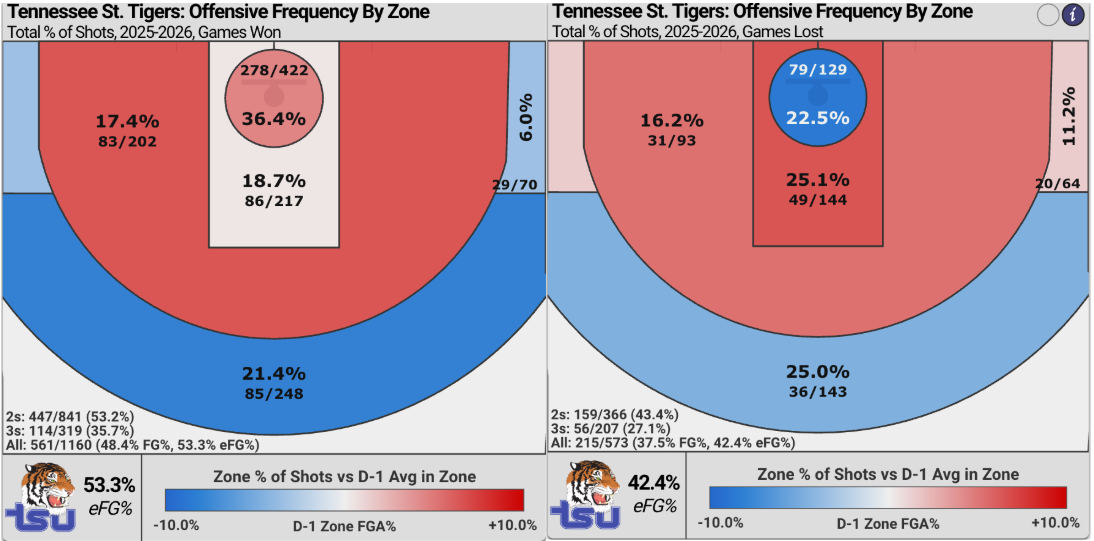
The Tigers have not been particularly effective on non-at-the-rim paint 2s, either, rating in the 15th percentile at a 34.0% conversion rate. While they have been excellent on mid-range jumpers outside the paint, even connecting at a 70th-percentile efficiency pales in comparison to its at-the-rim finishing: 38.6% field goal percentage vs. 64.8%.
From an individual standpoint, it is a team-wide differential in rim rate in wins vs. losses:
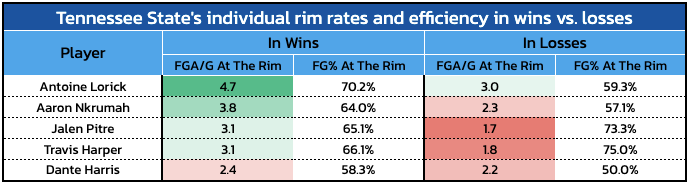
Looking back on those aforementioned nonconference top 200 games, Tennessee State only attempted 15.5% of its shots at the rim in those contests. The Tigers have attempted at least 25% of their shots from that range in eight of their last nine games entering the NCAA Tournament; they are 16-3 when reaching that threshold, and 11-0 when attempting at least 35% of shots at that range.
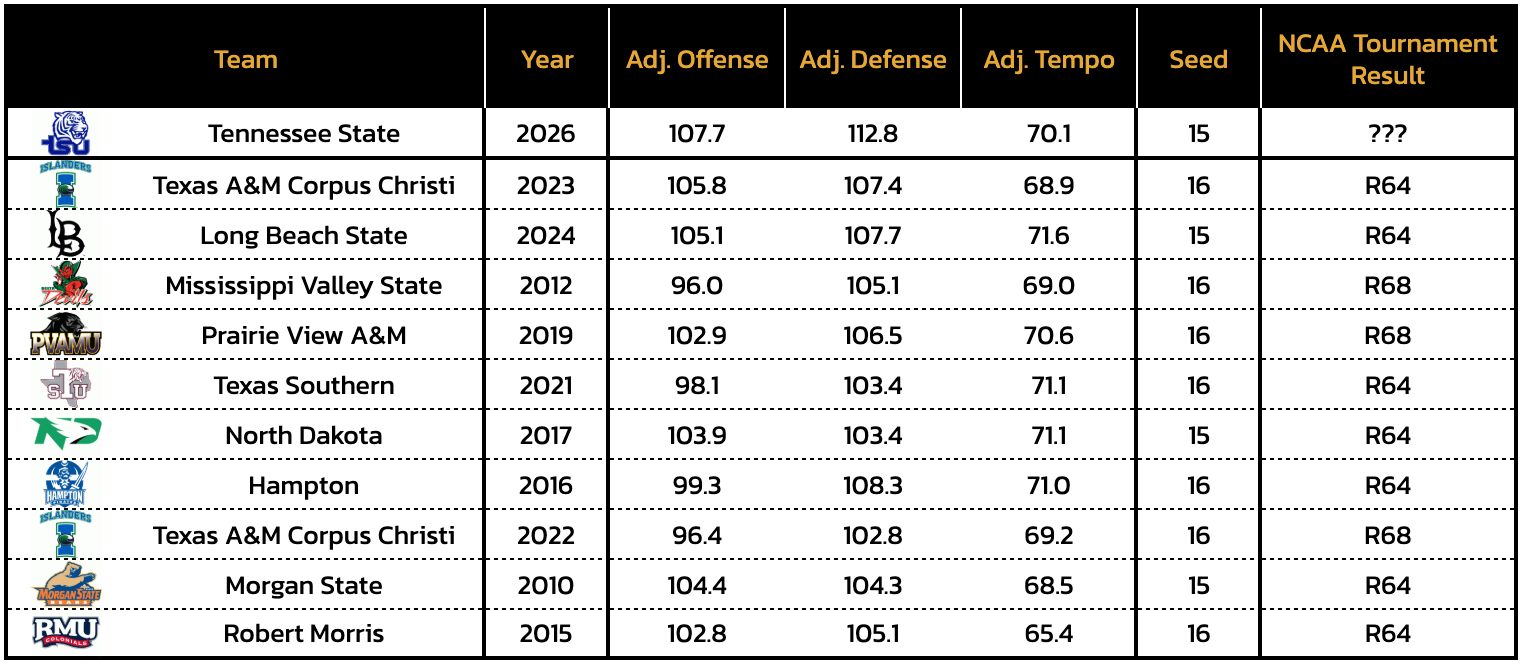
Similar NCAA Tournament efficiency profiles
Tournament Index evaluation
As it stands, Tennessee State is a projected No. 16 seed by our bracketology at Basket Under Review and on the Bracket Matrix.
Should that be the case, the Tournament Index rates the Tigers as a slightly-above-average No. 16 seed (21st-strongest power rating out of 49 teams) compared to the last 12 NCAA Tournament fields. If the Tigers land above that projected seed, they would be the third-weakest No. 15 seed compared to the last 12 fields. The TI projects an average of 0.06 wins (excluding First Four) for Tennessee State given its projected seed and strength.
