

The year is 2018. The Villanova Wildcats finish off an impressive 36-4 campaign with a sweat-free national championship win over Michigan, 79-62. Villanova takes 27 of its 57 shots from deep in the contest. The 47.4% 3-point rate is their 22nd-highest of the season, and mirrors their season average of 47.5%.
This was a banner campaign for the 3-point arc in college hoops. Just a couple years removed from the rise of the Golden State Warriors in the NBA, teams began firing away from deep in ways the college game had never seen. Schools shot an average of 37.5% of attempts from three, a new record. They also hit 35.1% of them, the highest clip ever on at least a 30% rate.
This surge was exemplified in the Final Four. Villanova was first in the Big East in 3-point rate, Michigan was first in the Big Ten in that stat, Kansas was first in the Big 12, and even Cinderella Loyola Chicago, who was only 229th nationally in rate, were 17th in their shooting percentage at 39.8%.
However, the flipside to this was how low the teams' rim rates were. Only Loyola Chicago ranked in the top 90 in rim rate that year. Villanova ranked 312th. Second-best KenPom team Virginia (the UMBC loss team) was eighth-last nationally in rim rate. That year, there were 12 teams that averaged at least 16 made field goals at the rim per game.
Flash forward to 2026. Eight years later, and college basketball teams are setting a new 3-point rate record at 39.6%. This year is also crushing the KenPom adjusted offensive efficiency record, with an average of 108.3, over two points higher than it's ever been. Part of that is a record-setting 51.4% effective field goal percentage clip, surpassing that aforementioned 2018 campaign.
But that surge in efficiency is not coming from deep. Teams shot 1.1% better from beyond the arc in 2018, compared to this year. There are just 22 teams shooting 38% or better from deep this season. There were 45 in 2018.
Rather, the difference is at the rim. Compared to the 12 teams that averaged 16 rim field goals per game back in 2018, there are 57 this year. That list includes Michigan, Duke, Arizona, and Florida in the top 25, four of the five best teams on KenPom.
The 2025-26 college basketball campaign is the Year of the Rim Point. If you can't get to the rim, or score efficiently around it, we'll see you next season.
Rim Points by Brute Force
The main way that teams are increasing their rim points this season is by simply being bigger and stronger than their opponents. Sounds easy, right? To demonstrate, here is a table of the nine best power conference rim scoring teams this season.
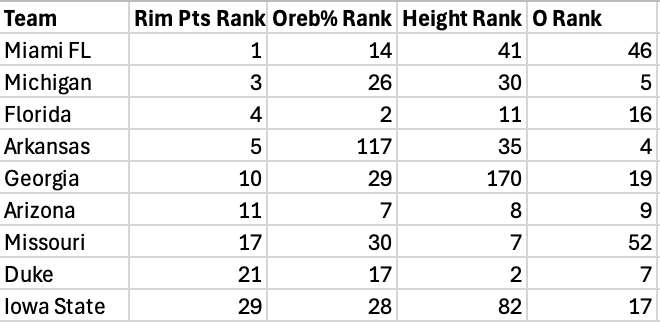
Of those nine elite rim point squads, eight of them rank in the top 30 in offensive rebounding rate, and seven of them rank in the top 45 in height. Perhaps most importantly, seven of them are Top 20 offenses. Now, let's do that same thing defensively.
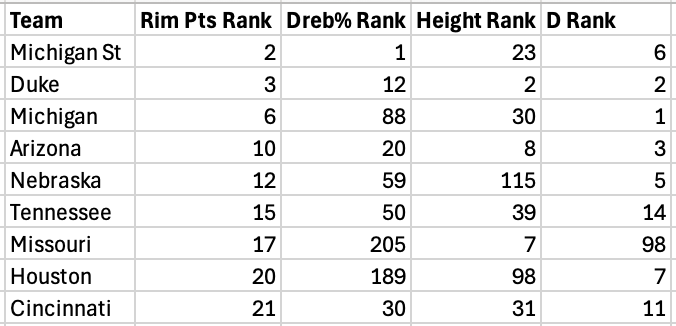
The rebounding is much less correlated on the defensive end, but for the most part, these teams are still massive, and are even more skewed towards elite defensive units than the offensive side. Eight of the nine-best power conference rim defenses are Top 15 overall defenses.
Notably, there are four teams on both these lists. Three of them happen to be the three best teams in KenPom by a wide margin, Michigan, Duke, and Arizona. The fourth is Missouri, who are a massive outlier in this study. Somehow, the Tigers are the worst-ranked KenPom team of any of the 14 teams that made either of the lists, and they made both.
The only team that ranks in the Top 10 nationally in both rim offense and defense is Michigan.
Amongst all teams that take at least 27 rim attempts per game, the Wolverines lead the country averaging 1.37 points per attempt, shooting 66.1% from the field. Additionally, Michigan is one of two teams allowing under 20 rim attempts per game on lower than 50% shooting (Hofstra is the other).
It is only fitting that the most dominant team in 2026 is also the country's most dominant two-way rim team in the Year of the Rim Point.
Many ridiculed Dusty May for saying he'd start big men Morez Johnson and Aday Mara at the start of the season. In reality, he may have revolutionized the way we see frontcourts at the top of the sport.
Johnson and Mara have combined to shoot an unfathomable 218 for 297 (73%) at the rim this year. When they share the court together, Michigan allows just 18.6% of opponents' shots within 4.5 feet, a 99th% rate per CBB Analytics. Opponents are shooting right around 43% at the rim and in the paint when both are on the floor.
The thing is, this emphasis on physical offensive play is relatively new this year. Last season, only four top 10 KenPom teams were within the top 50 offensive rebounding teams, only three were within the top 50 2-point percentage teams, and only one was top 50 in both, the national championship Florida Gators. This year, all 10 of the top 10 teams are within the top 50 offensive rebounding squads, and seven of them are top 50 2-point offenses. The defenses are slightly less correlated, but paint a similar picture.
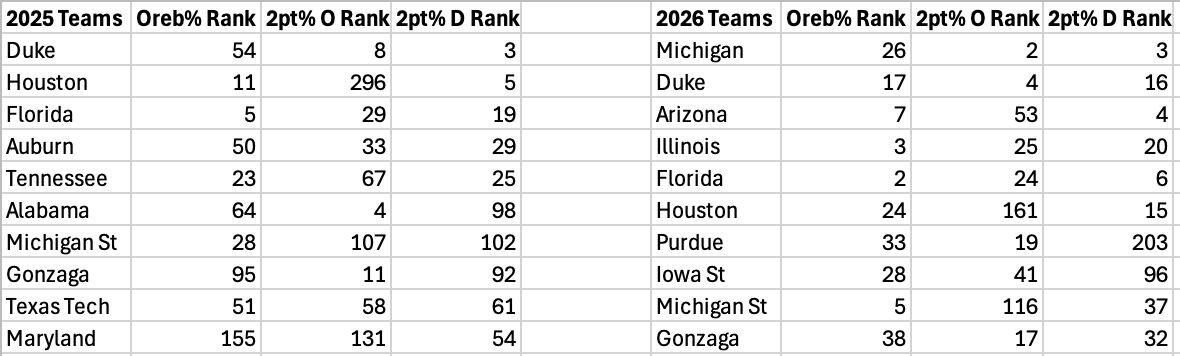
Look for power conference teams to try and emulate what Michigan and folks are doing next season. While it's obviously not easy to just add elite size and physicality, sacrificing spacing and speed for rim dominance so long as you have competent guard play and some shooting around them has clearly been an effective strategy. Playing big, winning the glass, and being the better rim team has been the name of the game for the best squads in the country this year. Unless you're Missouri, of course.
The Value of 2-Point Distance
Whether prophetic, well-timed, or a bit of both, KenPom picked an excellent season to unleash a new statistic: average 2-point attempt distance. The stat popped up out of nowhere on New Year's Day, almost as a symbolic way to state this year is the Year of the Rim Point.
Unlike pure rim rate, which simply shows what percentage of your shots come from around the hoop, average 2-point distance is a commentary of your quality of shot attempt inside the arc. Cal State Northridge is the No. 1 rim rate team in the country at 51.7%, but are just 171st in 2-point distance because they still average 5.3 2-point jump shots per game.
On the flipside, Saint Louis is first in average 2-point distance offense, but 24th in rim rate. The Billikens have taken 36 2-point jumpers all season. They are somehow both a top 15 3-point offense and 2-point offense at the same time.
However, my favorite stat from the Billikens this season is that their five best assist per game players are also their five leaders in rim field goals made. Unlike the traditional thought that your guards are the ones making plays and dishing to the bigs, Saint Louis flipping that concept around allows their more efficient finishers to be the ones driving to the hoop thanks to the space that their elite shooting guards provide.
The one sort-of exception here is Dion Brown, a 6-foot-3 player that most certainly has a guard frame, but is the team's leading rebounder and leads the squad in rim points. Because he's a crafty finisher with ball skills, unusual forward chops, and court vision, Saint Louis is able to invert their positioning while still technically having a guard on the ball.
In this clip, Saint Louis' 6-foot-3 guard/forward drives baseline, their 6-foot, 47% 3-point shooter fills the corner, their 6-foot-10 big man clears the paint, and their 6-foot-6 point forward cuts opposite side for the and-one finish. How is anyone supposed to guard that?
With all due respect to Brown, it's not like he's some world-class finisher or anything. He only has five dunks on the year, and was just a 51.5% rim finisher last year before surging to 72.1% this year. But when you space the floor around him with a 40.3%, a 40.6%, and a 47.1% 3-point shooter, you get comical attempts like this one.
It is a lot easier to finish over a 6-foot-4 guard than a big man roaming the paint, who has no choice but to vacate given Saint Louis' other options. It is certainly no coincidence that 67% of Brown's minutes have come with the Billikens' other two non-shooters off the floor.
My other favorite offense that plays this "inverted" style happens to be the No. 2 2-point distance squad, St. Thomas. The Tommies lead the country in pick-and-pop rate, where 80% of the shots their screeners take after setting a screen is a 3-pointer. Their two on-ball players, Nolan Minessale and Nick Janowski, are both in the top five in rim makes in the Summit League. And their starting big man Carter Bjerke leads the Summit in 3-point percentage. Look at what Bjerke's gravity does to the guards' 2-point quality, and what the guards' downhill ability does to Bjerke's 3-point quality.
In many ways, 2-point distance is only truly effective if you have that spacing around you. If defenses don't respect your off-ball shooting, it doesn't matter how disciplined your 2-point shot profile is.
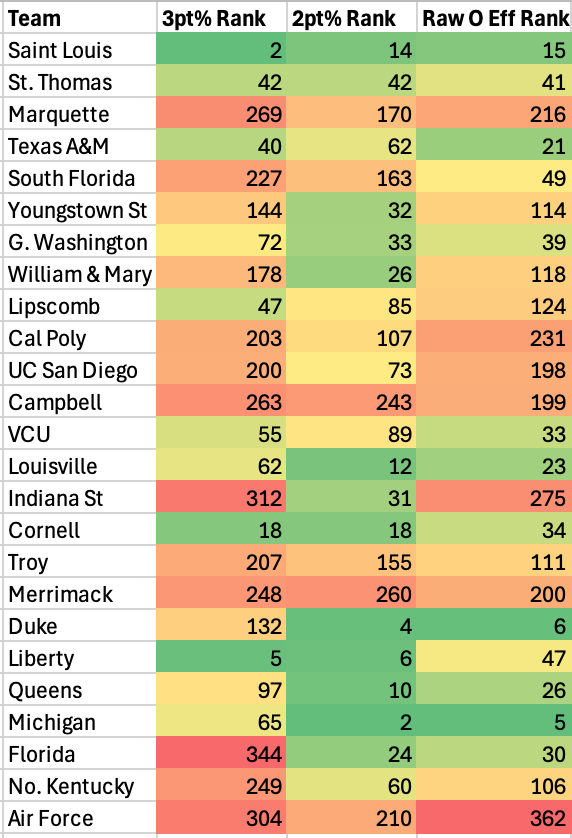
Above are the top 25 teams in the country in average 2-point distance offense. There is definitely strong correlation between how a team shoots from 3, how a team shoots from 2, and how good an offense is. Simply getting to the rim a lot does not automatically make you a good unit.
Saint Louis, St. Thomas, Texas A&M, George Washington, Lipscomb, VCU, Louisville, Cornell, Duke, Liberty, Queens, and Michigan are the 12 teams that are on this list and Top 100 in 2-point and 3-point percentage. Unsurprisingly, 11 of them are in the Top 50 in raw offensive efficiency nationally.
Teams are catching onto this. KenPom's 2-point distance data begins in the 2021-22 season. Six teams had average 2-point distances shorter than five feet, and 71 had one shorter than six feet. This year, 37 teams are shorter than five feet, and 175 teams are shorter than six feet. According to CBB Analytics, the percentage of teams' points in the paint has shrunk this year from 43.1% last year to 42.7% this year. However, according to my calculations, rim rate is actually up 1% on average.
In other words, teams' 2-point attempts are becoming smarter, and the better you are at diagnosing that, the better your offense will be.
I'll end this section by saying that there is actually a stronger correlation to 2-point distance defense and defensive success than on the offensive end. There is no greater defensive skill than denying the rim, now more than ever, for all the reasons I've outlined in this article. This is a fascinating topic for another day. I suspect there will be more teams that try dramatic zones like South Alabama's (more on that next), or extremely deep drops like Coastal Carolina's. If you cannot prevent rim attempts, you are completely cooked.
The Sport's Most Influential Rim Player
Duke's Cameron Boozer may be a runaway National Player of the Year winner, but he's not first in the country in rim points. He may, or may not be second.
Instead, the leader in rim points is South Alabama point guard Chaze Harris, which all things considered, is pretty historic.
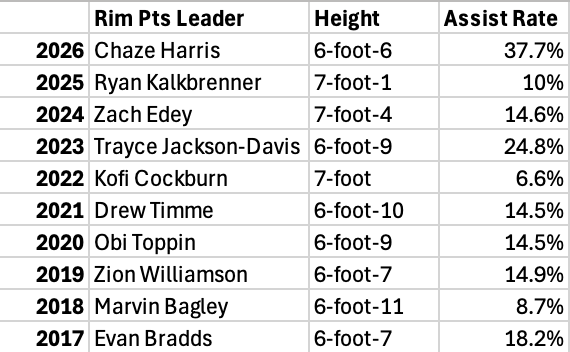
Not only is Harris the shortest guy on this list, and the only guard to ever lead the country in rim points in Synergy's 15-year database, (I acknowledge the season is not done yet), but he also laps the field with his assist rate. In other words, he's the only guy scoring at the rim this much while also being a team's lead initiator.
Harris came to South Alabama this offseason by way of Life University, where he was a First-Team NAIA All-American. He was second in that league in rim points last year. However, he made just 12 threes on the campaign, and I can understand Division-I programs' hesitation to add a non-shooting guard from the NAIA ranks.
Credit to South Alabama for being different. Their offense is fascinating and unique. Harris is second-nationally in possession usage with his insane rim numbers, plus he's taken 34% of his team's total free throws and 34% of his team's 2-point attempts. The other four starters on the Jaguars' roster have taken 481 threes and 339 twos. Harris also has 41% of the team's total assists, and only 11% of his attempts have been assisted this year. Here are some examples of this funky scheme.
South Alabama's offense not only runs through Harris, but is largely Harris-dependant. It's no surprise that he possesses a 99th% net rating, per CBB Analytics. The Jaguars have a +9.3 net rating when he's on the floor, and a -21.4 mark when he sits.
Not pertinent to this argument, but I do just want to say Harris would be even more prolific if he just made his free throws. He's a poor 58.4% with 3.2 misses per game.
However, my point is not that Harris is the best rim scorer in college basketball this season, or even the best rim scoring guard of the modern era. It's that he's the most influential rim player in the sport.
That's because Harris is second in minutes and and the lead perimeter defender on the best rim denial defense in at least the last 14 years. Synergy data goes back to 2011-12, and the Jaguars' 24.3% rim rate is the lowest ever tracked for a Division-I team.
I could do an entire article on how funky and unique South Alabama's zone defense is. They allow 64.2% of attempts from deep, which is the highest in the nation by 11.6%, or the gap between first and 145th.
This is one of the funniest possessions of the season. Appalachian State's guards pass it back and forth to each other eight times, before making one pass to the wing, before passing it back up top for a contested three at the horn. In the 30 seconds of the possession, the ball gets inside the 3-point line for about one of them.
All you really need to know is one of the craziest stats you'll ever hear. South Alabama has allowed just 131 more rim points this season than their star point guard has scored on his own.
Or in other terms, if South Alabama's rim defense was equally as proficient with Harris on the floor versus off it (which is being generous since he's a 96th% on/off defender), the Jaguars have allowed approximately 401 rim points with Harris on the floor this year, and he's scored 374 on his own.
And for that reason, I declare Chaze Harris as the King of the Rim Point, in the Year 2026, otherwise known as the Year of the Rim Point. South Alabama has as good a chance as any to come out of the Sun Belt as the March Madness representative, and for the sake of my narrative, I really hope they do.
