

In the 2024-25 season, South Alabama employed a zone defense that did exactly what the title of this article states, they dared teams to shoot threes.
In the 2025-26 season, South Alabama has been doing it once again, and they're doubling down as they're doing it at a historical rate.
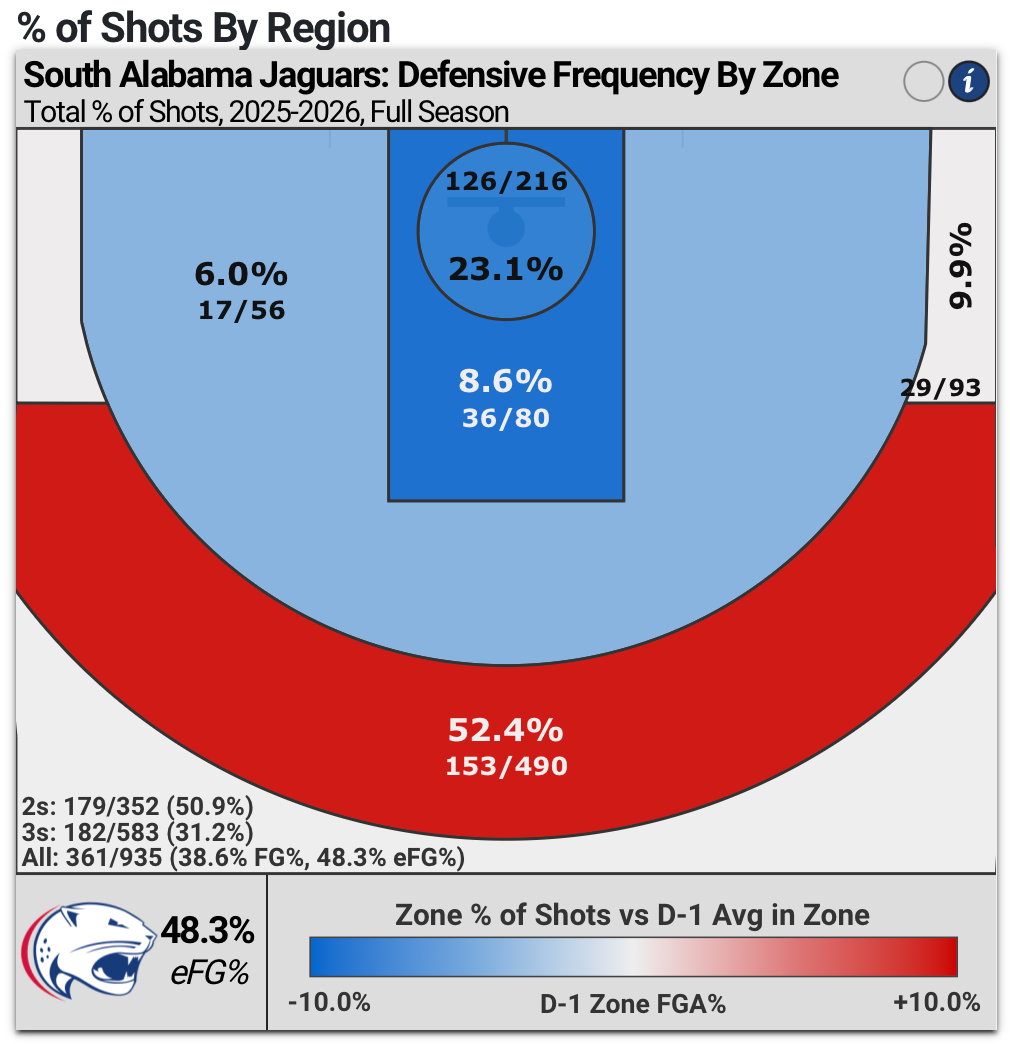
Above shows the percentage of shots that teams take against South Alabama in each territory. Teams are currently taking 52.4% of their shots from three, above the break. That's the highest rate in the country. When you add in corner threes, teams are taking 62.3% of their shots from three, the highest rate in the Kenpom database (going back to 1997).
So in the modern age of analytical thinking that tends to promote defenses looking to take away shots at the rim and from three, how does a defense that promote these looks find any success?
Richie Riley has been the head coach at South Alabama since the 2018-19 season. In the 2023-24 season, South Alabama had a defensive three point attempt rate of 36.1. As mentioned before, that jumped to 59.3 last season and is up to 62.3% this season. Despite this gigantic increase in three point attempts allowed, the defense has found some success.
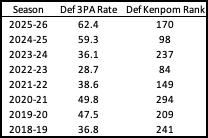
Above shows the defensive three point attempt rates and Kenpom national defensive ranks for South Alabama under Richie Riley. As shown, Riley has been willing to tinker and try different things, and after having a top 100 defense last season, he's gone back to the zone once again. To put the Kenpom ranking into some context, South Alabama currently has the 4th best defensive rating in the Sun Belt, although the difference between #1 and South Alabama is small enough that a single game could jump South Alabama to #1.
South Alabama is accomplishing this by running more zone than anyone in the country. It isn't just the fact they run a ton of zone though, it's that they run a unique zone built specifically to eliminate drives at all costs.
Base zone
By definition, I think this gets classified as a 2-3 zone. But sometimes it looks like a 1-3-1 shell and other times it looks like a 3-2 zone and other times it looks like a 2-2-1 and other times it looks like...
Well, other times it just is. It's a zone, with rules and structure, don't get that mistaken, but it isn't necessarily held always to looking like a stereotypical 2-3 zone. This is because, more than anything, the zone has to be able to take drives away.
In the clip above, the ball gets into the paint once, something that honestly doesn't always happen. When that happens though, South Alabama collapses down to force a kickout and have to rotate from there.
The zone starts in a 2-3 look in the clip above. As the ball gets moved side to side though, it eventually takes more of a 1-3-1 type shape. This is pretty common for the South Alabama defense as the weakside top guy of the 2-3 is tasked with digging down and taking away a pass to the high post. When this happens, the weakside low man steps up some, generally in line with the free throw line, to give the 1-3-1 look.
Zone Defense - Low Man in gap
The clip above is another good example of the base of the defense. What I really want to highlight is where #12 is positioned for South Alabama as the ball is on the opposite side of the court. He, Adam Olsen, is one of the bottom wings in the 2-3 zone. As the ball goes to the weakside, you can see him lift up to the elbow area, and it's for the exact reason that happens. South Alabama allows a drive from the top of the key, but they aren't able to get anywhere because Olsen is already in position to help on the drive. This also means that the defender in the middle, protecting the rim, doesn't have to step up and away from the paint.
South Alabama is fine with the ball moving back and forth across the perimeter, and that's how a lot of possessions look. Teams will try to move the ball, but there's no where to really move it on the interior when all 5 defenders rarely ever extend beyond the three point line.
Zone Defense - Game winning possession
I've shown two clips where the offense gets decent looks that South Alabama lives with, but here's an example of it shutting down an offense. With the game on the line, Alcorn State spends 20 seconds moving the ball along the perimeter. They never get it inside the three point line, and they also never get it to either of the corners (by design of the defense).
Below seems to be the general rules for each of the 5 defenders. Just for clarification, the "strong side" defender is the defender on the same side of the court as the ball. The "weak side" defender is the defender on the opposite side of the court as the ball. The "top man" are the guards at the top of the zone, and the "low man" are the defenders in the corners area. The big is the center of the paint.
- On ball defender - Don't press too far beyond the three point line. Limit drives first and foremost, and force into help if needed.
- Weak side top defender - If there's an offensive player that flashes to the elbow, this defender has the responsibility of dropping down and limiting the post entry pass. If there isn't an offensive player that flashes there, then they still have to drop down some to be able to help on the drive.
- Strong side low man - They have to play in the gap between the wing and the corner. They set up generally halfway between the ball and the corner in order to 1.) prevent the ball handler from driving at all and 2.) make the pass to the corner more difficult since the defender is already in the passing lane
- Weak side low man - They generally have to rise up a bit from the weakside corner, and this is often where the 1-3-1 look comes in. Their job is to be in position if the ball gets quickly reversed to be able to stop the drive from either someone at the top of the key or the wing that they're on.
- Big man - Their job is to stay in the paint, not allow post entry passes, and be the last line of defense in case someone is able to drive to the rim.
Jumping back into the some of the numbers because some of the defensive stats this team has are absurd.
On the season, teams are taking just 30% of their shots inside of the paint against South Alabama, the lowest rate in the country. 23.1% of those shots come at the rim, and 8.9% of shots come in the paint outside of the rim. Those are the 13 lowest and #1 lowest ranks in the country respectively.
Rim + 3 Rate is the percentage of shots teams take at the rim or from three. Despite allowing the 13th fewest shots at the rim, South Alabama ranks 364th out of 365 teams in Rim + 3 Rate, solely because of how many threes they allow.
That right there could sum up the entire article. Take away drives, and force three point shots. It's a gimmicky type defense by definition, but it's had success just because of how bought in everyone on the team is to it. It's also so unusual that teams don't necessarily have the reps in practice to always try and figure it out.
South Alabama faces the fewest amount of pick and rolls in the country, in an age where spread pick and roll is the most common offense you can find.
Every team has attempted at least 50% of their shots from three on the season against South Alabama, except Texas State who only attempted 38.3% of their shots from three.
26% of shots are from 25+ feet away, the 3rd highest rate in the country.
Teams are 8/57 (14.0%) on pull up 3s in the half court against South Alabama, because there simply is just no chance to get any rhythm against this defense. To me, that's the bet South Alabama is making. Yes, you can get some looks from three, but will you have enough rhythm and flow to your game to be able to knock them down consistently? Only two teams have shot above 40% from three in a game, and on the season, teams are only shooting 31.2% form three against South Alabama, the 77th best defensive rate in the country.
A few more stats before getting back to some film.
On the season, 56% of opponent shots are catch and shoot threes. When filtering out transition, that number jumps to 64.6%. And the one stat that probably best shows why this defense is what it is....
38.7% of opponent shots are CONTESTED catch and shoot threes. When filtering out transition, 45% of opponent shots are contested catch and shoot threes. Not just threes or catch and shoot threes. They are contested catch and shoot threes.
If we can do a bit of rounding and accounting for pull up threes, essentially 50% of the time that a team comes down the floor and gets into the half court, they end up taking a contested three pointer. That feels pretty important.
Zone Defense - Loading up on drive
Above is another great example of just how South Alabama limits shots in the paint. As the ball gets reversed, North Texas is able to dump the ball into the post. However, when that happens, look where all five guys for South Alabama are. The big and strong side low man double the post, the weakside low man gets two feet in the paint, and both of the top defenders are in or right next to the paint as well. As soon as the ball got on the interior, all five defenders collapsed so that there was simply no way to be able to generate a look. This does open up the kickout that happens, but that's where South Alabama is comfortable letting those happen because they can rotate out to contest.
Press into zone defense
We've talked in length about the 2-3 zone that South Alabama runs, and that is the large majority of the defense that they run. However, they also do have a full court press that drops back into a true 1-3-1 zone as shown above.
They'll start in a 1-2-1-1 press, looking to get some traps in around half court. If that doesn't work, then they'll drop into a true 1-3-1 zone that can involve some trapping in the corners.
South Alabama runs more zone than anyone in the country, but even they have multiple looks they can go to when needed defensively.
Zone defense forces a settle
If I were to summarize the South Alabama defense, it might be the clip above. In this clip, South Alabama limits all driving opportunities and forces Alcorn State to not get within 15 feet of the rim. As the ball gets moved around, Alcorn State takes a somewhat deep three that ends up missing.
In the clip, I'd argue that it was a "fine" shot. It wasn't a great shot, it wasn't a terrible shot, it was just... fine. And that's what this South Alabama defense does. They're not going to consistently force terrible shots, or at least what would be considered a terrible shot in 2026. However, they're also going to really limit the amount of great shots a team gets in a game. By doing this, even though they introduce more variance into the game, it almost raises the floor of their defense since teams won't be able to generate high quality looks all of the time.
It's a unique system that at worst right now isn't specifically causing losses, and it can easily be argued that the defense is playing a large part of their 12-5 start which includes wins over Toledo and New Mexico State. The losses this season have generally come when teams are able to get downhill as three of their losses have been the games when opposing offenses have the lowest three point attempt rates of the season.
For now, South Alabama won't be the favorite to win the Sun Belt tournament, but they're far from out of it, which means there's a chance that a top seed in March will have to figure out how to break this zone in order to advance in the tournament.
