

Welcome to the Conference Championship Weekend Watchlist! This edition will be updated early Sunday morning, so be sure to check back tomorrow for notes on the final games before the Selection Show.
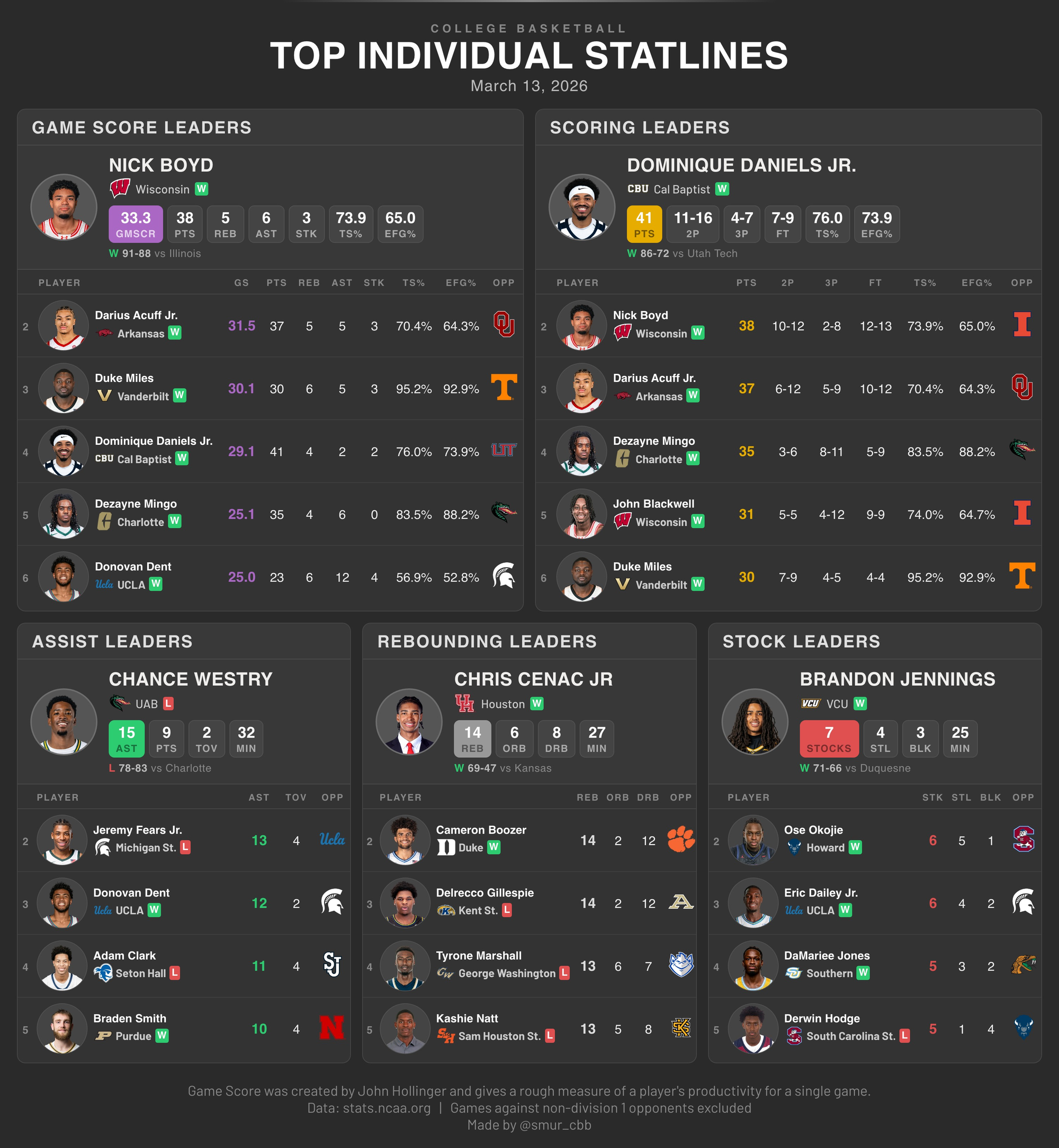
As usual, check out last night's top performances and today's Watchability Index.
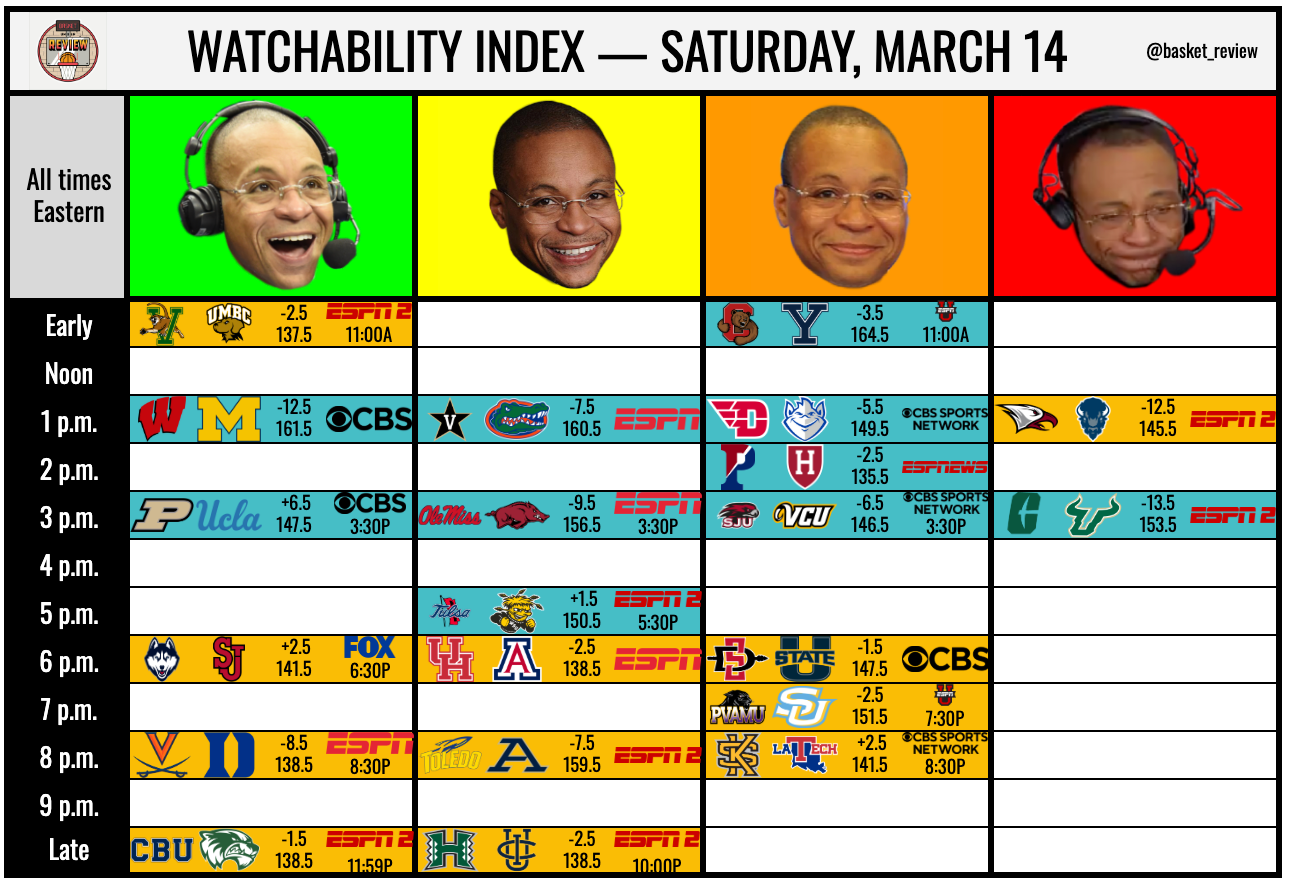
Saturday, March 14
Championships
America East final: #234 Vermont at #194 UMBC (-4), 11 AM ET, ESPN2.
Vermont’s dribble defense improved as the season progressed, thanks to a combination of Sean Blake’s improvements, TJ Long’s return from injury, and Lucas Mari finding his role.
Of course, that’s the single most important thing when talking about stopping the Retrievers, as the guard trio of Ace Valentine, Jah’likai King, and DJ Armstrong form the crux of Jim Ferry’s rim-attack-and-kick offense. If you can’t stop those guys off the bounce, you’re doomed.
John Becker has always run a fairly conservative base man-to-man defense, but the Cats have packed it in more than ever this year, attempting to hide Gus Yalden, who can be a cone out in space. They were able to stop UMBC from getting downhill in both meetings, but they baited them into a ton of dribble jumpers. The Retrievers missed them in the first meeting (6-for-26, 23%) and lost, while they made them in their second meeting (11-for-26, 42%) and won.
Tanchyn is a key matchup on this side of the court. His interior size has transformed UMBC’s defense, but it’s his ability to stretch the floor, shoot, and play off the bounce that keeps him on the court in Ferry’s offense. He can — and has — cooked Yalden out in space in pick-and-pop sets.
Look at these plays by Jose Roberto Tanchyn. The guy is 6-foot-10!! He's so good off the bounce for that size. I audibly gasped at that step-back 3 over Yalden to tie the game with 6 mins left. pic.twitter.com/KgqLd3rSNJ
— Tanner McGrath (@tannerstruth) February 3, 2026
On the other side of the rock, Vermont’s offense revolves around the TJ Hurley-Gus Bus two-man game. Hurley is one of the most talented shot-makers among the low-major ranks, while Yalden is an impossibly talented inside-out big man offensive talent. Becker’s perimeter actions are fairly simple, but the DHO, ball-screen, and flex actions between the two are electric.
UMBC did an excellent job defending those two in both regular-season meetings — as expected, given the Retrievers evolved into the league’s best ball-screen coverage unit behind added perimeter length, and Tanchyn’s ascension has lifted the interior defense. Down in Baltimore, UMBC rotated Valentine, Diggs, and Armstrong on Hurley, and the trio face-guarded him for 40 minutes while bringing extra help from the baseline on drives, forcing eight difficult looks (he made one). Up in Burlington, UMBC forced Yalden to catch the ball far away from the basket and then brought stunts and help from one guy away, which messed with his typical post-bucket-getting abilities and screwed up the spacing in Vermont’s four-out sets.
Ultimately, UMBC is a freight train behind JRT’s improved play, so Vermont’s margins are thin. That said, I expect a slow-paced game, given that these are two elite transition defenses, while Ferry has pumped the brakes on tempo this year. Theoretically, that helps Vermont more, which is more comfortable in a half-court rock fights. But, ultimately, I think we’re in for a low-scoring, high-variance coin flip. Fun!
Vermont’s path to winning involves three things:
First, the Cats must continue to play elite dribble defense. Unfortunately, that might not be enough, as if the guards step into those jumpers off the bounce and shoot 45%, you’re doomed. It doesn’t help that UMBC is undefeated at home in conference play after shooting 37% from 3. Becker is always toying with his defensive structure, but he typically returns to his base man-to-man, because that’s where they’re at their best. So, I would be surprised if Vermont gambles a bit more on the perimeter, so it might come down to how effective the Cats are on their close-outs in isolation.
Second, Gus has to catch the ball closer to the basket. He can take Tanchyn one-on-one, as long as he’s in the low post, keeping space in-between him and UMBC’s perimeter defenders. If the Retreivers want to gamble for help, that should make life easier on Hurley, Johnson, et cetera.
Finally, Vermont has found a very effective bench unit spearheaded by Frosh Momo Nkugwa and TJ Long. I suspect those two enter the game in a key second-half stretch, but they’ll be up against Caden Diggs, who parlayed his elite dribble defense and crafty middle-floor game into a Sixth Man of the Year award. Whoever wins that battle might win the war.
My best guess? UMBC holds serve at home behind a massive two-way game from Tanchyn. - Tanner McGrath (you can find more of Tanner's AmEast thoughts here)
MEAC final: #352 North Carolina Central vs. #204 Howard (-12), 1 PM ET, ESPN2.
What can North Carolina Central do to keep this MEAC title game from being a coronation for Howard's third title in four years? Howard surprisingly started MEAC play 0-2, but have since dropped just 1 league game and really ran roughshod over the conference, scoring 1.15 PPP in MEAC games and more impressively holding league foes to .90 PPP. NCC was one of two MEAC teams to top 1 PPP in a league game against the Bison, barely getting over the mark at 1.01 PPP in a game they were still blown out in at home.
Howard runs a souped up Princeton style offense, utilizing PNR at just a 1st percentile rate nationally and cuts at the highest rate in the country. Howard also owned the highest rim rate in the country. In the season series, Howard absolutely dominated the Eagles in transition and at the rim, scoring 52 and 98 points in that regard, respectively.
Howard runs a zone press at high rates, which led to the highest defensive turnover rate in the league
and NCC graded out in the 8th percentile in zone offense efficiency and 3rd percentile in press offense efficiency rating (both at some of the highest rates seen in the country given the nature of the MEAC as a whole, as they themselves run a zone press at an equal rate to Howard).
NCC is the best 3PT shooting team in the country, and they hit 10 triples in the game they were somewhat competitive in against the Bison, vs just 2 when they were blown out 100-67 in the second meeting. It will take a monumental shooting effort for the Eagles and Howard struggling in zone press offense for NCC to have any chance. But even in that scenario Howard can crush in shot volume. - Jordan Majewski
Mountain West final: #32 Utah State (-3) vs. #46 San Diego State, 6 PM ET, CBS.
This feels perfect and right for the 'true' final title game of the Mountain West. These have been the league's two best programs for some time now and were the two best teams in league play. Neither team played more than 40 yesterday but I do wonder about some universe of Utah State having a dual advantage in getting ~2.5 extra hours of rest and playing a much lower intensity game than the Aztecs. Still, we need bid thieves to save this garbage bubble from itself, so I'm openly rooting for San Diego State to get it done.
The good news for the Aztecs is that, outside of UNLV for inexplicable Josh Pastner reasons, no team in the MWC did a better job of stunting what Utah State wants to do offensively. Across this year's matchups, USU posted 1.01 PPP, turned it over on 21% of possessions, and shot just 51% from two (a pretty big deal when you shot 60% from two in league play). The length and motor of the SDSU defense clearly seems to give the Aggies real problems on that end of the court. I don't know that a 26% 3PT is repeatable in a third matchup, but teams are shooting all of 30% from deep in the MWC-T so far, so maybe so.
If USU wants to win they've simply gotta finish at the rim better, because across these two games they've rebounded very well against the Aztecs. The shot quality battle will obviously go USU's way, and Dutcher's crew has to find a way to dictate the pace of this game. If San Diego State's able to play in transition it's going to benefit them massively because USU can more or less 'dork' half the team in the half-court. This is a lot of words to say I'm excited and a little sad because I love this league. Go get a second bid on your proverbial way out. - Will Warren
Big 12 final: #3 Arizona (-3) vs. #5 Houston, 6 PM ET, ESPN.
Not sure it’s possible for Houston and Arizona to follow up the dramatics of the Arizona/Iowa State semifinal, which is the lead contender for game of the year. This is however a great game in its own right and a rematch of last year’s title game, taken by the Cougars. Arizona did exact some revenge in the regular season win AT Houston this year, a game they didn’t have Koa Peat available for. Despite not having Peat, Arizona still predictably won the rim with ease, out scoring the midrange pull up artists 32-13 at the tin. One would think winning at Houston probably became of some hot shooting on weakside catch and shoots against Houston’s overloaded defense, but Arizona hit just 3 triples and got 22 points from Anthony Dell’Orso, most of which came from attacking in isolation (who saw Dell’Orso out scoring Kingston Flemings in a 1v1 battle?).
Arizona also turned the ball over just 5 times, and with Koa Peat available, they have their best short roll creator/passer against the Houston ball screen hard hedges. Brayden Burries is clearly playing hurt, which is concerning (a virtually nothing stat line in just 19 minutes), and his shooting would certainly be beneficial against this defensive scheme.
Arizona’s Big Mo Drop was effective in Houston rim deterrence, but Houston’s offense often does that themselves, as they own the second lowest rim rate in the country. That’s just as well against Krivas, as you’re not going to score at the rim anyway, and you might as well hope Flemings goes bananas off the dribble in drop space. He had an inefficient 17 points, and that was more or less it for Houston’s offense. I think Houston would need another Chris Cenac multiple three night like he just had against Kansas, but that was an aberration (he went 0-5 from beyond the arc against Arizona). The Wildcats are the more complete team, and have proven they can beat Houston without some sort of crazed shooting night on catch and shoots out of the ball screen hedge and Monster in the post. - Jordan Majewski
Big East final: #20 St. John's vs. #9 UConn (-1), 6:30 PM ET, FOX.
There have only been 18 instances of a team shooting under 17% from 2-point range on at least 36 attempts going back to 2005. Prior to last month, 2019 Wagner was the last to suffer that feat, with 205 Appalachian State the last team before them.
And then St. John's did it in one of the most pitiful offensive displays of the entire season in a 72-40 loss at UConn on Feb. 25. 6-of-21 at the rim. 0-of-15 on non-rim twos. 5-of-20 from deep. The Red Storm's 24.1% effective field goal percentage was the sixth-worst of the entire year, and second-worst in a non-buy game. (Hilariously, the Big East is responsible for the worst non-buy game performance with Georgetown against DePaul).
How could St. John's possibly recover from that performance? Well, if it has selective memory, it could just recall the impressive 81-72 home win it gave UConn just three weeks earlier. Remarkably, the first matchup was UConn's second-worst 2-point percentage defense game, and the second matchup was its best all year. This doesn't make sense.
The reality is St. John's has had issues scoring inside the arc all year. The team is just 288th in layup percentage at 52%, and they shoot just 35% on dribble jumpers inside the arc on 180 attempts, which is far too many to begin with. That's a perfect storm to struggle against a UConn team that forces you to put the ball on the floor and finish over great rim protection.
The reason that didn't work in the first game was St. John's got nearly double the transition possessions than in the second matchup, thanks to the 15 turnovers UConn coughed up. The Huskies also fouled way too much, and the 19-free throw discrepancy in game one was just six in game two.
Inevitably, if UConn can handle St. John's pressure in a bipartisan crowd at Madison Square Garden after failing to do so the first time out, the Huskies will force a super slow, halfcourt game that the Red Storm have proven they have no business winning. It will take St. John's winning all the extras to get this game out of that playstyle. But we've already seen them do it once, even if it's clouded by whatever 17% from inside the arc was. - Matthew Winick
SWAC final: #291 Prairie View A&M vs. #275 Southern (-1), 7:30 PM ET, ESPNU.
My beautiful, sloppy SWAC, back for one more ride this year buried amongst a ton of games most people will want to watch more. Southern has the efficiency edge but the two PVAMU battles this year were extremely chaotic and fun, with each team winning on the other's home court (PVAMU 89-85, Southern 87-82). These are two terrible defenses that foul profusely and attack relentlessly on the perimeter, so get ready for a long one.
I lean Southern solely because their path home makes more sense to me. Across the two games this year the Jags posted an OREB% advantage of +16.9%, got more free throws than PVAMU, and were way more downhill than the Panthers. Southern got 50% of all shots at the rim, while PVAMU got just 35% and took over a third of their shots from midrange. The key player for me is Southern center Terrance Dixon, whose 6'8" frame undersells his brute force. In the win over PVAMU: 24 points, 11 boards, just three fouls. In the loss to PVAMU: 4 points, 2 boards, three fouls, played off the court. If you get the first version, Southern is your SWAC rep this year. - Will Warren
MAC final: #133 Toledo vs. #64 Akron (-8), 8 PM ET, ESPN2.
There have been thousands and thousands of college basketball games this season. But only 13 have seen a team that made at least 55% of their threes on a 35%+ rate lose by double digits. One of those was the only regular season meeting between Toledo and Akron, when the Rockets went nuclear from deep and still lost 91-81.
One of the shortest teams in the country, Akron will do everything to keep the ball in front of them due to a lack of rim protection. That means allowing a ton of threes. Toledo is 29th nationally in hitting those attempts, but much prefer to use their elite on-ball guards in the middle of the floor on floaters and pull-ups. They are 1-3 when more than 42% of their shots are threes.
A result of Akron's defense and Toledo's marksmanship is shooting 55% like the Rockets did in round one. The most important part of that is how little it mattered in the final result.
That's because Akron is an utterly elite shotmaking team. And Toledo starting 6-1, 6-1, and 6-3 in the backcourt will just not provide much resistance for the scintillating on-ball options of the Zips. But the real game-changer in this matchup was the Mahaffey brothers, Evan (formerly of Penn State and Ohio State), and Eric. The two combined for 17 rebounds in the contest, and Toledo had 25 as a team.
All in all, because of Toledo's issues on the boards and lack of perimeter length, they it didn't take Akron out of anything it wanted to do. Akron's 1.3 points per possession would be the best of the year for many teams, but hilariously was just the 11th-best effort the Zips have had this season. Truly one of the most proficient offenses anywhere in America.
There are ways to beat Akron. Be big, physical, 3-point snipers on volume, or have a post-up weapon. Toledo has none of those things. Their skill-based, on-ball approach is slightly different, but in many ways an inferior version of what Akron brings.
In a game with so much perimeter talent, a wild gap in shotmaking favoring Toledo could help the Rockets pull off the upset. But we've already seen that happen in this matchup, and the result was still an easy Akron win. There's no reason to expect much else in this one. - Matthew Winick
ACC final: #13 Virginia vs. #1 Duke (-8), 8:30 PM ET, ESPN.
I call these 'wealth exhibitions' because they generally do not matter, no matter how much nostalgia or enjoyment you may have for the ACC. Duke doesn't need this beyond liking to have another trophy in an overstuffed trophy case. Virginia would obviously really love to beat Duke, but they seeded the top three lines on Thursday. Unless you had Virginia ahead of any of Nebraska, Gonzaga, or Purdue on Thursday, they're gonna be a 4 seed win or lose.
Looking back at the first blowout by Duke, the actual shots from each team doesn't make it feel like a true blowout. SQ graded it Duke 73-70, and Duke was surprisingly battled to a functional draw on the boards and on turnovers. While I don't think Duke is shooting 50% from 3 again, I also don't think UVA can win this game straight-up if they take 64% of their shots from deep again. It's a great way to introduce variance, but the Cavs barely threatened the rim at all the first time around, and as such, neither team really attempted many free throws at all. If UVA's going to win this game it has to be Thjis De Ridder's single best game of the season, and even with a shorthanded Duke, I'm betting against it. - Will Warren
CUSA final: #169 Kennesaw State (-2) vs. #196 Louisiana Tech, 8:30 PM ET, CBSSN.
The once annually multi-bid CUSA has likely been reduced to the 16 seed line with Liberty being knocked out early in Huntsville, and the title game featuring the 5th and 6th place finishers Louisiana Tech and Kennesaw State. AJ Bates has carried LA Tech here, scoring 56 points through 2 games on mega high usage and mega high efficiency. Bates took 19 (!) ball screens against Missouri State in the semis, but was held to just 22 points total vs Kennesaw State in the regular season (a series split), on literally about half the usage he’s posted in this tournament.
First meeting between these two in Ruston was an efficiency fest, with LA Tech coming back at home from a double digit 2H deficit. That game was more or less an even statistical matchup, but the Dawgs got 28 points from a now defunct Scooter Williams, but also didn’t have Kaden Cooper, who was doghoused for defensive and rebounding carelessness reportedly. Second meeting was basically the opposite in every regard, with both teams scoring at just .8 PPP, but KSU pulled out the win thanks to a few more made triples.
LA Tech offensively is heavily reliant on the Bates ball screen and midrange pullups/off the dribble jumpers, and they can’t shoot a lick from the perimeter, but supplement heavily on the offensive glass, where they led CUSA in OREB% (think Houston’s offense at their worst, as Talvin Hester was on Kelvin Sampson’s first staff at Houston for a few seasons). Defensively the Bulldogs were the best unit in CUSA in terms of efficiency rating, and actually led the country in lowest “high quality shot” rate allowed, per Synergy shot quality data. That’s built on a 5th percentile rim rate allowed with a 97th percentile efficiency rating (top 6 block rate nationally thanks to Melian Martinez minutes, who recorded 8 blocks against KSU this season), and while they allowed the highest 3PTA rate in the league, Synergy shows a 96th percentile catch and shoot rate allowed. In Hester’s no middle scheme, the Bulldogs have been aggressive in ball screen denial, and have allowed just 4 points scored via ball screen in this tournament. KSU actually isn’t a particularly ball screen/PNR heavy offense (19th percentile rate), preferring to drive/kick/cut “rim and 3” heavy offense (97th percentile catch and shoot rate with a 79th percentile rim rate, per Synergy data). KSU actually generated the highest “high quality shot” rate allowed by LA Tech’s defense this season (in the loss at Ruston) and their highest catch and shoot rate of the season (in the win at KSU, but went just 7-30 from 3).
Defensively KSU doesn’t have as strong of an overall profile as LT, but they’re extremely long and athletic 1-5, with their own elite rim protection in Braedan Lue’s drop (12 “stocks” in the series vs LA Tech), which really bothered Bates’ shot making in both games.
In a game with two strong rim defenses and rangy athletes across the board, I’m more inclined toward KSU’s ability to at least hit a few more jump shots, which is how the second meeting at Kennesaw played out. - Jordan Majewski
Big West final: #104 UC Irvine (-1) vs. #110 Hawaii, 10 PM ET, ESPN2.
If you love defense and you love Real Hoop™, you should be locked in on this like a cat on a bird. Excluding Gonzaga from true mid-majordom as you should, these are two of the 10 best defenses out there that play in very different ways. Both teams want to eliminate high-value shots at all costs, but UCI sinks in to contain and is completely okay with allowing catch-and-shoot threes to the right guys while Hawaii never, ever switches unless ordained by God.
Both of this year's games between the two were fantastic, with Hawaii defeating UCI at home on a buzzer-beater:
MIDNIGHT MADNESS!! Hunter Erickson sinks the BUZZER BEATER fadeaway jumper. Hawai’i wins 67-66 over UC Irvine pic.twitter.com/YFGOy2nQLH
— NCAA Buzzer Beaters & Game Winners (@NCAABuzzerBters) January 11, 2026
And UC Irvine returning the favor at home three weeks later in a fabulous overtime win. That second game is super educational, because it featured the most bizarre shooting splits of the year for a team that nearly won. Hawaii shot 27% from two, 41% from 3, and 89% from the line while getting demolished in the shot volume department and having half their frontcourt in foul trouble. How'd they survive? Well, UCI's offense shot 18% from 3 and 65% from the line. Sadly, neither of those are all that unusual.
Considering these two are functionally the same team with the same problems, I guess I lean towards the slightly better version of the two teams in Irvine, who turns it over less and should be able to more or less draw even on the boards, if not outright win them. I also feel like who gets the better whistle matters here a lot. When Hawaii is allowed to get away with a lot of perimeter contact they're generally going to fare better, especially against a UCI offense that can devolve into "please save us Jurian Dixon" way too often. Hawaii also has the better best player in Isaac Johnson, however, and if UCI could magically get back Bent Leuchten for this game I'd feel better about my pick. - Will Warren
WAC final: #89 Utah Valley (-2) vs. #108 Cal Baptist, 11:59 PM ET, ESPN2.
Sir, a second fantastic Western title game has hit the timeline.
This is the extremely rare fourth matchup between two teams in a postseason title game, as the WAC was forced to play a triple round-robin due to Grand Canyon's early departure. The surface read of the three UVU/CalBap games is pretty easy: the home team won all three. But some of the hidden values in these games favor UVU, and it feels like a possible Bad Matchup for the Baptists of California. (I'm not looking up how religious they are or aren't. Do Baptists do fish fries? This is important.)
I say this because of three key items from the three regular season games.
- UVU won the turnover battle all three times to the tune of +12.4 per 100 possessions.
- UVU went 2-1 despite shooting 21% from deep across the three games (35% in all others).
- Cal Baptist's normally gigantic edge on the boards against the average opponent was more or less neutralized. UVU lost the rebounding battle 32%-27%, but considering CalBap won this by +10.5% in their other games, I don't love it.
It adds up to a matchup that UVU simply seems well-equipped for. The Valley did a great job of making CalBap finish at the rim 1-on-1, and the Lancers shot just 48% at the rim across three battles with the Wolverines. Whoever wins here is a first-time Tournament team, which rules, so I'm more excited to watch than anything else. Lean Utah Valley unless the Wolverines manage to shoot 21% from deep again. - Will Warren
Semifinals
Ivy League semifinal #1: #81 Yale (-4) at #158 Cornell, 11 AM ET, ESPNU.
Boy, who couldn't love a true road game for a 1-seed in the semifinals? The Southland thought it was innovative by making 1-seed Stephen F. Austin play at McNeese in their title game. No sir! Try that in the semifinals, baby. Only the best and brightest in the Ivy League, of course.
For the moment, I will put aside my pure hatred of the existence of the Ivy Tournament and simply preview the game. This isn't a great matchup for either defense, which was pretty obvious on the Yale side (1.28 PPP across the two matchups) in the pair of regular season battles. Cornell generally plays a more aggressive style defensively to try and force turnovers, but all this did against the third-best 3PT% team in America and 24th-best eFG% team was lead to a ton of open threes and backdoor cuts. I'm not sure how you erase that, even at home.
Good news for Cornell is they are at home, but for reasons best left to God and/or statistics they were unbelievably bad in home games this year minus the Yale win. Torvik has them as the 251st-best home team in college basketball this year and 121st away from home, almost entirely because they don't get rebounds or get to the line. (The Ivy is also the rare conference where home teams do not get home-court advantage; away teams actually average about half a free throw attempt more.)
All that being said, this is a very leaky Yale defense, and much like Cornell, Yale went overboard in walling off the paint this year to force Cornell into taking nearly 64% of all shots from deep across the pair of matchups. This works great if you're actually guarding the threes, and Synergy did grade nearly 76% of Cornell threes as guarded...but again, home game, shooting variance at an all-time high, who knows. Worth noting Yale also had an unusual reverse split between road and home, but not as severe and almost entirely because they shot 42% from deep away from home this year. Not sure how real that is. Lean Yale for a more sustainable path to points and a major frontcourt advantage, but it's the Ivy Tournament, nothing surprises me. - Will Warren
Big Ten semifinal #1: #2 Michigan (-11) vs. #24 Wisconsin, 1 PM ET, CBS.
Fairly certain Dusty May will remember his former FAU guard Nick Boyd is left handed and is lethal going left, because it certainly appeared for stretches that Illinois forgot. Wisconsin was looking pretty lifeless midway through the 2H, trailing by 15 with 11 minutes left. From there Boyd and Blackwell basically just started dropping nukes, with the Illini completely unable to keep Boyd in particular out of the paint. Illinois switched, they dropped, they zoned, they even hedged a few possessions (and got roasted), and absolutely nothing worked because they kept letting him get to his left. Wisconsin even shot just 10-41 from 3, marking the first time in B1G play that they won a game shooting sub 33% from beyond the arc, and it was because Illinois could not defend their ball screens, scoring 27 points on 1.23 PPP in that regard alone, and drawing a ton of (often questionable) whistles, outshooting the Illini by double at the stripe.
Michigan meanwhile had moments of dominance against rival Ohio State, and other moments of offensive struggles when bogged down in the halfcourt. The Wolverines did score 21 transition points, and doubled up the Bucks at the rim (predictably), but shot just 5-17 from 3 and were kept off the offensive glass effectively all game.
Of course now we’re set up for a much anticipated rematch, with the Badgers being the only B1G team to defeat Michigan, and it was on the strength of an incredible 3PT shooting spectacle in Ann Arbor. Wisconsin shot 15-33 from 3, and was the first/only offense to exploit Michigan’s switch and draw out Mara. Nolan Winter was a large part of that floor stretching, but so was Aussie Rapp and Aleksas Bieliauskas will have to pick up his shooting slack (the latter had a career game in Ann Arbor of course). Michigan will most likely cross match Yaxel Lendenborg’s size against Boyd and/or Blackwell, with Burnett also in the mix in those matchups- basically whatever it takes to avoid Elliot Cadeau on either.
Wisconsin “only” lost the rim battle by 11 in the first meeting, but the obvious concern is that without Winter (by far their best rim presence defensively), that number gets blown up. Wisconsin also needed a nearly historic shooting night to win that game at Michigan, and anything close to what they shot against Illinois yesterday is a certain death sentence. That said, Boyd/Blackwell were the best guards on the floor yesterday, severely outplaying Wagler and especially Boswell, and the same is true today against the Wolverines. I think they’re capable of controlling the game enough to keep the Badgers very competitive, but ultimately Wisconsin doesn’t hit the triple at the same elite level it took to actually beat Michigan, like they did in Ann Arbor. - Jordan Majewski
SEC semifinal #1: #4 Florida (-6) vs. #12 Vanderbilt, 1 PM ET, ESPN.
Actually a really fun SEC semifinal. At this point these games for P5s are largely wealth exhibitions, as Florida is only in danger of falling off the 1 line via a highly specific set of circumstances and Vanderbilt is probably firmly locked into their spot, whether it's a 4 or 5 seed (I lean former, but who knows). Take this for what it is, which is a semifinal game that has little meaning but was outstanding when initially played in January.
I treat ShotQuality's numbers with trepidation but I do believe it's telling that the initial Florida/VU battle was graded as a four-point Vanderbilt win, which is one of just three SQ losses the Gators took in league play. (Oddly enough, the others were a pair of large wins over Texas and Georgia.) Florida did own Vanderbilt on the boards, which isn't hard to do, but the 'Dores had next-to-no turnovers and went bucket-for-bucket with the Gators for two-plus hours in what might grade out as the 'worst' Florida defensive outing of the year.
I kinda think Vanderbilt could do it again here. Florida's going to have a massive physicality and frontcourt edge, but the backcourt of Duke Miles and Tyler Tanner ripped the Gators up over and over through a bevy of P&Rs. Vanderbilt dumped 1.31 PPP on their P&R sets in that initial game, and while doing that twice to Florida is much easier said than done, it's still a Gators team that seems susceptible to exceptional ball-handlers and rollers. Every team has good and bad matchups, and it's plausible to me that Vandy could be that for Florida. - Will Warren
Atlantic 10 semifinal #1: #40 Saint Louis (-6) vs. #80 Dayton, 1 PM ET, CBSSN.
Good luck finding a matchup anywhere in the country this season with a wider gap in result. Saint Louis absolutely pummeled Dayton at home to end the month of January, with a 102-71 win. The Flyers returned the favor on their home court just three weeks later with an easy 77-62 victory. Nothing like a 46-point margin between two games!
In a way, the first Saint Louis game was an intervention for the Flyers. Dayton is 8-2 since that loss, with both defeats coming against fellow semifinalist VCU. They've also allowed under 1.1 points per possession in all eight of their wins, and under 1 point per possession in five of them. The defense has climbed 19 spots in KenPom since that blowout loss.
Beyond that, Dayton completely changed its defensive approach with Saint Louis. You'd figure as much when you allow 40 fewer points to an opponent! In game one, Saint Louis had a 50% 3-point rate and a 66% assist rate. In game two, that changed dramatically to a 38% 3-point rate and 45% assist rate. 3-point specialists Trey Green and Ishan Sharma combined for 18 3-point attempts in game one and six in game two. Slashers and downhill drivers Dion Brown and Kellen Thames combined for 13 shots in game one and 26 in game two.
Essentially, Dayton used its elite length and athleticism at the guard and wing spots to deny absolutely every off-ball action, and just force Saint Louis to win in isolation, while leaving whatever non-shooter was on the floor wide open. It was an excellent scout, and one that Saint Louis couldn't overcome.
Dayton also dominated the free throw line 28-16 in that matchup, which is the biggest flaw of this Saint Louis squad on that end. And for their own efforts, the Flyers are sixth nationally in free throw rate.
Inevitably, the question will be can Dayton nail this game plan again on a short rest and away from its home gym? Or will Saint Louis' season-long execution on both ends of the floor overcome the over help with capable athletes at all positions. One could argue Dayton has actually been the better team over the last month or so. I think this has all the makings of an awesome game that comes down to the wire. - Matthew Winick
Ivy League semifinal #2: #162 Penn vs. #151 Harvard (-1), 2 PM ET, ESPN News.
Penn and Harvard played a pair of virtually identical coin flips in series split. Harvard successfully switched on Fran's off ball screening actions (99th percentile rate), and graded out in the 87th percentile in off-ball defensive efficiency rating. Penn suffered a tremendous blow however since the end of Ivy regular season play, with star wing Ethan Roberts suffering a relapse in terms of concussion symptoms suffered from a nasty fall earlier in the season. Roberts scored 48 points in the regular season series, and owned the highest on/off offensive rating on the team per EvanMiya adjusted on/off efficiency data. Brutal break for the Quakers. - Jordan Majewski
AAC semifinal #1: #181 Charlotte vs. #52 South Florida (-11), 3 PM ET, ESPN2.
Pretty unexpected semifinal here, as Charlotte needed to pull off a mild upset of UAB in yet another UAB 'home' loss. The question of rest versus rust will be at play here, and I would be remiss to not cover that the team with the rest disadvantage in conference tournaments this March is 54% ATS.
Charlotte and USF only tangled once this year and it was last Sunday, where USF shredded the 49ers with no remorse for two straight hours. I'd argue it's never a good sign when your opponents' average 2PA distance is three feet (!) and that you allowed 1.26 PPP despite said opponent shooting just 47% from two. The key to stopping this style of offense is shrinking the gaps while not having to send two to the ball on drivers. Charlotte has openly bad rim protection and doesn't force turnovers, which makes this a nightmare matchup unless this is one of the nights where USF shoots 23% from deep. And even then, if they do, can Charlotte rebound well enough to keep USF from simply putting the misses back in? I've got serious doubts. - Will Warren
Big Ten semifinal #2: #8 Purdue (-5) vs. #27 UCLA, 3:30 PM ET, CBS.
Donovan Dent is arguably playing the best pure PG in the country right now, and he completely dominated Michigan State’s ball screen defense last night. The Bruins either scored directly off the ball screen (23 points for Dent on 1.64 PPP via ball screen) or he kicked out to wide open catch and shoot targets (season high catch and shoot total and highest unguarded rate of the entire season for the Bruins).
Unfortunately the biggest development for UCLA in the quarters was Tyler Bilodeau’s knee injury. Fortunately it looks like he avoided the worst case scenario, but Mick Cronin has already stated there’s almost no way he can play today. Bilodeau’s absence takes away Dent’s primary pick and pop target, which is what he slayed the Boilers with at Pauley back on Jan 20, torching Oscar Cluff’s hedge.
That game was really when Dent had his UCLA awakening, as he and the Bruins had been mostly scuffling until that moment, but he went for 23 and 13 and hasn’t looked back since.
Purdue had the easiest night of any of the Final 4 participants, as they basically replayed the first meeting with Nebraska. The Boilers didn’t shoot it particularly well from 3 again vs Nebraska’s over shifted defense, but still dominated the offensive glass and rim and just generally overwhelmed the Huskers with their size.
Braden Smith actually had his second least efficient game of the season against UCLA’s hedge, tallying just 4 assists (tied for his season low) and 4 turnovers, but Purdue stayed in the game/could have very easily won if not for that Bilodeau shot by winning the rim and offensive glass against UCLA’s very lackluster rim protection.
Defensively Purdue was switching against Dent with horrific results, but obviously hedging with Cluff was giving up the Bilodeau pick and pops (including the game winner). With his absence, does Purdue go back to the hedge? I think they almost have to because they don’t have anyone to stay in front of Dent without overhelping and exposing themselves to the kickouts like Sparty did (and worth noting Skyy Clark wasn’t available in that first meeting). Dent’s ability to get paint at will against this Boiler defense keeps the Bruins in the game, but the loss of Bilodeau’s pop threat and UCLA’s porous frontcourt allows the Boilers to advance to the title game. - Jordan Majewski
SEC semifinal #2: #69 Ole Miss vs. #16 Arkansas (-10), 3:30 PM ET, ESPN.
Just like we all expected, the second SEC semifinal will be between Arkansas and... Ole Miss? Does that say Ole Miss? 4-14 in the SEC regular season, losers of 12 of their last 13 games prior to the conference tournament Ole Miss?
I wish I could pinpoint one thing Ole Miss is doing differently in the three straight victories against Texas, Georgia, and Alabama, two surefire, and a third potential NCAA Tournament team. Something that they have done since losing at home to South Carolina to end the regular season. I don't have a good answer for you.
In Ole Miss' wins against Georgia and Alabama, the team has a combined 32 points in the mid-range and 29 points at the rim. It doesn't take an analytics nerd to tell you that's bad. And yet the Rebels just took down one of the most curated shot profile offenses in the country in Alabama, who took 22 more rim/three attempts than Ole Miss in the contest. Maybe the mid-range is back?
If the mid-range is back, then the greatest beneficiary should be Arkansas' Darius Acuff, who is just on another planet right now. He is fresh off of dropping 37 points on 21 shots against Oklahoma, but Ole Miss is going to send way more bodies his way and force ball movement. In this first matchup, Acuff scored 26 points, but his nine assists to three turnovers is what sealed the deal for the Razorbacks road win.
If you couldn't tell by my tone throughout this section, I do not think Ole Miss will win this game. But quite frankly, I haven't thought Ole Miss would win any of its SEC Tournament games, and yet here we are. At minimum, when you're watching this game, I hope you can take solace in knowing that the mid-range is in fact not dead quite yet. - Matthew Winick
Atlantic 10 semifinal #2: #47 VCU (-8) vs. #115 Saint Joseph's, 3:30 PM ET, CBSSN.
Not sure how much to take from the lone regular season matchup between these two, which VCU won 79-72 at home. Saint Joe's immediately changed their starting lineup after that game and has proceeded to win 11 of 13 since, but in that game the Hawks shot 44% from 3 and survived despite turning it over on a quarter of possessions and getting out-rebounded. VCU played Saint Joe's straight-up and never sent a helper to any driver, which led to a shocking number of rim attempts for the Hawks but some super-low rim efficiency (51%) on high volume.
In general I don't love the matchup for the Hawks. VCU has torn up drop coverage for essentially the whole season, and if/when VCU decides to feed Lazar Djokovic in the post he's been efficient enough to handle 1-on-1s while also being an excellent passer out of the post when doubled. The flipside here is a Saint Joe's offense that badly struggles to score in half-court and needs a lot of runouts off turnovers or long misses to score efficiently. The Joe's defense is more than good enough to force VCU into a frustrating day but athletically it feels like the Rams have the upper hand here. For the Hawks' sake it would've been much better had they drawn Duquesne, who SJU beat earlier this year and would've shut down much easier in half-court. - Will Warren
AAC semifinal #2: #55 Tulsa (-3) vs. #88 Wichita State, 5:30 PM ET, ESPN2.
Tulsa survived a 3OT quarterfinal win (I'm tempted to put win in quotation marks given the way that game played out) over North Texas to get to the semis against ladder rested Wichita State. Tulsa PG Tylen Riley brutalized Wichita State's drop coverage, scoring an efficient 51 in the series split.
Paul Mills, wary of Tulsa's elite perimeter shooting, played aggressively on the 3 point line in Tulsa, but were destroyed by back cuts and Riley's dribble penetration. In the second meeting he dropped Will Berg deeper, which opened up the ball screen creation.
Tulsa actually had a reasonable chance at the sweep until Kenyon Giles decided it was his turn to go nuts against Tulsa's drop, scoring 31 and virtually every big bucket down the stretch (eventually eliciting zone from Tulsa, which was ineffective) to lead the Shockers to a comeback win and overcome a 30-6 three point scoring deficit.
This series between rivals was definitely dictated by coaching adjustments game by game, so Mills and the Shockers having a massive rest/prep advantage is even more pronounced. - Jordan Majewski
Sunday, March 15
Hello! Just like last week, these games don't have teams assigned to them just yet. Instead of previewing various hypothetical matchups, check back here on Sunday morning for full previews of all five games.
Championships
Ivy League final: 12 PM ET, ESPN2.
- Jordan Majewski to preview.
Atlantic 10 final: 1 PM ET, CBS.
- Will Warren to preview.
SEC final: 1 PM ET, ESPN.
- Will Warren to preview.
AAC final: 3:15 PM ET, ESPN.
- Will Warren to preview.
Big Ten final: 3:30 PM ET, CBS.
- Jordan Majewski to preview.