

Welcome to the first edition of the NCAA Tournament Watchlist! Similar to our weekend watchlists, one of our staff writers will give you a breakdown of each game that day.
First, here's the day's schedule. Pro tip: save it to your phone and make it your background image for easy referencing.
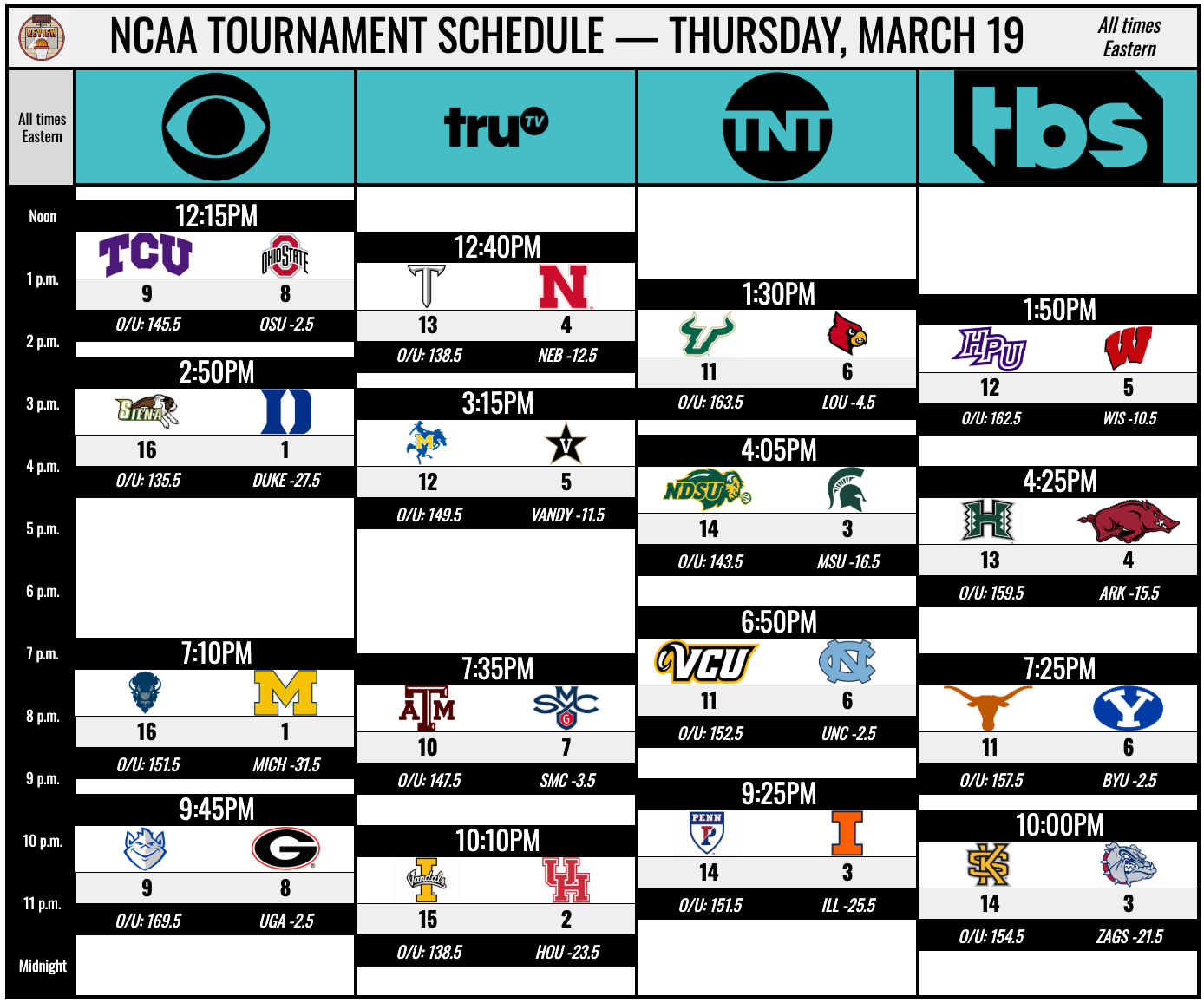
(8) Ohio State (-2.5) vs. (9) TCU, 12:15 PM ET, CBS.
Bruce Thornton carried the previously bubbly Buckeyes all the way to home jerseys this week, but faces a tough matchup against TCU's aggressive ball screen defense that will switch (95th percentile isolation rate forced) and hedge/trap at high rates (98th percentile rate, per Synergy data).
Jake Diebler, while often not regarded as a coaching luminary, actually schemed effectively down the stretch against defenses that wanted to hedge out on Thornton, particularly Iowa in the B1G tournament, who had just shut him down two weeks prior. Thornton was elite in ball screens (98th percentile scoring efficiency) and off the dribble (87th percentile), but TCU's high hedge essentially eliminates both. The difference in Thornton's game this season? He's been used off the ball at a 72nd percentile rate with a 92nd percentile scoring efficiency, as opposed to 16th percentile rate and a 12th percentile efficiency rating last season (per Synergy data).
TCU offensively isn't particularly skilled, and can really struggle when denied rim and transition. OSU isn't a going to protect the rim at anything resembling a high level, and both David Punch and Xavier Edmonds like to work in clear out/booty ball situations, working their way to the rim. This is where the TCU offense has to make hay, as OSU graded out as a 5th percentile defense in post efficiency and 9th percentile in isolation (although Bynum graded out as an "excellent" iso defender per Synergy, allowing just .53 PPP in that regard, and he'll be defending Punch- key matchup).
OSU is elite in transition denial (6th percentile allowed) however.
Ohio State has been a top 5 team overall in March, and the third most efficient offense in the country per Torvik filtering, and Diebler has proven he can work Thornton around off the ball and Juni Mobley can bury the catch and shoots on the weakside advantage the high hedge allows for, although the Frogs have the athleticism to effectively avoid the mismatches OSU likes to create with Royal and Bynum against bigger but less athletic frontcourts. Additionally, the Frogs can really supplement on the offensive glass and free throw line in this matchup. However, if this becomes a free throw shooting contest (and a lot of TCU games do), OSU has a significant FT% advantage.
In 13 games vs top 50 teams, TCU has been a top 15 defense overall from an efficiency standpoint and generated a top 20 defensive turnover rate in those games (per Torvik)- but they're the 74th rated offense in that sample. Ohio State meanwhile has been a top 25 offense in 17 games vs top 50 competition, but 80th defensively. Strength vs strength essentially, and who can limit what. Outstanding game to kick off the first round action. - Jordan Majewski
(4) Nebraska (-13.5) vs. (13) Troy, 12:40 PM ET, TruTV.
Nebraska's extreme no middle where they hedge out the ball screen and front/double the post effectively works as a zone, which Troy is very familiar with in the extreme zone usage of the Sun Belt. The Huskers allow the lowest rim rate in the country, and the 4th highest 3PTA rate. Troy is a true rim and 3 offense, but they're only going to have the 3 available in this one, just like against South Alabama's zone in SBC play, as their best offensive asset is big bodied wing Victor Valdes rambling to the rim in ball screens
but you simply can't run ball screens at volumes against this Husker defense (7th percentile rate allowed with a 99th percentile efficiency rating). While Troy shoots the 3 at a top 50 rate, they made just 33% and were a 16th percentile catch and shoot offense in terms of efficiency rating, on an 87th percentile rate, typically via a heavy drive and kick offense with an onslaught of ghost screens. Troy does have some recourse if the triples aren't falling at a high rate, as they're a strong offensive rebounding team (a staple under Scott Cross) and they're mobile and athletic in the frontcourt, capable of defending Mast when Hoiberg goes 5 out hub (Bellamy replacing the injured Seng hasn't missed a beat in this regard, but Seng is slated to return to the lineup, giving Troy valuable frontcourt versatility). The Huskers crisscross the lane with a litany of screening and cutting action with Mast at the top of the key
but the Trojans graded out in nearly the 90th percentile in efficiency rating defending against cuts and off ball screening, as they're generally in drop coverage but will extend out a variety of zone looks frequently (92nd percentile zone rate, 89th percentile press rate).
Over the past month, Troy has shot 28% from 3 and opponents have hit 23% (the second lowest mark in the country in that time frame). Nebraska meanwhile has the country's 5th best defense in that same month long stretch because opponents have hit just 28% from 3 on a top 20 rate allowed- this variance is likely where Troy upset potential lives and dies. But there is a reasonable case to be made for Troy keeping this close with their defense off the ball and offensive rebounding (and for a 4 vs 13, the athleticism deficit is basically nil for the Trojans) even if they shoot around 30% from 3 on massive volume like they did against USA in both games (42 attempts each game, averaged 11.5 makes), but they likely can't actually win without at least 35-40% 3PT shooting, because they'll get little at the rim outside of some putbacks. - Jordan Majewski
(6) Louisville (-5.5) vs. (11) South Florida, 1:30 PM ET, TNT
Two up-tempo teams meet in Buffalo in one of the earlier tips on Thursday. From a situational perspective, that probably favors Louisville, as USF just played on Sunday, locking up its bid just before the NCAA selection show, while Louisville has been off for a week.
That rest time could be crucial for Mikel Brown Jr.’s ailing back, which has kept him out of 12 games this season and is a serious concern entering the NCAA Tournament. Brown is vital for the Louisville offense, a clear alpha playmaker that allows Ryan Conwell and Isaac McKneely to hunt shots around the perimeter. Brown is also a high-volume assassin himself, displaying limitless range and a quick release, though he did go through some streaky stretches this year.
Against top 100 opponents and excluding garbage time, the Cardinals were an extremely similar team with or without Brown, per Hoop Explorer (within 0.5 in net rating on or off). Perhaps his absence is being overblown? But the eye test and logic would indicate Louisville needs its NBA lottery pick to be its best self.
If Brown does play, South Florida has multiple options to throw at him. CJ Brown and Wes Enis will each get cracks at the star freshman, and Bryan Hodgson can also send the bigger Josh Omojafo at him for stretches as a burlier, longer curveball.
Hodgson was in the news Tuesday night for turning down the Syracuse job. Considering he is from upstate New York, that does not speak highly of the Orange’s current resources, but that’s neither here nor there for this matchup.
Hodgson’s Bulls are one of the few mid-majors that is plenty content to run with P5 foes, and they can match and exceed the Cardinals’ athleticism in the paint while also mirroring the Cards’ four-out looks. Izaiyah Nelson is a dunking machine at center, but he is more than that, as he earned both the American’s Player of the Year and the Defensive Player of the Year awards. Sananda Fru has acquitted himself well as a rim presence and finisher, but he will have his hands full against Nelson. And if Louisville goes with Aly Khalifa, the athleticism contrast will be jarring.
Louisville has been a different team against quality competition (363rd nationally in Haslametrics’ Paper Tiger Factor) and away from home (357th in AFH ranking, also per Haslam). The Bulls have similarly struggled away from home (309th), but they are surging lately (26th in Momentum).
South Florida’s results against P5 teams are decent: 103-95 loss at Oklahoma State (82 possessions), 104-93 loss at Alabama (79 possessions). They’ve been an even better team in the second half of the season, though, in part because they have ridden a consistent lineup. Hodgson used seven different starting groups in the first 13 games; the same five players have started all 20 games since.
This one should be a track meet. Louisville results can be high variance given their insistence on bombing 3s, but I am not altogether convinced the Cardinals have a talent edge if Brown is limited or out. USF can bomb away, too, as Enis and Joseph Pinion have each hit over 100 triples this year. - Jim Root
(5) Wisconsin (-10.5) vs. (12) High Point, 1:50 PM ET, TBS.
God help me, I'm Falling For It with a Big South team. If you're unaware, the league last won a game in 2007 with 11-seed Winthrop defeating 6-seed Notre Dame. Now, I would argue almost all of this is due to all but one Big South representative since 2007 being a 13 seed or worse, and per Torvik's odds, the Big South's odds of actually losing all these games were just 31%. They're due. Plus, while I had remembered High Point losing by a lot (12 points) last year, it really wasn't that bad. The Panthers actually held Purdue to 50% from 2 and trailed by just three points with seven minutes to play.
This is also not the greatest or most stable Wisconsin team in history. Quoting Jordan Brenner at The Athletic:
Wisconsin is a good team, but its style isn’t in line with how a safe giant operates. The Badgers take 52.6 percent of their shots from 3-point range, which is a great strategy when battling the likes of Michigan, Illinois, Purdue and Michigan State (all of whom Bucky knocked off), but less so against an inferior foe, because it introduces more variance. Sure, if they’re on, they might win by 30. But if they are off, it could spell doom, like their 9-for-37 performance in a home loss to USC. This would be less problematic if the Badgers offset that risk by generating extra possessions, but they neither grab offensive rebounds (29.4 percent) nor force turnovers 14.5 percent). So High Point has a route to a victory.
There's also some non-conference effects to it I'd like some to consider. As I explored ages ago, non-conference play is a bit more predictive than conference play for Tournament success. Teams with huge positive splits in play between the first two and last two(ish) months (meaning they were way better in February/March than November/December) are significantly likelier to underperform in the Tournament. This matters for a team like Wisconsin, who rated out 46th at Torvik in November/December but 9th since February 1. (Others of note here: Florida from 15th to 4th, St. John's from 23rd to 12th.)
But beyond the boring stats-y stuff I'm starting to see where this could be a potential negative matchup for a Wisconsin team with a nasty penchant for playing up or down to its competition. High Point's hard hedge on the perimeter caused a lot of turnover issues even for the better teams they faced this season:
And I do believe that for a Big South team they're unusually athletic and talented. (Here's where I note the rumor that High Point's roster cost is between 5-6x as much as anyone else in their league.) Wisconsin did draw a hedgier schedule this year as the Big Ten seems to be dropping drop coverage minus the usual suspects (Nebraska, Iowa, Michigan State, and UCLA were all primary hedge teams) so it won't be anything the Badgers haven't seen, but you could argue this is a lesser version of Nebraska's ball screen blitz, which forced the second-worst day of the season for the Badger O. Also notable to me that of Wisconsin's ten worst offensive showings this year, seven came against hedge-first offenses. The way Wiscy played against TCU is High Point's defensive path here.
Still, the upset path is less an argument about Wisconsin's offensive variance and more about if they can defensively handle a High Point team that will look to attack a defense sitting 210th in 2PT% allowed and 227th in Block%. Against top-75 offenses, the Badgers are bleeding to death (1.18 PPP allowed, 62% allowed at the rim, 55% 2PT), and a half-court defense that forces TOs on just 12% of possessions is asking for trouble. I'll also note that teams with lots of off-ball motion have driven the Badgers crazy this season:
And yes, I am here to note HPU has fared quite well against hedge-first defenses this season. The Big South is almost entirely teams who switch on ball screens so this will take an adjustment, but for the fears I have about the Panther defense, their offense dumped 1.11 and 1.25 PPP and the two best defenses they played (Southern Illinois and UIC), two defenses that were as good if not superior (especially in SIU's case) compared to what they'll be facing here. Both teams hedged, and there, High Point beat it by letting it rip from three. Against their three top-100 defenses faced, they averaged an incredible 50% 3PT attempt rate while still getting back 30% of missed shots.
It's going to be a big variance game, but spreading Wisconsin out and attacking through their usual fare of downhill drives (Rob Martin and Terry Anderson are both exceptional on these) will be huge. I genuinely do believe High Point can score consistently on Wisconsin's man-to-man D, and Flynn Clayman has some other intriguing pulls (a zone defense, plus drop coverage against a Wisconsin team that had bizarre issues versus Oregon and Villanova's drops) to make this interesting. I guess above all else we're going to learn a lot about just how high-major High Point's athleticism is. - Will Warren
(1) Duke (-28.5) vs. (16) Siena, 2:50 PM ET, CBS.
Broke this one down in my East Region preview here at BUR, and since then Pat Ngongba has been officially ruled out (I'm guessing we won't see him until the second weekend at the earliest).
Duke's path begins with MAAC champion Siena, who more than likely is seeing their last game with Gerry McNamara at the helm. Siena's offense is almost totally halfcourt based, and they really want to limit possessions in general, with a 4th percentile transition rate offensively and a 19th percentile defensive transition rate allowed (per Synergy data). Siena runs mostly off-ball screening and cutting motion to free up crafty wing scorer Gavin Doty into flow ball screens
and Justice Shoats will provide some electric on-ball and isolation scoring when needed. Francis Folefac is undersized height wise, but is a stout post scorer/drop off threat around the rim. Defensively the Saints will primarily be in drop coverage, especially with the rise of former Iowa 7 footer Riley Mulvey, whose rim defense helped fuel Siena's dominant defensive run in Atlantic City, where no opponent even sniffed 1 PPP. Mulvey really stepped up in the absence of the recently declared ineligible Antonio Chandler. While Siena's rim defense was stout (and stouter with Mulvey, where they've actually been a top 60 defense in a limited March sample and 2nd nationally in 2PT% defense), the Saints were really inefficient defending on the ball, grading out in the 14th percentile in ball screen defense efficiency rating and 1st percentile defending off the dribble offense- not exactly ideal when playing predominantly drop coverage.
Duke doesn't run a ton of offense on the ball, and even less without Caleb Foster, but obviously Siena has no realistic matchup against Cam Boozer, and Duke's length in their switch is absolute hell on cutting/screening based offenses like Siena. There's no reasonable path to offense here for the Saints, but they'll grind it down and I don't think Duke has any real interest in running this thing up unnecessarily given they just played until Saturday night to win the ACC tournament with a shorthanded roster (and Cam Boozer was visibly gassed out there). I'm also vaguely interested in the fact that Siena's closest resume comp on Torvik is a 2014 Albany team that actually led future Final Four participant Florida in the 2H. Duke advances of course, but just maybe not in full blown humiliation fashion. - Jordan Majewski
(5) Vanderbilt (-11.5) vs. (12) McNeese, 3:15 PM ET, TruTV.
As I highlighted in the South Region preview, McNeese is the most turnover-dependant team in the entire country, let alone the field. They are first in turnover rate forced, sure, but also first in points off turnovers. The Cowboys are the 13th-most efficient transition offense in the nation, and rank 309th in points per game in the halfcourt.
Of course, when you run a press with four players above halfcourt, those numbers make some sense.
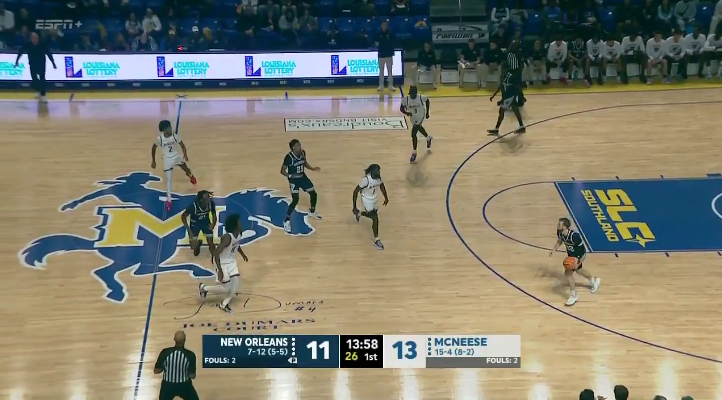
Now, let's turn those McNeese turnovers numbers onto Vanderbilt. By contrast, the Commodores are No. 11 in offensive turnover rate, in the 91st% in fewer points off turnovers allowed, and forced the fourth-lowest transition rate in the SEC.
Even more, Vanderbilt actually loves to attack a press. Vanderbilt turned 40 of its 140 possessions while being pressured fullcourt into a transition attack, which is one of the highest rates in the country. When seeing how McNeese lines up in its press, that seems like it would smell doom. Vanderbilt will waste no time pushing the ball up the floor.
McNeese played just one power conference team in the regular season, losing to Michigan 112-71. The Wolverines went an unfathomable 26-of-34 at the rim in that one, constantly taking advantage of McNeese's overleveraged defense for easy points. While Vanderbilt isn't the prolific interior squad Michigan is, the Commodores are the nation's eighth-most efficient rim offense when they get there.
McNeese is also a very poor defensive rebounding team that fouls at an extremely high rate. Vanderbilt is 9-2 when they grab McNeese's season-average offensive rebounding rate allowed, and 10-1 when they get to the free throw line at McNeese's season-average rate allowed.
In other words, unless Tyler Tanner and Duke Miles suddenly stop becoming one the nation's most steady backcourt duos like they've been all season, Vanderbilt likely should have no worries of dealing with a 5 vs. 12 upset scare. - Matthew Winick
(3) Michigan State (-15.5) vs. (14) North Dakota State, 4:05 PM ET, TNT.
Michigan State heads to Buffalo stumbling a bit, as they followed up their all out effort vs Michigan to close the regular season with a hasty exit in Chicago after Donovan Dent picked apart their PNR coverage. They'll have Summit champs North Dakota State in Buffalo, which is probably a fairly strong matchup for Sparty. NDSU is an elite 3PT shooting team, which is a requisite against Michigan State's hedge and notorious gap help from the nail. The Bison are a 93rd percentile catch and shoot rate offense with a 93th percentile efficiency rating, but their looks are borne from an inside out offense with an 82th percentile post rate, despite being severely undersized (339th in average height per KenPom), especially with their primary post man being 6'6 Markhi Strickland.
NDSU was a shot volume behemoth vs a midmajor only schedule this season
(14) North Dakota State
Shot Volume Index overall: +7.3 (seed average: +2.7)
Easy Shot Volume overall: +11 (seed average: +4.0)
SVI, top-150 games only: +6.3
SVI, road/neutral games only: +10.7
ESV, top-150 games only: -11.1
ESV, road/neutral games only: -3.6
(via our very own Will Warren's shot volume database)
but that's obviously going to be put to the test against Sparty's two big lineup. NDSU defensively switched things up this season, as Dave Richman typically passively dropped last year, but they were an aggressive hedge, denial, and help defense this year, much like Sparty in fact.
That ability to deny the rim and Fears (NDSU was in the 90th percentile in both ball screen and post doubles) and force catch and shoots against MSU is potentially NDSU's path to an upset here, as well as their transition denial, where they allowed just an 11th percentile rate (always at the top of the scouting report against an Izzo offense). At first blush I announced on X that this was a rough matchup for NDSU in terms of a big upset, but on closer inspection, I'm warming more and more to the Bison's chances to at least compete with multiple shooters and forcing jump shots in a battle of similar defensive schemes- I just worry about the lack of overall size and lack of data vs top tier competition for this new defensive scheme from Richman.- Jordan Majewski
(4) Arkansas (-15.5) vs. (13) Hawaii, 4:25 PM ET, TBS.
Probably the least-exciting 4/13 on the board to me. It would have helped Hawaii a lot to draw basically any other 4 seed on the board (Kansas in particular was my desire), but drawing the single best 4 seed in the field at tearing up drop coverage and in ISO hunting was brutal for a team that never, ever switches and forces a ton of 1-on-1 possessions. It's possible this is the game Arkansas's pair of elite shooters in Darius Acuff and Meleek Thomas finally combine to shoot 25% from the field, but I doubt it.
If you're unfamiliar with Hawaii's whole thing, take 12 minutes and watch Jordan Sperber's outstanding video on it:
They don't help at all, ever, which works really well against Big West competition that doesn't have elite 1-on-1 scorers but seems nightmarish against Arkansas. This will be Hawaii's first Quad 1 game of the year, which will be a serious adjustment, but so is the part where they haven't played a single top-100 offense all season. At least with High Point there's true plus athleticism and some scattershot stuff in their past to point to, but here, this is truly a first for the Warriors.
If Arkansas played in a conference that switched a ton (and to be fair, teams like Texas A&M and Auburn do a lot) then I might be intrigued, but even so Arkansas can just hunt in P&R over and over to get Acuff/Thomas downhill against less-athletic competition.
Interestingly, Arkansas hard-hedged more than any team in the SEC, which could be beneficial to a Hawaii offense that was actually pretty good against hedge-first defenses in conference play (they did dump 1.08 PPP at UC San Diego in January, which is probably the closest thing to what Arkansas wants to do defensively in the Big West). Still, it requires a lot of squinting and hoping, and ultimately it feels to me that Arkansas is just way too talented for the Warriors. Also worth noting that Hawaii's offensive shot volume was horrific in their two Quad 2 games (as in a 20% OREB%) and Arkansas was quietly decent defensively against non-Q1 comp. - Will Warren
(6) North Carolina (-2.5) vs. (11) VCU, 6:50 PM ET, TNT.
Since the day Caleb Wilson went out with injury (wrist, and then broken thumb), UNC ranks 38th in the country per Bart Torvik, going 5-3 in that span. VCU, meanwhile, is 9-1 and ranks 31st nationally over that span. The competition is different for both squads, of course, but the fact remains that one team is trending up and one is trending down.
Haslametrics offers a similar perspective. UNC ranks 350th in Momentum, playing well below their traditional level in recent games. VCU is no superstar there (ranking (111th), but the Rams have won 16 of 17 games and clearly appear to be a better version of themselves since LSU transfer Tyrell Ward reentered the rotation.
VCU’s first task will be figuring out how to score against UNC’s drop coverage. With Henri Veesaar patrolling the paint, UNC forces a huge diet of midrange jumpers. Per KenPom, the Heels rank 4th nationally in average 2PA distance allowed, and their defensive shooting heat map via CBB Analytics displays that tendency:
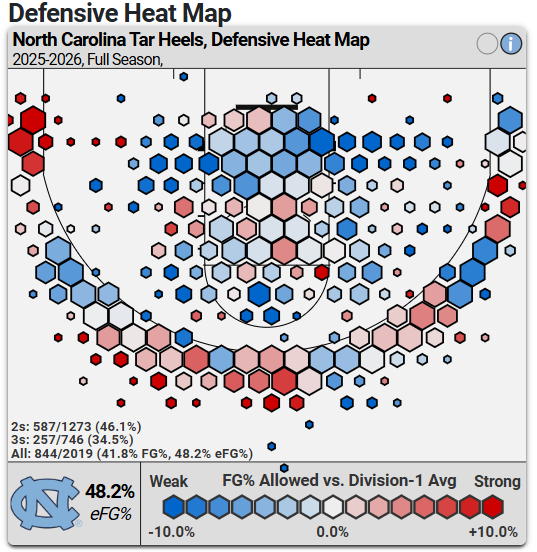
VCU’s offense has been extremely rim-and-3 heavy this year, so they may not be overly thrilled to try and win the game from 15 feet. Also per CBB Analytics, VCU took just 4.3% of its field goals in the midrange. The Rams did shoot 45.9% on those shots, ranking in the 99th percentile in the country, but it is not a significant part of their offense.
On the other hand, getting to the free throw line IS a huge part of VCU’s attack (15th nationally in FT rate). UNC never fouls from its withdrawn drop coverage, though (3rd in defensive FT rate), so VCU is going to have to get creative.
When UNC is on offense, VCU’s ability to switch 1-4 could frustrate Hubert Davis’ team somewhat. Ordinarily, the Heels would just bury that by isolating Wilson in the mid-post, but without him, they will have to lean more heavily on the creation of Seth Trimble and Derek Dixon. VCU is not Duke, but Duke’s switching certainly frustrated UNC’s attack in the regular season finale (48 points in the first 35 minutes, tallied 0.94 points per possession).
They will also feed Veesaar in the post, letting the towering Estonian work his way to the basket to finish with his crafty array of half hooks. Veesaar ranks in the 85th percentile nationally in efficiency on post ups, per Synergy, and fellow eastern European Lazar Djokovic (Serbia) will be tasked with slowing down the Heels’ big man. That could be an issue: VCU grades out at a hideous 5th percentile in efficiency against post-ups.
VCU is playing far better right now. UNC may have the matchup advantages per the data. I lean towards the scorching Rams, but admittedly, this deep dive gave me some pause given how the Heels can attack VCU’s weaknesses. - Jim Root
(1) Michigan (-31.5) vs. (16) Howard, 7:10 PM ET, CBS.
In the Midwest Region preview I noted that "Howard is more likely to make for an interesting game," but this is in the sense that their full-court press could frustrate Michigan into some early turnovers and cause a potential STOP THE COUNT! scoreline that No Context College Basketball posts. Once Michigan gets used to it, I don't think I'll be logging much if any time with this game on my TV at all, save for making for the aesthetically pleasing quadbox.
Howard's whole thing this year was running up a gigantic shot volume edge on the boards/turnovers against overwhelmed MEAC competition, but that huge rebounding edge is totally nuked by good teams and the Bison gave up a 68% hit rate at the rim versus the six top-200 teams they drew. Howard is going to run out the aforementioned interesting zone press looks, but Michigan has thrived in zone offense the entire season and this would open up Howard to getting demolished even further both at the rim and on the boards.
Perhaps unsurprisingly, Michigan tore up switch coverages (Howard's primary look) because smaller guards on any of Michigan's bigs is a nightmare matchup:
The closest thing the Wolverines played to this is maybe McNeese, who is obviously far more athletic and talented than the Bison...and Michigan dumped 112 points/1.37 PPP on the Cowboys because Michigan shot 75% from two and 26-32 at the rim. I highly doubt this game will be played as rapidly as that one was (83 possessions), and Howard can probably muck things up a little offensively with their tough shot-making, but it's hard to see a scenario other than a Wolverine demolition for 40 minutes. - Will Warren
(6) BYU (-1.5) vs. (11) Texas, 7:25 PM ET, TBS.
Yuck. Both these teams have been really bad for quite some time. If you filter these teams on Torvik starting after February 14th, or when BYU star Richie Saunders got hurt, then BYU ranks 46th and Texas sits at No. 64. Hardly inspiring.
Perhaps notably, neither defense sits in the Top 100 since that date, and both have been sieves down the stretch. Texas' 0.98 points per possession allowed against NC State in the First Four was just the second time all year the Longhorns forced a team under 1PPP.
Texas' defense is good at one thing and one thing only, and that's preventing ball movement, forcing isolation, and limiting catch-and-shoot jumpers. But the downside to that strategy is they never, ever force turnovers, and allow wide open shots if you have enough skill to manipulate the no-help coverage.
Luckily for BYU, the Cougars have two tremendous on-ball options with potential No. 1 pick AJ Dybantsa and downhill point guard Rob Wright. Both are excellent creators in the middle of the floor on jumpers, floaters, and getting to the rim. The closest comparison to Texas' defense in the Big 12 is Utah, and Dybantsa and Wright combined for a hilarious 64 points the second time the in-state rivals played after both topping 20 in the first meeting. They made things look tremendously easy.
Perhaps equally as important, BYU got to the free throw line a combined 52 times against Utah's drop with its relentless downhill attack. Texas' only big man is Matas Vokietaitis, one of its two most important players, and a guy who did foul out in just 26 minutes against the Wolfpack on Tuesday.
On the other end, Texas will look to isolate individual matchups and work the post with Vokietaitis against a shorter BYU frontline. BYU will likely double the post a bunch here, which would allow Texas to burn them from deep, but the Longhorns are just an average team from long range. Plus, head coach Kevin Young has played a bunch of defensive specialists Khadim Mboup and Dominique Diomande, who would both be solid options to throw on Texas' other star, Dailyn Swain.
BYU is not perfect, but Texas is arguably far less perfect at this point in time. - Matthew Winick
(7) Saint Mary's (-2.5) vs. (10) Texas A&M, 7:35 PM ET, TruTV.
It doesn’t get any more “clash of two styles” in the first round of the NCAA Tournament than the showdown between Randy Bennett’s Saint Mary’s Gaels and Bucky McMillan’s Texas A&M Aggies on Thursday evening. The #7 seed Gaels have the 41st-slowest offense in the country, while the Aggies have the 14th-fastest offense. McMillan’s approach on defense is to speed you up and create turnovers, while Bennett’s style grinds the game to a halt and limits you to accepting difficult looks late in the shot clock.
The Aggies are in the 98th percentile for the frequency of offensive looks within the first 10 seconds of their possessions, averaging the highest points per possession across all 10-second shot clock intervals (0-10, 11-20, 21-30 seconds) at 0.99 points per possession. The speedy style, coupled with an emphasis on three-point looks (McMillan’s teams have finished in the top 50 for three-point attempt rate in 4 out of 6 seasons he’s coached Division I) and a defensive emphasis on aggressive ball pressure to manufacture turnovers, has been affectionately called “Bucky Ball.”
McMillan is still trying to get his style to translate into tournament success, but this Gaels team will be an interesting test of whether deliberately slow teams can be sped up. The lone other tournament team A&M has played with a sub-300-ranked tempo is Tennessee, whom they lost to in double overtime. The Vols had a 22% turnover rate in that game.
Saint Mary’s holds a similar analytics ranking of years past, but the components to this team offer different strengths and weaknesses than the unit that brought them to the second round three of the last four seasons. The Gaels’ 16.5% turnover rate is the highest turnover rate they’ve held since 2021-2022. Sophomore guard Joshua Dent has been targeted for ball pressure throughout his first season as the starting point guard, and the Saint Mary’s staff has done a decent job buoying him with increased on-ball creation by shooting guard Mikey Lewis when ball pressure is ratcheted up.
The question for this matchup is not just which playstyle holds, but also if the Aggies’ three-point barrage can supplant the likely advantage the Gaels will have inside and on the glass. Over their last five games, A&M has given up 71% shooting at the rim and 52.9% in the paint. They’re giving up an offensive rebounding rate of 32.5% to opponents and allowing 12.3 second-chance points per game on the season.
The Gaels have a clear size advantage with their duo of 7-footers and leading scorer Paulius Murauskus in the front court. Considering the foul issues for Zech Clemence, it will be interesting if McMillan tries to go small with athletic frontcourt pieces Rashaun Agee and Ruben Dominguez, or tries to use Federiko Federiko for some extended run (averages 8.6 minutes this season).
The onslaught of guards McMillan has to throw at a short rotation of trustworthy guards for Saint Mary’s could be the advantage that makes this a potential upset game. The athleticism from Pop Isaacs, Rylan Griffen, Josh Holloway and Marcus Hill could be effective enough to mask the lack of size in the frontcourt.
Expect a game with some of the most drastic, teeter-tottering runs we’ll see this first day of action. - Tuck Clarry
(3) Illinois (-23.5) vs. (14) Penn, 9:25 PM ET, TNT.
Brad Underwood lost his first 5 games to Fran McCaffery to start his Illinois tenure, but went 9-1 after (with the one loss a late comeback by the Hawkeyes). So yes, Underwood is quite familiar with the nonstop screening action the Illini are going to see from Penn (99th percentile rate, per Synergy data). Ironically Illinois has actually been awful defending off-ball screening action (91st percentile rate allowed, 16th percentile efficiency rating), but they can completely camp out on the perimeter in their drop coverage given Penn is one of the least efficient rim and 2PT offenses in general in the country. TJ Power won't be able to rise and fire over smaller defenders off those pindowns like he did in the Ivy. Illinois has trouble with more physical frontcourts on both ends, but that is absolutely not the case here against the Quakers, in fact it couldn't be any farther from the case, with Penn owning a brutal 8th percentile rim finishing efficiency rating offensively and 29th percentile defensively (per Synergy data). Penn has been a top 40 defense since February when Fran started switching 1-5, but that's going to be a nightmare against Illinois who hunts mismatches out of the ball screen and isolation better than any offense in the country (95th and 91st percentile rates, respectively).
Illinois has struggled shooting the ball from the perimeter of late (especially Tomi Ivisic, who has been brutal), and there have been some whispers about a souring relationship between Underwood and Stojakovic, but it should be milk and honey at least for one round for the Illini, especially with Penn announcing Ethan Roberts' concussion symptoms will keep him out again and Power has been battling an illness that has him questionable. - Jordan Majewski
(8) Georgia (-2.5) vs. (9) Saint Louis, 9:45 PM ET, CBS.
Mike White versus the power of friendship and good vibes. Georgia has actually been quite fun to watch this year as White went back to his days at Louisiana Tech and brought back both the transition game and his famed (to me) full court press. Here's 2026:
and here's 2014:
This has made White's team much more entertaining and much more prone to hilarious variance. Georgia has given up 29 (to UMES, but it counts), 57, 59, 94, 96, and 100 this year. Predictably, a team that presses after made baskets has huge bench usage, but to White's credit the drop-off from the starting five to everyone else isn't as severe as you'd guess. They also run a bunch of nifty dribble handoff sets to free up a jittery and small backcourt, which goes super-small when Jeremiah Wilkinson (6'1") enters to pair with Marcus 'Smurf' Millender (5'11").
Because of the way UGA plays Wilkinson has a huge Steal% for a bad defender (3.5%), which will make you believe he isn't a bad defender, but do not believe this. Georgia's defense is 80th nationally and gave up 1.2 PPP on average to top-70 offenses (nearly half of their schedule). They're particularly really bad at defending DHOs and off-ball screens, which is perhaps a major problem when you are about to play the Billikens:
Who are as great as anyone this year in scoring on these actions. Georgia is among the worst teams in the field at allowing open catch-and-shoot threes, and the ones they turn into guarded ones are largely shot fakes with a step to the side. (One question I have here is if White runs his occasional zone coverage, which stunted SLU's off-ball motion in league play at times.) The most similar thing to Saint Louis I would guess UGA played in the SEC is maybe Oklahoma, who dropped 1.5 PPP on the Bulldogs and annihilated them instantly. Obviously you can't guess that SLU will shoot 56% from 3 like OU did but UGA's defense opens themselves up to that possibility. Georgia also allows a ton of transition opportunities with how they play defense, which means SLU (who loves playing fast) could simply outscore UGA via bucket after bucket.
As someone that's a pretty firm believer neither team can stop the other, I'm looking for any tiny edge I can find, and I did enjoy Basketball Index's research on the data for each team in the field. Georgia's actually going to be very well prepped for Saint Louis's mix of drop and hedge coverage as that's the primary coverage of choice in the SEC this year, but it's less than ideal to note that UGA posted just a 51.5% eFG% against this type of coverage and got back only 26% of their missed shots. SLU's style, albeit with less elite talent, is probably most similar to Vandy's amongst SEC competition, which UGA had a great day against and dumped 1.21 PPP on (shooting 10-24 from 3 certainly helps).
Unfortunately for UGA, their dribble-drive offense matches up with a lot of offenses SLU had great success against (best example VCU, who SLU held to 0.93 and 0.82 PPP and largely controlled the boards against). On the flipside UGA does a pretty good job of mixing up their coverages (mostly switch and drop), which has held down SLU's shot volume but generally results in a lot of open 3PAs for the Billikens. Off-ball motion has befuddled UGA all year as mentioned, and despite originally picking UGA I find myself leaning more towards SLU as game time approaches. - Will Warren
(3) Gonzaga (-20.5) vs. (14) Kennesaw State, 10 PM ET, TBS.
Kennesaw State went on a three-game heater in the Conference USA tournament, just one game shy of their most consecutive games won in a row this season. Their reward is to play a Gonzaga program that hasn’t lost in the first round since Steph Curry and Davidson beat them in 2008. That’s a 17-game streak in the round of 64.
The Owls were picked to finish second in the Conference USA Preseason Poll, but they lost their leading scorer and conference preseason player of the year, Simeon Cottle, in mid-January after being charged with involvement in a game-fixing scheme by federal prosecutors. The team finished sixth in the conference regular season with a 10-10 record.
If losing their central player wasn’t enough, Antoine Pettway’s team also faces one of the most unfavorable style matchups imaginable to try and pull off the 24th #14 over #3 in the history of the tournament. The Owls love to push pace, something that the Bulldogs would be more than comfortable matching, and find most of their success coming from drawing fouls, something the Zags have found success in avoiding. Kennessaw State averages a free throw rate of 45.1%, Gonzaga this season is giving up a rate of 31%.
In their run through the conference tournament, 19.99% of Kennesaw State’s points came from 2nd chance opportunities and they held an offensive rebounding rate of 36.4% (94th percentile). Throughout the season, Gonzaga has allowed an opponent's offensive rebounding rate of 25%.
The question for the Owls is how they will stop Graham Ike in the paint and on post-ups. Pettway’s team rotates three forwards for the majority of front court minutes, each having a foul per 40-minute rate of 4.8 or higher. Ike is averaging 4.9 fouls per 40 minutes this season and 7.1 fouls per 40 outside of WCC play.
Even if Kennesaw State is able to muck things up in the halfcourt and offer junk zone looks to try and leverage Gonzaga’s 34% three-point shooting, they’ll need to limit their turnovers to keep Gonzaga out of transition.
The Owls have a turnover rate of 16.1% (180th in Division I) this season and Gonzaga’s defense is averaging 20.5% turnover creation (17th). Worse, Kennesaw State’s offense gives up live-ball turnovers in 11% of their possessions (356th in the country), and the Bulldogs produce a rate of 12% (23rd) on defense. - Tuck Clarry
(2) Houston (-23.5) vs. (15) Idaho, 10:10 PM ET, TruTV.
Idaho rebounds well (5th in DREB% per KenPom) and is strong in both rim deterrence and rim defense (top 25 2PT% defense the past month), which hardly matters against Houston's midrange game, and is actually something of a hindrance with the way they funnel ball screen and dribble creation against Kingston Flemings. Idaho's offense meanwhile is one of the most post up predicated in the country, with a 96th percentile rate led by Jackson Rasmussen. This is a typical Idaho halfcourt possession (and I give Rasmussen a lot of credit for being such a crafty finisher), but this is pretty far from ideal against the Houston post double and denial Monster scheme (and Rasmussen has not been a strong passer out of double teams).
The Vandals' secondary form of offense? Kolton Mitchell ball screens- again not ideal against the Houston high hedge. As a 15 seed, you're not going to see too many friendly schematic matchups, but this was probably the worst 2 seed the Vandals could have drawn. - Jordan Majewski