

The 2026 NCAA Tournament field has been selected and bracketed. The fourth annual Stat Pack dives into statistical trends to watch in each of the 32 first-round matchups.
The 2026 NCAA Tournament is here. Finally. While the college basketball regular season is great, there is no substitute for the spectacle that is the Big Dance. The volatility of the event, particularly on the opening weekend, is what makes March...Madness. There is no way to predict precisely what will happen, and nothing epitomizes that more than the insane odds of achieving a "perfect" bracket.
There is no avoiding the chaos that is set to ensue in the coming days (and who would want to?). Still, there are always trends. The Stat Pack — now in its fourth year (previously published on Heat Check CBB) — dives into the data of the 30+ games from each team in the field in hopes of determining the most meaningful numbers to track and how first-round opponents stack up in those areas.
Basketball isn't played on a spreadsheet — thank goodness — but numbers are a vital part of the sport. No matter how you fill out your bracket — clicking through an online version, printing it out and scribbling the old-fashioned way, or pulling out a dry-erase marker for the whiteboard on the wall or refrigerator — maybe these stats can help with your choices.
East Regional (Washington, D.C.)
No. 1 Duke vs. No. 16 Siena (Thursday, 2:50 p.m. ET, CBS; Greenville)
Duke enters the NCAA Tournament as the No. 1 overall seed, and the second-most powerful No. 1 seed by Tournament Index standards over the last 13 fields. It isn't completely healthy, though. The Blue Devils played the entire ACC Tournament without Caleb Foster and Patrick Ngongba. Granted, it still won the event but it had a pair of close calls against Florida State and Virginia. Assuming both remain out, here are Duke's numbers with and without the duo:
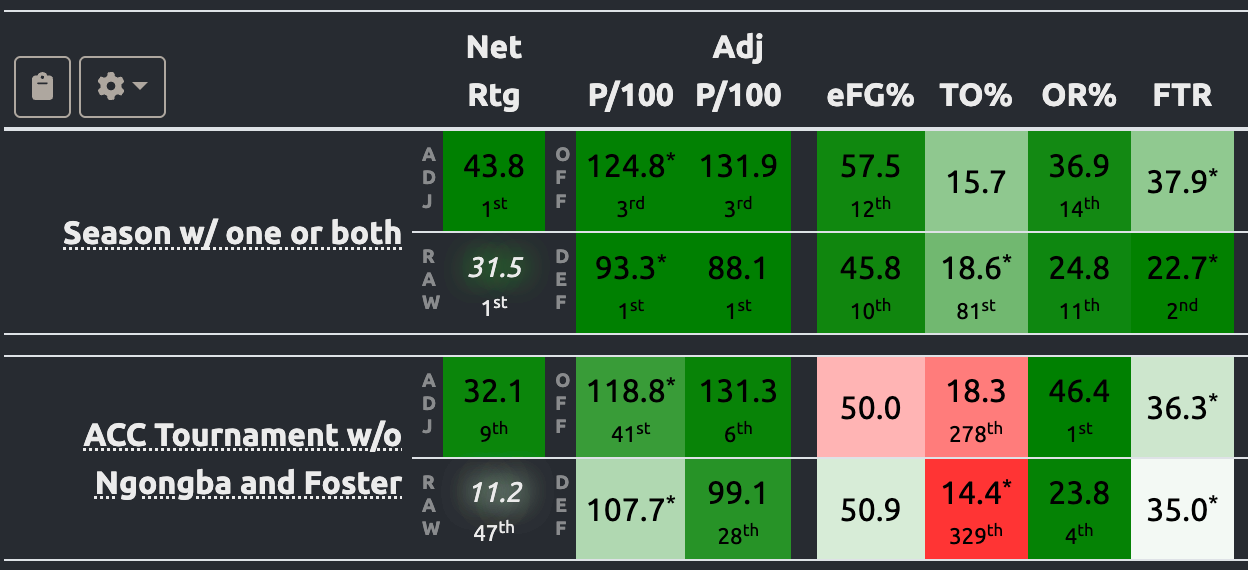
As far as how this relates to Siena, there has not been a ton of correlation between its wins/losses and its TO%s or FTRs, the main areas Duke has appeared to struggle in without Foster and Ngongba. Perhaps the biggest difference for the Saints in Duke without Foster/Ngongba is the decreased pace. Duke has played at a 64.3 pace over its last three games compared to 66.7 prior; it is not due to opponent much, either, as all three of Florida State, Clemson, and Virginia rank in the top 200 in offensive tempo. If Siena can keep it slow, it could keep it close for a while. The Saints are 13-2 in games with 64 or fewer possessions this season (10-9 otherwise). If they get into late-game situations, Gavin Doty and Justice Shoats are tough shot-makers in the intermediate.
Siena has only played one game against the KenPom top 140, losing by 21 at Indiana, so the jump to facing Duke is enormous. The Saints are 1-4 against the KenPom top 200, having only beaten Merrimack once in three tries and also losing to St. Bonaventure.
No. 8 Ohio State vs. No. 9 TCU (Thursday, 12:15 p.m. ET, CBS; Greenville)
Ohio State enters the NCAA Tournament playing some of its basketball of the season, ranking 14th nationally in adjusted efficiency on Bart Torvik since Feb. 5. TCU is only 36th over that span, fitting with its seed, but it can boast elite confidence in its ability to beat top teams, having already knocked off Florida, Wisconsin, Iowa State, and Texas Tech in the regular season.
TCU is a tricky team to find determining factors for. The easy statistic is that the Horned Frogs are 13-0 when posting an offensive rebounding rate over 36%, and just 9-11 when they fail to do so. The counter is that their wins over Iowa State, Florida, and Wisconsin all came when held below that mark.
Diving into those three games in particular, a common theme was forcing turnovers. TCU forced those teams into turnover rates 9.1%, 8.4%, and 10.1% above their season-long marks, respectively. With that in mind, the keys for the Horned Frogs might be to keep pushing on the offensive glass but pivot to needing transition buckets if it fails. Ohio State ranks 156th in DR% and 100th in offensive TO%; solid, but not elite in either department.
As for the Buckeyes, their rim efficiency is critical. Ohio State only rates in the 31st percentile for at-the-rim attempt rate this season, per CBB Analytics, but shoots 76.1% on those shots in their wins compared to 52.7% in their losses. The Buckeyes went just 6-9 against defenses in the 54th percentile or better at rim efficiency allowed; TCU is in the 61st percentile.
No. 5 St. John's vs. No. 12 Northern Iowa (Friday, 7:10 p.m. ET, CBS; San Diego)
In a down year for the Big East, St. John's has faced several teams of Northern Iowa's quality over the past few months. The Red Storm are 16-1 against teams ranked between No. 50 and No. 100 on KenPom, while the Panthers enter the NCAA Tournament at No. 72. A big key for St. John's in its great record against such teams is that it relies on its ability to win possession battles on the glass and via turnovers rather than shooting variance.
When the Red Storm have been vulnerable is when it doesn't protect the defensive glass as well, and its possession margin shrinks. They rank only 171st in DR% for the season, and are 11-6 when allowing OR%s of 30% or higher to their opponents (17-0 otherwise). Their lone loss to a team between No. 50-100 on KenPom was when allowing a 36.6% offensive rebounding rate to Providence on Jan. 3. That said, a big reason for winning the Big East regular-season and tournament titles was ranking 50th in the country in DR% since.
Northern Iowa also only ranks 356th in offensive rebounding rate, so St. John's shouldn't have much trouble in that area. Where the Panthers could pose some issues is with how well they've played when healthy (9-3 record), stout defense (24th in AdjD), a volatile offense that can make 3s, and a slooooow pace of play. The fewer possessions, the more variance comes into play, and Northern Iowa ranks 363rd nationally in adjusted tempo.
With St. John's likely to gain major advantages in field goal attempt and free-throw attempt margins, Northern Iowa has to counter with elite shooting. UNI is 13-1 when it shoots at least 39% from three (10-11 otherwise). Trey Campbell is a vet, Leon Bond is a high-major athlete, and Max Weisbrod is a sniper; all three must be excellent. The Panthers are winless against the KenPom top 100 this season, but only lost to Tulsa by three, in OT to Wichita State, and to Saint Mary's by five.
No. 4 Kansas vs. No. 13 California Baptist (Friday, 9:45 p.m. ET, CBS; San Diego)
Let's preface this by saying California Baptist only played KenPom's No. 205 strength of schedule, and its non-opponent-adjusted statistics are thus a tad inflated. It is an important caveat to mention with a lot of these first-round matchups. Moving along, Kansas is just 6-8 this season against teams who rank in the top 110 for defensive rebounding rate (17-2 otherwise), and just 2-7 against teams in the top 50 for 2-point percentage defense (21-3 otherwise).
California Baptist ranks 45th and 34th, respectively. It is also sixth in 3-point percentage defense. A flip side is that the Lancers only rank 191st in adjusted offensive efficiency, but Kansas did lost to a pair of heavily defense-forward teams in Cincinnati (No. 131 in offense) and West Virginia (No. 154 in offense) during the regular season. California Baptist also features an elite scoring guard in Dominique Daniels, who could make things interesting if unchecked; Daniels is averaging 28.2 points over his last six games, all wins, coming into the Big Dance.
Among other areas, Kansas could halt an upset bid in its tracks is with its size. The Jayhawks rank 24th in average height, while California Baptist ranks 312th. Height isn't everything on the glass, but it is hard to foresee the Lancers keeping up their 11th-best OR% and 45th-best DR% in the country numbers against KU's size, even with KU only ranking 223rd and 168th in those categories. CBU is 5-4 when it does not win the rebounding rate margin battle (20-4 when it does).
No. 6 Louisville vs. No. 11 South Florida (Thursday, 1:30 p.m. ET, TNT; Buffalo)
Louisville ranks fourth nationally in 3-point attempt rate, which immediately signifies its game-to-game 3-point percentage as a determinant. The Cardinals are 13-0 when they shoot at least 39% from deep, and 10-10 when failing to do so. It is hard to judge a team's 3-point defense by statistics, but South Florida ranking essentially-perfectly middle of the country in both 3PAr allowed (184th) and 3P% allowed (180th) means we don't have to judge on that, either.
Whether or not Louisville makes 3s will be huge. Mikel Brown's availability will also be a major factor in that; Louisville shoots 37.2% from three in games he plays, and just 32.7% when he is unavailable. South Florida is 13-0 when it keeps its opponents under 30% from deep (12-8 otherwise), including its win over Utah State.
A larger determinant for the Bulls, though, is whether it can maintain its offensive rebounding. They rank seventh nationally for OR% and are 15-1 when securing at least a 37% rate (10-7 otherwise); the lone loss was to Alabama, though, so it might need more than just second-chances. As such, can its duo get hot? Wes Enis and Joseph Pinion have both made 100+ 3s on at least 36% efficiency this season. If Louisville is feeling it from deep, those two will have to be throwing counterpunches.
No. 3 Michigan State vs. No. 14 North Dakota State (Thursday, 4:05 p.m. ET, TNT; Buffalo)
Michigan State's emphasis on 2-point scoring is not as strong as in other years under Tom Izzo, but it is still pronounced. For the season, the Spartans are 20-0 when they shoot over 50% on 2-pointers and 5-7 when failing to do so; two of their four wins when falling short of that mark were against KenPom sub-100 opponents in Colgate and Penn State. Diving into that a little bit further, the main drop-offs in wins vs. losses are at-the-rim and on mid-range jumpers:
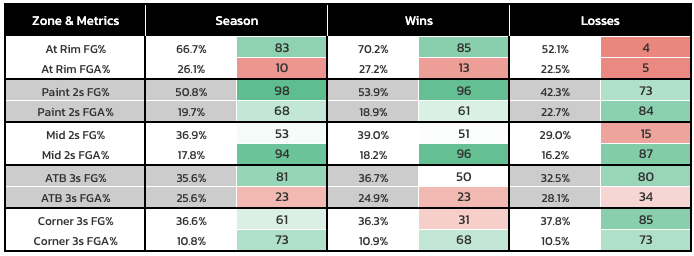
North Dakota State ranks just 221st in 2P% allowed, but is in the 82nd percentile for limiting shots at the rim; the Bison largely force teams into 3-pointers or mid-range 2s. As shown above, though, Michigan State is among the more deadly mid-range shooting teams in the country. If the Spartans are forced away from the rim, their ability to hit in the intermediate will keep them hard to stop.
When NDSU has the ball, its 3-point shooting tells a lot of the story. The Bison rank 121st nationally in 3-point attempt rate, and hit 38.1% of their trifectas in wins compared to just 26.6% in their losses. Michigan State does allow a lot of 3s (344th in attempt rate surrendered) but is above-average in limiting efficiency (32.9%, 111th). Given the amount of attempts the Spartans surrender, though, they are just 4-5 when opponents hit 38% of better (21-2 otherwise), including allowing 47.6% in an upset loss to KP 77 Minnesota.
NDSU has hit at least 38% in 17 games this season, 16 of which were over 40%; they've hit double-digit 3s 16 times. The Bison are the only team in the country to feature five players who have made 35+ 3s on at least 37% efficiency this season.
No. 7 UCLA vs. No. 10 UCF (Friday, 7:25 p.m. ET, TBS; Philadelphia)
UCLA ranks 57th nationally in 3-point percentage defense, but is 330th in 3-point attempt rate allowed. As such, it is unsurprising that its biggest issues this season have come against teams who take advantage of the high attempt rate allowed and feature multiple viable shooting threats. There is obviously overlap between the lists, but UCLA's numbers when allowing made 3s or facing teams who make 3s are concerning:
- 8-11 when allowing >30.5% from three (15-0 otherwise)
- 4-9 when allowing >32.0% from three (19-2 otherwise)
- 1-6 against the top 60 for 3-point percentage (22-5 otherwise)
- 5-11 against the top 200 for 3-point percentage (18-0 otherwise)
UCF does not attempt a ton of 3s against most opponents, ranking 286th in attempt rate, but is 48th in overall 3-point efficiency (36.2%). Riley Kugel and Jordan Burks have both made 50+ 3s on at least 36% efficiency this year. That being said, the Knights enter the Big Dance having shot just 9-for-61 (14.8%) from three over their last three games. If that doesn't turn around, UCLA's 15-0 record when limiting its opponents under 30.5% from three becomes the important note.
On the other end of the court, UCF has had the most success when it can force giveaways. The Knights are 13-1 when forcing turnovers on at least 16.5% of their opponents' possessions (8-10 otherwise). Doing so against UCLA will be easier said than done; the Bruins rank 12th nationally in TO% at just 13.4%; the Bruins have committed a 16.5% or higher turnover rate in only eight of 34 games — and have not done so in over a month. Donovan Dent has been awesome, and is expected to be available for the Big Dance.
No. 2 UConn vs. No. 15 Furman (Friday, 10:00 p.m. ET, TBS; Philadelphia)
After starting 22-1, UConn has lost four of its last 11 games. Two of them were to No. 5 seed St. John's, but losing at home to Creighton and on the road to Marquette were head-scratchers. Over this closing stretch, the Huskies are forcing fewer turnovers and, per CBB Analytics, are allowing 5.9% higher shooting at the rim and 5.0% higher shooting from three compared to the first 23 games. The rim+3s attempt rate allowed has also gone from 65.6% to 69.7%.
These trends are important for Furman, who rates in the 92nd percentile for rim+3s attempt rate offensively. The 3s are the larger determinant for the Paladins, though, as they finish at a similar rate at the rim in wins (65.6%) versus losses (62.9%); they connect on 37.2% of 3s in wins but only 27.2% in losses. If Furman can continue the unluckiness of UConn's defensive shooting variance down the stretch, it can hang around. Furman also has plenty of size that many mid-majors do not, ranking fifth nationally in average height.
On the flip side, Furman does not own a single KenPom top 150 win this season. Their only attempts were in losses to KP 92 High Point (by 26), KP 143 Troy (by three), KP 72 Northern Iowa (by 16), and KP 103 Illinois State (by seven). UConn is 29-0 this season when it shoots over 16% from three and records an offensive rebounding rate over 21% – it has taken phenomenally bad games in one of those areas for the Huskies to fall.
West Regional (San Jose, CA)
No. 1 Arizona vs. No. 16 LIU (Friday, 1:35 p.m. ET, TNT; San Diego)
It is hard to find much to dislike with 32-2 Arizona. The Wildcats rank in the top 75 for seven of the Four Factors statistics across both sides of the ball, and their lone sub-75 ranking isn't bad at 172nd in TO% forced. They also have not had the injury bug to the degree of fellow No. 1 seed Duke. Looking at the only two losses taken this far, at Kansas and vs. Texas Tech, the similarities are that they were against elite competition that held Arizona under 46% on 2s; they are two of only three teams (Alabama being the other) to do that all year.
Given Arizona ranks 362nd in 3-point attempt rate, the importance of 2-point percentage checks out. In the first round, it will face an LIU opponent that allows a ton of 2-point attempts and is 129th in 2-point percentage. Even though the Sharks have held 12 opponents under 46%, 11 of them have been sub-280 KenPom opponents (KP 233 La Salle being the other). They also lost one of those games to KP 328 New Haven. With a massive uptick in competition, LIU must find a way to maintain excellent interior defense.
Overall, this is battle of two teams who live inside the arc offensively. LIU ranks 355th itself in 3-point attempt rate. From a shot selection standpoint, it is hard to not foresee Arizona winning out with its own style offensively (>46% on 2s has meant W) and defensively (2nd-best 2P% defense in the country). The lone sub-75 ranking in Arizona's Four Factors is also not likely something LIU will take advantage of; the Sharks rank 320th in offensive TO%.
No. 8 Villanova vs. No. 9 Utah State (Friday, 4:10 p.m. ET, TNT; San Diego)
Before diving into styles of play, neither of these teams have great track records against quality competition this season. Villanova went just 1-6 against the KenPom top 50 during the regular season, but with a nice win over Wisconsin. Utah State is 5-2 against the top 50, but all of the wins are over teams ranked between No. 45-50 (pretty amazing, actually). A win for Villanova would be its second-best of the year, while a win for USU would be its best of the year.
In terms of more numbers, Villanova's turnover rate is critical. The Wildcats have lost twice to poor teams (Georgetown and Creighton) when avoiding giveaways but are still 17-2 when keeping their turnover rate to 15.8% or lower (7-6 otherwise). A key player to watch is Acaden Lewis. The freshman guard averages 13.6 points, 5.7 assists, and 2.0 turnovers in Nova's wins, but those numbers flip to just 8.4 points, 4.0 assists and 2.5 turnovers in losses. Utah State's defense ranks 16th in turnover rate forced and features plenty of size to put on Lewis with Mason Falslev and Drake Allen, both of whom are 6-4 or taller with top-100 individual steal rates.
When Utah State has the rock, it is about how often and well it can attack the basket. From an efficiency standpoint, Utah State shoots 75.3% at the rim in its wins but only 52.7% in its losses. Volume-wise, the Aggies are 13-0 when they attempt over 63% of their shots inside the arc instead of relying on 3s (15-6 otherwise). As part of USU's interior attack, second-chance points could be a determinant as well. The Aggies' offensive rebounding hasn't been a major tell, but Villanova is only 5-6 when it surrenders an OR% over 35% (19-2 otherwise); Utah State has secured such a rate in 12 of 34 games (11-1 record).
No. 5 Wisconsin vs. No. 12 High Point (Thursday, 1:50 p.m. ET, TBS; Portland)
Wisconsin is an extremely high-volume 3-point shooting team, ranking sixth nationally in attempt rate and 53rd in efficiency. With over half of the Badgers' total shots coming from beyond the arc, it isn't a surprise to note how important it is for those shots to drop. But shutting down the perimeter is not the only bar that opponents need to clear to beat Wisconsin this season; they have also needed to force giveaways out of the No. 3 turnover rate offense in the country.
There is some overlap between the lists, but Wisconsin is 21-2 this season when it shoots over 33.3% from three (3-8 otherwise), and 21-2 when keeping its turnover rate under 15% (3-8 otherwise). It has done both in 18 games, winning all of them.
High Point's defense doesn't project horribly in those two areas, though. The Panthers do allow a lot of 3-point attempts but limit efficiency at the 64th-best level in the country (31.9%). They also rank fifth nationally in turnover rate forced at 21.9% of possessions. While doing it against Wisconsin is easier than Big South opponents, and HPU has zero KenPom top-100 wins to its name, the team has reached the criteria of <.333 3P% allowed and >.16 TO% forced in 17 games.
When High Point has the ball, its key is getting to its spots on non-at-the-rim paint 2s. The Panthers attempt 20.2% of its shots from that area and convert on 49.4% of them in their wins; those numbers dip to a 10.7% attempt rate and a 32.1% conversion rate in its losses. Wisconsin's defense ranks in just the 17th percentile for field goal percentage allowed on those shots (45.8%).
No. 4 Arkansas vs. Hawaii (Thursday, 4:25 p.m. ET, TBS; Portland)
The biggest battle to watch in this game will be when Arkansas has the ball and is looking to score inside the arc. The Razorbacks rank only 311th in 3-point attempt rate this season, and score 52.8% of their points on 2-pointers (70th-highest). From a results standpoint, Arkansas is 14-0 when it shoots at least 58% on 2s and 12-8 when it fails to do so. Hawaii's defense, meanwhile, allows the 15th-lowest 3-point attempt rate in the country and ranks 22nd in 2P% defense.
Of course, strength of schedule plays a factor in those raw numbers. Hawaii has not beaten a KenPom top-100 opponent yet this season. Its closest prior-opponent comparison to Arkansas is high-major Arizona State (KP 87); the Warriors lost by seven to ASU but only gave up 44.2% shooting on 2s.
But while Hawaii's defense might be able to slow down Arkansas' primary scoring route, its offense ranks just 211th in adjusted efficiency. The Warriors are 300th or worse in both TO% and 3P%, making it difficult to win a possession battle or make momentum-swinging or momentum-halting 3s. Hawaii is 14-1 when it posts an offensive rebounding rate of at least 33.3% (10-7 otherwise), and Arkansas is only 212th in DR%, so perhaps there is hope in that. Arkansas should be able to create a large turnover disparity, though.
No. 6 BYU vs. Texas (Thursday, 7:25 p.m. ET, TBS; Portland)
After a thrilling finish in the First Four that saw Tramon Mark hit the game-winner, Texas advanced to the Round of 64 to face BYU. For the Longhorns to win again, its work on the offensive glass will need to remain excellent. They secured 15 offensive rebounds in the First Four victory over NC State as part of a 36.6% offensive rebounding rate, moving their record to 15-6 when securing an OR% of at least 33.3% (4-8 otherwise). If the Longhorns can notch a higher mark, they are 11-0 when reaching an OR% of at least 41% this season, and 7-14 when falling short.
As for the looming matchup, the higher-seeded BYU ranks 126th nationally in defensive rebounding rate. It has surrendered a >33.3% offensive rebounding rate in 12 of 34 games, and a >41.0% rate in only two games. Keeping Texas from one of its main objectives is key, but the determining statistic for the Cougars might be their interior defense. BYU is 18-1 when it holds its opponents to 50% or worse on 2-pointers, with the only loss coming on the road to No. 1 seed Arizona. None of its five wins when giving up over 50% are over NCAA Tournament teams. Texas ranks 65th in 2-point percentage.
Another area to watch for BYU is its first-half performance. The Cougars play equivalent to the No. 57 team in the country in first halves, per Hoop-Explorer, compared to playing at the level of the nation's third-best team in second halves:
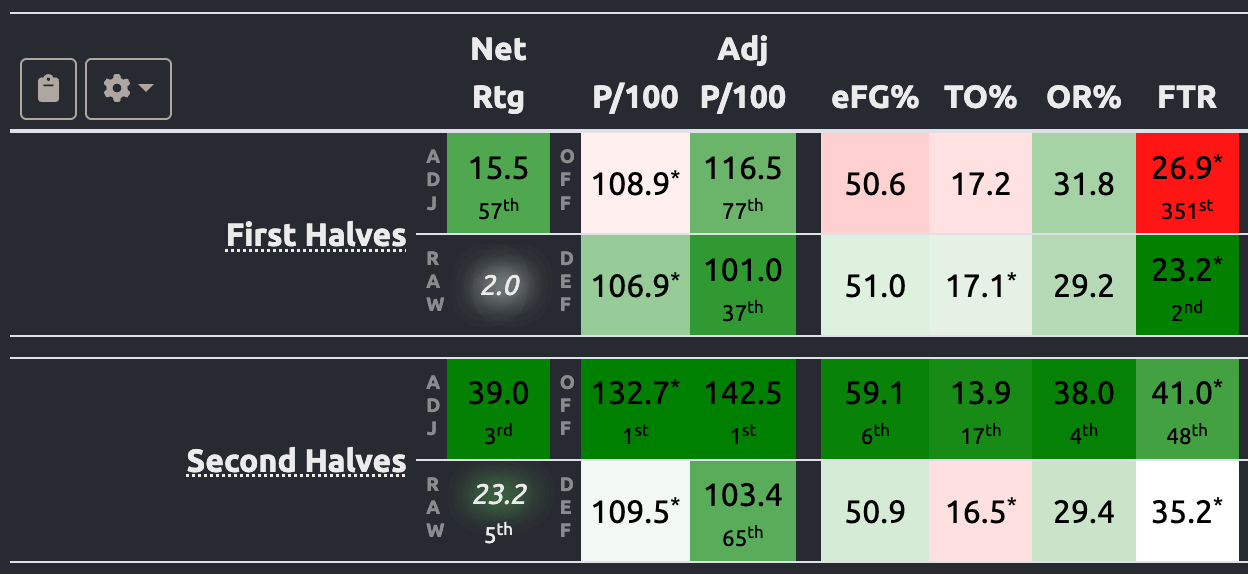
For comparison sake, Texas is also better in second halves but to a lesser degree (equivalent to No. 54 before halftime, No. 24 after halftime). Both are elite second-half offensive teams.
No. 3 Gonzaga vs. No. 14 Kennesaw State (Thursday, 10:00 p.m. ET, TBS; Portland)
As most Mark Few teams have been, Gonzaga is among the nation's best at prioritizing attacking and finishing inside the arc. Not only do the Bulldogs rank 17th nationally in 2-point percentage but they are diverse in the attempts inside the arc. They rank in the 71st percentile or higher in attempt rates at all three 2-point levels (at rim, paint, and mid-range), and in the 86th percentile or higher in FG% at each of those three levels, per CBB Analytics.
With the varied levels inside the arc at which Gonzaga is efficient, shutting down its interior attack is nearly impossible. Doing so has been the only path to victory over the Bulldogs so far this season, though. Gonzaga's three losses have come in its worst three games by 2P%: 45.7% vs. Portland, 43.6% vs. Saint Mary's, and 42.3% against Michigan. The latter two make sense, as Saint Mary's and Michigan rank 18th and 1st in 2P% defense, respectively; the loss to Portland, which ranks 162nd, remains an enormous head-scratcher.
As far as this matchup goes, Gonzaga is facing the only No. 14 seed to rank in the top 200 for 2-point percentage defense. Kennesaw State ranks 29th, which also lands it as the third-toughest 2P% defense Gonzaga has faced at just 47.0% allowed for the year. The Owls did allow 54.8% and 52.4% 2-point finishing to their only KenPom top-50 opponents, South Florida and Alabama, though.
Shutting down Gonzaga inside is Task #1. Offensively, KSU will have to rely on first-shot efficiency more than normal. The Owls rank 39th in OR% but Gonzaga is their toughest DR% opponent by a wide margin — the Bulldogs rank 19th in DR% and KSU's current toughest DR% faced was Jacksonville State at 67th. KSU also ranks seventh in FTA/FGA but Gonzaga's defense is top 100 in the category defensively. With just a No. 204 ranking in eFG%, winning without as many second-chances and free throws could be tricky for the Owls.
No. 7 Miami (FL) vs. No. 10 Missouri (Friday, 10:10 p.m. ET, truTV; Saint Louis)
A big reason for Missouri's inclusion in the NCAA Tournament field, and perhaps bump to a No. 10 seed, was its big wins. The Tigers beat all of Florida, Kentucky, Vanderbilt, Texas A&M and Tennessee this season en route to the Big Dance. Isolating those performances as tournament-caliber victories shows how important forcing turnovers and flipping them into points has been for the Tigers. Although they beat Florida without many giveaways, the notched at least 16 points off turnovers in each of the other four wins.
For the season, Missouri ranks in the 86th percentile for points off turnovers. The Tigers are 16-2 when they create at least 14 points off turnovers – 4-10 otherwise. Miami's offense ranks near the middle of the country in TO% offense, coughing up 16.2% of possessions. It has allowed 14+ points off turnovers in 16 games, but has persevered to be 11-5 in those games. Missouri might need to win that battle, while Miami seemingly has other ways around it.
For instance, on possessions when the Hurricanes take care of the rock, they should have an advantage on the glass. Miami ranks 17th nationally in offensive rebounding rate, while Missouri is just 220th in defensive rebounding rate.
Outside of the margins, the game will be determined at the rim:

No. 2 Purdue vs. No. 15 Queens (Friday, 7:35 p.m. ET, truTV; Saint Louis)
After stumbling to the finish line with four losses in its last six regular-season games, Purdue won four games in four days to win the Big Ten Tournament. The Boilermakers beat three single-digit tournament teams along the way in Nebraska, UCLA, and Michigan. So what's changed over the small sample compared to the six preceding contests?
The offense has remained elite regardless, but the defense has taken a big step forward over the last four games. Opponents shot just 33.7% from three in the Big Ten Tournament compared to 44.1% over the six preceding contests. Perhaps the largest disparity, though, is Purdue stopped sending its opponents to the foul line at an absurd rate (.148 FTR allowed compared to .401). Continuing to stay on its BTT trajectory will bode well for Purdue in this game and the rest of the tournament.
For Queens to pull off the upset, it especially needs to reverse the 3-point turnaround for Purdue's defense. The Royals rank 35th nationally in 3-point attempt rate and hit 35.9% of them (68th-best). If the shots fall, Queens could put up a strong point total. The flip side is trying to defend an elite Purdue offense that didn't really slip up even during the earlier "skid," and Queens only ranks 322nd in adjusted defense. The Royals do not rank top-200 in a single major defensive stat. As such, it comes down to hoping Purdue misses shots. Even so, Purdue's 22nd-best OR% should thrive against Queens' 276th-ranked DR%.
When Purdue lost as a No. 1 seed a few years ago, Fairleigh Dickinson offset its disadvantages by ranking 38th in TO% and forcing 16 turnovers. Purdue also ranked only 100th in TO% that year. It ranks 15th this year, and Queens is 286th in TO% forced.
Midwest Regional (Chicago, IL)
No. 1 Michigan vs. Howard (Thursday, 7:10 p.m. ET, CBS; Buffalo)
Howard won its first NCAA Tournament game in program history on Tuesday night, holding off UMBC to set up a Round of 64 matchup with Michigan. Howard has already faced a No. 1 seed once this season, falling on the road to Duke by 37 in November. Looking at the rest of their season, the Bison's wins vs. losses have been largely determined by at-the-rim finishing. Howard has attempted the exact same rate of shots at the rim in wins vs. losses (36.8%, 89th percentile), but its efficiency has dipped from 63.6% in victories to 46.8% in defeats. The Bison have also dipped from 46.7% in wins to 27.8% in losses on other paint 2s.
As far as how that relates to the looming R64 game, Michigan's defense is in the 99th percentile for at-the-rim attempt rate and the 83rd percentile for efficiency allowed. Howard will both have a harder time reaching its shots but also meeting the efficiency it has often needed to win.
Isolating the Wolverines' metrics shows more struggles when it is forced into longer possessions. In games when Michigan's possessions are shorter than its season-long average of 14.4 seconds per offensive trip (97th percentile), it is an undefeated 16-0 with an average margin of +26.7 points. In games where its possessions have averaged longer than its season average of 14.4 seconds, Michigan is 15-3 with an average margin of +9.6.
No. 8 Georgia vs. No. 9 Saint Louis (Thursday, 9:45 p.m. ET, CBS; Buffalo)
After starting 24-1, Saint Louis enters the NCAA Tournament having lost four of its last eight games. As a result, the recent trending is not pretty. The Billikens rank just 148th on Bart Torvik since the start of this stretch on Feb. 17, whereas its first-round opponent Georgia has ranked 26th over this period. Still, Saint Louis's profile of ranking top 15 in 2P% and 3P% on both ends of the floor over the course of the full season is wildly interesting.
From a play style standpoint, Saint Louis is as analytically-friendly of an offense as there is in the country. The Billikens rate in the 100th percentile for rim+3s rate, attempting 87.2% of their total shots from those areas. That hasn't changed down the stretch, either. The difference is a drastic downturn in at-the-rim offense and 3-point defense:

For Georgia, its drop-off in wins vs. losses is drastically more pronounced defensively than offensively. An already-poor defensive rebounding rate decreases, and an elite block+steal rate plummets. Turnovers and points off them are vital to Georgia, as it averages turning 14.7 turnovers into 21.2 points in wins but just 11.0 into 11.6 in the losses. Saint Louis ranks 230th in offensive turnover rate, so the Bulldogs could create an advantage there. With both teams ranking top 10 nationally for average possession length, a track meet could be on our hands.
No. 5 Texas Tech vs. No. 12 Akron (Friday, 12:40 p.m. ET, truTV; Tampa)
Buoyed by its nine-point road at Iowa State, Texas Tech's adjusted efficiency margin has not changed much without JT Toppin. It is on a three-game losing streak, though, and the style of play has seen a shift without the All-American:
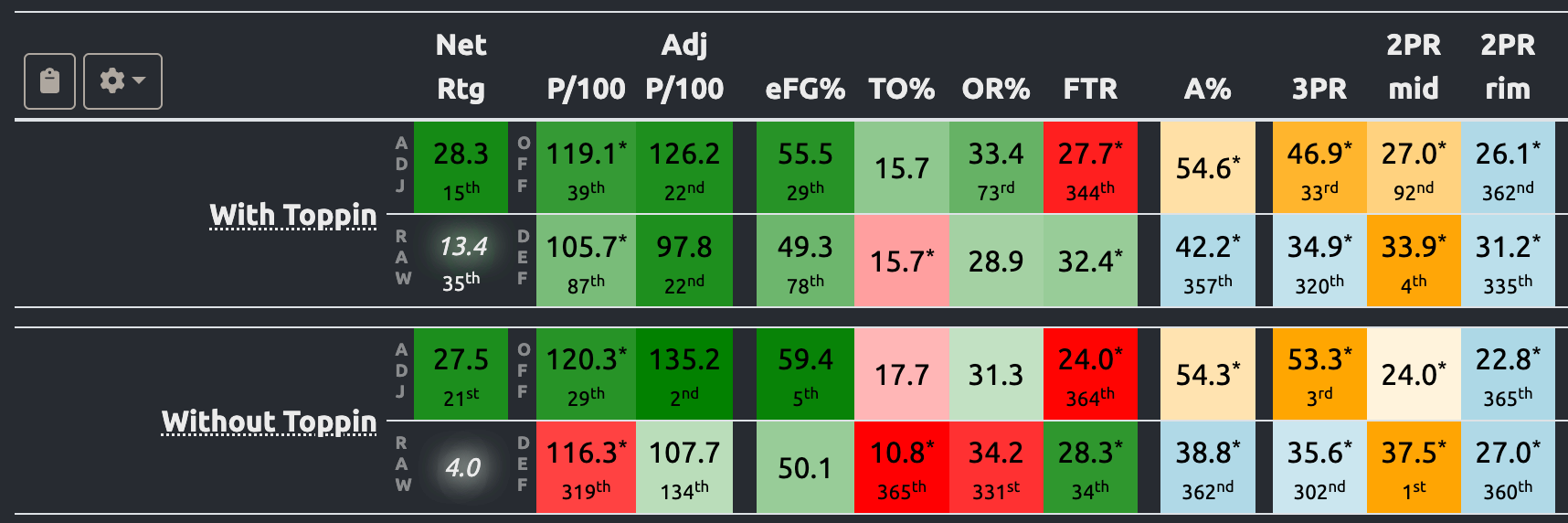
Most notably, the Red Raiders are forcing far fewer turnovers and surrendering far more second-chances as their defense has suffered. Offensively, Texas Tech has moved from already attempting a fair number of 3s to attempting them at one of the highest rates in the country. Texas Tech is less balanced without Toppin, but its offense remains explosive with Christian Anderson, Donovan Atwell, and Jaylen Petty combining to make 64-of-150 (42.7%) from three over the last six games. Either that must continue, or the defense must bounce back. The former might seem unlikely, but Akron ranks 304th in 3-point attempt rate allowed and 253rd in 3-point percentage allowed.
On the flip side, Akron's offense is top 15 in both 2P% and 3P%, and could pose problems for the struggling TTU unit on that end. Arguably the Zips' primary offensive determinant is how often it gets to the rim. They rank in the 95th percentile for FG% at the rim but shoot 33.1% of their shots there in wins and 27.5% of their shots there in losses. TTU's defense rates in the 75th percentile for at-the-rim attempt rate for the season, but equivalent to the 51st percentile without Toppin.
No. 4 Alabama vs. No. 13 Hofstra (Friday, 3:15 p.m. ET, truTV; Tampa)
The offensive tempos could not be much different between the two teams competing in the 'Aaron Estrada Bowl.' The Crimson Tide rank eighth in the country in average possession length at 15.3 seconds, while the Pride rank at just 334th. But assuming the game is played somewhere in the middle, a category to look at could be how each team has performed outside of its tempo comfort zone.
Hofstra is just 4-5 when forced to play faster in games with 68+ possessions, with one of those wins coming over a non-Division I opponent. It is 20-5 in slower-paced contests. Alabama has had more mixed results, without a heavy sway to playing better in slower versus faster games. However, the Crimson Tide don't really play slow games. They have played only two games all year under that 68-possession threshold of Hofstra's determining stat, seemingly making them more likely to assert their style than Hofstra.
Tempo-aside, Alabama leads the country in 3PAr but its results aren't as tied to 3P% as one would expect. The main stat to watch for both teams might be Hofstra's 2-point shooting. The Pride are 8-0 when they shoot at least 60% inside the arc (16-10 otherwise) and 18-4 when 44.8% or better (6-6 otherwise); the Crimson Tide are 9-0 when holding opponents under 44.8% (14-9 otherwise) and 20-6 when holding them under 56% (3-3 otherwise). Hofstra ranks 295th in 2P% offense, while Alabama is 55th in 2P% defense.
No. 6 Tennessee vs. Miami (OH)/SMU (Friday, 4:25 p.m. ET, TBS; Philadelphia)
Kansas is the only team to beat Tennessee this season when shooting under 48.5% on 2-point attempts — and that was all the way back on Nov. 26. Otherwise, the Volunteers have won all 15 other games when stifling the interior to that degree. For the season, the Volunteers rank 71st nationally in 2-point percentage defense, and 15th in overall adjusted efficiency on that end. Narrowing the focus a little further, Tennessee only allows 23.9% of opposing shots to come within 4.5 feet this season, which grades in the 97th percentile. The Volunteers force their opponents to make jump shots, then also rank 95th in above-the-break 3P% defense.
To simplify matters, Tennessee gives up 49.2% 2-point shooting for the season; it is 15-2 when it allows below that mark and 7-9 when is surrenders better.
As for its looming potential first-round opponents, Miami (OH) ranks second nationally in 2-point percentage with many of its shots coming at the rim – which could be harder to come by against Tennessee. SMU ranks 48th in 2-point percentage but many more of them come via the mid-range.
No. 3 Virginia vs. No. 14 Wright State (Friday, 1:50 p.m. ET, TBS; Philadelphia)
Virginia has only lost twice since late-January, and both losses were to No. 1 overall seed Duke. While the Cavaliers do not boast a ton of great wins that would ignite confidence for a deep run, they have consistently handled their business throughout the vast majority of this season. Virginia is very strong defensively at limiting shot efficiency, but is sub-100 in TO% defense, DR%, and FTA/FGA allowed. Where the Cavaliers are at their best defensively is at stopping shots at the rim and in the paint: 95th percentile for FG% allowed in both spots.
Virginia's elite rim protection likely poses some problems for Wright State. The Raiders lead the country in at-the-rim attempt rate, but are just in the 33rd percentile for efficiency — and that is without facing a defense like Virginia's inside. Perhaps Wright State's volume at the rim continues and it can find some efficiency, but not many have gone around Johann Grunloh and Ugonna Onyenso successfully this year. The Raiders might then have to pivot to the mid-range game of Michael Cooper and the 3-pointers of Solomon Callaghan for consistent offense.
Defensively, an upset recipe always requires the higher seed missing shots but can Wright State end those possessions with boards? The Raiders are 2-5 against the highest-rated OR% teams on their schedule, with both wins coming over Detroit Mercy; its only high-major game agains a strong OR% team ended in a 25-point defeat at Butler (KP 86, 60th in OR%). Virginia ranks 10th in OR%.
No. 7 Kentucky vs. No. 10 Santa Clara (Friday, 12:15 p.m. ET, CBS; Saint Louis)
It is perhaps all about the interior on both ends of the floor in this game. For Santa Clara, 33.3% of its shots come at the rim in wins but just 21.2% come from that range in their losses. Defensively, it has allowed much lower shooting percentages at the rim (-13.8%) and on non-rim paint 2s (-18.1%) in its wins than its losses. In short, the Broncos must work their way to the rim offensively and limit efficiency in those areas (and non-rim paint 2s) on the other end.
As far as how that lines up with the opposition, Kentucky's defense does an excellent job shutting off at-the-rim attempts (87th percentile in FGA%), even if it allows efficiency (30th percentile in FG%). When the Wildcats have the ball, they rate in the 96th percentile for the at-the-rim finishing, although are worse on other paint 2s (25th percentile). Kentucky is 12-2 against teams in the 40th percentile or worse for at-the-rim defense (Santa Clara is 34th percentile), and 11-0 when shooting 60% or better on 2s (10-13 otherwise).
The bright side inside for Santa Clara is a potential advantage on the glass. The Broncos rank 19th nationally in offensive rebounding rate, while Kentucky is just 164th in defensive rebounding rate. Another key area for the Broncos could be forcing turnovers; they rank 17th nationally in steal rate, while Kentucky is 189th in offensive steal rate. Carving out those possession advantages could be critical.
No. 2 Iowa State vs. No. 15. Tennessee State (Friday, 2:50 p.m. ET, CBS; Saint Louis)
Elite defenses built on physicality and interior presences can be outshot in a one-game sample size. Iowa State's defense is built a bit differently, though, still ranking 84th in effective field goal percentage but is a terror at forcing turnovers. The Cyclones rank fourth in turnover rate forced and ninth in steal rate, giving them different paths to stops — some of which lead to points going the other way. As such, Iowa State's results this season have not been super tied to the shooting percentages it allows.
The main hole has been when the Cyclones struggle to protect the glass. They did beat Purdue and St. John's while giving up a 41.7% offensive rebounding rate to each, but are overall just 6-7 when allowing an offensive rebounding rate of at least 31%. The counter to that is they are undefeated 21-0 when they keep teams under that threshold.
As it applies to this first-round matchup, Tennessee State ranks 50th nationally in OR%, and has reached 31% in 23 of 32 games. Iowa State is the second-best DR% team it has faced, though, having lost by 29 to Tennessee (64th in DR%) when securing only a 30.0% rate. The Tigers went 4-7 against the top 235 for DR% during the regular season, and 19-2 against all others.
South Regional (Houston, TX)
No. 1 Florida vs. No. 16 PVAMU/Lehigh (Friday, 9:25 p.m. ET, TNT; Tampa)
Florida was rolling down the stretch of this season before being stopped in its tracks by Vanderbilt at the SEC Tournament. Even still, the Gators arrive at the Big Dance after a short drive to Tampa having won 12 of their last 13 games. With an elite frontcourt leading the way, the Gators rank 28th nationally for lowest 3-point attempt allowed, and then run their opponents into the eighth-best 2-point percentage defense. The philosophy has yielded these results: Florida is 3-7 when it holds opponents under 50% on 2s, and 23-0 otherwise.
Teams are unable to avoid Florida's interior defense because of how well it runs teams off the line, and the interior defense more often than not holds its ground. The championship pedigree of the Thomas Haugh, Alex Condon, and Rueben Chinyelu returning frontcourt triumvirate stands out.
As for the likelihood of its first-round opponents reaching that 50% mark seemingly required to contend with Florida, Prairie View A&M ranks 331st for 2-point percentage offense and Lehigh ranks 154th.
No. 8 Clemson vs. No. 9 Iowa (Friday, 6:50 p.m. ET, TNT; Tampa)
After a four-game skid in mid-February, Clemson refound some of its form with four wins its last six games coming into the Big Dance. Iowa, meanwhile, stumbled to the finish with only three wins in its last 10 games — although schedule played a factor. For Clemson, its drop-off between wins and losses comes defensively. Albeit using unadjusted numbers, the Tigers go from a 97.5 defensive rating in wins to a 117.9 defensive rating in losses. A main factor is a drastic difference of holding opponents to 30.1% from three in wins but surrendering 38.1% in losses.
The 3-point strength of the opponent has played some factor, but not all. Clemson is actually 6-2 against the toughest opponents it has faced by 3P%. Iowa will be the ninth-toughest 3P% game, squeezed between that 6-2 record and Clemson having lost all three to teams ranked between 88 and 109 (Duke x2, so perhaps not fair).
As for Iowa's key metrics, there is a 10.1% discrepancy between its 2P% allowed in wins vs. losses. The bigger number might be the insane drop-off in free-throw rate drawn offensively, though. Iowa's free-throw attempt rate is .417 in wins, but just .226 in losses. The Hawkeyes only rank 199th in FTA/FGA on KenPom, but getting easy points at the foul line is critical. Iowa is 2-10 against teams in the 78th percentile or better at free-throw rate allowed, and 19-2 otherwise. Clemson is in the 64th percentile, a good sign for Iowa but not far from that threshold.
No. 5 Vanderbilt vs. No. 12 McNeese (Thursday, 3:15 p.m. ET, truTV; Oklahoma City)
Vanderbilt's metrics perhaps warranted higher than a No. 5 seed, but that is now in the past. The Commodores proved capable of beating anyone in the country with their 17-point win over Florida at the SEC Tournament, and now hope they can prove that on the largest stage of the Big Dance. To do so, the consistent metric to track for Mark Byington's team has been 3-point defense. Of course, every team is better when it limits 3-point shooting, but Vandy's splits between wins and losses are staggering; the Commodores hold their opponents to 28.5% from beyond the arc in wins but surrender 45.7% in their losses.
Unlike Clemson above, Vanderbilt's 3-point numbers are a bit more tied to their competition's season-long rates. The Commodores went 15-2 against the bottom half of the country for 3-point percentage this season, with the only losses coming to Florida and Tennessee. They went 11-6 against better 3-point shooting teams.
McNeese comes in at just 299th, so it might need to find another way to beat Vanderbilt. Its path is likely to try to take away one of Vanderbilt's strengths. The Commodores rank 11th nationally in offensive turnover rate, while the Cowboys lead the nation in turnover rate forced. Something likely has to give in either direction. If Vanderbilt's ball security neutralizes McNeese's defensive tenacity, an upset could be hard to find. If McNeese can fluster Vandy, though, it could have ripple effects. Vanderbilt getting Duke Miles back a bit ago to rejoin Tyler Tanner in the starting backcourt has been a boon in many areas, including this one.
No. 4 Nebraska vs. No. 13 Troy (Thursday, 12:40 p.m. ET, truTV; Oklahoma City)
Nebraska's ability to end defensive possessions with rebounds is its determining factor. The Cornhuskers rank 55th in defensive rebounding rate for the season, but the defining number is whether they can limit their opponent to a 32% or worse offensive rebounding rate. While they did win vs. Michigan State and at Illinois while surrendering 32.4% and 40.6% offensive rebounding rates, respectively, they are just 4-6 when failing to cover the aforementioned mark. They are undefeated at 22-0 when keeping opponents below 32%.
From an opponents faced standpoint, four of Nebraska's six losses have come against teams ranked in the top 50 for offensive rebounding rate. The losses to UCLA and Iowa were outliers, but those two teams crossed the 32% threshold in their wins over the Cornhuskers. While Troy's schedule is not as tough as Nebraska's, it does rank a potentially-dangerous 55th in OR%. The Trojans posted a 43.9% offensive rebounding rate in a triple-OT loss to USC, a Big Ten team, in nonconference play, so there is also hope the OR% is sustainable.
As for Troy's defining factor, its best wins of the season came when shooting 14-for-27 (51.9%) and 12-for-34 (35.3%) from three against Akron and San Diego State; the Trojans also shot 11-for-32 in the 3OT loss to USC. Troy ranks 54th in 3-point attempt rate but just 219th in 3P%. When it does hit shots, it can be very dangerous. Nebraska surrenders a ton of 3-point attempts but is seventh-best in limiting efficiency. Still, a positive shooting variance game for Troy could occur.
No. 6 North Carolina vs. No. 11 VCU (Thursday, 6:50 p.m. ET, TNT; Greenville)
North Carolina will be without Caleb Wilson for the NCAA Tournament, but that isn't new, either. Wilson has been out since Feb. 14, so there are eight games of data and film from which to analyze who the Tar Heels are without him. From a numbers standpoint, UNC has looked like this without him:
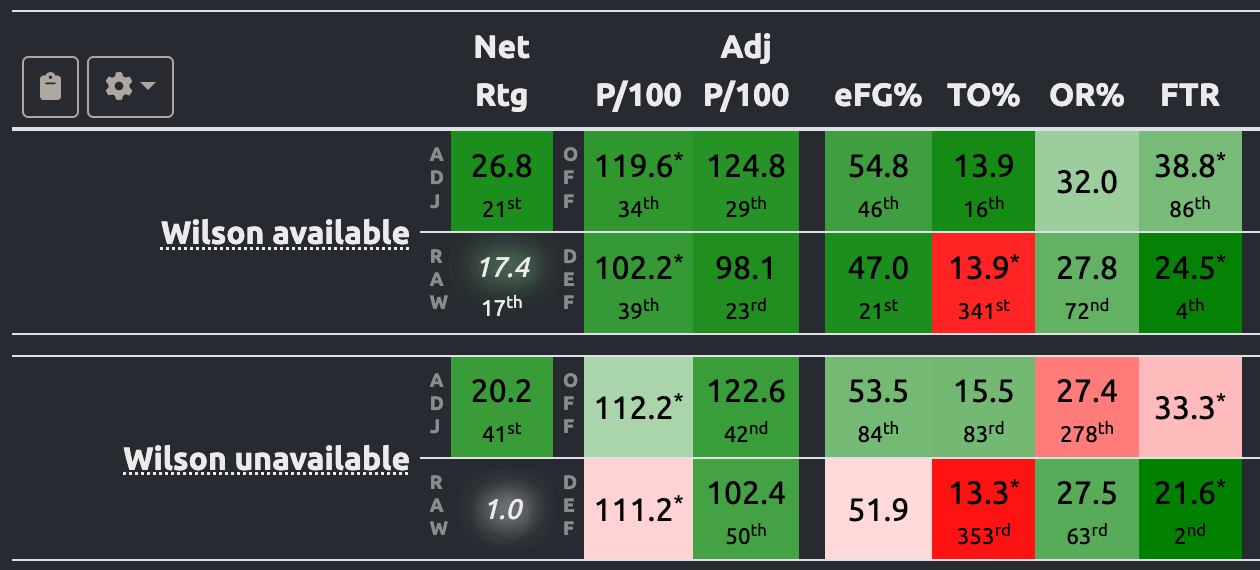
The Tar Heels have taken a step back without him, but many of the numbers remain in the same ballpark. The change defensively is mainly in opponents shooting 2.1% better from three over the eight games without him, which can be chalked up to shooting variance. The larger differential is the drop-off offensively to less second-chances and free-throw attempts. The free-throw rate is potentially concerning as UNC's only losses this season with a FTR over .350 were on the road to Stanford and Cal (14-2 record when meeting the threshold, 10-6 when not). UNC has been held under a .300 FTR in three straight coming into the dance.
As for VCU, it ranks 132nd in FTR allowed defensively at .331. Perhaps more importantly, it has stayed under that .350 threshold in eight consecutive games heading into the Big Dance — including holding the nation's No. 1 FTR team, Dayton (.471), to .273 and .222 in two critical, must-win victories.
That said, VCU has to defend better inside even if it means surrendering some foul shots. The Rams are 0-4 in their games against top-40 offenses by 2P%, all of which are fellow NCAA Tournament teams; they are also 5-7 total against the top 130 for 2P% offense (22-0 otherwise). North Carolina ranks 37th for the full season and would rank 63rd for its percentage in the games without Wilson.
No. 3 Illinois vs. No. 14 Penn (Thursday, 9:25 p.m. ET, TNT; Greenville)
Illinois ranks No. 2 in the country in adjusted offensive efficiency, and it should be able to score throughout the Big Dance. Even with the 12th-highest 3-point attempt rate, the Illini can often survive off shooting nights with the 10th-best turnover rate aiding in maximizing initial chances and the third-best offensive rebounding rate creating second chances. The concerns are more on the defensive end. Illinois ranks dead-last in the country in turnover rate forced, making it potentially susceptible if one or multiple of the areas they typically thrive in slides. They have allowed 80+ points in seven of their eight losses.
The most detrimental staple faltering thus far has been when Illinois allows free-throw attempts. The Illini lead the country in FTR allowed, but are just 4-6 when surrendering a FTR of .270 or higher (20-2 otherwise). The only times they have lost when holding an opponents' FTR under .270 required Wisconsin making 16 3s on 44.4% efficiency and Nebraska to make 12 3s on 46.2% efficiency. The path has been either draw whistles or shoot an astronomical number from deep.
As it pertains to the first round, Penn only ranks 173rd in free-throw rate drawn. The Quakers do rank 11th-best for 3-point efficiency, but likely lacks the volume to reach the make numbers of Wisconsin and Nebraska; they are 274th in attempt rate. If TJ Power gets hot, though, maybe there is hope. The former five-star recruit scored 44 points in the Ivy League title game, and is shooting 28-for-51 (54.9%) from three over his last six games.
No. 7 Saint Mary's vs. No. 10 Texas A&M (Thursday, 7:35 p.m. ET, truTV; Oklahoma City)
Albeit not opponent adjusted, Saint Mary's is one of only four teams in the country to rank in the top 15 for both offensive and defensive rebounding rates, along with Florida, Michigan State, and Duke. The margins that the Gaels are able to create on the glass are astounding, and also pose problems for a Texas A&M team that has struggled against elite rebounding units. The Aggies are...
- 3-5 against the top 50 for OR% (18-6 otherwise)
- 10-11 against the top 170 for OR% (11-0 otherwise)
- 2-4 against the top 100 for DR% (19-7 otherwise)
- 7-9 against the top 235 for DR% (14-2 otherwise)
For Saint Mary's, the game could be about proving it can maintain its elite rebounding numbers against high-major competition. Its rebounding numbers against Virginia Tech (+1.6% margin), Vanderbilt (-10.7% margin) and Gonzaga (+12.7%, -8.9% margins) are a mixed bag at best but in a limited sample size. At the very least, SMC will not be outsized; it ranks 12th in average height compared to Texas A&M ranking 203rd.
Another key metric for the Gaels will be maintaining what has been elite 3-point efficiency (38.6%, 13th nationally). They are 21-0 when they make at least 34% of 3s this season, and 6-5 when they fail to do so. Texas A&M ranks 54th in 3-point percentage defense. As for when the Aggies have the ball, they similarly are 16-6 when making at least 34% from deep, and 5-9 when falling short. SMC ranks 41st in 3-point percentage defense, but limits attempts better than TAMU.
No. 2 Houston vs. No. 15 Idaho (Thursday, 10:10 p.m. ET, truTV; Oklahoma City
Houston is yet to lose to a non-top-5 seed so far this season. To keep that train rolling, and preferably avoid any more losses, the Cougars will look to apply defensive pressure without falling into foul trouble. While four of their six losses have come in the six games allowing over 40% shooting from three, the fact that that level of shooting has only happened six times is telling of the 3-point defense.
As far as other defensive numbers go, Houston is 24-1 when it forces turnovers on at least 16% of opponent possessions (4-5 otherwise), with the lone loss requiring Kansas to record a .400 FTR and make 41.2% of 3s. Speaking of the free-throw rate, the Cougars are an undefeated 17-0 when limiting opposing FTRs under .400.
For the first-round matchup, Idaho ranks 62nd in turnover rate and 188th in free-throw rate; neither are poor rankings but it must be better than those while also facing their toughest foe. Either that, or the Vandals catch fire from three; their 34th-ranked 3-point attempt rate is the fourth-highest Houston has seen, which creates some volatility.
Houston's ability to dominate the turnover margin (+8.0% is third-best in the country behind McNeese and High Point) makes it hard to upset. It hasn't really been rattled, and mostly does the rattling.
