

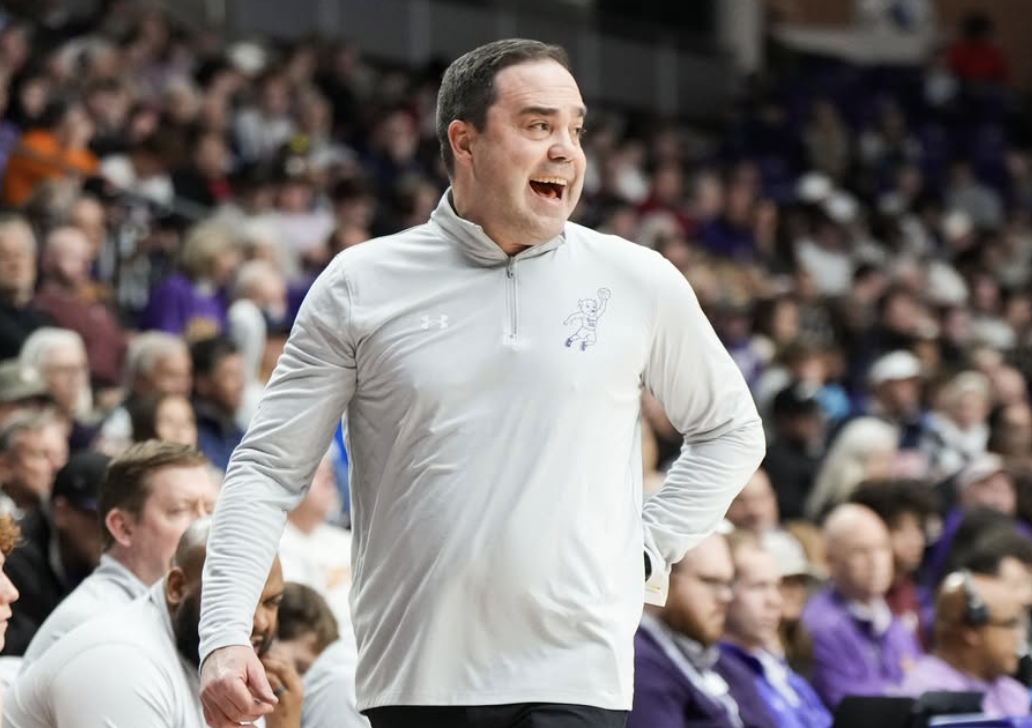
The bus rattles at a frantic pace, as if the wheels are about to fall off, and Kevin Carroll opens his eyes in surrender. Lipscomb was racing through the night on its sleeper bus, but sleep clearly wasn’t in the cards for Carroll, despite his optimism that a bus with seats that convert to beds would give him at least a respectable night’s rest.
When Carroll thought about it for a second, he realized that his players and assistant coaches were probably in the same boat as him. This Monday night was going to be a sleepless one for Lipscomb basketball. The bad news: its matchup with Iowa was less than 24 hours away.
“You’re really starting to question your decisions as a head coach and your scheduling decisions,” Carroll told Basket Under Review, half joking.
But Carroll brought this upon himself. He felt the best bang for his buck was playing SEMO and Iowa on back-to-back days to open the 2026-27 season and he was getting the full back-to-back experience as a result.
Carroll and company discussed a number of different possibilities that included flying from around Cape Girardeau, Missouri, to Iowa City–including Iowa chartering Lipscomb there–but nothing panned out. The quickest way Lipscomb could get from Cape Girardeau to Carver Hawkeye Arena was a six-hour bus ride.
Lipscomb boarded the bus at 9:30 P.M. after a brutal season-opening 86-79 loss to SEMO and drove through the night to Iowa City for its election-night buy game with the Hawkeyes. Carroll and company turned the lights out at 11:00 and didn’t arrive in Iowa City until 3:30 A.M. When Carroll got off the bus and checked his sleep-tracking watch, it declared that he hadn’t gotten any sleep.
 Joey Dwyer

Carroll eventually got to sleep in the hotel, but was only running on a few hours after waking up early to prepare film for Lipscomb’s 12:00 film breakdown of the SEMO game. He caught his breath when the players left for their one-hour break before returning for an Iowa scouting session, walkthrough, pregame meal, and the bus ride to the arena. Lipscomb used a 13-0 run to go up 27-26 on Iowa at one point before Iowa punched back and won 76-54. Carroll laughs at the premise that it was a miracle his team was even in the game with Iowa after all it had been through in the previous 48 hours.
He also knows that what his team did is a relative rarity, but isn’t entirely unheard of. Stetson–Lipscomb’s ASUN foe--also played Nov. 2 and Nov. 3 back-to-back against Clemson and South Carolina. ASUN preseason favorite Queens is playing a Dec. 8 game at Colorado State and will make the trek to Baylor the next night. Carroll believes that’s an indicator of the state of the game and the lengths mid-major programs are tasked with going to generate revenue.
But Carroll had no time to deliberate the state of the sport in that stretch. There was no direct flight from Iowa City to Nashville, so his team flew from Iowa City to Chicago, connected to Nashville, and arrived home at 4:00 P.M. the afternoon after the Iowa game. Three days later, they were on the floor at Allen Arena fighting to hold onto a second-half lead against SIUE. Carroll recalls his team looking dead in the second half because of the travel, but Lipscomb hung on and won 78-77.
Celebrating wasn’t much of an option, though. Lipscomb’s biggest rivalry game–the Battle of the Boulevard–loomed with Belmont set to come into Allen Arena on Tuesday, Nov. 10, three days after Lipscomb’s Saturday win. Carroll brought his players in for a Sunday-night film session and dinner before a light Monday practice. Before he knew it, his team was battling to win against Belmont for the first time since 2022.
He hoped they had enough left in the tank to do it while playing their fourth game in nine days, and it turns out they did. Lipscomb’s gauntlet of an opening nine days ended with Carroll picking up his first win over Belmont as a head coach and a court storming.
“It was a lot physically and probably more so mentally,” Carroll said. “I was extremely proud of our team not just for Tuesday, but for their ability and resolve through the week to get through just an extremely challenging week.”
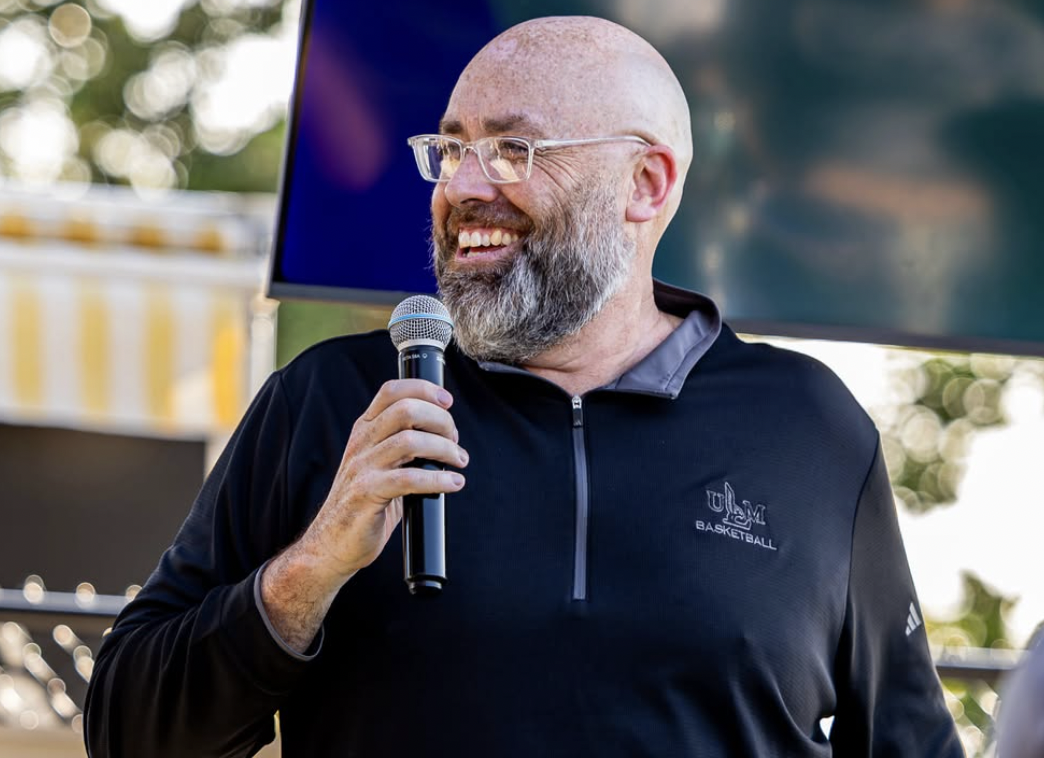
WITH A FEW DAYS left until UL Monroe coach Ryan Cross boards the airplane to Texas for a non-conference buy game marathon of his own, he pulls out his calculator. “I’m old school,” he jokes.
But Cross isn’t too old school to know that he had to evolve in his first year as UL Monroe’s head coach. He knew the deal when he took this job: buy games are among the only ways to generate revenue until he gets a historically down program rolling in the Sun Belt. Cross’s first schedule includes eight buy games–against Texas A&M, TCU, Arizona State, Grand Canyon, LSU, Tulane, Ole Miss and Oklahoma–when he really only needed to add two to meet school requirements.
He knows his team will have to be almost perfect to leave any of those games with a win. He also knows that playing Texas A&M and TCU–which it lost to in double overtime–in a Monday, Tuesday back-to-back before playing Arizona State and Grand Canyon in a Friday, Saturday back-to-back could wear his team down. He believes they’ll prepare his team for the Sun Belt Tournament—which will require them to play on back-to-back days if they make a run. More importantly, he’s willing to take some losses on the chin now if it means positioning his program as more than the Sun Belt bottom feeder it was before his arrival.
As Cross types the numbers into his calculator, though, the method behind his madness becomes much easier to understand. He murmurs a few numbers and smacks the keys before declaring that his program is bringing in $720,000 in buy-game revenue this season.
Cross has to give a significant portion of that money back to UL Monroe to cover athletics expenses, but he keeps more of it and puts it toward player compensation. The losses he takes will inevitably sting—particularly if they come by a large margin—but they’ll be easier to swallow when UL Monroe lands an impact player in the portal as a near-direct trade-off for playing a buy game.
“My philosophy was real simple: raise revenue, save money so we can put together a team that can be a competitive team in the Sun Belt Conference,” Cross said. “My goal is to be a good team in the Sun Belt Conference, not win the non-conference national championship.”
Sounds familiar.
“Goal No. 1 is to produce the most amount of revenue,” Queens coach Grant Leonard said the morning of his team’s buy game win at Loyola Marymount, which reportedly netted it $90,000. “The two things I care about are preparing our team for conference and generating revenue. Maybe some people want winnable games. I’m not worried about that as much. I’m worried about winning against the 25-like opponents. I’m not worried about winning the buy game. I’m worried about taking the lessons that we can apply for ourselves in conference play.”
There’s still room for additional buy game revenue to be used for non-NIL costs like upgraded travel, equipment, adding additional members to coaching staffs that aren’t budgeted in the initial staff pool, and other miscellaneous costs, but buy game revenue going directly into the roster through revenue sharing is among mid-major basketball’s biggest trends.
Carroll points out that the trend has led to a number of programs choosing to put their non-conference record–and thus its overall win total–to the wayside in an effort to generate revenue and form stronger rosters. He doesn’t state it as a good or bad thing, but he does seem curious about the long-term impact of that philosophy. Among the variables at play is how athletic directors and fans at mid-majors respond to lower win totals. Another is the impact of there being far more demand for buy games than supply. Perhaps the change means that there will be more talent at mid majors than there would be otherwise.
But Carroll isn’t closed off to the idea. He knows he can’t be.
Cross gets the majority of his player compensation pool from buy game revenue. Liberty coach Ritchie McKay says he would do the same thing if he got bought a few times. Georgia State coach Jon Cremins uses a mixture of fundraising and buy games to field a roster. Leonard estimates that he gets 35-to-40% from buy games–and doesn’t buy Division II teams to make sure the money he gets from buy games stays with his program. Lindenwood coach Kyle Gerdeman–who notes that he’s fortunate that his administration allows him to spend buy-game revenue on players because not every school does–estimates that he gets 90% of his player compensation from buy games.
“It definitely gives you a chance to level the playing field a bit,” Gerdeman said on the day of his buy game against Nebraska. “I think you’re taking those games with a big dose of reality of understanding how big the challenge is, but you also know why you play them. I think the guys do, too.”
HOW MANY TIMES did you hear no from a team this offseason from a team you were looking to get bought by?
“People were open to playing us this year, but there were still the teams that would tell us ‘no’ right away,” Leonard said, “Like ‘you guys are too good.’”
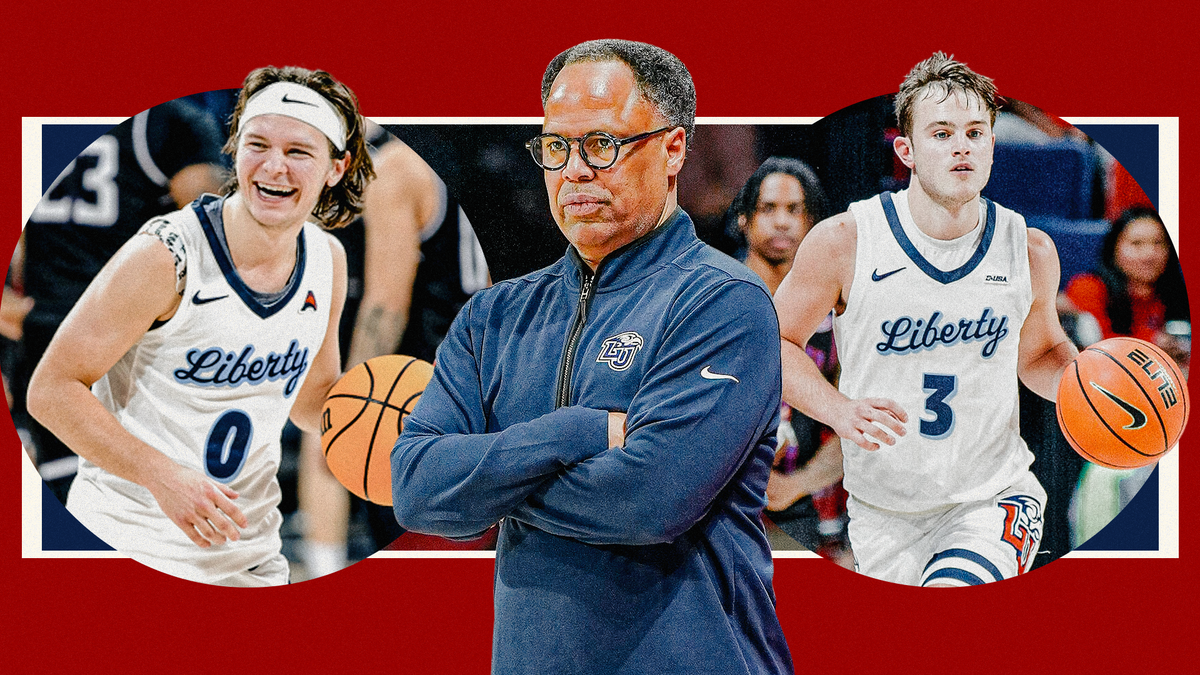
“I think last year the highest we got to in the NET was 104, and the previous year they were, I believe, 100 in the NET rankings; no one is signing up for that when they can sign up to play a team in the 330s that they feel like they can beat by 40,” Carroll said. “It’s honestly the hardest part of the job in a lot of senses, the scheduling part, and that has a lot to do with the buy games.”
“Enough,” McKay said.
It doesn’t seem like that’s an accident.
“You don’t want to schedule a Liberty or schools like that. Those guys are really, really good," Cremins—now a mid-major head coach and a Vanderbilt assistant the last two seasons—said, citing the system in place from a Power Five perspective. "They have high-major players, incredible coaches, and really good NIL budgets. Really, with those guarantee games now, you’re looking for teams that have a really low rev share number.”
 Joey Dwyer
Even Cremins—in his first year at Georgia State, a Sun Belt program that’s been down but has a talented roster—acknowledges his program isn’t the first choice for Power Five teams to schedule. He believes most mid majors can get bought, but it's a complicated process.
What coaches like Cremins, Carroll, McKay and Leonard are up against isn’t necessarily the uncompetitiveness of Power Five coaches as much as the system they’re encouraged to fit into. McKay points out that Alabama coach Nate Oats and LSU coach Will Wade will play almost anyone, but those two are decidedly the exception. McKay doesn’t blame anyone who won’t schedule a program like his. He gets it.
The formula is clear for Power Five programs. Quad-one games are a commodity. Quad-four games in which a Power Five team can overpower a mid major and win by 20+ points are, too. Quad two games are fine. Non-conference quad threes and quad fours in which the team getting bought is capable of winning represent the worst-case scenario. Power-conference leagues have gone as far as to advise programs how to schedule.
For Wade's NC State team a year ago, McKay’s team was a quad-three opponent–as were three other teams in Conference USA–which easily explains why he heard no so often. Cremins’ Georgia State program is No. 218 in KenPom and has a few former high-major players on its roster. Leonard’s Queens team finished No. 192 and will have to outperform already-high preseason expectations to get into quad three, but it’s a league winner and is No. 47 in minutes continuity–making it a dangerous quad-four opponent.
McKay didn’t land a Power Five buy game this year. He's not the only one, getting bought at programs like VCU isn't even a thought. Cremins has one buy game against a true Power Five, though he did get bought by Charlotte and Fresno State. Leonard is insistent that it’s possible to land them–and has proof of concept with Oklahoma State, BYU, Houston, LSU and Baylor on his schedule–but admits his program isn’t anyone’s first choice. He believes landing buy games requires releasing a non-conference schedule well after the desired date and being ultra-flexible on dates to serve the Power Five program.
Power Five teams generally seem to avoid teams ranked between 100 and 300, as they provide the worst balance of risk and reward. As a result, McKay’s Liberty program, Cremins’ Georgia State program, Carroll’s Lipscomb program and Leonard’s Queens program are stuck in no–man’s–land– a number of industry sources are surprised that Leonard was able to land five Power Five buy games and would likely feel the same way about Carroll having four on his.
Their only way out of it is to experience a few down years that move them out of the top 300 in the NET for a few consecutive seasons or move into the top 100–which only a few mid-majors have done. The teams that have become reliably top 100 have earned opportunities to play Power Five opponents in non-conference play–albeit generally in home and home, neutral-site matchups and in multi-team events rather than buy games.
“We just happen to be good enough to be right there in the wheelhouse of what teams were looking for,” Wichita State coach Paul Mills—who landed a neutral site game against USC through a third party and a game with Kentucky at Rupp Arena that was initially a third-party game, but ended up being scheduled directly through the two teams. “Other quad ones: if they’re looking for games and they want a quad one, they play teams that are on the lower end of the quad one spectrum. If you’re gonna play at somebody else’s gym, they’re gonna find 65-to-75 on the NET.”
Even Wichita State isn’t a fair comparison to Queens and Liberty, though, because it’s in a multi-bid league. Mills’ program, along with Saint Louis, VCU, Memphis, San Diego State, and a number of others, has found its way into the top 100 each year. The only programs that became top-100 teams in traditionally multi-bid leagues in 2025-26 were High Point, Miami University, Akron, McNeese, Stephen F. Austin, Yale, Utah Valley, Northern Iowa, Belmont, Illinois State, Hofstra, Cal Baptist, and UNC Wilmington.
The only ones that appear to have buy games on their schedules in 2026-27 are High Point, Stephen F. Austin, Yale, Northern Iowa, Illinois State, Hofstra and Cal Baptist. Two of those seven programs have first-year head coaches. Even then, it’s surprising those teams were able to land buy games.
Surely it wasn’t an easy feat to land them.
IN VANDERBILT coach Mark Byington’s 2025 press conference before Lipscomb and Vanderbilt played for the first time since 2014, he had an admission.
He’d just done something that scheduling gurus often don’t advise. He was about to play a good, local mid-major. Byington scheduled the game for a multitude of reasons and won in blowout fashion, but he acknowledged that his scheduling process wasn’t quite conventional.
Byington was once in the shoes of good mid-majors as James Madison’s head coach and led the second-highest-ranked team from a one-bid league during the 2023-24 season, but he can’t let his sympathy for mid-majors win. He and several other former mid-major coaches turned Power Five coaches have had to put their programs first by avoiding programs like the one he ran at James Madison at all costs. That James Madison team proved the concept by beating Michigan State in a buy game.
Michigan State coach Tom Izzo has job security and was willing to risk playing James Madison for his team’s long-term benefit, but he’s the exception. Most of his colleagues will play the numbers game and won’t play games like that for the foreseeable future.
“I think that’s always going to be the same,” Gerdeman said. “People are going to spend money on a game that they think they can win. We do it the same way with our non-Division I teams, for example. I’ll be honest. I don’t want to play a competitive non-Division I team. I want to play a team that, on our worst day, we can walk in and still win by 20. I think that’s the thought that a lot of schools have with their games. I don’t think schools are looking for challenges. At the end of the day, there’s a lot of pressure on teams that spend that kind of money to win. The last thing they need is Lindenwood coming in and beating them.”
Perhaps things would be different if the NCAA hadn't shifted its focus so heavily toward the current NET ranking formula, but it has. As a result, the clearest path to Power Five coaches keeping jobs and making the expanded NCAA Tournament field is scheduling to appease the NET. They've done that.
As a result, the only Power Five teams to lose buy games through the first 11 days of the season are Kansas State, Oklahoma, and Purdue. Nine mid-majors have lost buy games to other mid-majors. The consensus is that chaos is inevitable, but it will remain relatively limited, and mid-major 20-game winners will become less prevalent.
“Unless there’s a national scheduler, I doubt there’s a fix,” McKay said. “The only other option you have is if the NCAA Tournament selection committee had as a criterion or subtly spoke to your strength of schedule [being emphasized].”
But will a major shift in scheduling that popularizes playing good mid-majors ever actually happen?
“I don’t see that ever changing,” Carroll said, “Because that doesn’t benefit the high majors to make that change.”
