

If you're unfamiliar with IU Indy (formerly and forever in my heart known as IUPUI), Ben Howlett and The System, let me introduce you. The System means running. A lot. Howlett presses the entire game, sprints out in transition, and frequently runs full hockey-style five-player line changes to keep his guys fresh.
I recommend this piece by Sam Federman from last summer for a deeper dive, but the ten-second version above should get the point across.
The System debuted at the D-I level last year, but it doesn't come from Howlett. He played and then coached at West Liberty University under the brains behind the operation, the legendary Jim Crutchfield. Howlett, though, was the first to workshop it at the top level of the college game.
In year one, there were signs of life, but they were relatively few and far between. The Jaguars went 7-25 (3-17 Horizon League), a three-win decrease from the one and only season under Paul Corsaro. They finished 317th at KenPom, an improvement over their 354th spot in preseason projections but nevertheless a mild drop from 312th under Corsaro.
So far this year, it's been a different story. The Jags have four wins in seven games and have jumped from 316th preseason in KenPom to 275th in the season's first month. They led Penn State for nearly 25 minutes before ultimately losing by seven. They've won three of four against the four D-I teams within 100 spots of them at KenPom, either way, including a win over UT-Martin, an OVC favorite.
And Howlett has accomplished it by doing something he may have never thought he'd do: slow down. Not all the way, but enough.
The changes by the numbers
Don't get me wrong, this team still runs. If you saw the Jags last season and you've watched them this November, it probably looks nearly indiscernible play by play. They still press full court for 40 minutes. The hockey subs still come into play. Their games are still track meets: in seven contests, neither IU Indy nor their opponent has scored below 70 points even once. But a look at the underlying numbers shows some distinct changes, most of which have had a positive effect early on.
First and foremost is the pace. The 25-26 iteration of the Jaguars played 74.6 possessions per game, the highest in the country. This season, they're at 70.6 possessions, an unremarkable number that has them in the 67th %ile for pace. But if they're not backing off the press, what's causing it?
First of all, the Jags have made strides on the offensive glass. They get three more misses back per game, despite taking almost two fewer shots. That's boosted their offense while slowing the game down possession-wise.
The stat that jumps out most, though, and that points directly to the slower pace, is how much of IU Indy's games are played in transition. Last year, it allowed a stunning 17% of opponent FGA to come in transition while taking 17.5% of its shots on the run. This year, offensive transition sits at 14.6%, while transition FGA defense sits at 14.3%, up from 11.9% before its most recent game against William & Mary. In transition efficiency, the numbers have gotten worse on offense but improved defensively. Last year, the Jags allowed an NCAA-worst 69.2% on transition FGA. This year, it's 67.8% but was 65.2% before the W&M game, still bad but survivably so.
Overall, the defense has been much stiffer inside. Year-over-year, Jags opponents are shooting 8.5% worse at the rim and taking 3% more mid-range FGA than a year ago, when they forced the fewest of any team in the country. The 3-point defense has also been significantly better, but that may be attributable to variance.
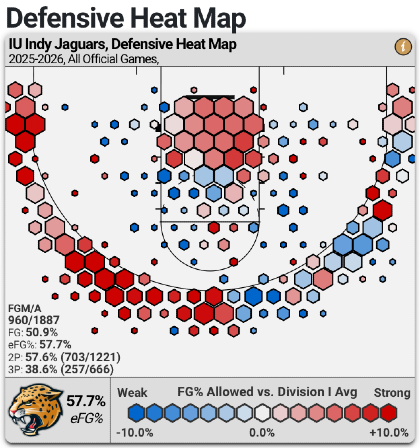
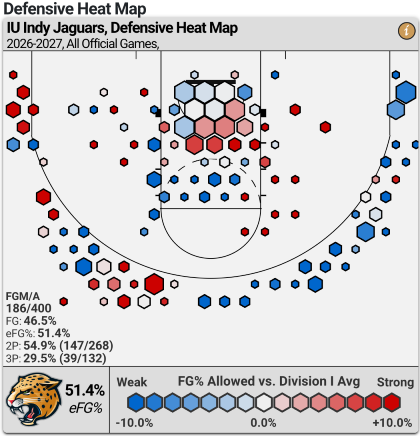
IU Indy defensive heat maps, 25-26 left and 26-27 right
IU Indy's improvement is more noticeable on the defensive end, but it's been better offensively too. The change is attributable to a strategic alteration of the shot diet. The Cats are taking threes at a rate about 10% higher than last year's already-above-median 42.7%. Their 52.6% 3Pr so far is in the top 20 nationally. While that creates variance that could bug them game-to-game, it has paid off impressively so far, putting the math more in their favor while opening up opportunities to offensive rebound and forcing at least one defender back to prevent so many transition opportunities.
The other change has come at the free throw line. No team took fewer free throws last year than the Jaguars, whose 21.1% FTA rate was more than 3% lower than anyone else. That number has risen to 33.3%, around the 36th percentile nationally. They're not overpowering, but it's a marked improvement over a year ago. All told, the Jaguars have posted a 9.3 net rating so far, per CBB Analytics, compared to -6.3 a year ago. Now let's look at who's driving the strong start.
The players behind the numbers
As you may expect in The System, there isn't really a star. Because of how much running this team does, they have 11 guys who have played 60+ minutes in the first seven games. All told, the Jags run out 98 bench minutes a night, or 49% of total minutes, a top 15 mark in the country. The production mirrors it, with 40 points per game (right around 49%) coming from the reserves, similarly a top 15 ranking.
If you're looking for a place to start, Billy Smith is as good as any. The fifth-year transfer from Chattanooga leads the team in scoring at 14.3 PPG, and he's doing it by simply not missing.
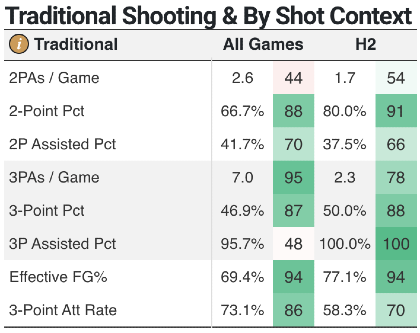
This is what the shooting chart spits out for Smith. He's making 67% of his twos (and he's made 12 of 13 at the rim thus far) and a ridiculous 46.9% from three despite nearly three of every four shot attempts coming from beyond the arc. In the second half of games, he's rocking a cool 80/50 split from the floor. Oh yeah, he's also come off the bench in all seven games.
The two returners are Kameron Tinsley and Reece Hagy. Tinsley is the third-leading scorer and second-best three-point shooter behind Smith, making 39% of his six attempts per game. Hagy, meanwhile, is scoring just 1.7 points per game in under 12 minutes a night, but has a nearly 3:1 A:TO ratio and is swiping away a 2.1% steal rate, which ranks in the 65th percentile.
If you're into on/off splits, Peyton Heiss is your guy. When Heiss is on the floor, the offense may not shoot as many free throws, but they make more shots, take more threes, and pass the ball much better without turning it over more. Defensively, they're nearly 13 points better when the 6'4" guard is out there defending versus riding pine.
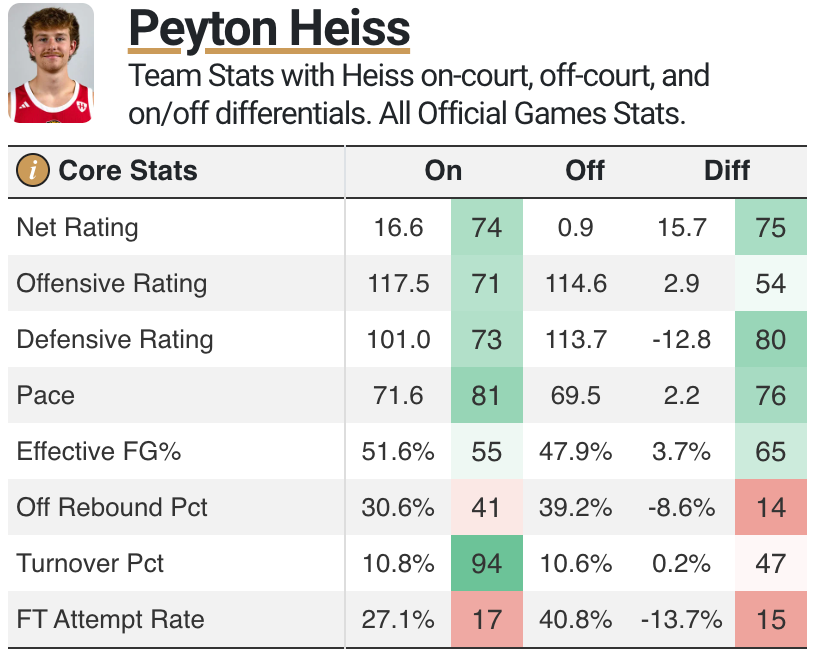
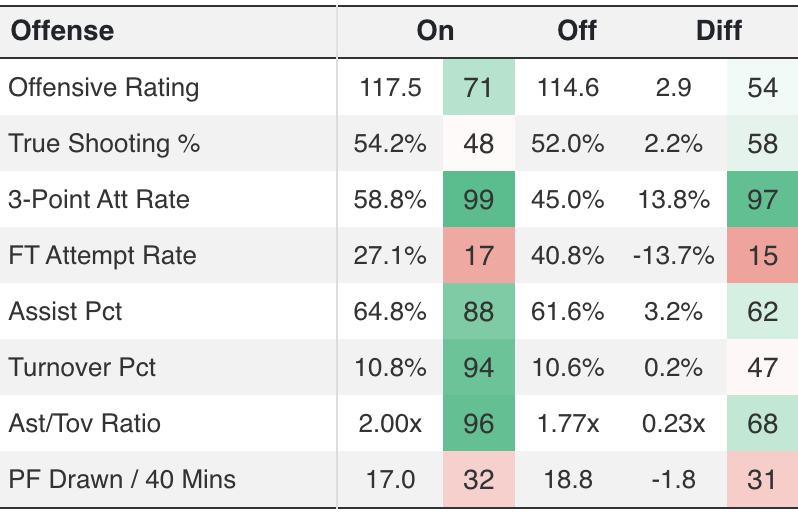
Peyton Heiss on/off splits
Part of what makes this team so great is that anyone can beat you on any night. But if Coach Howlett can keep leaning on his vets and returners, this team will continue to shine.
What this start means
At the top of the article, you may remember I mentioned that IU Indy was up to 275th in KenPom and thought that sounded unimpressive. In comparison to the rest of the country, it largely is. However, it's important to contextualize where this program is.
A 275th-place finish in KenPom would be the best since 2021 and just the second time this side of COVID finishing inside the top 300, a stretch that includes four different coaches. Within the Horizon League, the Jaguars sit 10th out of 12 teams right now by KenPom rank. However, there are a ridiculous SIX teams in a 20-team range from the Horizon, with IU Indy sitting last of those six.
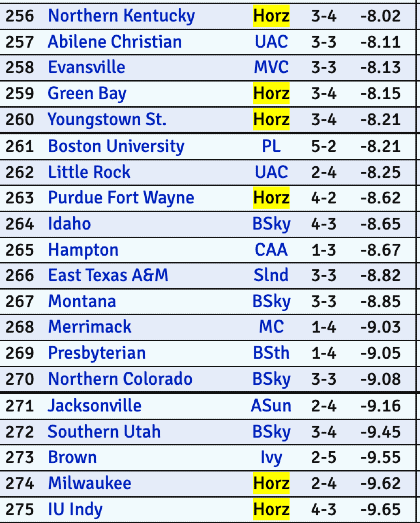
If it can filter its way to the top of this group, that would put the Jags 5th in the league, an achievement IU Indy has not completed since making the move from the Summit League in 2017-18. Its best finish was 6th place in a 10-team Horizon in its first year. Even if IU Indy gets to, say, 8th in the league, that would be its second-best finish ever as a Horizon member. The Jaguars haven't played a .500 season or better in conference play since 2015-16, in the Summit. There's a real path to do so here and Ben Howlett will have his boys ready and running in pursuit of it.
