


Midway through his 18th season and ninth at his alma mater is not a time when you would often find a veteran coach changing a fundamental aspect of his team’s playing style. Yet, at the precipice of Atlantic 10 play, the University of Dayton’s Anthony Grant has done just that. In Grant’s tenure in charge of the Flyers, the team has had Obi Toppin and DaRon Holmes II-led highs and “last team out of March Madness” and losing three straight buy-game-at-home lows. Throughout that tenure, no matter what UD’s fortunes were at a particular time, one constant criticism has been leveled at Grant and his charges. Whether it is Twitter, message boards, or the local Marion’s Pizza, you’ll likely hear some form of “they play too slow” from Flyers fans.
Before this season, Grant’s teams at Dayton ranged in ranking in KenPom’s adjusted tempo from 220th to 354th. The Obi Toppin COVID-shortened dream season did so on average at 67.6 possessions a game, while DaRon Holmes II leading Dayton back from a double-digit deficit over Nevada did so averaging 64.5 possessions a game. Those two tournament teams* (sad caveat for the canceled 2020 March Madness when Dayton was in line for a one-seed) for Grant were ranked 220th and 334th nationally in tempo. Slow, deliberate offense has been the constant for Anthony Grant’s Flyers squads.
The downfall of this style for a team like Dayton has been seen all too many times for Flyers fans’ liking. Popularized by Jordan Brenner and Peter Keating’s Slingshot Model, underdogs in college basketball who slow the pace down, shoot threes effectively, and create extra possessions via turnovers or rebounding have a better chance of pulling off upsets in March Madness. The same is applicable to regular-season college basketball as well. If a buy-game opponent comes into UD Arena and the Flyers are playing at a slower pace, there are fewer possessions for the typically more talented Dayton team to exert its dominance. Real-life examples of this have been littered throughout Grant’s time at Dayton, most infamously a three-game losing streak in 2021–22 to UMass Lowell, Lipscomb, and Austin Peay that quite literally kept the Flyers out of March Madness as the “Last Team Out.”
At the start of every college basketball season, the well-worn cliché of coaches and players swearing up and down they will play at more pace in the upcoming season is a sign of the upcoming season’s arrival. With a career’s worth of evidence to the contrary, credit to Anthony Grant for not providing such clichés though. There is the occasional player or Dayton-linked pundit who will claim the Flyers will get up and down the court more this season, but this usually elicits a knowing smirk and chuckle from most Dayton fans. Yet, as the college basketball season rounds toward conference play, there is plenty of evidence that Anthony Grant has tried to make sure his Dayton team does play with more pace.
Through their 13 non-conference games, Dayton has an adjusted tempo of 69.5 possessions a game, the highest in Coach Grant’s time with the Flyers. Now, pace across college basketball is up across the board as well, but the 155th rank in adjusted tempo on KenPom would be easily the highest seen in the Grant tenure. Their average possession length on offense of 17.1 seconds would be the shortest average possession length for UD since that Obi Toppin 2020 season. This year’s version of Dayton is not exactly the Showtime Lakers, but by comparison to their predecessors, an average-paced team among D1 has this Dayton team a Mach 3 jet compared to the Wright Flyer of prior seasons.
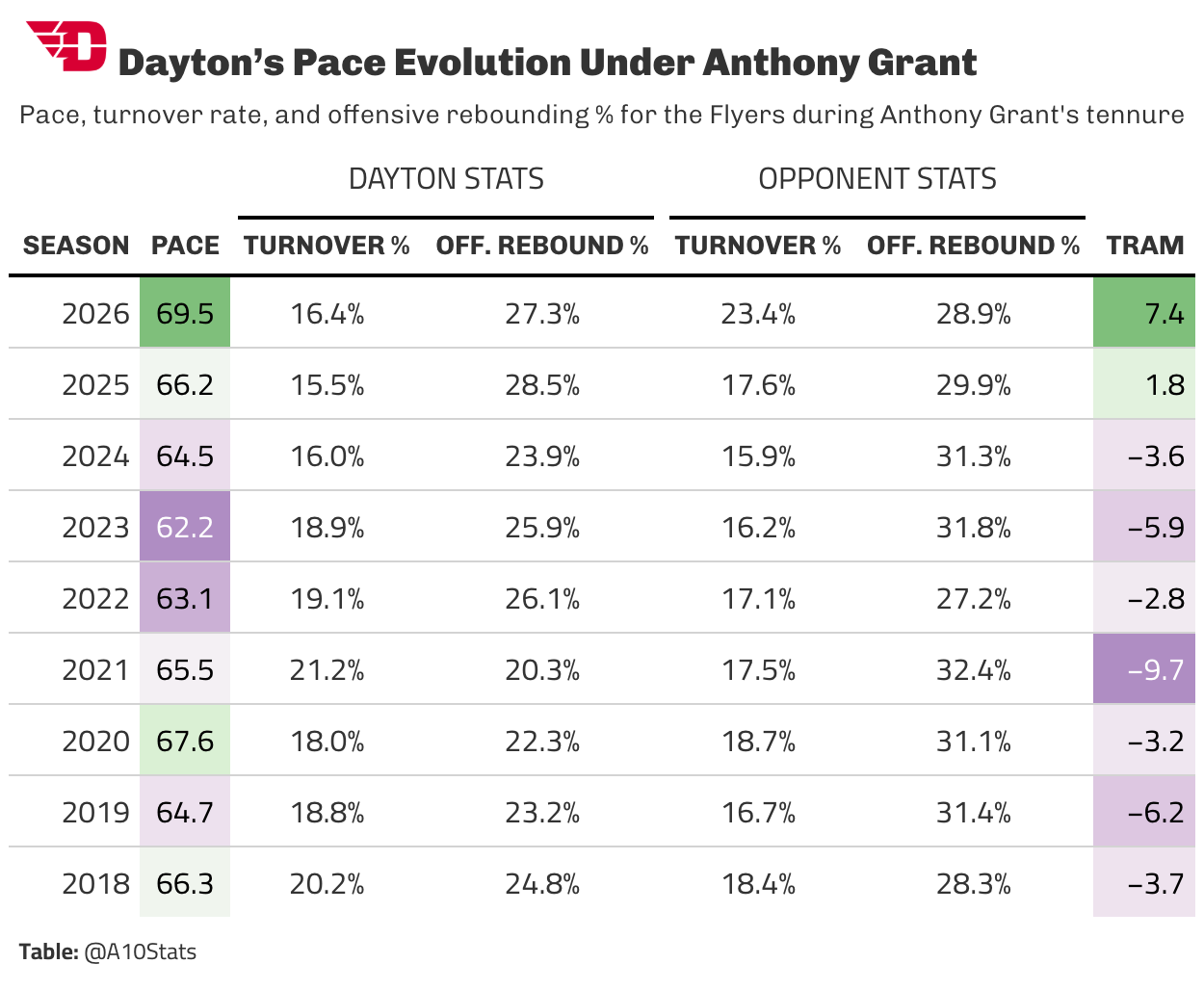
Not only is this version of Dayton playing at a faster pace to get more possessions, but they are also earning extra possessions on defense at a rate they have not done in a while. The 23.4% turnover rate on defense for the Flyers this season is easily the highest seen during Anthony Grant’s tenure and is 7th nationally at the time of writing. In addition to taking the ball from opponents, the Flyers have done well to limit turnovers on their end with a below-average 16.4% turnover rate of their own. While Dayton isn’t a prolific offensive rebounding team, their 27.3% offensive rebound rate is the second highest of Grant’s time in Dayton.
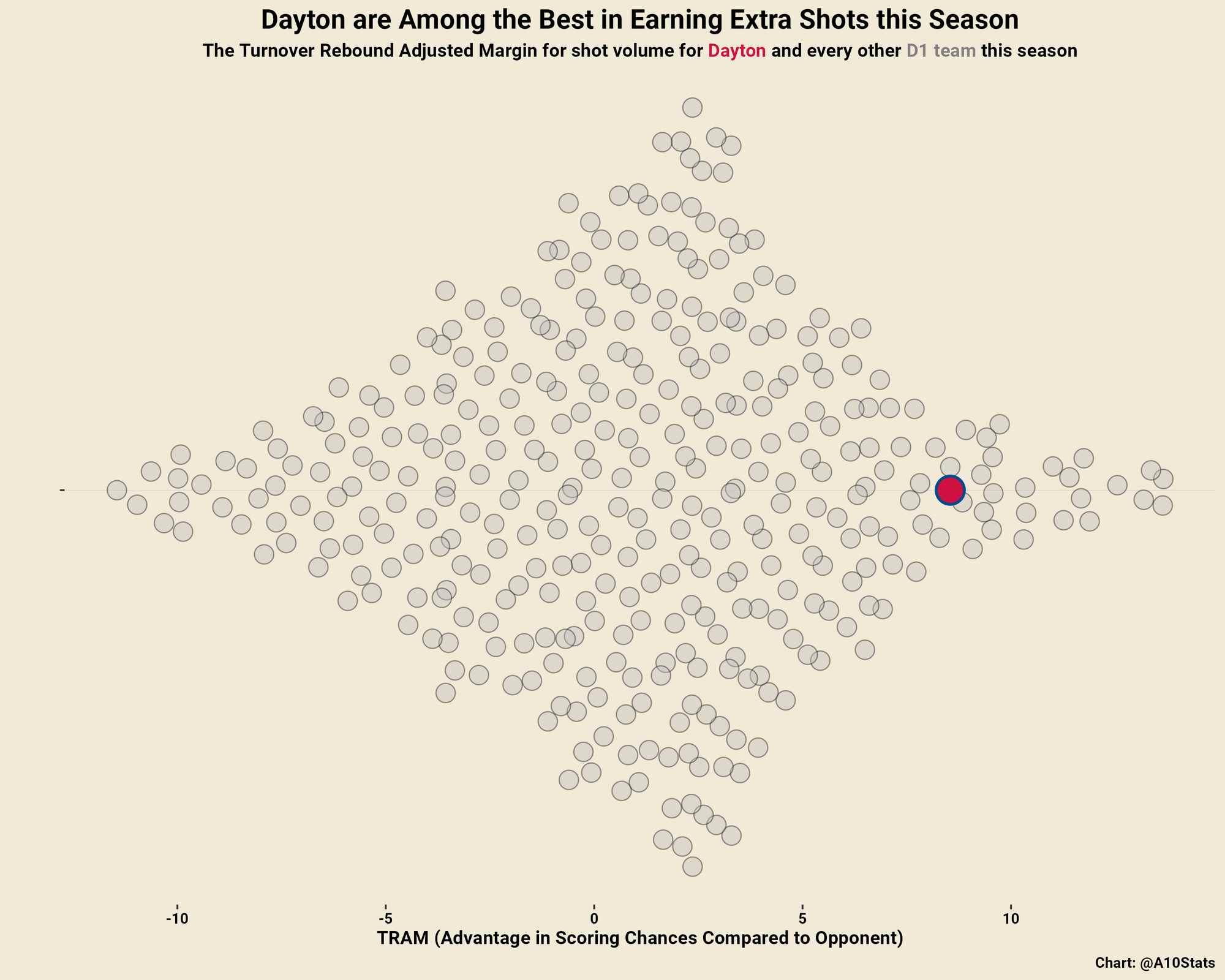
The impact for Dayton of creating more turnovers and digging out more rebounds than they have previously can be quantified using Shot Volume and “TRAM.” John Gasaway has shared some ways to calculate shot volume with his Shot Volume Index (SVI), and Chris Gallo built on this work with his Turnover-Rebound-Adjusted Margin (TRAM), which “measures a team’s advantage in scoring chances based on turnovers and rebounds.” Using Gallo’s TRAM measurement for Grant’s Flyers teams across his career, the current squad has a TRAM of 7.4, by far the highest of any Dayton team with Grant in charge. The Flyers forcing turnovers and getting more rebounds than they had in previous years has seen them 25th nationally in TRAM, meaning they are one of the top teams in the country at creating more scoring opportunities than their opponents.
So, the Dayton Twitter naysayers have won. Anthony Grant has succumbed to their demands, and his Dayton team is playing at a (ever so slightly) above-average pace. The Flyers are among of the top teams at creating more scoring opportunities than their opponents in the country. Everything from Stuart Hill to Edward C. Moses Boulevard is rosy, right? Unfortunately for the Flyer Faithful, the story heading into Atlantic 10 play is like one they have heard before, where a nearly perfect conference campaign is required for at-large consideration and even then, it might not be enough. If that is the case, Dayton will have to do what it hasn’t done in over two decades: win the Atlantic 10 tournament to go dancing.
How did Dayton find themselves here despite the seemingly philosophical changes Anthony Grant made with this Flyers team? The increase in pace giveth to Dayton for much of the season, but it also taketh away in the headline games of the Flyers’ non-conference slate. In matchups against BYU, Virginia, and Cincinnati, even though they matched up against presumed NBA lottery picks and expensive NIL-payment opposition, UD did not take their foot off the proverbial gas. In those three games, the possession count was 75, 74, and 81 respectively. Remember that Slingshot model we discussed, where a slower pace allows for fewer possessions for the more talented team to exert its dominance? These talented rosters at BYU, UVA, and UC were able to do that over 40 minutes despite Dayton either leading in the game or putting a scare into their big-name opponents. A slower pace might have allowed less time for those opponents and for Dayton to escape one of those games with a win.
It was surely disappointing to not win any of those big games for Dayton, but the common refrain before the Flyers’ matchup with Liberty on December 20th was that a win and a 10–3 non-conference record would keep UD’s at-large hopes alive. Sixty slow possessions, a 44% Flames three-point shooting performance, and a three-point loss against Liberty at UD Arena later meant that despite a veteran coach in Anthony Grant trying something new for much of the season, a frustrating loss that looked all too familiar for the Flyers means the outlook for Dayton fans in March looks similar to what it has been f0r many of those deliberately paced teams in the past.
