

The NCAA Tournament selection committee revealed their early top 16 seeds on Feb. 21. To few people's surprise, the top No. 1 seeds were Michigan, Duke, and Arizona. The debate that raged in the week leading up was who would snag the fourth No. 1 spot after UConn dropped a home game to Creighton, and the committee leaned in favor of Iowa State on at least the partial basis of its head-to-head win over Houston. A few other notable placements included UConn staying ahead of Houston on the No. 2 line after its loss and Texas Tech not falling further than the No. 4 seed line despite losing JT Toppin for the season.
The reveal was already a few days ago, and 15 of the teams in the committee's top 16 has logged at least one game since then. Still, the committee's rankings and the chair's comments on air during the reveal are the best insight we have into what the bracket might look like next month. As such, let's dive into some takeaways and how each might impact not just the top of the bracket but the middle seeds and the bubble. Before jumping in, here is a quick refresher on the committee's top 16:
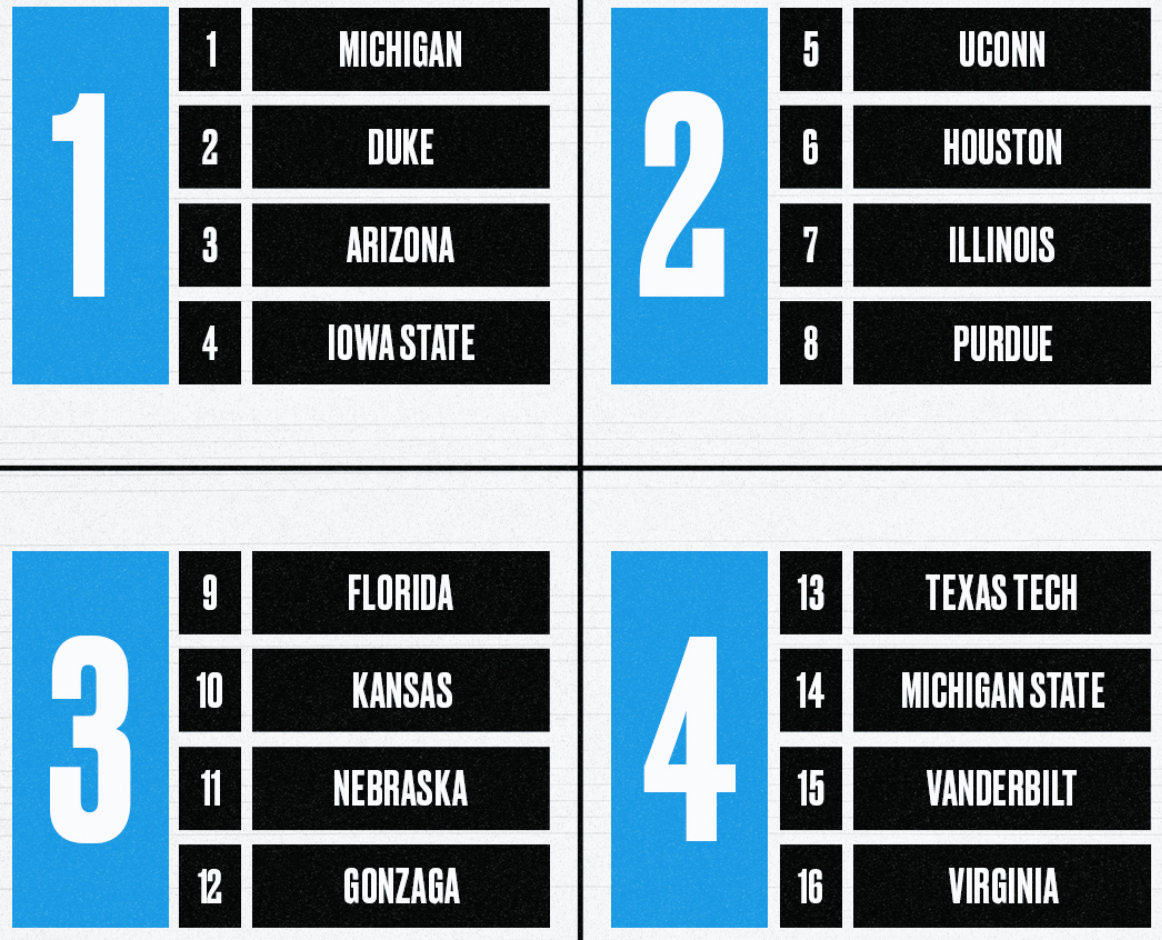
As we dive into takeaways, keep in mind that these are speculative based on the minimal information gained at the Bracket Preview. Given the Bracket Preview is the only time we hear from the selection committee before the official reveal of the field of 68 next month, though, it is all we have to go on for clues from this committee instead of just prior committee precedents.
Head-to-head results matter. Even at home.
The most pressing question coming into the Bracket Preview was who would earn the last No. 1 seed. As mentioned in the introduction, the committee settled on Iowa State for the spot. While the Cyclones have plenty of other qualities on their resume to warrant No. 1 seed consideration, they were behind Houston in both resume and predictive metric averages on Bracket Preview day. When asked about Iowa State vs. Houston, the committee chair noted Iowa State's excellent quality wins and lack of bad losses, but also its head-to-head win over Houston.
The specific mentioning of the head-to-head result is notable, perhaps especially so given Iowa State won that game at home. For some, it might feel more prudent to only award major head-to-head kudos for winning on a neutral site or on the road, but this committee seems to lean in favor of those mattering regardless of location (though probably more so if on a neutral or on the road). While it mattered for Iowa State vs. Houston at the Bracket Preview, the in-season precedent also could have impacts throughout the seed list next month.
For instance, as early as the same night as the Bracket Preview, Duke picked up a massive head-to-head neutral-site win over Michigan. Sticking with teams in the Bracket Preview, Illinois owns a road win over Purdue. Moving off the committee's top 16 and into the uncharted waters of the rest of the field and bubble, there are plenty of other notable nonconference and intra-conference head-to-head results that might have gained value over the weekend.
For some examples of head-to-head results on similar projected seed lines right now, Tennessee has road wins over Alabama and Vanderbilt, Villanova beat Wisconsin in Milwaukee, Texas A&M has road wins over fellow bubble teams Auburn, Texas, and Georgia, Indiana beat UCLA on the road, Texas won at Missouri, and New Mexico beat Santa Clara at home.
Elite-level wins reign supreme.
When discussing UConn vs. Houston for the No. 5 overall spot, the committee chair referenced that UConn's best three wins were better than Houston's best three wins. Albeit framed around two of the best teams in the country, the insight into valuing a team's best wins so strongly carries weight. To use the chair's own words, "they weighted those wins a little bit higher." Looking further down the seed line, there are several teams that could gain or lose ground in the eyes of the committee for their quantity or dearth of quality wins.
For instance, North Carolina's predictive metrics (29.7 average) paint the picture of a No. 7 seed but it owns five Quadrant 1A wins — including a home win over the projected No. 1 overall seed (Duke) and a road win over a No. 4 seed (Virginia). Bracketologists had already been labeling UNC as a projected No. 6 seed for weeks, but the committee's comments regarding the elite wins brings more confidence to those projections or might even indicate the resume is underrated.
Wisconsin is another potential beneficiary given it owns road wins over Michigan and Illinois. Kentucky doesn't own quite that level of top-of-the-line wins but its collection of victories over St. John's (neutral), Arkansas (road), and Tennessee (2x) could earn a boost in the eyes of bracketologists due to the committee's preferences.
On the downside, Louisville becomes something of a nightmare for bracketologists and the committee alike. The Cardinals' predictive metrics (14.7) are superb and could warrant a jump into the protected seed conversation. However, they are 0-6 in Quadrant 1A. Perhaps a team like Saint Louis, whose best victory is over VCU or Santa Clara, could also see a dip due to lack of elite quality, although it hasn't had the opportunities to prove itself like Louisville has.
Towards the bubble, the "elite wins" conversation benefits teams like UCLA (wins over Purdue and Illinois) and TCU (wins over Florida and Iowa State), while is a blow to squads like USC (1-6 in Q1A) and Ohio State (0-8 in Q1A).
Texas Tech was docked but not majorly.
Texas Tech announced that JT Toppin suffered a season-ending torn ACL on Feb. 18. Aside from the obvious fact that Toppin's injury is sad, unfortunate, and a huge blow to the Red Raiders, the announcement also occurred during the deliberation period for the selection committee ahead of the Bracket Preview. Without any results from games completely without Toppin to judge Texas Tech on, their placement was likely a heavily-discussed topic in the committee room.
In the end, Texas Tech landed as the top No. 4 seed (No. 13 overall). The committee chair mentioned during the Bracket Preview that the Red Raiders had originally been a No. 3 seed but were moved down with the news. All things considered, Texas Tech was moved but not by all that much. Moving forward, if the Red Raiders continue to operate as an elite team without Toppin, their seeding should be unaffected. If they struggle, a seed dip could occur.
Texas Tech is safely in the field regardless, but if it dips down the stretch, it will be interesting to see if the committee grades how teams performed against Texas Tech with or without Toppin on a curve.
It is also worth noting the rarity of the committee having to seed a team who just lost a star player for the rest of the season without any results without said star player. While it won't matter too much in this case given TTU will have several results without Toppin before Selection Sunday, this Bracket Preview could be looked at as future precedent for the impact a conference tournament injury could have on seeding in a future NCAA Tournament.
Alabama, Arkansas knocking on the top 16 door
The committee chair mentioned Alabama and Arkansas as the first two teams on the outside-looking-in at the top 16, presumably in that order given their head-to-head result from earlier in the week. These two teams earning a mention also checks out given the committee's earlier noted preference for top-end wins. Compared with other teams around their metric average, such as St. John's, BYU, and Louisville, the Crimson Tide and Razorbacks have an elite collection of wins.
Alabama has eight wins over the field, including beating Illinois on a neutral site and St. John's on the road. Arkansas has six wins over the field, including beating Texas Tech (with Toppin) on a neutral site and Vanderbilt, Tennessee, and Louisville all at home. There is a lot to like about the high-end wins for these teams, and both can already make a case to be a protected seed since the Bracket Preview given Vanderbilt losing hours after the reveal.
With Tennessee as the road victor over the Commodores, though, it might have also climbed into the mix. The Volunteers can boast their own strong collection of victories.
No. 1 seeds likely saw same-day shakeup
While the No. 1 seed line from the selection committee at the Bracket Preview listed Michigan, Duke, Arizona, and Iowa State as its order, results as soon as hours from the reveal likely shifted things.
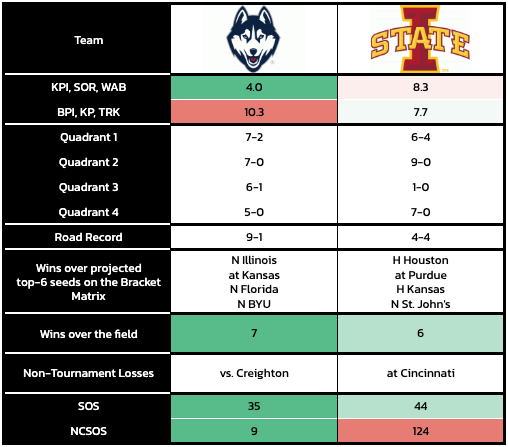
Iowa State lost at BYU mere hours after the Bracket Preview, while UConn won at Villanova. As such, the Huskies might be back on the No. 1 line; the committee chair said it was UConn's spot before it lost to Creighton. The Huskies' resume metrics were already ahead of the Cyclones but their predictive metrics are now closer (albeit still behind) after the weekend's results. Houston suffering two more losses since the Bracket Preview has removed it from No. 1 seed consideration for now. Between UConn and Iowa State, though, here's the breakdown:
At the top of the list, Duke may have leapfrogged Michigan for the No. 1 overall spot due to its neutral-site head-to-head win later that day in Washington DC.
Fast-forward a few days later, and Michigan still holds the edge in six of the seven team sheet metrics. However, the same (or at least similar) could have been said about Houston and Iowa State at the Bracket Preview, yet the committee leaned in favor of the latter for a home head-to-head victory. As such, Duke likely leapt into the No. 1 spot and it might not relinquish it barring a loss; if Duke passed Michigan in the eyes of the committee for its head-to-head win, Michigan will have a hard time jumping ahead again.
