

Selection Sunday for the 2026 NCAA Tournament is closing in. Our Bubble Watch dives into every at-large contender.
The 2026 NCAA Tournament is drawing nearer, and with that comes a new season of the Bubble Watch — this time for Basket Under Review. The goal of the Bubble Watch is to assess the at-large landscape, separate teams into categories based on their current status, and evaluate the pros and cons of resumes, as well as the remaining schedules.
The Bubble Watch page will be updated each Wednesday, sandwiched between updates to the bracketology projected field that are posted on Tuesdays and Fridays. If looking simply for that projected bracket, see here.
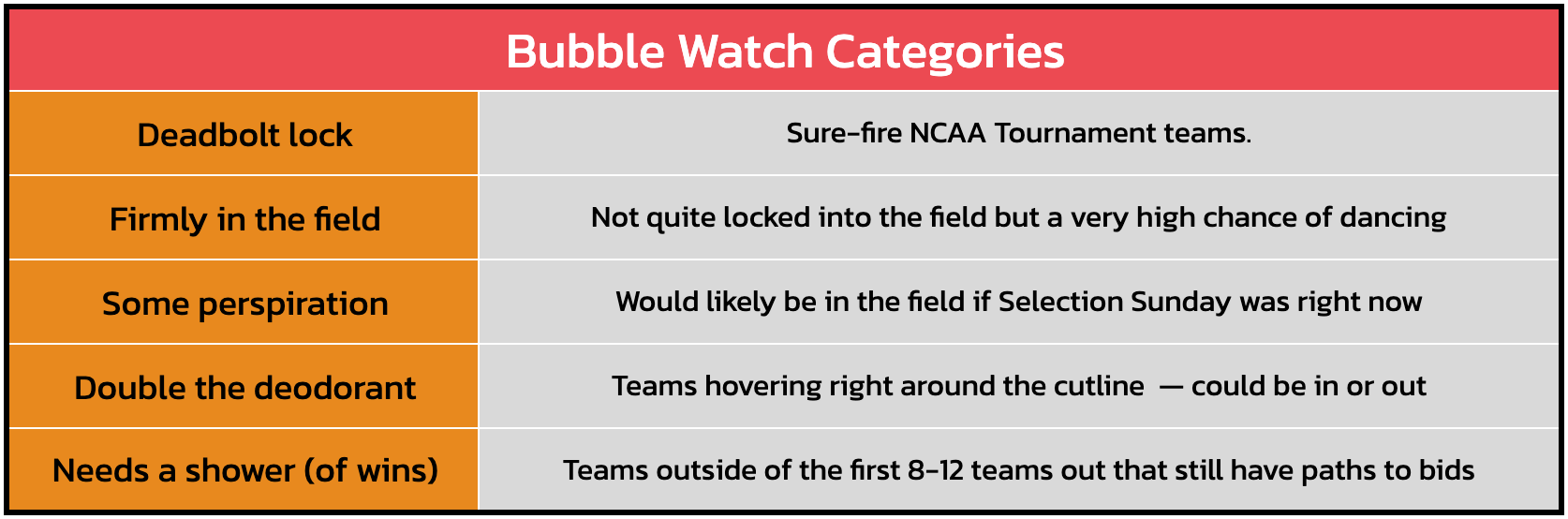
For those who are new to the Bubble Watch column (previously at Heat Check CBB for the past few seasons), here is a breakdown of the categories:
Write-ups are current through March 14th at 2:30pm ET
Atlantic Coast
Deadbolt lock: Duke, Virginia, North Carolina, Louisville, Miami (FL), Clemson
Some perspiration: None
Double the deodorant: NC State, SMU
Needs a shower (of luck): Virginia Tech, California, Stanford, Florida State
NC State Wolfpack
NC State could have removed most, if not all, doubt with a win over Virginia in the ACC Tournament quarterfinals, but it was unable to pull off the upset. The Wolfpack’s status in the field also became a bit more precarious while they were on the ACC Tournament court, as a bid-stealer might have emerged with Miami University falling in the MAC Tournament. Even with the more damaging loss, the RedHawks remained ahead of NC State in the ever-important WAB. The Wolfpack should still be ahead of true cutline teams like SMU, Auburn, and Texas, though — at least in the eyes of most bracketologists. They are 16-12 against the upper three quadrants with five Quadrant 1 wins; those should outweigh having suffered the Quadrant 4 loss that its bubble peers didn’t. But there is no way of knowing if the committee agrees with that line of thinking, or if more bid-stealers will emerge.
SMU Mustangs
SMU helped itself with a win over Syracuse in its first ACC Tournament game, but could not close out what would’ve been a huge result over Louisville the next day. As such, the Mustangs find themselves right in the thick of the projected cutline conversation. They rate in the extremely bubbly 40s across all non-NET metrics, the most important being ranking 46th in WAB. The team sheet is relatively clean, with an above-.500 record against the upper three quadrants and no losses in the bottom two quadrants, but SMU only has three wins over the field. Numbers can only tell us so much about any team’s situation, but that is especially true with SMU. The Mustangs are 1-4 without BJ Edwards down the stretch of the season, though the program has been outwardly confident he will be back for the NCAA Tournament. If the committee believes SMU, it would be a boon to selection hopes; SMU is a tournament-caliber team with him. If the committee thinks he won’t be available, SMU is in very shaky territory. It can only wait and hope. Projected on the right side of the cutline for now by our bracketology at Basket Under Review, SMU will be rooting against bid-stealing potential.
Virginia Tech Hokies
Virginia Tech missed a huge chance in its regular-season finale at Virginia, but still could have been firmly in the at-large mix had it not also dropped its first game of the ACC Tournament to Wake Forest. The Hokies have a few nice wins to their name, including beating Virginia at home and Clemson on the road, but are just 2-10 in Quadrant 1 and ranked at 51st in the WAB. Virginia Tech could still remain on the board given its 12-13 record against the upper three quadrants is still better than some bubble peers like Texas (10-14), Auburn (11-16), and Oklahoma (12-15). Still, it feels more likely than not that Virginia Tech is on the outside-looking-in. The best it can do is wait, root against bid-stealers, and hope.
California Golden Bears
California played its way back into the bubble mix with back-to-back home wins over Stanford and SMU near the end of February. The Golden Bears followed those results with one of their worst stretches of the season, though, losing at home to Pittsburgh and on the road to Wake Forest sandwiched around a win over Georgia Tech to close the regular season. Even still, they might have remained in the mix with a run at the ACC Tournament, but fell to Florida State in their first game. California is now sub-50 in all three resume metrics, including No. 53 in WAB, and has some of the worst predictive metrics in the conversation. With that being said, it has four Quadrant 1 wins and is one of the few high-major bubble teams with an above-.500 record against the first three quadrants (12-11). That combination keeps it potentially selectable. California can only wait and hope that combination is enough, though not ranking in the top 50 for a single team sheet metric makes it hard to envision a selection. The Golden Bears also only played the No. 326 nonconference strength of schedule.
Stanford Cardinal
Yet another ACC bubble team that lost its conference tournament opener, Stanford undid a lot of good work over its four-game win streak to end the regular season when it lost to Pittsburgh. The Cardinal can hold onto hope that the committee emphasizes KPI (where they rank 43rd) this season, but all indications have been a heavy preference towards WAB (where they rank 56th). Owning five Quadrant 1 wins (two in Q1A) is a big plus, as is being above-.500 against both Q1+2 (9-8) and Q1+2+3 (13-12), even with four Quadrant 3 losses. A problem for Stanford is that if — and it is a big if — the committee likes its combination of Q1 wins with Q1+2+3 record, the same can be said about California. Cal swept Stanford in the regular season.
Florida State Seminoles
After just a 7-11 start, Florida State won 11 of 14 games to move 18-14 overall and reach the bubble conversation. The Seminoles added solid wins at Miami, at Virginia Tech, at Clemson, and vs. SMU over the stretch. It was always going to be a tall task for Florida State to beat Duke in the ACC Tournament, but it needed to do so and finished one basket shy of the upset. As a result, FSU's WAB stayed in the 60s (No. 64) and it is out of opportunities to improve its status before Selection Sunday. The Seminoles put together a valiant late run but the window appears to be closed.
Big 12
Deadbolt lock: Arizona, Houston, Iowa State, Kansas, Texas Tech, BYU, TCU
Some perspiration: UCF
Double the deodorant: None
Needs a shower (of luck): Cincinnati, Oklahoma State
UCF Knights
UCF avoided what could have been a slip into more dangerous waters when it beat Cincinnati in overtime at the Big 12 Tournament. The Knights entered their quarterfinal matchup with Arizona at No. 36 in the WAB; a win would have caused a major seed boost, but the loss – even by 22 points — shouldn't cause a major hit to their resume metrics. UCF has five Quadrant 1 wins and is 11-11 against the upper two quadrants with no bad losses. Poor predictive metrics make it very hard to determine seed, as they could end up anywhere from a No. 9-11 seed, in my opinion. The Knights should dance, though, and bring the fronds with them.
Cincinnati Bearcats
Cincinnati’s late run at an at-large bid seemed to be gaining even more steam when it led UCF late in the second half at the Big 12 Tournament. With just over two minutes to play, the Bearcats had a 96.6% chance of victory on KenPom. Alas, they fell in overtime and are also not out of opportunities to further improve their resume. Cincinnati has clearly played at the level of a tournament team for the last month, but it was likely starting from too far behind. The Bearcats rank at just 66th in WAB, are 3-11 in Quadrant 1 and 11-14 in Q1+2+3, plus have a Quadrant 4 loss. Cincinnati could be a surprise selection if the committee is determined to argue about its quality of play with Jizzle James in the lineup, hence still staying on the board, but it feels unlikely. The numbers are too far behind the rest of the bubble.
Oklahoma State Cowboys
Even after losing to TCU in the Big 12 Tournament, the Cowboys are still top 50 in WAB (No. 50). The predictive metrics (71.7 average) are poor, but shouldn't play a major factor in selection. Oklahoma State only has two Q1 wins in 13 tries, but has double-digit Q1+2 wins and no losses in the bottom two quadrants. For precedent's sake, only two teams with 10+ Q1+2 wins and no Q3+4 losses have missed the tournament in the NET era. So while it feels like a longshot, it’s feeling less so the more I write this. Still would take the committee being very favorable to the Cowboys for it to happen, though.
Big Ten
Deadbolt lock: Michigan, Michigan State, Illinois, Purdue, Nebraska, Wisconsin, UCLA, Ohio State
Some perspiration: Iowa
Double the deodorant: None
Needs a shower (of luck): Indiana
Iowa Hawkeyes
Iowa’s WAB (No. 39) wasn’t perfect before its loss to Ohio State in the Big Ten Tournament but it should still be safe for selection when compared with the teams right at the cutline. The Hawkeyes are 15-12 against the upper three quadrants, which compares very favorably, plus has a solid quantity of four Quadrant 1 wins. Predictive metrics averaging in the top 30 bodes well for a seeding boost even if the Hawkeyes might be closer to the cutline than the projected No. 9 seed on the Bracket Matrix would indicate. The loss to Ohio State means that Iowa has no more opportunities to improve its team sheet before Sunday, but even bid-stealers are unlikely to swipe Iowa’s spot at this point. There do not appear to be enough teams behind the Hawkeyes still playing to make the jump over them.
Indiana Hoosiers
If any team besides itself is to blame for Indiana likely missing the NCAA Tournament, it is Northwestern. The Hoosiers could have survived the losses it took to Illinois, Purdue, Michigan State, and Ohio State — three of which on the road — since mid-February; the losses they likely could not survive were both to Northwestern, one at home and one in the Big Ten Tournament. The latter loss put an end to IU’s chances to improve its team sheet in the Big Ten Tournament, and left the team with just a 3-10 Quadrant 1 record to pair with a 3-4 Quadrant 2 record. Even with being flawless in the bottom two quadrants, being eight games below-.500 against the top two quads is brutal. The wins over Purdue, Wisconsin, and UCLA are very nice, but it took so many opportunities to get there. IU’s WAB has dipped to No. 52. The Hoosiers’ predictive metrics are higher than most on the bubble but are unlikely to have major sway for selection. Indiana could get some votes and discussion in the committee room, but odds are likely that it will not hear its name called on Selection Sunday.
SEC
Deadbolt lock: Florida, Alabama, Vanderbilt, Arkansas, Tennessee, Kentucky, Georgia
Some perspiration: Texas A&M
Double the deodorant: Missouri, Texas, Auburn, Oklahoma
Needs a shower (of luck): None
Texas A&M Aggies
Texas A&M closed its regular season with four wins in six games, including beating Kentucky at home. As a result, the Aggies built some solid separation from the cutline and were in the mix for a single-digit seed...but lost to Oklahoma by 20 in its first SEC Tournament game. The WAB will dipped from No. 38 before the loss, but only to No. 40; the top-42 of WAB last season dance. The Aggies own five Quadrant 1 wins, are 13-11 against the upper three quadrants, and average a 36.7 across the three quality metrics. They probably still have some cushion and are projected as a No. 10 seed.
Missouri Tigers
Missouri could have removed most, if not all, doubt had it won vs. Kentucky in the SEC Tournament, but fell short in a six-point loss. Metrics do not love the Tigers, placing them at No. 41 in the WAB and averaging at 47.0 across quality numbers, but they are still likely above the cutline due to an elite collection of wins. Their 12-12 record against the upper three quadrants is comparable to other bubble teams, if not slightly better, and few can match these victories: vs. Florida, vs. Vanderbilt, vs. Tennessee, at Kentucky, at Texas A&M. Three straight losses to end the resume-building portion of the season was not ideal, though, setting up a wait in which Missouri will still want to keep an eye on bid-stealers. As mentioned with Texas A&M, the extremely small one-year sample size of the WAB era included all top-42 teams in the field, and Missouri is No. 41.
Texas Longhorns
Texas is one of the many bubble teams that did not help its case down the stretch of this season. The Longhorns lost four of their last five regular-season games to slip towards the cutline, then dropped their first SEC Tournament game to Mississippi by double-digits. As such, Texas is out of opportunities to impress the committee before Selection Sunday and will just have to wait and hope. Looking at their now-completed set of results shows a bubbly WAB (No. 47) and predictive metrics (40.3), and a Q1+2+3 record that is four games below-.500. The bright side is that Texas owns six Quadrant 1 wins and itself proved last season that a below-.500 record in Q1+2+3 games is far from a disqualifier. However, the Longhorns had a better record in such games last year (12-15) than this year (10-14) and had one more Q1 win. Texas is still on the right side of the projected cutline for our bracketology at Basket Under Review, but it wouldn’t be a surprise if unselected. The Longhorns should be actively cheering against bid-stealers over the remaining days, and did not cheer loud enough for Miami University in its loss to UMass. Wins vs. Vanderbilt and at Alabama are huge.
Auburn Tigers
Auburn successfully navigated a must-win game against Mississippi State in its SEC Tournament opener, but Miami University losing to UMass early on Saturday ramped up the pressure for Auburn to beat Tennessee in the SEC second round. Regardless of what the predictive metrics say about the quality of a team, it is hard to imagine the committee taking a 17-16 Auburn over a 28-1 Miami. Even if the comparison isn’t those two teams, having Miami in the field shrinks the number of available bids. The Tigers started strong against Tennessee, leading for 27:37 of the first 32:28 o the game, but saw their major opportunity — and perhaps their bubble hopes — slip away when they allowed a 19-0 run en route to a 10-point loss. Auburn still has a superb set of wins, including beating Florida on the road, but an immense number of losses. Auburn is still 44th in WAB, but is now just 11-16 against the upper three quadrants – and only one game above-.500 for the season with no more games left. Auburn's elite wins could defy precedent, but it feels like the Tigers will be on the outside-looking-in on Sunday, especially if there are more bid-stealers.
Oklahoma Sooners
It is hard to imagine a team that was once 11-12 and on a nine-game losing streak is in the thick of the bubble conversation, but here we are. Winning six of eight games to end the regular season built some momentum, and wins over South Carolina and Texas A&M in their first two games of the SEC Tournament brought the Sooners right towards the projected cutline. A win over Arkansas in the ensuing game would have really helped their case, but they fell short. Still, the full team sheet deserves to remain in consideration. Oklahoma has four Quadrant 1 wins, its predictive metrics (40.3) are strong if the committee decides to lean on team quality for a toss-up decision, and its 12-15 Q1+2+3 record isn't out of bounds anymore after Texas danced with that exact record last year. On the down side, the WAB is only 49th, and there is some trepidation with getting too caught up in a big SEC Tournament run. Oklahoma could become a victim of the 2022 Texas A&M situation, when the Aggies lost eight straight, then won eight of 10 and reached the SEC Tournament final before being left out of the Big Dance later that day.
Big East
Deadbolt lock: UConn, St. John's, Villanova
Some perspiration: None
Double the deodorant: Seton Hall
Needs a shower (of luck): None
Seton Hall Pirates
Seton Hall fell to St. John's in the Big East Tournament semifinals, bringing its total record against the league's three NCAA Tournament teams to 0-7. The Pirates were close in the majority of contests, but needed to win at least one to supplement only owning one win over the field (neutral over NC State). Seton Hall is 15-12 against the upper three quadrants, which makes it potentially more selectable than teams with poorer records in such games, but the WAB accounts for strength of schedule and puts the team at 55th. Having more Q3 losses than Q1 wins makes it hard to foresee Seton Hall making the dance.
Mountain West
Deadbolt lock: Utah State
Some perspiration: None
Double the deodorant: San Diego State, New Mexico
Needs a shower (of wins):
San Diego State Aztecs
San Diego State won the pivotal Mountain West Tournament semifinal bubble battle against New Mexico on Friday night into Saturday morning, and is now likely the last remaining home for a two-bid MWC. Still, the Aztecs lack top-end wins and their WAB is extremely bubbly at 45th. If the Aztecs lose to Utah State in the MWC Tournament final, it will be right at the cutline, although probably projected on the wrong side by many. A point in SDSU's favor is its 15-10 record against the upper three quadrants, which would win competitions with teams like Texas (10-14), Oklahoma (12-15), and Auburn (11-16) if it reached that point, though all of those teams played more and won more Q1 games. If San Diego State beats Utah State, poof, there goes worrying and welcome to the AQ field.
New Mexico Lobos
New Mexico was on the losing end of that semifinal, and thus will have a hard time making the field. The Lobos are down to 58th in the WAB. The 13-11 record in Q1+2+3 games is nice, as are wins over Santa Clara and VCU, but spots for the field are limited and SDSU won two of three head-to-head matchups. It is hard to foresee three MWC teams in the field, and SDSU now has the edge for the second (if the league gets a second).
Atlantic 10
Deadbolt lock: None
Some perspiration: Saint Louis
Double the deodorant: VCU
Needs a shower (of luck): None
Saint Louis Billikens
A loss to George Washington on Friday could have created some uneasiness, but Saint Louis came from behind to pull out the victory. The Billikens are 37th in WAB, and a loss to Dayton, Saint Joseph's, or VCU before the final bracket reveal would not change that enough to warrant sweating much. Rating higher in the two other resume metrics, 27th in KPI and 33rd in SOR, helps, as do predictive metrics all ranking in the top 43. Saint Louis is one of the rare teams with an above-.500 record in all our quadrants. Odds are likely that they have already been voted into the field before their semifinal game. The Billikens are more likely to see a single-digit seed next to their name than miss the tournament.
VCU Rams
It is hard to imagine the last week going much better for VCU – at least, until Miami University's loss in the MAC Tournament. The Rams helped themselves with a fringe Quadrant 1 road win over Dayton in their season finale, and then watched the bubble fall apart around them. What appeared to previously be a 50/50 situation has started to lean in VCU’s favor. In advance of the Atlantic 10 Tournament, VCU is featured in 109 of 114 fields on the Bracket Matrix. The Rams’ WAB is up to No. 42, which bodes well relative to other bubble teams sitting in the other half of the 40s. They are not safe, though, considering the bad-loss-potential in the A10 Tournament. VCU should be able to feel good about its placement in the field if it can reach the A10 Tournament final (and face Saint Louis), while winning it would obviously earn the automatic bid. VCU has not lost to anyone on its side of the A10 bracket yet this season. It faces Saint Joseph's in the semifinals later today.
Others
Deadbolt lock: Gonzaga, Saint Mary's, McNeese, High Point, Northern Iowa, Hofstra, North Dakota State, Troy, Wright State, Tennessee State, Furman, Idaho, Siena, Queens, LIU, Lehigh
Some perspiration: Santa Clara
Double the deodorant: Miami University, South Florida
Needs a shower (of luck): Tulsa, Akron
Santa Clara Broncos
Santa Clara could have removed all doubt if it upset Gonzaga to win the WCC Tournament. Although the Broncos were unable to do so, their semifinal victory over Saint Mary’s was pivotal in staying away from doubling the deodorant. The Broncos now own two wins over the at-large field for beating the Gaels twice, once now on a neutral site, plus their nonconference win over McNeese is now over an automatic qualifier. Santa Clara cannot improve its resume more before Selection Sunday as it is out of games, but it has put itself in a decent position for selection. The top 42 in the WAB all danced last season, and the Broncos rank 36th; they also average in the mid-30s across predictive metrics. They appear to be hinging on the No. 10/11 lines but figure to be more of a Last Four Byes team than sent to Dayton.
Miami University RedHawks
Miami University’s undefeated stretch to begin the season lasted all 31 regular-season games, but came to a halt in its first game of the MAC Tournament. The loss to UMass falls in Quadrant 3. Had the loss come to Akron in the title game, Miami would likely be only dealing with some perspiration — and perhaps still should be dealing with only some perspiration; after all, it is still 31-1 (28-1 vs. DI). The NET WAB update placed the RedHawks at No. 38, still likely to be in the field but Dayton is not out of the question given predictive metrics averaging at 91.0. I never went as far as to lock Miami given the potential for this exact loss, but the team should still dance with its elite record. But with only slightly-above-bubble resume metrics and the worst predictive metrics on the board, it is hard to avoid doubling up on the deodorant.
South Florida Bulls
As the projected automatic bid for the American, South Florida has not received a ton of attention as a potential at-large team. With a WAB of just No. 59, it is also an unlikely scenario. But with bubble teams losing across the country, maybe USF’s 13-8 record against the upper three quadrants becomes a bit more appealing. There probably isn’t a scenario where the Bulls jump into the at-large field for bracketologists, but there have been surprise selections in the past. South Florida stays on the board in that unlikely scenario that it makes the American title game and the rest of the options continue to wither.
Tulsa Golden Hurricane
Tulsa is 24-6 against Division I opponents with an 12-6 record against the upper three quadrants. A No. 60 WAB and owning zero Quadrant 1 wins means an at-large bid is extremely unlikely. Due to Cincinnati’s late run potentially keeping it on the board, though, my WAB cutoff includes Tulsa (No. 63). If it can make a run to the American title game, maybe the committee falls in love with the very strong record relative to floundering high-major bubble teams. It is a big stretch, though.
Akron Zips
Okay, so hear me out. Akron does not have a single win in Quadrants 1 or 2 (0-4) and its WAB is just No. 57. But if the committee does not like any of its high-major options and Akron loses in the MAC title game to Miami, why not give a mid-major with a great record and decent predictives a shot? Well, it wouldn’t have happened to begin with, but Miami losing to UMass means it now *can’t* happen. But this can still happen: The Zips winning the MAC Tournament and the RedHawks earning an at-large bid is the most fun and realistic result that the MAC can produce over the next few days. In fact, it is now likely to happen.
