

A year after a tumultuous non-conference slate marred Saint Joseph's season, the Hawks have reversed their early-season fortunes, now 4-0, including an upset win over an AAC favorite in South Florida and a Big 5 home win over Penn.
A year ago, St. Joseph's had one of the most up-and-down (or, more accurately, down-and-up) seasons in recent memory. Head coach Billy Lange retired right before the season, forcing Steve Donahue into the role.
The Hawks opened 2025-26 as KenPom's #109 team. But non-conference losses to Penn (Donahue's former bench patrol), UNLV and Coastal Carolina pushed them lower as Donahue got his feet under him. After losses to Saint Louis and Davidson to begin conference play, St. Joe's was down to 218 at KenPom.
The Hawks naturally proceeded to go 13-3 the rest of the regular season to finish 106th in KenPom. Donahue won A10 Coach of the Year for his efforts as the team finished third in the conference behind the two eventual NCAA Tournament teams, SLU and VCU.
The defense led the resurgence, ranking 24th at Torvik in the final 16 regular season games. Thus far, Donahue has led a top-45 defense with fifth-year transfer Sean Logan at the core.
Lockdown Logan
With the obvious caveat that it's only been four games, Logan is setting up for a career year. Logan, who spent the past four seasons at A10 rival Davidson, has blocked 19 shots through four contests, comfortably the most in the country (the next closest is Virginia's Johann Grunloh with 14). When Logan is on the floor for the Hawks, they are rejecting an astounding 30% of opponent 2-point attempts, per CBB Analytics. That doesn't even tell the whole story, since Logan has blocked four three-point shots this season.
Opponents are making just 52.1% of their attempts at the rim against Logan and the Hawks, placing them in the upper echelon of defenses in the early going. Logan also takes St. Joe's defensive rebounding from bad to respectable, grabbing 6.5 boards a game on his own end and improving the DRB% by 13 points when he's on the floor. He's also playing a tick over 30 minutes a night, a notable feat for a guy who has never crossed the 20-minute threshold in his college career.
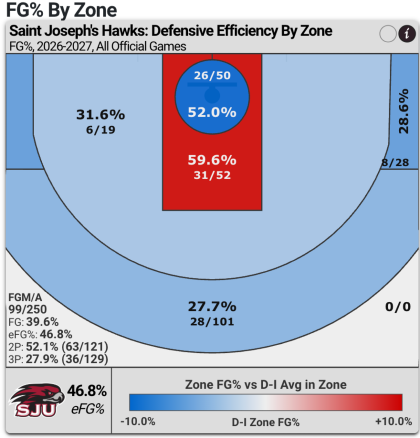
Offenses have found success against the Hawks in the painted area beyond the rim and reaches of Logan, but have struggled everywhere else. And it's not just Logan doing the defensive damage.
Perimeter Pressure
St. Joe's is also posting a top-70 steal rate nationally; six different players are averaging at least a steal per game, led by sophomores Khaafiq Myers and Austin Williford, who have eight thefts in four contests. Between 99th-percentile shot blocking and 81st-percentile turnover forcing, few teams are better at shot suppression early (though the defensive rebounding leaves something to be desired).
In part because of backline support from Logan, and in part because the quality of defenders on the perimeter is quite high, St. Joe's throws a ton of pressure at opposing ball handlers. The Hawks regularly extend coverage five or six feet beyond the three-point line, daring opponents to drive into the teeth of the defense. They help a ton, which is why they're giving up over 50% of attempts from beyond the arc.
The most noticeable part of the defense is its proactivity rather than reactivity. They bring intentional early rotations, double teams, and ball screen blitzes to force the ball to move; when it does, ten arms are in the passing lanes swiping for steals. And if a perimeter defender gets caught gambling, Logan is sitting in the paint on cleanup duty.
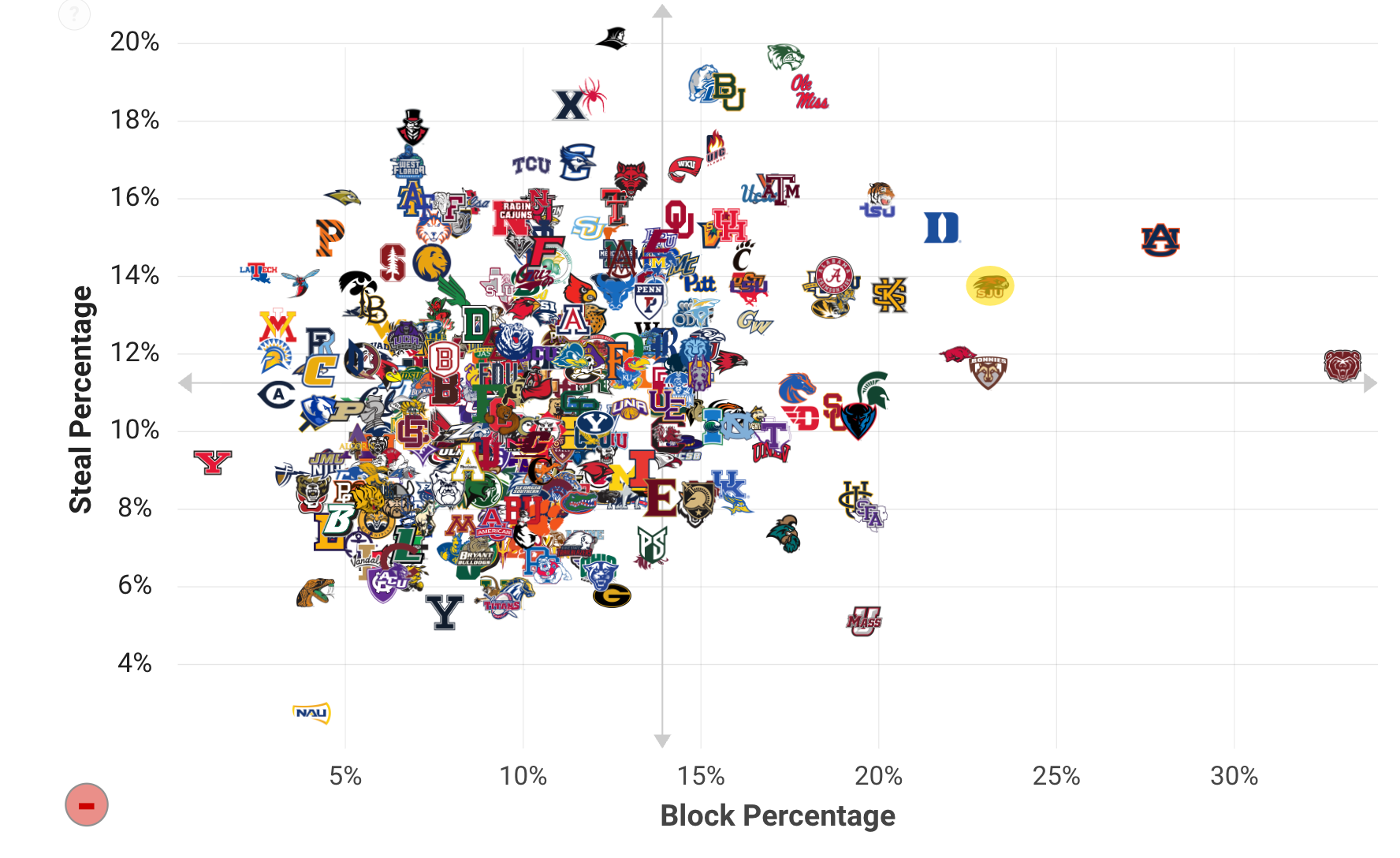
In particular, Logan Carey has been a pest on the defensive end. Carey, an up-transfer from Maine, brings a career 3.5% steal percentage with him to Philadelphia. That number is 4.4% through four games, and the defense is 24 points better with him on the floor than without him. He's only played around 18 minutes a night so far, but the 6-foot-3 senior guard flies around the perimeter with a ridiculously high motor and just stops opposing drives in their tracks.
Notably, in 50 minutes sharing the floor, (Sean) Logan and (Logan) Carey (confusing, I know) have held opponents to a ridiculous 33.9% eFG% and their defensive rating when paired is 80.2, with a Net Rating of +42.2. When Last Name Logan is on the floor without First Name Logan, the team's defensive rating is 104.9. Carey's defensive ability gives this team a lethal point-of-attack and rim pairing that raises their floor in the A10 considerably.
Hot and Cold Offense
The questions so far for St. Joseph's have all come on the offensive end, where the Philadelphians rank 217th at KenPom early on. However, it's posted back-to-back 83-point outputs, and the numbers reflect a clear improvement over its first two games.
Against Longwood and Lafayette, the Hawks had an offensive rating of just 96.6. They played with pace but couldn't hit anything from deep, shooting just 22.2% from three.
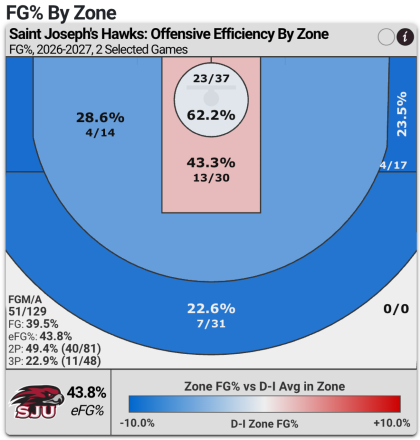
In their latter two games, the Hawks upped their pace by a few possessions, have cut their turnovers by 4%, but most importantly, the shots have gone in. After making just 11 threes in the first two games combined, they made 12 triples in each of their next two games. This is what that looks like.
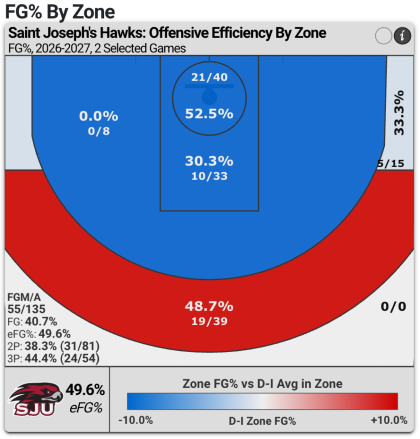
Now naturally, their three-point percentage will settle in somewhere between 22-49%. So the question is: how do they develop some sort of interior offense and sustain this offensive outbreak even when the shots stop falling?
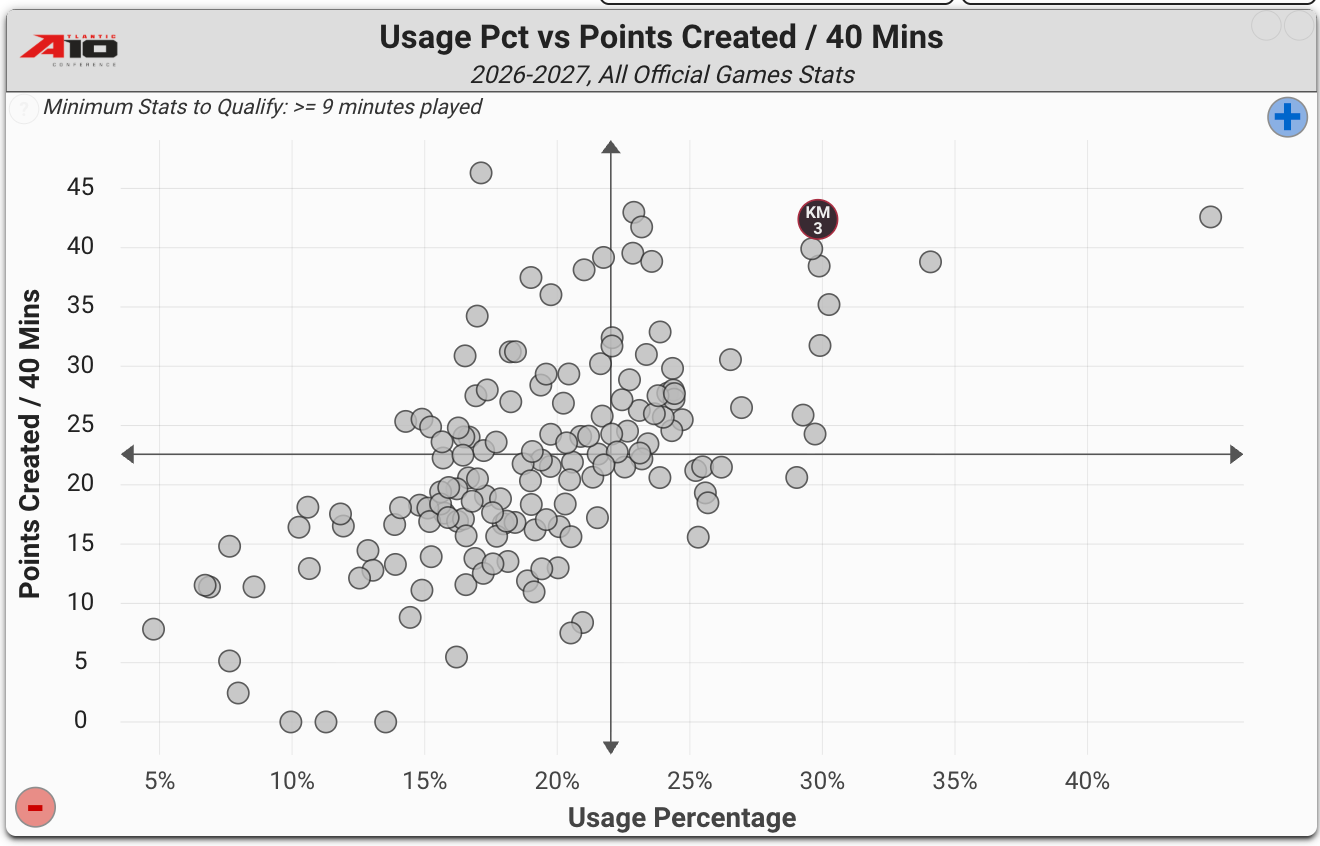
Everything starts with Khaafiq Myers, the sophomore point guard. Myers is averaging 21.5 points and 5.3 assists so far, despite shooting just 4-for-16 from deep. Myers can get to the paint at will and is one of the few Hawks who can finish. Per CBB Analytics, Myers is attempting 12.8 2PA per game (the next-highest Hawk is Jaiden Glover-Toscano at 6.8) and making 55.3% of his twos (only one other Hawk is north of 41%). Of his twos, six attempts a game come at the rim and another 4.5 attempts are non-rim paint attempts. Both attempt numbers are in the 99th percentile nationally.
Myers is also creating points for his teammates by getting to the paint and kicking for open treys. It's no surprise that as SJU has started to shoot it better from deep, Myers' assist totals have kicked up from four per game in the first two to 6.5 a contest over the last two. 13 of his 21 total assists have been on three-pointers.
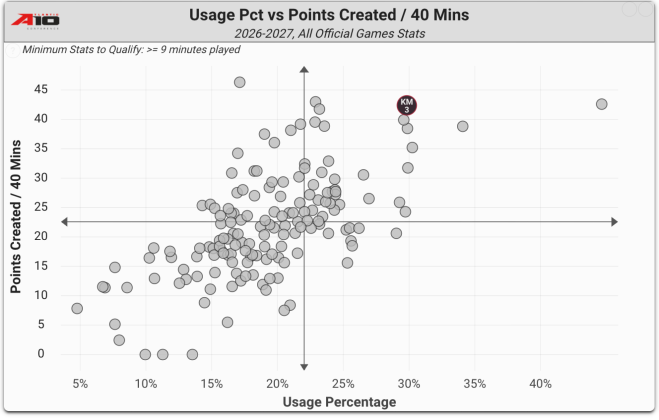
Jaiden Glover-Toscano was the expected best player on this team after being named an A10 2nd Team player last year. He's been very solid in counting stats at 13.3 points and 6.0 rebounds a game so far, but has an eFG% of just 39.2%. True freshman BJ Ranson has probably been the second-best player offensively behind Myers, knocking in 15 of his 28 three-point attempts and scoring 17.0 PPG over his first four career games.
Zooming out, the biggest difference between St. Joseph's first two games and the last two (besides the three-point shooting bump) is the increase in pace from fast to very fast and the combined decrease in turnovers, counterintuitive as it may seem. The ball has been in Myers' hands more and he's been pushing the pace while making smart decisions.
The only drawback so far has been that SJU's two best offensive games have been their two worst on the defensive end. If the Hawks can combine their hot shooting with the ridiculous defense they've played at times this season, they'll be a legit A10 threat.
