

Key Returners:
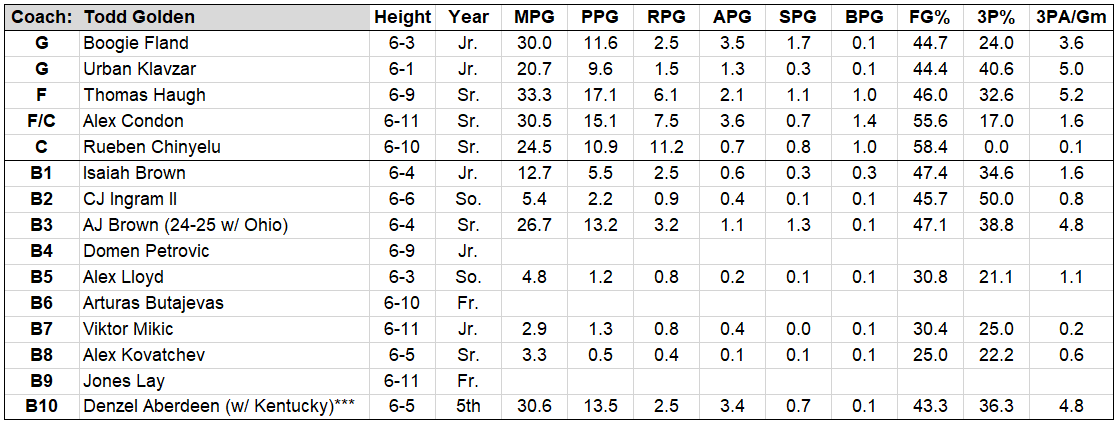
Thomas Haugh, Alex Condon, Rueben Chinyelu, Boogie Fland, Urban Klavzar, Isaiah Brown
Key Newcomers:
Denzel Aberdeen*, Domen Petrovic, Arturas Butajevas
Key Losses:
Xaivian Lee, Micah Handlogten
Roster:
Reasons for Optimism:
A year after winning a national title, Florida took a shocking early postseason loss, falling to Iowa in dramatic fashion in the NCAA Tournament second round. That (plus many large bags of NIL money) prompted the bulk of Florida’s rotation to return, including its three-headed frontcourt that exerts unflinching dominance over the rim and the glass.
Said in a more statistical fashion: per Bart Torvik, only nine teams return 70% of their minutes from last season. Florida is the only member of that group that lands in the top 120 nationally for next season; the Gators rank 3rd. They are a rare blend of top-end talent, proven production, and high-level continuity, and they appear poised to earn a third straight top seed in the NCAA Tournament come March.
Along with analytically savvy boss Todd Golden, the ballyhooed frontcourt is the main reason. Golden’s style emphasizes easy baskets at a high tempo: the Gators thrive on quick looks at the rim, while they rigidly take those chances away from opponents. The same applies to the glass, where Florida is arguably the best two-way rebounding team in the entire country.
The headliner is Thomas Haugh, who shockingly spurned a likely late lottery placement in the NBA Draft to return to Gainesville for a fourth campaign. He does everything well, and his growth as a shooter and tertiary ball-handler let Florida run jumbo lineups without sacrificing the perimeter. His versatile skill set and mobile size let him slide easily between the 3 and 4, and he is unsurprisingly among the top three preseason candidates for National Player of the Year.
Of course, there will be plenty of days where Haugh is not even the best player in his own frontcourt. Alex Condon evolved even further as a facilitator last year, tallying 123 assists – more than returning point guard Boogie Fland, a strong creator in his own right. Flexing Condon out towards the perimeter and playing through him helped mitigate UF’s spacing concerns, and though it hindered Condon’s rebounding numbers, it cleared room for Rueben Chinyelu to explode inside.
The returning National Defensive Player of the Year, Chinyelu, has improved rapidly. He went from a very good rebounder to perhaps the best in the entire country, and his ability to corral guards has developed exponentially. This possession against Alabama encapsulates his dominance on that end:
Chinyelu has also progressed markedly on offense, becoming a legitimate post-scoring threat with a bullying half hook. His free throw shooting epitomizes his improvement: he has gone from putrid (48.9% as a freshman) to solid (69.5%), with room to improve further.
That trio ensures Florida will crush the rim again. Per CBB Analytics, Florida took nearly 40% of its field goals there (97th percentile nationally) and made 69.1% of them (93rd percentile). At the same time, it held foes to 55.9% at the rim (95th percentile). Add that to being a top seven team in rebound rate on both ends of the court, and Florida’s floor is sky-high.
Florida’s defense is built from the inside out, but having an on-ball force like Fland certainly helps. He uses his chest well to stop drivers, and his anticipation and hands are assets, too. Case in point: Fland tied a school record with eight steals against Alabama last year. Offensively, to Fland’s credit, he willingly took on a much smaller offensive role as a sophomore and let his defense and decision-making (2.2 assist/turnover ratio) shine through.
Fland also took a seismic leap as a rim finisher. In his injury-marred freshman season at Arkansas, he shot just 40.5% at the bucket, per CBB Analytics. Last year, with Florida’s bigs sealing off driving lanes for him, that number jumped to 72.7%. You’d be hard-pressed to find a bigger year-over-year increase nationally in that category.
Perhaps unfairly to its opponents, Florida may have upgraded its final starting spot by bringing Denzel Aberdeen back to Gainesville. He brings more size, better shooting, and similar playmaking to Xaivian Lee, all underpinned by his familiarity with the system. He is still awaiting a waiver to play as of this writing, but with Urban Klavzar waiting in the wings as a lethal perimeter gunner (44% from 3 in SEC play), the Gators are not overly leveraged on the Aberdeen decision.
Causes for Concern:
Klavzar excepted, last year’s Gators had a nightmarish season shooting. Lee shot sub-30% from 3, Fland tanked to 24%, and Condon – trying to add a jumper to his arsenal – connected on an abysmal 17% from deep. Florida’s interior onslaught masked that struggle for most of the campaign, but the shot-making was starkly in contrast to the title team, with Walter Clayton, Will Richard, and Alijah Martin lighting up the nets.
Klavzar helps, but Florida needs Fland to rediscover his shot-making – a standout asset of his in his prep days. Haugh could also show more consistency, as his low-release shot can be streaky. Aberdeen would be a massive addition after he had a standout season from beyond the arc at Kentucky.
“Would” is the key term in that sentence, as the boomerang Gator may not ultimately be ruled eligible – by Florida’s own lawsuit challenging redshirt criteria or via the pending 5-for-5 litigation. If he cannot play, UF would be alarmingly low on perimeter playmaking and proven depth.
Fortunately, the Gators retained four – four! – bench players who are candidates to fill that void. At most schools, former top 100 recruits CJ Ingram and Alex Lloyd would have transferred after barely seeing the court as rookies. Golden and staff have heavily emphasized retention, though, and they are back to challenge for minutes. Ingram’s frame and defense are enticing, but they both likely land behind Isaiah Brown again, a rising junior who became a key reserve last year. He is a smart cutter, physical defender, and capable shooter. Brown’s brother, AJ Brown, redshirted last season while recovering from a torn labrum but might be the best marksman of the bunch.
We’re picking nits here, but Florida’s frontcourt depth also must find another piece. Micah Handlogten is no longer around, and Florida went international for its three main options: returner Viktor Mikic (Serbia) and newcomers Domen Petrovic (Slovenia) and Arturas Butajevas (Lithuania). Mikic is more of a like-for-like replacement for Handlogten’s backup center minutes, but Petrovic is by far the most talented after winning the MVP of the Slovenian KLS (posting extremely Haugh-esque numbers). Butajevas and Jones Lay probably need more seasoning.
A final minor concern: defending the pick-and-roll. Chinyelu is certainly much better in space now, but occasionally, he and Condon can be attacked in ball screens. Per Synergy, Florida ranked just 151st in points per possession allowed to Pick-and-Roll + Passes, a far cry from their elite numbers in many other categories. Some of that is due to the conference the Gators played in – Darius Acuff, Labaron Philon, Tyler Tanner, Josh Hubbard, etc. – but it bit Florida on the biggest stage against Bennett Stirtz and Iowa, too.
Bottom Line:
Florida is completely loaded. It is absolutely absurd for a No. 1 seed and a top six KenPom team to return its four best players and the SEC Sixth Man of the Year in this era, and the Gators will rightfully rank in the top two or three in every set of preseason prognostications you can find. Even an adverse Aberdeen ruling would not dim the national championship hopes in Gainesville.
With its proven production and championship experience, Florida reminds me of Villanova in 2016-2018. Those Wildcats won a title in 2016, then lost disappointingly in the second round a year later as a No. 1 seed on a late bucket by a Big Ten foe. In response, Villanova returned four of their top six players, including a leading Wooden Award candidate, and were driven to redeem that loss. Sound familiar? These Gators could echo that pathway with a second title in three seasons.
