

Titan versus titan is still pretty unique. In the history of Ken Pomeroy's website, there have been 21 1 vs. 2 battles over the last three decades (not counting the Michigan/Duke game from February, which this post was about):
It's official. We'll be adding a 20th entry to this list on Saturday.
— kenpom (@kenpom.com) 2026-02-19T04:07:26.331Z
But as far as I'm aware, this is the first time the same team will be playing in both 1 versus 2 games since 2018-19 Duke/Virginia and just the second time it's happened since 1998 (Kansas in 2008). On one hand, I'm legally obligated to point out to you that in those situations, a team involved in two 1 versus 2 matchups that season ended up winning the national title. Then again, in 1998, all it got Duke was an Elite Eight loss and North Carolina a Final Four loss to a team west of Texas. Time is a flat circle and such.
These two titanic teams and their elite starting lineups will give us not only the highest-rated matchup in the history of Ken's website, but also just the sixth Final Four-specific matchup between the top two teams in the sport. Four of the five to come before it had scoring margins of seven or fewer points, and even the Kansas/UNC blowout of 2008 saw UNC roar back from a 40-12 deficit to make it 64-59 with just over five minutes to play. Unsurprisingly, you pair two elites together and you're likely going to get an elite game.
The Michigan equation here is going to center first around what they can create in transition, which Arizona is generally fantastic at eliminating...but it's Michigan, fellas. They put Tennessee's usually great transition defense in a blender for 40 minutes. I'll still note that no Power Five team got more than 16 points in transition on the 'Cats, and that was Kansas in the no-DP game, which raises a variety of questions about KU but not my problem. Because of how hard Arizona crashes the glass, they can be taken a fool in transition from time to time by quick-thinking offenses:
But assuming this isn't the pre-eminent source of offense for the Wolverines I'd look for varying P&R attacks. With Krivas at the 5 you'll mostly see drop from Arizona (with some hedge here and there), and no team in the sport forces more floaters/runners than the Wildcats do. In general they're trying to force as many of those and pull-up jumpers as possible, which is why there's a terrifying path here of Michigan putting this in the hands of Elliot Cadeau, a highly improved shooter but not an infallible one.
As such I'm wondering if Michigan instead turns primary ball-handler duties for significant stretches to Yaxel, a superior shooter off the dribble and far more threatening player headed downhill. It's relative to their normal elite-ness, but against larger skilled ball-handlers Arizona has struggled. I'm thinking of Dybantsa (who quietly shredded Arizona's P&R looks for long periods of each game), sure, but even Riley Kugel had an excellent showing against the Wildcats in a loss.
Michigan will presumably post up a good bit here, but posting up on Arizona is a meat-on-meat thing and to be honest, predicting how that's gonna go is anyone's guess. Either Michigan's about to have a very inefficient day at the races on those or they're gonna have Arizona cruise to foul trouble. I'm more intrigued by how/where Michigan chooses to use off-ball action, which Arizona defends very well but isn't above giving up some buckets to. Oddly, in their toughest game of the Tournament so far, Utah State was the team that gave the Wildcats some strife with their off-ball action:
On the flipside it's kinda like rewriting the exact same story. Arizona - an elite transition offense - will look to run and run fast against a Michigan team that's elite at stopping transition play. A great group of Arizona ball handlers will look to expose a Michigan defense likely to sink deep into the paint to make them shoot over the top. An Arizona offense with several great post-up options, including my beloved Tobe Awaka, will go up against an outstanding post denial defense and post defense in general. The only real difference is that Michigan is the best team left at denying off-ball actions before they happen, but Arizona's not much for running those anyway.
The area I'd be concerned about for Arizona is that the two areas Michigan surrenders a lot of shots in, relative to the norm, are either areas Arizona's not efficient in (pull-up jumpers) or not areas Arizona ever exploits (pick-and-pops). Will Brayden Burries and Jaden Bradley be able to knock the former down? Well, of course, but as a team Arizona hits these at 0.9 points per shot, and even Bradley (0.94) doesn't reach the coveted 1 PPS mark to make these worthwhile. (Burries does, which will make him perhaps the X-factor here.) But I really wish there was a frontcourt piece on Arizona I could trust to pop out for something like this, which is a thing Michigan's Big Three has struggled with:
It's kind of a boring answer to tell you this is 50/50 but it is. I guess that I would make it 52/48 Michigan or something, because I do think Michigan has slightly more paths to consistent stops, but I don't know that. All I know is we're in for a hell of a Saturday night. - Will Warren
At first blush, my pedestrian brain had me convinced Michigan would edge out Arizona simply by math balling them: the Wolverines take and make threes, the Wildcats are third to last in 3PT attempt rate. Michigan makes shots, Arizona doesn't. Simple right? And to be fair if Michigan continues to shoot 45% from 3 like they have this tournament, then yes, the non galaxy brain take is almost certainly the correct take. But what if they shoot like they did in their 3 losses, where they were 28% from 3? Or not even that bad, what if they simply don't make nearly 50% from beyond the arc? This is where Arizona can win, by being the more physical team. When Wisconsin beat Michigan, the initial pundit class take was that you have to spread out Aday Mara and Morez Johnson with stretch shooters. Wisconsin went 15-33 from 3 in that game and still could have easily lost (and Arizona of course won't sniff those numbers from 3), so I'm more interested in Michigan's losses to Duke and Purdue, who went a combined 10-33 from 3 but still won. How? Their physicality. TKR's post game and finishing was elite in both matchups against Michigan (with Oscar Cluff joining the fray in the tournament win over the Wolverines), and Duke routinely finishing at the rim by attacking or drawing Mara out in ball screens and finishing behind the defense.
What does Arizona do as well as any offense in the country? Finish at the rim with physicality. That said, their two losses this season came against switch heavy defenses, but also worth noting Koa Peat was injured in one, and Arizona still had second half leads in both of those losses and could easily be heading to Indianapolis undefeated.
Arizona defensively will be in their Big Mo Drop, which isn't necessarily anything that's going to disrupt Michigan's offense per se, but it does force a high rate of guard creation, with Arizona forcing a 95th percentile ball screen rate, 88th percentile isolation rate, and 98th percentile off the dribble rate (per Synergy data). Those are all areas the Michigan offense tends to avoid (31st percentile ball screen rate, 11th percentile isolation rate, 4th percentile off the dribble rate), and if you're going to take your chances with Michigan's offense, it's forcing guard production. Duke primarily dropped against the Wolverines and Cadeau/Burnett/Gayle/McKenney went 3-19 for a combined 12 points. Of course they've also torched drop coverage at various times this season, and after saying he wasn't going to dork Cadeau like he did when Alabama played UNC, Nate Oats proceeded to dork Cadeau again, but to detrimental effect. Michigan also has drop coverage cheat codes in Aday Mara's hub passing ability and of course moving Yaxel Lendeborg on the ball, where he's scoring in the 95th percentile (and scored an unbelievable 2 PPP in 5 ball screens against Alabama's drop coverage, which is several galaxies away from Arizona's). Ivan Kharchenkov is an excellent defender, but bigger wings in ball screens have quietly had a lot of success against Arizona all season, and Yaxel could definitely join that list, which includes Cam Carr, AJ Dybantsa, and Tommy Haugh.
The transition game is going to be interesting, as both teams love to hunt early offense with elite transition offenses, and both are similar in their transition denial and efficiency ratings (elite as well). Michigan has been a touch more vulnerable in that regard however, as a similarly constructed Michigan State team put 42 transition points on the Wolverines, and had second half leads in both games- they also ultimately lost both games by double digits. While it's not like Michigan is a downgrade in the halfcourt (far from it in fact, owning a 97th percentile halfcourt efficiency rating), I don't think introducing more possessions is necessarily wise, as their two most notable losses that didn't involve three-pointmaxxing (sorry everyone) from their opponent were their two slowest games of the season- 62 possessions vs Duke and 63 vs Purdue. This Michigan offenses avalanches you when they spread the floor and pinball the ball around the perimeter in transition. Additionally, Arizona can slow Michigan's transition attack down with their elite offensive rebounding (5th nationally in OREB% per KenPom- and yes, the idea that you punt offensive rebounding to deny transition has generally been reversed by more modern thinking, that you actually deny transition by "tagging up") against what has quietly been a vulnerable Wolverine team on the defensive glass.
Michigan certainly has the capability to make my Arizona lean look foolish if they keep hitting threes at their current tournament rate, but Arizona's 2nd percentile catch and shoot rate allowed (with elite contest) anchored by an elite drop big will put the onus on Michigan's backcourt, which is probably where you want to roll the dice. Michigan's 1st percentile rim rate allowed and 99th percentile rim defensive efficiency against a rim reliant Arizona offense can also turn this entire section into a meme:
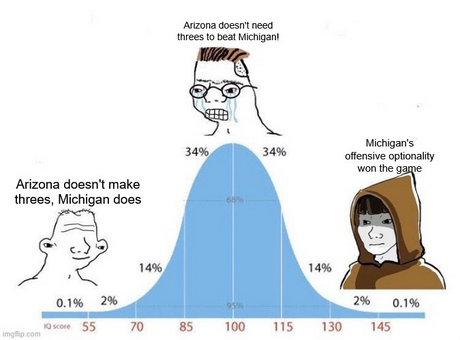
But I'll lean towards a combination of Arizona's physicality at the rim and glass with Michigan returning to earth from the 3PT line in the Lucas Oil atmosphere. But I reserve the right to change my mind before tip. - Jordan Majewski
When there’s already three other smart people writing about this game, we will surely have some overlap, so forgive me if you run into some repetition here.
This game is kind of like the Monstars from Space Jam playing against another set of Monstars (Duke, the third team of Monstars, choked away its chance to be at the Final Four like the real Monstars did against the Tune Squad). I asked ChatGPT to generate an image of the Monstars imitating the Spider-Man pointing meme, but it said that broke some copyright law or other.
Ok, that’s the most “Monstars” has ever been typed in a single paragraph. Let’s talk ball!
These rosters were constructed very similarly: from the inside out, with two-way dominance at the rim being the top priority. The European clash at the rim between Motiejus Krivas and Aday Mara should be memorable: Krivas is a more fluid mover and stronger, while Mara is longer and is more of a true shot blocker. That’s how you end up with two hyper-elite rim defenses – Arizona’s numbers are on the left, Michigan’s on the right (the top row is the one to focus on):
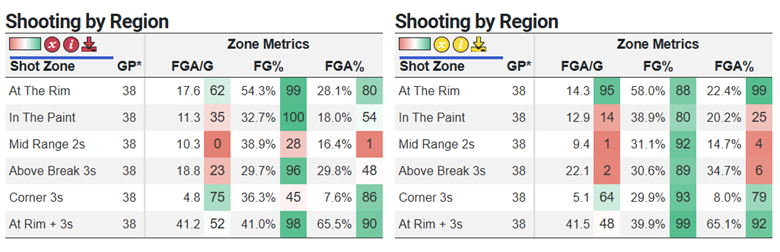
No one can finish inside against Arizona. No one even bothers going inside against Michigan. So…what happens when two teams that want to score at the bucket meet a defense designed specifically to take that away? We’ll find out on Saturday!
Of course, the rim-centric attacks are more than just a powerful bludgeoning in the half court. Both teams want to run in transition; per Synergy, Arizona ranks in the 79th percentile in transition rate, while Michigan is in the 88th percentile. Both coaches know the value of getting early looks around the rim, and both teams’ immense size allows for that. Both teams’ transition defenses grade out extremely well in efficiency, per Synergy (93rd percentile for Michigan, 99th for Arizona), so neither team may have much of an upper hand in that regard.
Mara will be tested by the back-and-forth nature of the game. He got gassed a few times against Alabama, and while Arizona won’t force him to defend the perimeter like the Tide did, an up-and-down pace could wear him down as the game develops.
He likely struggles to play huge minutes (I’d guess around 24-25?) as a result. He has only gone over 28 minutes once in the last two months, more consistently landing around 22-23 per night. The Wolverines will need as much of him as they can get: top 50 opponents get to the rim far more frequently when he sits (34.7% of attempts without him vs. 25.2% with him) and finish at a much better clip (58.6% vs. 50.8%), per Hoop Explorer. Morez Johnson and Yaxel Lendeborg are a formidable pair, but they cannot mask Mara’s absence in that regard.
Krivas has similar splits: when he plays, top 50 opponents take 24.7% of their attempts at the rim, making 49.8% of them. When he sits, those numbers rise to 31.3% and 58.3%. The main difference is that Krivas routinely exceeds 30 minutes in Arizona’s biggest games: he played 35 in the Elite Eight against Purdue, 32 vs. Utah State, 31 in a win over Kansas, 38 in an OT loss to Texas Tech, etc.
The officiating in this game will be of the utmost importance. With giant, powerful athletes hurling themselves at the rim repeatedly on both ends of the court, we must form a *prayer circle* and hope the refs let the boys play (so long as they operate with the right level of verticality). Early foul trouble to either Krivas or Mara would give the opponent a window of opportunity around the bucket.
Moving out from the paint, Michigan does seem to have a slight perimeter advantage, particularly with Yaxel Lendeborg currently operating in God Mode. He has obliterated three straight opponents, averaging 25.0 PPG on 61% shooting from the field. Few teams in the country have a defender capable of checking him inside or out, but Arizona might have one in Ivan Kharchenkov. The German wing/forward is a maniac, perfectly willing to put his body in the path of a freight train if it helps the Wildcats win. He’s built like a brick house and mobile, so watching him attempt to neutralize Lendeborg is yet another must-watch individual battle.
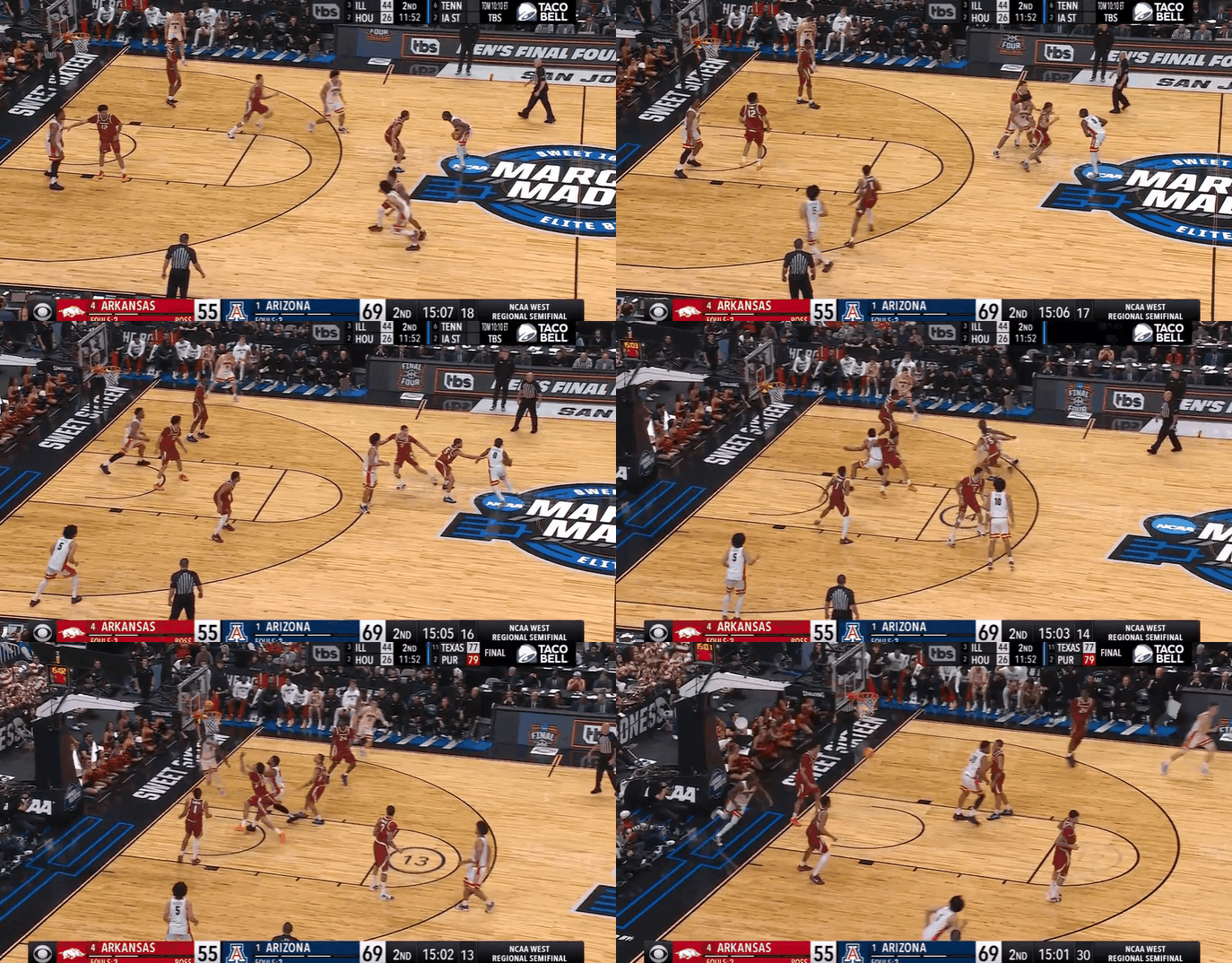
I’m told both teams will also use guards in this one, and I do think the size/strength of Arizona’s duo – Jaden Bradley is 6-3, 205 pounds, and Brayden Burries is 6-4, 205 – giving them a decided bulk advantage over Elliot Cadeau (6-1, 180) and even Nimari Burnett (6-5, 195). Those two are lethal getting downhill, and their bigs do a great job of sealing off potential help defenders via Gortat screens (see Awaka here):
The ultimate question is the shooting optionality on each side of the court, but Jordan handled that question with aplomb. Michigan is more willing to fire, especially in transition, but between Burries, Anthony Dell’Oroso and even Bradley and Dwayne Aristode, the Wildcats have enough perimeter potency to punish Michigan if it plays too compact.
I’ve gone back and forth on this game all week. I think it is a true coin flip. I’ve said Michigan for part of the week, but as I write this on Thursday afternoon, I’ll take Arizona narrowly. - Jim Root
With two teams that are truly incredible, and three equally as talented basketball minds breaking down the game above, I decided to focus on what I would say each of these two teams does the worst conceptually, and how the opponent fares in those scenarios.
For Michigan, it's defending big men outside of the paint. The Wolverines have allowed 1.2 points per possession just twice all season. Against Wisconsin, the Badgers used their shooting bigs to create open looks with Michigan not wanting to bring their elite rim protection away from the paint. Against Purdue, Trey Kaufman-Renn and Oscar Cluff scored an absurd 16 points off runners and hooks, a shot that Michigan will allow as it focuses on rim denial.
Unfortunately for Arizona, none of its bigs shoot threes, only have 15 combined made field goals on runners all year, and are 208th in field goal percentage on hooks. Michigan's defense is truly special unless a defense has any way to use its bigs dynamically without needing the rim, and that is just not the Wildcats at all.
For Arizona, the team's biggest weakness is actually highly correlated. The Wildcats have only failed to shoot 50% at the rim on six occasions all year. Those games include both their losses, and four of their six worst offensive games of the entire season. Because of how few threes this team shoots, and how rim-dependant their bigs are, if you can defend the hoop effectively, the pathway to points starts to diminish.
Unfortunately, Michigan is as good a rim defense as there is in the country. The only other comparable rim defense Arizona played this season was Houston, who one, plays an entirely different defensive style, and two, Arizona needed a combined 58 free throws in two games to beat by single digits twice. Michigan is 14th in free throw rate defense.
All told, Arizona wins this game if its bigs can create outside of directly under the rim and scores efficiently at the hoop. Michigan wins this game if it can deny the rim defensively and dodge lots of big-man self creation. With how these teams play, I would say the significant advantage goes to Michigan when we compare each team's flaws. - Matthew Winick
