
A lot of people will point to this season's game between Illinois and UConn in November as the sole source of data necessary, and a lot of people will point to it as completely irrelevant. To be certain, both teams have changed lineups and strategies since, and thank Christ this will not be played on one of the ugliest courts in basketball history.
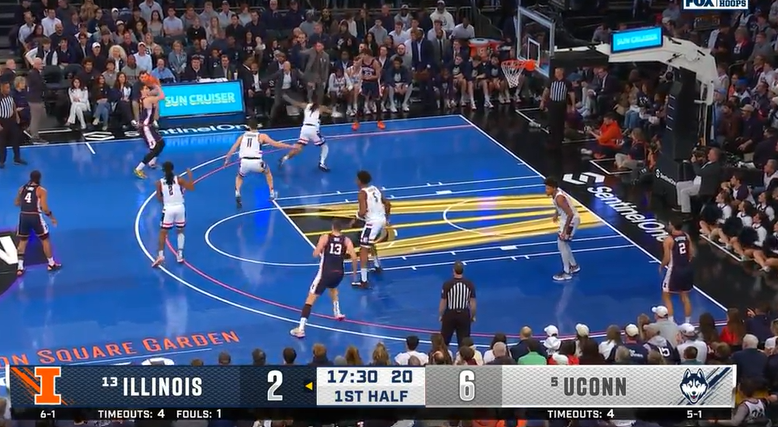
I think the only way they could've improved it is perhaps by having glass and gigantic oil company logos splattered everywhere. Anyway, I lean more column B than column A, but there's at least something to UConn having already played the Illini, and Dan Hurley and Brad Underwood are about to face off for the third time in 24 months. While Underwood has toned his act down somewhat, the frequency of this pairing makes me wish they were somehow in the same conference, because the potency is certainly there for a real rivalry to take hold. Maybe in 2047 when we have the Big 38 Sponsored by Eater and Northrup Grumman.
UConn had an excellent day against the Illini offensive attack on that November day but I'm not 100% sold it's repeatable. For one, the Illini shot 21% on 29 threes, their worst result of the season in any game with 20+ attempts, shooting a pretty standard 5-14 on open threes but 1-9 on guarded ones. (Going 0-for-6 on dribble threes was unusual, too.) If UConn had guarded the majority of these well then I'd feel differently, but it's more likely the Illini just had a bad day.
For their actual attack on Saturday, the Illini are gonna do what they always do: tons of pick-and-roll, a good amount of post-ups, and an extremely limited amount of off-ball screens. As noted by Jordan Sperber, the Illini use P&R for pick-and-pops more than anyone else has possibly in the sport's history:
 Jordan Sperber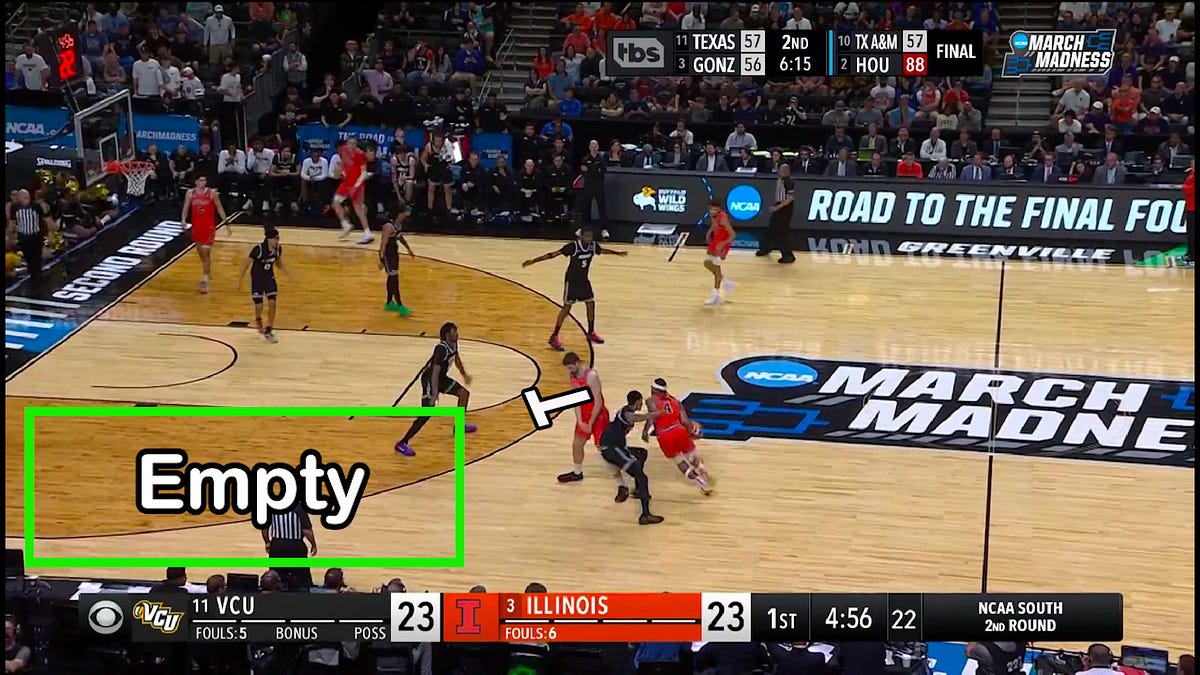
And I'm highly intrigued by that against a UConn team somewhat more likely to hedge the ball screen than to stay back in the paint. Illinois ripped the hedge-hogs of the Big Ten to shreds this year: 1.39 PPP against Purdue, 1.29 and 1.14 PPP against Iowa (the former of which was despite shooting 3-17 from deep), and 1.23 and 1.27 PPP against Nebraska. I'd make the argument only Nebraska is as good or better defensively as the Huskies are, but their level of extension to the screen is a lot more extreme:
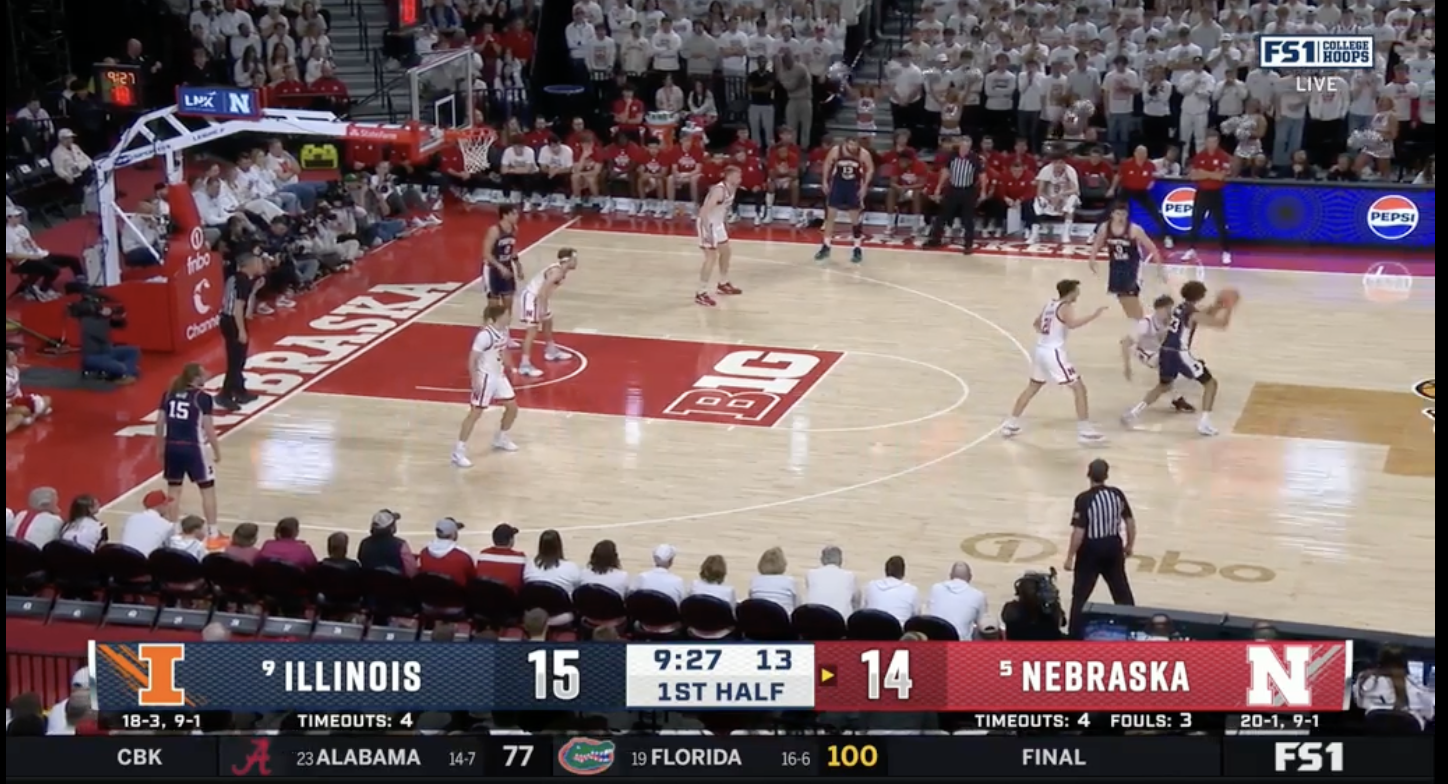
Than the average UConn defensive look against a good P&R unit:
That level of coverage mixing could prove fruitful here, because while the Illini were largely supernova against any sort of hedge or switch they were mortal-ish (as in, per Basketball Index, merely the 10th-best offense out there) against drop coverage. This does make sense to me. Keaton Wagler is a tremendous shooter whether stationary or moving, but teams that can funnel him into the midrange or even to the rim seem to have success. Wagler's floater game is below average (11-34, per Synergy) and he's converting 54% of his attempts at the rim. These aren't disastrous numbers but when the average jumper is going for 1.15 points per shot, you make your bed and lie in it with the layups.
Still, there will be holes. UConn has generally been better at funneling their opponents to the rim to meet a demise, but against super P&R heavy offenses like Illinois there's been trouble brewing. The most ball screen-centric offense in the Big East, Providence, lit the Huskies up for 1.18 and 1.13 PPP, two of their nine worst efforts of the season. Outside of the Illinois game, UConn did also allow 1.12 PPP to Arizona, which I'm hesitant to point to because of missing Reed + Mullins but it's still an interesting data point. It's a good P&R defense but not an elite one - 69th-percentile at Synergy - and teams that hammer the roll man have had some real success, including Michigan State:
And that does really worry me against this Illini offense who loves pick-and-pops. Even if they're not hitting those it's an offense with so many outs. They are tremendous in getting Wagler ISO'd onto a weaker defender (very likely Mullins). They produce extremely high-quality kickout threes because so many of these guys are so good at finishing. Even if they miss a shot, they get back almost 40% of their misses (43% of their three-point misses are retrieved, per CBB Analytics). They don't turn it over, and when the 'bad' thing you're pointing to is "they take a lot of off-the-dribble jumpers" that whole thing kinda becomes pointless when they're dumping 1.15 points per shot on dribble jumpers.
The good news for UConn is the good news for basically anyone left: you can score on the Illini and do it with fair frequency. Illinois has never been great at defending off-ball action, which is a genuinely huge concern against the Huskies. As pointed out by Jordan below, UConn scored 16 points via off-ball screen at 1.33 PPP in the November matchup, which seems plausible enough to replicate though it would require similarly strong deep shooting. You can't and won't post Illinois up basically ever, and they're oddly hard to beat in ISOs, but Tarris Reed is the best post Illinois will have drawn in the Tournament and UConn rarely isolates anyway.
Illinois is generally going to stick in drop coverage, which does potentially eliminate one path of offense to me (Demary/Smith's great ability to hit Reed in the P&R) but does open up the chance for UConn to get off a lot of open jumpers in this game. I'm not really huge on basically any of Illinois' defensive options on the perimeter, especially when those same guys know they've gotta score and score a lot to make the equation work. Over half of UConn's threes were considered open by Synergy in that first game, and UConn does probably the best job of anyone left at producing said open looks:
It's just about if they go in or not. UConn's shooting 41% on open threes and 28% on guarded ones this year, which is a severe split but seems telling that it's not a team stuffed of guys who will hit a ton of difficult shots. That's probably why I lean Illinois here: they've got more paths, and while threes will be the story in both directions the Illini are the superior rebounding unit/shot volume unit. They're also likely to have the advantage in pure free throw attempts, which would make the Huskies' path mostly shooting-based. That can absolutely work and has worked before...but in a one-game anything-goes setup I gotta go with the team with wider paths to a win. - Will Warren
This matchup is exactly what I love about college basketball, two totally different schematic approaches to offense. Illinois wants to exploit and prod on-ball matchups they like, while UConn wants to run you through the screen ringer, which in turn can all be a glittering lure for a deep Tarris Reed post seal with tons of manufactured space. Illinois has scored 84 points on the ball, via ball screen or iso, this tournament. UConn has scored 20 points in that regard, and zero the past 3 rounds. UConn has scored 46 points via off-ball screening action this tournament, Illinois has scored a grand total of 0. Illinois has allowed one post attempt this entire tournament, while Tarris Reed has scored 43 post points. While a good deal of Illinois' post denial has been opponent based, they've denied the post at an elite level all season, allowing just a 6th percentile post rate with a 99th percentile efficiency rating. This isn't because Cam Crocker is sending a ton of post doubles, but rather they just have so much size in the frontcourt that entry passes are difficult, and they're typically dorking off a non shooter allowing a free safety to front/dig on those post touches. What's interesting however is that the two post players to have success against the Illini (TKR at Purdue and JT Toppin at Texas Tech), came from non-dorkable offenses. This screen and immediate deep seal from Toppin is exactly what Reed does on nearly every post attempt, and Illinois wanted to stay tethered to TTU's flamethrowers on the perimeter.
So the question becomes, does UConn have a dork? Nominally the answer is no, and Illinois can struggle against teams with 5 legitimate offensive options. Functionally, the answer might be Solo Ball, but even then Ball is comfortable working in that midrange space, so I don't think dorking is going to be an option for the Illini here, and UConn will be able to run Illinois' size through their 99th percentile off-ball screen rate (where Illinois has defended in just the 20th percentile in terms of efficiency rating, per Synergy data). There isn't much to be gleaned from that noncon meeting at MSG between these two, as my colleague Matthew Winick noted immediately on X.
The first matchup between Illinois/UConn in November may be the biggest throwaway Game 1 of all-time.
— Matthew Winick (@matthewwinick) March 30, 2026
- Mihailo Petrovic played more than Keaton Wagler
- Brandon Lee played more than Jake Davis
- Eric Reibe played more than Tarris Reed
- Jaylin Stewart played more than Braylon…
But I will note that UConn scored 16 points via off-ball screen at 1.33 PPP in that matchup, and I think that's capable of being duplicated if not expanded in Indy given that the Illini drop coverage is so passive. Illinois has size, but they're not going to use it to disrupt UConn from running their script.
The question becomes what's the end result of UConn's screening, a make or a miss- perhaps a dubious prospect in the airy sight lines of Lucas Oil?
While this might be a "make or miss" type of game for the Huskies, the Illini have a bit more optionality offensively out of their elite spread PNR attack (97th percentile rate, 98th percentile efficiency rating). Out of PNR, Illinois can pop the big (highest pop rate in the history of Synergy's database, as highlighted by Jordan Sperber's latest HoopVision entry), or they can attack one of UConn's weaker defenders like Braylon Mullins. UConn is typically going to late switch 1-4 on the perimeter while hedging with varying degrees of aggressiveness with Reed. Nominally hedging Keaton Wagler can take him out of the offense, but it exposes you to so much Illinois offense on the backside, where those exploitable mismatches come into play, either with David Mirkovic/Kylan Boswell as a secondary creator, or Andrej Stojakovic in isolation, or hitting a roller/popper between the Ivisics/Davis/Humrichous. Illinois shot 3-17 from 3 against Iowa and it didn't even matter because of that multifunctionality. In fact, Illinois' offensive system under Tyler Underwood has really started to dominate the rim, outscoring opponents 123-59 in that regard in this tournament.
If we consider the boards a wash (Illinois probably has an edge here, as an underrated aspect of Silas Demary's limited minutes with the ankle injury has been his elite rebounding as a guard being off the floor more- you hope the extra time has allowed him to more fully recover, as he's such a big two-way piece in this matchup against Wagler and his ability to play on the ball when UConn needs it) and turnovers likely being a nonissue on each side (Illinois doesn't turn the ball over and they won't force UConn out of their offense with ball pressure like St. John's), I think we ultimately see a low possession but efficient halfcourt game, with each offense being able to function (UConn off the ball and Illinois hunting mismatches since UConn isn't likely to help outside of their Reed hedge). In that scenario, UConn has to be able to make shots whereas Illinois has some offensive recourse if they are not making pick and pop triples, especially with Donovan Clingan unavailable to "block 100 shots" and spark a 30-0 run.
As for schematic wrinkles, we could see the Illinois jumbo zone if Mirk and company are getting bumper car'd by UConn's screening, and that's really something UConn hasn't seen a ton of this season. A personnel wrinkle would be Hurley sacrificing skill for defensive size/rebounding with Jaylin Stewart minutes, but then you're hand delivering Underwood and Crocker their dork.
Ultimately I lean towards Illinois given their multifunctionality offensively, but caveat emptor, this is a game where Hurley can theoretically scheme his way to victory yet again. - Jordan Majewski
It was UConn that famously played practically zero help on Purdue National Player of the Year winner Zach Edey in the title game two years ago. The results of that game were astounding - Edey took 25 of Purdue's 54 shots and 10 of their 15 free throws. He didn't register an assist, the Boilermakers only had 8, and they were all by Braden Smith. The Huskies allowed Smith to dump it into Edey, UConn denied all other action, and correctly assumed that the somewhat inefficient post-up attempts alone wouldn't be enough to beat their multifaceted offensive attack. And of course, UConn could only do this because it had a 7-footer to defend Edey 1-on-1.
Does any of that sound familiar? Because I think that's a bunch of what Illinois may end up doing on Saturday with Reed. Teams have largely not dared to test Illinois' monster Ivisic brothers or even the burly Mirkovic in the post at all. Only JT Toppin has scored more than three baskets in the post against the Illini this season, and only four others have hit just three. For reference, Reed has 15 post-up field goals made in his four March Madness games.
In the first matchup, only four UConn possessions ended with a big in the post. They went as such:
- Reed fouled on easy layup attempt
- Reed turnover on charge attempt by Zvonimir Ivisic
- Reed miss on drop step against Mirkovic
- Eric Reibe bucket on drop step against... 6-foot-2 Kylan Boswell
Reed was clearly not right in that one, as he missed a couple bunnies and it was his only contest in a five-game span as he worked back from injury. Also notably, none of those post-ups came with UConn's other four current starters on the floor, and all of Ball, Demary, Karaban, and Mullins fall in between the "respect the jumper" and "know where they are at all times" categories. Illinois often at least showed a second at Reed in the post with the defender guarding Jayden Ross or Jaylin Stewart.
Anyways, this is a long way of saying, if UConn plays lengthy amounts of its starting five, expect Illinois to live and die by playing Reed straight up in the post, so as to not need to help and recover much defensively (which they basically never do) and focus on UConn's intricate perimeter screening action, which Illinois has had some issues defending this year.
While Indiana's Sam Alexis is no Tarris Reed, this is largely what to expect from Illinois. Indiana is a team that, like UConn, runs a million off-ball screen for their shooters, and play largely through motion and through the pass rather than the dribble. When Alexis is backing down Ivisic here, Illinois' other players are painful uninterested in helping. It is much more vital for them to stay on shooters.
Alexis took a season-high in post-up attempts in that meeting, and Indiana had just a 50% assist rate, one of its lowest of the season. As a result, the Hoosiers scored just 0.9 points per possession, their second-lowest mark of the year.
Maybe it's being in the state of Indiana while writing this that saw me draw a Purdue and an Indiana connection off the bat here, but I really think Illinois' post-up defense is the key to this game. In general, making the Huskies individuals rather than a team is the best strategy to beat them, and Illinois' extremely soft drop coverage aims to do that already.
In practice, I would expect a below-average assist rate for UConn, and at least one shot per every two minutes on the floor from Reed.
That said, it is worth noting that UConn had an astounding 19 assists on 26 attempts in the first meeting, the second-highest Illinois has allowed all year. A whopping 11 of those came due to off-ball screening action. It's one thing for Illinois to want to limit that action and force 1-on-1 in the post. It's another to actually do it. They surely will have more prep and scouting tape this time. All things considered, that defensive scout was really bad in November.
On the other end, Jordan mentioned Illinois' desire to hunt mismatches offensively, and the Illini have plenty of options to attack here as the tallest team in the country against a team that is averaged-sized at forward. I wrote all about Illinois' offensive roles earlier in the week, and how Mirkovic and Stojakovic are the two guys that are primed to take advantage of their individual matchups.
The Huskies were still playing a ton of Jaylin Stewart back in November, who basically never sees the floor now. He actually grades out as one of UConn's best defenders, and was the primary guy on Stojakovic in that contest. It's worth remembering Stojakovic was Illinois' leading scorer and usage guy in the team's previous two power conference games before scoring just three points against UConn. Assuming Stewart remains buried on the bench, Stojakovic could have a much larger output here.
Inevitably, I will trust Illinois' positional size and improved defensive priorities here over UConn's flow-based action and individualistic defensive principles. But unlike the other matchup (due to its extreme physicality and rim presence), I think this is a game where one coach can truly will his team to a win. We all know that would likely favor Dan Hurley and Co. - Matthew Winick
- Writer 4
