

Well, how do you follow up a season where you...
- Started out 14-0, then 25-1;
- Went 3-0 in the Players Era Tournament against three KenPom top-50 teams with a scoring margin of +110;
- Defeated 17 Quadrant 1 opponents;
- Were +17% from 2PT% land;
- Had the nation's best defense along with a top-five offense;
- Oh, and were ranked #1 at KenPom for over two months?
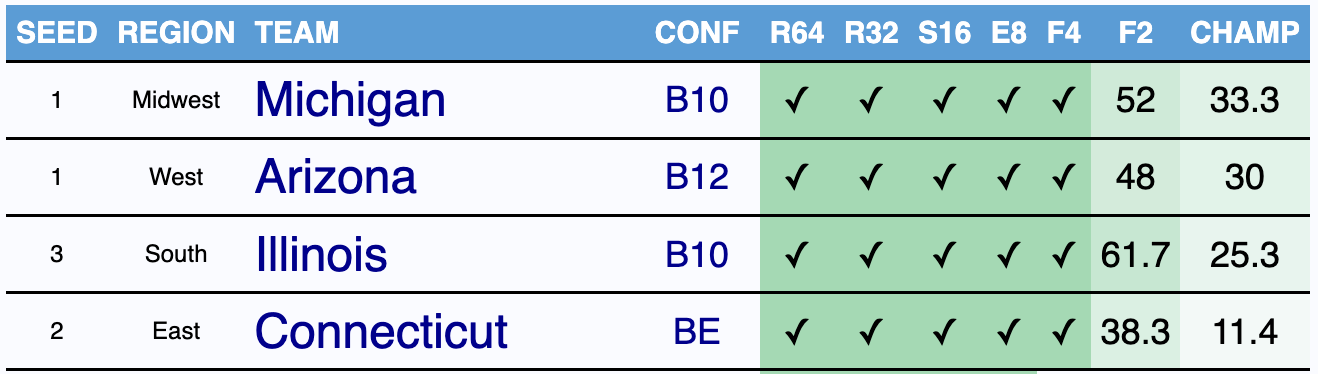
I mean, you could do it a lot of ways. For one, you could lose via the most shocking back-breaking buzzer-beater imaginable. Alternately, you could demolish the entire Midwest Region, go 4-0 with a scoring margin of +90, shoot 64% from 2/45% from 3, and fail to score under 90 points even once. That's the path Michigan chose, and because of it, they have emerged as the slight statistical favorite to be your national champion.
Throughout the year, we've talked a bunch about the Michigan Wolverines, so I'll link them here. If you haven't checked these out yet, indulge yourself:
- Brian Rauf in August on Yaxel Lendeborg being an upgrade on Danny Wolf
- Rocco Miller on the 'thoroughly prepared men of Michigan' in December
- Scout Team on Michigan
- Matt Winick's Year of the Rim Point, with a significant focus on Michigan
- Dean Wendel on Michigan
- My Midwest Region preview, along with the reset preview
Onward and upward. Let's dive into who and what makes the Wolverines this year's model.
Michigan's offense
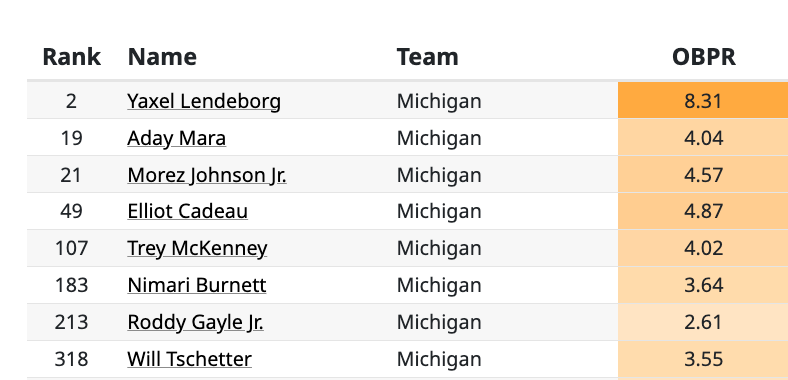
Similar to Jordan Majewski's work on Arizona, we'll do a quick personnel report. Here's Evan Miyakawa's BPR numbers on the Michigan men:
And here's their stats from Torvik this season, which you can click to expand.

Elliot Cadeau is the point guard and perhaps the most controversial piece on the roster. Cadeau's emergence as a legitimate plus shooter from deep this year gives the Wolverines a backcourt dimension they wouldn't have otherwise, and in the Tournament Cadeau's passing has leveled up (33 assists!) as his steady hand at point runs a Michigan offense perhaps operating at its highest level in three months. Due to the season-ending injury to L.J. Cason, previously Cadeau's backup, Cadeau regularly pulls 32+ minutes after being at around 27 MPG in non-garbage time before the injury. Much of Michigan's P&R offense runs through Cadeau; with him on the court this year, Michigan averages a 63% Assist%, 38.5% 3PT%, and a schedule-adjusted 135.6 points per 100 possessions.
Nimari Burnett's third year at Michigan has been his most rewarding. As Michigan's main 2-guard, Burnett's excellent shooting (38% 3PT overall, 41% in league play) means the Wolverines almost always have three legitimately good shooters on the court at all times, which is a luxury when paired with their elite frontcourt. Burnett is Not Just A Shooter and is a very threatening downhill driver in transition/off of backdoor cuts, but when you're ripping 40.4% on catch-and-shoot 3s and 50.7% (!) on open ones, you're gonna be known for the one thing. If Burnett is the weakest of your five starters you have an unbelievably good team.
Yaxel Lendeborg is the true head of the snake. He'll end up #2 on the average Player of the Year ballot, but an argument can be made that no one in America - certainly no one left in the Tournament - has more two-way impact than Lendeborg. With him on the court, Michigan is an astounding +49.9 per 100 possessions (adjusted for opponent), outshoots their opposition by 18% from 2 and 9% from 3, and is +8 per 100 on the boards. In Bart Torvik's 20-year database, Lendeborg is the second player ever to post a 130+ Offensive Rating on 20%+ Usage% while making 120+ twos, 60+ threes, and posting 3+ assists a game. The only other: Bruce Thornton, who had way less help than Yaxel does and was much shorter.
Lendeborg is everywhere all of the time. He can run the offense as the main ball-handler, as seen here:
He can shoot both off the dribble (40%) and stationary (37%). He's unstoppable at the rim when he gets there (69.6%, per Synergy, including 65% on layups). In the Sweet Sixteen and Elite Eight, Lendeborg posted 50 points, 19 rebounds, and 11 assists. The last guy to go 50/15/10 in those two rounds was UNLV's Stacey Augmon...in 1990. We haven't seen something quite like the Yax Attax before.
Morez Johnson came over from Illinois and is a two-way bulldozer that put up some insane numbers this year: 131 ORtg on 21% USG%, 65.8% from 2, a 12.4% OREB% and 19.3% DREB%. The only other high-major players in the last decade to put up this combo: Zion, Clingan, and Tarris Reed. Zion is the only other player on that list to flash a jumper like Johnson has (12-33 from deep this year), and the number of rim-finishing bigs (to use Synergy's terminology) with a higher number of points scored from threes this year at the high-major level is a list of one: Aidan Sherrell at Alabama. Sherrell's a hell of a lot less physical and less physically imposing than Johnson. Not much of a passer, but that's not his job.
Aday Mara is your average 7'3" center who has the second-highest Assist% on the team and seems to dunk flat-footed. With Mara on the court, Michigan is an unbelievable +20% at the rim (69% to 49%) and nearly +20% from two on the whole. Mara had 76 dunks this year, which is only unimpressive if you note that he somehow missed six additional dunks. His lone dark spot to me is that he's not that efficient in true 1-on-1 post-ups, and he can be hassled into bad passes/turnovers. But, well, when your top statistical comps are guys like 2008 Roy Hibbert and 2024 Donovan Clingan you're in fine company.
Michigan has three true options off the bench, headlined by freshman 2-guard Trey McKenney, who has emerged as possibly Michigan's best all-around shooter down the stretch of the season. McKenney is a frequent target on Michigan's dribble handoff sets, and blowing these up before they happen is a must for the Arizona defense:
Roddy Gayle is the small forward when Michigan opts out of a three-big lineup for the most part. Gayle will never be much more than an okay shooter, but he's started to find his stroke again in the Tournament and is 7-12 since the Tournament began after a horrendous 6-27 run in conference play after a 3-34 run in conference play last year. Perhaps just tell this guy that every game is against a non-Big Ten opponent. Despite that, Gayle is a pretty athletic finisher and is more threatening than his 53% rim FG% would imply. Clearly a step down from the other wings, however.
Will Tschetter is a fifth-year Michigander who is mostly Just A Shooter and a very gawky one at that. However, the oddness of his play wears off once a shot of his goes in. 35% off the bench from deep, and he's typically used to spell Lendeborg.
Michigan will first attempt to make their presence known in transition, where they've ruled the roost all year long. Against top-25 competition, per Hoop-Explorer, the Wolverines are posting an astonishing 1.38 PPP in transition - easily the best in America - shooting 70% from 2 and 46% from 3. If you let them run on you, not only can they use their athleticism to hunt quick advantages, they find open threes before you can get set. Against one of the nation's best no-transition defensive programs in Tennessee, the Wolverines acted like they were playing Tennessee Tech on a December Tuesday:
The half-court offense is tri-pronged: hunting pick-and-roll mismatches using Cadeau (or Yaxel) as the orchestrator, hunting pure physical mismatches in the post using their overwhelming size and positioning, and using those two off of each other to round out the attack with quality off-ball movement and complementary actions. The post play in particular is brutal to the max. You can think you have these guys covered, and as the season has gone on, teams have tried to double (whether a 'true' double or a temporary second defender) the post more and more. This is a very bad idea, especially if the poster is Mara, who may have the best eye for cuts to the rim I've seen from a 7'3" guy in a while.
If this sounds really hard to stop, it's because it is. After a pair of early scuffles with Wake Forest and TCU when the Wolverines were figuring things out, they've been held under 50% from two exactly once since (an 82-61 win at Ohio State) and under 1.04 PPP just twice (Duke and Wisconsin). Against top-10 competition this year, Michigan averaged 120.7 points per 100 possessions. The only offenses better: Wisconsin and Arizona.
Per EvanMiya's Keys to Victory, the offensive numbers to watch for the Wolverines are 33% from 3 and 58% from two. When Michigan hits either this year, they haven't lost a single game. As a bonus: when they've notched 16 or more assists, they're undefeated.
Michigan's defense
Here's Evan Miyakawa's BPR numbers on the Michigan men:
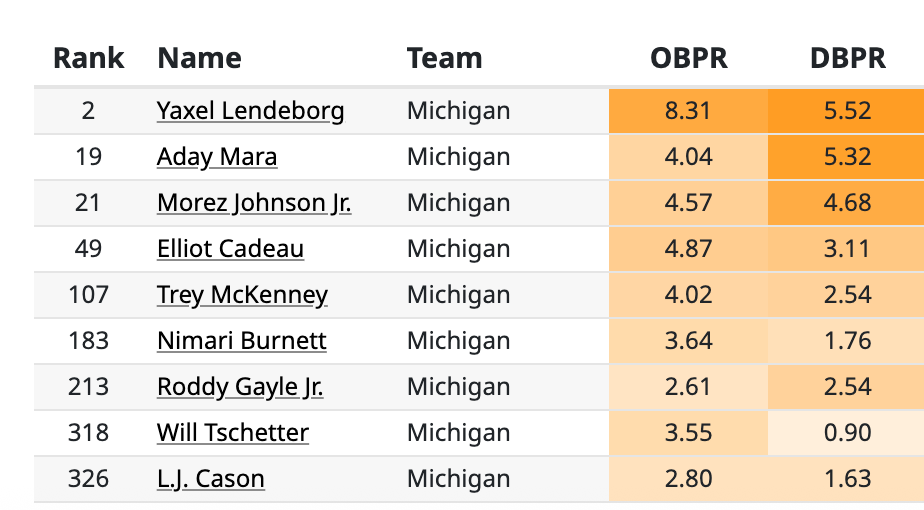
First off, Michigan has two of the three highest-rated DBPR players in Lendeborg in Mara. Wild enough! But beyond that, they and Duke were the only teams this year to have three players at +4 or better. That was why I thought we were headed for a Duke/Michigan title game, but hey, here we are.
Of the five starters, Cadeau isn't the most impactful point of attack defender in world history, but he's improved quite a bit from his time at North Carolina and looks a lot like the guy we saw in 2023-24 ACC play on that end of the court. Mostly a "keep him in front of you" guy, and typically not one to take a bunch of chances on generating steals.
Burnett also is far from elite defensively, but as the player typically assigned to whoever the least threatening offensive piece on the other team is, he acquits himself fine.
Lendeborg has always been a pretty good defender but he exploded into an elite one this year. His 4.6% Block%/2.1% Steal% are in high company alongside guys like Zuby Ejiofor, Tarris Reed, and Ugonna Onyenso for disruptiveness on the defensive end. Actually, here's a sell: Lendeborg drew the Nate Ament matchup against Tennessee and the London Jemison/Houston Mallette matchup(s) against Alabama. Collectively, those three players posted 17 points on 24 shots and had almost zero impact on their respective games.
Johnson is the least-amazing of Michigan's Big Three on defense, which is to say he would probably be the best 1-on-1 post defender on most other rosters this season. He's Michigan's best rebounder and best 1-on-1 post defender, which...well, look at his shape. You think you're getting around that guy often?
Mara is obvious. Michigan runs drop with him and a hedge/at-the-level coverage with anyone else, but it's because Mara is the rim protector in this Final Four. With the Big Three on the court together (598 possessions), Michigan has held opponents to 40.5% from 2, 49% at the rim, and an opponent-adjusted 87.1 points per 100 possessions. In this era of supreme offense, these numbers are roughly like holding a 2019 offense to around 80 per 100. We built statues of 2019 Texas Tech for numbers like that.
Of the backups, Gayle is the strongest and best perimeter defender and has become more useful in that role than he has in a shooter. McKenney is fine, but has some typical freshman mistakes in coverage and doesn't have very active hands. Stays in front of his guy, though, and that's all you have to do when the Big Three are behind you to help. Tschetter is the worst defender on the team and still grades out as above-average.
This is full man-to-man with the ability to mix coverages in a way even elite teams of the past usually didn't. Michigan's gigantic frontcourt allows the guards to hang back and limit transition runouts, and even in the rare games where they have given up transition looks they haven't often gone down. At the old newsletter last year I did a big piece on Michigan's bet on shot quality being more important than pure talent:
 Will Warren
But I'm not sure I anticipated they would pair shot quality with top-5 talent this quickly. Michigan's Big Three is tremendous in rim protection, and similar to last year, chaos in terms of steals and turnovers isn't totally necessary if you have top-end positioning and size. I am continuously impressed by how well Michigan shuts down off-ball actions, which to me shows incredible communication and instincts not just from the players but from the staff who's taught them to blow up these actions. It's telling to me that against Tennessee, routinely a top-10 program in points generated from off-ball screens, the Wolverines gave up two (2) points on these actions because Tennessee couldn't get to them in the first place. Watch the anticipation here:
And even when a Tennessee player did get the ball off of a screen, it was no less than 25 feet from the basket. Michigan pushed them way out, further than I saw anyone else do this season...and I promise this matters, because I am one of the few freaks that watched every minute of every Tennessee game this season. That level of pushing out on the perimeter forces a bunch of ugly looks and long, stale possessions. Michigan's elite at spot-up and perimeter suppression in general, and Tennessee had to go to the mid-range pretty often because that was all that was left open by the Wolverines.
The one area they can be vulnerable to is strong, hot-shooting ball-handlers, as evidenced by Labaron Philon going for 35 on Michigan in the Sweet Sixteen. (I'll also note Ja'Kobi Gillespie posted 23 for Tennessee, but it took 22 shots.) Michigan's drop coverage with Mara under the free throw line can and should remind a lot of people of the Zach Edey era at Purdue, and they look fairly similar in screenshot form:
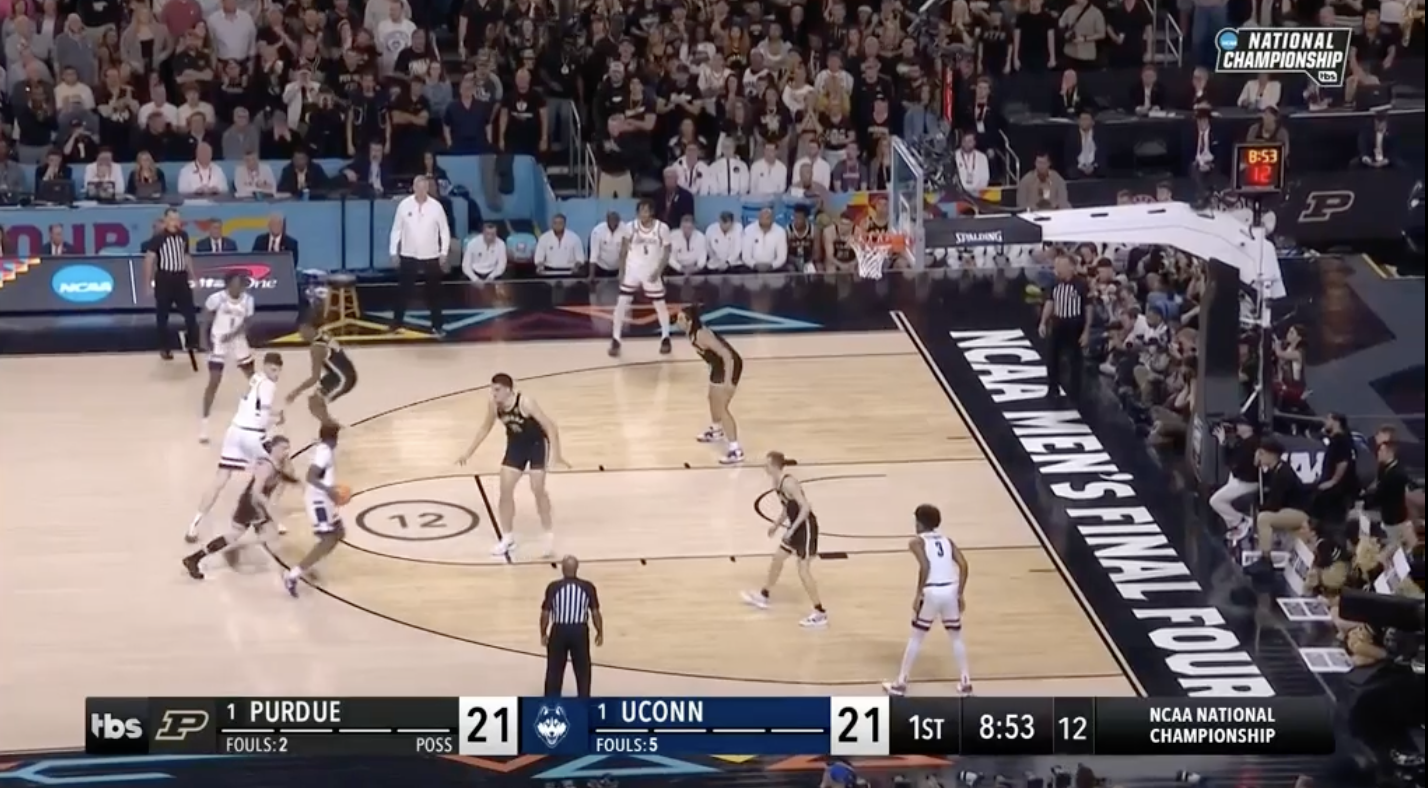
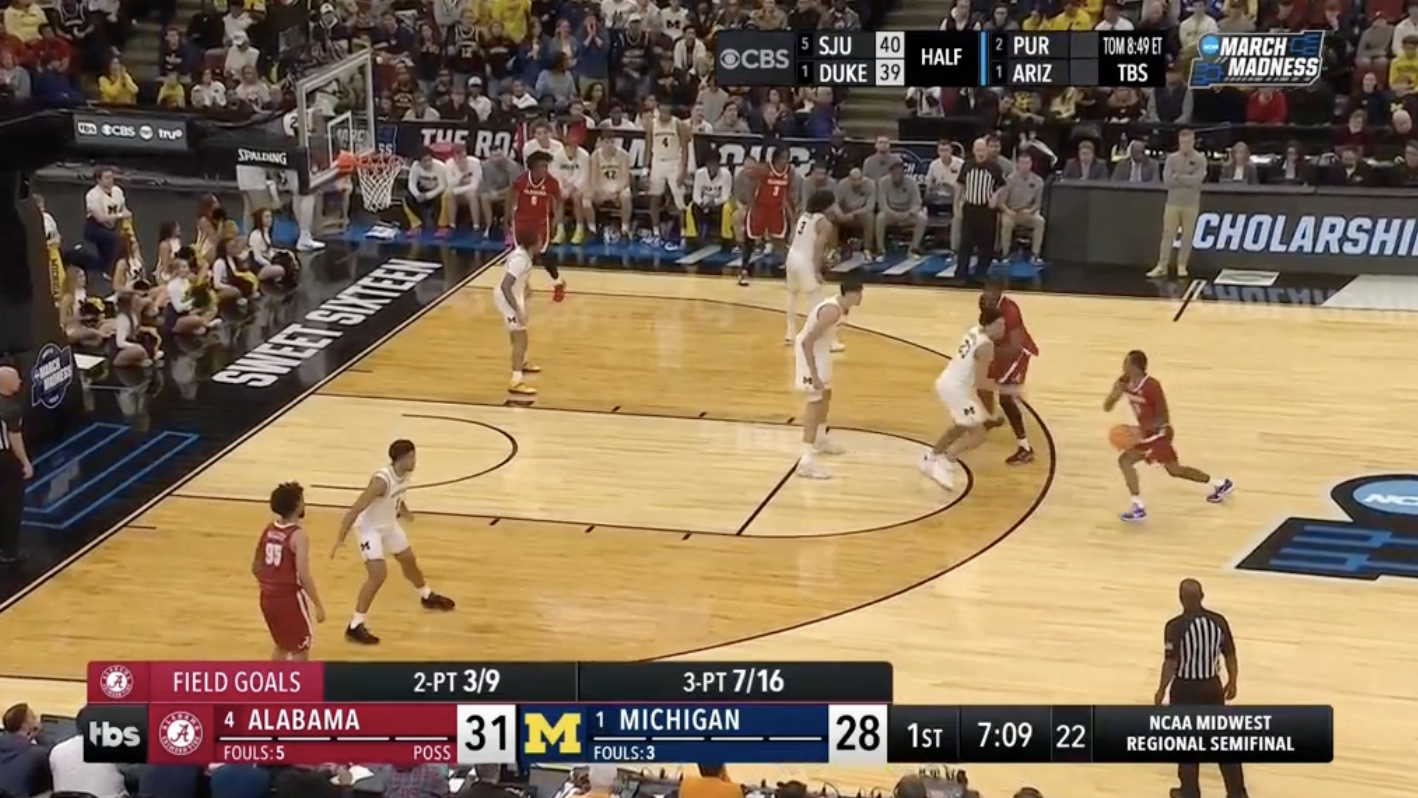
With that in mind, I'll note that against Illinois (a potential title game foe, and the team with the highest-usage ball-handler left in Keaton Wagler) Michigan generally stuck to their identity but came out of the gate swinging a bit more, with more of an attack mindset at the screen itself:
Generally speaking, though, this is a containment-based look that will shrink the court and force you into long jumpers. Illinois - ILLINOIS!!! - took 35% of their shots from midrange in that game. Even top-25 opponents still only got 28% of their shots at the rim against the Wolverines. Think you can do it? That's easier said than done. Per ShotQuality, Michigan forced the worst shot selection of any team in the sport this year, which tracks.
Vulnerabilities
I think the pick-and-roll can be one with the right opposing guard. Michigan has generally shown a willingness to tell these guards "you go and hit these shots" if it means walling off the rim and containing everything else. Michigan did lose a game almost entirely from three-point variance to Wisconsin, and Braden Smith shredded Michigan's defense in the Big Ten title game. It's doable, but you kinda have to be the best. Everyone left in this Tournament has a baseline of excellence, but you have to be the best on this day to beat them. If you get hot, you're naturally going to drift out further to stop those shots...which is where Purdue (and Wisconsin) took advantage.
The other side of the ball...boy. I do believe there is some amount of shooting regression owed, and they're running quite hot from 3 in the Tournament, but you can't predict how much it'll regress or when. Kinda up to the basketball gods and the bounces. I still think that Michigan's backcourt is clearly its weak link, and Cadeau's looseness with the ball has gotten them in trouble. In games where Michigan has tossed up a 20% or higher TO%, Michigan's PPP is just 1.12, which is still good but certainly not elite. There's not a pure correlation between losses and turnovers for Michigan - in fact most of their losses have come in games with few turnovers! - but you look through Cadeau's year and you see 8 turnovers against Nebraska, 6 to TCU, 4 to Iowa, 4 to Purdue...it's possible he could be the problem in a one-off game.
How they match up against Arizona
I'm gonna save most of my thoughts for our actual game previews this weekend, but I genuinely believe this game is as close to 50/50 as it gets, and in 50/50 battles I lean towards which half-court offense is better at in-game execution...which is technically Michigan's based on the stats. The shot volume should be close to equal (barring a Cadeau turnover bonanza), but the more Michigan makes this an execution-based half-court game, the better I like their odds. Strange to say that about such a lethal transition team, but you can point to Arizona being elite in the exact same way. It'll be a game decided on extremely thin margins...so I guess I go with the team that's +9% from two against top-10 opponents over the one that's +5%. I mean, look at how these teams have performed against the top-10. YOU tell me which one is better, because I genuinely think it's so close to dead even.


A key thing for me here is ranking the players most likely to close this game out. For Michigan I am assuming it's the Big Three, Cadeau, and (preferably) McKenney or Burnett. For Arizona, Bradley, Burries, Kharchenkov, Peat, and probably Krivas (or Awaka?). If that's the case, Yaxel is the best player on the court but there's a real argument over who the weakest weak link is. Is it Cadeau? Kharchenkov? Peat? McKenney? So many questions, and I like that I have a few more days to think these things through.
