

Here we are, with the ashes still smoldering on 2026 Feast Week.
It is always a rough comedown on the Saturday-Monday following five days of wall-to-wall hoops. The teams who played in MTEs are returning home and settling in for their next midweek game, while the teams who are ready to play this weekend typically don't play high-level competition so close to Thanksgiving. As such, we have just two games over the next three days with a KenPom FanMatch score higher than 50, and both (Utah State/New Mexico + Saint Louis/South Florida) take place on Sunday.
While I wish there was a little more to watch, I also accept that this is a fair price to pay after the CBB gods gifted us our first smorgasbord of the season. From leaky roofs to controversial calls to 10:00 a.m. onions, no matter what form it assumes, Feast Week will always deliver.
In a week where it's quite difficult to stick out, here's who found a way:
1) When you list the best guards in the nation, it may not take long to get to Alijah Arenas
Alijah Arenas has not taken the path of a typical five-star recruit. The son of Gilbert had to fight like hell just to arrive on campus at USC, as he was involved in a serious car crash only a few months before his freshman season was set to begin. Once a full recovery was made, another setback arrived via a torn meniscus. Through it all, Arenas still found a way to suit up for the Trojans in mid-January, putting up admirable statlines for a player who had fought as hard as he did just to take the court.
This year, with a fully healthy offseason behind him, the true talent of Arenas is on display for all of us to witness. It is quite the sight.
Through eight games – half of which came against top-90 competition – Arenas has put up a:
- 132.3 ORtg on 26.8% usage (8th-highest ORtg among all players with 26%+ usage)
- 58.9% eFG%
- 65.1% TS%
- 8.2% TO% (6th-lowest among players with 26%+ usage)
- 7.2 FD/40
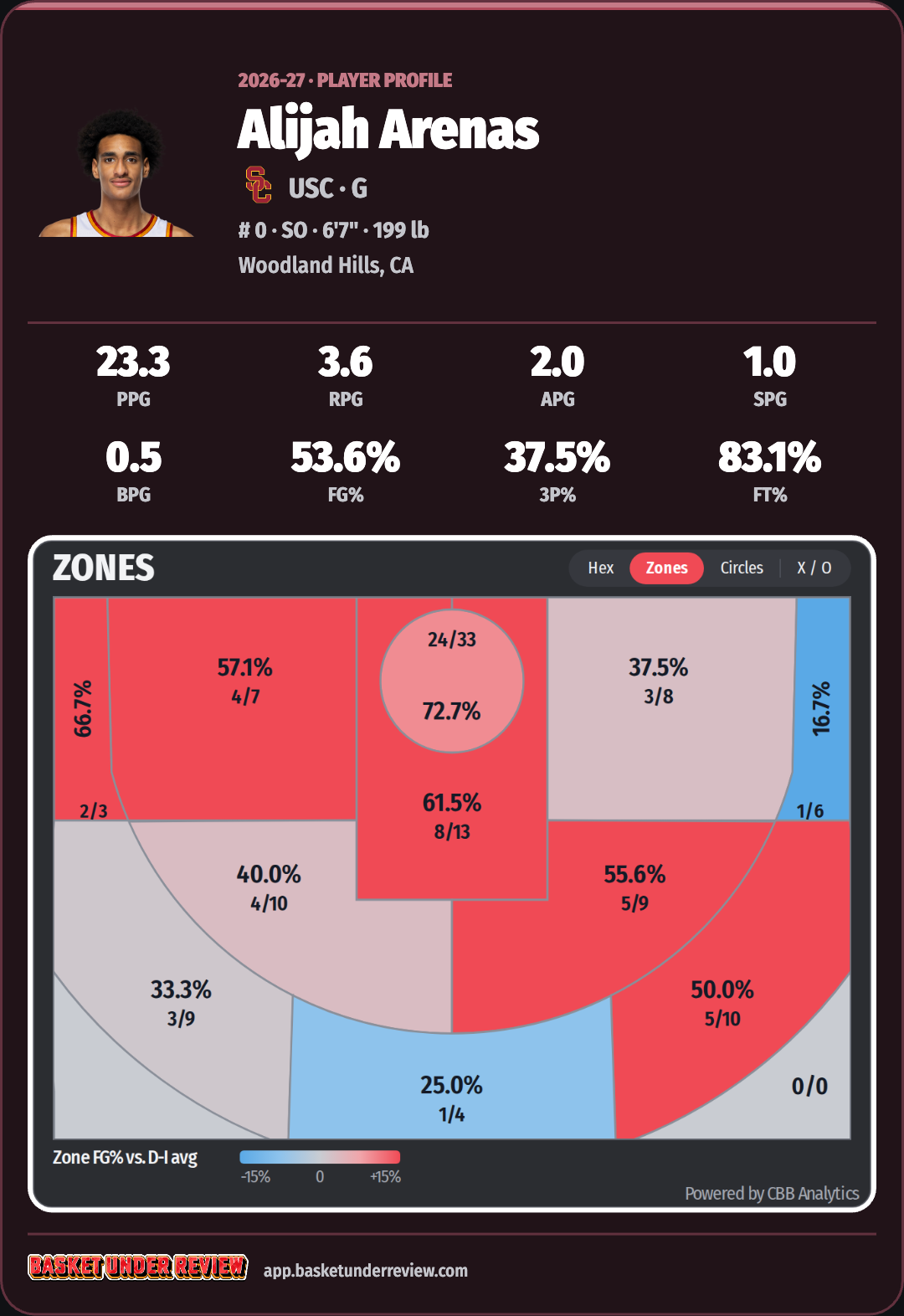
On a USC team that grades out as defensively-driven, Arenas has been a spectacular offensive piece for Musselman. The sophomore isn't afraid to step outside the arc, specifically at the wings, but his best work has come driving downhill and finishing amongst the trees.
There are certainly some deficiencies to Arenas' game – he only broke the two-assist mark vs. Arkansas-Pine Bluff and his defense is just okay – but the strengths are so elite that most draftniks have still moved him up their early draft boards. From a college perspective, keep in mind that very few guards at this level are above-average in all facets of the game; some of the sport's best are growing as we speak, and Arenas is growing right in line with them.
He might be growing at an even quicker rate, actually. Per EvanMiya, his BPR has risen from a preseason mark of 2.45 to 5.85, the 6th-highest leap of all high-major players. The future is now for the younger Arenas; I'd expect his name to keep climbing the list of this sport's top guards.
2) Caleb Holt just needed some time
Moving from a heralded sophomore guard to a heralded freshman, Caleb Holt represented the gold standard of high school guards in the 2026 recruiting class. Alabama, Kentucky and Providence all made runs to get the Prolific Prep product, but it was Tommy Lloyd who won out and got Holt to commit to his Arizona Wildcats.
The first career college game for Holt was one to forget. He scored 7 points on 2-of-7 shooting in a loss to UCLA, and his performance coupled with his teammates' statlines raised bigger questions on who could consistently help Ivan Kharchenkov score.
It only took a little over three weeks for Holt to answer the bell. Since that opening-night loss, he's averaged a hair under 20 points a night to go along with 7.1 rebounds and a 45.8% 3PT%. His and Motiejus Krivas' contributions have made Arizona a trustworthy Final Four contender again.
The physicality of Holt is his selling point when compared to other freshman guards. It's not often that a player at his height (6-foot-5) brings both elite burst and a tight end's ability to shake defenders loose.
The freshman's also brought the juice defensively, holding up to his reputation on that end thus far with a +3.0 DBPM. In the Maui Invitational final on Wednesday, his main assignment was Ole Miss' Ilias Kamardine; the Frenchman did reach 12 points but on 5-of-14 shooting (4-of-12 on 2s).
With elite physical attributes and good finishing/defense, any semblance of a three-point shot could take Holt's stock to new heights. I highly doubt his 39% season-long mark will hold (shot 29% in EYBL last season), but even at 35%, he'll be a two-way guard that NBA teams will drool over in June.
VJ Edgecombe scored 4 points in his first college game. Jared McCain scored 8 against Dartmouth. Sometimes elite freshman guards need to get their feet wet a bit.
3) Baylor's defense has stamped its authority
Sometimes a picture can explain more than words ever could:
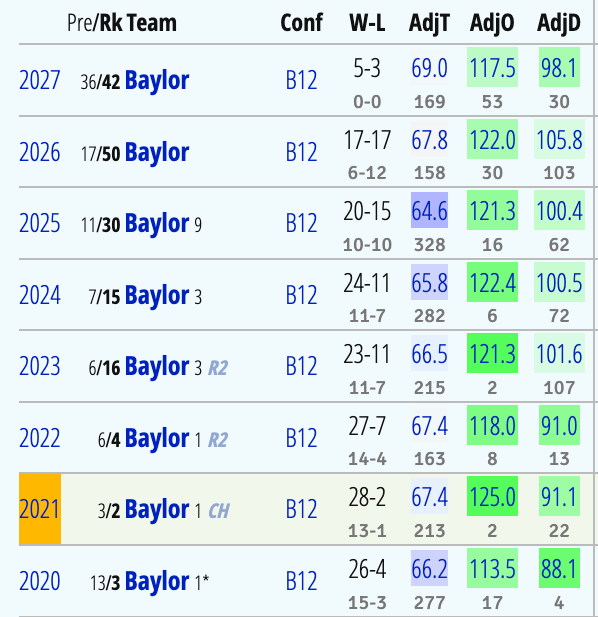
See those bottom three years (2020-22)? That's when Jerome Tang was second-in-command to Scott Drew.
See those middle four years (2023-26)? That's when Jerome Tang was at Kansas State.
See that top year (2027)? That's with Jerome Tang being second-in-command to Scott Drew.
Whatever formula Tang had on defense was lost both for him and for Baylor when he departed to Manhattan, but now it's back in full force. Prior to Friday's disappointing performance against TCU, the Bears had held 6 of their 7 opponents to under 1.05 points per possession; the outlier (Texas) still only mustered 1.13.
Against Alabama in its Players Era opener, I saw Baylor put in one of the best defensive performances this season to date. Aggressive switching and active hands dragged Nate Oats' offense into deep waters – something that rarely occurs – and it led to the Crimson Tide putting up just 63 points in a 65-possession game.
This was just the second Alabama game over the past three seasons to feature <66 possessions; defensive genius Rick Barnes was the only other coach to rattle Oats' status quo this much.
It's clear that Drew and Tang want to run back the defensive strategy that cut down nets in 2021, bringing out guards that can stick to a ballhandler's hip and pounce on any errant dribble. In the Mingo brothers and Isaac Williams, Baylor has the personnel to be just as successful in that aspect as it was five years ago. Even after the TCU loss, the Bears' defense is still top-30 on KenPom with a 14.9% steal rate that far surpasses any of the program's previous units.
4) Grand Canyon is mini-LSU
After LSU came back to defeat Gonzaga two weeks ago, BUR staff writer Brian Rauf pointed out the level of experience in Baton Rouge that kept the Tigers composed while down late.
 Brian Rauf
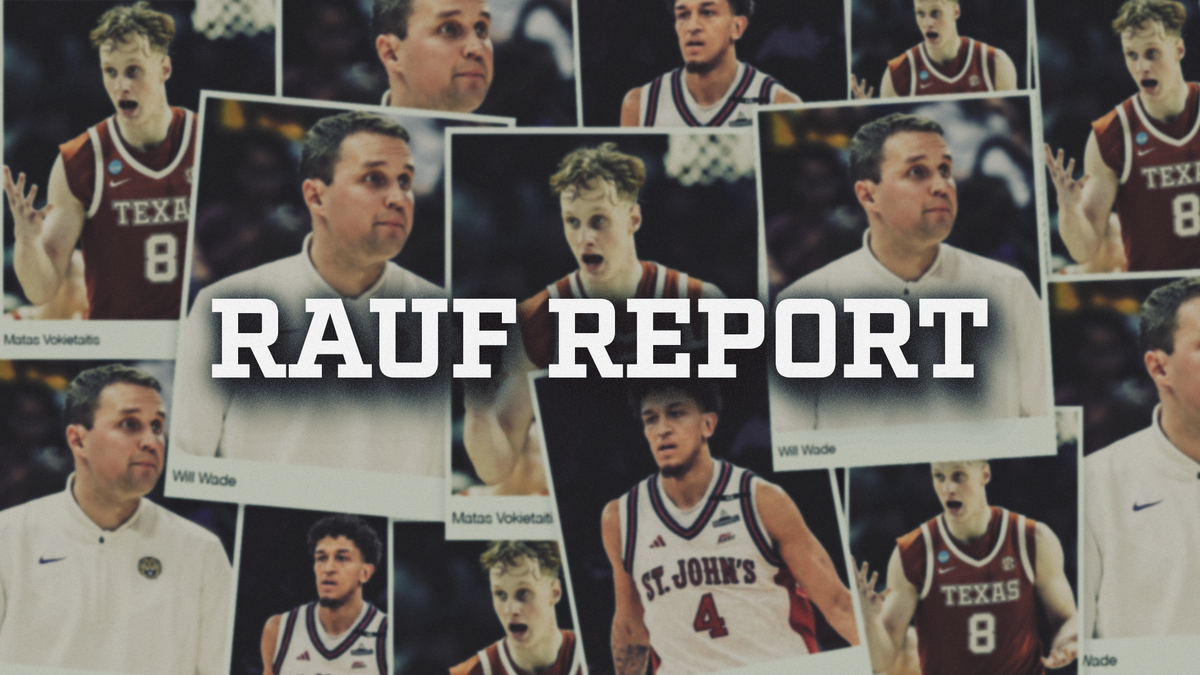
In addition to the old Europeans on Will Wade's roster, LSU has an average of 2.53 seasons of Division I experience spread out amongst the team. That ranks 12th in the nation.
Eight spots ahead of the Tigers sits Bryce Drew's Grand Canyon Antelopes. The most experienced non-power squad in the nation resides in Phoenix, and like LSU, GCU used its collective close-game acumen to secure two wins in Palm Springs this week.
First off, I know this team has money, but can I still point out how crazy it is that four former power-conference starters elected to transfer to the same team in the hollowed-out soul that is the 2026-27 Mountain West? Regardless, those four (Dylan Darling/Amarion Dickerson/Tre Holloman/Omaha Biliew) have over 350 Division I appearances combined, and most of their running mates have amassed 3-4 years of college ball apiece. If this team was a retail outlet, they'd be Chico's or L.L. Bean.
Thus, when Saint Louis had a 52.4% chance of victory with 8:00 remaining (70-68 SLU) and Colorado had a 64.9% chance of victory with 4:30 remaining (66-62 Buffs), the Antelopes' players did a thing or two because they've seen a thing or two. There was no one star who singlehandedly lifted Drew's squad to a victory in either game; rather, a multitude of experienced guys did their jobs, and late-game success followed.
I'm intrigued to see if Grand Canyon can build up an at-large case this season. It's passed every test thus far, and if it can knock off Oklahoma State on Wednesday, it should have a chance with up to 3 conference losses.
5) A second SoCon hub big has been spotted
Last week, I wrote about Cutter Sisk, the freshman big at Wofford who's sweeping the nation (if the nation solely consisted of SoCon ball watchers/CBB sickos).
 Dean Wendel
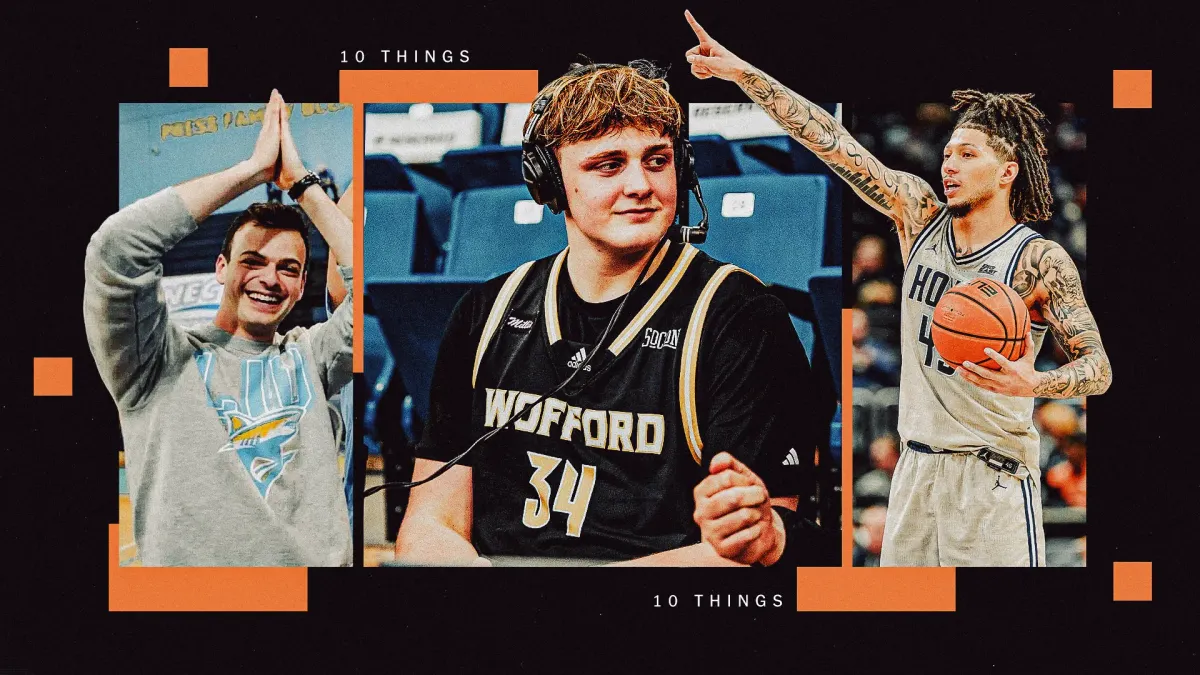
Much of Sisk's appeal comes from the fact that he can put up extremely efficient numbers with a non-prototypical frame. Kevin Giltner does not care: he gives the big man the ball down low constantly, and with points and assists, Sisk rewards him for it.
I tuned into Samford/Georgia Tech when I saw the Bulldogs were up on Tuesday night, and I discovered Sisk has an eerily similar running mate in his own conference.
Meet junior Will Shaver. He is one inch taller than Sisk, the same weight and he is also a big who can make plays with the ball in his hands.
There are six players in the nation who:
1.) are 6-foot-9 or taller
2.) have a 26% or higher usage rate
3.) have an 11% or higher AST%
4.) have a 15% or lower TO%
Four are in different conferences: Patrick Wessler (UNC Wilmington), Sebastian Rancik (Florida State), Roman Domon (Murray State) and Frederik Erichsen (Radford). The other two are Sisk and Shaver.
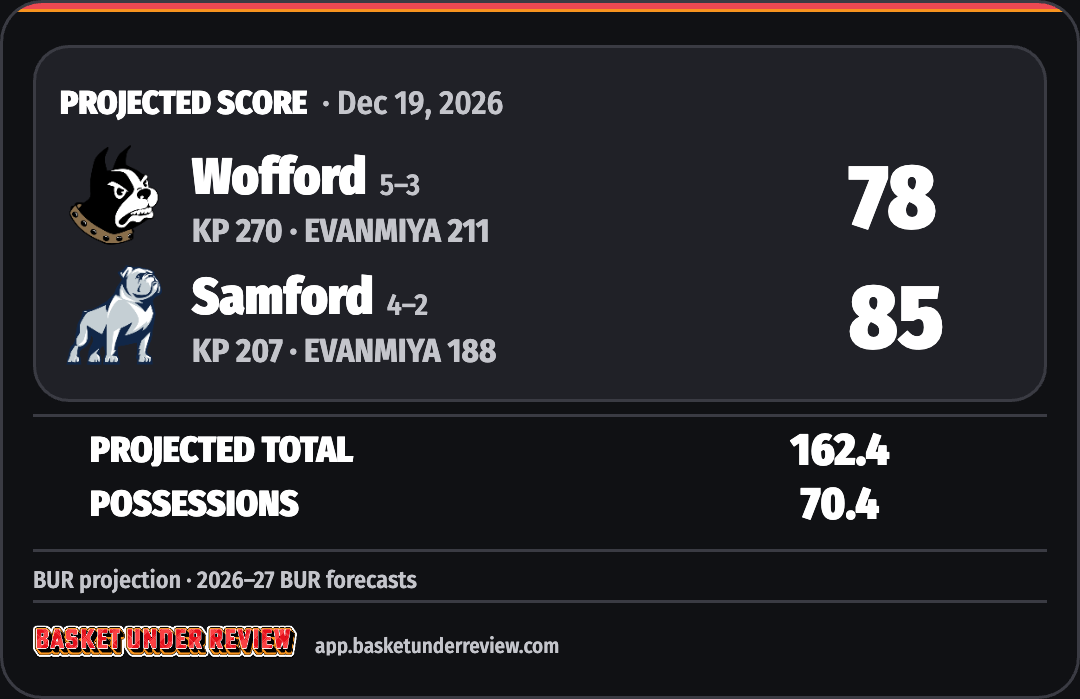
Screw it: if Sisk can get the Jokic comparison, so can Shaver. Jokic vs. Jokic in the SoCon at 5:00 ET December 19th. That's a loaded day of college basketball, but give it a spot on your quadbox and I promise you won't be disappointed.
6) Battles will be waged down low in Knoxville Tuesday night
Year 4 of the ACC/SEC Challenge begins Tuesday night, and there are a couple blockbusters that will take center stage (Florida/Duke, Texas/Louisville, Alabama/Miami (FL) round two).
Down in Knoxville, Rick Barnes will welcome Florida State to Thompson-Boling Arena in what KenPom proclaims is the ninth-best game of the challenge. I disagree due to one particular element.
Under Barnes, Tennessee has historically been good at controlling the glass. This season's roster is actually lagging behind previous Volunteers teams in that area, with only DeWayne Brown being consistent, but it still did enough to out-rebound Michigan State and Iowa State in wins.
Florida State currently has a 44.6% OREB% (5th in nation) and a 23.8% allowed OREB% (11th in nation). It also has a 7-foot, 285-pound true freshman in Marcis Ponder, who has put up monster rebounding numbers to this point.
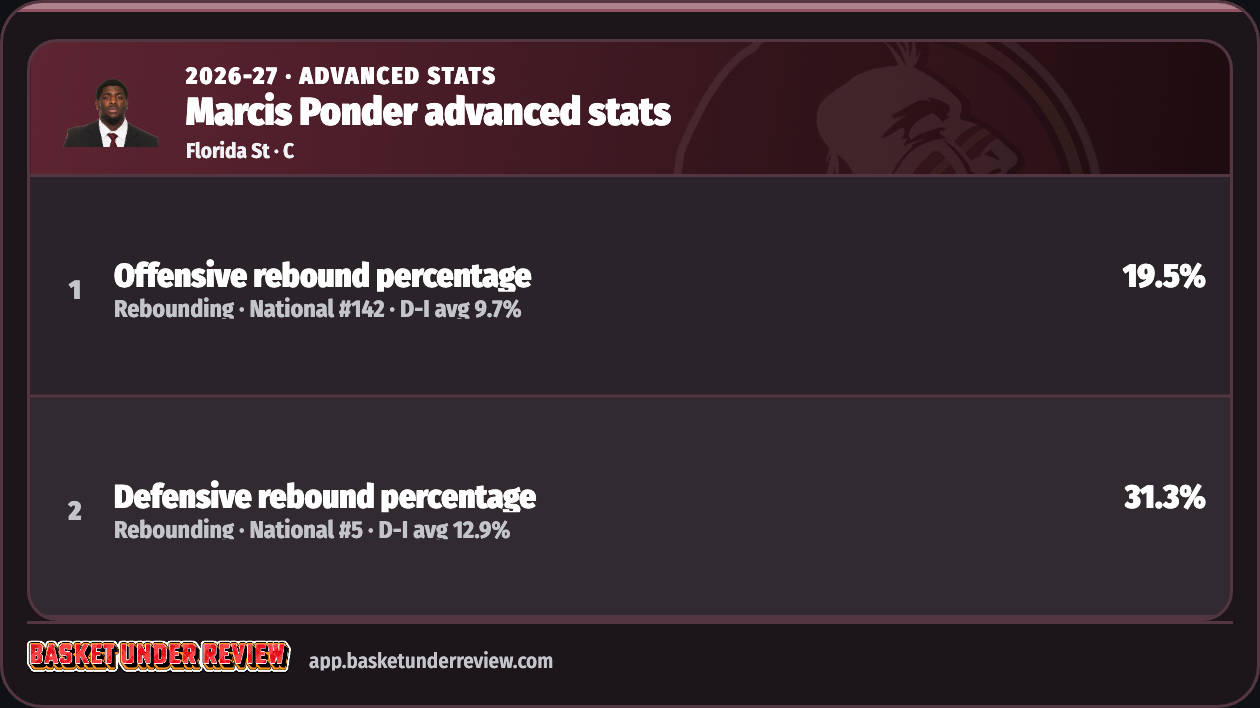
Tennessee will likely stick Brown on him, creating a delectable rebounding matchup. Between those two and their respective frontcourt mates, I'll be watching box-outs just as much as shots on ESPN2.
7) Jackson Holcombe and Utah are in a bad place
Utah basketball has been in rough shape for a while now.
The Utes are tied for the fourth-longest active NCAA Tournament drought at the power conference level; it's been 10 seasons since we saw Utah in the Big Dance, and this season will likely mark an 11th.
Alex Jensen was brought in from the NBA two seasons ago to re-energize the program, a former Mavs assistant renowned for his hoops IQ and player development skills. Reports show that Utah moved out of the basement of the Big 12 in NIL spending this offseason, landing in the $7-10M range per CBS Sports.
That didn't come as a shock given the Utes' portal haul. EvanMiya ranked Utah's incoming transfer class 16th in the nation, ahead of Duke, Baylor and other big spenders. Two four-star transfers (per Miyakawa's rating system) in Trey Campbell and TJ Burch were important gets, but the head of the class was five-star wing Jackson Holcombe. The 6-foot-6 Holcombe was a two-way star at Utah Valley with a good all-around game: the projections showed that he'd lead a solid Big 12 roster into battle.
I say all this to say that none of this is working for Jensen, Holcombe and Utah. The Utes are the second-lowest rated power conference team on KenPom, Jensen can't seem to fix one side of the ball without ruining the other (defense up 139 spots from last season, offense down 146) and Holcombe has been a pretty major whiff thus far.
I have no sources for these numbers, but if this is an $8 million team, I'm going to speculate Holcombe's getting $1.5-2 million of that? And in return, Utah's getting an 11 point/5 rebound player with poor advanced stats. Shield your eyes for this one, Utes fans: Holcombe's BPR has fallen from a preseason 6.0 to 3.34, the largest drop of any power conference player this season.
Something's got to change quick for this program. I'm all for a good bounce-back story, whether that's through a person's rebirth or a team's. Maybe we can watch both at the same time here... (foreshadowing)
8) In a gutted Feast Week, I'm developing a soft spot for the Acrisure Series
Feast Week brought all the action we've come to expect from it this season, but it still isn't the same. Just 11 bracketed events remain in our sport, taking away many unique neutral sites and quirky consolation games.
Now, more than ever, we need to latch onto the fun things that survive in college sports, even if they're 10% less fun than what we used to get. For me, that means embracing the Acrisure Series.
The Acrisure Series is wacky in the best way for college basketball. This week, 26 teams (!) descended to a G-League arena in Palm Springs to play in an MTE. First, though, we needed to have a showcase game between Duke (wow, what a get) and Washington State (???) that wound up being pretty fun?
Ok, MTE time. I know we'd all love for some good 8-team brackets; theoretically, there could be two of those with a 4-team bracket and a 6-team pod to spare! Or, if the five power conference teams participating (+ Utah State) want to rain on our parade, how about a six-team pod and five 4-team brackets?
The Acrisure organizers went with three 6-team pods (boo), but then tried to make it up with two four-team brackets, searching for the best of both worlds. It was a strange decision. We need more strange decisions in college sports.
The teams on deck were also random in the best way possible. A lot of West Coast schools took part, but Loyola Chicago flew out for this, as did Tulsa, Fordham and Illinois State. If you went to all 26 games of this event, you saw KenPom No. 16 and No. 327 play on the same court. That is exactly what I'm looking for out of Feast Week.
9) It's fun to predict Mark Pope's future soft landing this early in the season
As I'm writing this, Mark Pope just ran a baseline play that is illegal in all 50 states. His Kentucky Wildcats fell to Wichita State at home.
You can read/hear about Big Blue Nation's frustrations with Pope on tons of different sites; I want to do something different. I want to get out ahead of things and be the first (non-verified) media member to predict where Pope lands after his impending firing.
My first thought is a school I just wrote about: how about he reneges on his Holy War allegiance and replaces Alex Jensen at Utah? He'll be back in a state that adores him rather than vilifies him, and as such, he could raise some money and build a solid Big 12 squad.
Moving farther south, maybe Grand Canyon gets an at-large bid and a middling power school gives Bryce Drew a second chance? How close is Leon Rice to retirement at Boise State?
In all seriousness, I do think Pope is a good coach and a good guy in general. The pressure of the Kentucky gig claimed him as it has other coaches. If he's not sitting on his buyout, I'll be rooting for him at this time next year.
10) Scheduling exaggerates the power/non-power split in this sport
This isn't a new discovery, but rather a reminder. Last week, I saw this tweet from ESPN analyst Mark Adams:
Rich get richer and $$$ matters!
— Mark Adams (@EnthusiAdams) November 19, 2026
P5 versus non-P5, thru 11/18 (271 Games):
-P5 Record: 258–13 (95.2%)
-P5 Margin of Victory: +25.7 PPG
-P5 Home Buy Games Record: 249–5 (98.0%)
-P5 Margin of Victory: +27.2 PPG
Less parity than EVER! @NCAA
His take confused me, because earlier this month, I read this take from BUR's own Brian Rauf:

 Brian Rauf
All in all, sorry Mark: I side with Brian on this debate. As much as the NIL/transfer portal era has led to a mid-major talent drain, there is still plenty of talent at the mid-major level, and these schools have done a better job recently of keeping their top guys.
If most power conference schools scheduled like they did pre-COVID – filling their non-conference schedules with more teams ranked 100th-200th rather than 250th-350th – I truly believe the discussion around an expanded talent gap would decrease by at least 60%. We'd be seeing similar non-conference scoring margins and just as many buy game upsets as we did in the late teens.
The problem is that teams have gotten smart with their scheduling (remember: we need more strange decisions in college sports). There is no incentive to schedule games that could be Quad 3 or even Quad 2 losses, so most squads either play top-end non-conference games or take free wins against the basement-dwellers of Division I.
It sucks, but until the NET system changes, nothing will change. Just remember the context the next time you see a take like Mark's in the wild.