

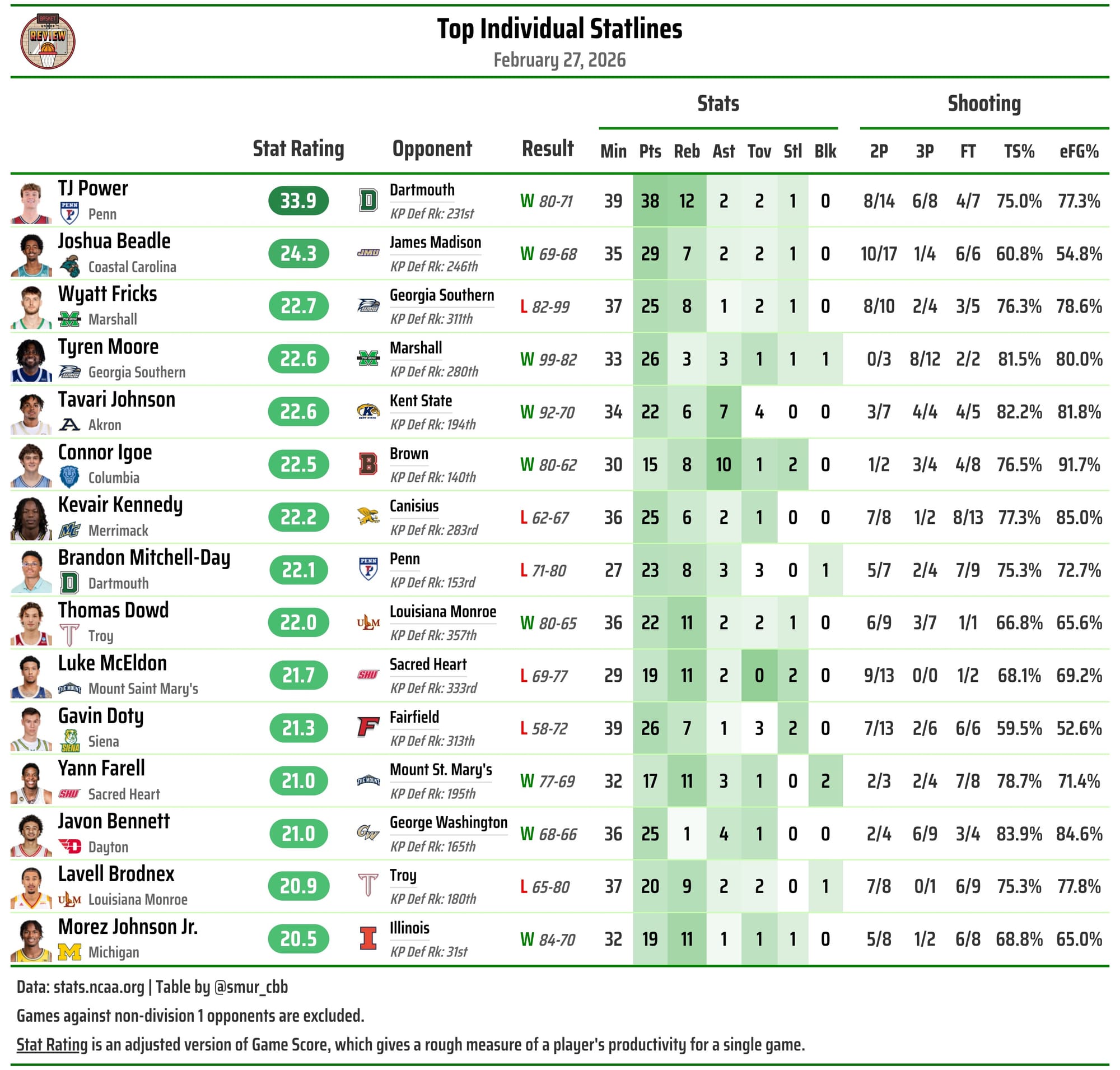
Welcome to another edition of the Weekend Watchlist! Before you dive in, check out yesterday's top performances and today's Watchability Index.
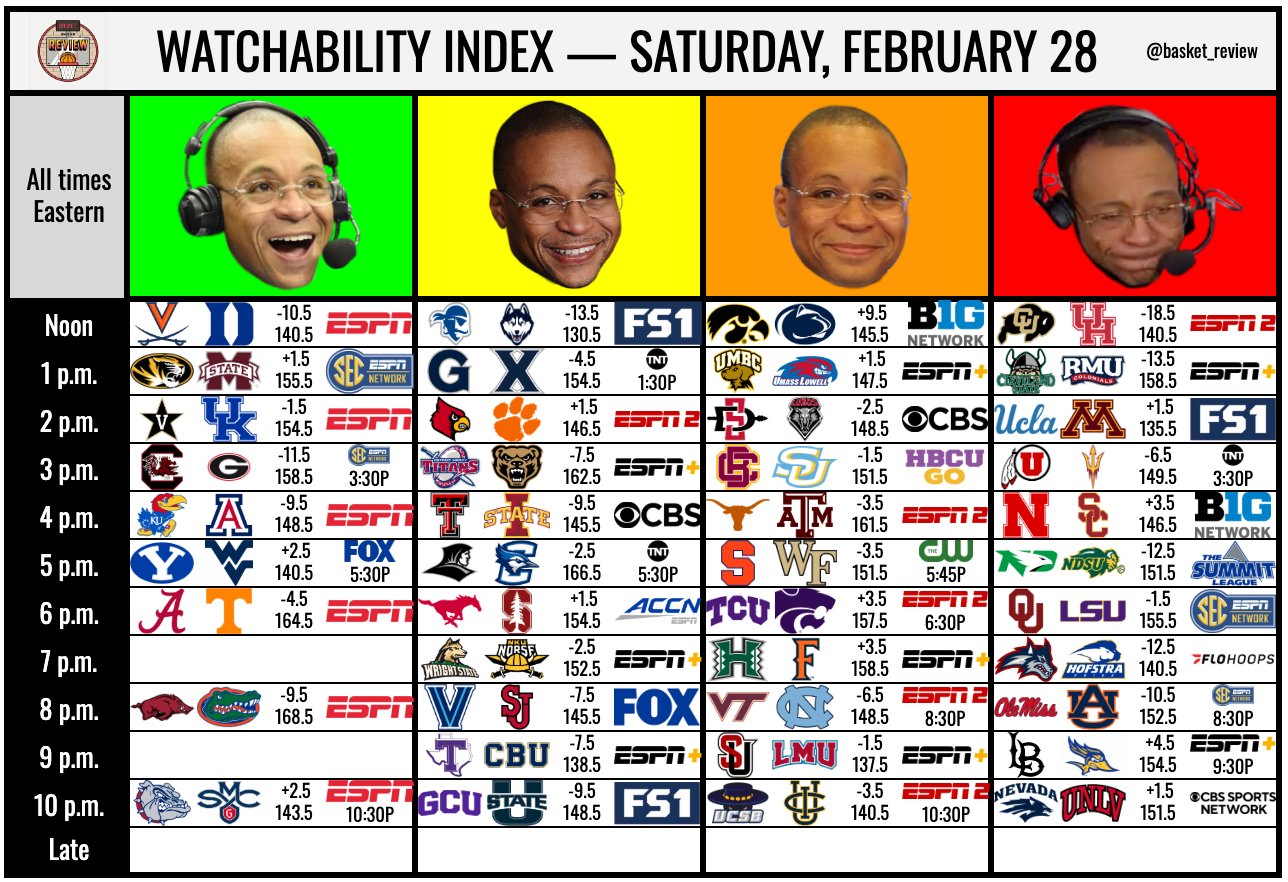
Saturday, February 28
The A+ Game of the Weekend
#11 Gonzaga (-2) at #24 Saint Mary's, 10:30 PM ET, ESPN.
The late-night headliner, college basketball’s best rivalry west of the Mississippi and the final trip to Moraga for Gonzaga University for the foreseeable future, it’s hard to know where to start with this Zags vs. Saint Mary’s matchup because of all of the narratives.
It’s senior night for the Gaels, who also hold a 25 game winning streak playing at home. The Saturday night matchup decides if Gonzaga wins the conference title outright for the first time since 2021 or if the Gaels get at least a share of regular season trophy for the fourth straight season. Randy Bennett’s team is looking to even the season series after losing 73-65 at the end of January.
What worked in Gonzaga’s favor in that game were the defensive minutes logged by utility wing-turned-forward Jalen Warley and guard Emmanuel Innocenti, who made the Gaels’ two leading scorers in conference play, Paulius Marauskas and Joshua Dent, play some of the least efficient basketball they had all season.
But there is a chance that Warley is held out of tonight’s game due to injury management for a thigh bruise he’s been playing through for around three weeks. The 6-foot-7 defensive stalwart was held out of Gonzaga’s game Wednesday against Portland to try and give him a full week of rest. If Warley were held out of the game, his rest between games would extend to over two weeks, potentially giving him a chance to get as healthy as possible before the WCC semifinals and the NCAA tournament.
If Warley is out, how Gonzaga attempts to guard Murauskus could very well dictate who wins this game. Tyon Grant-Foster likely slides into the frontcourt role, but it’s yet to be seen if he’s comfortable guarding a player of Murauskus’ size attacking the rim. The Zags could opt to go positionless and have their best healthy defender on Murauskus in Innocenti, but that then forces freshman Mario Saint-Supery to defend marathon man Joshua Dent on top of his offensive duties.
In terms of game script and identities, this game isn’t your typical Bulldogs and Gaels matchup. Gonzaga is actually the defense-leveraging team in this one, boasting a defensive rating of 95.2 (99th percentile), a steal rate of 13% (96th percentile) and an opponent turnover percentage of 19% (97th percentile) in conference play. Saint Mary’s leads the conference in three-point shooting and has gotten hot from the perimeter since their loss in Spokane, shooting 43% from behind the arc over their last 7 games.
Gonzaga will need to find offense to pair with Graham Ike and find a way to make shots outside of the paint to keep Saint Mary’s honest on defense. Mark Few’s team has the 18th-lowest three-point shooting rate in the country and for good reason–they’ve lost any semblance of efficient three-point shooting for the better part of two months.
With all of these components, we’re looking at a finale to the regular season that has all of the signs of a classic back-and-forth, wire-to-wire. - Tuck Clarry
A Games
#14 Virginia at #2 Duke (-10), 12 PM ET, ESPN.
Duke certainly didn’t take a “bad spot” break in South Bend following their dismantling of Michigan last Saturday, as the Blue Devils proceeded to put a 100 on the Irish at a 1.4 PPP clip. Virginia’s elite drop coverage anchored by arguably the best shot blocking duo in the country in Onyenso and Grunloh is the polar opposite of Notre Dame’s double team heavy approach, which allowed the Blue Devils to snipe from a season high catch and shoot rate, 18 of which were unguarded. This Virginia scheme is far more akin to what Duke saw from Michigan, where their elite size at the rim allows sell out catch and shoot denial. Duke however doesn’t attack drop coverages from the conventional standpoint of ball screen offense and off the dribble attempts, where drop 5 usually funnels you. Instead Scheyer typically attacks off the ball, scheming up engagement with the low man through staggers, flares, and flex/back/45 cuts
and when they do go PNR, they often invert it with Cam Boozer and generate advantage mismatches.. Against Michigan, Duke only scored 2 points via ball screen and 7 points off the dribble, while they scored 25 total points off the ball. Again, not your typical plan of attack against an elite drop coverage, and honestly not something UVA’s defense has seen a ton of in ACC play.
Offensively Virginia is a little more PNR oriented than Duke, but they generate a massive catch and shoot and 3PTA rate through Odom’s scheme, including a 92nd percentile unguarded rate. This is as good a scheme as any to beat Duke’s elite switching scheme that completely denies the rim (2nd percentile rate allowed with a 92nd percentile efficiency rating). Michigan, a team who owns the rim against practically everyone, scored a season low 24 points against Duke, which was actually one of the higher totals the Blue Devils have allowed in that regard this season. Of course the tradeoff of a sellout rim denial is a higher 3PTA rate allowed, and Duke allows the third highest in the ACC. Duke typically tries to hide Cam Boozer’s defense on a nonshooter, but I don’t think Scheyer can risk having him on Thijs De Ridder’s foul drawing.
The final piece of this puzzle is Duke isn’t going to let Virginia play volleyball on the offensive glass like they did against NC State, and as the Blue Devils shut you down with their first shot defense and rebounding. In the end, I don’t think Virginia is out executing Duke at Cameron, and Duke’s plan of attack in terms of engaging the lowman vs elite defensive frontcourts within drop coverage with Ngongba initiations for off-ball actions and Boozer inverted PNRs is too fluid. - Jordan Majewski
#13 Vanderbilt (-1) at #30 Kentucky, 2 PM ET, ESPN.
Here’s a dark update as it pertains to Kentucky basketball: this, a game they will be home underdogs in, is their best chance remaining at one more regular season win statistically. This was preseason AP #9! You know, back when there was no chance this team could ever disappoint based on one (1) exhibition game. Now, all these months later, Kentucky has to find a win between now and approximately 6:10 PM ET on March 7 to avoid the ignominy of going 9-9 in the SEC after being preseason #9.
Vandy has been just shaky enough that I can see where optimism may be coming from for this to be UK’s best chance. Strictly based on conference play only, the true spread here should be in a pick’em. Vandy has played like what I personally thought they’d be in preseason (a back-end top-20 team), while Kentucky has gotten a little lucky to get to 9-6 despite playing at the exact efficiency level of Auburn (6-9) and below that of Texas (8-7). Still, this Vandy defense isn’t what it was in the non-conference, largely thanks to the combined absence of Frankie Collins and Duke Miles for much of SEC play. Miles is back, but it still hasn’t fixed that 1) Vandy’s perimeter pressure is well down; 2) Vandy is therefore pretty vulnerable to guards that can create their own looks.
That intrigues me given that Kentucky’s current-day offense is a whole lot of “Otega Oweh, generate something” and/or “Collin Chandler, make this shot.” I do also like Denzel Aberdeen in these spots - say what you will, the guy is unafraid to take and sometimes make. Given Vandy’s standard drop coverage, it’s going to shrink driving lanes in general and force the ‘Kats to hit shots over the top of VU’s wall. The Pope system isn’t really much for that, and for reasons known only to Pope they’ve been leaning more into having the offense flow through Malachi Moreno in the post (clearly an attempt to buy back what worked last year with Williams), but I can envision a scenario where Oweh simply beats Miles or whoever to the rim and, if Vandy overcompensates, Oweh can hit a cutter or someone sitting on the perimeter for 3.
Anyway, this is all nice but unless Kentucky forces the issue at the rim and beats Vandy on the boards I kinda think this is a bad matchup for the ‘Kats. This is the same Kentucky team that lost by 25 at Memorial mere weeks ago, and since that game, Vandy gained Miles back while Kentucky’s still Kentucky. Unless Kentucky is much better at guarding cutting bigs, and unless Kentucky makes this a much faster-paced game than the first try, it feels to me like a game that favors the ‘Dores, even on the road, even in a situation where Kentucky really needs this. It’s not a ‘Kats defense that bogs opponents down, and all of Vanderbilt’s rebounding problems are cancelled out by Kentucky’s own turnover issues. Lean Vandy, with the UK path being some sort of Aberdeen/Chandler shotmaking festival that feels similar to Kentucky’s wins over Tennessee. - Will Warren
#16 Texas Tech at #7 Iowa State (-7), 4 PM ET, CBS.
First road trip for Texas Tech after losing JT Toppin, and boy, is it a brutal one. Hilton Magic awaits, as does one of the most lethal defensive backcourts in the country – which could dampen the production of one Christian Anderson, who has gone supernova (26.0ppg, 8.0rpg, 8.5apg) in two games since Toppin went down.
Killyan Toure and Tamin Lipsey are among the very best on-ball defending combinations in the country, and Anderson has had turnover issues in the past (six against Cincinnati, seven at Arizona St, five vs. Colorado – all in the last 2.5 weeks). The Red Raiders sorely lack ball-handling alternatives, but I would not be shocked to see LeJuan Watts
Texas Tech’s two outstanding offensive performances sans Toppin have been buoyed by 3P shooting: 13-of-28 (46.4%) against K State, 10-of-25 (40.0%) against Cincinnati. The skill level on the roster is still immense, with Anderson and Donovan Atwell as arguably the country’s best shooting duo, but without Toppin drawing tons of defensive attention, the open looks could vanish against one of the country’s best defenses.
Defense has been TTU’s biggest concern all year. While the Red Raiders have recently fortified the cracks on that end (aided by the healthy returns of Josiah Moseley and Luke Bamgboye), they could get exposed against Iowa State’s improved attack. Josh Jefferson is always a handful as a jumbo creator, driver and mid-post attacker, and without Toppin, the options against him dwindle. Watts and Moseley at least make sense from a physical standpoint, leaving Bamgboye to try and keep the high-effort center tandem of Dominykas Pleta and Blake Buchanan off the offensive glass.
The biggest threats for ISU may be on the wings, though. Milan Momcilovic is the nation’s best shooter, having hit a ludicrous 50.7% of his 205 attempts thus far. The Cyclones are also getting contributions from Nate Heise and the massively improved Jamarion Batemon, a scoring specialist who has suddenly evolved into a perfect bench microwave.
Tech has looked great thus far without Toppin. Iowa State’s ball pressure and overall offensive pressure may be too much for the shorthanded Red Raiders, though. - Jim Root
#19 Alabama at #20 Tennessee (-4), 6 PM ET, ESPN.
I think that, barring some sort of shocking outcome, the top 12 teams here are all locked into 1-4 seeds.
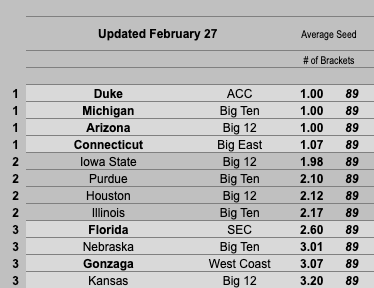
I wouldn’t mind arguing that Michigan State has possibly locked themselves in, too, after their win over Purdue. That leaves what looks to me like seven teams for three spots, and boy, is it fascinating that two of them will be playing each other right here.
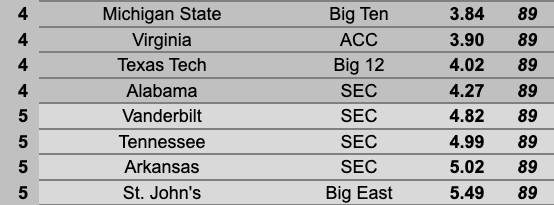
Given what we know about the Committee, this could be a Certified Seed Line Game. For all intents and purposes, WAB will be the main draw this year, and even with a 3-0 finish by Tennessee, it still projects Tennessee to finish 17th in WAB versus Bama’s 15th and Vandy’s 19th. And yet: in cases just like this in the past, we have seen the Committee use head-to-head as a functional tiebreaker. If Tennessee sweeps Alabama and Vanderbilt, I have a very hard time envisioning said Committee keep the Vols off the 4 line.
Compare the win rates over the last 25 years for 4s versus 5s - 79% in the R64 versus 61%, 63% in the R32 versus 57% - and while it is literally one integer it does seem meaningful. As always in the Oats/Barnes ‘rivalry’ it’s my duty to note Tennessee has won five straight in this series and Alabama’s last win was 1) a home win in 2021 2) that came with Tennessee missing two starters due to illness. I must also note that the first game this year came with Alabama down a pair of starters, but that win seemed to kickstart Tennessee’s ‘new season’ of sorts, having gone 8-2 since.
The pattern of the last several Alabama/Tennessee games has all been very similar: Tennessee and Alabama play a tight game for the first 10-15 minutes, Tennessee builds a late first-half lead, then for a variety of reasons, Alabama can never firmly regain the lead in the second half. The lone outlier was the Jahmai Mashack buzzer-beater last year where Bama led in the final minute and lost. Tennessee’s perimeter ball pressure routinely gives Alabama fits and forces much slower games on average, and even against a weaker Tennessee defense than usual, Alabama still played easily their slowest game of the year with their lowest number of catch-and-shoot threes of the entire season:
Tennessee’s still excellent at guarding and limiting kickout threes, though as usual I’ll admit some concern over what combination of frontcourt players they’re rolling with here. (My recommendation is to realize in late February that there aren’t two great bigs on this roster and to simply have a center with four guards/wings, but I digress.) Offensively I don’t think I’ll ever be fully in love with this edition of Tennessee, but two items feel pretty heavy in Tennessee’s favor here: the #1 OREB% in the entire country against a thoroughly mediocre rebounding frontcourt for Bama (UT won OREB% 38%-26% at Alabama) and a 49th-percentile rim attack defense at Hoop-Explorer against a team with Nate Ament. - Will Warren
#17 Arkansas at #4 Florida (-8), 8:30 PM ET, ESPN.
Since the surprising home loss to Auburn on 1/24, Florida has won 8 straight and filters out as the best team in the country in that span per Torvik, with the most efficient defense in the country. The caveats here are the Gators have played an easy SEC schedule in that stretch thanks to a down year for the league, with the home win over Alabama the only real notable victory. Florida’s opponents are shooting just 29% from 3 in that stretch, while the Gators themselves are shooting 37%, a substantial improvement that was this team’s most glaring issue, and has pushed their season long percentage over 30% for basically the first time all season. Hitting threes at even a lower percentage than that is more than enough for this Florida team, because they absolutely dominate the rim on both ends. During this winning streak, the Gators own a +18% 2PT% delta, and that’s probably the deal breaker for visiting Arkansas in this matchup. The Hogs are athletic but thin in the frontcourt, grading out as a 22nd percentile rim defense in terms of efficiency, per Synergy data. SEC foes are scoring at 1.22 PPP at the rim and shooting 61% at a high rate allowed- that’s going to be sure fire way to a loss against the Gators. Arkansas has also been spotty in transition denial as well, and just allowed 18 transition points to Texas A&M, which would also be a quick way to an easy Gator home win.
Arkansas isn’t without recourse offensively however, as Florida can struggle against big, athletic wings like Billy Richmond, who has been an absolute terror offensively of late, but I should note Florida’s struggles have come against big shot creating wings (like Dailyn Swain Wednesday), and Richmond doesn’t create his own offense. That job is left to Darius Acuff. Florida’s monster lineup is going to funnel ball screen and dribble creation (both 99th percentile rates allowed) into that elite rim defense for a reason, but Acuff is of course a transcendent on-ball creator, grading out as a 93rd percentile ball screen scorer (although I will note his jump shot has been noticeably short since Cal revealed he’s been wearing a protective boot between games). Arkansas doesn’t turn the ball over (literally the lowest turnover rate in the country) and they have the ability to find matchups they like offensively (although Boogie Fland might take the Acuff assignment with a little more gusto given he essentially lost his job at Arkansas to him), but I’m not sure that’s enough to overcome the frontcourt and rebounding disparity here, especially if Florida’s backcourt is going to continue to hit threes at even a semi decent clip. In that same stretch where Florida has been the best defense in the country, Arkansas has barely been top 75 (but have been the 3rd most efficient offense). - Jordan Majewski
B Games
#18 Louisville (-1) at #41 Clemson, 2 PM ET, ESPN2.
Stoppable force (Louisville’s 0-7 record in Q1A games) against movable force (Clemson four-game losing streak, three against likely non-NCAA Tournament teams) in this one.
It should be noted, though, that the Tigers’ slide has aligned with horrific 3P splits: in those four games, they are shooting 29% from beyond the arc, while opponents are a scorching 43%. With any reasonable normalization of those numbers, the Tigers would be locked up and set to go for the NCAA Tournament. As it stands, though, they need another win or two to ensure safety. If Louisville shoots like recent Clemson opponents, this one is a wrap for the Cards. But I’d guess Clemson sees some beneficial regression.
Louisville, meanwhile, has been awful in its biggest games this year (I called them a “dead fish” on a couple different shows). Per Bart Torvik, the Cardinals rank 71st in the country in the Q1A sample size – on par with powerhouses like Weber State and Mercer (note: Gonzaga is 72nd, though only in two games…).
Clemson’s transition defense looms large here, as the Cardinals are at their best when they can get out and run. That simply doesn’t happen against Brad Browell teams, though Louisville did manage to control last year’s matchup (74-64 Louisville win) in a pedestrian 66-possession game. The rematch in the ACC Tournament had 73 possessions, but the pace was heavily skewed by a foul-heavy final 2ish minutes.
The other key matchup is Louisville’s post defense against the brutish Clemson frontline. The Tigers are in the 99th percentile in post up efficiency and the 96th percentile in frequency, per Synergy – the offense revolves around it. Much to my surprise, Louisville grades out well there (84th percentile in PPP allowed in the post), though starting center Sananda Fru is only in the 34th percentile himself. I expect Nick Davidson, RJ Godfrey and Carter Welling to be able to produce points inside.
As is the case in any Louisville game thanks to its 53.3% 3PA rate, the biggest variable is the Cards’ shooting. Notably, they have been markedly worse on the road (33.1% vs. 37.5% at home). I’m thinking the Tigers finally seal their at-large bid, while Louisville followers see the big game angst rise yet another notch. - Jim Root
#42 San Diego State at #45 New Mexico (-3), 2 PM ET, CBS.
(Jim Nantz voice) Hello, friends. This is the Mountain West Game of the Year, at least for me. A smarter guy might say it was the Utah State/San Diego State game on Wednesday. Sure, I’ll hear it out…but this is on big CBS, and the two teams involved are literally on the cutline as it stands. Just ask Bart Torvik.

That makes SDSU/New Mexico the Official Basket Under Review Bubble Game of the Year for 2025-26. At Torvik’s site, using a combo of two-way leverage (i.e., both teams need to have something at stake and be on/near the bubble) and the Torvik Tourney Thrill Quotient (FanMatch, but boosted for Tournament implications), this is only surpassed by Texas/Mizzou on Valentine’s Day and Cincinnati/TCU next Saturday. Me personally, I’d rather get whacked with hammers than watch Cincinnati play TCU, and I’m simply going to take this game over both, because it’s on CBS and game production matters.
The first version of this game a month back was an anomaly in many different ways: UNM’s second-fastest game of the year, SDSU’s fastest, a 78-possession banger that nearly contained New Mexico’s third 15+ point comeback of the season in an 83-79 SDSU win. I don’t think both of these teams will shoot 40% from deep again, but some aspects of the game do seem sustainable. For one, New Mexico dumped 22 points on transition against the Aztecs, and UNM’s unique defense (one of the hardest double teams in the entire sport on post-ups) forced SDSU’s sixth-worst TO% of the season.
But! This also was a game that showed some of UNM’s limitations for me. For all Eric Olen has done right, this roster was never going to be very good at rebounding or on the interior. SDSU essentially won the game entirely off of shooting 11-14 at the rim and getting 30 free throw attempts. They shot fairly normally everywhere else, but the interior decidedly went SDSU’s way. It didn’t help that, outside of Tomislav Buljan (8-10), UNM only generated 10 attempts at the rim from a team that typically averages 18 non-Buljan attempts.
These two both have pretty similar indicators for wins. New Mexico is 15-1 this year (6-6 otherwise) when winning the combined rebound/turnover differential, which they lost by 3 the first time around to SDSU. The Aztecs, meanwhile, are 15-3 when they win this stat. Is it a little reductive? Sure, but considering how little of the first game seems repeatable to me, I’m focusing on shot volume - which has generally swung UNM’s way a tad more on average this year. - Will Warren
#15 Kansas at #3 Arizona (-10), 4 PM ET, ESPN.
Another Saturday, another matchup of two of the better teams in the country out of the Big 12 as Kansas heads to Tucson to take on Arizona. The Wildcats not only get a chance at revenge with the Jayhawks coming to McKale, but they also have a chance to clinch a share of the Big 12 regular season title if they win Saturday.
Arizona’s frontcourt will look to respond to their out-of-character struggles when they visited Lawrence three Mondays ago. Kansas held Ivan Kharchenkov, Koa Peat, Motiejus Krivas and Tobe Awaka to 42.9% shooting from the field, roughly 12% lower than their season-long average of 54.6%. Peat is expected to be available in the afternoon matchup, his first game back from a calf strain he suffered against Texas Tech on February 14th.
The Wildcats have been dealing with not just Peat’s injury but illnesses for their other freshmen, Brayden Burries and Dwayne Aristode. Burries needed an IV against BYU and played through a bout of bronchitis against Baylor. Aristode has missed the last four games due to an ongoing illness but returned to practice this week.
Kansas is looking to continue its ascent up the rankings and seed line prognostications, but more importantly, to also work through its offensive continuity as Darryn Peterson gets more and more integrated into Bill Self’s rotations. The Jayhawks trounced Houston at home on Monday, winning 69-56. A win on the road against Arizona would be Kansas’ first road win against a top 20 team in the NET rankings.
Flory Bidunga will look to replicate what looked like a proclamation game from the two team’s first matchup, where he went for 23 points, 10 rebounds and 3 blocks and 72.7% shooting from the field. Since then, he’s averaged 10.3 points on 50% shooting. - Tuck Clarry
#31 Texas at #36 Texas A&M (-3), 4 PM ET, ESPN2.
Bucky Ball has been going through some stuff in February. Since sitting at 7-1 in the SEC, the Aggies have unsurprisingly gone 2-5 this month as the backloaded schedule has increased in difficulty. During that span, A&M is rated 140th in defensive efficiency per Torvik filtering, and have been generating more layups for the opposing offense rather than turnovers with their zone pressure. In February, A&M is generating just a 12.5% turnover rate, which is bottom 30 in the country, and 6% lower than their season long rate. In that stretch, teams are shooting a robust 68% at the rim (compared to their season long percentage of 59% allowed), and they just allowed 42 points at the rim to Arkansas Wednesday night. The good news for the Aggies is that Texas recorded their farthest 2PT attempt distance of the season in their first meeting in Austin (7th percentile per KenPom data). The Aggies meanwhile sported a 93rd percentile 2PT attempt distance, and outscored the Horns 33-23 at the rim, generally off a series of back cuts against Texas' drop coverage.
Texas' iso-centric approach offensively isn't necessarily ideal against Bucky Ball, as the Aggies are far more vulnerable to teams that can move the ball around the perimeter against their help, which Texas doesn't do at all. But the Aggies are extremely vulnerable in transition since they're not generating turnovers in SEC play, and the big Texas wing creators could simply do what Arkansas did offensively. I think we likely see a couple more crooked numbers just like Wednesday. - Jordan Majewski
#21 BYU (-3) at #65 West Virginia, 5:30 PM ET, FOX.
Filtering for the past month, BYU has been the country’s 20th most efficient offense, 184th defensively. West Virginia in that same stretch? 280th offensively, 20th defensively. That’s certainly music to the ears of a legion of concerned BYU fans, who have seen a team with deep March potential get decimated by injuries and struggle to defend basically any Big 12 offense, with the nadir coming at home Tuesday with 1.25 PPP from a shorthanded UCF team. BYU’s defense tends to overhelp because they’re so poor defensively on the ball, but that’s far less of an issue against this West Virginia offense that has been the worst 3PT shooting team in the Big 12 on the second highest volume (although Honor Huff and Treysen Eaglestaff are the definition of streak shooters). The Mountaineers have made triples at a sub 30% clip at home, also on the second highest rate in the league.
Defensively Ross Hodge is an excellent schemer, and they’ve posted strong defensive metrics despite being unlucky in catch and shoot defense (where they’re 99th percentile in c&s graded guarded by Synegy). Brennen Lorient is also an outstanding individual defender with size and mobility to at least throw at AJ Dybantsa, but BYU has only lost once (to Arizona) when Dybantsa has 5+ assists. He scored efficiently against UCF, but tallied 0 assists for just the second time all season. West Virginia’s defensive scheme necessitates ball movement (highest assist rate allowed in the league), but again, without Richie Saunders, options to score outside of Dybantsa isos and Rob Wright ball screens are few and far between. That should theoretically be enough to outscore this WV offense, but BYU’s 3 road wins aren’t exactly mouth waterers. They underwhelmed at a brutal Kansas State team, barely got by Utah in the Holy War, and let a 6 man Baylor team go for 1.3 PPP. - Jordan Majewski
#29 Villanova at #22 St. John's (-5), 8 PM ET, FOX.
Well, Rick Pitino may have a new most unenjoyable experience of his lifetime after the Johnnies lost 72-40 to UConn on Wednesday, the largest loss for Pitino in his time coaching in Queens. And it was even uglier than the deficit suggests, with St. John’s going 2 for 28 from the field in the second half and missing their final 24 shots of the game.
Pitino and company will look to reset against his former assistant, Kevin Willard, and Villanova in Madison Square Garden. St. John’s won the matchup earlier in the season in Philadelphia, 86-79. The two teams have contrasting strengths that make this one interesting. The Red Storm have arguably the most dominant frontcourt in the Big East, owning the glass on both ends and winning the scoring battle at the rim. Villanova will try to exploit their advantages in the backcourt and on the perimeter, averaging almost 3 more made three-pointers than St. John’s over the season.
The game will not just come down to which strength is being exploited more effectively between the glass and perimeter shooting, but also whether or not the Johnnies’ success in turning Villanova over in the first game was a natural product of their defense or if Villanova’s guards had an off game. Villanova had the most turnovers they’ve had all season, 14, in that loss, and freshman point guard Acaden Lewis also had a season high 6 turnovers. Lewis finished with 3 points and 5 assists while going 1 for 7 from the field. 17 of St. John’s points came from turnovers.
The Wildcats will need to not just be effective from the perimeter but get out ahead early to try and minimize the Madison Square Garden crowd, likely just as irate about the Red Storm’s last game as the coaching staff. Easier said than done, knowing how Pitino teams usually respond in games following a disappointing performance. One thing is for certain: I doubt the players get screen time during gameday breakfast this go-around.
If Villanova pulls off the upset, they keep the door open for a two-seed in the Big East tournament should Seton Hall’s stifling defense steal their senior night game against the Red Storm. - Tuck Clarry
#58 Virginia Tech at #28 North Carolina (-9), 8:30 PM ET, ESPN2.
An intriguing and inconvenient question: is Virginia Tech actually any good? By resume, they’re firmly on the bubble and probably somewhere in the First or Next Four Out range. By actual team quality, they aren’t a top-50 team in any metric out there and, per the three metrics on the Teamsheet itself, average out to being a worse team than LSU. I don’t think anyone on earth would actually say that LSU is superior to Virginia Tech this year, but are we sure we need this VT team in the field?
Since the new year, this is the nation’s 54th-best team at Torvik, a 6-8 basketball team, a team that ranks lower than Oklahoma. I guess I’m just not that invested in ensuring these guys make the field. Sorry! Anyway, as for the actual game, this combines two major danger spots for the Hokies: top-50 competition and playing away from home. They’re 3-7 against top-50 teams this year, and even adjusted for opponent quality, their offensive efficiency drops nearly five points from home to non-home games.
Strangely, their path here probably runs through the defensive end. Sans Caleb Wilson, UNC has been just fine on both ends of the court, almost entirely thanks to Henri Veesaar and Jarin Stevenson playing way better when he’s unavailable. Still, they do play differently, and differently in this case means a team that’s not quite as scary inside the two-point arc (59% 2PT vs. 54%) and takes nearly 46% of their shots from 3. It just takes one bad shooting day against a Virginia Tech defense that’s going to primarily sit back in the hopes of not having their putrid rim protection exposed. The problem: it also only takes one great shooting day for this to turn into a 15-point UNC win or worse. I ultimately think Neo Avdalas has to have his best game in three months to be swayed against the Heels here. - Will Warren
#62 Grand Canyon at #25 Utah State (-10), 10 PM ET, FS1.
There’s been lots of talk about the Big 12 and Big Ten backloading their schedules, but man, the Mountain West also did it to the extreme. The top six of Utah State, San Diego State, New Mexico, Nevada and Boise State is in a multi-week brawl until the end of the regular season. This is USU’s fourth straight game against that group, and though GCU’s slate has been slightly tamer, the Lopes did complete a sweep of San Diego State 11 days ago.
GCU can get a second high-level sweep here after separating late against the Aggies back on January 17th. The Antelopes dominated the rim in both ends (60.6% on 2s vs. 43.9%, 33 FTAs vs. 23), though USU’s staggering 46.8% offensive rebound rate was jarring. The Lopes have to avoid such a shellacking in this one, or shot volume could overwhelm (USU took 16 more FGs in that meeting).
This is also a battle of the best 2P% offense (USU) in the league against the best 2P% defense (GCU). The Lopes obviously won that clash in the first matchup, but that was at home. USU struggled to really spread the court (25% from deep), allowing the Antelopes massive frontcourt to hang near the rim.
One other notable aspect of that first matchup: USU struggled to contain Grand Canyon’s quicker guards, Brian Moore and Makaih Williams, both of whom went for efficient 20-point scoring days. USU’s backcourt has size but lacks impactful 1v1 defenders. USU has played less zone this year – only 20.4% of possessions, per Synergy, compared to 66.2% last year – but resurrecting that look could help contain the bounce. Synergy says the Aggies didn’t play a single possession of zone in that game, which surprises me immensely. GCU ranks in the 28th percentile in PPP against zones this year. - Jim Root
C Games
#27 NC State (-5) at #89 Notre Dame, 12 PM ET, The CW.
Judging by Notre Dame’s effort against Duke (something like the worst loss since the late 1800s) and NC State’s beatdown at the hands of Virginia in what was a brutal schematic matchup for the Pack, one would think this is a walk in the park for NC State in South Bend. And that may be entirely correct, but I still harbor suspicion of a potential “Shrews Special” when you least expect it. That of course means completely taking the air out of the ball like they did against Stanford and relentlessly blitzed stud ball screen creator Ebuka Okorie into his least efficient game of the season. The problem with trapping/hard hedging Quadir Copeland and this NC State offense is that they move the ball around the perimeter to lethal catch and shoot targets and have an elite (when he’s engaged) short roll filter in Darrion Williams. The Pack have been at their best against hedge and help heavy schemes and the Irish allowing a 93rd percentile catch and shoot rate is very dangerous against this NC State offense.
On the other end, NC State’s ball pressure could lead to some major issues for an Irish offense that has been very turnover prone, although Jalen Haralson is off the availability report and should be available (less Logan Imes minutes is good news for the Irish). Typically a Shrews offense is fine working in isolation, which is where the Pack force you to operate at one of the highest rates in the country with a true 1-5 switch, so the return of Haralson is important in this regard as well. All in all, the Ven-Allen Lubin revenge tour likely continues, and the Pack have generally played well after Will Wade declares his team to be one of the worst he’s ever seen. - Jordan Majewski
#53 Seton Hall at #9 UConn (-14), 12 PM ET, FS1.
This serves as Seton Hall Voodoo’s Last Stand. When initially played in Jersey on January 13, Seton Hall was 14-2, 4-1 Big East, and made a raging comeback from a double-digit second half deficit to nearly topple UConn yet again. The loss was a bummer, but the next morning, they woke up with an 81% chance of making this year’s Tournament, per Torvik. Just over six weeks later, this is down to 4%, and since that game, Seton Hall has lost 6 of 11 while operating the nation’s 265th-best offense.
This is still a fantastic defense that may protect the rim better than anyone else in the nation and still shuts down gaps exceptionally well. It’s routinely been a hard matchup for this UConn roster, which can struggle with on-ball pressure and doesn’t always have the best self-creation. The problem is on the other end, and considering Seton Hall has touched 70 points once in their last seven games, I cannot figure out what type of absurd events would have to happen against a top-10 defense for them to do so here.
UConn’s defense has been leakier as of late, and against the Huskies’ drop coverage, a team with a fine ball screen operator (Budd Clark) and exactly one other thing they do well (midrange jumpers) does seem like a reasonable matchup. But…well…I mean, have you seen this Seton Hall offense. They’ve attempted just 24% of all shots from 3 in their last 10 games. The only stat they’re in the top-200 in offensively is offensive rebounding, which is not a shocker when you miss as many shots as they do. All UConn really has to do here is get to 60 points, which they’ve done in every single game this season. The Seton Hall shocker would have to be some sort of 56-54 win that makes no sense at the time and less sense in hindsight. - Will Warren
#40 UCLA (-1) at #70 Minnesota, 2 PM ET, FS1.
I don't think anyone actually ever thought that Minnesota was going to beat Michigan, even though the Gophers only trailed by four with 10 minutes left. KenPom certainly didn't, with the Wolverines' lowest win probability in Tuesday's contest being 95.8%.
But Minnesota didn't get killed, which is a major accomplishment in a road game against a top three team in the sport with only six players and only seven minutes played from lone reserve Kai Shinholster. Niko Medved and Co. slowed Michigan down to their third-slowest pace of the season, highest 3-point rate, and lowest free throw rate by playing 98% of their possessions in zone defense. The extremely undermanned Gophers have played at least 67% of their possessions in zone for each of the four games star forward Jaylen Crocker-Johnson has missed, and he should remain out here.
UCLA is a 86th% man offense, and a 64th% zone offense, and the only two times they've seen at least a quarter of their possessions in zone were a 12-point road loss to Ohio State, and a six-point home win against Eastern Washington. Not great.
Speaking of the road, this is UCLA's first game away from Los Angeles since the Mick Cronin postgame press conference that everyone's been talking about. I'm sure Minneapolis is lovely this time of year for a Southern California resident.
This has all the makings of a grimy, slow, physical game, which both coaches probably want, but a style that one's roster is actually more built on playing. UCLA has more than enough shooting to make Minnesota's soft coverage pay, but if the Bruins aren't hitting from deep, they are at risk of taking a major step back after a step forward during last week's homestand. - Matthew Winick
#226 Tennessee State at #197 Tennessee Martin (-4), 2 PM ET, ESPNU.
While no longer being the most important game for OVC stakes, now that Morehead State has locked up at least a share of the title and the top four seeds are all locked in, this does still mean something to each side. Tennessee State, with a win, can not only clinch a share of the OVC regular season title. They’d be ahead of Morehead thanks to sweeping UT Martin, which would give Nolan Smith the #1 seed in the OVC in his first try. Not bad.
Meanwhile, for UTM, all there is to play for is an outside chance of the 3 seed, but pride does matter. Also, the fact that the Skyhawks are #1 in the OVC in most metrics matters. (For what it’s worth, UTM may actually prefer the 4 seed. They swept both 5 seed SIUE and likely 8 seed Eastern Illinois, while they went 2-2 against likely 6/7 seeds Lindenwood and Little Rock.) The first version of this game saw TSU post the fourth-highest PITP total (38) of any UTM opponent all year, which was pretty shocking given UTM’s status in allowing just 26 a game on the season.
At home, you’d hope the Skyhawks can hold serve a bit better, but this TSU team shows no real advantage/disadvantage regardless of arena. For all the good the Tigers can provide, this is still a middling rebounding unit playing against the best rebounding team in the league, and no defense in the OVC is better at producing havoc plays defensively than Martin despite a fairly control/contain philosophy rather than a gamble-gamble-gamble one. The way to beat them is to play fast and not allow them to set up. TSU did it once. Can it do it twice? I have my doubts, but the OVC’s main mission this year seems to be making home court advantage meaningless (a 53% win rate for home teams). - Will Warren
#12 Nebraska (-8) at #61 USC, 4 PM ET, BTN.
Is Nebraska over the flu? With (at least) Jamarques Lawrence and Berke Buyuktuncel under the weather, the Cornhuskers slogged through a home win over moribund Maryland, trailing the Terps with 10 minutes remaining before pulling away. Of course, they’re healthier than the MASH unit Trojans, whose litany of injuries seems to have finally caught up with them in a poorly played four-game losing streak.
The Huskers’ five-out attack is theoretically not a huge issue for USC’s frontcourt, as both Jacob Cofie and Ezra Ausar have some mobility. The overall off-ball discipline of USC is a problem, though, and Eric Musselman’s scheme has tried to eliminate that action with sagging off the ball (surrender only a 2% frequency rate on cuts). Few teams in the entire country move and pass like Nebraska, though, and USC’s recent defensive struggles (1.2 PPP or more allowed in 3 of 4) suggest a pristine-executing Husker squad could feast.
USC’s isolation scorers – Chad Baker-Mazara, Alijah Arenas, even Kam Woods – could find mismatches in the athleticism-deficient Husker lineup, but Nebraska’s hyper-condensed scheme will force them to shoot over the top (99th percentile spot up rate allowed). That’s bad news for the Trojans. Seems like a solid two-way matchup edge for the visiting Cornhuskers. - Jim Root
#34 Wisconsin (-1) at #48 Washington, 4 PM ET, FS1.
I guess I just want to know why Washington rates so highly. They’ve played a tough schedule, they’ve lost some close games, analytically I get it. But when I actually watch Washington play, I think this team is absurdly lucky to be touching the top-60, much less inside the top-50 and ahead of multiple teams that are on the bubble. Squint and you can see how a team that is 1-5 in games decided by six or fewer points could be having a better season if they’d just beaten UCLA (lost 82-80) or Penn State (63-60). Watch them play as they shoot 32% from 3 and rarely if ever get to the line, and you’ll wonder how they’re even 14-14.
The way Washington can or would win a game like this is by dictating the pace so severely it makes Wisconsin tired. Essentially: the anti-Wisconsin style of basketball. Washington does score very efficiently in transition, which not coincidentally happens to be when their litany of intriguing-but-not-often-interesting guards can get to the rim. Let me illustrate it for you: in the first 10 seconds of the shot clock this year, Zoom Diallo has 35 attempts directly at the rim, per CBB Analytics. In the remaining 20 seconds of the shot clock: 44.
I’m also worrisome about how Washington guards ball screens. This is a contain-and-contest defense, and while it’s not a super-drop it’s also not really committed to any one coverage. I always liked the old adage of “if you have two quarterbacks, you have none,” which can apply to how Washington sets up defensively. A team that lets bigs slip the screen like this is probably not going to be long for serious contention in a game against Wisconsin of all teams.
Still, this is a coin flip at KenPom for good reason. Wisconsin is a bad defensive team that cannot defend straight-line drives to the rim or true post play, which is a hell of a thing to say when your opponent is bringing Hannes Steinbach to the arena. If Washington can’t win in transition with their guards, they could simply win if Steinbach scores 25+ points here. Or, hey, a cold Wisconsin shooting night. Easy enough? - Will Warren
#217 Howard (-9) at #349 Morgan State, 4 PM ET, ESPN+.
Howard and Morgan State sit tied atop the MEAC standings, so this is a huge late season battle in terms of regular season title implications, not to mention an intense rivalry game. Morgan State won the first meeting at Howard despite trailing by double digits with 5 minutes remaining and allowing 40 free throw attempts and an astounding 25 offensive rebounds to the Bison. These two teams are extremely similar in that they both press the hell out of each other and run a souped up Princeton motion offensively (Howard 100th percentile in cut rate, Morgan State 89th percentile). Morgan State overcame that shot volume disparity in the first meeting by winning the transition battle, but I suspect we’ll see the favor returned by the Bison today. Given the similarities in styles, it’s no surprise 6 of the last 7 meetings have been decided by single digits, and the last two by a single point. - Jordan Majewski
#32 SMU (-3) at #74 Stanford, 6 PM ET, ACC Network.
Remember that super fun Stanford/North Carolina game in mid-January where Ebuka Okorie really put himself on the map with a 36-point, nine-assist performance and Stanford splashed threes late to upset North Carolina? That may very well have been the peak of Stanford's season. The Cardinal have gone 0-7 against Top 100 KenPom teams since that victory.
That progression may still make more sense than what SMU is going through. A win against Louisville and losses to Syracuse and Cal in the same two weeks is as Jekyll and Hyde as one can be. The key differentiator there is the game location: the big win against the Cardinals was in Dallas, while the questionable losses were away from home. SMU has not beaten a team away from home ranked higher than Stanford.
The Mustangs will also have to win this very important game for NCAA Tournament candidacy without the services of starting guard BJ Edwards, one of the more underrated players in the ACC. He would have likely been a main option defending Okorie, and now Boopie Miller is the only player on the SMU roster with an assist rate over 10%.
That said, SMU's defensive scheme that allows ACC-high 3-point and assist rates will be an issue for a downhill-heavy Stanford group that is just 3-8 against Top 100 teams when they take more than 45% of their shots from beyond the arc.
It feels like there are issues working against both of these teams right now. We'll see which group can get the train back on the correct tracks. - Matthew Winick
#109 Hawaii (-2) at #173 Cal State Fullerton, 7 PM ET, ESPN+.
The door is still very much open for Hawaii to win the Big West, especially with co-leader UC Irvine set for a very challenging game against UC Santa Barbara later on Saturday. If Hawaii can win this contest, it will get lowly UC Riverside and Long Beach State with a combined 8-27 league record. 15-5 very likely gets them the regular season title.
But Cal State Fullerton is no easy foe, up a whopping 178 KenPom spots from their horrific 6-26 campaign last year. The Titans are extremely fast and very athletic, and are an ultra-impressive 8-3 in their home gym.
That said, Game 1 against Hawaii was CSUF's worst offensive points per possession output of the entire year, which has included three power conference opponents and two matchups against the monstrous Irvine defense. Fullerton had a dreadful four assists against the famous Hawaii "no help" drop coverage. They aimlessly drove to the rim against the lengthy trees for the Rainbow Warriors.
That was way, way back on December 6th, which feels like a different season ago at this point. Fullerton is up 114 KenPom spots since then, Hawaii is down eight. Can the Rainbow Warriors fight off their last serious beast of the regular season? Or will the Titans play another round of spoiler in a bounceback campaign. - Matthew Winick
#126 Duquesne at #26 Saint Louis (-17), 8 PM ET, ESPN+.
SLU returns to Chaifetz absolutely desperate for a return to normalcy, having lost 2 of their last 3, both on the road, including their worst offensive performance of the season in the Arch Baron Cup II at Dayton. The issue is that like Dayton’s ball pressure, Duquesne’s two way physicality on the ball generated a 21% turnover rate defensively and 31 free throw attempts offensively- both areas that have been season long thorns in the collective Billiken side. Duquesne’s athleticism also allowed for 17 offensive rebounds, which in turn also led to a significant shot volume deficit for the Bills, another season long concern for Josh Schertz (although that Dukes offensive rebounding effort was a little atypical for them). Duquesne’s 3-2 zone was effective in limiting all of SLU’s cutting actions (second lowest cut rate of the A10 season), but the Billikens did produce their highest “high quality shot” rate of the league season in that first game. That’s probably not something Duquesne wants to repeat at Chaifetz, where SLU is undefeated and scoring at 1.27 PPP in league games, and a top 20 offense overall at home. - Jordan Majewski
#130 UC Santa Barbara at #111 UC Irvine (-3), 10:30 PM ET, ESPN2.
The Anteaters of Irvine host the Gauchos of Santa Barbara in what looks like one of the biggest games left in Big West action, and a possible conference race-altering matchup.
It’s the rubber match for these two after the Gauchos pulled off the upset in Santa Barbara earlier this month, winning 84-79. The Anteaters are trying to remain atop the league standings and fulfill their 1st-place preseason poll ranking. They’re also likely hoping to not just win but win with some room to spare after coming off of a buzzer-beater win on Thursday that kept Cal State Northridge a game behind them in the closing weeks of league play.
An unbelievably blown assignment in the final second, allows a wide open layup that barely goes in for UC Irvine.
— Rocco Miller (@RoccoMiller8) February 27, 2026
Anteaters stun Northridge, 68-67. The matadors were one second away from having the inside track to the 1-seed.
Incredible finish tonight. #BigWest pic.twitter.com/xmoBG1moas
The Anteaters are one of the better defenses in the mid-major ranks, limiting opponents to a 44.7% effective field goal rate on the season. The Gauchos are the foil to that stifling defense, however, as they’re tied with Belmont for most points scored against Russell Turner’s team this season. It’s a game of the best defense in the conference, trying to limit the best offense on Saturday night.
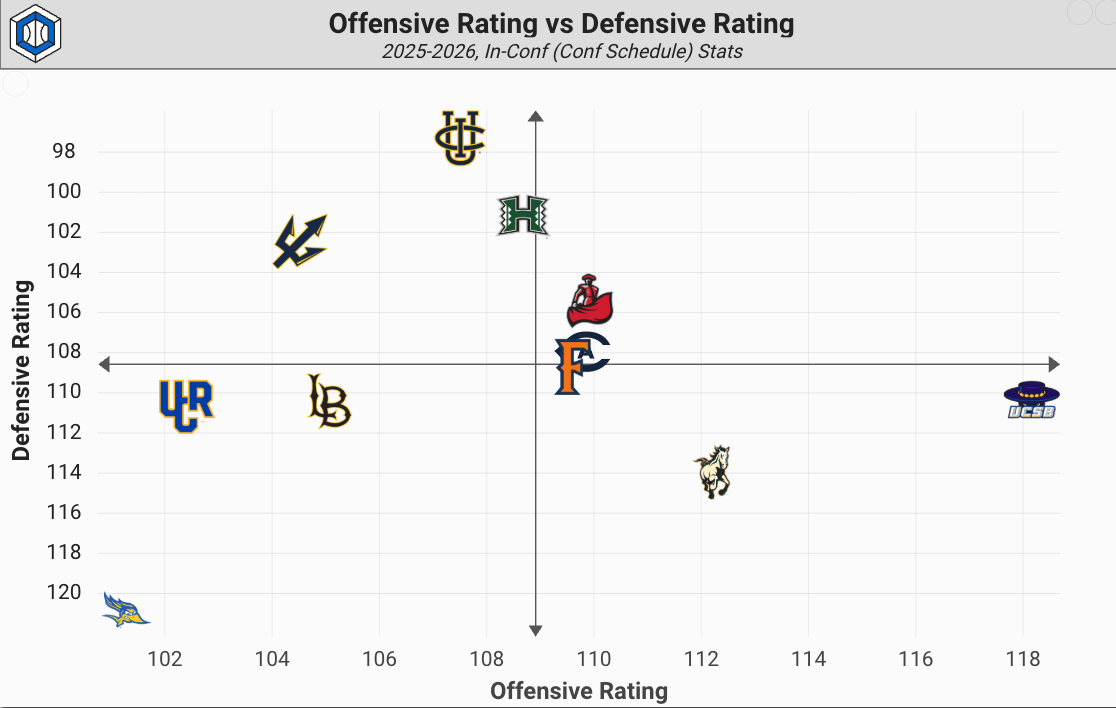
If Irvine avenges the earlier loss, they tighten their grip on at least a share of the regular season title. But if Santa Barbara goes 2-0 against the Anteaters, we may have some real drama to close out Big West play. - Tuck Clarry
Sunday, March 1
A Game
#8 Purdue (-5) at #39 Ohio State, 1:30 PM ET, CBS.
Well, the good news for Purdue is that they’re not playing at Mackey. Purdue is the league’s 2nd best road defense at .94 PPP, at home they’re 12th, allowing 1.04 PPP (it doesn’t help that opposing offenses are shooting 38% on massive volume from 3, but they’re also horrible at the rim at home as well). Bad news is Ohio State was on the vanguard of beating the Boilers in West Lafayette, completing a big comeback at Mackey last season to stun Purdue. Purdue’s major issue defensively is that they’re just totally devoid of athleticism, and opposing offenses relentlessly drive their guards/wings and thus the Boilers are constantly in rotation. We see Painter hedge a lot with Cluff to flatten out those drives, but that’s in turn allowing a 94th percentile unguarded catch and shoot rate. Ohio State’s offense is predicated almost entirely on creating off the dribble (87th percentile rate with a 91st percentile efficiency rating), and that’s precisely how they beat Purdue last season, with the Boilers allowing a season high 19 points off the bounce. Purdue actually did an excellent job denying Bruce Thornton last season, limiting him to 7 field goal attempts, but again, it was the Devin Royal/Micah Parrish wing combo that drove by Purdue all game.
Iowa just played heavy denial on Thornton and OSU had no recourse offensively when he was held to 8 field goal attempts, and I’m doubtful Christoph Tilly will be suiting up, which leaves the Buckeyes very limited against the TKR/Cluff duo, and would allow TKR to slot down to the 5, which has been unlocking Purdue’s offense at times the last few games. Purdue’s athleticism issues are still going to be a problem against Royal and Amare Bynum, but they can hedge out Thornton from the offense somewhat (he was eventually just completely moved off the ball against Iowa) and the Boiler offense should be able to do what they want against this porous OSU defense. - Jordan Majewski
B Games
#10 Michigan State (-4) at #43 Indiana, 3:45 PM ET, CBS.
Indiana’s first meeting with Michigan State at Breslin was actually going ok for the Hoosiers. The score was tied at 53, the Hoosiers were moving the ball well (81% assist rate) against the Sparty hedge…then the wheels completely fell off. From 53-53 it was soon 81-55, and the game was over. Everything that a limited Michigan State offense had to do to win in blowout fashion, the Hoosiers allowed. Sparty scored 23 points in transition, snagged offensive rebounds at a 48% rate, Jeremy Fears carved up the IU drop coverage, and the MSU was able to play through their two bigs with impunity, shooting 19-27 on 2PT attempts. The entire premise of DDV’s offensive scheme is that their spacing, shooting, and ball movement would reverse course on the Woodson era two-big faceplants against the league’s help and hedge oriented defenses that he never beat like Nebraska and Northwestern. That’s what made the home collapse to Northwestern on Tuesday so deflating- it felt like the Woody era again. This Hoosier offense is still very capable of scoring against this Sparty defensive scheme, and I’m sure the spot crowd loves the “lean and desperate” Hoosiers off 3 losses vs the “fat and happy” Spartans finishing up the Indiana trip on shorter rest from the physical Purdue win. But the concern is that the Hoosiers were wholly incapable of limiting the areas Michigan State has to dominate to be efficient offensively. - Jordan Majewski
#55 Belmont (-1) at #98 Illinois State, 5 PM ET, CBSSN.
This season finale for Belmont is more or less meaningless, save for building out an at-large case that I wish would gather more steam than it seems to be gathering. You want me to prefer 18-10 TCU (50th KenPom) or 19-9 Missouri (51st) over 26-4 Belmont (55th)? Well, I’m not going to, so quit asking.
Anyway, this carries some meaning for Illinois State depending on the results of other games. If all favorites win in the other MVC games this weekend, Illinois State either finishes fourth (win) or sixth (loss) in the league. If Valpo loses to Evansville AND Indiana State beats UIC (around a 12% chance), I think Illinois State can finish as high as third with a win. In any case, they are very likely to finish somewhere from fourth to sixth with an extreme outside shot at third. You can read all of these scenarios here.
MVC Tournament Seeding #ArchMadness - The Final 64 Scenarios: pic.twitter.com/PDUAEqbwg8
— Matt Hackman (@mjhackman) February 26, 2026
Based on the way these two match up, I’d initially think of this as a points explosion and a game that simply comes down to whichever’s defensive weakness is less weak. The first game kind of got there - Belmont won 80-69 mostly because they hit so many shots that Illinois State’s huge rebounding edge got washed out - but it was also an anomaly where two great offenses had to take significantly more midrange twos than they’re used to. (Also, this was Snowmageddon in Nashville, so the crowd was thinned out.) I don’t trust much of anything about how Illinois State defends ball screens, and almost any scenario involving a screener favors Belmont on offense to me. The Bruins dumped an absurd 1.53 PPP on ISUred in Nashville in P&R sets, partially because the Redbirds just…never adjusted. Even pick-and-pops were left wide open:
P&R isn’t a huge feature of Belmont’s offense but I’m not really sure how ISUred plans on guarding any sort of screening action when 1) Belmont is among the nation’s very best in dribble handoffs and 2) Illinois State runs the same basic, laissez-faire drop coverage against those too. The good news here is that matching up a weak two-way rebounding unit with arguably the best two-way rebounding team in the MVC certainly favors the Redbirds. This Belmont team is far better defensively than the Belmont teams of old, but they’ve had major struggles in overcommitting on drives to the paint, allowing an absolutely monstrous amount of kickout threes this year. It allows them to wall off the rim exceptionally well, but they’re going to be vulnerable to a huge shooting day from Boden Skunberg and/or Landon Wolf. Bonus points if this is the day Johnny Kinzinger hits threes. Whichever offense blinks first loses. - Will Warren
C Games
#115 Murray State at #127 Bradley (-4), 2 PM ET, ESPN+.
I think it’s possible for the loser here to fall out of the top 5 in the Valley, and thus lose out on a bye spot in Arch Madness, but I’m not entirely certain of the tiebreaker scenarios. First meeting between these two saw Jaquan Johnson struggle to his worst offensive game of the season, shooting 2-12 against Murray State drop coverage. Johnson has been on an offensive tear to close out the regular season however, and Bradley desperately needs his ball screen and dribble creation in the rematch in Peoria. The Racers were in the middle of racing out to an 8-0 Valley start when they first met the Braves back on January 4, but since that blazing start they’ve gone 4-7 with truly awful perimeter defense. Since that 8-0 start, the Racers have played like the 192nd best team in the country, with the 293rd defense. Yes, a -11% 3PT% delta in that stretch is brutal, but the rim defense has been just as bad, sitting at 310th in 2PT% defense in that span. If Johnson plays like he has of late on the ball and the Racers defend on the ball like they have of late, the Braves should finish out with a home win and an Arch Madness bye. - Jordan Majewski
#160 Charleston at #103 UNC Wilmington (-6), 7 PM ET, CBSSN.
Since losing to Charleston in the CAA finals in 2023, Takayo Siddle has rattled off 6 straight wins against the Cougars, including a domination at TD Arena a few weeks ago, where the Seahawks were +19 in field goal attempts. Charleston, the league’s best rim offense, scored just 16 rim points and allowed 39, their second highest total allowed of the season, with Pat Wessler winning the post battle against Christian Reeves. The wrinkle was Chris Mack’s 1-3-1 was actually very efficient, with UNCW scoring just .7 PPP in 27 zone offense possessions, but I guess the offensive rebounding risk was too much for Mack, as the Cougars oddly abandoned it for stretches. UNCW is playing to close out an outright CAA title in front of their home crowd, while Charleston would need to win today (this is their final regular season game) and have Elon beat UNCW Tuesday to share the title, which would also give them the tiebreaker for the top seed in the CAA tournament as well. So this is for all the CAA regular season marbles. - Jordan Majewski