

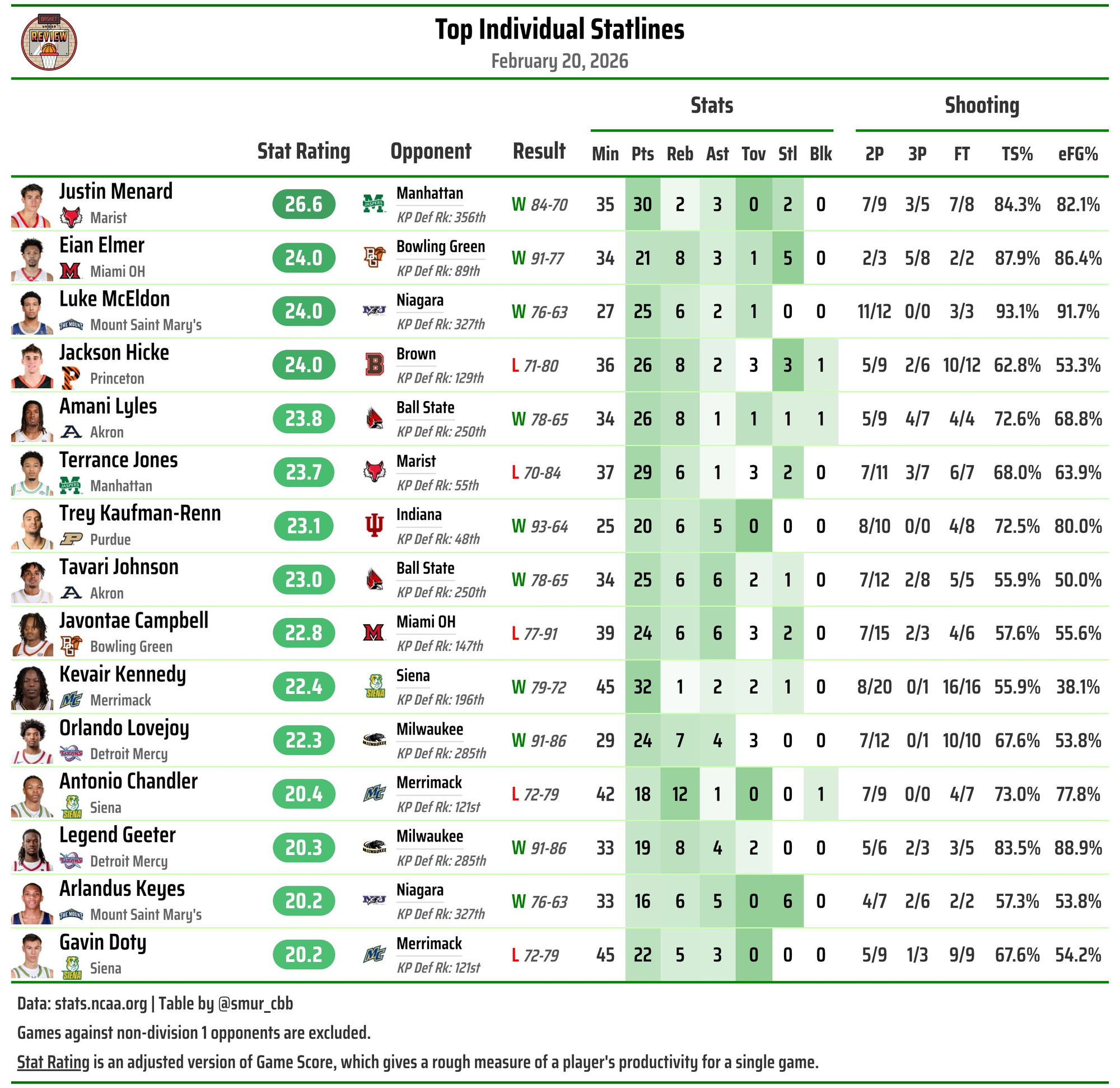
Welcome to another edition of the Weekend Watchlist! Before you dive in, check out yesterday's top performances and today's Watchability Index.
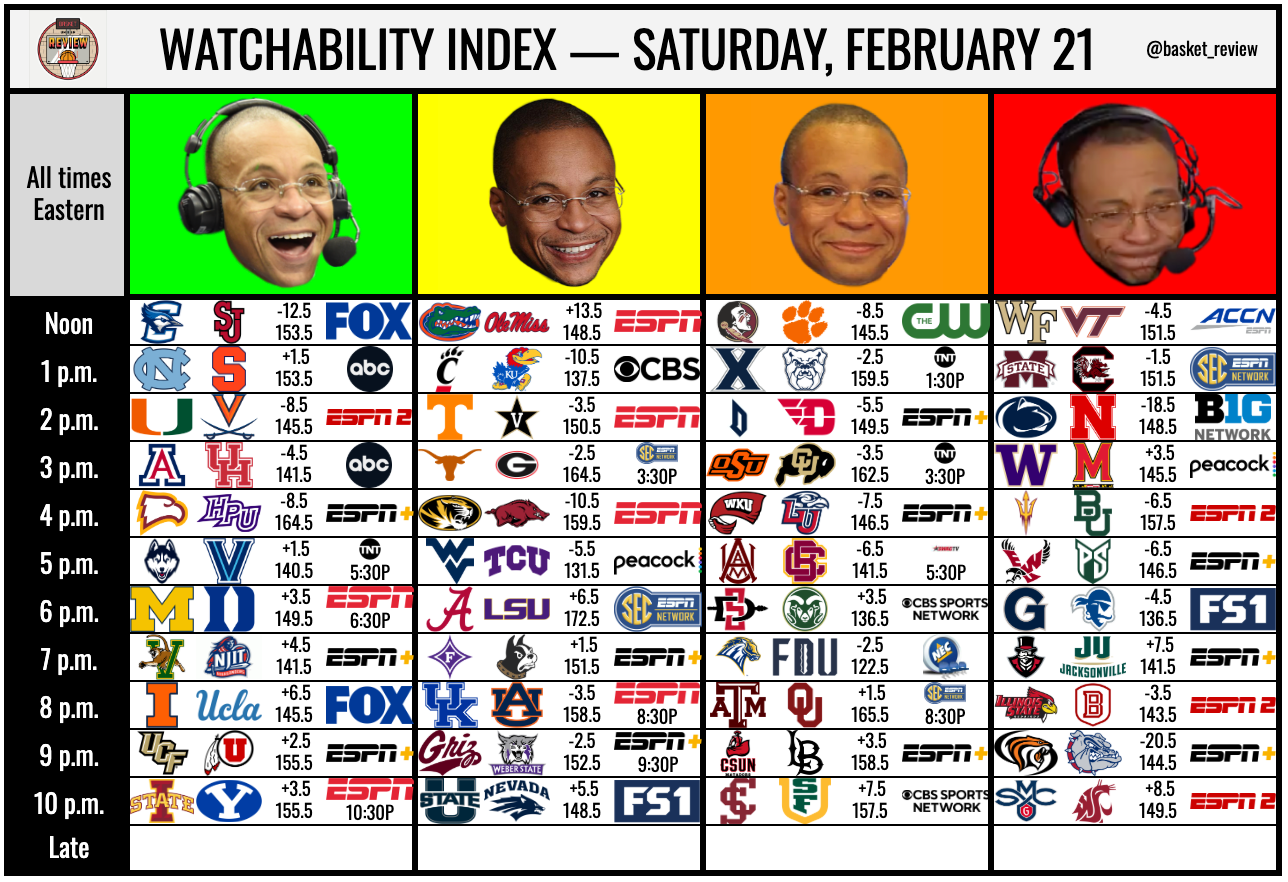
Saturday, February 21
The TWO! A+ Games of the Weekend
#3 Arizona at #5 Houston (-2), 3 PM ET, ABC.
This was a tough schematic matchup for Arizona last year, and now the Wildcats catch Houston back home where they've lost just once in the past 3 seasons while also being shorthanded and reportedly recovering from some teamwide illness (who isn't at this point in the season though). I'm a broken record when it comes to scheming against Arizona, but giving yourself the best chance to win against Tommy Lloyd primarily involves keeping Arizona off the rim and out of transition, and Houston certainly accomplished that last season. Houston limited the regular season matchup to 63 possessions, the slowest game at McKale of the Tommy Lloyd era, and then in the Big 12 tournament they played just 66 possessions. The Wildcats also scored just 22 points at the rim in the regular season meeting, the lowest total of the season for Arizona, while shooting just 10-41 from 3 in the 2 games. Clearly, the post Monster and the aggressive ball screen hedging were effective in slowing down the Arizona rim and transition attack and forcing Arizona into jump shots they didn't want to take.
Offensively however Houston didn't exactly take it to the Wildcats, and actually trailed in the second half of both of those games despite accomplishing what they wanted defensively. Of course players have changed, and Arizona has struggled defending in ball screens of late, allowing primary ballhandlers to kind of go berserk. AJ Dybantsa being unstoppable in ball screens Wednesday night is forgivable, as is Christian Anderson picking them apart in PNR with JT Toppin, but Melvin Council, Themus Fulks, Moe Odum, Terrence Brown- all have been efficient ball screen scorers against the Wildcats, who are typically going to funnel ball screen and dribble creation. That of course could be problematic against Kingston Flemings, who is as electric a ball screen and dribble scorer as there is in the country.
Houston's shot diet (96th percentile low quality shot rate and the lowest rim rate in the entire country) is practically the opposite in every regard to Arizona's offense, but they peddle in exactly the areas Arizona leaves unattended. Of course sometimes that tough shot diet means they go on long scoring droughts, and that's certainly cost them in big games before. But with Houston's defensive scheme so seemingly designed to limit Arizona's offensive strengths (outside of the offensive glass), that offensive wonkiness becomes mitigated somewhat. Huge gulf between the analytical lines and Vegas, as Arizona's injuries and the "spot" have certainly created the perfect storm for that schism. - Jordan Majewski
#1 Michigan (-2) vs. #2 Duke, 6:30 PM ET, ESPN.
These are the two best teams in the country according to KenPom, and thanks to the powers that be, we get to see them play on a neutral site in mid-February. This is probably the closest you can ever come to a national championship game not played in the NCAA Tournament.
As far as historical ramifications go, Michigan will surpass last year's Duke team as the second-best team in KenPom's 30-year database if it wins by more than two points, surpassing, of course, last year's Duke team, and remaining behind... 1998-99 Duke. In the name of KenPom and history: even just an average game from Cameron Boozer would see him remain as the greatest player in the website's database since it started tracking Player of the Year rankings in 2010.
In other words, it is possible this contest features the best team of the 21st century against the best player of the 21st century. No pressure!
In a year that has been dominated by size and physicality, these squads are arguably the best two-way rim teams in the country. There are only three power conference teams that shoot 65% or better at the rim on 25+ attempts per game: Duke, Michigan, and Arkansas. There are also just three power conference teams that allow below 55% at the rim on fewer than 10 makes per game: Duke, Michigan, and Michigan State.
No team has scored more than 30 rim points on Duke, but they've hit that number offensively in 19 of their 26 games. No team has scored more than 30 rim points on Michigan either, and they've hit that number offensively in 22 of their 26 games. I think you get the point.
There are other fascinating micro-battles in this game too. Michigan is fifth amongst P5 teams in transition points per game, but Duke is amongst the very best in transition denial. Duke is fifth-nationally in points scored off cuts, but Michigan is amongst the very best at denying that action with their lack of over-aggression defensively.
The rebounding should be about even. The turnover battle should be close. Both teams do a great job at not fouling. Both teams are good 3-point shooting squads, but not amongst the game's elite. Heck, this game is even on a neutral site in Washington, D.C., so no home court advantage either.
However, there's one fact that should be relatively undisputed, and that is Duke has the best player in this game with Boozer. Michigan doesn't really double much at all. They have sky-high pick-and-roll, isolation, dribble jumper, and floater rates. They are likely going to trust their defenders on Boozer and not allow him to become a playmaker here. Yaxel Lendeborg or Morez Johnson as an initial defender and Aday Mara as a backline rim protector is as good a matchup you could throw at him, on paper.
If Michigan gets out in transition, overwhelms Duke's interior, and stays hot from deep, this may not get as ugly as the stunning Gonzaga rout, but it could be an emphatic win for the Wolverines. But if Duke is able to keep this one clean and slow, and the best player in the sport plays like the best player on the floor, we could have a serious debate on who the best team in the country is by around 9pm ET on Saturday. - Matthew Winick
A Games
#16 Tennessee at #12 Vanderbilt (-4), 2 PM ET, ESPN.
A month ago, I thought this might be a bloodletting. On the morning of January 20, Vandy may have lost two in a row, but they were still 16-2 and 7th at Torvik. Tennessee, meanwhile, had just completed a two-hour humiliation ritual at home against Kentucky, was 12-6, and had fallen to 20th at Torvik. Since the 20th, Vandy is 5-3 and Tennessee 7-1. Both of these are fine records, but the vibes of each are so different at this stage that it’s hard to ignore.
Much of Vandy’s decline can be attributed to some mix of simple regression to the mean (they were nearly +10% from 3 in non-conference play) and genuine bad luck with injuries. Frankie Collins has missed every game since December 21, and Duke Miles last played against Mississippi State on January 24. Vandy can survive an injury to either but not both; in the minutes with neither on the floor, the ‘Dores go from playing like a top-10 team to one outside of the top-25, per Hoop-Explorer.
The biggest impact is on defense, where Vandy really misses the pure perimeter pressure and gambling nature those two bring. In minutes with neither on the court, VU goes from forcing TOs on 20.5% of opponent possessions to 15.7%, which is a huge problem when you have the rest of Vandy’s roster. Tyler Tanner has done great work, but he’s just one guy. Jalen Washington is a fine rim protector, but he’s at 5 fouls committed per 40 minutes played. Devin McGlockton is a great rebounder and all-around glue guy, but his aggressiveness gets him in foul trouble often and he’s already playing out of position at the 5. Add it all up and you get a defense surrendering a 59% hit rate at the rim combined with the 339th-best DREB% allowed over the last month.
That’s an extremely dangerous combo to me when your opponent has Nate Ament and is posting an astounding +17.0 rebounding margin per 100 in conference play. True story: since conference play began, Tennessee is not only the single best rebounding team in the entire country, they’re tracking to have the highest rebounding margin per 100 in conference play by a high-major since 2016-17 North Carolina (+17.9). (At +15.3, Florida is merely tracking to be the best since Zach Edey’s final Purdue team.) That, combined with Ament’s monster breakout since mid-January (over his last 10 games, he’s averaging 23.4 PPG and a 127 ORtg on 28% USG), has quietly made Tennessee a top-15 team as of late.
That, plus the way Vandy covers ball screens (generally preferring to sit back and not pursue over the top, which would open things up for a lot of Ja’Kobi Gillespie threes), tempts me to pick Tennessee in a spot that’s pretty obviously favoring Vandy. Tennessee’s non-home performances have been super up-and-down, and while this is the same team that’s beaten Houston and Alabama away from home it’s also the same one that lost at Syracuse for reasons unknown. I also think Tyler Tanner could simply have an advantage over literally anyone guarding him in this game. To be honest I’m giving this one a grade of Incomplete - I can’t really figure out which way I lean until the status of Miles is confirmed. - Will Warren
#13 UConn (-1) at #27 Villanova, 5:30 PM ET, TNT.
The Big East never disappoints. After starting 12-0 in conference play, Dan Hurley’s UConn is a game back from first place and just a game ahead of third–their opponents on Saturday–as they head to the final four games of their season. The Huskies are 3-2 in February after dropping a shocker at home to a Creighton team that is now 14-13 on the season.
Meanwhile, Villanova hasn’t lost since their overtime defeat in Storrs almost a month ago. Over their last five games, they have the third-best turnover differential among power conference teams and have an assist-to-turnover ratio of 1.8, putting them in the 92nd percentile. Freshman guard Acaden Lewis has been playing his best basketball in this five-game stretch, averaging 16.2 points and 5.4 assists.
In the first matchup, Lewis was swallowed up by the Huskies’ stalwart guards, going 1 for 13 from the field. Villanova took UConn to overtime by corralling offensive rebounds and converting second-chance opportunities. 22 of their 67 points came after a miss.
The question is whether Hurley’s challenge to his players and their defensive performances will garner the proper response. Creighton’s 91 points on Wednesday night were the most points a UConn team has surrendered at home in Big East play in over two decades.
Over the last 5 games, opponents have a true shooting percentage of 58.1%, a near 7% increase from their season-long average. Even worse for the Huskies, they’ve been giving up a staggering 48.7% free throw rate to opponents in that span. Centers Tarris Reed and Eric Reibe are averaging 4.6 and 6.6 fouls per 40 minutes during this stretch.
Starters Solo Ball and Alex Karaban didn’t get much playing time towards the end of the Creighton game, likely in large part to the open looks they gave up during most of the game. The levers Hurley pulls in a crucial matchup between second and third place in the league not only impact who gets the Big East title, but also whether UConn is still in the running for a 1 seed in the NCAA tournament. - Tuck Clarry
#7 Iowa State (-1) at #22 BYU, 10:30 PM ET, ESPN.
BYU put up a pretty game effort in Tucson in their first game without Richie Saunders, and as expected, AJ Dybantsa’s usage went through the roof. Dybantsa had a season high 46% usage rate and a season high 28 field goal attempts. His elite contested shot making makes this not necessarily the worst thing in the world for BYU moving forward, but it’s certainly not ideal against Iowa State’s denials and doubles on the ball screen and post, which necessitates ball movement and weakside perimeter shooters, where Saunders would have slotted in perfectly (Saunders scored 46 in two thrilling BYU wins over ISU last season). Last season BYU notched the highest and third highest catch and shoot totals ISU allowed, with an 80% assist rate in the Big 12 tournament win. This year’s BYU squad is dead last in Big 12 assist rate, and just generated their lowest catch and shoot rate of the season in their first game without Saunders. The Clones force isolation at a 96th percentile rate with a 93rd percentile efficiency rating, but I’m not sure TJO wants Josh Jefferson or Milan Momcilovic exposed to the AJD whistle, but the issue now is you can help on his midpost isos with relative impunity, and Rob Wright’s ball screen creation is going to be mitigated by ISU’s denial defense (Wright had the second lowest ORtg of his career last year vs the Clones). Wright completely took over as a ball screen scorer when Saunders was hurt early against Colorado, but that's very unlikely to be an option against ISU, who allows just a 46th percentile ball screen rate with an 83rd percentile efficiency rating, per Synergy data.
Defensively, BYU somewhat surprisingly didn’t zone at a significantly higher rate than they usually do against Arizona, but that probably wouldn’t be ideal against ISU and Jefferson’s passing out of the middle of the floor anyway (small sample size, but ISU is a 99th percentile zone offense this season, per Synergy data). More Khadim Mboup minutes in Saunders’ wake is actually beneficial defensively, and he has the versatility to defend on the perimeter and stay in front of Jefferson (he actually did a reasonable job even switching onto Kingston Flemings at times vs Houston).
The problem is on the offensive end he's a guy ISU can totally abandon to help on Dybantsa.
I'm not exactly painting the rosiest picture for BYU schematically here, but it is important to keep in mind that ISU is heading to altitude in the same week they played an all out, come from behind, Hilton Magic™ game against the most physical team in the league, and the Cougars still have the most elite scorer on the floor. Like if you told me AJD went for 40+ and ISU had a subpar shooting night on the road in altitude, it wouldn't be the most shocking thing on a monster CBB Saturday. - Jordan Majewski
B Games
#50 Cincinnati at #14 Kansas (-12), 1 PM ET, CBS.
In mid-January, this game would have hardly warranted much attention. Cincinnati was in the middle of banging their collective heads against the wall, losing three games by a total of 10 points and unable to get out of their own way. But the Bearcats have won their last three games, a streak they haven’t had since their opening four games of the season.
During this stretch, Wes Miller’s team has posted the best effective field goal percentage in the conference while allowing the second-lowest opponent effective field goal percentage. We’ll see if that offensive efficiency travels to Phog Allen, where opponents are shooting 37.3% from the field, the fifth-lowest average amongst high major teams.
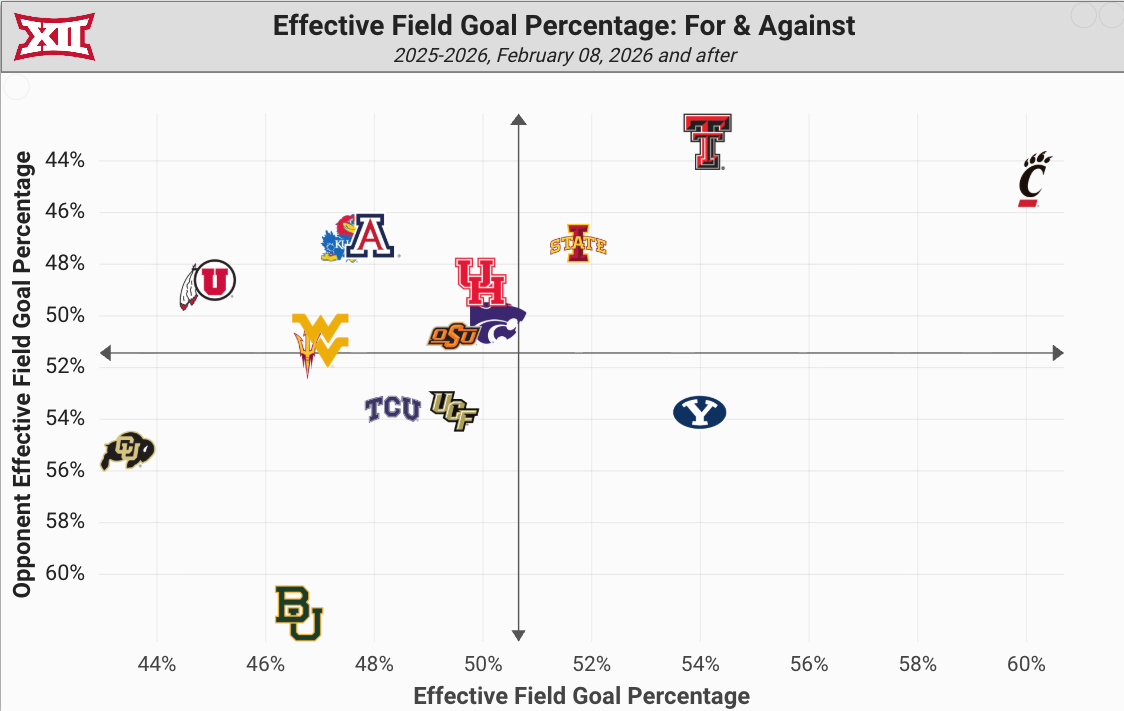
Cincinnati is playing well enough that it could keep it tight even as Kansas has won 9 of its last 10 games and steadily climbed in bracketology seeding projections. There is, of course, the added storyline of Darryn Peterson’s availability in this game after playing just three minutes in the second half of the Jayhawks' win over Oklahoma State on Wednesday.
Peterson continues to show that the most complete scorer in college basketball. He dropped 13 points before the first under-16 timeout against the Cowboys and finished with 23 points on a true shooting percentage of 83.6%.
Bill Self and the Rock Chalk base are clearly getting tired of the “will he, won’t he” nature of seemingly every game. Peterson’s provided offense is an ideal complement to a Kansas defense that ranks second in opponent effective field percentage across the power conferences. And Kansas will need Peterson’s half-court efficiency against a Bearcats team that is holding opponents to 36.8% field goal shooting when they’re back on defense.
Peterson is in the 94th percentile in the country for field goal percentage in the halfcourt at 48% this season. Despite playing half as many minutes as his teammates, he leads Kansas in half-court made threes and is shooting 45% on those attempts.
In terms of individual matchups, the battle at the rim between Jayhawk Flory Bidunga and Cincinnati’s Moustapha Thiam will be the one to watch. Bidunga’s athleticism has made him one of the best rim protectors and lob threats in the country, but he’s also giving up at least 4 inches to Thiam, who is finally healthy. Thiam recorded 4 blocks in Cincinnati’s win against Utah last weekend. - Tuck Clarry
#39 Miami (FL) at #15 Virginia (-8), 2 PM ET, ESPN2.
The big cause for concern if you’re the Canes is Virginia’s dominant rim defense when you’re one of the most rim reliant offenses in the country (98th percentile rim rate, 94th percentile efficiency rating). Virginia meanwhile has the two-headed shot blocking tandem of Johann Grunloh and Ugonna Onyenso, who leads the entire country in block rate. Essentially every ACC defense has doubled Malik Reneau on the catch given the Canes’ general lack of spacing and shooters, but Virginia doesn’t really do that since Grunloh is an absolute lock down individual post defender, who has only allowed 7 buckets in 34 post possessions all season.
Mitigating Miami's rim attack is objective one, without question, but that doesn't leave the Canes totally bereft offensively here. As a result of that dominant drop coverage, the Cavs funnel ball screen and dribble creation at some of the highest rates in the country, but their backcourt isn't particularly adept at staying in front of plus ball screen operators, and Tre Donaldson has been an electric ball screen scorer of late. Donaldson completely took over against VA Tech and willed the Canes to a win with his dribble:
I'll be interested to see how much zone Jai Lucas sticks with, as the 3-2 has been a factor for the Canes' defense in the past month or so, and Virginia's zone offense nearly cost them the game against Florida State a week and a half ago. Lucas might be reluctant to sacrifice defensive rebounding (Miami's double big lineup is the best defensive rebounding team in the ACC) against Virginia's elite offensive rebounding group. On first glance, this looks like a pretty rough schematic matchup for the Canes given their rim reliance and UVA's defensive rim dominance, but I generally think they prefer to see a drop coverage than a help/hedge scheme that exposes their spacing and shooting issues. The Canes sitting at 10-3 in the league despite a -9% 3PT% delta is impressive work. - Jordan Majewski
#28 Texas at #40 Georgia (-2), 3:30 PM ET, SEC Network.
At the time of writing, this is a 10 seed traveling to play an 11. You don't need me to tell you that this is potentially a play-in game for the NCAA Tournament, particularly knowing the way both of these teams have played this year. Texas has the best win of either team (at Alabama on January 10) but possibly the worst loss (home to Mississippi State the week before). Georgia, meanwhile, may have saved their run to the Tournament by beating Kentucky on Tuesday, which obscures a five-losses-in-six-games run that started by getting obliterated in Austin on January 24.
Let's look back at that first game, then. Sean Miller and Mike White had faced off once prior in the 2024 NIT, but considering that's the NIT, it's a lot more useful to look at a recent game where Texas owned the boards (44%-34% OREB%) and...uh...made roughly a billion shots from 13 feet out. That part isn't a joke, by the way. In the game in Austin, Texas shot 9-14 on all jumpers inside 16 feet. Dailyn Swain - he of 33 made jumpers all season - got five (three midrange, two from deep) to fall out of seven total jump shot attempts.
I guess part of me thinks Georgia could run back a similar strategy on defense and hope for better results. ShotQuality scores aren't the be-all end-all by any stretch, but their scoreline of Texas 78-75 is more in line with the actual shots produced in that game. Georgia had a ton of success running actions through Somto Cyril in this game, which isn't surprising considering how porous Texas's interior defense is. That combined with some better shot-making by Marcus Millender and/or Blue Cain can flip this game quickly, and yeah, I guess I'm not all in on the Longhorns just yet. The rebounding? Great! The interior defense and extreme fouling issues? Less so. - Will Warren
#52 Missouri at #17 Arkansas (-12), 4 PM ET, ESPN.
I have this a tier too high, I'm sure, but let me note a thing that I would be remiss to not note: we have yet to have our yearly Dumb John Calipari Loss. Some will point to Kentucky, but that's a team who will probably be a 7 seed or something. Not dumb. Maybe you think the road loss to Georgia was dumb, but Georgia also owns wins over Auburn and Kentucky.
The list of Certifiable Dumb John Calipari Losses by year:
- 2024-25: at LSU, at South Carolina.
- 2023-24: UNC Wilmington.
- 2022-23: home South Carolina, road Georgia.
- 2021-22: ever heard of Saint Peter's?
- (We'll exclude 2020-21 for obvious reasons.)
- 2019-20: Evansville.
You have to go back to 2018-19 to find the last year without a truly dumb loss by a team coached by ol' JC, and even then that team blew an 8-point lead with three minutes to go against Tennessee. The staple of Late Stage Calipari is accepting that, while his teams are guaranteed to produce several great wins, they are also going to produce at least one inexplicable loss per season. This is the only game left on the schedule that qualifies to me, and just barely. Can Calipari escape his past? I would hope so, because all other indications make this a clear blowout. - Will Warren
#60 West Virginia at #51 TCU (-5), 5 PM ET, Peacock.
Both teams took bad midweek losses that can/will hurt their March odds significantly, which may make this a competition for the team that eventually ranks in First Four Out versus Next Four Out. Still! It's important. Torvik's DayCast tool has this as the biggest game of the season to-date for each side. WVU jumps to 17% to make the field with a win (4% with a loss), while TCU would shoot all the way to 58% (39% with a loss). The only game this Saturday with greater Tournament odds leverage is Kentucky/Auburn, and that one probably only really matters for one team.
This will be the first scrap between Jamie Dixon and Ross Hodge, as TCU's cowardice choices in non-conference scheduling meant the Horned Frogs didn't play North Texas while Hodge was HC. If you're an optimist, you'll look at this is a game that could potentially elevate WVU to the top of a loose pile of 7-6/6-7 teams and possibly push them ahead of BYU (!) in the standings if BYU loses tonight. Alternately: #15 offense in league play at #10 with two top-30 defenses involved.
Adjusted for competition, WVU's offense has actually been a little better against top-40 groups, but in the sense that being hit by a Corolla is maybe less bad than being hit by an F-150. (They're averaging 0.98 PPP in these games.) TCU's offense actually gets notably better, which is in line with season-long results but obscures how bad their half-court offense is, as it sits at 0.89 PPP against top-40 defenses. It becomes a simple game to me if you assume the baseline analytical projection of a close TCU win. If TCU generates 20+ points in transition and is allowed to run and/or gun, they could win by 18. If WVU successfully turns this into a grindfest and makes this a race to 60, TCU can lose outright and be in some pretty serious trouble as it pertains to March odds. - Will Warren
#4 Illinois (-7) at #42 UCLA, 8 PM ET, FOX.
Illinois' first SoCal trip resulted in a mere 1.41 PPP at USC, their most efficient Big Ten offensive output of the season. Brad Underwood then proceeded to subtweet Mick Cronin when he noted how the travel isn't a big deal for his team, made even worse because Cronin was in East Lansing putting together his Sgt. Pepper's of meltdowns.
Regardless, this is a pretty brutal offensive scheme for a now apologetic Cronin and the Bruins to return home to, as the Illini spacing and ball movement is capable of masterblasting hedge/show heavy schemes, which is Cronin's preferred base defense.
Of course you also don't want to drop on Wagler's ball screen, because he can put up a crooked individual number with that kind of space- there's a reason this is the most efficient offense in the entire country (oh and they're fully healthy again).
UCLA however has unsurprisingly been much better at home in virtually every metric, and if we're choosing poisons against the Illini offense, hedging them out of their PNRs and turning them into strictly jump shooters (the Sparty/Nebraska model) is probably the poison I'd choose and hope the jump shooting is just off that night (although the Illini could still dominate the shot volume battle in that scenario), and that's exactly what we'll see from UCLA. Illinois could theoretically have issues with the Dent/Bilodeau two man game against their drop coverage (and UCLA has been a surprisingly decent zone offense should Underwood turn to that again), but Dent was back to being awful on the Michigan trip. I guess this could be a "circle the wagons" type moment for the Bruins with their season on the brink, or the Michigan trip was just the beginning of Cronin easing his way back to Cincinnati by next season. - Jordan Majewski
#30 Kentucky at #32 Auburn (-3), 8:30 PM ET, ESPN.
After a few weeks of something resembling a ceasefire, KSR (or at least some particularly vocal segments of BBN) is back underway with their campaign to ask Senator Mark Pope to Resign, Sir, For the Good of the Commonwealth. Whether they’re successful this time after being unsuccessful the previous eight is TBD, but I wish them well in their endeavors.
Actual future Senator Bruce Pearl has handed off a fascinating team to his son. Despite the record I’d argue Steven has done okay this year with the talent at hand. This Auburn team was never going to be good defensively based on roster construction, and at minimum, I do think the half-court offense flows as well as it usually has while being among the sport’s best at overloading their opponents with pure volume of shots. Their actual shooting efficiency isn’t great, but when you get back 38% of your misses and are fifth in the country in FT Rate, hitting shots is kind of a bonus.
All of that kinda gets shoved to the wayside here because it seems the status of Keyshawn Hall is up in the air for AU, not just in this game but going forward. Hall got yeeted from the Vandy game midway through, didn’t play against Arkansas, then somehow played a full 40 against Mississippi State in a game where he scored 29 but looked completely disengaged and bored defensively. That was Auburn’s fifth straight loss, by the way, which is a hard thing to do when you’ve scored 75+ in the last four.
The situation favors Auburn here, given the status as a certified Must Win Game and with Kentucky (who was beyond ripe for regression) coming down to earth with a home loss to Georgia. I also think Auburn’s straight-up the better team in half-court here, and if the Tigers can do a good job of holding onto the ball, they can win this game without a ton having to go their way. The problem for me is that it seems impossible to guess who or what this Auburn team is going to bring to the table on a nightly basis, and they’re bad at preventing transition opportunities, which is sometimes the only way Kentucky can generate points at all.
It goes against type, but if Pearl can get this to be a half-court game played through Hall I think Auburn’s got a terrific chance. This simply isn’t a great UK defense and as much as journalists have begged readers to believe otherwise, Kentucky’s still just 38th at Torvik over their last ten games, including 73rd on defense. Auburn’s 44th, but at least there I can point to the unlikelihood of a 40% hit rate by opponents from 3 continuing to hold. - Will Warren
#23 Utah State (-4) at #72 Nevada, 10 PM ET, FS1.
Two teams headed in opposite directions are meeting up in Reno, as the margin for error remains small for Utah State’s chances of winning regular season title honors for the second time in three years and Nevada’s season is on the ropes after back-to-back ugly losses.
The Wolfpack lost by 14 to San Diego State last Saturday, but it’s the 16-point loss to 11th-place San Jose State that has the walls closing in. Steve Alford’s team’s perimeter defense has disappeared, going from 32.5% allowed in their first 10 conference games to 38.1% from deep over their last five games. In those first 10 games, they also held opponents to 38.9% shooting on half-court attempts. It’s grown to 43.3% in their last five matchups.
Meanwhile, the Aggies weathered their back-to-back mid-January losses to win eight straight games and sit alone atop the conference standings. More importantly, MJ Collins has adapted his game, as his three-point efficiency has not matched his early-season numbers. Collins has made his last 13 shots from inside the arc, including a 24 point outing in Utah State’s 99-75 win over Memphis.
As much as the trends for these two teams are headed in opposite directions, their individual game scripts and strengths leave the door open for a legitimate challenge for Utah State. The Aggies try to get out on fastbreak as a turnover-creating team, but Nevada is one of the better teams in the conference at taking care of the basketball.
Utah State scores 39.6 points in the paint per game and over 47% of their points are from inside the key. Nevada has been one of the better interior defensive teams throughout the season, ranking in the 94th percentile in paint points allowed, limiting opponents to 26.1 points per game.
Nevada sophomore Elijah Price has been one of the best rim protectors in the conference. He leads the league in blocks recorded this season, and his 7.5% block rate ranks fourth. How Price is officiated on both ends of the court could have a massive impact in this one. He leads the Mountain West in foul drawing per 40 minutes, but has also recorded four or more fouls in three of his last four games. - Tuck Clarry
C Games
#6 Florida (-12) at #79 Ole Miss, 12 PM ET, ESPN.
KenPom released a new stat in the middle of this season called 2-point distance, essentially measuring how far the average 2-point field goal a team attempts is. The lower the number the better, meaning that team typically avoids the mid-range and gets to the rim a lot. Here are the five worst teams in the entire country at that stat offensively.
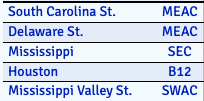
Yes, that would be the country's 355th, 364th, 93rd, 10th, and 365th (dead-last). Ignoring the fact that Houston is a giant outlier, that puts Ole Miss in a category with three of the 10 worst offenses in the country. Even if we wanted to compare them to the Cougars, Houston grabs 37% of their misses on those attempts, while the Rebels are at just 29%.
So Ole Miss doesn't get to the rim. They also are last in the SEC in offensive free throw rate, second-last in offensive rebounding rate, and 10th in 3-point shooting. They never turn it over, first in that category, but is it really an accomplishment if the shot you're taking is almost always a bad one? The Rebels are 343rd in ShotQuality's shot selection metric, an area usually reserved for the sport's worst teams.
Anyways, this was a long-winded way to say Ole Miss' offense is gross. They also cannot rebound. Did I mention their opponent is the best two-way rebounding team in the country in Florida? The other SEC team that is bottom-three in offensive and defensive rebounding rate is South Carolina, and in their two games against the Gators, they lost the boards by a total of 38 in two blowout losses.
This season has not gone to plan for Ole Miss, who play extremely deep rotations searching for answers, and currently sit as the second-worst defensive team head coach Chris Beard has ever had. Florida has won six straight games by an average of 22 points per contest. This one should get ugly. - Matthew Winick
#33 North Carolina (-3) at #73 Syracuse, 1 PM ET, ABC.
This only touches interesting territories if UNC loses. Otherwise, we wouldn't bother to put this on here on an otherwise extremely interesting day of basketball. However, here is a strange and true fact: Hubert-era UNC has yet to cover a spread at the Carrier Dome and has yet to defeat Syracuse on the road by more than 6. There's a real chance UNC loses two in a row sans Caleb Wilson, which would lead to some uncomfortable conversations both now and later.
For Syracuse to win, they've gotta find a way in the frontcourt. They're a bad rebounding team, and bad rebounding teams haven't done well against the Heels this year. Per KenPom, UNC is 2-3 against top-50 DREB% teams and 18-3 against everyone else on their schedule. I can't say that bodes well for Syracuse. Then again, by this number, you would've expected UNC to pull off a road upset of NCSU on Tuesday and they got stomped. I don't know how much I can trust UNC right now, and while I think they're winning this game, I'm applying a vote of no confidence in that guess. That lack of confidence increases if Henri Veesaar is an official no-go, as he is questionable. - Will Warren
#175 Penn at #76 Yale (-10), 2 PM ET, ESPN+.
Thanks to some late-game magic last week, Yale can spend this week focusing on finishing 4-0 and winning the Ivy outright, which won't help them for at-large status but would at least solidify them as a 12 seed if they win the league. Plus: winning good. Winning is always good.
The game at the Palestra last month was notable in that it probably could've been way worse. Penn shot 28% from 3 and Yale 41%, which would normally have me running in the other direction, save for two items:
- Yale won the combined OREB/TO margin by +9, allowing them to get up the equivalent of six more shots;
- Yale shot 48% from 2 despite an average two-point attempt distance of 3.9 feet, one of their closest of the season.
Penn blocked eight Yale two-point attempts the first time around but saw all three members of their frontcourt rotation pick up three or more fouls. Along with that, Yale just...missed some easy ones. Of the Bulldogs' 23 unblocked layup attempts, they missed eight without serious guidance from Penn's defense. For one of the better finishing teams in the country, I would imagine that's more of a one-off than any sort of serious trend that only happens when they play the nation's 165th-best defense.
On the flip side, Yale's defense is still bad but is improving despite no serious rim protection to speak of. Yale can and will sit fairly deep defensively, which means Penn can and should get up a ton of jumpers in this game but likely won't get to the rim often. That's dangerous against TJ Power (40%), Ethan Roberts (39.5%), and Michael Zanoni (39.6%), sure, but this is the same offense that's dead last in the league in 2PT%...and in three-point attempt rate, for reasons unknown. - Will Warren
#134 Winthrop at #90 High Point (-7), 4 PM ET, ESPN+.
The Big South’s best rivalry is for all the regular season marbles, as Winthrop and High Point both hold just one loss. High Point’s one loss however was at Winthrop, who dominated the game from start to finish. Here’s what I wrote ahead of that first meeting in a preview here at BUR:
Top 2 teams in the Big South meet in Rock Hill when Winthrop hosts High Point. I've noted this before, but Flynn Clayman has totally departed the Huss Bus in terms of defensive scheme, as his iteration of the Panthers is really aggressive in the gaps and on the ball screen, generating the highest TO rate in the league, the opposite of the Huss drop. Winthrop however has multiple shot creators and turns the ball over at one of the 20 lowest rates in the country. Ironically it's Winthrop that's in drop coverage more this season with Logan Duncomb at the 5, but High Point has two high level ball screen creators in Rob Martin and Conrad Martinez. No word on Cam Fletcher's return in what has become a prolonged absence away from the team, but HPU was a net -15 when he was on the floor, per EvanMiya adjusted on/off efficiency splits. Ultimately I think Winthrop's backcourt can handle High Point's ball screen coverage, and they're started to show some positive 3PT shooting regression against Upstate, which actually RAISED their Big South 3PT% to 27%. This is Winthrop's first crack at the Panthers after blowing a 15 point 2H lead in last year's Big South title game.
So how did that all of that pan out? Winthrop went a solid 10-26 from 3, but more importantly, they absolutely destroyed High Point’s defensive aggression, slipping and cutting to the rim with outstanding short roll passing from Logan Duncomb and a massive 24 points via cuts.
High Point meanwhile tallied their lowest rim total of the Big South season, marking the first of only two times they’ve been outscored in the paint in conference play. Winthrop turned the ball over at just a 13% rate in that first meeting, which is 10% below HPU’s Big South turnover rate forced, and the Eagles clearly have the requisite spacing and ball movement to beat this aggressive defensive scheme. High Point however is looking to close out back to back undefeated home seasons in the Big South, while Winthrop hasn’t lost in the calendar year 2026. What a game!
#149 Troy (-1) at #202 South Alabama, 4 PM ET, ESPN+.
“Logjam” doesn’t do the Sun Belt standings justice, as there could very easily be 5 teams at the top of the standings with 6 losses by the end of the weekend, with another logjam right behind them. What makes this even more fraught with peril for everyone is that SBC runs an exaggerated stagger bracket in Pensacola, so the line between advancing straight to the semis or playing multiple games in a row is incredibly thin.
Troy is one of the two 5 loss teams (Marshall the other) at the top currently, but South Alabama is in the pack of 6 loss teams right behind them. Troy won the first meeting at home by hitting just enough threes (13-42) and grabbing just enough offensive rebounds (15) to beat the infamous USA zone. It wasn’t pretty, with just 59 points on 1.01 PPP, but USA turned in their least efficient offensive performance of the season at .83 PPP, going 3-18 from 3 and worse yet 10-22 on layups, which was the central issue considering how rim reliant the Jags are offensively and how typically lackluster the Troy rim defense is. Troy has struggled on this road trip, barely salvaging a win at dreadful UL Monroe Wednesday, and they were without Theo Seng that game, a vital rebounder and floor stretcher against the zone. - Jordan Majewski
#20 Alabama (-5) at #53 LSU, 6 PM ET, SEC Network.
It's for someone, I'm sure. Nate Oats has yet to fail at decimating the Matt McMahon defense during their crossover games, dropping 100+ three times and having a low score of 79 in a road victory. He's 5-0 against LSU and has yet to win by less than seven. Considering LSU's level of play for the last two months since revealing themselves as FRAUDS and COMPUTER TRICKERS (am I doing this right?), this should be an obvious outcome. Right?
Well, maybe. Alabama is coming off a double-overtime home win over a semi-rival, and while their road performances this year have been good, I continue to be fearful of what happens when teams expose the fact they're dead last in America in forced turnovers on the road and have a negative turnover margin. If LSU was good at either of these things my outlook would be rosier, but this league does provide strange outcomes on a yearly basis. I never love the concept of a drop coverage against Alabama, though, and while I'm confident just about anyone or anything can score on the 'Bama D, it won't matter if you give up 100+ again. - Will Warren
#43 San Diego State (-2) at #91 Colorado State, 6 PM ET, CBSSN.
The divergent paths these two have taken since the calendar flipped to December have been pretty nutty. San Diego State, since December 1, has a top-5 defense in the sport buoyed by a top-6 rim protection unit. Can they score? Well, no, they're San Diego State. You can get away with a lot if you have a top-5 defense, though. Meanwhile, Colorado State has barely been the MWC's seventh-best team after spending November with a top-10 offense, almost entirely thanks to shooting 45% from 3. Once that dried up, so did the results.
Considering the CSU attack plan and format is much the same it was under Niko Medved, I am indeed worried for CSU here because this has routinely been a bad matchup for them. Since Medved’s first year, they’re 4-11 against SDSU and have only topped 70 points on the Aztecs twice, which is a real problem when 1) SDSU has held 13 of their last 19 opponents below 1 PPP in a game expected to be played south of 65 possessions; 2) Colorado State has quietly had a midpack offense in MWC play, being held below 70 in seven of 15 games.
I’m rarely if ever worried about what SDSU’s offense is going to do, so this ultimately falls on the Ram offense to produce at home against possibly the pre-eminent mid-major defense of 2026. SDSU is superb at mixing defensive coverages and mucking things up with perimeter pressure - another concern against a team with a putrid turnover margin - but the ways SDSU does struggle defensively (backside threes, pick-and-pops) matches up somewhat well with how CSU produces when they’re hitting shots. Worth noting that the last four versions of this game at Moby have all finished with 8 point MOVs or smaller. - Will Warren
#75 Stanford at #68 California (-4), 6 PM ET, ACC Network.
Can we call this one a Next Four Out eliminator? Cal is in that pile for sure, and Stanford’s probably still lurking on the outside of it with the chance to get on it if they can finish hot. (The Cardinal have two mondo opportunities after this - SMU and at NCSU - that could really flip their resume.) It’s also a rivalry, and even when both of these teams play in the ACC, the Stanford/Cal rivalry will forever matter…especially when Cal has the chance to complete the sweep on their home floor. This would be Cal’s first sweep in the series since 2010.
Cal’s road win at Maples Pavilion came thanks to a somewhat unrepeatable combo: Stanford shooting 34% 2PT/19% 2PT, and Cal managing to shoot 40% from 3 but 25% on midrange twos. Stanford missed 10 (!) unblocked layups in that game, so there’s that. You could chalk all that up to poor variance, but the areas Cal is most susceptible on defense (essentially anything involving a frontcourt action) is not where Stanford makes its hay. Plus, Stanford’s drop coverage actually plays directly into the type of actions Cal generally runs for Dai Dai Ames and Justin Pippen.
This is kind of an actual Must Win for Cal, so the stats I’m looking for are more surrounding what type of shots they give up this time out. In the first game, Stanford generated 27 shots within four feet of the rim, which is a little scary when this Cal team probably has the second-worst interior defense in the ACC ahead of Pittsburgh. If Ebuka Okorie is driving to the lane whenever he wants and Cal’s not stopping him, it may not matter what type of shooting variance occurs here. FWIW, Cal is 33-13 under Madsen when holding opponents below 50% from two, and Stanford’s average in ACC play is 48.5%. - Will Warren
#235 Vermont (-3) at #317 NJIT, 7 PM ET, ESPN+.
Some of the NJIT magic seemed to have worn off at home against shorthanded Albany on Thursday, as the Highlanders were tuned up in the second half 49-21 after building a double digit lead in the first half. Regardless, this is a huge game for NJIT if they want to have any hope of erasing UMBC’s one game lead in the standings and clinching a regular season title and home court advantage throughout the AmEast tournament. The first meeting against Vermont really solidified the Highlanders as AmEast contenders, as they handed Vermont their only home loss of the conference season, really controlling the game until a furious rally by the Catamounts. I think there was probably a good deal of shotmaking luck in favor of the Highlanders in that first meeting however, as they scored a season high 21 points on contested catch and shoots, with 7 of their 8 3PT makes being labeled as guarded by Synergy. That said, the dual PG look of Bolden/Robinson in ball screens really found a lot of midrange space against Vermont, who has to park Gus Yalden in drop coverage (who eventually fouled out, the only time he’s done so in league play).
NJIT however was outscored by 10 in the paint and lost the shot volume battle as well (although not in an overwhelming way). The Highlanders did double the Gus Bus at a higher rate than they usually do, and Vermont responded by going 8-29 from 3, their second worst 3PT performance of the AmEast season. I've been burned most of the year banking on a "vintage Vermont" performance from this team, but I'm once again tempted to return to the well. - Jordan Majewski
#98 Illinois State at #132 Bradley (-1), 8 PM ET, ESPN2.
ISUred's best MVC game of the season was in BloNo against Bradley, scoring 1.32 PPP in that first meeting, but Chase Walker was a large part of that, going for 20 and 11 with 4 stocks. He's still questionable with a hamstring injury, but it's worth noting how efficient and spread out against Murray State's drop coverage the Redbirds were without him (although this might be more emblematic of the Racers' defensive issues).
With Walker on the block however, ISUred scored 40 points in the paint, their second highest total of the MVC season, while Bradley scored just 24- but the Braves' inability to score at the rim (least efficient rim offense in the Valley) probably continues with or without Walker in the lineup. The real issue for Bradley that game was Jaquan Johnson's inefficiency as a ball screen scorer against ISU's drop coverage. Bradley has lost every Valley game Johnson has scored 14 or fewer points, as they simply don't have a lot of scoring options. The Braves are also running a wild +18% 3PT% delta in the month of February (SIU contributed heavily with a nice 0-15 in there). - Jordan Majewski
#37 Texas A&M (-1) at #57 Oklahoma, 8:30 PM ET, SEC Network.
More SEC slop for your trough. Fill it up! Feed me my slop. Yum! I love this garbage.
I saw Oklahoma in person at Thompson-Boling Arena on Wednesday, and I saw two things: a reminder of why Nijel Pack was so magical to begin with, and the single least physical SEC team in the entire conference. South Carolina has 20% of the talent and is awful, but at least when they’re awful I can point to the talent and not to the fact that they seem to be uninterested and/or not really giving it their all.
It’s a pretty simple game, then: if you get that Oklahoma, the disengaged one that exclusively cares about offense and whatever magic Pack and Xzayvier Brown can bring on a nightly basis, then Texas A&M is going to win this game and win it easily. A true and surreal stat is that, since January 1, Oklahoma is 349th in 2PT% allowed, 321st in TOs forced, and 346th in DREB% allowed. That is the trifecta of defensive suck. You can be bad at one of those things and possibly two, but if you go 3-for-3, there is not a number of points you can score to where you’ll feel safe about winning.
This also makes them dangerous, because in that same timespan, Texas A&M is 276th in 2PT% allowed and 336th in DREB%. They also aren’t forcing turnovers the way they did in non-conference play, which is probably the main reason for their recent swoon. The last time TAMU got an opponent to turn it over on more than 20% of possessions was January 12, which is a huge issue when you’re the press-after-every-made-basket team and you are super reliant on generating easy points to obscure an okay half-court D. If OU can get past the initial press, they’re going to score a lot on a team with nothing in the way of interior protection, particularly one that aggressively shuts down driving lanes and allows a ton of kickout threes. Decent chance OU attempts 35+ threes here. - Will Warren
#110 Pacific at #9 Gonzaga (-18), 9 PM ET, ESPN+.
In their final season in the WCC, Gonzaga is just two straight wins away from clinching at least a share of the regular season title and the 1 seed in the conference tournament in Las Vegas. News broke on Friday that sidelined star Braden Huff is still far away from suiting up this season, but Mark Few has found a new identity: leaning into their switchable defense and freshmen over the last few games.
Freshman point guard Mario Saint-Supery was inserted back into the starting lineup earlier this week against San Francisco. The Spaniard had a plus-minus of +34 in Gonzaga’s 80-59 win in the Bay. After a stretch where he lost his footing and progress as a decisionmaker and scorer, he’s finally begun to showcase the offensive creation and downhill skills that make him a tantalizing prospect for the next level.
Saint-Supery struggled mightily scoring inside the arc before Huff’s injury. He shot 35.6% from two and just 50% at the rim. In the last 10 games, he’s averaged 57.1% from two and 78.6% within 4.5 feet of the hoop. His effective field goal percentage went from 49.5% in those first 18 games to 61.5% in the last 10.
But the biggest development has been freshman wing Davis Fogle, who has gone from 8 minutes per game to 22 over the last 10 games. Fogle impressed in those early games as the go-to guy in garbage time, but he took the backseat during games that mattered. Now, Fogle is taking the third most attempts on the team, averaging 9.8 points per game and challenging on defense with a 7.9% Hakeem rating (block percentage + steal percentage), which would put him in the 97th percentile in the country.
Pacific has stumbled since becoming the fourth-place team in the league. They dropped their last two games to Saint Mary’s and Washington State, the latter being a 17 point loss where the Cougars shot 56.7% from the field, including 14 for 28 from three.
Dave Smart’s Tigers are a solid mid-major team that gets tilted once they face high-level teams. They’re giving up a 24.3% offensive rebound rate to teams this season, one of the lowest in the country, but against Quad 1 teams, that rate rises to 34.1%. Those coughed-up rebounds lead to an increase of 6 2nd-chance points given up per game.
But where Pacific is really in trouble is in taking care of the basketball. The Tigers have the worst turnover rate on offense in the WCC, while the Zags rank first in both offensive and defensive turnover rates. This could get ugly if Gonzaga gets out in transition. - Tuck Clarry
#130 UC Santa Barbara at #114 Hawaii (-4), 10 PM ET, ESPNU.
Two weeks ago, I discovered that nine straight Big West teams travelling to Hawaii for a Saturday game after playing on the mainland that Thursday had failed to top 1.01 points per possession. UC San Diego then moved that streak to 10, scoring 0.9PPP in a 72-67 loss. Prayers up for UC Santa Barbara.
The Gauchos have gone 11-3 with star point guard Miro Little in the lineup, but are just 4-7 without him, including back-to-back losses against CSUN and Cal Poly. With no word on his return and just a two-day turnaround from their last game, it would be assumed Little will not be available.
Hawaii's extreme no-help drop coverage did its job in game one against the Gauchos, forcing just 10 total assists, but UC Santa Barbara won 77-62 regardless, thanks to elite individual shotmaking. Their 61.3% effective field goal percentage the highest the Rainbow Warriors have allowed all season. The Gauchos' plethora of bigs all made tough shots in the lane, going a combined 16-of-23 from the field. They will need that level of production again if Little remains sidelined.
Speaking of recent struggles, Hawaii has dropped two straight and recently lost their first home game in league play all year when 7-8 Cal Poly came in and won by 11 on Thursday. Hawaii desperately needs its own point guard Aaron Hunkin-Claytor back, the team has an unfathomable 10 assists combined in its last two games.
Two teams that have had struggles of late and could be without their floor generals. That's already a lot to overcome, but UC Santa Barbara has the curse of the short-week Hawaii trip to shake off at the same time. - Matthew Winick
#38 Santa Clara (-8) at #129 San Francisco, 10 PM ET, CBSSN.
Dan Gavitt’s announcement (more of a direct reminder) at the media mock selection event this week that “Wins Above Bubble is [especially] important from the selecting of teams” is pretty big news for Santa Clara. As I’m writing, the Broncos sit 43rd in WAB, which is important when 45th is generally the cutoff and the top 42 teams last year in WAB made the field. That makes the remainder of the regular season really simple to me: if the Broncos go 3-0, they’re in. Full stop, no questions, they’re in. Using Torvik’s Teamcast, a 3-0 finish pushes them all the way to 30th (!) in WAB, and even a loss to Saint Mary’s next week would put them 39th or so.
All they have to do is take care of business in games like this, which is good news when Herb Sendek has pretty well owned Chris Gerlufsen. Santa Clara is 5-3 SU/7-1 ATS against the Dons, almost entirely because they’ve been better than anyone in the WCC not named Gonzaga at scoring on USF’s traditionally solid defense. However, the home version of this game at SC was a 15-point win that was much closer than it looked, and it required Santa Clara to go 12-26 from 3 (34% from deep in all other games) to get to that 88-73 margin.
The Broncs’ defense has been excellent when it’s able to apply perimeter pressure, which makes Santa Clara the rare WCC team that plays very havoc-y, very aggressive defensive basketball. This is a USF offense that’s been super reliant on its backcourt to create quality kickout threes, which is less than ideal when playing against a defense that limits those shots pretty well. If USF were a team that pushed the pace and exposed Santa Clara’s less-than-elite athleticism I could be swayed, but they’re very slow offensively and will let Santa Clara dictate the pace here. I don’t love the matchup for the Dons, but I love it for March Madness purposes, because I would very much like Santa Clara in the field of 68. - Will Warren
Sunday, February 22
A Game
#24 Iowa at #31 Wisconsin (-2), 4 PM ET, FS1.
My first, second, and third questions would all be the same thing: what version of Iowa are we getting, and what version of Wisconsin are we getting? The Iowa team that generally plays well away from home (minus the Maryland disaster) and has been exceptional at limiting shot volume defensively would be plus value here. The Iowa team that, over its last ten games, is 74th nationally in defensive efficiency and is allowing a 57% hit rate on twos could lose this by double digits.
Wisconsin is deceptively simple in comparison. Are you going to get the version of the Badgers that makes threes? You're probably going to witness a Wisconsin win, because in games where they've shot 34% or better from deep, they're 15-1, which includes every single one of their big victories on the year. If Wisconsin is cold from three, you're going to witness a loss, as they're 3-7 in all other events and two of the three wins were over Northern Illinois and Milwaukee.
There's no serious rhyme or reason as to why or when Wisconsin elects to make their threes, so I'm focusing more on the shot volume aspects. If Iowa can manage to force ten turnovers in this game, they'll give themselves a real chance. That would roughly convert to a 15% TO% or so, and in games where Wisconsin has a 15% or higher TO% offensively, they're 3-6. - Will Warren
B Game
#36 Ohio State at #10 Michigan State (-9), 1 PM ET, CBS.
This could be a really simple preview, and maybe it should be. Ohio State’s gone win/loss/win/loss/win/loss/win/loss/win over their last nine games, which makes for what has to be an infuriating viewing experience and a certified Scheduled Loss here. In a huge plus spot on Tuesday they stomped Wisconsin behind supreme shotmaking and a rare great day on the boards. Unfortunately, I don’t think you can define yourself on the boards against Michigan State the same way you can against Wisconsin, and the only Spot Logic to be found here is perhaps some Lookahead stuff with road games at Purdue and Indiana looming next week for Izzo’s crew.
If they played all the Tournament games in home environments, or at least the first two rounds, I’d be more into this Michigan State team than I am. Per Torvik, they’ve played like a top-7 team in the nation at home with a top-5 defense and are +17.2 on the boards per 100. This doesn’t mean they suddenly start making shots, but if you’re into the whole Michigan State Home Officiating thing they go from -0.3 in FT Rate Differential on the road to +12.5 at home.
Road Ohio State is fine, but a game where they are nearly guaranteed to get demolished on the boards and in the frontcourt makes one’s path to winning super slim. This State defense sinks in exceptionally well to wall off driving lanes and forces a lot of jumpers. That’s going to open this game up to variance, both good and bad, but it opens up more paths to a Michigan State demolition than an Ohio State surprise road win here. If you can’t get your misses back, along with likely breaking even on turnovers, getting fewer free throw attempts, and taking a ton of midrange twos…what’s your path, exactly? It reads to me like a game where Ohio State has to shoot 64% or something from 2 on a lot of 12-foot jumpers, which I can’t say thrills me when your opponent even held Michigan to 47% from two. - Will Warren
C Games
#167 Robert Morris at #143 Wright State (-4), 2 PM ET, ESPNU.
Robert Morris returns to action after a week off, and they'll look to remain the hottest team in the league, currently riding a 4 game winning streak that began with a win at home over Wright State. The Raiders however are looking to clinch the Horizon regular season title outright in their final home game of the season.
That first meeting in Moon Township was Wright State's least efficient offensive game of the Horizon season, primarily due to the fact the Raiders (a typically dominant rim offense) shot just 42% at the rim on their usual high rim rate. That's by far WSU's lowest mark of the Horizon season, and the only game they've been held below 50% (they shoot 61% at the rim on the season, on a 93rd percentile rate, per Synergy data). The crazy part is RMU is a mid-tier Horizon rim defense by the numbers, and dead last in the league in block rate, but tallied 9 blocks at a 20% rate in that game. The Raiders enjoyed a higher "high quality shot" rate, were +7 in FGAs, +11 in offensive boards, and +10 in FTAs- they just missed a lot of layups. RMU has been without starting PG Albert Vargas, and there's a fairly large efficiency drop between him and freshman Darius Livingston (RMU a net +6 in comparison with Vargas on the floor, per EvanMiya on/off efficiency data)- we'll see if the week off allowed him to return to health. - Jordan Majewski
#247 Saint Peter's at #198 Siena (-5), 2 PM ET, ESPN+.
Look, man, just follow whatever Sam Federman tells you about this one.
I can see a scenario where Siena's super-downhill attack via Justice Shoats and Gavin Doty gives SPU serious issues defensively, but this Siena defense is so bad that I'm declaring Gerry McNamara a perfect fit for Syracuse right now. Siena did lose the first half of this series at SPU a few weeks back, and if they want to change that, they can't get housed on the boards and in the frontcourt like they did then. - Will Warren