

I spent the whole offseason tracking college basketball's entire Division-I to Division-I transfer portal moves. All things considered, I'd like to say I did a pretty good job. My top player was Bennett Stirtz, who is No. 8 on EvanMiya's most indispensable players metric. Nearly every player I gave an "A" grade to is having an excellent season. Many players with poor grades are out of their teams' rotation.
But as much as college basketball teams make mistakes with their portal evaluations, I certainly do too. And in order to grow for next season, I'm looking back on some of the biggest transfer portal surprises - both good and bad - to note as we go through this whole process once again in a couple months.
Keyshawn Hall and the Value of Pure Production
Auburn's Keyshawn Hall is currently sitting at No. 3 in KenPom's SEC Player of the Year race, and I had his move from UCF as just a B grade. "Hall has toed the line between effective and valuable each of the last two seasons," I said, "Having a versatile player is definitely a good thing, but he's not a versatile defender, he's too small to guard bigs and not fast enough to guard wings. He's played a massively heavy role, and that will have to change here. Can he play more off-ball? Can he defend at a higher level? Can he contribute to winning?"
In a way, I wasn't fully wrong in spots here. Hall had previously been an awful defender, and though his block rate is at a career-high, he's playing for a 65th-ranked Auburn defense that is just ninth-best in the SEC. He's ranked as EvanMiya's 78th-best defender in the SEC out of 153 qualified players. He has a 10th% on/off defensive rating, per CBB Analytics. He often has head coach Steven Pearl scratching his head with gaffes on the defensive end.
But at the end of the day, it doesn't really matter, because the offense has been so incredible. My questions about role and playing off-ball were pointless, as Hall has an identical possession rate at Auburn compared to his UCF and George Mason campaigns. For all of the defensive issues, Hall is the No. 5 offensive player in the SEC at EvanMiya and has a 99th% offensive RAPM per CBB Analytics.
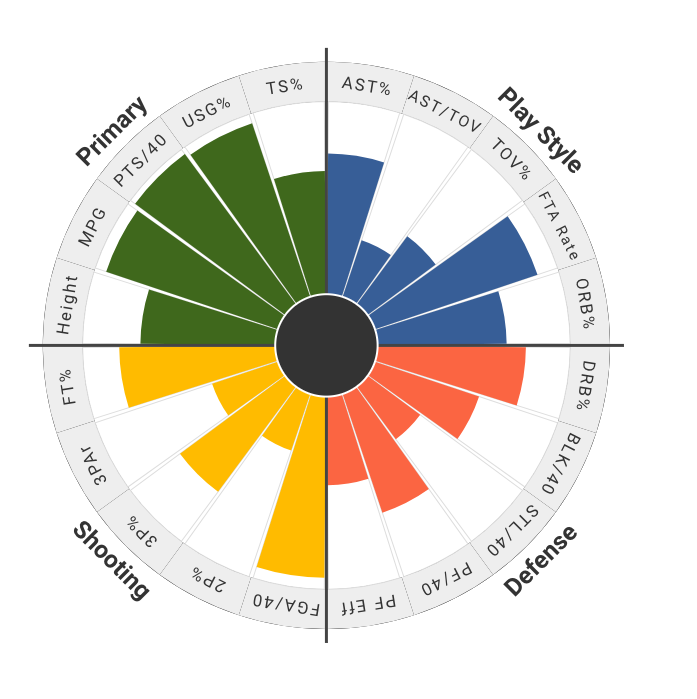
My lesson from Hall's success, is that you cannot underrate pure production. Even through the off-court concerns and defensive effort/versatility questions, you could not debate whether Hall was productive on the floor.
Including this year, Hall is the only player to score at least 100 free throws, 70 2-pointers, and 30 3-pointers on a 55% true shooting in three straight years. The only other players to hit those marks this year that have previous done it are Chad Baker-Mazara and Boopie Miller. Only Eric Dixon, RJ Davis, and Walter Clayton had done it the three years prior. Hall put the ball in the basket, a lot, and from everywhere, while being somewhat efficient at doing it. As it turns out, that is hard to do.
I also think a wing/forward is by far the easiest position to just go off pure production. We'll get to bigs shortly, and for guards, on/off ball roles and the offensive scheme as a whole is likely more important. For a wing, if you're a positive passer and rebounder who scores in volume with efficiency, there's likely no on-court reason why you cannot be productive at any place in the country. Perhaps the greatest testament to Hall's ability as a player: his most accurate player comparison for the 2025-26 season amongst thousands of options in KenPom's database? 2024-25 Keyshawn Hall.
With that in mind, some very productive, all-around, on-ball, relatively efficient wings and forwards at a high or upper mid-major level to keep an eye on this cycle: Wake Forest's Juke Harris, Colorado's Sebastian Rancik, Murray State's Roman Domon, Wyoming's Nasir Meyer, and Western Kentucky's Teagan Moore.
The Importance of Team Defense for Bigs
Another player I whiffed on was Creighton's Owen Freeman, who I was far too high on. I gave the Iowa transfer an A- grade, and the junior has seen his role fade from clear-cut starter, to deep reserve over the course of the season. Almost poetically, I began his notes section with: "The ultimate question with Freeman: was his rim protection holding Iowa's awful defensive personnel on by a thread, or was he just a part of the problem?"
The answer was very clearly the latter. Iowa's defense was No. 157 and No. 167 in the two seasons that Freeman manned the middle, and though it's not like the roster was littered with elite perimeter defenders, it's now evident he was part of the problem. Even though Creighton's defense has actually improved with Freeman on the floor versus off this season, the Bluejays are still allowing their highest 2-point percentage since 2019-20, and have posted their worst defensive rating since 2014-15.
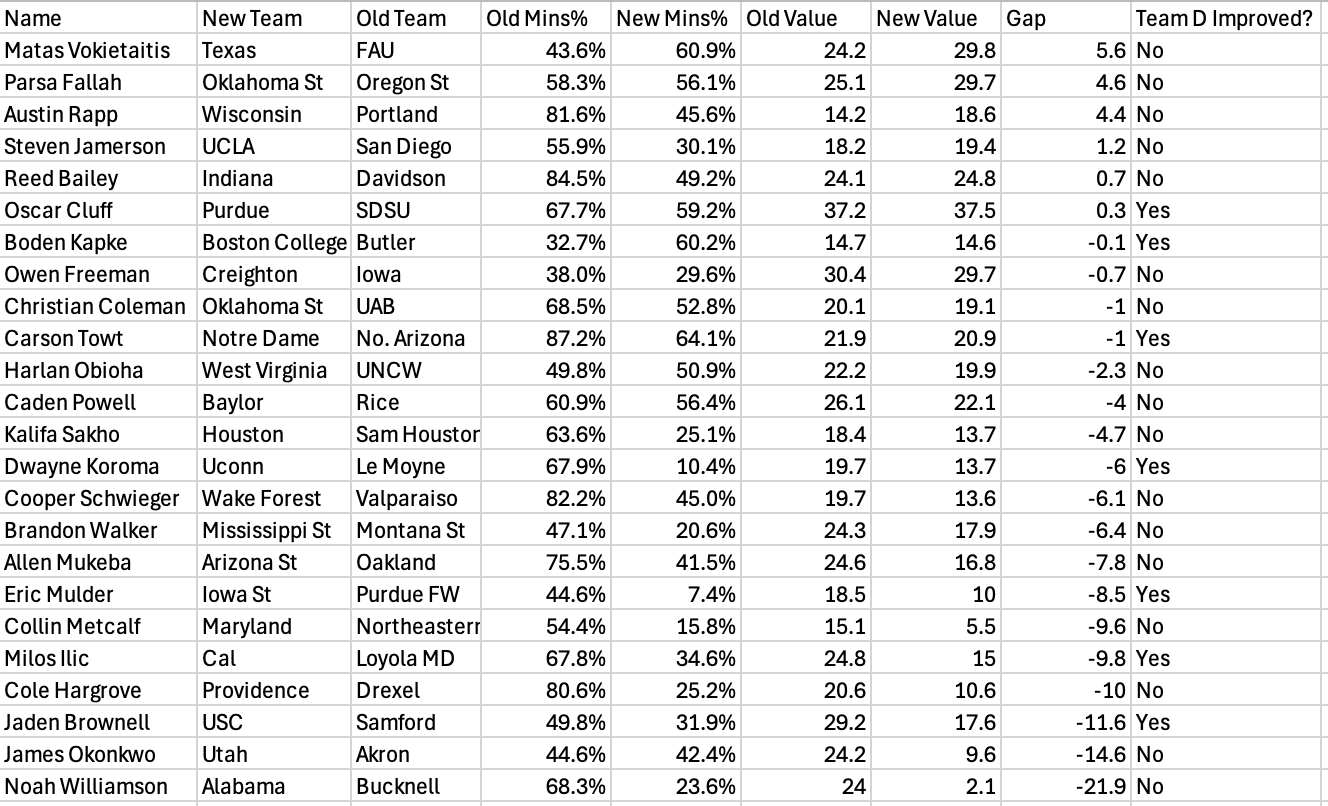
Above is a list of every player that transferred to a high major team after being the predominant starting big man on a sub-150th ranked defensive unit last season. By minutes percentage, only Matas Vokietaitis and Boden Kapke have seen a minutes increase. By a very rudimentary value equation of RAPM + PER (team value + box score value), only six of the 24 listed players have seen improvement this season. 11 players saw larger decreases than the highest increase, and Vokietaitis is a bit of an outlier in this query.
It's also worth noting that only seven of the 24 players joined programs who have seen a defensive improvement this season from last. Further, of those seven, only Oscar Cluff and Carson Towt have started more than six games for their teams.
Freeman does fine in this deep dive because the somewhat-flawed PER stat loves his rebounding and block rates, but the lesson remains the same. It is highly unlikely that starting big men on bad defenses will move up or remain at the high major level and improve as players, and/or improve the team that is adding them's defensive unit.
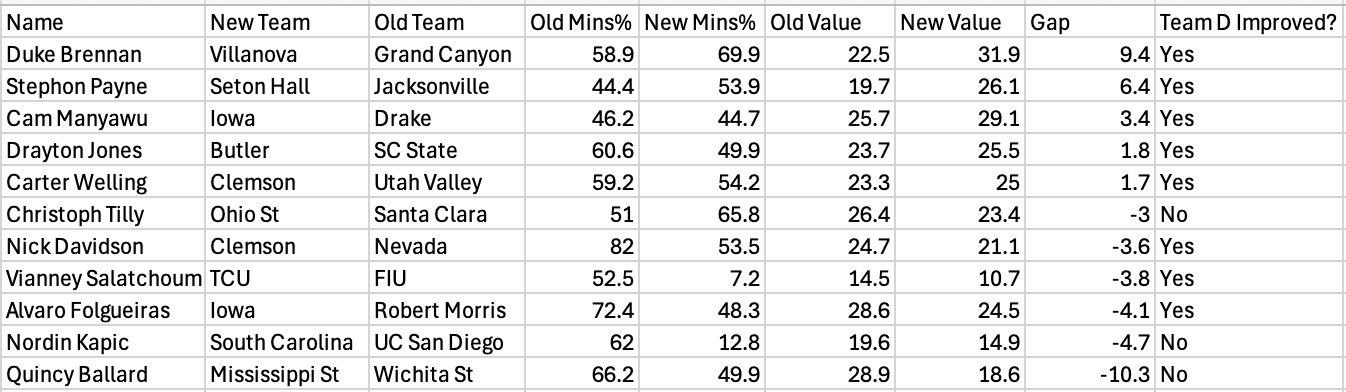
Now, let's compare that to this collection of the 11 big men who transferred from Top 150 defenses on mid-major teams last year to a power conference squad. While not everyone panned out, five of them saw increased RAPM + PER despite jumping up in level, and eight of the 11 play for a team that improved its defensive unit from the year prior.
On this list is also where two of my biggest whiffs of the cycle were: Villanova's Duke Brennan and Seton Hall's Stephon Payne.
"Block numbers are stunningly low but his rim D numbers and D on/off are terrific... He should be fine. But definitely not expecting a breakout," I said about Brennan, giving a B- grade.
"Payne is an elite two-way rebounder and versatile defender WHEN he's the superior athlete. When he isn't, he's an average-at-best rebounder who has no ball skills, is a below average scorer at the rim, and cannot shoot. Unfortunately, Seton Hall is in the Big East, not the Big South." was my note on a "C" grade for Payne.
As it turns out, both guys being defensive anchors on really good mid-major defenses, one of only 38 players to post a 14%+ offensive rebounding rate and a 19%+ defensive rebounding rate, and transferring over to a similar defensive scheme than their previous stop ended up trumping any other concerns.
Brennan's elite defensive positioning and rebounding has allowed Villanova's drop-heavy scheme to thrive, and Payne's excellent defensive ball skills that saw significant block and steal rates at Jacksonville last year has paid dividends for a Seton Hall team in the top three as a team in both categories this year. While the offense is nothing spectacular for either guy, their role as rebounding and defensive anchors given their prior production and what we know about their new head coaches could have indicated that they were bound to carve out a useful role.
Looking forward, guys like Nevada's Elijah Price, Cal Baptist's Thomas Ndong, and Wichita State's Will Berg are all players with elite rebounding numbers and strong defensive metrics for very good squads at that end. Though all three have offensive limitations, they're the types of players that will likely be productive in the right system.
The same concept also applies to backup bigs on elite defensive teams. There were three players who were reserve 5-men on Top 25 defenses last year that transferred to a different high major - Vince Iwuchukwu, Aday Mara, William Kyle - and all three have been awesome this season. If someone like Tennessee's JP Estrella or St. John's Ruben Prey comes available, that could be a fruitful addition.
Just Take a Chance on that High Major Guy
Of the Top 100 mid-major transfers this season in Wins Above Replacement Player, a massive 39 of them played at the high-major level at some point in their careers. That is exceptionally disproportionate.
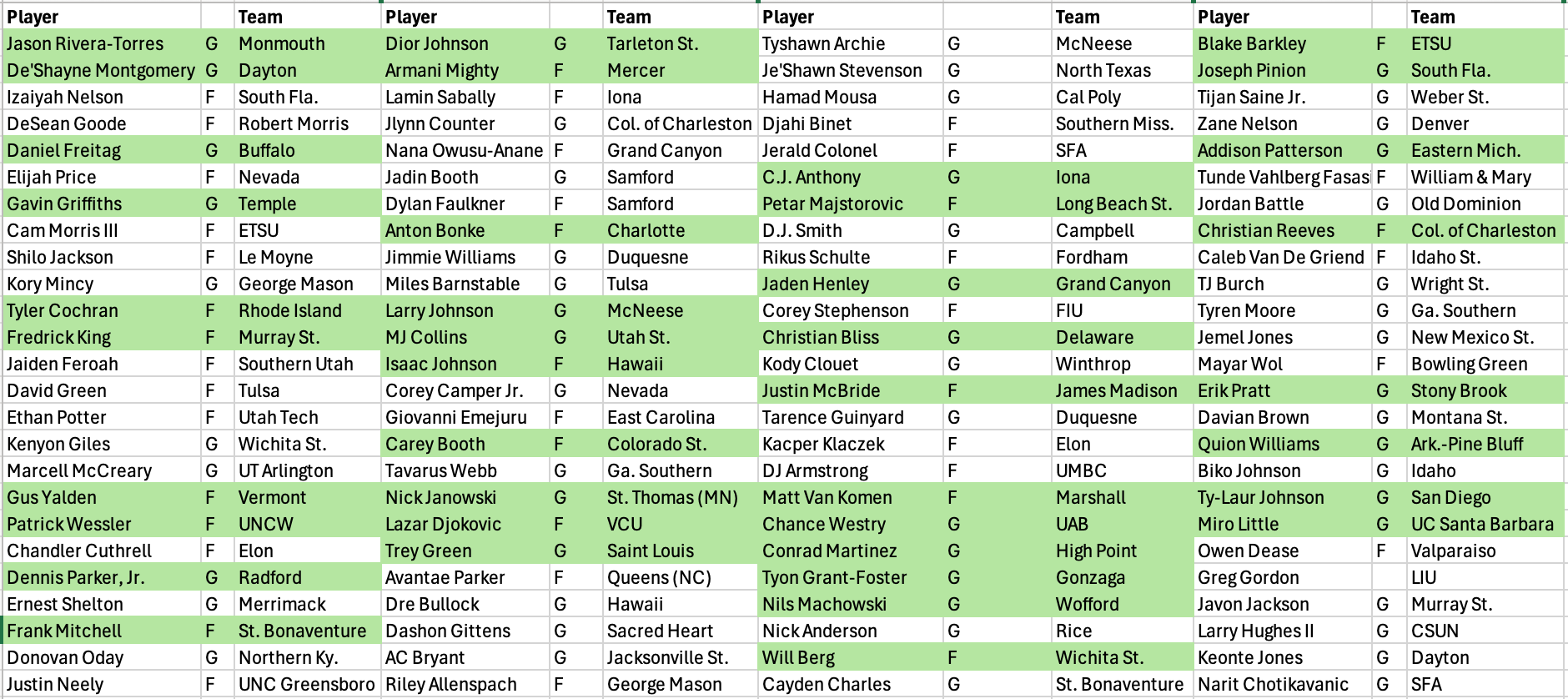
I was wrong on a bunch of these guys. MJ Collins got a C for being "so bad in three years of college I almost wonder if he should have dropped to true MM level for his senior season." Armani Mighty got a C+ for being "perhaps the worst player in HM hoops in his two years at Boston College." Only Conrad Martinez and Dennis Parker got above a "B+" on this list. It was a significant blind spot in my rankings, with the lack of proven or efficient production at a higher level forcing me to second-guess their additions.
In his three seasons at Virginia Tech and Vanderbilt, Collins averaged 13.2 points on 62/146 shooting (42.5%) when he took at least 10 attempts in a game. Those figures were both way above his career average. And yet, he only had that volume 13 times across those campaigns. This year, he's taken 10+ shots in all but four contests. As a non-passer and rebounder with shifty off-dribble scoring skills, he needed a role with significant scoring opportunity to thrive, and that's exactly what the Aggies gave him.
There are only so many players in the country that can create this type of space.
In Mighty's case, he really struggled to finish at the rim at Boston College, but did have a solid 25% dunk rate on rim attempts, and that's translated to a similar 32% rate at Mercer. Dunk rate is one of the more transferrable offensive skills for big men, because it's less dependant on the level of defender contesting the rim attempt than rim efficiency itself. As expected moving down from the ACC to the SoCon, Mighty's layup efficiency has gone way up to pair with his dunk rate, leading him to rank second in his conference in rim scoring.
Additionally, what stood out about Mighty's one year of spot minutes at Boston College was his monstrous 94th% offensive rebounding on/off numbers. The Eagles rarely crashed the glass that year, but their offensive rebounding rate increased 6% when Mighty was on the floor. Now on a team that prioritizes second chances, Mighty is grabbing an absurd 20.5% of available offensive rebounds when he's on the floor in league play.
Imagine getting to do this against mid-major opponents all season.
This same concept applies to Wichita State's Will Berg, who had a 98th% offensive rebounding on/off at Purdue last year, and now unleashed for the Shockers' glass-heavy philosophy, is No. 9 nationally in total rebound percentage.
Some bench players on high-major teams with strong offensive rebounding on/offs on squads that don't crash the glass often: Ole Miss' Corey Chest, NC State's Musa Sagnia, and TCU's Jace Posey all could dominate the boards at a slightly lower level.
