


Hello, friends. It's good to be back. Let's dance.
If you were previously a reader at Heat Check CBB, you may recall our annual Tournament Index projections model. The purpose of the model is to help you make savvy bracket choices by maximizing "expected value" in comparing each team's round-by-round advancement probabilities to the nationwide pick rate. You can find more details on the model's methodology here.
If that sounds complicated, it really isn't. Think of it this way: If Purdue has a 90% likelihood of advancing in the first round according to our model but only 85% of people are selecting the Boilers, you stand to gain 5% in "expected value" multiplied by that round's bracket points. So, for a first-round game where a correct pick yields 10 points, a 5% surplus multiplied by 10 possible points means you have an "expected value" of 0.5 bracket points over your competition should Purdue win. That might not sound like much, but as we progress into the later rounds of the bracket where points become more valuable — Tournament Index projections are based on the standard 10-20-40-80-160-320 scoring format — it can mean the difference between winning and losing your bracket pool.
Without further ado, let's dive into the bracket.
Overall Bracket Takeaways
As you have likely read by now, the college basketball season has been dominated by the top dogs. This year's March Madness contenders are as strong as ever. Eight teams will enter the NCAA Tournament with a KenPom rating better than 30.0, which sets an all-time record.
If that wasn't enough, Champ Week carnage tipped the scales even further. Of the 23 one-bid leagues this year, only 10 of those conference tournaments were won by their regular-season champions. Whether it's a product of bracket formats or the broader NIL/portal landscape is another discussion, but what we do know is that there has never been a bigger margin between the haves and have-nots in recent NCAA Tournament history.
The purpose of Tournament Index, though, is to identify value that will help you win your bracket pool. Going chalk in your bracket is not only boring, but it's also not an effective strategy to win your pool. If you pick Duke to win the championship but everyone else in your pool does as well, you won't gain any points on your competition. We need to find surplus value.
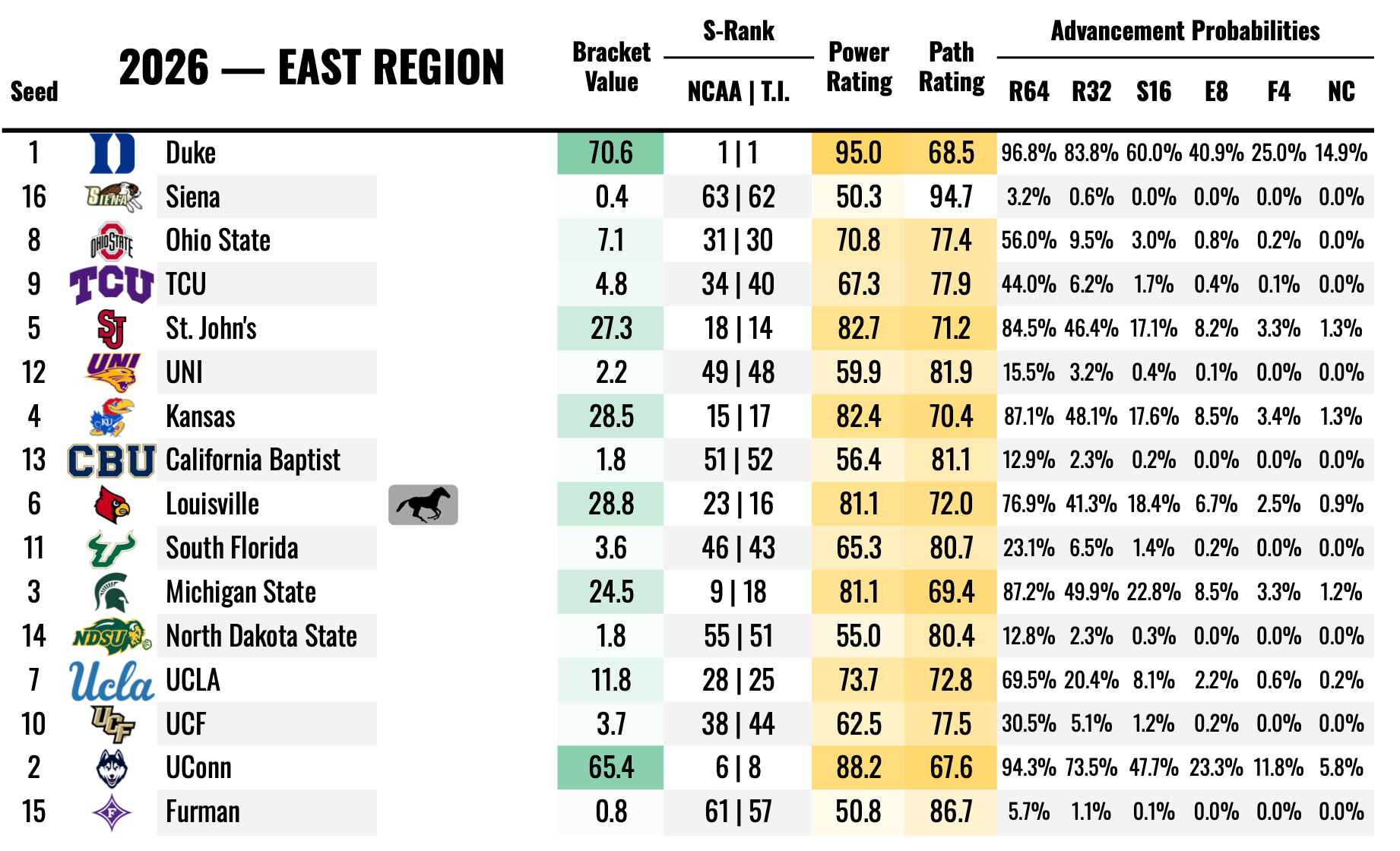
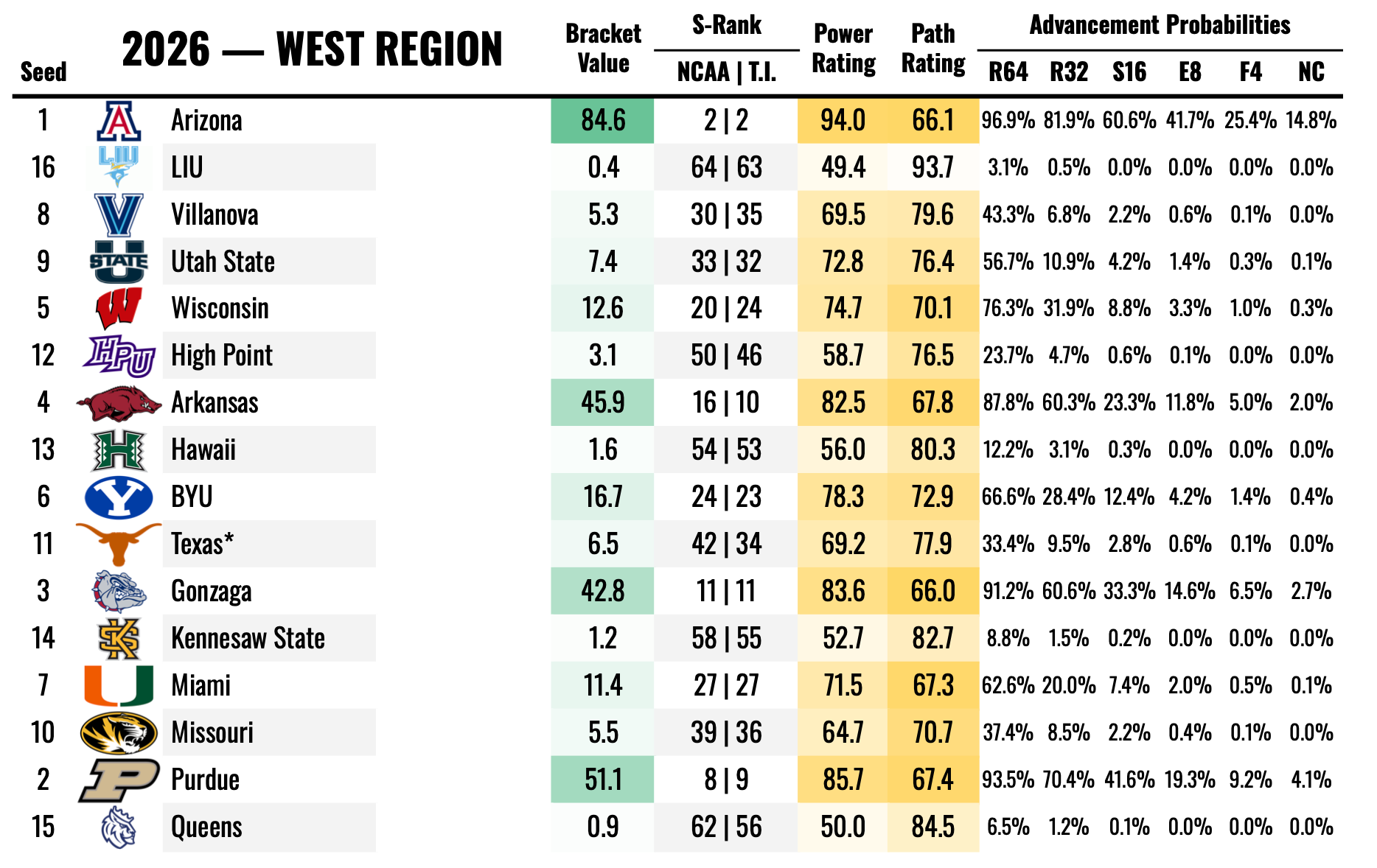
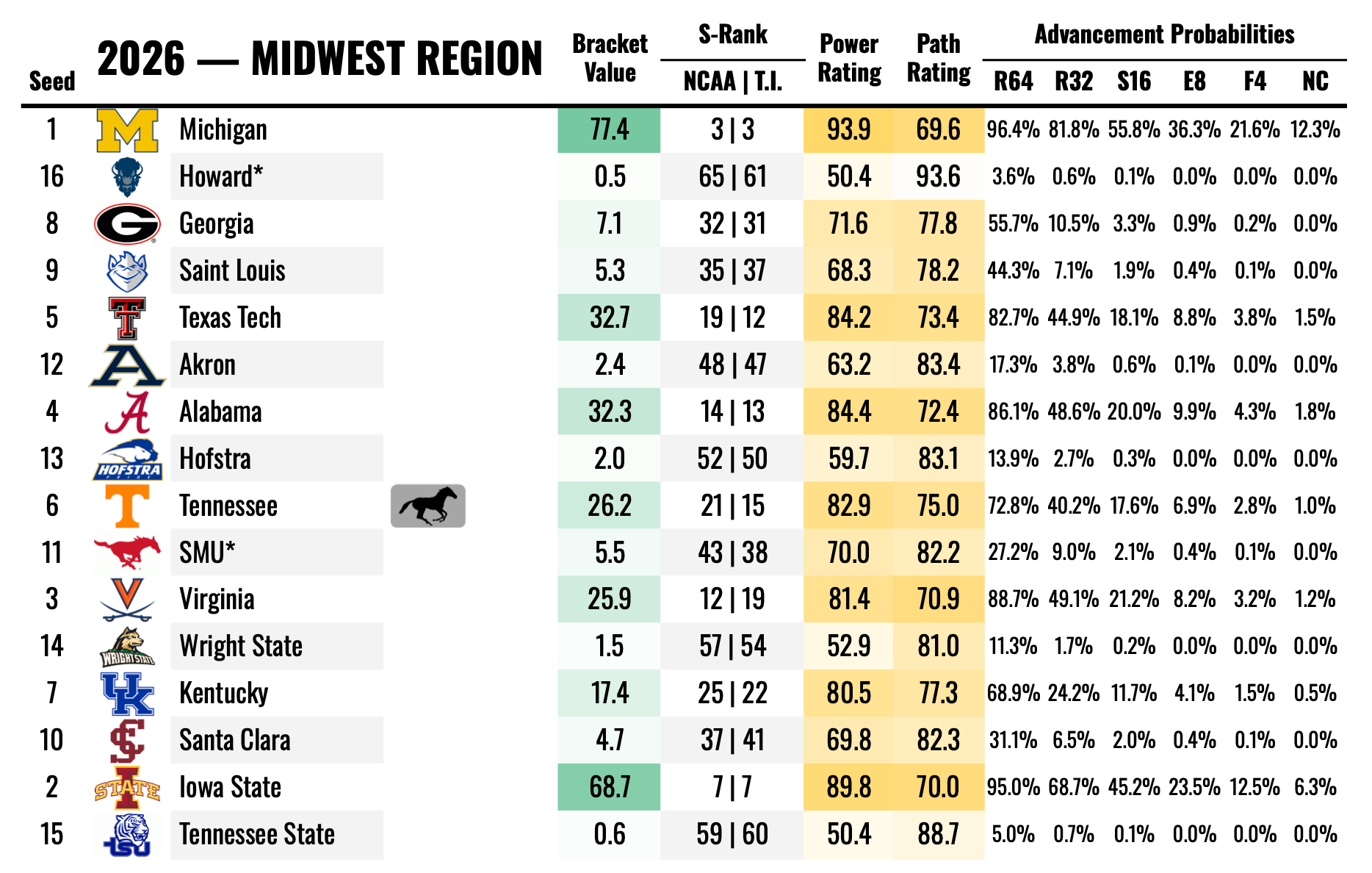
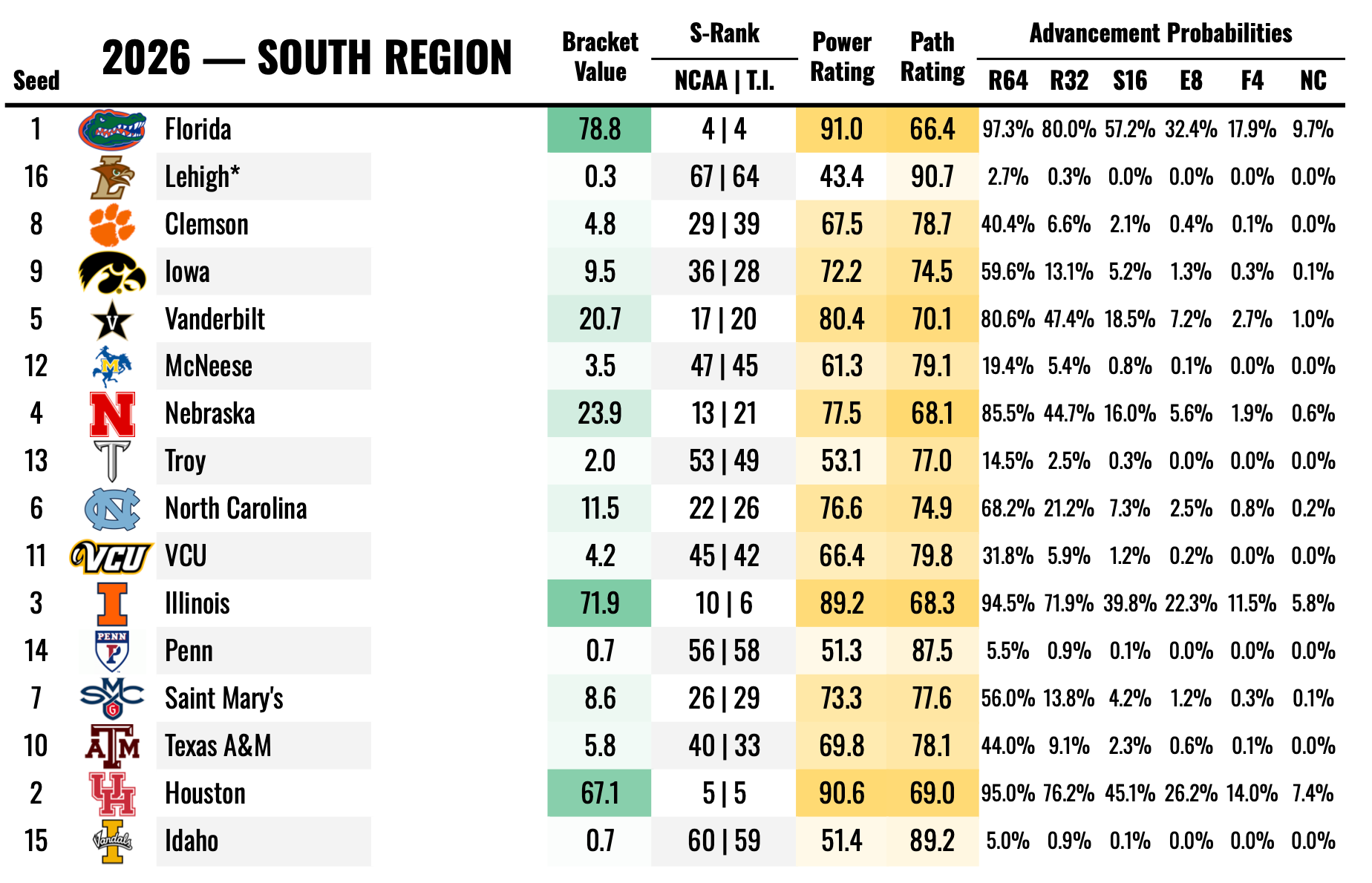
Let's kick things off with round-by-round win probabilities, expected bracket values, and power and path ratings for each of the regions.
East Region Preview & Projections
West Region Preview & Projections
Midwest Region Preview & Projections
South Region Preview & Projections
Optimal Value Bracket
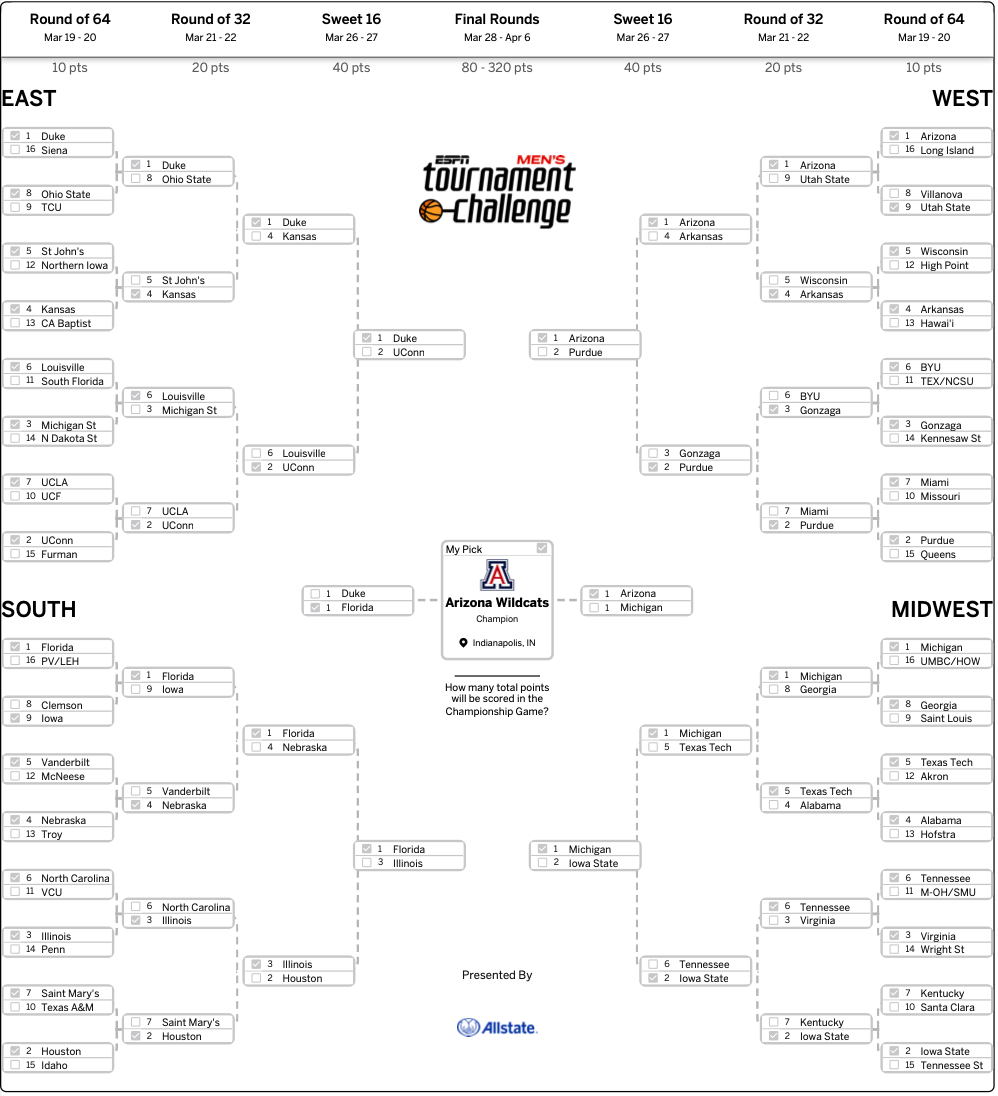
National Contenders
The most important decision you will make in your bracket is selecting your national champion. Correctly picking a champion is worth 320 points under standard bracket scoring, which is the same number of points as nailing every first-round game. Choose wisely.
Given the overwhelming strength of this year's top seeds, it is highly recommended that you choose a No. 1 seed to win it all. Duke (14.9%) and Arizona (14.8%) are the frontrunners purely based on win probability while Michigan (12.3%) and Florida (9.7%) aren't far behind.
Duke and Arizona have nearly identical championship likelihoods according to our model. However, according to Yahoo's pick distribution data, the Blue Devils are being picked nearly 50% more often than the Wildcats. This indicates that Arizona provides far more expected value as your national title pick.
Final Four Value Picks
Excluding 1-seeds, seven teams have at least a 10% likelihood of reaching the Final Four, according to the model. We have 2-seed Houston (26.2%), 2-seed Iowa State (23.5%), 2-seed UConn (23.3%), 3-seed Illinois (22.3%), 2-seed Purdue (19.3%), 3-seed Gonzaga (14.6%) and 4-seed Arkansas (11.8%) all poised for third-weekend contention.
Unlike most years, it's really difficult to justify picking a 5-seed or worse to the Final Four. Texas Tech (8.8%) and St. John's (8.2%) would be somewhat intriguing options on the 5-line but the Red Raiders are forging ahead without star forward J.T. Toppin and the Johnnies would likely face top-seeded Duke in the Sweet 16. No teams seeded 6th or worse have Final Four probabilities above 7%.
Middle Rounds
If you choose wisely, the middle bracket rounds can help you distance yourself from the competitors. In most years, we'd have 1-seeds set to fall in the second round or Sweet 16, or double-digit seeds with reasonable paths to the second weekend.
Not so much this year.
In fact, dating back to its first year in 2015, this is the first time that the Tournament Index projections feature zero dark horses or Cinderellas. Sad, I know.
What does this mean for your bracket? Well, we have to scrape and claw even more for expected value in the middle rounds. Below are some decent choices.
Round of 32
- 6-seed Louisville over 3-seed Michigan State (Probability: 41.3% | Pick Rate: 18.2%)
- 5-seed Texas Tech over 4-seed Alabama (Probability: 44.9% | Pick Rate: 33.7%)
- 6-seed Tennessee over 3-seed Virginia (Probability: 40.2% | Pick Rate: 31.6%)
Sweet 16
- 3-seed Illinois over 2-seed Houston (Probability: 39.8% | Pick Rate: 20.4%)
These obviously aren't the most flashy picks, nor would they even qualify as "upsets" generally speaking. However, there is quite a bit of expected value that can be gained by those four selections alone.
Highest Expected Value By Round
Let's take a look at the teams that are providing the highest expected value by round. This takes into account the team's likelihood of advancing in said round, how often that team is being picked by the general population, and your expected point value by correctly choosing that team.
- Round of 64: 9-seed Utah State (+3.1 expected points), 9-seed Iowa (+3.0), 11-seed Texas (+2.8), 7-seed Saint Mary's (+2.7), 6-seed Louisville (+2.7)
- Round of 32: 6-seed Louisville (+6.8), 4-seed Nebraska (+6.0), 4-seed Arkansas (+6.0), 5-seed Texas Tech (+5.9), 3-seed Illinois (+5.6)
- Sweet 16: 3-seed Illinois (+12.7), 2-seed UConn (+9.9), 2-seed Iowa State (+9.5), 4-seed Arkansas (+9.4), 3-seed Gonzaga (+9.3)
- Elite Eight: 3-seed Illinois (+16.3), 2-seed UConn (+16.2), 2-seed Iowa State (+15.7), 1-seed Florida (+15.4), 1-seed Arizona (+14.4)
- National Semis: 1-seed Florida (+25.3), 1-seed Michigan (+24.6), 1-seed Arizona (+24.4), 1-seed Duke (+20.0), 2-seed Houston (+19.8)
- National Championship: 1-seed Arizona (+37.6), 1-seed Michigan (+33.5), 1-seed Duke (+32.9), 1-seed Florida (+29.8), 2-seed Houston (+22.6)
Upset Alerts, Cinderellas & Dark Horses
As mentioned earlier, this year's bracket appears as chalky as ever. Tournament Index projects only two dark horses — Louisville and Tennessee — and zero upset alerts or Cinderellas.
With that being said, I am not one to chalk it up on my bracket. You can still strategically sprinkle in a few upsets and dark horses without completely derailing your chances at winning a bracket pool.
Here are a couple of questions to ponder when deciding on an upset pick:
- Would I pick the better-seeded team to advance in the following round anyway?
- How much expected point value would I lose if I'm wrong?
Let's check out an upset-heavy version of the optimal value bracket below and walk through this together.
Optimal Value Bracket — Chaos Edition
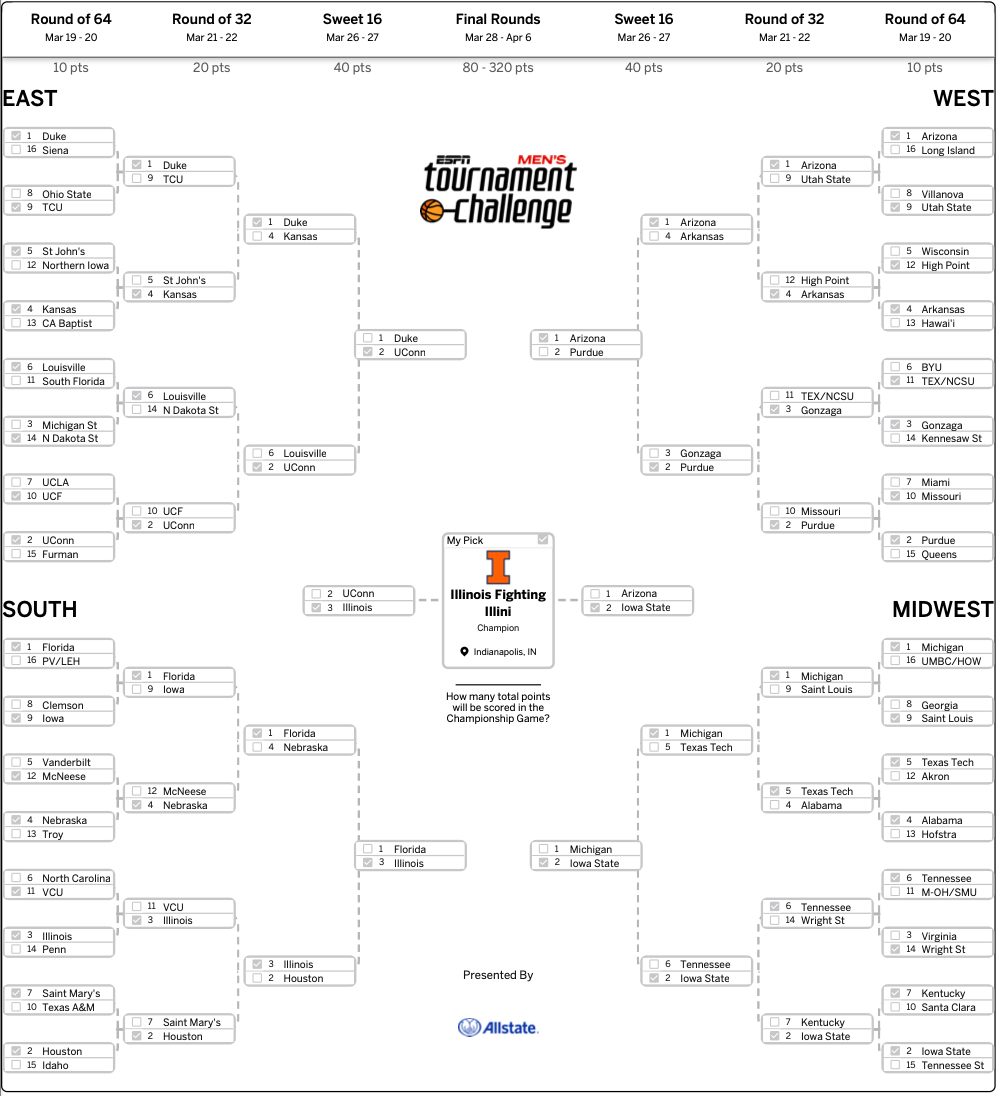
Alright, first off, let's get into the upsets. If you actually choose eight double-digit seeds to win first-round games this year, I commend you on your courage. Sorry, but it's likely not happening.
We can still make these choices in our bracket without destroying our expected value, though. Both of the 3-seeds we have losing in the first round, Michigan State and Virginia, wouldn't be advancing to the next round anyway, since our model favors 6-seeds Louisville and Tennessee in our model, respectively. Both of the 5-seeds that we're picking against also offer below-average value and would be dumped in the next round as well.
The Final Four selections are especially intriguing. Unlike the initial best value bracket, we have just one top-seeded squad, Arizona, reaching the third weekend here. And while UConn, Iowa State and Illinois are all top-3 seeds, each of them is a formidable Final Four threat that you likely won't find this deep in many other brackets. These are the types of considerations that can decide your bracket's fate.
