


In their final MWC Championships, Utah State takes home the tournament title for their third time. The Aggies’ conference tournament run was a revenge tour, taking down the three teams that had defeated them in the final weeks of the regular season. After winning just two of their final five regular season games, Utah State won every tournament game by double digits and looked like the team clearly at the top of their league back in December and January.
One Team. One Goal.
— USU Men's Hoops (@USUBasketball) March 15, 2026
WE GOT THE JOB DONE AGGIE NATION! pic.twitter.com/k5TIL2zyCY
This will be Utah State’s fourth straight NCAA Tournament appearance and their sixth of the last seven. Jerrod Calhoun has now made the dance in both of his seasons as the Aggies’ head coach. The program is 1-5 over their last five tournaments. Notably, they have been the lower seed in all the games that they’ve lost in the tournament and won their lone game as the seeding favorite.
Winning the MWC Championship and taking down the Aztecs, who were on the bubble, helps fortify the Aggies’ resume. More importantly, the Aggies’ defense and individual scoring have returned at the right time. Here is what makes Utah State a team to look out for in March.
Defense leading to offense
When the Aggies are at their best, they leverage their stifling, turnover-causing defense into fast-break opportunities and attack the rim with defenders on their heels. They’re 16th in the country in steal percentage and 35th in fast-break points per game. McNeese is the only NCAA tournament team ranked ahead of them in both categories.
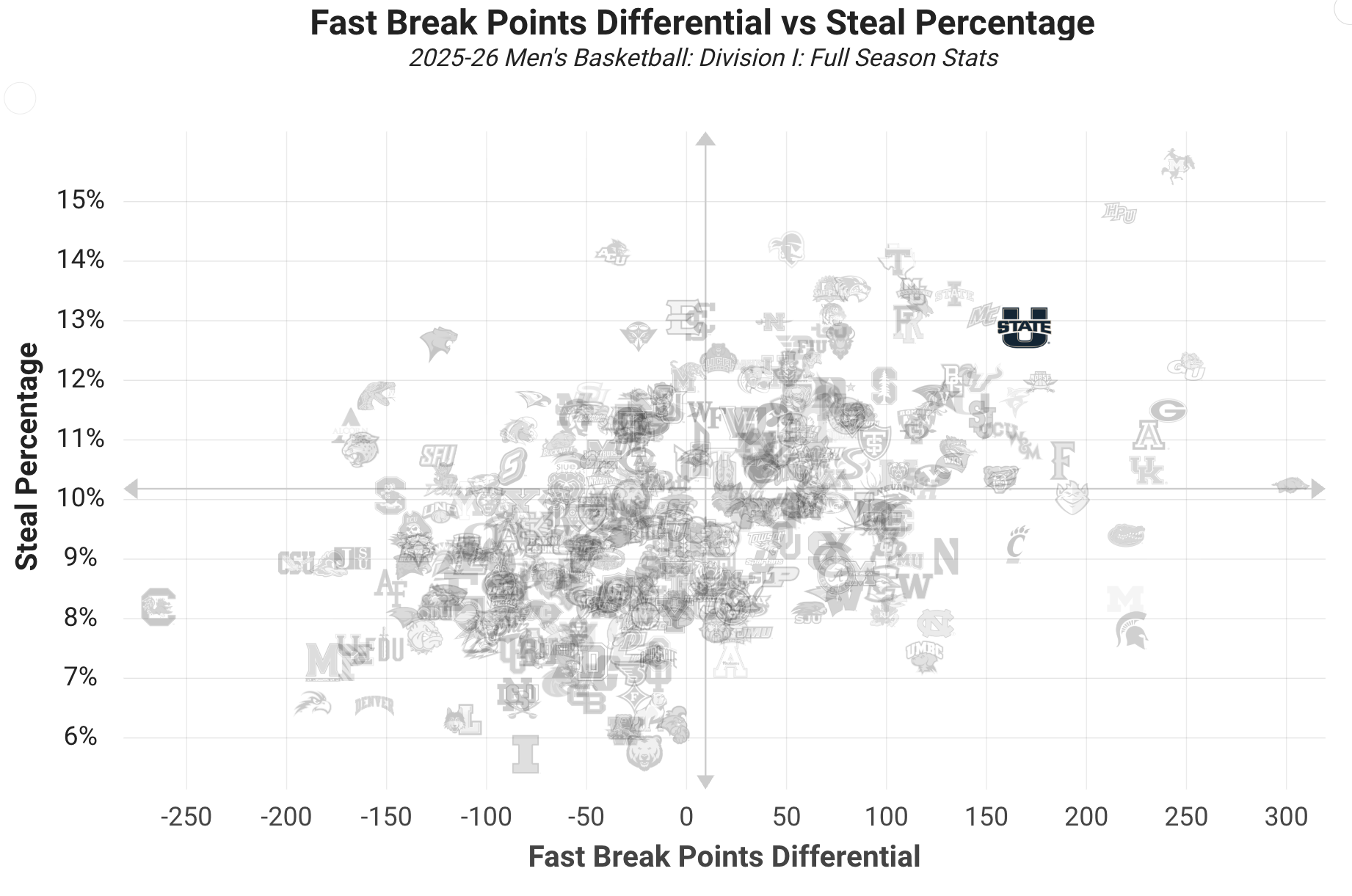
In the conference tournament, the Aggies nearly had a 10-point differential in fastbreak points per game and won the turnover battle each night by 6. Calhoun has his team wear opponents down by picking them up defensively well beyond halfcourt and forcing opposing bigs to initiate action higher up the court, helping their guards get separation and creating uncomfortable passing lanes and difficult reads.
Utah State had just 6 turnovers in their game against San Diego State while forcing 14. Per Torvik, the Aggies rank fourth in defensive efficiency over the final three games. They averaged 20 points per game off turnovers while allowing just 7 points off turnovers on the defensive end.
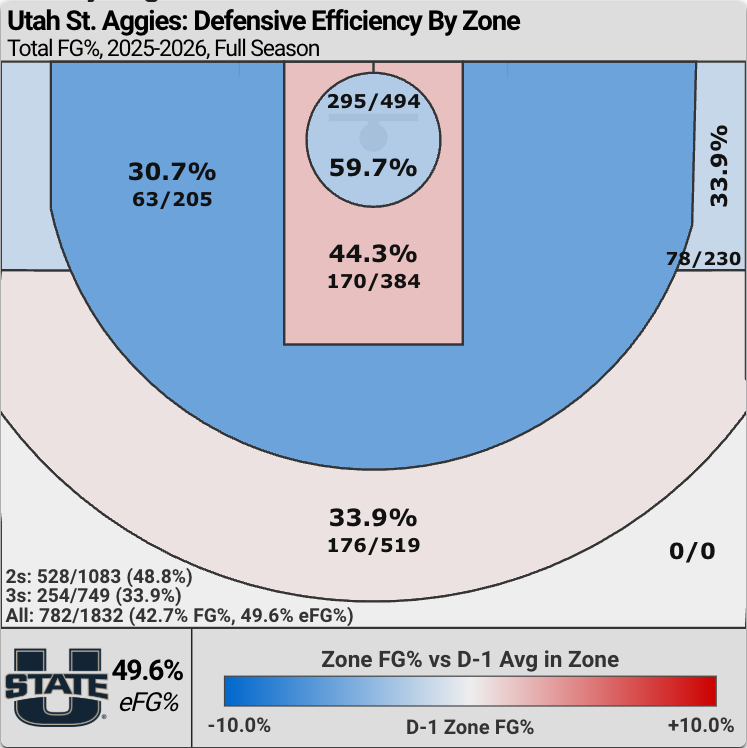
In the halfcourt, Calhoun’s team does a great job of leveraging that high-fronting defense to force tough looks in the midrange and contested shots when the offense gets to the paint and the rim. Calhoun throws out a platoon of bigs that are able to rotate and hedge while returning to the rim to help contest. Opponents are scoring 28 paint points per game against the Aggies this season, putting Utah State in the 85th percentile nationally for interior points allowed.
Threes and interior feeds
What made Utah State take a leap in December and become the team to beat in the MWC, and one of the better mid-majors in the country, was the development of its offense in the halfcourt, notably the emergence of transfer guard MJ Collins as a catch-and-shoot nightmare on the perimeter. Entering the season, Collins was a career 28% three point shooter; he’s shooting 35% this season. If Collins makes a three-pointer in the NCAA Tournament, he’ll have made as many threes this season as he did in his first three seasons of college basketball.
Utah State was one of the best interior scoring teams in the country last season and this marathon has been no different for them. Point guard Drake Allen and two-way, do-everything wing Mason Falslev are phenomenal at post entry passes, coupled with how Calhoun’s staff develops bigs for duck-ins and post-ups, making Utah State relentlessly automatic in the paint. The Aggies are scoring 38.7 points in the paint per game and are shooting 60.9% inside the key this season.
Utah State’s Weaknesses
While the mobility and depth of Utah State’s frontcourt feed into their defensive identity and allow for a high floor in terms of paint offense efficiency, the Aggies sum of parts doesn’t truly overpower opponents, especially considering the caliber of opponent they’ve played all season.
The Aggies rank 81st in KenPom’s Strength of Schedule, with their best win on the season being an 80-77 win against VCU in the second game of the season. With that in mind, the lack of dominance in some components of games could be some warning signs that this team may have limitations against high majors.
While Utah State is able to exploit opponents with their aggressive defense, they’re unable to limit teams on the glass. Their frontcourt gave up the fourth-most 2nd-chance points in the MWC this season, and their 11.5 2nd-chance points allowed rank in the 35th percentile of Division I. Because of their frontcourt's lack of size and positioning under their defensive approach, they had the second-worst defensive rebounding average in the league and they rank 267th nationally for defensive rebounding percentage.
Similar NCAA Tournament efficiency profiles
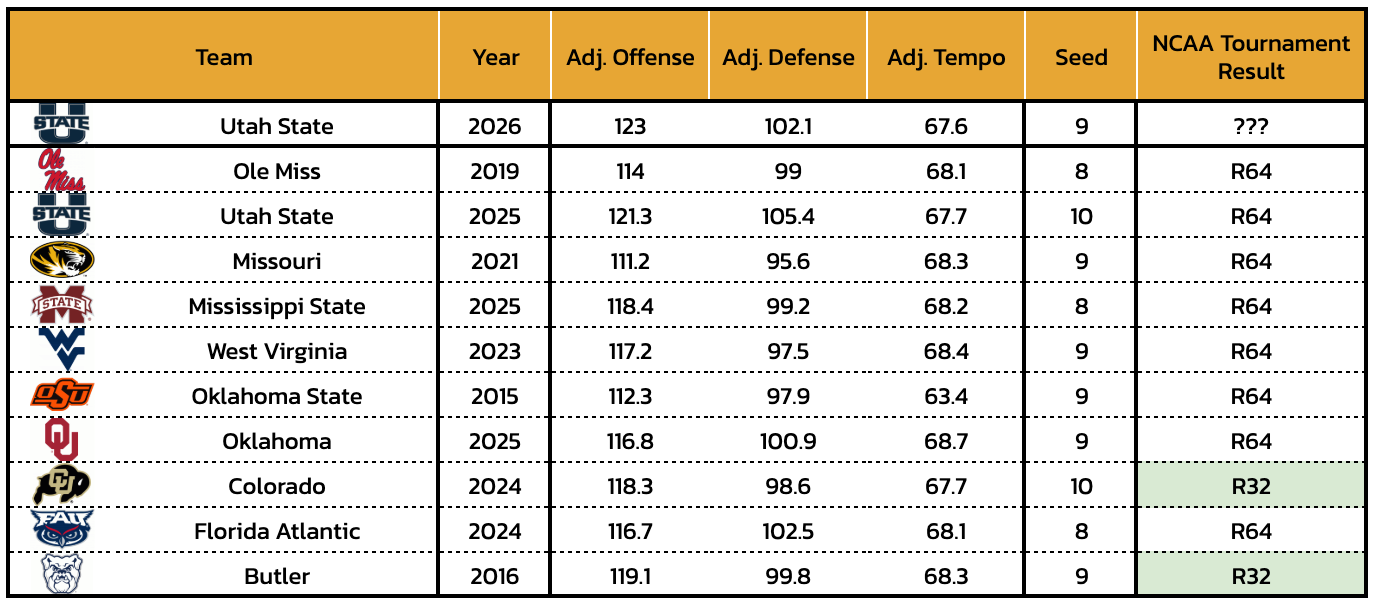
While consistent on both ends, the Aggies profile screams a team good enough for March but likely halted out of the gates. Only 20% of teams with their profile make it to the Round of 32 or further.
Tournament Index evaluation
Utah State earned a No. 9 seed at the NCAA Tournament. In terms of seed strength, the Tournament Index grades the Aggies as the eighth-strongest No. 9 seed of the last 13 tournaments (out of 52 teams). For Utah State, the TI projects an average of 0.66 wins given its seed and team strength.
