

All automatic qualifiers enter the NCAA Tournament on win streaks, but UMBC's recent run to the Big Dance is eye-opening...
UMBC entered the 2025-26 season only picked to finish seventh in the nine-team America East. Fast-forward to Feb. 28, though, and the Retrievers clinched the league's regular-season title — and thus hosting rights for each round of the conference tournament. They finished the regular season having won nine consecutive games, and continued that momentum into the America East Tournament. UMBC won its first two games against New Hampshire and UMass Lowell by a combined 37 points to face Vermont in the title game.
UMBC had met Vermont five times in the conference tournament since the league moved to top seeds hosting in each round, losing four times, but it never hosted. This time, it was the Retrievers playing in front of their fans at the Chesapeake Employers Insurance Arena. In front of a sold-out crowd, UMBC continued its run of success with a 15-point win to cut down the nets. Tournament MVP DJ Armstrong would not let the Retrievers lose, hitting seven huge 3s on nine attempts en route to a game- and season-high 33 points.
With the win, the Retrievers earned the league's automatic bid and also concluded a perfect 11-0 record in intra-league home games, conference tournament included. Add a few road wins to the mix, and UMBC owns the second-longest win streak in the country at 12 games. But that's not all. Over the last 11 of those victories, the Retrievers are winning by an average of 18.1 points...
So let's talk about the last 11 games...
UMBC was already 5-2 in league games when it started its ongoing win streak. It followed it up with a three-point road win at Albany to reach 6-2, but the head-turning stretch has been the last 11 wins coming by an average of 18.1 points. From an analytics standpoint, UMBC had been playing at the level of just the No. 264-ranked team on Hoop-Explorer over its first 21 games (13-8 record). Over the last 11 games, the Retrievers have played equivalent to the nation's 86th-best team:

Given that the NCAA Tournament selection committee grades teams on their total body of work, UMBC's recent run of form makes it very likely to be underseeded.
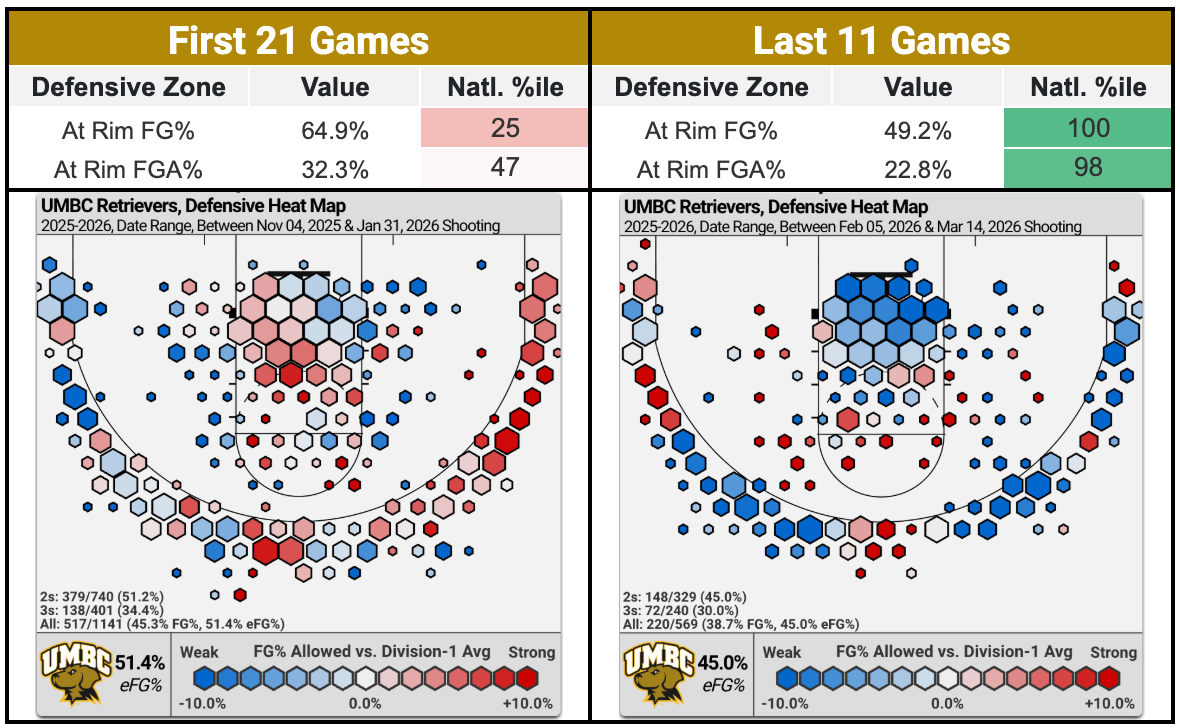
From an individual standpoint, head coach Jim Ferry's decision to move Jose Roberto Tanchyn into the starting lineup has proven to be a masterstroke. The 6-10 Spaniard joined the starters for the first time on Jan. 15, but he really started to find his footing over the last 11 dominant games. A rim deterrent and elite rebounder (27th nationally in DR%), Tanchyn's role increase has been a contributing factor in the domination down the stretch.
For the full season, UMBC has been 10.5 adjusted points per 100 possessions better with Tanchyn on the floor (per Hoop-Explorer). As his minutes per game have jumped from 15.8 over the first 21 games to 24.3 over the last 11, the difference in UMBC's overall rim rate and efficiency allowed is astounding:
Offensively, UMBC's shooting efficiency is better over the last 11 games, but only marginally so compared to the first 21. The big difference is the increase in shot attempts by virtue of securing more second-chance opportunities (.291 OR% compared to a previous .227 OR%) and eliminating turnovers (.115 TO% compared to a previous .156 TO%). Combine the improved rebounding on both ends with limiting giveaways better offensively, and UMBC has gone from averaging 4.5 fewer field goal attempts per game than its opponents over the first 21 games to attempting 1.7 more per game over the last 11. The trending is superb.
Guard play leads the way.
Armstrong (12.6 points) was the star in the America East title game, but he is just one part of an excellent triumvirate of guards for UMBC. Jah'Likai King (14.3 points) and Ace Valentine (11.9 points, 4.2 rebounds, and 4.0 assists) are both excellent as well, and their dribble-drives pace an offense that feasts on their finishes and Armstrong's deadly shooting off kickouts and stepbacks.
While a lot of dribble-drive-based teams tend to live at the rim, UMBC thrives with non-at-the-rim paint 2s; the Retrievers rank in the 94th percentile for attempt rate for such shots (24.6% of FGAs), and convert in the 96th percentile for efficiency (49.5%). Odunowo takes a ton from that area, while Tanchyr, King, Valentine, and Armstrong all rate in the 77th percentile or better for their positional group for efficiency from those spots.
The ability to self-create is vital, and UMBC has plenty of that between its three guards — and not just going to the basket. Armstrong (0.9 per game), Cougar Downing (0.5), King (0.4), and Valentine (0.4) all rate in the 78th percentile or higher for unassisted made 3s per game. The Retrievers aren't overly reliant the 3-ball, ranking 195th in 3-point attempt rate, but their efficiency has been a determinant. UMBC is 17-1 when it shoots at least 37% from three (7-7 otherwise), and is shooting 43.6% over its last four games.
As far as where those 3s come from, the Retrievers have had a preference down the stretch. Over the last 11 games, UMBC has attempted 16.3% of its shots on the left-side 3s and connected on 41.1% of them, compared to 11.1% of shots on right-side 3s at a 30.8% efficiency clip. The charts below highlight those tendencies for non-at-the-rim paint 2s and left-side 3s over the last 11 games:
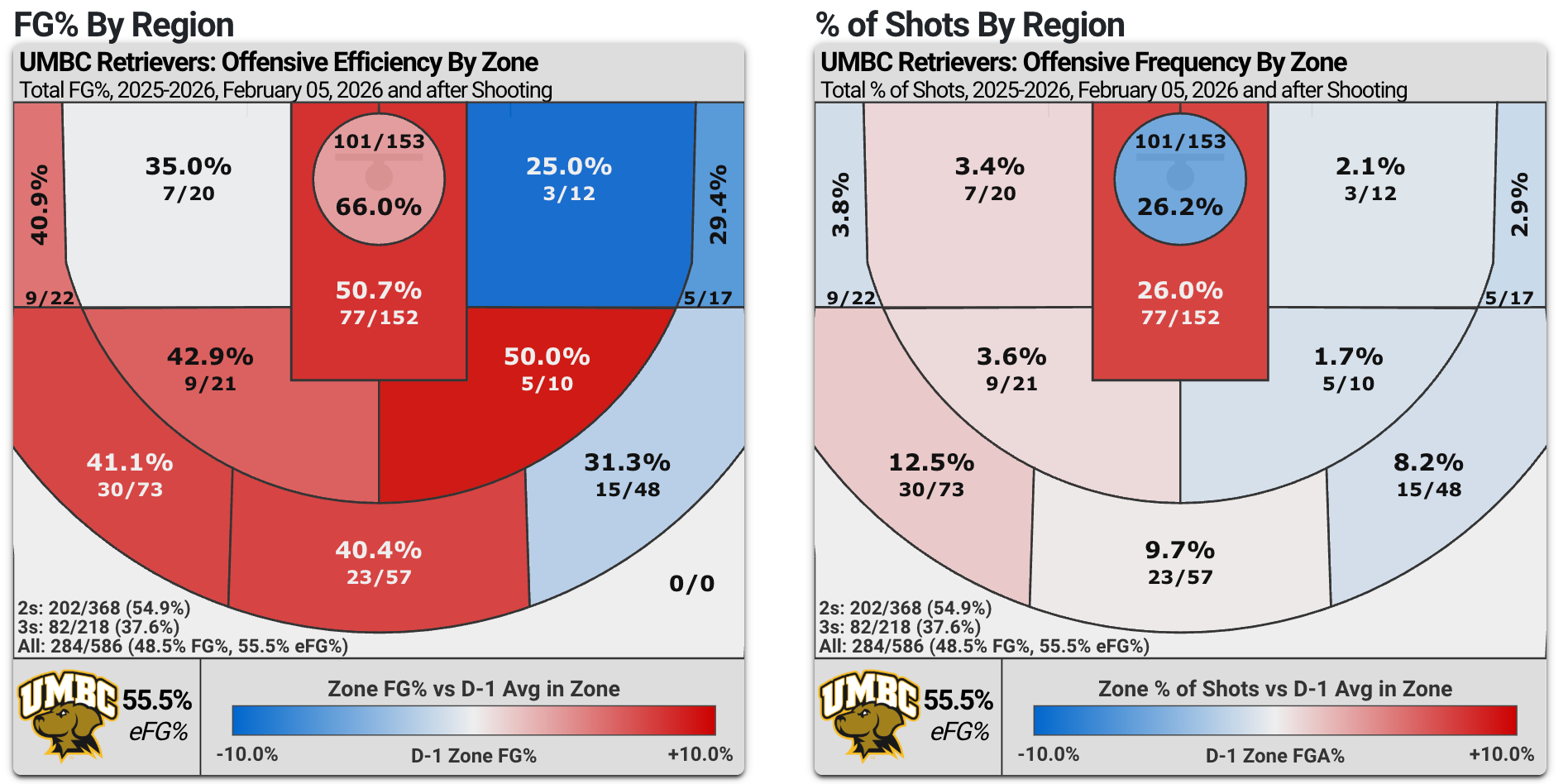
Armstrong, in particular, is shooting 35.3% better from the left side than the right side over the last 11 games. He hit a crucial and-one 3-pointer from the left wing in the title game as part of a performance that showed his "tough shot-making beats good defense" ability that UMBC will need on full display in the Big Dance to spring an upset:
Clips for ESPN's highlights for the game.
There is a lot to like about how UMBC's guards profile, but they have not faced much elite competition. The Retrievers played the No. 365 overall strength of schedule on KenPom — easiest in the whole country — and have not faced a KenPom top 200 team since Dec. 21 or a KenPom top 40 team all season. Close losses at Dayton (by six) and at Georgetown (by nine) are nice signs, but both were losses to sub-50 KenPom teams; they also suffered blowout losses at George Washington (by 37) and at South Florida (by 25).
A looming Round of 64 game will be their toughest test of the season by far, and if the initial shots on possessions aren't falling, UMBC will have a hard time surviving while ranking 340th in offensive rebounding rate.
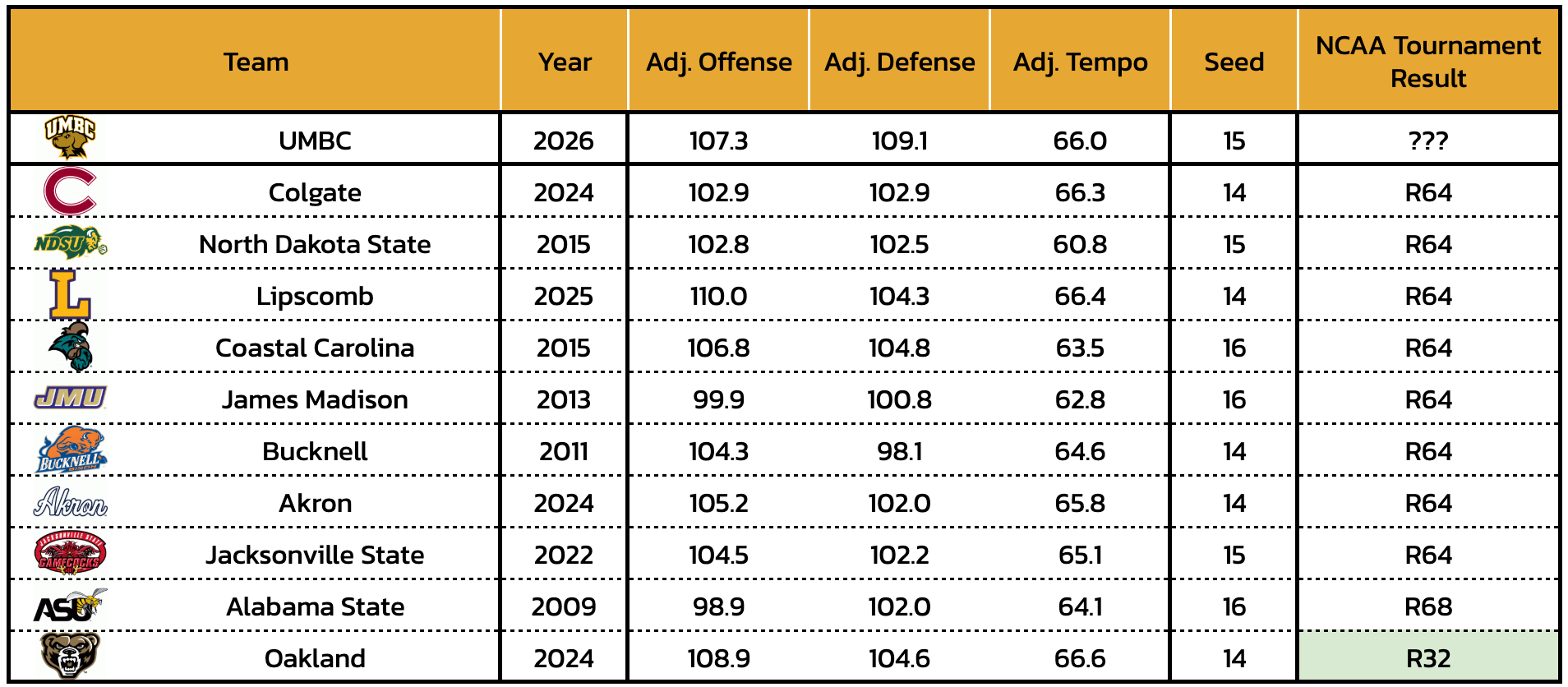
Similar NCAA Tournament efficiency profiles
Tournament Index evaluation
As it stands, UMBC is a projected No. 16 seed by our bracketology at Basket Under Review and on the Bracket Matrix.
Should that be the case, the Tournament Index rates the Retrievers as a slightly-above-average No. 16 seed (23rd-strongest power rating out of 49 teams) compared to the last 12 NCAA Tournament fields. If the Retrievers land above that projected seed, they would be the second-weakest No. 15 seed compared to the last 12 fields. The TI projects an average of 0.05 wins (excluding First Four) for UMBC given its projected seed (No. 16) and strength.
