

You could easily make an argument that the Atlantic Sun was the best offensive league in the country this year. They were second in efficiency, first in effective field goal percentage, and remarkably first in both 2-point and 3-point percentage.
By the same token, you could easily make an argument that because of that, the Atlantic Sun was the worst defensive league in the country this year.
Welcome to the case of the Queens Royals, the ASUN's representative in March Madness after surviving 49 points from Central Arkansas' Camren Hunter in the tournament championship on Sunday.
Offense First, Defense Second
Queens ranks No. 25 nationally in raw offensive efficiency, scoring 1.19 points per possession. Even adding in KenPom's adjustment for their 353rd-ranked defensive strength of schedule, that still slots them in at an admirable 79th. That was the second-best mark in the ASUN, and is the best ranking a March Madness representative from the league has had since Liberty in 2021.
The Royals are a heavily analytics-based offense, ranking 13th in rim-and-3 rate per ShotQuality, with 91% of their attempts coming right at the rim or from beyond the arc. Considering Queens is 19th-nationally in Catch-and-Shoot effective field goal percentage and 56th at the rim, that's a pretty awesome equation. Their shot profile is about as good as it gets.
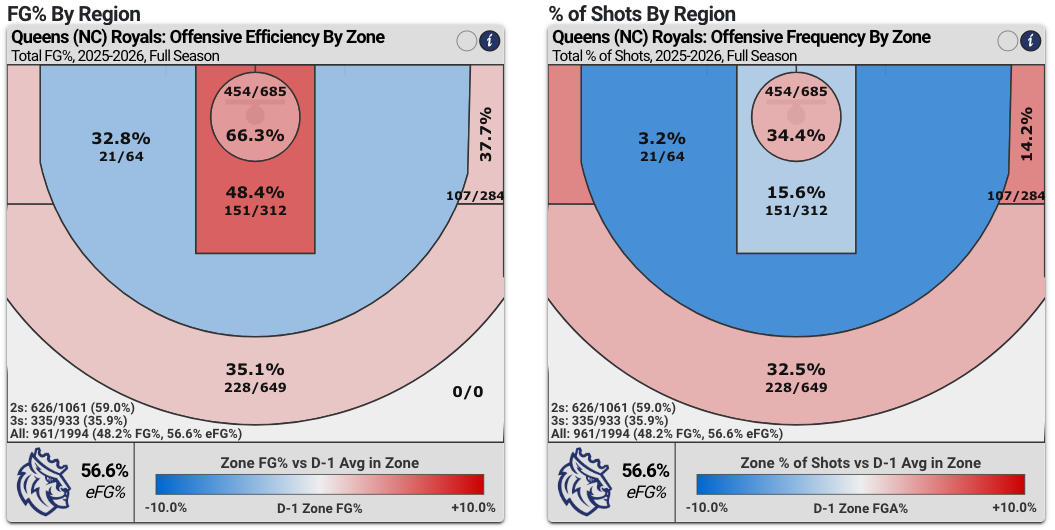
However, there are two sides to basketball games, and Queens is not good at the other one. The contrast between green and red on their KenPom scouting report page is as glaring as you'll ever see from an NCAA Tournament team:
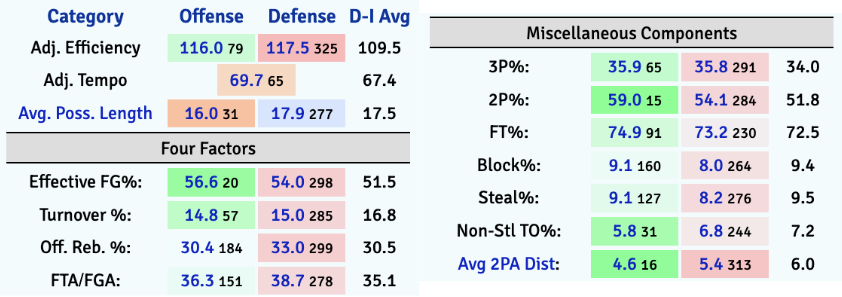
As you can see from that report, there are no redeeming qualities for this defensive unit. They are not top-200 in literally anything. Even Bellarmine, the worst defense in the country, is top-200 in free throw rate defense.
Because of this dichotomy, Queens needs a strong offensive showing to have a chance to win, against any team in the country. The Royals went 19-5 against Division-I competition when posting over 1.10 points per possession, and went 1-8 when they didn't hit that number.
Level of Competition
Much like their offensive and defensive splits, Queens' results were also very consistent. In non-conference play, the Royals went 0-8 against top-200 opponents, with an average margin of defeat of 22. They also went 4-0 against sub-200 opponents with an average winning margin of 20.
It was more of the same in league play. In the regular season, Queens went 0-3 against the two teams ranked ahead of them (Austin Peay, Central Arkansas), and 13-2 against everyone else. Of course, Queens got the last laugh by taking down Austin Peay and Central Arkansas in the ASUN Tournament semis and finals.
Naturally, as a likely 15 or 16 seed, Queens will not only be playing a top-200 team, but likely a top-10 one. Against the five top-70 offenses they played this season, they allowed an average of 1.44 points per possession. Or, in other words, an average 0f 100.5 points in a 70 possession contest. It's safe to say Queens has very little chance to pull off a March Madness upset allowing 100 points to a No. 1 or 2 seed.
Player Profiles
If Queens has any chance at an upset, it's because Chris Ashby goes nuclear. The senior sniper from Texas is tied for ninth in made threes with 109. He went off for 10 threes on 19 attempts against Central Arkansas in the ASUN championship game, hitting shots from all over the floor. Hilariously, he made more threes in the ASUN tournament than he made twos across the entire season.
The Royals also have one of the most electric freshmen in the country with super sub Jordan Watford. The 6-foot-5 guard is 32nd-nationally in assist rate and draws a whopping 6.7 fouls per 40 minutes, getting downhill, attacking the rim, and kicking out to open shooters when the defense collapses. His 19 points in the ASUN title were second to Ashby.
The team's x-factor would be Nasir Mann, the brother of Charlotte Hornets guard Tre Mann. Mann is the glue guy for this squad — he can do a little bit of everything, and is the team's leading rebounder despite standing at just 6-foot-5.
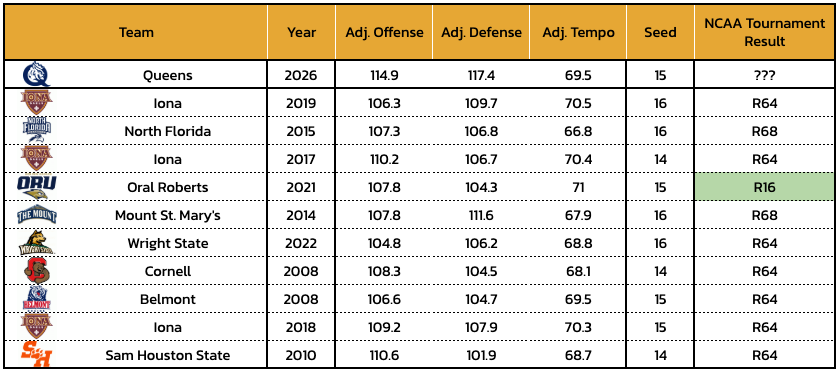
Similar NCAA Tournament efficiency profiles
Tournament Index evaluation
As it stands, Queens is a projected No. 16 seed by our bracketology at Basket Under Review and the Bracket Matrix.
The Tournament Index rates the Royals as a slightly-above-average No. 16 seed (21st in power rating out of 49 teams) compared to the last 12 NCAA Tournament fields. They would be the ranked as second-weakest No. 15 seed over the same time frame if they end up on that seed line. The TI projects an average of 0.21 wins (excluding First Four) for Queens given its projected seed (No. 16) and strength.